Compare commits
90 Commits
| Author | SHA1 | Date | |
|---|---|---|---|

|
3529607948 | ||
|
|
0a658b7a2a | ||

|
289ccc7bb7 | ||

|
c1d1e8f1db | ||

|
71c35ecdc0 | ||

|
4f8e45dda6 | ||
|
|
d624c327b6 | ||
|
|
b46a24f834 | ||
|
|
d31376d55d | ||
|
|
dbfd294ff3 | ||
|
|
e111bd0647 | ||
|
|
ba69319198 | ||
|
|
f9df925181 | ||
|
|
2d72efe447 | ||

|
95af6eba97 | ||
|
|
06dc537767 | ||

|
2d79d961dc | ||
|
|
027bf8386b | ||
|
|
a0e548ef71 | ||
|
|
132519b471 | ||

|
e6c330fc9d | ||
|
|
968e8286ea | ||
|
|
0f60c070ab | ||
|
|
810430f7b1 | ||
|
|
b4860c2b8d | ||
|
|
60bd522a97 | ||
|
|
fc39cf5f40 | ||
|
|
f6fb7487d5 | ||
|
|
0f585be0c9 | ||
|
|
492c95aff5 | ||
|
|
a530051bbd | ||
|
|
4ef82af8ce | ||
|
|
2ea5cf471b | ||
|
|
f6afaf2715 | ||
|
|
f29b2f9b81 | ||
|
|
de9b95903e | ||
|
|
d112273c58 | ||
|
|
73a9ca4e53 | ||
|
|
1334bdbd8f | ||
|
|
646ef47f6f | ||
|
|
c344c43185 | ||
|
|
062f8a617d | ||
|
|
70f91f3cbe | ||
|
|
668053b352 | ||
|
|
6ff9ff1ee5 | ||
|
|
3f95ed74f4 | ||
|
|
6e42904ddf | ||
|
|
4c1fc396fb | ||
|
|
d6ec7a86be | ||
|
|
a3f8715fe5 | ||

|
a1a9a8bbab | ||
|
|
d5c5869276 | ||
|
|
c4b03f8c1e | ||

|
ac206a949f | ||
|
|
4bccb746b8 | ||
|
|
e999705286 | ||
|
|
b4873bfd27 | ||
|
|
b00dc09c80 | ||
|
|
da6d6cbce6 | ||
|
|
864e904e21 | ||

|
0ee4fe355d | ||

|
53dce224cd | ||
|
|
2fd60074c7 | ||

|
549423b313 | ||

|
6bd1b1137e | ||
|
|
189418e69a | ||
|
|
4ab932f44e | ||

|
e1ff23fb30 | ||
|
|
7b657ffabf | ||
|
|
acd22d1fc4 | ||
|
|
d6f33d5796 | ||
|
|
c1ebb46ac6 | ||
|
|
eee4a9c4e3 | ||
|
|
2a3d3ff877 | ||
|
|
a9c368d64c | ||
|
|
1595ff32a2 | ||
|
|
c49545d9e3 | ||
|
|
f4598a407e | ||
|
|
d96fe4bec7 | ||
|
|
a9b87b3aee | ||
|
|
c512cb6f74 | ||
|
|
9269240fe3 | ||
|
|
91ba2387b2 | ||
|
|
162efb4709 | ||
|
|
6a97622226 | ||
|
|
5db7a49e75 | ||
|
|
d7cdf79561 | ||
|
|
07ac7beb7d | ||
|
|
7ded723c8b | ||

|
5369111f2d |
@@ -1,11 +1,30 @@
|
||||
default_config:
|
||||
|
||||
recorder:
|
||||
auto_purge: true
|
||||
purge_keep_days: 1
|
||||
commit_interval: 5
|
||||
include:
|
||||
domains:
|
||||
- input_boolean
|
||||
- input_number
|
||||
- switch
|
||||
- climate
|
||||
- sensor
|
||||
- binary_sensor
|
||||
- number
|
||||
- input_select
|
||||
- versatile_thermostat
|
||||
|
||||
logger:
|
||||
default: warning
|
||||
logs:
|
||||
# custom_components.versatile_thermostat: debug
|
||||
# custom_components.versatile_thermostat.underlyings: debug
|
||||
# custom_components.versatile_thermostat.climate: debug
|
||||
custom_components.versatile_thermostat: debug
|
||||
# custom_components.versatile_thermostat.underlyings: info
|
||||
# custom_components.versatile_thermostat.climate: info
|
||||
# custom_components.versatile_thermostat.base_thermostat: debug
|
||||
custom_components.versatile_thermostat.sensor: info
|
||||
custom_components.versatile_thermostat.binary_sensor: info
|
||||
|
||||
# If you need to debug uncommment the line below (doc: https://www.home-assistant.io/integrations/debugpy/)
|
||||
debugpy:
|
||||
@@ -72,6 +91,48 @@ input_number:
|
||||
icon: mdi:thermostat
|
||||
unit_of_measurement: °C
|
||||
mode: box
|
||||
fake_offset_calibration1:
|
||||
name: Sonoff offset calibration 1
|
||||
min: -12
|
||||
max: 12
|
||||
icon: mdi:tune
|
||||
unit_of_measurement: °C
|
||||
mode: box
|
||||
fake_opening_degree1:
|
||||
name: Sonoff Opening degree 1
|
||||
min: 0
|
||||
max: 100
|
||||
icon: mdi:valve-open
|
||||
unit_of_measurement: "%"
|
||||
mode: box
|
||||
fake_closing_degree1:
|
||||
name: Sonoff Closing degree 1
|
||||
min: 0
|
||||
max: 100
|
||||
icon: mdi:valve-closed
|
||||
unit_of_measurement: "%"
|
||||
mode: box
|
||||
fake_offset_calibration2:
|
||||
name: Sonoff offset calibration 2
|
||||
min: -12
|
||||
max: 12
|
||||
icon: mdi:tune
|
||||
unit_of_measurement: °C
|
||||
mode: box
|
||||
fake_opening_degree2:
|
||||
name: Sonoff Opening degree 2
|
||||
min: 0
|
||||
max: 100
|
||||
icon: mdi:valve-open
|
||||
unit_of_measurement: "%"
|
||||
mode: box
|
||||
fake_closing_degree2:
|
||||
name: Sonoff Closing degree 2
|
||||
min: 0
|
||||
max: 100
|
||||
icon: mdi:valve-closed
|
||||
unit_of_measurement: "%"
|
||||
mode: box
|
||||
|
||||
input_boolean:
|
||||
# input_boolean to simulate the windows entity. Only for development environment.
|
||||
@@ -123,6 +184,12 @@ input_boolean:
|
||||
fake_presence_sensor1:
|
||||
name: Presence Sensor 1
|
||||
icon: mdi:home
|
||||
fake_valve_sonoff_trvzb1:
|
||||
name: Valve Sonoff TRVZB1
|
||||
icon: mdi:valve
|
||||
fake_valve_sonoff_trvzb2:
|
||||
name: Valve Sonoff TRVZB2
|
||||
icon: mdi:valve
|
||||
|
||||
climate:
|
||||
- platform: generic_thermostat
|
||||
@@ -133,6 +200,7 @@ climate:
|
||||
name: Underlying thermostat2
|
||||
heater: input_boolean.fake_heater_switch3
|
||||
target_sensor: input_number.fake_temperature_sensor1
|
||||
ac_mode: false
|
||||
- platform: generic_thermostat
|
||||
name: Underlying thermostat3
|
||||
heater: input_boolean.fake_heater_switch3
|
||||
@@ -165,17 +233,23 @@ climate:
|
||||
name: Underlying thermostat9
|
||||
heater: input_boolean.fake_heater_switch3
|
||||
target_sensor: input_number.fake_temperature_sensor1
|
||||
- platform: generic_thermostat
|
||||
name: Underlying Sonoff TRVZB1
|
||||
heater: input_boolean.fake_valve_sonoff_trvzb1
|
||||
target_sensor: input_number.fake_temperature_sensor1
|
||||
ac_mode: false
|
||||
- platform: generic_thermostat
|
||||
name: Underlying Sonoff TRVZB2
|
||||
heater: input_boolean.fake_valve_sonoff_trvzb2
|
||||
target_sensor: input_number.fake_temperature_sensor1
|
||||
ac_mode: false
|
||||
|
||||
recorder:
|
||||
commit_interval: 1
|
||||
include:
|
||||
domains:
|
||||
- input_boolean
|
||||
- input_number
|
||||
- switch
|
||||
- climate
|
||||
- sensor
|
||||
- binary_sensor
|
||||
input_datetime:
|
||||
fake_last_seen:
|
||||
name: Last seen temp sensor
|
||||
icon: mdi:update
|
||||
has_date: true
|
||||
has_time: true
|
||||
|
||||
template:
|
||||
- binary_sensor:
|
||||
@@ -222,14 +296,14 @@ switch:
|
||||
friendly_name: "Pilote chauffage SDB RDC"
|
||||
value_template: "{{ is_state_attr('switch_seche_serviettes_sdb_rdc', 'sensor_state', 'on') }}"
|
||||
turn_on:
|
||||
service: select.select_option
|
||||
action: select.select_option
|
||||
data:
|
||||
option: comfort
|
||||
target:
|
||||
entity_id: select.seche_serviettes_sdb_rdc_cable_outlet_mode
|
||||
|
||||
turn_off:
|
||||
service: select.select_option
|
||||
action: select.select_option
|
||||
data:
|
||||
option: comfort-2
|
||||
target:
|
||||
|
||||
2
.github/ISSUE_TEMPLATE/issue.md
vendored
@@ -4,6 +4,8 @@ about: Create a report to help us improve
|
||||
|
||||
---
|
||||
|
||||
> Please read carefuly this instructions and fill this form before writing an issue. It helps me to help you.
|
||||
|
||||
<!-- This template will allow the maintainer to be efficient and post the more accurante response as possible. There is many types / modes / configuration possible, so the analysis can be very tricky. If don't follow this template, your issue could be rejected without any message. Please help me to help you. -->
|
||||
|
||||
<!-- Before you open a new issue, search through the existing issues to see if others have had the same problem.
|
||||
|
||||
1
.vscode/settings.json
vendored
@@ -4,7 +4,6 @@
|
||||
"editor.formatOnSave": true,
|
||||
"editor.formatOnSaveMode": "modifications"
|
||||
},
|
||||
"pylint.lintOnChange": false,
|
||||
"files.associations": {
|
||||
"*.yaml": "home-assistant"
|
||||
},
|
||||
|
||||
1679
README-fr.md
372
README.md
@@ -4,6 +4,8 @@
|
||||
[![hacs][hacs_badge]][hacs]
|
||||
[![BuyMeCoffee][buymecoffeebadge]][buymecoffee]
|
||||
|
||||
[En](README.md)|[Fr](README-fr.md)
|
||||
|
||||

|
||||
|
||||
>  This thermostat integration aims to drastically simplify your automations around climate management. Because all classical events in climate are natively handled by the thermostat (nobody at home ?, activity detected in a room ?, window open ?, power shedding ?), you don't have to build over complicated scripts and automations to manage your climates ;-).
|
||||
@@ -13,7 +15,7 @@
|
||||
- [In the case of a central configuration](#in-the-case-of-a-central-configuration)
|
||||
- [Redesign of the configuration menu](#redesign-of-the-configuration-menu)
|
||||
- [The 'Incomplete configuration' and 'Finalize' menu options](#the-incomplete-configuration-and-finalize-menu-options)
|
||||
- [Changements dans la version 5.0](#changements-dans-la-version-50)
|
||||
- [Changes in release 5.0](#changes-in-release-50)
|
||||
- [Thanks for the beer buymecoffee](#thanks-for-the-beer-buymecoffee)
|
||||
- [When to use / not use](#when-to-use--not-use)
|
||||
- [Incompatibilities](#incompatibilities)
|
||||
@@ -28,10 +30,10 @@
|
||||
- [For a ```thermostat_over_switch``` type thermostat](#for-a-thermostat_over_switch-type-thermostat)
|
||||
- [For a thermostat of type ```thermostat_over_climate```:](#for-a-thermostat-of-type-thermostat_over_climate)
|
||||
- [Self-regulation](#self-regulation)
|
||||
- [Self-regulation in Expert mode](#self-regulation-in-expert-mode)
|
||||
- [Internal temperature compensation](#internal-temperature-compensation)
|
||||
- [synthesis of the self-regulation algorithm](#synthesis-of-the-self-regulation-algorithm)
|
||||
- [Auto-fan mode](#auto-fan-mode)
|
||||
- [Automatic start/stop](#automatic-startstop)
|
||||
- [For a thermostat of type ```thermostat_over_valve```:](#for-a-thermostat-of-type-thermostat_over_valve)
|
||||
- [Configure the TPI algorithm coefficients](#configure-the-tpi-algorithm-coefficients)
|
||||
- [Configure the preset temperature](#configure-the-preset-temperature)
|
||||
@@ -48,6 +50,9 @@
|
||||
- [How to find the right service?](#how-to-find-the-right-service)
|
||||
- [The events](#the-events)
|
||||
- [Warning](#warning)
|
||||
- [Expert Mode Settings](#expert-mode-settings)
|
||||
- [Self-regulation in Expert mode](#self-regulation-in-expert-mode)
|
||||
- [On Time Clamping (max\_on\_percent)](#on-time-clamping-max_on_percent)
|
||||
- [Parameter summary](#parameter-summary)
|
||||
- [Tuning examples](#tuning-examples)
|
||||
- [Electrical heater](#electrical-heater)
|
||||
@@ -76,6 +81,7 @@
|
||||
- [Troubleshooting](#troubleshooting)
|
||||
- [Using a Heatzy](#using-a-heatzy)
|
||||
- [Using a Heatsink with a Pilot Wire](#using-a-heatsink-with-a-pilot-wire)
|
||||
- [Using a heater with a Nodon module](#using-a-heater-with-a-nodon-module)
|
||||
- [Only the first radiator heats](#only-the-first-radiator-heats)
|
||||
- [The radiator heats up even though the setpoint temperature is exceeded or does not heat up even though the room temperature is well below the setpoint](#the-radiator-heats-up-even-though-the-setpoint-temperature-is-exceeded-or-does-not-heat-up-even-though-the-room-temperature-is-well-below-the-setpoint)
|
||||
- [Type `over_switch` or `over_valve`](#type-over_switch-or-over_valve)
|
||||
@@ -92,6 +98,9 @@
|
||||
This custom component for Home Assistant is an upgrade and is a complete rewrite of the component "Awesome thermostat" (see [Github](https://github.com/dadge/awesome_thermostat)) with addition of features.
|
||||
|
||||
> _*Latest releases*_
|
||||
> * **Release 6.5** :
|
||||
> - Added a new function allowing the automatic shutdown and restart of a VTherm `over_climate` [585](https://github.com/jmcollin78/versatile_thermostat/issues/585)
|
||||
> - Improved management of openings at startup. Allows to memorize and recalculate the state of an opening when restarting Home Assistant [504](https://github.com/jmcollin78/versatile_thermostat/issues/504)
|
||||
> * **Release 6.0**:
|
||||
> - Added entities from the Number domain to configure preset temperatures [354](https://github.com/jmcollin78/versatile_thermostat/issues/354)
|
||||
> - Complete redesign of the configuration menu to remove temperatures and use a menu instead of a configuration tunnel [354](https://github.com/jmcollin78/versatile_thermostat/issues/354)
|
||||
@@ -100,13 +109,13 @@ This custom component for Home Assistant is an upgrade and is a complete rewrite
|
||||
> - addition of regulation thresholds for the `over_valve` to avoid draining the TRV battery too much [#338](https://github.com/jmcollin78/versatile_thermostat/issues/338),
|
||||
> - added an option allowing the internal temperature of a TRV to be used to force self-regulation [#348](https://github.com/jmcollin78/versatile_thermostat/issues/348),
|
||||
> - added a keep-alive function for VTherm `over_switch` [#345](https://github.com/jmcollin78/versatile_thermostat/issues/345)
|
||||
<details>
|
||||
<summary>Others releases</summary>
|
||||
|
||||
> * **Release 5.3**: Added a central boiler control function [#234](https://github.com/jmcollin78/versatile_thermostat/issues/234) - more information here: [Controlling a central boiler](#controlling-a-central-boiler). Added the ability to disable security mode for outdoor thermometer [#343](https://github.com/jmcollin78/versatile_thermostat/issues/343)
|
||||
> * **Release 5.2**: Added a `central_mode` allowing all VTherms to be controlled centrally [#158](https://github.com/jmcollin78/versatile_thermostat/issues/158).
|
||||
> * **Release 5.1**: Limitation of the values sent to the valves and the temperature sent to the underlying climate.
|
||||
> * **Release 5.0**: Added a central configuration allowing the sharing of attributes that can be shared [#239](https://github.com/jmcollin78/versatile_thermostat/issues/239).
|
||||
<details>
|
||||
<summary>Others releases</summary>
|
||||
|
||||
> * **Release 4.3**: Added an auto-fan mode for the `over_climate` type allowing ventilation to be activated if the temperature difference is significant [#223](https://github.com/jmcollin78/versatile_thermostat/issues/223).
|
||||
> * **Release 4.2**: The calculation of the slope of the temperature curve is now done in °/hour and no longer in °/min [#242](https://github.com/jmcollin78/versatile_thermostat/issues/242). Correction of automatic detection of openings by adding smoothing of the temperature curve.
|
||||
> * **Release 4.1**: Added an **Expert** regulation mode in which the user can specify their own auto-regulation parameters instead of using the pre-programmed ones [#194]( https://github.com/jmcollin78/versatile_thermostat/issues/194).
|
||||
@@ -125,6 +134,10 @@ This custom component for Home Assistant is an upgrade and is a complete rewrite
|
||||
> * **major release 2.0**: addition of the "over climate" thermostat allowing you to transform any thermostat into a Versatile Thermostat and add all the functions of the latter.
|
||||
</details>
|
||||
|
||||
|
||||
<details>
|
||||
<summary>Changes in version 6.0</summary>
|
||||
|
||||
# Changes in version 6.0
|
||||
|
||||
## Temperature entities for presets
|
||||
@@ -192,11 +205,12 @@ Once all configuration is valid, the last option changes to:
|
||||
Click on this option to create (resp. modify) the VTherm:
|
||||
|
||||

|
||||
</details>
|
||||
|
||||
<details>
|
||||
<summary>Changements dans la version 5.0</summary>
|
||||
<summary>Changes in release 5.0</summary>
|
||||
|
||||
# Changements dans la version 5.0
|
||||
# Changes in release 5.0
|
||||
|
||||
You can now define a central configuration which will allow you to share certain attributes on all your VTherms (or only part of them). To use this possibility, you must:
|
||||
1. Create a VTherm of type “Central Configuration”,
|
||||
@@ -212,7 +226,7 @@ Consequently, the entire configuration phase of a VTherm has been profoundly mod
|
||||
</details>
|
||||
|
||||
# Thanks for the beer [buymecoffee](https://www.buymeacoffee.com/jmcollin78)
|
||||
Many thanks to @salabur, @pvince83, @bergoglio, @EPicLURcher, @ecolorado66, @Kriss1670, @maia, @f.maymil, @moutte69, @Jerome, @Gunnar M, @Greg.o, @John Burgess, @abyssmal, @capinfo26, @Helge, @MattG, @MattG, @Mexx62, @Someone, @Lajull, @giopeco, @fredericselier, @philpagan, @studiogriffanti, @Edwin, @Sebbou, @Gerard R. for the beers. It's very nice and encourages me to continue!
|
||||
Many thanks to @salabur, @pvince83, @bergoglio, @EPicLURcher, @ecolorado66, @Kriss1670, @maia, @f.maymil, @moutte69, @Jerome, @Gunnar M, @Greg.o, @John Burgess, @abyssmal, @capinfo26, @Helge, @MattG, @MattG, @Mexx62, @Someone, @Lajull, @giopeco, @fredericselier, @philpagan, @studiogriffanti, @Edwin, @Sebbou, @Gerard R., @John Burgess, @Sylvoliv, @cdenfert, @stephane.l, @jms92100 for the beers. It's very nice and encourages me to continue!
|
||||
|
||||
# When to use / not use
|
||||
This thermostat can control 3 types of equipment:
|
||||
@@ -236,6 +250,8 @@ Some TRV type thermostats are known to be incompatible with the Versatile Thermo
|
||||
3. Thermostat of type Heatzy which doesn't supports the set_temperature command.
|
||||
4. Thermostats of type Rointe tends to awake alone even if VTherm turns it off. Others functions works fine.
|
||||
5. TRV of type Aqara SRTS-A01 and MOES TV01-ZB which doesn't have the return state `hvac_action` allowing to know if it is heating or not. So return states are not available. Others features, seems to work normally.
|
||||
6. The Airwell with the "Midea AC LAN" integration. If two orders are too close, the device shut off.
|
||||
7. System based on intégration Overkiz don't work as expected. It seems not possible to turn off nor sending setpoint on those systems.
|
||||
|
||||
# Why another thermostat implementation ?
|
||||
|
||||
@@ -286,9 +302,6 @@ This component named __Versatile thermostat__ manage the following use cases :
|
||||
> 3. In addition to this centralized configuration, all VTherms can be controlled by a single entity of type `select`. This function is named `central_mode`. This allows you to stop / start / freeze / etc. all VTherms at once. For each VTherm, the user indicates whether he is affected by this `central_mode`.
|
||||
|
||||
|
||||
<details>
|
||||
<summary>Creation of a new Versatile Thermostat</summary>
|
||||
|
||||
## Creation of a new Versatile Thermostat
|
||||
|
||||
Click on Add integration button in the integration page
|
||||
@@ -299,11 +312,6 @@ The configuration can be change through the same interface. Simply select the th
|
||||
Then choose the type of VTherm you want to create:
|
||||

|
||||
|
||||
</details>
|
||||
|
||||
<details>
|
||||
<summary>Minimal configuration update</summary>
|
||||
|
||||
## Minimal configuration update
|
||||
|
||||
Then choose the “Main attributes” menu.
|
||||
@@ -324,10 +332,6 @@ Give the main mandatory attributes:
|
||||
>  _*Notes*_
|
||||
> 1. With the ```thermostat_over_switch``` type, calculation are done at each cycle. So in case of conditions change, you will have to wait for the next cycle to see a change. For this reason, the cycle should not be too long. **5 min is a good value**,
|
||||
> 2. if the cycle is too short, the heater could never reach the target temperature. For the storage radiator for example it will be used unnecessarily.
|
||||
</details>
|
||||
|
||||
<details>
|
||||
<summary>Select the driven entity</summary>
|
||||
|
||||
## Select the driven entity
|
||||
|
||||
@@ -389,98 +393,17 @@ These three parameters make it possible to modulate the regulation and avoid mul
|
||||
|
||||
Self-regulation consists of forcing the equipment to go further by forcing its set temperature regularly. Its consumption can therefore be increased, as well as its wear.
|
||||
|
||||
#### Self-regulation in Expert mode
|
||||
|
||||
In **Expert** mode you can finely adjust the auto-regulation parameters to achieve your objectives and optimize as best as possible. The algorithm calculates the difference between the setpoint and the actual temperature of the room. This discrepancy is called error.
|
||||
The adjustable parameters are as follows:
|
||||
1. `kp`: the factor applied to the raw error,
|
||||
2. `ki`: the factor applied to the accumulation of errors,
|
||||
3. `k_ext`: the factor applied to the difference between the interior temperature and the exterior temperature,
|
||||
4. `offset_max`: the maximum correction (offset) that the regulation can apply,
|
||||
5. `stabilization_threshold`: a stabilization threshold which, when reached by the error, resets the accumulation of errors to 0,
|
||||
6. `accumulated_error_threshold`: the maximum for error accumulation.
|
||||
|
||||
For tuning, these observations must be taken into account:
|
||||
1. `kp * error` will give the offset linked to the raw error. This offset is directly proportional to the error and will be 0 when the target is reached,
|
||||
2. the accumulation of the error makes it possible to correct the stabilization of the curve while there remains an error. The error accumulates and the offset therefore gradually increases which should eventually stabilize at the target temperature. For this fundamental parameter to have an effect it must not be too small. An average value is 30
|
||||
3. `ki * accumulated_error_threshold` will give the maximum offset linked to the accumulation of the error,
|
||||
4. `k_ext` allows a correction to be applied immediately (without waiting for errors to accumulate) when the outside temperature is very different from the target temperature. If the stabilization is done too high when the temperature differences are significant, it is because this parameter is too high. It should be possible to cancel completely to let the first 2 offsets take place
|
||||
|
||||
The pre-programmed values are as follows:
|
||||
|
||||
Slow régulation :
|
||||
|
||||
kp: 0.2 # 20% of the current internal regulation offset are caused by the current difference of target temperature and room temperature
|
||||
ki: 0.8 / 288.0 # 80% of the current internal regulation offset are caused by the average offset of the past 24 hours
|
||||
k_ext: 1.0 / 25.0 # this will add 1°C to the offset when it's 25°C colder outdoor than indoor
|
||||
offset_max: 2.0 # limit to a final offset of -2°C to +2°C
|
||||
stabilization_threshold: 0.0 # this needs to be disabled as otherwise the long term accumulated error will always be reset when the temp briefly crosses from/to below/above the target
|
||||
accumulated_error_threshold: 2.0 * 288 # this allows up to 2°C long term offset in both directions
|
||||
|
||||
Light régulation :
|
||||
|
||||
kp: 0.2
|
||||
ki: 0.05
|
||||
k_ext: 0.05
|
||||
offset_max: 1.5
|
||||
stabilization_threshold: 0.1
|
||||
accumulated_error_threshold: 10
|
||||
|
||||
Medium régulation :
|
||||
|
||||
kp: 0.3
|
||||
ki: 0.05
|
||||
k_ext: 0.1
|
||||
offset_max: 2
|
||||
stabilization_threshold: 0.1
|
||||
accumulated_error_threshold: 20
|
||||
|
||||
Strong régulation :
|
||||
|
||||
"""Strong parameters for regulation
|
||||
A set of parameters which doesn't take into account the external temp
|
||||
and concentrate to internal temp error + accumulated error.
|
||||
This should work for cold external conditions which else generates
|
||||
high external_offset"""
|
||||
|
||||
kp: 0.4
|
||||
ki: 0.08
|
||||
k_ext: 0.0
|
||||
offset_max: 5
|
||||
stabilization_threshold: 0.1
|
||||
accumulated_error_threshold: 50
|
||||
|
||||
To use Expert mode you must declare the values you want to use for each of these parameters in your `configuration.yaml` in the following form:
|
||||
```
|
||||
versatile_thermostat:
|
||||
auto_regulation_expert:
|
||||
kp: 0.4
|
||||
ki: 0.08
|
||||
k_ext: 0.0
|
||||
offset_max: 5
|
||||
stabilization_threshold: 0.1
|
||||
accumulated_error_threshold: 50
|
||||
```
|
||||
and of course, configure the VTherm's self-regulation mode in **Expert** mode. All VTherms in Expert mode will use these same settings.
|
||||
|
||||
For the changes to be taken into account, you must either **completely restart Home Assistant** or just the **Versatile Thermostat integration** (Dev tools / Yaml / reloading the configuration / Versatile Thermostat).
|
||||
|
||||
#### Internal temperature compensation
|
||||
Sometimes, it happens that the internal thermometer of the underlying (TRV, air conditioning, etc.) is so wrong that self-regulation is not enough to regulate.
|
||||
This happens when the internal thermometer is too close to the heat source. The internal temperature then rises much faster than the room temperature, which generates faults in the regulation.
|
||||
Example :
|
||||
1. the room temperature is 18°, the setpoint is 20°,
|
||||
2. the internal temperature of the equipment is 22°,
|
||||
3. if VTherm sends 21° as setpoint (= 20° + 1° auto-regulation), then the equipment will not heat because its internal temperature (22°) is above the setpoint (21°)
|
||||
Sometimes, a device’s internal temperature sensor (like in a TRV or AC) can give inaccurate readings, especially if it’s too close to a heat source. This can cause the device to stop heating too soon.
|
||||
For example:
|
||||
1. target temperature: 20 °C, room temperature: 18 °C,
|
||||
2. device’s internal sensor: 22 °C
|
||||
3. If the target temperature is increased to 21 °C, the device won’t heat because it thinks it’s already warm (internal temperature is 22°C).
|
||||
|
||||
To overcome this, a new optional option was added in version 5.4: 
|
||||
The Adjust Setpoint for Room vs. TRV Temperature feature fixes this by adding the temperature difference between the room and the device’s internal reading to the target. In this case, VTherm would adjust the target to 25°C (21°C + 4°C difference), forcing the device to continue heating.
|
||||
|
||||
When enabled, this function will add the difference between the internal temperature and the room temperature to the setpoint to force heating.
|
||||
In the example above, the difference is +4° (22° - 18°), so VTherm will send 25° (21°+4°) to the equipment forcing it to heat up.
|
||||
|
||||
This difference is calculated for each underlying because each has its own internal temperature. Think of a VTherm which would be connected to 3 TRVs each with its internal temperature for example.
|
||||
|
||||
We then obtain much more effective self-regulation which avoids the pitfall of large variations in faulty internal temperature.
|
||||
This adjustment is specific to each device, making the heating system more accurate and avoiding issues from faulty sensor readings.
|
||||
See 
|
||||
|
||||
#### synthesis of the self-regulation algorithm
|
||||
The self-regulation algorithm can be summarized as follows:
|
||||
@@ -503,6 +426,17 @@ Obviously your underlying equipment must be equipped with ventilation and be con
|
||||
If your equipment does not include Turbo mode, Forte` mode will be used as a replacement.
|
||||
Once the temperature difference becomes low again, the ventilation will go into a "normal" mode which depends on your equipment, namely (in order): `Silence (mute)`, `Auto (auto)`, `Low (low)`. The first value that is possible for your equipment will be chosen.
|
||||
|
||||
#### Automatic start/stop
|
||||
This function was introduced in 6.5.0. It allows VTherm to stop equipment that does not need to be turned on and to restart it when conditions require it. This function has 3 settings that allow the equipment to be stopped/restarted more or less quickly.
|
||||
|
||||
To use it, you must:
|
||||
1. Add the `Use the auto start and stop feature` function in the 'Features' menu,
|
||||
2. Set the detection level in the `Auto start and stop` option that is displayed when the function has been activated. You choose the detection level between 'Slow', 'Medium' and 'Fast'. The 'Fast' level will result in more shutdowns/restarts.
|
||||
|
||||
Once configured, you will now have a new entity of type `switch` that allows you to authorize or not the automatic shutdown/restart without touching the configuration. This entity is available on the VTherm device and is called `switch.<name>_enable_auto_start_stop`. Check it to authorize the automatic startup and shutdown.
|
||||
|
||||
The detection algorithm is described [here](https://github.com/jmcollin78/versatile_thermostat/issues/585).
|
||||
|
||||
### For a thermostat of type ```thermostat_over_valve```:
|
||||

|
||||
You can choose up to domain entity ```number``` or ```ìnput_number``` which will control the valves.
|
||||
@@ -510,11 +444,6 @@ The algorithm to use is currently limited to TPI is available. See [algorithm](#
|
||||
|
||||
It is possible to choose an over valve thermostat which controls air conditioning by checking the "AC Mode" box. In this case, only the cooling mode will be visible.
|
||||
|
||||
</details>
|
||||
|
||||
<details>
|
||||
<summary>Configure the TPI algorithm coefficients</summary>
|
||||
|
||||
## Configure the TPI algorithm coefficients
|
||||
|
||||
Ff you choose a ```over_switch``` or ```over_valve``` thermostat and select the "TPI" menu option, you will get there:
|
||||
@@ -522,11 +451,6 @@ Ff you choose a ```over_switch``` or ```over_valve``` thermostat and select the
|
||||
|
||||
For more informations on the TPI algorithm and tuned please refer to [algorithm](#algorithm).
|
||||
|
||||
</details>
|
||||
|
||||
<details>
|
||||
<summary>Configure the preset temperature</summary>
|
||||
|
||||
## Configure the preset temperature
|
||||
|
||||
The preset mode allows you to pre-configurate targeted temperature. Used in conjonction with Scheduler (see [scheduler](#even-better-with-scheduler-component) you will have a powerfull and simple way to optimize the temperature vs electrical consumption of your hous. Preset handled are the following :
|
||||
@@ -547,11 +471,6 @@ The pre-settings are made (since v6.0) directly from the VTherm entities or from
|
||||
> 4. if you uses the advanced configuration you will see the preset set to ``safety`` if the temperature could not be retrieved after a certain delay
|
||||
> 5. ff you don't want to use the preseet, give 0 as temperature. The preset will then been ignored and will not displayed in the front component
|
||||
|
||||
</details>
|
||||
|
||||
<details>
|
||||
<summary>Configure the doors/windows turning on/off the thermostats</summary>
|
||||
|
||||
## Configure the doors/windows turning on/off the thermostats
|
||||
|
||||
You must have chosen the ```With opening detection``` feature on the first page to arrive on this page.
|
||||
@@ -593,11 +512,6 @@ And that's all ! your thermostat will turn off when the windows are open and tur
|
||||
> 3. **Only one mode is allowed**. You cannot configure a thermostat with a sensor and automatic detection. The 2 modes may contradict each other, it is not possible to have the 2 modes at the same time,
|
||||
> 4. It is not recommended to use the automatic mode for equipment subject to frequent and normal temperature variations (corridors, open areas, ...)
|
||||
|
||||
</details>
|
||||
|
||||
<details>
|
||||
<summary>Configure the activity mode or motion detection</summary>
|
||||
|
||||
## Configure the activity mode or motion detection
|
||||
If you choose the ```Motion management``` feature, lick on 'Validate' on the previous page and you will get there:
|
||||

|
||||
@@ -622,11 +536,6 @@ For this to work, the climate thermostat should be in ``Activity`` preset mode.
|
||||
>  _*Notes*_
|
||||
> 1. Be aware that as for the others preset modes, ``Activity`` will only be proposed if it's correctly configure. In other words, the 4 configuration keys have to be set if you want to see Activity in home assistant Interface
|
||||
|
||||
</details>
|
||||
|
||||
<details>
|
||||
<summary>Configure the power management</summary>
|
||||
|
||||
## Configure the power management
|
||||
|
||||
If you choose the ```Power management``` feature, click on 'Validate' on the previous page and you will get there:
|
||||
@@ -644,10 +553,6 @@ This allows you to change the max power along time using a Scheduler or whatever
|
||||
> 3. Always keep a margin, because max power can be briefly exceeded while waiting for the next cycle calculation typically or by not regulated equipement.
|
||||
> 4. If you don't want to use this feature, just leave the entities id empty
|
||||
> 5. If you control several heaters, the **power consumption of your heater** setup should be the sum of the power.
|
||||
</details>
|
||||
|
||||
<details>
|
||||
<summary>Configure presence or occupancy</summary>
|
||||
|
||||
## Configure presence or occupancy
|
||||
|
||||
@@ -670,11 +575,6 @@ ATTENTION: groups of people do not function as a presence sensor. They are not r
|
||||
> 1. the change in temperature is immediate and is reflected on the front shutter. The calculation will take into account the new target temperature at the next calculation of the cycle,
|
||||
> 2. you can use the person.xxxx direct sensor or a group of Home Assistant sensors. The presence sensor manages the ``on`` or ``home`` states as present and the ``off`` or ``not_home`` states as absent.
|
||||
|
||||
</details>
|
||||
|
||||
<details>
|
||||
<summary>Advanced configuration</summary>
|
||||
|
||||
## Advanced configuration
|
||||
|
||||
Those parameters allows to fine tune the thermostat.
|
||||
@@ -691,6 +591,8 @@ Setting this parameter to ``0.00`` will trigger the safety preset regardless of
|
||||
|
||||
The fourth parameter (``security_default_on_percent``) is the ``on_percent`` value that will be used when the thermostat enters ``safety`` mode. If you put ``0`` then the thermostat will be cut off when it goes into ``safety`` mode, putting 0.2% for example allows you to keep a little heating (20% in this case), even in mode ``safety``. It avoids finding your home totally frozen during a thermometer failure.
|
||||
|
||||
Note: parameters `security_min_on_percent` et `security_default_on_percent` are not used by `over_climate` VTherm.
|
||||
|
||||
Since version 5.3 it is possible to deactivate the safety device following a lack of data from the outdoor thermometer. Indeed, this most of the time having a low impact on regulation (depending on your settings), it is possible that it is absent without endangering the home. To do this, you must add the following lines to your `configuration.yaml`:
|
||||
```
|
||||
versatile_thermostat:
|
||||
@@ -709,11 +611,6 @@ See [example tuning](#examples-tuning) for common tuning examples
|
||||
> 4. For natural usage, the ``security_default_on_percent`` should be less than ``security_min_on_percent``,
|
||||
> 5. Thermostat of type ``thermostat_over_climate`` are not concerned by the safety feature.
|
||||
|
||||
</details>
|
||||
|
||||
<details>
|
||||
<summary>Centralized control</summary>
|
||||
|
||||
## Centralized control
|
||||
|
||||
Since release 5.2, if you have defined a centralized configuration, you have a new entity named `select.central_mode` which allows you to control all VTherms with a single action. For a VTherm to be centrally controllable, its configuration attribute named `use_central_mode` must be true.
|
||||
@@ -730,11 +627,6 @@ Example rendering:
|
||||
|
||||

|
||||
|
||||
</details>
|
||||
|
||||
<details>
|
||||
<summary>Control of a central boiler</summary>
|
||||
|
||||
## Control of a central boiler
|
||||
|
||||
Since release 5.3, you have the possibility of controlling a centralized boiler. From the moment it is possible to start or stop this boiler from Home Assistant, then Versatile Thermostat will be able to control it directly.
|
||||
@@ -836,7 +728,112 @@ context:
|
||||
>  _*Notes*_
|
||||
> Controlling a central boiler using software or hardware such as home automation can pose risks to its proper functioning. Before using these functions, make sure that your boiler has safety functions and that they are working. Turning on a boiler if all the taps are closed can generate excess pressure, for example.
|
||||
|
||||
</details>
|
||||
|
||||
## Expert Mode Settings
|
||||
|
||||
Expert Mode settings refer to Settings made in the Home Assistant `configuration.yaml` file under the `versatile_thermostat` section. You might have to add this section by yourself to the `configuration.yaml` file.
|
||||
|
||||
These settings are meant to be used only in **specific niche cases and with careful considerations**.
|
||||
|
||||
|
||||
The following sections describe the available export mode settings in detail with examples on how to configure them. Be aware that these settings require a **complete restart** of Home Assistant or a **reload of Versatile Thermostat integration** (Dev tools / Yaml / reloading the configuration / Versatile Thermostat) to take effect.
|
||||
|
||||
|
||||
### Self-regulation in Expert mode
|
||||
|
||||
In **Expert** mode you can finely adjust the auto-regulation parameters to achieve your objectives and optimize as best as possible. The algorithm calculates the difference between the setpoint and the actual temperature of the room. This discrepancy is called error.
|
||||
The adjustable parameters are as follows:
|
||||
1. `kp`: the factor applied to the raw error,
|
||||
2. `ki`: the factor applied to the accumulation of errors,
|
||||
3. `k_ext`: the factor applied to the difference between the interior temperature and the exterior temperature,
|
||||
4. `offset_max`: the maximum correction (offset) that the regulation can apply,
|
||||
5. `stabilization_threshold`: a stabilization threshold which, when reached by the error, resets the accumulation of errors to 0,
|
||||
6. `accumulated_error_threshold`: the maximum for error accumulation.
|
||||
|
||||
For tuning, these observations must be taken into account:
|
||||
1. `kp * error` will give the offset linked to the raw error. This offset is directly proportional to the error and will be 0 when the target is reached,
|
||||
2. the accumulation of the error makes it possible to correct the stabilization of the curve while there remains an error. The error accumulates and the offset therefore gradually increases which should eventually stabilize at the target temperature. For this fundamental parameter to have an effect it must not be too small. An average value is 30
|
||||
3. `ki * accumulated_error_threshold` will give the maximum offset linked to the accumulation of the error,
|
||||
4. `k_ext` allows a correction to be applied immediately (without waiting for errors to accumulate) when the outside temperature is very different from the target temperature. If the stabilization is done too high when the temperature differences are significant, it is because this parameter is too high. It should be possible to cancel completely to let the first 2 offsets take place
|
||||
|
||||
The pre-programmed values are as follows:
|
||||
|
||||
Slow régulation :
|
||||
|
||||
kp: 0.2 # 20% of the current internal regulation offset are caused by the current difference of target temperature and room temperature
|
||||
ki: 0.8 / 288.0 # 80% of the current internal regulation offset are caused by the average offset of the past 24 hours
|
||||
k_ext: 1.0 / 25.0 # this will add 1°C to the offset when it's 25°C colder outdoor than indoor
|
||||
offset_max: 2.0 # limit to a final offset of -2°C to +2°C
|
||||
stabilization_threshold: 0.0 # this needs to be disabled as otherwise the long term accumulated error will always be reset when the temp briefly crosses from/to below/above the target
|
||||
accumulated_error_threshold: 2.0 * 288 # this allows up to 2°C long term offset in both directions
|
||||
|
||||
Light régulation :
|
||||
|
||||
kp: 0.2
|
||||
ki: 0.05
|
||||
k_ext: 0.05
|
||||
offset_max: 1.5
|
||||
stabilization_threshold: 0.1
|
||||
accumulated_error_threshold: 10
|
||||
|
||||
Medium régulation :
|
||||
|
||||
kp: 0.3
|
||||
ki: 0.05
|
||||
k_ext: 0.1
|
||||
offset_max: 2
|
||||
stabilization_threshold: 0.1
|
||||
accumulated_error_threshold: 20
|
||||
|
||||
Strong régulation :
|
||||
|
||||
"""Strong parameters for regulation
|
||||
A set of parameters which doesn't take into account the external temp
|
||||
and concentrate to internal temp error + accumulated error.
|
||||
This should work for cold external conditions which else generates
|
||||
high external_offset"""
|
||||
|
||||
kp: 0.4
|
||||
ki: 0.08
|
||||
k_ext: 0.0
|
||||
offset_max: 5
|
||||
stabilization_threshold: 0.1
|
||||
accumulated_error_threshold: 50
|
||||
|
||||
To use Expert mode you must declare the values you want to use for each of these parameters in your `configuration.yaml` in the following form:
|
||||
```
|
||||
versatile_thermostat:
|
||||
auto_regulation_expert:
|
||||
kp: 0.4
|
||||
ki: 0.08
|
||||
k_ext: 0.0
|
||||
offset_max: 5
|
||||
stabilization_threshold: 0.1
|
||||
accumulated_error_threshold: 50
|
||||
```
|
||||
and of course, configure the VTherm's self-regulation mode in **Expert** mode. All VTherms in Expert mode will use these same settings.
|
||||
|
||||
For the changes to be taken into account, you must either **completely restart Home Assistant** or just the **Versatile Thermostat integration** (Dev tools / Yaml / reloading the configuration / Versatile Thermostat).
|
||||
|
||||
|
||||
### On Time Clamping (max_on_percent)
|
||||
|
||||
|
||||
The calculated on time percent can be limited to a maximum percentage of the cycle duration. This setting has to be made in expert mode and will be used for all Versatile Thermostats.
|
||||
|
||||
```
|
||||
versatile_thermostat:
|
||||
max_on_percent: 0.8
|
||||
```
|
||||
|
||||
The example above limits the maximum ON time to 80% (0.8) of the cycle length. If the cycle length is for example 600 seconds (10min), the maximum ON time will be limited to 480 seconds (8min). The remaining 120 seconds of the cycle will always remain in the OFF state.
|
||||
|
||||
There are three debug attributes of interest regarding this feature:
|
||||
|
||||
* `max_on_percent` # clamping setting as configured in expert mode
|
||||
* `calculated_on_percent` # calculated on percent without clamping applied
|
||||
* `on_percent` # used on percent with clamping applied
|
||||
|
||||
|
||||
<details>
|
||||
<summary>Parameter summary</summary>
|
||||
@@ -903,6 +900,8 @@ context:
|
||||
| ``central_boiler_activation_service`` | Activation service of the boiler | - | - | - | X |
|
||||
| ``central_boiler_deactivation_service`` | Deactivaiton service of the boiler | - | - | - | X |
|
||||
| ``used_by_controls_central_boiler`` | Indicate if the VTherm control the central boiler | X | X | X | - |
|
||||
| ``use_auto_start_stop_feature`` | Indique si la fonction de démarrage/extinction automatique est activée | - | X | - | - |
|
||||
| ``auto_start_stop_lvel`` | Le niveau de détection de l'auto start/stop | - | X | - | - |
|
||||
</details>
|
||||
|
||||
# Tuning examples
|
||||
@@ -1158,6 +1157,9 @@ Custom attributes are the following:
|
||||
| ``is_controlled_by_central_mode`` | True if the VTherm can be centrally controlled |
|
||||
| ``last_central_mode`` | The last central mode used (None if the VTherm is not centrally controlled) |
|
||||
| ``is_used_by_central_boiler`` | Indicate if the VTherm can control the central boiler |
|
||||
| ``auto_start_stop_enable`` | Indicate if the VTherm is allowed to do auto start and stop |
|
||||
| ``auto_start_stop_level`` | Give the level of auto start/stop |
|
||||
| ``hvac_off_reason`` | Give the reason of stop of the VTherm. This could be Window, Auto-start/stop or Manual |
|
||||
|
||||
# Some results
|
||||
|
||||
@@ -1281,9 +1283,13 @@ Replace values in [[ ]] by yours.
|
||||
yaxis: y1
|
||||
name: Ema
|
||||
- entity: '[[climate]]'
|
||||
attribute: regulated_target_temperature
|
||||
yaxis: y1
|
||||
name: Regulated T°
|
||||
attribute: on_percent
|
||||
yaxis: y2
|
||||
name: Power percent
|
||||
fill: tozeroy
|
||||
fillcolor: rgba(200, 10, 10, 0.3)
|
||||
line:
|
||||
color: rgba(200, 10, 10, 0.9)
|
||||
- entity: '[[slope]]'
|
||||
name: Slope
|
||||
fill: tozeroy
|
||||
@@ -1308,12 +1314,19 @@ Replace values in [[ ]] by yours.
|
||||
yaxis:
|
||||
visible: true
|
||||
position: 0
|
||||
yaxis2:
|
||||
visible: true
|
||||
position: 0
|
||||
fixedrange: true
|
||||
range:
|
||||
- 0
|
||||
- 1
|
||||
yaxis9:
|
||||
visible: true
|
||||
fixedrange: false
|
||||
range:
|
||||
- -0.5
|
||||
- 0.5
|
||||
- -2
|
||||
- 2
|
||||
position: 1
|
||||
xaxis:
|
||||
rangeselector:
|
||||
@@ -1336,7 +1349,7 @@ Example of graph obtained with Plotly :
|
||||
|
||||
|
||||
## And always better and better with the NOTIFIER daemon app to notify events
|
||||
This automation uses the excellent App Daemon named NOTIFIER developed by Horizon Domotique that you will find in demonstration [here](https://www.youtube.com/watch?v=chJylIK0ASo&ab_channel=HorizonDomotique) and the code is [here](https ://github.com/jlpouffier/home-assistant-config/blob/master/appdaemon/apps/notifier.py). It allows you to notify the users of the accommodation when one of the events affecting safety occurs on one of the Versatile Thermostats.
|
||||
This automation uses the excellent App Daemon named NOTIFIER developed by Horizon Domotique that you will find in demonstration [here](https://www.youtube.com/watch?v=chJylIK0ASo&ab_channel=HorizonDomotique) and the code is [here](https://github.com/jlpouffier/home-assistant-config/blob/master/appdaemon/apps/notifier.py). It allows you to notify the users of the accommodation when one of the events affecting safety occurs on one of the Versatile Thermostats.
|
||||
|
||||
This is a great example of using the notifications described here [notification](#notifications).
|
||||
|
||||
@@ -1488,6 +1501,43 @@ Example :
|
||||
```
|
||||
</details>
|
||||
|
||||
<details>
|
||||
<summary>Using a heater with a Nodon</summary>
|
||||
|
||||
## Using a heater with a Nodon module
|
||||
As for the heatzy module above you can use a virtual switch which will change the preset of your heater depending of the state of the VTherm.
|
||||
Example :
|
||||
```
|
||||
- platform: template
|
||||
switches:
|
||||
chauffage_chb_parents:
|
||||
unique_id: chauffage_chb_parents
|
||||
friendly_name: Chauffage chambre parents
|
||||
value_template: "{{ is_state('select.fp_chb_parents_pilot_wire_mode', 'comfort') }}"
|
||||
icon_template: >-
|
||||
{% if is_state('select.fp_chb_parents_pilot_wire_mode', 'comfort') %}
|
||||
mdi:radiator
|
||||
{% elif is_state('select.fp_chb_parents_pilot_wire_mode', 'frost_protection') %}
|
||||
mdi:snowflake
|
||||
{% else %}
|
||||
mdi:radiator-disabled
|
||||
{% endif %}
|
||||
turn_on:
|
||||
service: select.select_option
|
||||
target:
|
||||
entity_id: select.fp_chb_parents_pilot_wire_mode
|
||||
data:
|
||||
option: comfort
|
||||
turn_off:
|
||||
service: select.select_option
|
||||
target:
|
||||
entity_id: select.fp_chb_parents_pilot_wire_mode
|
||||
data:
|
||||
option: eco
|
||||
```
|
||||
|
||||
</details>
|
||||
|
||||
<details>
|
||||
<summary>Only the first radiator heats</summary>
|
||||
|
||||
@@ -1542,7 +1592,7 @@ These parameters are sensitive and quite difficult to adjust. Please only use th
|
||||
|
||||
## Why does my Versatile Thermostat go into Safety?
|
||||
|
||||
Safety mode is only possible on VTherm `over_switch` and `over_valve`. It occurs when one of the 2 thermometers which gives the room temperature or the outside temperature has not sent a value for more than `security_delay_min` minutes and the radiator was heating at least `security_min_on_percent`.
|
||||
Safety mode is possible on all VTherm's type. It occurs when one of the 2 thermometers which gives the room temperature or the outside temperature has not sent a value for more than `security_delay_min` minutes and the radiator was heating at least `security_min_on_percent`.
|
||||
|
||||
As the algorithm is based on temperature measurements, if they are no longer received by the VTherm, there is a risk of overheating and fire. To avoid this, when the conditions mentioned above are detected, heating is limited to the `security_default_on_percent` parameter. This value must therefore be reasonably low. It helps prevent a fire while avoiding completely cutting off the radiator (risk of freezing).
|
||||
|
||||
|
||||
@@ -13,6 +13,7 @@ from homeassistant.const import SERVICE_RELOAD, EVENT_HOMEASSISTANT_STARTED
|
||||
|
||||
from homeassistant.config_entries import ConfigEntry, ConfigType
|
||||
from homeassistant.core import HomeAssistant, CoreState, callback
|
||||
from homeassistant.helpers.service import async_register_admin_service
|
||||
|
||||
from .base_thermostat import BaseThermostat
|
||||
|
||||
@@ -37,6 +38,23 @@ from .const import (
|
||||
CONF_USE_CENTRAL_BOILER_FEATURE,
|
||||
CONF_POWER_SENSOR,
|
||||
CONF_PRESENCE_SENSOR,
|
||||
CONF_UNDERLYING_LIST,
|
||||
CONF_HEATER,
|
||||
CONF_HEATER_2,
|
||||
CONF_HEATER_3,
|
||||
CONF_HEATER_4,
|
||||
CONF_CLIMATE,
|
||||
CONF_CLIMATE_2,
|
||||
CONF_CLIMATE_3,
|
||||
CONF_CLIMATE_4,
|
||||
CONF_VALVE,
|
||||
CONF_VALVE_2,
|
||||
CONF_VALVE_3,
|
||||
CONF_VALVE_4,
|
||||
CONF_THERMOSTAT_SWITCH,
|
||||
CONF_THERMOSTAT_CLIMATE,
|
||||
CONF_THERMOSTAT_VALVE,
|
||||
CONF_MAX_ON_PERCENT,
|
||||
)
|
||||
|
||||
from .vtherm_api import VersatileThermostatAPI
|
||||
@@ -69,6 +87,7 @@ CONFIG_SCHEMA = vol.Schema(
|
||||
CONF_AUTO_REGULATION_EXPERT: vol.Schema(SELF_REGULATION_PARAM_SCHEMA),
|
||||
CONF_SHORT_EMA_PARAMS: vol.Schema(EMA_PARAM_SCHEMA),
|
||||
CONF_SAFETY_MODE: vol.Schema(SAFETY_MODE_PARAM_SCHEMA),
|
||||
vol.Optional(CONF_MAX_ON_PERCENT): vol.Coerce(float),
|
||||
}
|
||||
),
|
||||
},
|
||||
@@ -107,13 +126,16 @@ async def async_setup(
|
||||
"VersatileThermostat - HA is started, initialize all links between VTherm entities"
|
||||
)
|
||||
await api.init_vtherm_links()
|
||||
await api.notify_central_mode_change()
|
||||
await api.reload_central_boiler_entities_list()
|
||||
|
||||
if hass.state == CoreState.running:
|
||||
await _async_startup_internal()
|
||||
else:
|
||||
hass.bus.async_listen_once(EVENT_HOMEASSISTANT_STARTED, _async_startup_internal)
|
||||
|
||||
hass.helpers.service.async_register_admin_service(
|
||||
async_register_admin_service(
|
||||
hass,
|
||||
DOMAIN,
|
||||
SERVICE_RELOAD,
|
||||
_handle_reload,
|
||||
@@ -156,14 +178,22 @@ async def async_setup_entry(hass: HomeAssistant, entry: ConfigEntry) -> bool:
|
||||
|
||||
await hass.config_entries.async_forward_entry_setups(entry, PLATFORMS)
|
||||
|
||||
await api.reload_central_boiler_entities_list()
|
||||
await api.init_vtherm_links()
|
||||
if hass.state == CoreState.running:
|
||||
await api.reload_central_boiler_entities_list()
|
||||
await api.init_vtherm_links(entry.entry_id)
|
||||
|
||||
return True
|
||||
|
||||
|
||||
async def update_listener(hass: HomeAssistant, entry: ConfigEntry) -> None:
|
||||
"""Update listener."""
|
||||
|
||||
_LOGGER.debug(
|
||||
"Calling update_listener entry: entry_id='%s', value='%s'",
|
||||
entry.entry_id,
|
||||
entry.data,
|
||||
)
|
||||
|
||||
if entry.data.get(CONF_THERMOSTAT_TYPE) == CONF_THERMOSTAT_CENTRAL_CONFIG:
|
||||
await reload_all_vtherm(hass)
|
||||
else:
|
||||
@@ -172,7 +202,7 @@ async def update_listener(hass: HomeAssistant, entry: ConfigEntry) -> None:
|
||||
api: VersatileThermostatAPI = VersatileThermostatAPI.get_vtherm_api(hass)
|
||||
if api is not None:
|
||||
await api.reload_central_boiler_entities_list()
|
||||
await api.init_vtherm_links()
|
||||
await api.init_vtherm_links(entry.entry_id)
|
||||
|
||||
|
||||
async def async_unload_entry(hass: HomeAssistant, entry: ConfigEntry) -> bool:
|
||||
@@ -203,10 +233,9 @@ async def async_migrate_entry(hass: HomeAssistant, config_entry: ConfigEntry):
|
||||
)
|
||||
new = {**config_entry.data}
|
||||
|
||||
if (
|
||||
config_entry.data.get(CONF_THERMOSTAT_TYPE)
|
||||
== CONF_THERMOSTAT_CENTRAL_CONFIG
|
||||
):
|
||||
thermostat_type = config_entry.data.get(CONF_THERMOSTAT_TYPE)
|
||||
|
||||
if thermostat_type == CONF_THERMOSTAT_CENTRAL_CONFIG:
|
||||
new[CONF_USE_WINDOW_FEATURE] = True
|
||||
new[CONF_USE_MOTION_FEATURE] = True
|
||||
new[CONF_USE_POWER_FEATURE] = new.get(CONF_POWER_SENSOR, None) is not None
|
||||
@@ -218,6 +247,50 @@ async def async_migrate_entry(hass: HomeAssistant, config_entry: ConfigEntry):
|
||||
"add_central_boiler_control", False
|
||||
) or new.get(CONF_USE_CENTRAL_BOILER_FEATURE, False)
|
||||
|
||||
if config_entry.data.get(CONF_UNDERLYING_LIST, None) is None:
|
||||
underlying_list = []
|
||||
if thermostat_type == CONF_THERMOSTAT_SWITCH:
|
||||
underlying_list = [
|
||||
config_entry.data.get(CONF_HEATER, None),
|
||||
config_entry.data.get(CONF_HEATER_2, None),
|
||||
config_entry.data.get(CONF_HEATER_3, None),
|
||||
config_entry.data.get(CONF_HEATER_4, None),
|
||||
]
|
||||
elif thermostat_type == CONF_THERMOSTAT_CLIMATE:
|
||||
underlying_list = [
|
||||
config_entry.data.get(CONF_CLIMATE, None),
|
||||
config_entry.data.get(CONF_CLIMATE_2, None),
|
||||
config_entry.data.get(CONF_CLIMATE_3, None),
|
||||
config_entry.data.get(CONF_CLIMATE_4, None),
|
||||
]
|
||||
elif thermostat_type == CONF_THERMOSTAT_VALVE:
|
||||
underlying_list = [
|
||||
config_entry.data.get(CONF_VALVE, None),
|
||||
config_entry.data.get(CONF_VALVE_2, None),
|
||||
config_entry.data.get(CONF_VALVE_3, None),
|
||||
config_entry.data.get(CONF_VALVE_4, None),
|
||||
]
|
||||
|
||||
new[CONF_UNDERLYING_LIST] = [
|
||||
entity for entity in underlying_list if entity is not None
|
||||
]
|
||||
|
||||
for key in [
|
||||
CONF_HEATER,
|
||||
CONF_HEATER_2,
|
||||
CONF_HEATER_3,
|
||||
CONF_HEATER_4,
|
||||
CONF_CLIMATE,
|
||||
CONF_CLIMATE_2,
|
||||
CONF_CLIMATE_3,
|
||||
CONF_CLIMATE_4,
|
||||
CONF_VALVE,
|
||||
CONF_VALVE_2,
|
||||
CONF_VALVE_3,
|
||||
CONF_VALVE_4,
|
||||
]:
|
||||
new.pop(key, None)
|
||||
|
||||
hass.config_entries.async_update_entry(
|
||||
config_entry,
|
||||
data=new,
|
||||
|
||||
@@ -0,0 +1,239 @@
|
||||
# pylint: disable=line-too-long
|
||||
""" This file implements the Auto start/stop algorithm as described here: https://github.com/jmcollin78/versatile_thermostat/issues/585
|
||||
"""
|
||||
|
||||
import logging
|
||||
from datetime import datetime
|
||||
from typing import Literal
|
||||
|
||||
from homeassistant.components.climate import HVACMode
|
||||
|
||||
from .const import (
|
||||
AUTO_START_STOP_LEVEL_NONE,
|
||||
AUTO_START_STOP_LEVEL_FAST,
|
||||
AUTO_START_STOP_LEVEL_MEDIUM,
|
||||
AUTO_START_STOP_LEVEL_SLOW,
|
||||
TYPE_AUTO_START_STOP_LEVELS,
|
||||
)
|
||||
|
||||
|
||||
_LOGGER = logging.getLogger(__name__)
|
||||
|
||||
# Some constant to make algorithm depending of level
|
||||
DT_MIN = {
|
||||
AUTO_START_STOP_LEVEL_NONE: 0, # Not used
|
||||
AUTO_START_STOP_LEVEL_SLOW: 30,
|
||||
AUTO_START_STOP_LEVEL_MEDIUM: 15,
|
||||
AUTO_START_STOP_LEVEL_FAST: 7,
|
||||
}
|
||||
|
||||
# the measurement cycle (2 min)
|
||||
CYCLE_SEC = 120
|
||||
|
||||
# A temp hysteresis to avoid rapid OFF/ON
|
||||
TEMP_HYSTERESIS = 0.5
|
||||
|
||||
ERROR_THRESHOLD = {
|
||||
AUTO_START_STOP_LEVEL_NONE: 0, # Not used
|
||||
AUTO_START_STOP_LEVEL_SLOW: 10, # 10 cycle above 1° or 5 cycle above 2°, ...
|
||||
AUTO_START_STOP_LEVEL_MEDIUM: 5, # 5 cycle above 1° or 3 cycle above 2°, ..., 1 cycle above 5°
|
||||
AUTO_START_STOP_LEVEL_FAST: 2, # 2 cycle above 1° or 1 cycle above 2°
|
||||
}
|
||||
|
||||
AUTO_START_STOP_ACTION_OFF = "turnOff"
|
||||
AUTO_START_STOP_ACTION_ON = "turnOn"
|
||||
AUTO_START_STOP_ACTION_NOTHING = "nothing"
|
||||
AUTO_START_STOP_ACTIONS = Literal[ # pylint: disable=invalid-name
|
||||
AUTO_START_STOP_ACTION_OFF,
|
||||
AUTO_START_STOP_ACTION_ON,
|
||||
AUTO_START_STOP_ACTION_NOTHING,
|
||||
]
|
||||
|
||||
class AutoStartStopDetectionAlgorithm:
|
||||
"""The class that implements the algorithm listed above"""
|
||||
|
||||
_dt: float | None = None
|
||||
_level: str = AUTO_START_STOP_LEVEL_NONE
|
||||
_accumulated_error: float = 0
|
||||
_error_threshold: float | None = None
|
||||
_last_calculation_date: datetime | None = None
|
||||
|
||||
def __init__(self, level: TYPE_AUTO_START_STOP_LEVELS, vtherm_name) -> None:
|
||||
"""Initalize a new algorithm with the right constants"""
|
||||
self._vtherm_name = vtherm_name
|
||||
self._init_level(level)
|
||||
|
||||
def _init_level(self, level: TYPE_AUTO_START_STOP_LEVELS):
|
||||
"""Initialize a new level"""
|
||||
if level == self._level:
|
||||
return
|
||||
|
||||
self._level = level
|
||||
if self._level != AUTO_START_STOP_LEVEL_NONE:
|
||||
self._dt = DT_MIN[level]
|
||||
self._error_threshold = ERROR_THRESHOLD[level]
|
||||
# reset accumulated error if we change the level
|
||||
self._accumulated_error = 0
|
||||
|
||||
def calculate_action(
|
||||
self,
|
||||
hvac_mode: HVACMode | None,
|
||||
saved_hvac_mode: HVACMode | None,
|
||||
target_temp: float,
|
||||
current_temp: float,
|
||||
slope_min: float | None,
|
||||
now: datetime,
|
||||
) -> AUTO_START_STOP_ACTIONS:
|
||||
"""Calculate an eventual action to do depending of the value in parameter"""
|
||||
if self._level == AUTO_START_STOP_LEVEL_NONE:
|
||||
_LOGGER.debug(
|
||||
"%s - auto-start/stop is disabled",
|
||||
self,
|
||||
)
|
||||
return AUTO_START_STOP_ACTION_NOTHING
|
||||
|
||||
_LOGGER.debug(
|
||||
"%s - calculate_action: hvac_mode=%s, saved_hvac_mode=%s, target_temp=%s, current_temp=%s, slope_min=%s at %s",
|
||||
self,
|
||||
hvac_mode,
|
||||
saved_hvac_mode,
|
||||
target_temp,
|
||||
current_temp,
|
||||
slope_min,
|
||||
now,
|
||||
)
|
||||
|
||||
if hvac_mode is None or target_temp is None or current_temp is None:
|
||||
_LOGGER.debug(
|
||||
"%s - No all mandatory parameters are set. Disable auto-start/stop",
|
||||
self,
|
||||
)
|
||||
return AUTO_START_STOP_ACTION_NOTHING
|
||||
|
||||
# Calculate the error factor (P)
|
||||
error = target_temp - current_temp
|
||||
|
||||
# reduce the error considering the dt between the last measurement
|
||||
if self._last_calculation_date is not None:
|
||||
dtmin = (now - self._last_calculation_date).total_seconds() / CYCLE_SEC
|
||||
# ignore two calls too near (< 24 sec)
|
||||
if dtmin <= 0.2:
|
||||
_LOGGER.debug(
|
||||
"%s - new calculation of auto_start_stop (%s) is too near of the last one (%s). Forget it",
|
||||
self,
|
||||
now,
|
||||
self._last_calculation_date,
|
||||
)
|
||||
return AUTO_START_STOP_ACTION_NOTHING
|
||||
error = error * dtmin
|
||||
|
||||
# If the error have change its sign, reset smoothly the accumulated error
|
||||
if error * self._accumulated_error < 0:
|
||||
self._accumulated_error = self._accumulated_error / 2.0
|
||||
|
||||
self._accumulated_error += error
|
||||
|
||||
# Capping of the error
|
||||
self._accumulated_error = min(
|
||||
self._error_threshold,
|
||||
max(-self._error_threshold, self._accumulated_error),
|
||||
)
|
||||
|
||||
self._last_calculation_date = now
|
||||
|
||||
temp_at_dt = current_temp + slope_min * self._dt
|
||||
|
||||
# Check to turn-off
|
||||
# When we hit the threshold, that mean we can turn off
|
||||
if hvac_mode == HVACMode.HEAT:
|
||||
if (
|
||||
self._accumulated_error <= -self._error_threshold
|
||||
and temp_at_dt >= target_temp + TEMP_HYSTERESIS
|
||||
):
|
||||
_LOGGER.info(
|
||||
"%s - We need to stop, there is no need for heating for a long time.",
|
||||
self,
|
||||
)
|
||||
return AUTO_START_STOP_ACTION_OFF
|
||||
else:
|
||||
_LOGGER.debug("%s - nothing to do, we are heating", self)
|
||||
return AUTO_START_STOP_ACTION_NOTHING
|
||||
|
||||
if hvac_mode == HVACMode.COOL:
|
||||
if (
|
||||
self._accumulated_error >= self._error_threshold
|
||||
and temp_at_dt <= target_temp - TEMP_HYSTERESIS
|
||||
):
|
||||
_LOGGER.info(
|
||||
"%s - We need to stop, there is no need for cooling for a long time.",
|
||||
self,
|
||||
)
|
||||
return AUTO_START_STOP_ACTION_OFF
|
||||
else:
|
||||
_LOGGER.debug(
|
||||
"%s - nothing to do, we are cooling",
|
||||
self,
|
||||
)
|
||||
return AUTO_START_STOP_ACTION_NOTHING
|
||||
|
||||
# check to turn on
|
||||
if hvac_mode == HVACMode.OFF and saved_hvac_mode == HVACMode.HEAT:
|
||||
if temp_at_dt <= target_temp - TEMP_HYSTERESIS:
|
||||
_LOGGER.info(
|
||||
"%s - We need to start, because it will be time to heat",
|
||||
self,
|
||||
)
|
||||
return AUTO_START_STOP_ACTION_ON
|
||||
else:
|
||||
_LOGGER.debug(
|
||||
"%s - nothing to do, we don't need to heat soon",
|
||||
self,
|
||||
)
|
||||
return AUTO_START_STOP_ACTION_NOTHING
|
||||
|
||||
if hvac_mode == HVACMode.OFF and saved_hvac_mode == HVACMode.COOL:
|
||||
if temp_at_dt >= target_temp + TEMP_HYSTERESIS:
|
||||
_LOGGER.info(
|
||||
"%s - We need to start, because it will be time to cool",
|
||||
self,
|
||||
)
|
||||
return AUTO_START_STOP_ACTION_ON
|
||||
else:
|
||||
_LOGGER.debug(
|
||||
"%s - nothing to do, we don't need to cool soon",
|
||||
self,
|
||||
)
|
||||
return AUTO_START_STOP_ACTION_NOTHING
|
||||
|
||||
_LOGGER.debug(
|
||||
"%s - nothing to do, no conditions applied",
|
||||
self,
|
||||
)
|
||||
return AUTO_START_STOP_ACTION_NOTHING
|
||||
|
||||
def set_level(self, level: TYPE_AUTO_START_STOP_LEVELS):
|
||||
"""Set a new level"""
|
||||
self._init_level(level)
|
||||
|
||||
@property
|
||||
def dt_min(self) -> float:
|
||||
"""Get the dt value"""
|
||||
return self._dt
|
||||
|
||||
@property
|
||||
def accumulated_error(self) -> float:
|
||||
"""Get the accumulated error value"""
|
||||
return self._accumulated_error
|
||||
|
||||
@property
|
||||
def accumulated_error_threshold(self) -> float:
|
||||
"""Get the accumulated error threshold value"""
|
||||
return self._error_threshold
|
||||
|
||||
@property
|
||||
def level(self) -> TYPE_AUTO_START_STOP_LEVELS:
|
||||
"""Get the level value"""
|
||||
return self._level
|
||||
|
||||
def __str__(self) -> str:
|
||||
return f"AutoStartStopDetectionAlgorithm-{self._vtherm_name}"
|
||||
@@ -39,6 +39,7 @@ from .const import (
|
||||
CONF_USE_WINDOW_FEATURE,
|
||||
CONF_THERMOSTAT_TYPE,
|
||||
CONF_THERMOSTAT_CENTRAL_CONFIG,
|
||||
CONF_USE_CENTRAL_BOILER_FEATURE,
|
||||
CONF_CENTRAL_BOILER_ACTIVATION_SRV,
|
||||
CONF_CENTRAL_BOILER_DEACTIVATION_SRV,
|
||||
overrides,
|
||||
@@ -63,10 +64,13 @@ async def async_setup_entry(
|
||||
name = entry.data.get(CONF_NAME)
|
||||
vt_type = entry.data.get(CONF_THERMOSTAT_TYPE)
|
||||
|
||||
entities = None
|
||||
|
||||
if vt_type == CONF_THERMOSTAT_CENTRAL_CONFIG:
|
||||
entities = [
|
||||
CentralBoilerBinarySensor(hass, unique_id, name, entry.data),
|
||||
]
|
||||
if entry.data.get(CONF_USE_CENTRAL_BOILER_FEATURE):
|
||||
entities = [
|
||||
CentralBoilerBinarySensor(hass, unique_id, name, entry.data),
|
||||
]
|
||||
else:
|
||||
entities = [
|
||||
SecurityBinarySensor(hass, unique_id, name, entry.data),
|
||||
@@ -81,7 +85,8 @@ async def async_setup_entry(
|
||||
if entry.data.get(CONF_USE_POWER_FEATURE):
|
||||
entities.append(OverpoweringBinarySensor(hass, unique_id, name, entry.data))
|
||||
|
||||
async_add_entities(entities, True)
|
||||
if entities:
|
||||
async_add_entities(entities, True)
|
||||
|
||||
|
||||
class SecurityBinarySensor(VersatileThermostatBaseEntity, BinarySensorEntity):
|
||||
@@ -95,7 +100,7 @@ class SecurityBinarySensor(VersatileThermostatBaseEntity, BinarySensorEntity):
|
||||
entry_infos,
|
||||
) -> None:
|
||||
"""Initialize the SecurityState Binary sensor"""
|
||||
super().__init__(hass, unique_id, entry_infos.get(CONF_NAME))
|
||||
super().__init__(hass, unique_id, name)
|
||||
self._attr_name = "Security state"
|
||||
self._attr_unique_id = f"{self._device_name}_security_state"
|
||||
self._attr_is_on = False
|
||||
@@ -103,7 +108,7 @@ class SecurityBinarySensor(VersatileThermostatBaseEntity, BinarySensorEntity):
|
||||
@callback
|
||||
async def async_my_climate_changed(self, event: Event = None):
|
||||
"""Called when my climate have change"""
|
||||
_LOGGER.debug("%s - climate state change", self._attr_unique_id)
|
||||
# _LOGGER.debug("%s - climate state change", self._attr_unique_id)
|
||||
|
||||
old_state = self._attr_is_on
|
||||
self._attr_is_on = self.my_climate.security_state is True
|
||||
@@ -142,7 +147,7 @@ class OverpoweringBinarySensor(VersatileThermostatBaseEntity, BinarySensorEntity
|
||||
@callback
|
||||
async def async_my_climate_changed(self, event: Event = None):
|
||||
"""Called when my climate have change"""
|
||||
_LOGGER.debug("%s - climate state change", self._attr_unique_id)
|
||||
# _LOGGER.debug("%s - climate state change", self._attr_unique_id)
|
||||
|
||||
old_state = self._attr_is_on
|
||||
self._attr_is_on = self.my_climate.overpowering_state is True
|
||||
@@ -181,7 +186,7 @@ class WindowBinarySensor(VersatileThermostatBaseEntity, BinarySensorEntity):
|
||||
@callback
|
||||
async def async_my_climate_changed(self, event: Event = None):
|
||||
"""Called when my climate have change"""
|
||||
_LOGGER.debug("%s - climate state change", self._attr_unique_id)
|
||||
# _LOGGER.debug("%s - climate state change", self._attr_unique_id)
|
||||
|
||||
old_state = self._attr_is_on
|
||||
# Issue 120 - only take defined presence value
|
||||
@@ -231,7 +236,7 @@ class MotionBinarySensor(VersatileThermostatBaseEntity, BinarySensorEntity):
|
||||
@callback
|
||||
async def async_my_climate_changed(self, event: Event = None):
|
||||
"""Called when my climate have change"""
|
||||
_LOGGER.debug("%s - climate state change", self._attr_unique_id)
|
||||
# _LOGGER.debug("%s - climate state change", self._attr_unique_id)
|
||||
old_state = self._attr_is_on
|
||||
# Issue 120 - only take defined presence value
|
||||
if self.my_climate.motion_state in [STATE_ON, STATE_OFF]:
|
||||
@@ -272,7 +277,7 @@ class PresenceBinarySensor(VersatileThermostatBaseEntity, BinarySensorEntity):
|
||||
async def async_my_climate_changed(self, event: Event = None):
|
||||
"""Called when my climate have change"""
|
||||
|
||||
_LOGGER.debug("%s - climate state change", self._attr_unique_id)
|
||||
# _LOGGER.debug("%s - climate state change", self._attr_unique_id)
|
||||
old_state = self._attr_is_on
|
||||
# Issue 120 - only take defined presence value
|
||||
if self.my_climate.presence_state in [STATE_ON, STATE_OFF]:
|
||||
@@ -312,7 +317,7 @@ class WindowByPassBinarySensor(VersatileThermostatBaseEntity, BinarySensorEntity
|
||||
@callback
|
||||
async def async_my_climate_changed(self, event: Event = None):
|
||||
"""Called when my climate have change"""
|
||||
_LOGGER.debug("%s - climate state change", self._attr_unique_id)
|
||||
# _LOGGER.debug("%s - climate state change", self._attr_unique_id)
|
||||
old_state = self._attr_is_on
|
||||
if self.my_climate.window_bypass_state in [True, False]:
|
||||
self._attr_is_on = self.my_climate.window_bypass_state
|
||||
|
||||
@@ -22,26 +22,12 @@ from homeassistant.const import (
|
||||
STATE_NOT_HOME,
|
||||
)
|
||||
|
||||
from .const import (
|
||||
DOMAIN,
|
||||
PLATFORMS,
|
||||
CONF_PRESETS_WITH_AC,
|
||||
SERVICE_SET_PRESENCE,
|
||||
SERVICE_SET_PRESET_TEMPERATURE,
|
||||
SERVICE_SET_SECURITY,
|
||||
SERVICE_SET_WINDOW_BYPASS,
|
||||
SERVICE_SET_AUTO_REGULATION_MODE,
|
||||
SERVICE_SET_AUTO_FAN_MODE,
|
||||
CONF_THERMOSTAT_TYPE,
|
||||
CONF_THERMOSTAT_SWITCH,
|
||||
CONF_THERMOSTAT_CLIMATE,
|
||||
CONF_THERMOSTAT_VALVE,
|
||||
CONF_THERMOSTAT_CENTRAL_CONFIG,
|
||||
)
|
||||
from .const import * # pylint: disable=wildcard-import,unused-wildcard-import
|
||||
|
||||
from .thermostat_switch import ThermostatOverSwitch
|
||||
from .thermostat_climate import ThermostatOverClimate
|
||||
from .thermostat_valve import ThermostatOverValve
|
||||
from .thermostat_climate_valve import ThermostatOverClimateValve
|
||||
|
||||
_LOGGER = logging.getLogger(__name__)
|
||||
|
||||
@@ -60,6 +46,9 @@ async def async_setup_entry(
|
||||
unique_id = entry.entry_id
|
||||
name = entry.data.get(CONF_NAME)
|
||||
vt_type = entry.data.get(CONF_THERMOSTAT_TYPE)
|
||||
have_valve_regulation = (
|
||||
entry.data.get(CONF_AUTO_REGULATION_MODE) == CONF_AUTO_REGULATION_VALVE
|
||||
)
|
||||
|
||||
if vt_type == CONF_THERMOSTAT_CENTRAL_CONFIG:
|
||||
return
|
||||
@@ -69,9 +58,19 @@ async def async_setup_entry(
|
||||
if vt_type == CONF_THERMOSTAT_SWITCH:
|
||||
entity = ThermostatOverSwitch(hass, unique_id, name, entry.data)
|
||||
elif vt_type == CONF_THERMOSTAT_CLIMATE:
|
||||
entity = ThermostatOverClimate(hass, unique_id, name, entry.data)
|
||||
if have_valve_regulation is True:
|
||||
entity = ThermostatOverClimateValve(hass, unique_id, name, entry.data)
|
||||
else:
|
||||
entity = ThermostatOverClimate(hass, unique_id, name, entry.data)
|
||||
elif vt_type == CONF_THERMOSTAT_VALVE:
|
||||
entity = ThermostatOverValve(hass, unique_id, name, entry.data)
|
||||
else:
|
||||
_LOGGER.error(
|
||||
"Cannot create Versatile Thermostat name=%s of type %s which is unknown",
|
||||
name,
|
||||
vt_type,
|
||||
)
|
||||
return
|
||||
|
||||
async_add_entities([entity], True)
|
||||
|
||||
|
||||
@@ -3,39 +3,20 @@
|
||||
# pylint: disable=line-too-long
|
||||
|
||||
import logging
|
||||
from datetime import timedelta, datetime
|
||||
from datetime import timedelta
|
||||
from homeassistant.core import HomeAssistant, callback, Event
|
||||
from homeassistant.components.climate import ClimateEntity, DOMAIN as CLIMATE_DOMAIN
|
||||
from homeassistant.helpers.entity_component import EntityComponent
|
||||
from homeassistant.helpers.entity import Entity
|
||||
from homeassistant.helpers.device_registry import DeviceInfo, DeviceEntryType
|
||||
from homeassistant.helpers.event import async_track_state_change_event, async_call_later
|
||||
from homeassistant.util import dt as dt_util
|
||||
|
||||
|
||||
from .base_thermostat import BaseThermostat
|
||||
from .const import DOMAIN, DEVICE_MANUFACTURER, ServiceConfigurationError
|
||||
|
||||
_LOGGER = logging.getLogger(__name__)
|
||||
|
||||
|
||||
def get_tz(hass: HomeAssistant):
|
||||
"""Get the current timezone"""
|
||||
|
||||
return dt_util.get_time_zone(hass.config.time_zone)
|
||||
|
||||
|
||||
class NowClass:
|
||||
"""For testing purpose only"""
|
||||
|
||||
@staticmethod
|
||||
def get_now(hass: HomeAssistant) -> datetime:
|
||||
"""A test function to get the now.
|
||||
For testing purpose this method can be overriden to get a specific
|
||||
timestamp.
|
||||
"""
|
||||
return datetime.now(get_tz(hass))
|
||||
|
||||
|
||||
def round_to_nearest(n: float, x: float) -> float:
|
||||
"""Round a number to the nearest x (which should be decimal but not null)
|
||||
Example:
|
||||
|
||||
@@ -29,27 +29,6 @@ COMES_FROM = "comes_from"
|
||||
|
||||
_LOGGER = logging.getLogger(__name__)
|
||||
|
||||
|
||||
# Not used but can be useful in other context
|
||||
# def schema_defaults(schema, **defaults):
|
||||
# """Create a new schema with default values filled in."""
|
||||
# copy = schema.extend({})
|
||||
# for field, field_type in copy.schema.items():
|
||||
# if isinstance(field_type, vol.In):
|
||||
# value = None
|
||||
#
|
||||
# if value in field_type.container:
|
||||
# # field.default = vol.default_factory(value)
|
||||
# field.description = {"suggested_value": value}
|
||||
# continue
|
||||
#
|
||||
# if field.schema in defaults:
|
||||
# # field.default = vol.default_factory(defaults[field])
|
||||
# field.description = {"suggested_value": defaults[field]}
|
||||
# return copy
|
||||
#
|
||||
|
||||
|
||||
def add_suggested_values_to_schema(
|
||||
data_schema: vol.Schema, suggested_values: Mapping[str, Any]
|
||||
) -> vol.Schema:
|
||||
@@ -77,7 +56,6 @@ class VersatileThermostatBaseConfigFlow(FlowHandler):
|
||||
VERSION = CONFIG_VERSION
|
||||
MINOR_VERSION = CONFIG_MINOR_VERSION
|
||||
|
||||
_infos: dict
|
||||
_placeholders = {
|
||||
CONF_NAME: "",
|
||||
}
|
||||
@@ -85,7 +63,7 @@ class VersatileThermostatBaseConfigFlow(FlowHandler):
|
||||
def __init__(self, infos) -> None:
|
||||
super().__init__()
|
||||
_LOGGER.debug("CTOR BaseConfigFlow infos: %s", infos)
|
||||
self._infos = infos
|
||||
self._infos: dict = infos
|
||||
|
||||
# VTherm API should have been initialized before arriving here
|
||||
vtherm_api = VersatileThermostatAPI.get_vtherm_api()
|
||||
@@ -94,39 +72,45 @@ class VersatileThermostatBaseConfigFlow(FlowHandler):
|
||||
else:
|
||||
self._central_config = None
|
||||
|
||||
self._init_feature_flags(infos)
|
||||
self._init_central_config_flags(infos)
|
||||
self._init_feature_flags(infos)
|
||||
|
||||
def _init_feature_flags(self, _):
|
||||
"""Fix features selection depending to infos"""
|
||||
is_empty: bool = False # TODO remove this not bool(infos)
|
||||
is_central_config = (
|
||||
self._infos.get(CONF_THERMOSTAT_TYPE) == CONF_THERMOSTAT_CENTRAL_CONFIG
|
||||
)
|
||||
|
||||
self._infos[CONF_USE_WINDOW_FEATURE] = (
|
||||
is_empty
|
||||
self._infos.get(CONF_USE_WINDOW_CENTRAL_CONFIG)
|
||||
or self._infos.get(CONF_WINDOW_SENSOR) is not None
|
||||
or self._infos.get(CONF_WINDOW_AUTO_OPEN_THRESHOLD) is not None
|
||||
)
|
||||
self._infos[CONF_USE_MOTION_FEATURE] = (
|
||||
is_empty
|
||||
or self._infos.get(CONF_MOTION_SENSOR) is not None
|
||||
or is_central_config
|
||||
)
|
||||
self._infos[CONF_USE_POWER_FEATURE] = is_empty or (
|
||||
self._infos[CONF_USE_MOTION_FEATURE] = self._infos.get(
|
||||
CONF_USE_MOTION_FEATURE, False
|
||||
) and (self._infos.get(CONF_MOTION_SENSOR) is not None or is_central_config)
|
||||
|
||||
self._infos[CONF_USE_POWER_FEATURE] = self._infos.get(
|
||||
CONF_USE_POWER_CENTRAL_CONFIG, False
|
||||
) or (
|
||||
self._infos.get(CONF_POWER_SENSOR) is not None
|
||||
and self._infos.get(CONF_MAX_POWER_SENSOR) is not None
|
||||
)
|
||||
self._infos[CONF_USE_PRESENCE_FEATURE] = (
|
||||
is_empty or self._infos.get(CONF_PRESENCE_SENSOR) is not None
|
||||
self._infos.get(CONF_USE_PRESENCE_CENTRAL_CONFIG, False)
|
||||
or self._infos.get(CONF_PRESENCE_SENSOR) is not None
|
||||
)
|
||||
|
||||
self._infos[CONF_USE_CENTRAL_BOILER_FEATURE] = is_empty or (
|
||||
self._infos[CONF_USE_CENTRAL_BOILER_FEATURE] = (
|
||||
self._infos.get(CONF_CENTRAL_BOILER_ACTIVATION_SRV) is not None
|
||||
and self._infos.get(CONF_CENTRAL_BOILER_DEACTIVATION_SRV) is not None
|
||||
)
|
||||
|
||||
self._infos[CONF_USE_AUTO_START_STOP_FEATURE] = (
|
||||
self._infos.get(CONF_USE_AUTO_START_STOP_FEATURE, False) is True
|
||||
and self._infos.get(CONF_THERMOSTAT_TYPE) == CONF_THERMOSTAT_CLIMATE
|
||||
)
|
||||
|
||||
def _init_central_config_flags(self, infos):
|
||||
"""Initialisation of central configuration flags"""
|
||||
is_empty: bool = not bool(infos)
|
||||
@@ -139,19 +123,62 @@ class VersatileThermostatBaseConfigFlow(FlowHandler):
|
||||
CONF_USE_PRESETS_CENTRAL_CONFIG,
|
||||
CONF_USE_PRESENCE_CENTRAL_CONFIG,
|
||||
CONF_USE_ADVANCED_CENTRAL_CONFIG,
|
||||
CONF_USE_CENTRAL_MODE,
|
||||
):
|
||||
if not is_empty:
|
||||
current_config = self._infos.get(config, None)
|
||||
self._infos[config] = current_config is True or (
|
||||
current_config is None and self._central_config is not None
|
||||
|
||||
self._infos[config] = self._central_config is not None and (
|
||||
current_config is True or current_config is None
|
||||
)
|
||||
# self._infos[config] = current_config is True or (
|
||||
# current_config is None and self._central_config is not None
|
||||
# )
|
||||
else:
|
||||
self._infos[config] = self._central_config is not None
|
||||
|
||||
if COMES_FROM in self._infos:
|
||||
del self._infos[COMES_FROM]
|
||||
|
||||
async def validate_input(self, data: dict) -> None:
|
||||
def is_valve_regulation_selected(self, infos) -> bool:
|
||||
"""True of the valve regulation mode is selected"""
|
||||
return infos.get(CONF_AUTO_REGULATION_MODE, None) == CONF_AUTO_REGULATION_VALVE
|
||||
|
||||
def check_valve_regulation_nb_entities(self, data: dict, step_id=None) -> bool:
|
||||
"""Check the number of entities for Valve regulation"""
|
||||
if step_id not in ["type", "valve_regulation", "check_complete"]:
|
||||
return True
|
||||
|
||||
underlyings_to_check = data if step_id == "type" else self._infos
|
||||
# underlyings_to_check = self._infos # data if step_id == "type" else self._infos
|
||||
regulation_infos_to_check = (
|
||||
data if step_id == "valve_regulation" else self._infos
|
||||
)
|
||||
|
||||
ret = True
|
||||
if (
|
||||
self.is_valve_regulation_selected(underlyings_to_check)
|
||||
and step_id != "type"
|
||||
):
|
||||
nb_unders = len(underlyings_to_check.get(CONF_UNDERLYING_LIST))
|
||||
nb_offset = len(
|
||||
regulation_infos_to_check.get(CONF_OFFSET_CALIBRATION_LIST, [])
|
||||
)
|
||||
nb_opening = len(
|
||||
regulation_infos_to_check.get(CONF_OPENING_DEGREE_LIST, [])
|
||||
)
|
||||
nb_closing = len(
|
||||
regulation_infos_to_check.get(CONF_CLOSING_DEGREE_LIST, [])
|
||||
)
|
||||
if (
|
||||
nb_unders != nb_opening
|
||||
or (nb_unders != nb_offset and nb_offset > 0)
|
||||
or (nb_unders != nb_closing and nb_closing > 0)
|
||||
):
|
||||
ret = False
|
||||
return ret
|
||||
|
||||
async def validate_input(self, data: dict, step_id) -> None:
|
||||
"""Validate the user input allows us to connect.
|
||||
|
||||
Data has the keys from STEP_*_DATA_SCHEMA with values provided by the user.
|
||||
@@ -159,7 +186,7 @@ class VersatileThermostatBaseConfigFlow(FlowHandler):
|
||||
|
||||
# check the heater_entity_id
|
||||
for conf in [
|
||||
CONF_HEATER,
|
||||
CONF_UNDERLYING_LIST,
|
||||
CONF_TEMP_SENSOR,
|
||||
CONF_EXTERNAL_TEMP_SENSOR,
|
||||
CONF_WINDOW_SENSOR,
|
||||
@@ -167,15 +194,20 @@ class VersatileThermostatBaseConfigFlow(FlowHandler):
|
||||
CONF_POWER_SENSOR,
|
||||
CONF_MAX_POWER_SENSOR,
|
||||
CONF_PRESENCE_SENSOR,
|
||||
CONF_CLIMATE,
|
||||
CONF_OFFSET_CALIBRATION_LIST,
|
||||
CONF_OPENING_DEGREE_LIST,
|
||||
CONF_CLOSING_DEGREE_LIST,
|
||||
]:
|
||||
d = data.get(conf, None) # pylint: disable=invalid-name
|
||||
if d is not None and self.hass.states.get(d) is None:
|
||||
_LOGGER.error(
|
||||
"Entity id %s doesn't have any state. We cannot use it in the Versatile Thermostat configuration", # pylint: disable=line-too-long
|
||||
d,
|
||||
)
|
||||
raise UnknownEntity(conf)
|
||||
if not isinstance(d, list):
|
||||
d = [d]
|
||||
for e in d:
|
||||
if e is not None and self.hass.states.get(e) is None:
|
||||
_LOGGER.error(
|
||||
"Entity id %s doesn't have any state. We cannot use it in the Versatile Thermostat configuration", # pylint: disable=line-too-long
|
||||
e,
|
||||
)
|
||||
raise UnknownEntity(conf)
|
||||
|
||||
# Check that only one window feature is used
|
||||
ws = self._infos.get(CONF_WINDOW_SENSOR) # pylint: disable=invalid-name
|
||||
@@ -201,6 +233,9 @@ class VersatileThermostatBaseConfigFlow(FlowHandler):
|
||||
CONF_USE_PRESENCE_CENTRAL_CONFIG,
|
||||
CONF_USE_PRESETS_CENTRAL_CONFIG,
|
||||
CONF_USE_ADVANCED_CENTRAL_CONFIG,
|
||||
CONF_USE_CENTRAL_MODE,
|
||||
# CONF_USE_CENTRAL_BOILER_FEATURE, this is for Central Config
|
||||
CONF_USED_BY_CENTRAL_BOILER,
|
||||
]:
|
||||
if data.get(conf) is True:
|
||||
_LOGGER.error(
|
||||
@@ -219,6 +254,11 @@ class VersatileThermostatBaseConfigFlow(FlowHandler):
|
||||
except ServiceConfigurationError as err:
|
||||
raise ServiceConfigurationError(conf) from err
|
||||
|
||||
# Check that the number of offet_calibration and opening_degree and closing_degree are equals
|
||||
# to the number of underlying entities
|
||||
if not self.check_valve_regulation_nb_entities(data, step_id):
|
||||
raise ValveRegulationNbEntitiesIncorrect()
|
||||
|
||||
def check_config_complete(self, infos) -> bool:
|
||||
"""True if the config is now complete (ie all mandatory attributes are set)"""
|
||||
is_central_config = (
|
||||
@@ -242,6 +282,14 @@ class VersatileThermostatBaseConfigFlow(FlowHandler):
|
||||
and infos.get(CONF_PRESENCE_SENSOR, None) is None
|
||||
):
|
||||
return False
|
||||
|
||||
if self._infos[CONF_USE_CENTRAL_BOILER_FEATURE] and (
|
||||
not self._infos.get(CONF_CENTRAL_BOILER_ACTIVATION_SRV, False)
|
||||
or len(self._infos.get(CONF_CENTRAL_BOILER_ACTIVATION_SRV)) <= 0
|
||||
or not self._infos.get(CONF_CENTRAL_BOILER_DEACTIVATION_SRV, False)
|
||||
or len(self._infos.get(CONF_CENTRAL_BOILER_DEACTIVATION_SRV)) <= 0
|
||||
):
|
||||
return False
|
||||
else:
|
||||
if (
|
||||
infos.get(CONF_NAME) is None
|
||||
@@ -256,21 +304,8 @@ class VersatileThermostatBaseConfigFlow(FlowHandler):
|
||||
):
|
||||
return False
|
||||
|
||||
if (
|
||||
infos.get(CONF_THERMOSTAT_TYPE) == CONF_THERMOSTAT_SWITCH
|
||||
and infos.get(CONF_HEATER, None) is None
|
||||
):
|
||||
return False
|
||||
|
||||
if (
|
||||
infos.get(CONF_THERMOSTAT_TYPE) == CONF_THERMOSTAT_CLIMATE
|
||||
and infos.get(CONF_CLIMATE, None) is None
|
||||
):
|
||||
return False
|
||||
|
||||
if (
|
||||
infos.get(CONF_THERMOSTAT_TYPE) == CONF_THERMOSTAT_VALVE
|
||||
and infos.get(CONF_VALVE, None) is None
|
||||
if infos.get(CONF_UNDERLYING_LIST, None) is not None and not infos.get(
|
||||
CONF_UNDERLYING_LIST, None
|
||||
):
|
||||
return False
|
||||
|
||||
@@ -303,6 +338,25 @@ class VersatileThermostatBaseConfigFlow(FlowHandler):
|
||||
):
|
||||
return False
|
||||
|
||||
if (
|
||||
infos.get(CONF_PROP_FUNCTION, None) == PROPORTIONAL_FUNCTION_TPI
|
||||
and infos.get(CONF_USE_TPI_CENTRAL_CONFIG, False) is False
|
||||
and (
|
||||
infos.get(CONF_TPI_COEF_INT, None) is None
|
||||
or infos.get(CONF_TPI_COEF_EXT) is None
|
||||
)
|
||||
):
|
||||
return False
|
||||
|
||||
if (
|
||||
infos.get(CONF_USE_PRESETS_CENTRAL_CONFIG, False) is True
|
||||
and self._central_config is None
|
||||
):
|
||||
return False
|
||||
|
||||
if not self.check_valve_regulation_nb_entities(infos, "check_complete"):
|
||||
return False
|
||||
|
||||
return True
|
||||
|
||||
def merge_user_input(self, data_schema: vol.Schema, user_input: dict):
|
||||
@@ -332,7 +386,7 @@ class VersatileThermostatBaseConfigFlow(FlowHandler):
|
||||
if user_input is not None:
|
||||
defaults.update(user_input or {})
|
||||
try:
|
||||
await self.validate_input(user_input)
|
||||
await self.validate_input(user_input, step_id)
|
||||
except UnknownEntity as err:
|
||||
errors[str(err)] = "unknown_entity"
|
||||
except WindowOpenDetectionMethod as err:
|
||||
@@ -343,6 +397,8 @@ class VersatileThermostatBaseConfigFlow(FlowHandler):
|
||||
errors[str(err)] = "service_configuration_format"
|
||||
except ConfigurationNotCompleteError as err:
|
||||
errors["base"] = "configuration_not_complete"
|
||||
except ValveRegulationNbEntitiesIncorrect as err:
|
||||
errors["base"] = "valve_regulation_nb_entities_incorrect"
|
||||
except Exception: # pylint: disable=broad-except
|
||||
_LOGGER.exception("Unexpected exception")
|
||||
errors["base"] = "unknown"
|
||||
@@ -394,6 +450,7 @@ class VersatileThermostatBaseConfigFlow(FlowHandler):
|
||||
if (
|
||||
self._infos.get(CONF_PROP_FUNCTION) == PROPORTIONAL_FUNCTION_TPI
|
||||
or is_central_config
|
||||
or self.is_valve_regulation_selected(self._infos)
|
||||
):
|
||||
menu_options.append("tpi")
|
||||
|
||||
@@ -422,6 +479,16 @@ class VersatileThermostatBaseConfigFlow(FlowHandler):
|
||||
if self._infos[CONF_USE_PRESENCE_FEATURE] is True:
|
||||
menu_options.append("presence")
|
||||
|
||||
if self._infos.get(CONF_USE_AUTO_START_STOP_FEATURE) is True and self._infos[
|
||||
CONF_THERMOSTAT_TYPE
|
||||
] in [
|
||||
CONF_THERMOSTAT_CLIMATE,
|
||||
]:
|
||||
menu_options.append("auto_start_stop")
|
||||
|
||||
if self.is_valve_regulation_selected(self._infos):
|
||||
menu_options.append("valve_regulation")
|
||||
|
||||
menu_options.append("advanced")
|
||||
|
||||
if self.check_config_complete(self._infos):
|
||||
@@ -491,6 +558,23 @@ class VersatileThermostatBaseConfigFlow(FlowHandler):
|
||||
"""Handle the Type flow steps"""
|
||||
_LOGGER.debug("Into ConfigFlow.async_step_type user_input=%s", user_input)
|
||||
|
||||
if (
|
||||
self._infos[CONF_THERMOSTAT_TYPE] == CONF_THERMOSTAT_CLIMATE
|
||||
and user_input is not None
|
||||
and not self.is_valve_regulation_selected(user_input)
|
||||
):
|
||||
# Remove TPI info
|
||||
for key in [
|
||||
CONF_PROP_FUNCTION,
|
||||
CONF_TPI_COEF_INT,
|
||||
CONF_TPI_COEF_EXT,
|
||||
CONF_OFFSET_CALIBRATION_LIST,
|
||||
CONF_OPENING_DEGREE_LIST,
|
||||
CONF_CLOSING_DEGREE_LIST,
|
||||
]:
|
||||
if self._infos.get(key):
|
||||
del self._infos[key]
|
||||
|
||||
if self._infos[CONF_THERMOSTAT_TYPE] == CONF_THERMOSTAT_SWITCH:
|
||||
return await self.generic_step(
|
||||
"type", STEP_THERMOSTAT_SWITCH, user_input, self.async_step_menu
|
||||
@@ -511,17 +595,45 @@ class VersatileThermostatBaseConfigFlow(FlowHandler):
|
||||
"""Handle the Type flow steps"""
|
||||
_LOGGER.debug("Into ConfigFlow.async_step_features user_input=%s", user_input)
|
||||
|
||||
schema = STEP_FEATURES_DATA_SCHEMA
|
||||
if self._infos[CONF_THERMOSTAT_TYPE] == CONF_THERMOSTAT_CENTRAL_CONFIG:
|
||||
schema = STEP_CENTRAL_FEATURES_DATA_SCHEMA
|
||||
elif self._infos[CONF_THERMOSTAT_TYPE] == CONF_THERMOSTAT_CLIMATE:
|
||||
schema = STEP_CLIMATE_FEATURES_DATA_SCHEMA
|
||||
|
||||
return await self.generic_step(
|
||||
"features",
|
||||
(
|
||||
STEP_CENTRAL_FEATURES_DATA_SCHEMA
|
||||
if self._infos[CONF_THERMOSTAT_TYPE] == CONF_THERMOSTAT_CENTRAL_CONFIG
|
||||
else STEP_FEATURES_DATA_SCHEMA
|
||||
),
|
||||
schema,
|
||||
user_input,
|
||||
self.async_step_menu,
|
||||
)
|
||||
|
||||
async def async_step_auto_start_stop(self, user_input: dict | None = None) -> FlowResult:
|
||||
""" Handle the Auto start stop step"""
|
||||
_LOGGER.debug("Into ConfigFlow.async_step_auto_start_stop user_input=%s", user_input)
|
||||
|
||||
schema = STEP_AUTO_START_STOP
|
||||
self._infos[COMES_FROM] = None
|
||||
next_step = self.async_step_menu
|
||||
|
||||
return await self.generic_step("auto_start_stop", schema, user_input, next_step)
|
||||
|
||||
async def async_step_valve_regulation(
|
||||
self, user_input: dict | None = None
|
||||
) -> FlowResult:
|
||||
"""Handle the valve regulation configuration step"""
|
||||
_LOGGER.debug(
|
||||
"Into ConfigFlow.async_step_valve_regulation user_input=%s", user_input
|
||||
)
|
||||
|
||||
schema = STEP_VALVE_REGULATION
|
||||
self._infos[COMES_FROM] = None
|
||||
next_step = self.async_step_menu
|
||||
|
||||
return await self.generic_step(
|
||||
"valve_regulation", schema, user_input, next_step
|
||||
)
|
||||
|
||||
async def async_step_tpi(self, user_input: dict | None = None) -> FlowResult:
|
||||
"""Handle the TPI flow steps"""
|
||||
_LOGGER.debug("Into ConfigFlow.async_step_tpi user_input=%s", user_input)
|
||||
@@ -857,6 +969,11 @@ class VersatileThermostatOptionsFlowHandler(
|
||||
if not self._infos[CONF_USE_PRESENCE_FEATURE]:
|
||||
self._infos[CONF_USE_PRESENCE_CENTRAL_CONFIG] = False
|
||||
self._infos[CONF_PRESENCE_SENSOR] = None
|
||||
if not self._infos[CONF_USE_CENTRAL_BOILER_FEATURE]:
|
||||
self._infos[CONF_CENTRAL_BOILER_ACTIVATION_SRV] = None
|
||||
self._infos[CONF_CENTRAL_BOILER_DEACTIVATION_SRV] = None
|
||||
if not self._infos[CONF_USE_AUTO_START_STOP_FEATURE]:
|
||||
self._infos[CONF_AUTO_START_STOP_LEVEL] = AUTO_START_STOP_LEVEL_NONE
|
||||
|
||||
_LOGGER.info(
|
||||
"Recreating entry %s due to configuration change. New config is now: %s",
|
||||
|
||||
@@ -16,6 +16,10 @@ from homeassistant.components.input_number import (
|
||||
DOMAIN as INPUT_NUMBER_DOMAIN,
|
||||
)
|
||||
|
||||
from homeassistant.components.input_datetime import (
|
||||
DOMAIN as INPUT_DATETIME_DOMAIN,
|
||||
)
|
||||
|
||||
from homeassistant.components.person import DOMAIN as PERSON_DOMAIN
|
||||
from homeassistant.components.binary_sensor import DOMAIN as BINARY_SENSOR_DOMAIN
|
||||
|
||||
@@ -42,6 +46,11 @@ STEP_MAIN_DATA_SCHEMA = vol.Schema( # pylint: disable=invalid-name
|
||||
vol.Required(CONF_TEMP_SENSOR): selector.EntitySelector(
|
||||
selector.EntitySelectorConfig(domain=[SENSOR_DOMAIN, INPUT_NUMBER_DOMAIN]),
|
||||
),
|
||||
vol.Optional(CONF_LAST_SEEN_TEMP_SENSOR): selector.EntitySelector(
|
||||
selector.EntitySelectorConfig(
|
||||
domain=[SENSOR_DOMAIN, INPUT_DATETIME_DOMAIN]
|
||||
),
|
||||
),
|
||||
vol.Required(CONF_CYCLE_MIN, default=5): cv.positive_int,
|
||||
vol.Optional(CONF_DEVICE_POWER, default="1"): vol.Coerce(float),
|
||||
vol.Required(CONF_USE_MAIN_CENTRAL_CONFIG, default=True): cv.boolean,
|
||||
@@ -59,6 +68,16 @@ STEP_FEATURES_DATA_SCHEMA = vol.Schema( # pylint: disable=invalid-name
|
||||
}
|
||||
)
|
||||
|
||||
STEP_CLIMATE_FEATURES_DATA_SCHEMA = vol.Schema( # pylint: disable=invalid-name
|
||||
{
|
||||
vol.Optional(CONF_USE_WINDOW_FEATURE, default=False): cv.boolean,
|
||||
vol.Optional(CONF_USE_MOTION_FEATURE, default=False): cv.boolean,
|
||||
vol.Optional(CONF_USE_POWER_FEATURE, default=False): cv.boolean,
|
||||
vol.Optional(CONF_USE_PRESENCE_FEATURE, default=False): cv.boolean,
|
||||
vol.Optional(CONF_USE_AUTO_START_STOP_FEATURE, default=False): cv.boolean,
|
||||
}
|
||||
)
|
||||
|
||||
STEP_CENTRAL_FEATURES_DATA_SCHEMA = vol.Schema( # pylint: disable=invalid-name
|
||||
{
|
||||
vol.Optional(CONF_USE_WINDOW_FEATURE, default=False): cv.boolean,
|
||||
@@ -100,17 +119,10 @@ STEP_CENTRAL_BOILER_SCHEMA = vol.Schema(
|
||||
|
||||
STEP_THERMOSTAT_SWITCH = vol.Schema( # pylint: disable=invalid-name
|
||||
{
|
||||
vol.Required(CONF_HEATER): selector.EntitySelector(
|
||||
selector.EntitySelectorConfig(domain=[SWITCH_DOMAIN, INPUT_BOOLEAN_DOMAIN]),
|
||||
),
|
||||
vol.Optional(CONF_HEATER_2): selector.EntitySelector(
|
||||
selector.EntitySelectorConfig(domain=[SWITCH_DOMAIN, INPUT_BOOLEAN_DOMAIN]),
|
||||
),
|
||||
vol.Optional(CONF_HEATER_3): selector.EntitySelector(
|
||||
selector.EntitySelectorConfig(domain=[SWITCH_DOMAIN, INPUT_BOOLEAN_DOMAIN]),
|
||||
),
|
||||
vol.Optional(CONF_HEATER_4): selector.EntitySelector(
|
||||
selector.EntitySelectorConfig(domain=[SWITCH_DOMAIN, INPUT_BOOLEAN_DOMAIN]),
|
||||
vol.Required(CONF_UNDERLYING_LIST): selector.EntitySelector(
|
||||
selector.EntitySelectorConfig(
|
||||
domain=[SWITCH_DOMAIN, INPUT_BOOLEAN_DOMAIN], multiple=True
|
||||
),
|
||||
),
|
||||
vol.Optional(CONF_HEATER_KEEP_ALIVE): cv.positive_int,
|
||||
vol.Required(CONF_PROP_FUNCTION, default=PROPORTIONAL_FUNCTION_TPI): vol.In(
|
||||
@@ -125,17 +137,8 @@ STEP_THERMOSTAT_SWITCH = vol.Schema( # pylint: disable=invalid-name
|
||||
|
||||
STEP_THERMOSTAT_CLIMATE = vol.Schema( # pylint: disable=invalid-name
|
||||
{
|
||||
vol.Required(CONF_CLIMATE): selector.EntitySelector(
|
||||
selector.EntitySelectorConfig(domain=CLIMATE_DOMAIN),
|
||||
),
|
||||
vol.Optional(CONF_CLIMATE_2): selector.EntitySelector(
|
||||
selector.EntitySelectorConfig(domain=CLIMATE_DOMAIN),
|
||||
),
|
||||
vol.Optional(CONF_CLIMATE_3): selector.EntitySelector(
|
||||
selector.EntitySelectorConfig(domain=CLIMATE_DOMAIN),
|
||||
),
|
||||
vol.Optional(CONF_CLIMATE_4): selector.EntitySelector(
|
||||
selector.EntitySelectorConfig(domain=CLIMATE_DOMAIN),
|
||||
vol.Required(CONF_UNDERLYING_LIST): selector.EntitySelector(
|
||||
selector.EntitySelectorConfig(domain=CLIMATE_DOMAIN, multiple=True),
|
||||
),
|
||||
vol.Optional(CONF_AC_MODE, default=False): cv.boolean,
|
||||
vol.Optional(
|
||||
@@ -164,17 +167,10 @@ STEP_THERMOSTAT_CLIMATE = vol.Schema( # pylint: disable=invalid-name
|
||||
|
||||
STEP_THERMOSTAT_VALVE = vol.Schema( # pylint: disable=invalid-name
|
||||
{
|
||||
vol.Required(CONF_VALVE): selector.EntitySelector(
|
||||
selector.EntitySelectorConfig(domain=[NUMBER_DOMAIN, INPUT_NUMBER_DOMAIN]),
|
||||
),
|
||||
vol.Optional(CONF_VALVE_2): selector.EntitySelector(
|
||||
selector.EntitySelectorConfig(domain=[NUMBER_DOMAIN, INPUT_NUMBER_DOMAIN]),
|
||||
),
|
||||
vol.Optional(CONF_VALVE_3): selector.EntitySelector(
|
||||
selector.EntitySelectorConfig(domain=[NUMBER_DOMAIN, INPUT_NUMBER_DOMAIN]),
|
||||
),
|
||||
vol.Optional(CONF_VALVE_4): selector.EntitySelector(
|
||||
selector.EntitySelectorConfig(domain=[NUMBER_DOMAIN, INPUT_NUMBER_DOMAIN]),
|
||||
vol.Required(CONF_UNDERLYING_LIST): selector.EntitySelector(
|
||||
selector.EntitySelectorConfig(
|
||||
domain=[NUMBER_DOMAIN, INPUT_NUMBER_DOMAIN], multiple=True
|
||||
),
|
||||
),
|
||||
vol.Required(CONF_PROP_FUNCTION, default=PROPORTIONAL_FUNCTION_TPI): vol.In(
|
||||
[
|
||||
@@ -187,6 +183,45 @@ STEP_THERMOSTAT_VALVE = vol.Schema( # pylint: disable=invalid-name
|
||||
}
|
||||
)
|
||||
|
||||
STEP_AUTO_START_STOP = vol.Schema( # pylint: disable=invalid-name
|
||||
{
|
||||
vol.Optional(
|
||||
CONF_AUTO_START_STOP_LEVEL, default=AUTO_START_STOP_LEVEL_NONE
|
||||
): selector.SelectSelector(
|
||||
selector.SelectSelectorConfig(
|
||||
options=CONF_AUTO_START_STOP_LEVELS,
|
||||
translation_key="auto_start_stop",
|
||||
mode="dropdown",
|
||||
)
|
||||
),
|
||||
}
|
||||
)
|
||||
|
||||
STEP_VALVE_REGULATION = vol.Schema( # pylint: disable=invalid-name
|
||||
{
|
||||
vol.Required(CONF_OPENING_DEGREE_LIST): selector.EntitySelector(
|
||||
selector.EntitySelectorConfig(
|
||||
domain=[NUMBER_DOMAIN, INPUT_NUMBER_DOMAIN], multiple=True
|
||||
),
|
||||
),
|
||||
vol.Optional(CONF_OFFSET_CALIBRATION_LIST): selector.EntitySelector(
|
||||
selector.EntitySelectorConfig(
|
||||
domain=[NUMBER_DOMAIN, INPUT_NUMBER_DOMAIN], multiple=True
|
||||
),
|
||||
),
|
||||
vol.Optional(CONF_CLOSING_DEGREE_LIST): selector.EntitySelector(
|
||||
selector.EntitySelectorConfig(
|
||||
domain=[NUMBER_DOMAIN, INPUT_NUMBER_DOMAIN], multiple=True
|
||||
),
|
||||
),
|
||||
vol.Required(CONF_PROP_FUNCTION, default=PROPORTIONAL_FUNCTION_TPI): vol.In(
|
||||
[
|
||||
PROPORTIONAL_FUNCTION_TPI,
|
||||
]
|
||||
),
|
||||
}
|
||||
)
|
||||
|
||||
STEP_TPI_DATA_SCHEMA = vol.Schema( # pylint: disable=invalid-name
|
||||
{
|
||||
vol.Required(CONF_USE_TPI_CENTRAL_CONFIG, default=True): cv.boolean,
|
||||
|
||||
@@ -2,8 +2,12 @@
|
||||
"""Constants for the Versatile Thermostat integration."""
|
||||
|
||||
import logging
|
||||
import math
|
||||
from typing import Literal
|
||||
from datetime import datetime
|
||||
|
||||
from enum import Enum
|
||||
from homeassistant.core import HomeAssistant
|
||||
from homeassistant.const import CONF_NAME, Platform
|
||||
|
||||
from homeassistant.components.climate import (
|
||||
@@ -15,6 +19,7 @@ from homeassistant.components.climate import (
|
||||
)
|
||||
|
||||
from homeassistant.exceptions import HomeAssistantError
|
||||
from homeassistant.util import dt as dt_util
|
||||
|
||||
from .prop_algorithm import (
|
||||
PROPORTIONAL_FUNCTION_TPI,
|
||||
@@ -22,8 +27,8 @@ from .prop_algorithm import (
|
||||
|
||||
_LOGGER = logging.getLogger(__name__)
|
||||
|
||||
CONFIG_VERSION = 1
|
||||
CONFIG_MINOR_VERSION = 2
|
||||
CONFIG_VERSION = 2
|
||||
CONFIG_MINOR_VERSION = 0
|
||||
|
||||
PRESET_TEMP_SUFFIX = "_temp"
|
||||
PRESET_AC_SUFFIX = "_ac"
|
||||
@@ -51,14 +56,13 @@ PLATFORMS: list[Platform] = [
|
||||
# Number should be after CLIMATE
|
||||
Platform.NUMBER,
|
||||
Platform.BINARY_SENSOR,
|
||||
Platform.SWITCH,
|
||||
]
|
||||
|
||||
CONF_HEATER = "heater_entity_id"
|
||||
CONF_HEATER_2 = "heater_entity2_id"
|
||||
CONF_HEATER_3 = "heater_entity3_id"
|
||||
CONF_HEATER_4 = "heater_entity4_id"
|
||||
CONF_UNDERLYING_LIST = "underlying_entity_ids"
|
||||
CONF_HEATER_KEEP_ALIVE = "heater_keep_alive"
|
||||
CONF_TEMP_SENSOR = "temperature_sensor_entity_id"
|
||||
CONF_LAST_SEEN_TEMP_SENSOR = "last_seen_temperature_sensor_entity_id"
|
||||
CONF_EXTERNAL_TEMP_SENSOR = "external_temperature_sensor_entity_id"
|
||||
CONF_POWER_SENSOR = "power_sensor_entity_id"
|
||||
CONF_MAX_POWER_SENSOR = "max_power_sensor_entity_id"
|
||||
@@ -87,25 +91,19 @@ CONF_THERMOSTAT_CENTRAL_CONFIG = "thermostat_central_config"
|
||||
CONF_THERMOSTAT_SWITCH = "thermostat_over_switch"
|
||||
CONF_THERMOSTAT_CLIMATE = "thermostat_over_climate"
|
||||
CONF_THERMOSTAT_VALVE = "thermostat_over_valve"
|
||||
CONF_CLIMATE = "climate_entity_id"
|
||||
CONF_CLIMATE_2 = "climate_entity2_id"
|
||||
CONF_CLIMATE_3 = "climate_entity3_id"
|
||||
CONF_CLIMATE_4 = "climate_entity4_id"
|
||||
CONF_USE_WINDOW_FEATURE = "use_window_feature"
|
||||
CONF_USE_MOTION_FEATURE = "use_motion_feature"
|
||||
CONF_USE_PRESENCE_FEATURE = "use_presence_feature"
|
||||
CONF_USE_POWER_FEATURE = "use_power_feature"
|
||||
CONF_USE_CENTRAL_BOILER_FEATURE = "use_central_boiler_feature"
|
||||
CONF_USE_AUTO_START_STOP_FEATURE = "use_auto_start_stop_feature"
|
||||
CONF_AC_MODE = "ac_mode"
|
||||
CONF_WINDOW_AUTO_OPEN_THRESHOLD = "window_auto_open_threshold"
|
||||
CONF_WINDOW_AUTO_CLOSE_THRESHOLD = "window_auto_close_threshold"
|
||||
CONF_WINDOW_AUTO_MAX_DURATION = "window_auto_max_duration"
|
||||
CONF_VALVE = "valve_entity_id"
|
||||
CONF_VALVE_2 = "valve_entity2_id"
|
||||
CONF_VALVE_3 = "valve_entity3_id"
|
||||
CONF_VALVE_4 = "valve_entity4_id"
|
||||
CONF_AUTO_REGULATION_MODE = "auto_regulation_mode"
|
||||
CONF_AUTO_REGULATION_NONE = "auto_regulation_none"
|
||||
CONF_AUTO_REGULATION_VALVE = "auto_regulation_valve"
|
||||
CONF_AUTO_REGULATION_SLOW = "auto_regulation_slow"
|
||||
CONF_AUTO_REGULATION_LIGHT = "auto_regulation_light"
|
||||
CONF_AUTO_REGULATION_MEDIUM = "auto_regulation_medium"
|
||||
@@ -122,10 +120,28 @@ CONF_AUTO_FAN_MEDIUM = "auto_fan_medium"
|
||||
CONF_AUTO_FAN_HIGH = "auto_fan_high"
|
||||
CONF_AUTO_FAN_TURBO = "auto_fan_turbo"
|
||||
CONF_STEP_TEMPERATURE = "step_temperature"
|
||||
CONF_OFFSET_CALIBRATION_LIST = "offset_calibration_entity_ids"
|
||||
CONF_OPENING_DEGREE_LIST = "opening_degree_entity_ids"
|
||||
CONF_CLOSING_DEGREE_LIST = "closing_degree_entity_ids"
|
||||
|
||||
# Deprecated
|
||||
CONF_HEATER = "heater_entity_id"
|
||||
CONF_HEATER_2 = "heater_entity2_id"
|
||||
CONF_HEATER_3 = "heater_entity3_id"
|
||||
CONF_HEATER_4 = "heater_entity4_id"
|
||||
CONF_CLIMATE = "climate_entity_id"
|
||||
CONF_CLIMATE_2 = "climate_entity2_id"
|
||||
CONF_CLIMATE_3 = "climate_entity3_id"
|
||||
CONF_CLIMATE_4 = "climate_entity4_id"
|
||||
CONF_VALVE = "valve_entity_id"
|
||||
CONF_VALVE_2 = "valve_entity2_id"
|
||||
CONF_VALVE_3 = "valve_entity3_id"
|
||||
CONF_VALVE_4 = "valve_entity4_id"
|
||||
|
||||
# Global params into configuration.yaml
|
||||
CONF_SHORT_EMA_PARAMS = "short_ema_params"
|
||||
CONF_SAFETY_MODE = "safety_mode"
|
||||
CONF_MAX_ON_PERCENT = "max_on_percent"
|
||||
|
||||
CONF_USE_MAIN_CENTRAL_CONFIG = "use_main_central_config"
|
||||
CONF_USE_TPI_CENTRAL_CONFIG = "use_tpi_central_config"
|
||||
@@ -144,6 +160,36 @@ CONF_CENTRAL_BOILER_DEACTIVATION_SRV = "central_boiler_deactivation_service"
|
||||
CONF_USED_BY_CENTRAL_BOILER = "used_by_controls_central_boiler"
|
||||
CONF_WINDOW_ACTION = "window_action"
|
||||
|
||||
CONF_AUTO_START_STOP_LEVEL = "auto_start_stop_level"
|
||||
AUTO_START_STOP_LEVEL_NONE = "auto_start_stop_none"
|
||||
AUTO_START_STOP_LEVEL_SLOW = "auto_start_stop_slow"
|
||||
AUTO_START_STOP_LEVEL_MEDIUM = "auto_start_stop_medium"
|
||||
AUTO_START_STOP_LEVEL_FAST = "auto_start_stop_fast"
|
||||
CONF_AUTO_START_STOP_LEVELS = [
|
||||
AUTO_START_STOP_LEVEL_NONE,
|
||||
AUTO_START_STOP_LEVEL_SLOW,
|
||||
AUTO_START_STOP_LEVEL_MEDIUM,
|
||||
AUTO_START_STOP_LEVEL_FAST,
|
||||
]
|
||||
|
||||
# For explicit typing purpose only
|
||||
TYPE_AUTO_START_STOP_LEVELS = Literal[ # pylint: disable=invalid-name
|
||||
AUTO_START_STOP_LEVEL_FAST,
|
||||
AUTO_START_STOP_LEVEL_MEDIUM,
|
||||
AUTO_START_STOP_LEVEL_SLOW,
|
||||
AUTO_START_STOP_LEVEL_NONE,
|
||||
]
|
||||
|
||||
HVAC_OFF_REASON_NAME = "hvac_off_reason"
|
||||
HVAC_OFF_REASON_MANUAL = "manual"
|
||||
HVAC_OFF_REASON_AUTO_START_STOP = "auto_start_stop"
|
||||
HVAC_OFF_REASON_WINDOW_DETECTION = "window_detection"
|
||||
HVAC_OFF_REASONS = Literal[ # pylint: disable=invalid-name
|
||||
HVAC_OFF_REASON_MANUAL,
|
||||
HVAC_OFF_REASON_AUTO_START_STOP,
|
||||
HVAC_OFF_REASON_WINDOW_DETECTION,
|
||||
]
|
||||
|
||||
DEFAULT_SHORT_EMA_PARAMS = {
|
||||
"max_alpha": 0.5,
|
||||
# In sec
|
||||
@@ -215,10 +261,6 @@ CONF_PRESETS_AWAY_WITH_AC_VALUES = list(CONF_PRESETS_AWAY_WITH_AC.values())
|
||||
ALL_CONF = (
|
||||
[
|
||||
CONF_NAME,
|
||||
CONF_HEATER,
|
||||
CONF_HEATER_2,
|
||||
CONF_HEATER_3,
|
||||
CONF_HEATER_4,
|
||||
CONF_HEATER_KEEP_ALIVE,
|
||||
CONF_TEMP_SENSOR,
|
||||
CONF_EXTERNAL_TEMP_SENSOR,
|
||||
@@ -248,20 +290,12 @@ ALL_CONF = (
|
||||
CONF_THERMOSTAT_TYPE,
|
||||
CONF_THERMOSTAT_SWITCH,
|
||||
CONF_THERMOSTAT_CLIMATE,
|
||||
CONF_CLIMATE,
|
||||
CONF_CLIMATE_2,
|
||||
CONF_CLIMATE_3,
|
||||
CONF_CLIMATE_4,
|
||||
CONF_USE_WINDOW_FEATURE,
|
||||
CONF_USE_MOTION_FEATURE,
|
||||
CONF_USE_PRESENCE_FEATURE,
|
||||
CONF_USE_POWER_FEATURE,
|
||||
CONF_USE_CENTRAL_BOILER_FEATURE,
|
||||
CONF_AC_MODE,
|
||||
CONF_VALVE,
|
||||
CONF_VALVE_2,
|
||||
CONF_VALVE_3,
|
||||
CONF_VALVE_4,
|
||||
CONF_AUTO_REGULATION_MODE,
|
||||
CONF_AUTO_REGULATION_DTEMP,
|
||||
CONF_AUTO_REGULATION_PERIOD_MIN,
|
||||
@@ -295,6 +329,7 @@ CONF_FUNCTIONS = [
|
||||
|
||||
CONF_AUTO_REGULATION_MODES = [
|
||||
CONF_AUTO_REGULATION_NONE,
|
||||
CONF_AUTO_REGULATION_VALVE,
|
||||
CONF_AUTO_REGULATION_LIGHT,
|
||||
CONF_AUTO_REGULATION_MEDIUM,
|
||||
CONF_AUTO_REGULATION_STRONG,
|
||||
@@ -329,7 +364,11 @@ CONF_WINDOW_ACTIONS = [
|
||||
CONF_WINDOW_ECO_TEMP,
|
||||
]
|
||||
|
||||
SUPPORT_FLAGS = ClimateEntityFeature.TARGET_TEMPERATURE | ClimateEntityFeature.TURN_OFF | ClimateEntityFeature.TURN_ON
|
||||
SUPPORT_FLAGS = (
|
||||
ClimateEntityFeature.TARGET_TEMPERATURE
|
||||
| ClimateEntityFeature.TURN_OFF
|
||||
| ClimateEntityFeature.TURN_ON
|
||||
)
|
||||
|
||||
SERVICE_SET_PRESENCE = "set_presence"
|
||||
SERVICE_SET_PRESET_TEMPERATURE = "set_preset_temperature"
|
||||
@@ -429,9 +468,9 @@ class RegulationParamVeryStrong:
|
||||
kp: float = 0.6
|
||||
ki: float = 0.1
|
||||
k_ext: float = 0.2
|
||||
offset_max: float = 4
|
||||
offset_max: float = 8
|
||||
stabilization_threshold: float = 0.1
|
||||
accumulated_error_threshold: float = 30
|
||||
accumulated_error_threshold: float = 80
|
||||
|
||||
|
||||
class EventType(Enum):
|
||||
@@ -444,6 +483,7 @@ class EventType(Enum):
|
||||
CENTRAL_BOILER_EVENT: str = "versatile_thermostat_central_boiler_event"
|
||||
PRESET_EVENT: str = "versatile_thermostat_preset_event"
|
||||
WINDOW_AUTO_EVENT: str = "versatile_thermostat_window_auto_event"
|
||||
AUTO_START_STOP_EVENT: str = "versatile_thermostat_auto_start_stop_event"
|
||||
|
||||
|
||||
def send_vtherm_event(hass, event_type: EventType, entity, data: dict):
|
||||
@@ -455,6 +495,38 @@ def send_vtherm_event(hass, event_type: EventType, entity, data: dict):
|
||||
hass.bus.fire(event_type.value, data)
|
||||
|
||||
|
||||
def get_safe_float(hass, entity_id: str):
|
||||
"""Get a safe float state value for an entity.
|
||||
Return None if entity is not available"""
|
||||
if (
|
||||
entity_id is None
|
||||
or not (state := hass.states.get(entity_id))
|
||||
or state.state == "unknown"
|
||||
or state.state == "unavailable"
|
||||
):
|
||||
return None
|
||||
float_val = float(state.state)
|
||||
return None if math.isinf(float_val) or not math.isfinite(float_val) else float_val
|
||||
|
||||
|
||||
def get_tz(hass: HomeAssistant):
|
||||
"""Get the current timezone"""
|
||||
|
||||
return dt_util.get_time_zone(hass.config.time_zone)
|
||||
|
||||
|
||||
class NowClass:
|
||||
"""For testing purpose only"""
|
||||
|
||||
@staticmethod
|
||||
def get_now(hass: HomeAssistant) -> datetime:
|
||||
"""A test function to get the now.
|
||||
For testing purpose this method can be overriden to get a specific
|
||||
timestamp.
|
||||
"""
|
||||
return datetime.now(get_tz(hass))
|
||||
|
||||
|
||||
class UnknownEntity(HomeAssistantError):
|
||||
"""Error to indicate there is an unknown entity_id given."""
|
||||
|
||||
@@ -475,6 +547,11 @@ class ConfigurationNotCompleteError(HomeAssistantError):
|
||||
"""Error the configuration is not complete"""
|
||||
|
||||
|
||||
class ValveRegulationNbEntitiesIncorrect(HomeAssistantError):
|
||||
"""Error to indicate there is an error in the configuration of the TRV with valve regulation.
|
||||
The number of specific entities is incorrect."""
|
||||
|
||||
|
||||
class overrides: # pylint: disable=invalid-name
|
||||
"""An annotation to inform overrides"""
|
||||
|
||||
|
||||
18
custom_components/versatile_thermostat/icons.json
Normal file
@@ -0,0 +1,18 @@
|
||||
{
|
||||
"entity": {
|
||||
"climate": {
|
||||
"versatile_thermostat": {
|
||||
"state_attributes": {
|
||||
"preset_mode": {
|
||||
"state": {
|
||||
"shedding": "mdi:power-plug-off",
|
||||
"safety": "mdi:shield-alert",
|
||||
"none": "mdi:knob",
|
||||
"frost": "mdi:snowflake"
|
||||
}
|
||||
}
|
||||
}
|
||||
}
|
||||
}
|
||||
}
|
||||
}
|
||||
@@ -10,6 +10,7 @@ the keep_alive setting of Home Assistant's Generic Thermostat integration:
|
||||
import logging
|
||||
from collections.abc import Awaitable, Callable
|
||||
from datetime import timedelta, datetime
|
||||
from time import monotonic
|
||||
|
||||
from homeassistant.core import HomeAssistant, CALLBACK_TYPE
|
||||
from homeassistant.helpers.event import async_track_time_interval
|
||||
@@ -18,16 +19,95 @@ from homeassistant.helpers.event import async_track_time_interval
|
||||
_LOGGER = logging.getLogger(__name__)
|
||||
|
||||
|
||||
class BackoffTimer:
|
||||
"""Exponential backoff timer with a non-blocking polling-style implementation.
|
||||
|
||||
Usage example:
|
||||
timer = BackoffTimer(multiplier=1.5, upper_limit_sec=600)
|
||||
while some_condition:
|
||||
if timer.is_ready():
|
||||
do_something()
|
||||
"""
|
||||
|
||||
def __init__(
|
||||
self,
|
||||
*,
|
||||
multiplier=2.0,
|
||||
lower_limit_sec=30,
|
||||
upper_limit_sec=86400,
|
||||
initially_ready=True,
|
||||
):
|
||||
"""Initialize a BackoffTimer instance.
|
||||
|
||||
Args:
|
||||
multiplier (int, optional): Period multiplier applied when is_ready() is True.
|
||||
lower_limit_sec (int, optional): Initial backoff period in seconds.
|
||||
upper_limit_sec (int, optional): Maximum backoff period in seconds.
|
||||
initially_ready (bool, optional): Whether is_ready() should return True the
|
||||
first time it is called, or after a call to reset().
|
||||
"""
|
||||
self._multiplier = multiplier
|
||||
self._lower_limit_sec = lower_limit_sec
|
||||
self._upper_limit_sec = upper_limit_sec
|
||||
self._initially_ready = initially_ready
|
||||
|
||||
self._timestamp = 0
|
||||
self._period_sec = self._lower_limit_sec
|
||||
|
||||
@property
|
||||
def in_progress(self) -> bool:
|
||||
"""Whether the backoff timer is in progress (True after a call to is_ready())."""
|
||||
return bool(self._timestamp)
|
||||
|
||||
def reset(self):
|
||||
"""Reset a BackoffTimer instance."""
|
||||
self._timestamp = 0
|
||||
self._period_sec = self._lower_limit_sec
|
||||
|
||||
def is_ready(self) -> bool:
|
||||
"""Check whether an exponentially increasing period of time has passed.
|
||||
|
||||
Whenever is_ready() returns True, the timer period is multiplied so that
|
||||
it takes longer until is_ready() returns True again.
|
||||
Returns:
|
||||
bool: True if enough time has passed since one of the following events,
|
||||
in relation to an instance of this class:
|
||||
- The last time when this method returned True, if it ever did.
|
||||
- Or else, when this method was first called after a call to reset().
|
||||
- Or else, when this method was first called.
|
||||
False otherwise.
|
||||
"""
|
||||
now = monotonic()
|
||||
if self._timestamp == 0:
|
||||
self._timestamp = now
|
||||
return self._initially_ready
|
||||
elif now - self._timestamp >= self._period_sec:
|
||||
self._timestamp = now
|
||||
self._period_sec = max(
|
||||
self._lower_limit_sec,
|
||||
min(self._upper_limit_sec, self._period_sec * self._multiplier),
|
||||
)
|
||||
return True
|
||||
|
||||
return False
|
||||
|
||||
|
||||
class IntervalCaller:
|
||||
"""Repeatedly call a given async action function at a given regular interval.
|
||||
|
||||
Convenience wrapper around Home Assistant's `async_track_time_interval` function.
|
||||
"""
|
||||
|
||||
def __init__(self, hass: HomeAssistant, interval_sec: int) -> None:
|
||||
def __init__(self, hass: HomeAssistant, interval_sec: float) -> None:
|
||||
self._hass = hass
|
||||
self._interval_sec = interval_sec
|
||||
self._remove_handle: CALLBACK_TYPE | None = None
|
||||
self.backoff_timer = BackoffTimer()
|
||||
|
||||
@property
|
||||
def interval_sec(self) -> float:
|
||||
"""Return the calling interval in seconds."""
|
||||
return self._interval_sec
|
||||
|
||||
def cancel(self):
|
||||
"""Cancel the regular calls to the action function."""
|
||||
@@ -43,7 +123,11 @@ class IntervalCaller:
|
||||
|
||||
async def callback(_time: datetime):
|
||||
try:
|
||||
_LOGGER.debug("Calling keep-alive action")
|
||||
_LOGGER.debug(
|
||||
"Calling keep-alive action '%s' (%ss interval)",
|
||||
action.__name__,
|
||||
self._interval_sec,
|
||||
)
|
||||
await action()
|
||||
except Exception as e: # pylint: disable=broad-exception-caught
|
||||
_LOGGER.error(e)
|
||||
|
||||
@@ -14,6 +14,6 @@
|
||||
"quality_scale": "silver",
|
||||
"requirements": [],
|
||||
"ssdp": [],
|
||||
"version": "6.0.1",
|
||||
"version": "6.8.0",
|
||||
"zeroconf": []
|
||||
}
|
||||
@@ -11,13 +11,15 @@ from homeassistant.components.number import (
|
||||
NumberMode,
|
||||
NumberDeviceClass,
|
||||
DOMAIN as NUMBER_DOMAIN,
|
||||
DEFAULT_MAX_VALUE,
|
||||
DEFAULT_MIN_VALUE,
|
||||
DEFAULT_STEP,
|
||||
)
|
||||
from homeassistant.components.climate import (
|
||||
PRESET_BOOST,
|
||||
PRESET_COMFORT,
|
||||
PRESET_ECO,
|
||||
)
|
||||
from homeassistant.components.sensor import UnitOfTemperature
|
||||
|
||||
from homeassistant.helpers.device_registry import DeviceInfo, DeviceEntryType
|
||||
from homeassistant.config_entries import ConfigEntry
|
||||
@@ -51,7 +53,9 @@ from .const import (
|
||||
CONF_USE_PRESETS_CENTRAL_CONFIG,
|
||||
CONF_USE_PRESENCE_CENTRAL_CONFIG,
|
||||
CONF_USE_PRESENCE_FEATURE,
|
||||
CONF_USE_CENTRAL_BOILER_FEATURE,
|
||||
overrides,
|
||||
CONF_USE_MAIN_CENTRAL_CONFIG,
|
||||
)
|
||||
|
||||
PRESET_ICON_MAPPING = {
|
||||
@@ -100,7 +104,7 @@ async def async_setup_entry(
|
||||
if not entry.data.get(CONF_USE_PRESETS_CENTRAL_CONFIG, False):
|
||||
if entry.data.get(CONF_AC_MODE, False):
|
||||
for preset in CONF_PRESETS_WITH_AC_VALUES:
|
||||
_LOGGER.warning(
|
||||
_LOGGER.debug(
|
||||
"%s - configuring Number non central, AC, non AWAY for preset %s",
|
||||
name,
|
||||
preset,
|
||||
@@ -112,7 +116,7 @@ async def async_setup_entry(
|
||||
)
|
||||
else:
|
||||
for preset in CONF_PRESETS_VALUES:
|
||||
_LOGGER.warning(
|
||||
_LOGGER.debug(
|
||||
"%s - configuring Number non central, non AC, non AWAY for preset %s",
|
||||
name,
|
||||
preset,
|
||||
@@ -128,7 +132,7 @@ async def async_setup_entry(
|
||||
) is True and not entry.data.get(CONF_USE_PRESENCE_CENTRAL_CONFIG, False):
|
||||
if entry.data.get(CONF_AC_MODE, False):
|
||||
for preset in CONF_PRESETS_AWAY_WITH_AC_VALUES:
|
||||
_LOGGER.warning(
|
||||
_LOGGER.debug(
|
||||
"%s - configuring Number non central, AC, AWAY for preset %s",
|
||||
name,
|
||||
preset,
|
||||
@@ -140,7 +144,7 @@ async def async_setup_entry(
|
||||
)
|
||||
else:
|
||||
for preset in CONF_PRESETS_AWAY_VALUES:
|
||||
_LOGGER.warning(
|
||||
_LOGGER.debug(
|
||||
"%s - configuring Number non central, non AC, AWAY for preset %s",
|
||||
name,
|
||||
preset,
|
||||
@@ -153,11 +157,12 @@ async def async_setup_entry(
|
||||
|
||||
# For central config only
|
||||
else:
|
||||
entities.append(
|
||||
ActivateBoilerThresholdNumber(hass, unique_id, name, entry.data)
|
||||
)
|
||||
if entry.data.get(CONF_USE_CENTRAL_BOILER_FEATURE):
|
||||
entities.append(
|
||||
ActivateBoilerThresholdNumber(hass, unique_id, name, entry.data)
|
||||
)
|
||||
for preset in CONF_PRESETS_WITH_AC_VALUES:
|
||||
_LOGGER.warning(
|
||||
_LOGGER.debug(
|
||||
"%s - configuring Number central, AC, non AWAY for preset %s",
|
||||
name,
|
||||
preset,
|
||||
@@ -169,7 +174,7 @@ async def async_setup_entry(
|
||||
)
|
||||
|
||||
for preset in CONF_PRESETS_AWAY_WITH_AC_VALUES:
|
||||
_LOGGER.warning(
|
||||
_LOGGER.debug(
|
||||
"%s - configuring Number central, AC, AWAY for preset %s", name, preset
|
||||
)
|
||||
entities.append(
|
||||
@@ -178,7 +183,8 @@ async def async_setup_entry(
|
||||
)
|
||||
)
|
||||
|
||||
async_add_entities(entities, True)
|
||||
if len(entities) > 0:
|
||||
async_add_entities(entities, True)
|
||||
|
||||
|
||||
class ActivateBoilerThresholdNumber(
|
||||
@@ -276,7 +282,7 @@ class CentralConfigTemperatureNumber(
|
||||
self.entity_id = f"{NUMBER_DOMAIN}.{slugify(name)}_preset_{preset_name}"
|
||||
self._attr_unique_id = f"central_configuration_preset_{preset_name}"
|
||||
self._attr_device_class = NumberDeviceClass.TEMPERATURE
|
||||
self._attr_native_unit_of_measurement = UnitOfTemperature.CELSIUS
|
||||
self._attr_native_unit_of_measurement = hass.config.units.temperature_unit
|
||||
|
||||
self._attr_native_step = entry_infos.get(CONF_STEP_TEMPERATURE, 0.5)
|
||||
self._attr_native_min_value = entry_infos.get(CONF_TEMP_MIN)
|
||||
@@ -338,7 +344,10 @@ class CentralConfigTemperatureNumber(
|
||||
async def async_set_native_value(self, value: float) -> None:
|
||||
"""The value have change from the Number Entity in UI"""
|
||||
float_value = float(value)
|
||||
old_value = float(self._attr_native_value)
|
||||
old_value = (
|
||||
None if self._attr_native_value is None else float(self._attr_native_value)
|
||||
)
|
||||
|
||||
if float_value == old_value:
|
||||
return
|
||||
|
||||
@@ -350,7 +359,7 @@ class CentralConfigTemperatureNumber(
|
||||
# We have to reload all VTherm for which uses the central configuration
|
||||
api: VersatileThermostatAPI = VersatileThermostatAPI.get_vtherm_api(self.hass)
|
||||
# Update the VTherms which have temperature in central config
|
||||
self.hass.create_task(api.init_vtherm_links(only_use_central=True))
|
||||
self.hass.create_task(api.init_vtherm_preset_with_central())
|
||||
|
||||
def __str__(self):
|
||||
return f"VersatileThermostat-{self.name}"
|
||||
@@ -361,7 +370,7 @@ class CentralConfigTemperatureNumber(
|
||||
# TODO Kelvin ? It seems not because all internal values are stored in
|
||||
# ° Celsius but only the render in front can be in °K depending on the
|
||||
# user configuration.
|
||||
return UnitOfTemperature.CELSIUS
|
||||
return self.hass.config.units.temperature_unit
|
||||
|
||||
|
||||
class TemperatureNumber( # pylint: disable=abstract-method
|
||||
@@ -390,11 +399,13 @@ class TemperatureNumber( # pylint: disable=abstract-method
|
||||
|
||||
self._attr_unique_id = f"{self._device_name}_preset_{preset_name}"
|
||||
self._attr_device_class = NumberDeviceClass.TEMPERATURE
|
||||
self._attr_native_unit_of_measurement = UnitOfTemperature.CELSIUS
|
||||
self._attr_native_unit_of_measurement = hass.config.units.temperature_unit
|
||||
|
||||
self._attr_native_step = entry_infos.get(CONF_STEP_TEMPERATURE, 0.5)
|
||||
self._attr_native_min_value = entry_infos.get(CONF_TEMP_MIN)
|
||||
self._attr_native_max_value = entry_infos.get(CONF_TEMP_MAX)
|
||||
self._has_central_main_attributes = entry_infos.get(
|
||||
CONF_USE_MAIN_CENTRAL_CONFIG, False
|
||||
)
|
||||
|
||||
self.init_min_max_step(entry_infos)
|
||||
|
||||
# Initialize the values if included into the entry_infos. This will do
|
||||
# the temperature migration.
|
||||
@@ -456,7 +467,9 @@ class TemperatureNumber( # pylint: disable=abstract-method
|
||||
return
|
||||
|
||||
float_value = float(value)
|
||||
old_value = float(self._attr_native_value)
|
||||
old_value = (
|
||||
None if self._attr_native_value is None else float(self._attr_native_value)
|
||||
)
|
||||
|
||||
if float_value == old_value:
|
||||
return
|
||||
@@ -473,6 +486,10 @@ class TemperatureNumber( # pylint: disable=abstract-method
|
||||
)
|
||||
)
|
||||
|
||||
# We set the min, max and step from central config if relevant because it is possible
|
||||
# that central config was not loaded at startup
|
||||
self.init_min_max_step()
|
||||
|
||||
def __str__(self):
|
||||
return f"VersatileThermostat-{self.name}"
|
||||
|
||||
@@ -480,5 +497,28 @@ class TemperatureNumber( # pylint: disable=abstract-method
|
||||
def native_unit_of_measurement(self) -> str | None:
|
||||
"""The unit of measurement"""
|
||||
if not self.my_climate:
|
||||
return UnitOfTemperature.CELSIUS
|
||||
return self.hass.config.units.temperature_unit
|
||||
return self.my_climate.temperature_unit
|
||||
|
||||
def init_min_max_step(self, entry_infos=None):
|
||||
"""Initialize min, max and step value from config or from central config"""
|
||||
if self._has_central_main_attributes:
|
||||
vthermapi: VersatileThermostatAPI = VersatileThermostatAPI.get_vtherm_api()
|
||||
central_config = vthermapi.find_central_configuration()
|
||||
if central_config:
|
||||
self._attr_native_step = central_config.data.get(CONF_STEP_TEMPERATURE)
|
||||
self._attr_native_min_value = central_config.data.get(CONF_TEMP_MIN)
|
||||
self._attr_native_max_value = central_config.data.get(CONF_TEMP_MAX)
|
||||
|
||||
return
|
||||
|
||||
if entry_infos:
|
||||
self._attr_native_step = entry_infos.get(
|
||||
CONF_STEP_TEMPERATURE, DEFAULT_STEP
|
||||
)
|
||||
self._attr_native_min_value = entry_infos.get(
|
||||
CONF_TEMP_MIN, DEFAULT_MIN_VALUE
|
||||
)
|
||||
self._attr_native_max_value = entry_infos.get(
|
||||
CONF_TEMP_MAX, DEFAULT_MAX_VALUE
|
||||
)
|
||||
|
||||
@@ -26,20 +26,14 @@ MIN_NB_POINT = 4 # do not calculate slope until we have enough point
|
||||
class WindowOpenDetectionAlgorithm:
|
||||
"""The class that implements the algorithm listed above"""
|
||||
|
||||
_alert_threshold: float
|
||||
_end_alert_threshold: float
|
||||
_last_slope: float
|
||||
_last_datetime: datetime
|
||||
_last_temperature: float
|
||||
_nb_point: int
|
||||
|
||||
def __init__(self, alert_threshold, end_alert_threshold) -> None:
|
||||
"""Initalize a new algorithm with the both threshold"""
|
||||
self._alert_threshold = alert_threshold
|
||||
self._end_alert_threshold = end_alert_threshold
|
||||
self._last_slope = None
|
||||
self._last_datetime = None
|
||||
self._nb_point = 0
|
||||
self._alert_threshold: float = alert_threshold
|
||||
self._end_alert_threshold: float = end_alert_threshold
|
||||
self._last_slope: float | None = None
|
||||
self._last_datetime: datetime = None
|
||||
self._last_temperature: float | None = None
|
||||
self._nb_point: int = 0
|
||||
|
||||
def check_age_last_measurement(self, temperature, datetime_now) -> float:
|
||||
""" " Check if last measurement is old and add
|
||||
|
||||
@@ -1,4 +1,5 @@
|
||||
""" The TPI calculation module """
|
||||
# pylint: disable='line-too-long'
|
||||
import logging
|
||||
|
||||
from homeassistant.components.climate import HVACMode
|
||||
@@ -14,6 +15,11 @@ PROPORTIONAL_MIN_DURATION_SEC = 10
|
||||
FUNCTION_TYPE = [PROPORTIONAL_FUNCTION_ATAN, PROPORTIONAL_FUNCTION_LINEAR]
|
||||
|
||||
|
||||
def is_number(value):
|
||||
"""check if value is a number"""
|
||||
return isinstance(value, (int, float))
|
||||
|
||||
|
||||
class PropAlgorithm:
|
||||
"""This class aims to do all calculation of the Proportional alogorithm"""
|
||||
|
||||
@@ -24,16 +30,44 @@ class PropAlgorithm:
|
||||
tpi_coef_ext,
|
||||
cycle_min: int,
|
||||
minimal_activation_delay: int,
|
||||
vtherm_entity_id: str = None,
|
||||
max_on_percent: float = None,
|
||||
) -> None:
|
||||
"""Initialisation of the Proportional Algorithm"""
|
||||
_LOGGER.debug(
|
||||
"Creation new PropAlgorithm function_type: %s, tpi_coef_int: %s, tpi_coef_ext: %s, cycle_min:%d, minimal_activation_delay:%d", # pylint: disable=line-too-long
|
||||
"%s - Creation new PropAlgorithm function_type: %s, tpi_coef_int: %s, tpi_coef_ext: %s, cycle_min:%d, minimal_activation_delay:%d", # pylint: disable=line-too-long
|
||||
vtherm_entity_id,
|
||||
function_type,
|
||||
tpi_coef_int,
|
||||
tpi_coef_ext,
|
||||
cycle_min,
|
||||
minimal_activation_delay,
|
||||
)
|
||||
|
||||
# Issue 506 - check parameters
|
||||
if (
|
||||
vtherm_entity_id is None
|
||||
or not is_number(tpi_coef_int)
|
||||
or not is_number(tpi_coef_ext)
|
||||
or not is_number(cycle_min)
|
||||
or not is_number(minimal_activation_delay)
|
||||
or function_type != PROPORTIONAL_FUNCTION_TPI
|
||||
):
|
||||
_LOGGER.error(
|
||||
"%s - configuration is wrong. function_type=%s, entity_id is %s, tpi_coef_int is %s, tpi_coef_ext is %s, cycle_min is %s, minimal_activation_delay is %s",
|
||||
vtherm_entity_id,
|
||||
function_type,
|
||||
vtherm_entity_id,
|
||||
tpi_coef_int,
|
||||
tpi_coef_ext,
|
||||
cycle_min,
|
||||
minimal_activation_delay,
|
||||
)
|
||||
raise TypeError(
|
||||
"TPI parameters are not set correctly. VTherm will not work as expected. Please reconfigure it correctly. See previous log for values"
|
||||
)
|
||||
|
||||
self._vtherm_entity_id = vtherm_entity_id
|
||||
self._function = function_type
|
||||
self._tpi_coef_int = tpi_coef_int
|
||||
self._tpi_coef_ext = tpi_coef_ext
|
||||
@@ -45,6 +79,7 @@ class PropAlgorithm:
|
||||
self._off_time_sec = self._cycle_min * 60
|
||||
self._security = False
|
||||
self._default_on_percent = 0
|
||||
self._max_on_percent = max_on_percent
|
||||
|
||||
def calculate(
|
||||
self,
|
||||
@@ -57,16 +92,19 @@ class PropAlgorithm:
|
||||
if target_temp is None or current_temp is None:
|
||||
log = _LOGGER.debug if hvac_mode == HVACMode.OFF else _LOGGER.warning
|
||||
log(
|
||||
"Proportional algorithm: calculation is not possible cause target_temp or current_temp is null. Heating/cooling will be disabled" # pylint: disable=line-too-long
|
||||
"%s - Proportional algorithm: calculation is not possible cause target_temp (%s) or current_temp (%s) is null. Heating/cooling will be disabled. This could be normal at startup", # pylint: disable=line-too-long
|
||||
self._vtherm_entity_id,
|
||||
target_temp,
|
||||
current_temp,
|
||||
)
|
||||
self._calculated_on_percent = 0
|
||||
else:
|
||||
if hvac_mode == HVACMode.COOL:
|
||||
delta_temp = current_temp - target_temp
|
||||
delta_ext_temp = (
|
||||
ext_current_temp
|
||||
ext_current_temp - target_temp
|
||||
if ext_current_temp is not None
|
||||
else 0 - target_temp
|
||||
else 0
|
||||
)
|
||||
else:
|
||||
delta_temp = target_temp - current_temp
|
||||
@@ -83,7 +121,8 @@ class PropAlgorithm:
|
||||
)
|
||||
else:
|
||||
_LOGGER.warning(
|
||||
"Proportional algorithm: unknown %s function. Heating will be disabled",
|
||||
"%s - Proportional algorithm: unknown %s function. Heating will be disabled",
|
||||
self._vtherm_entity_id,
|
||||
self._function,
|
||||
)
|
||||
self._calculated_on_percent = 0
|
||||
@@ -91,7 +130,8 @@ class PropAlgorithm:
|
||||
self._calculate_internal()
|
||||
|
||||
_LOGGER.debug(
|
||||
"heating percent calculated for current_temp %.1f, ext_current_temp %.1f and target_temp %.1f is %.2f, on_time is %d (sec), off_time is %d (sec)", # pylint: disable=line-too-long
|
||||
"%s - heating percent calculated for current_temp %.1f, ext_current_temp %.1f and target_temp %.1f is %.2f, on_time is %d (sec), off_time is %d (sec)", # pylint: disable=line-too-long
|
||||
self._vtherm_entity_id,
|
||||
current_temp if current_temp else -9999.0,
|
||||
ext_current_temp if ext_current_temp else -9999.0,
|
||||
target_temp if target_temp else -9999.0,
|
||||
@@ -110,11 +150,12 @@ class PropAlgorithm:
|
||||
self._calculated_on_percent = 0
|
||||
|
||||
if self._security:
|
||||
_LOGGER.debug(
|
||||
"Security is On using the default_on_percent %f",
|
||||
self._default_on_percent,
|
||||
)
|
||||
self._on_percent = self._default_on_percent
|
||||
_LOGGER.info(
|
||||
"%s - Security is On using the default_on_percent %f",
|
||||
self._vtherm_entity_id,
|
||||
self._on_percent,
|
||||
)
|
||||
else:
|
||||
_LOGGER.debug(
|
||||
"Security is Off using the calculated_on_percent %f",
|
||||
@@ -122,19 +163,23 @@ class PropAlgorithm:
|
||||
)
|
||||
self._on_percent = self._calculated_on_percent
|
||||
|
||||
if self._max_on_percent is not None and self._on_percent > self._max_on_percent:
|
||||
_LOGGER.debug(
|
||||
"%s - Heating period clamped to %s (instead of %s) due to max_on_percent setting.",
|
||||
self._vtherm_entity_id,
|
||||
self._max_on_percent,
|
||||
self._on_percent,
|
||||
)
|
||||
self._on_percent = self._max_on_percent
|
||||
|
||||
self._on_time_sec = self._on_percent * self._cycle_min * 60
|
||||
|
||||
# Do not heat for less than xx sec
|
||||
if self._on_time_sec < self._minimal_activation_delay:
|
||||
if self._on_time_sec > 0:
|
||||
_LOGGER.info(
|
||||
"No heating period due to heating period too small (%f < %f)",
|
||||
self._on_time_sec,
|
||||
self._minimal_activation_delay,
|
||||
)
|
||||
else:
|
||||
_LOGGER.debug(
|
||||
"No heating period due to heating period too small (%f < %f)",
|
||||
"%s - No heating period due to heating period too small (%f < %f)",
|
||||
self._vtherm_entity_id,
|
||||
self._on_time_sec,
|
||||
self._minimal_activation_delay,
|
||||
)
|
||||
@@ -144,12 +189,18 @@ class PropAlgorithm:
|
||||
|
||||
def set_security(self, default_on_percent: float):
|
||||
"""Set a default value for on_percent (used for safety mode)"""
|
||||
_LOGGER.info(
|
||||
"%s - Proportional Algo - set security to ON", self._vtherm_entity_id
|
||||
)
|
||||
self._security = True
|
||||
self._default_on_percent = default_on_percent
|
||||
self._calculate_internal()
|
||||
|
||||
def unset_security(self):
|
||||
"""Unset the safety mode"""
|
||||
_LOGGER.info(
|
||||
"%s - Proportional Algo - set security to OFF", self._vtherm_entity_id
|
||||
)
|
||||
self._security = False
|
||||
self._calculate_internal()
|
||||
|
||||
|
||||
@@ -3,21 +3,20 @@
|
||||
""" Implements the VersatileThermostat select component """
|
||||
import logging
|
||||
|
||||
from homeassistant.const import EVENT_HOMEASSISTANT_START
|
||||
from homeassistant.core import HomeAssistant, CoreState, callback
|
||||
from homeassistant.core import HomeAssistant
|
||||
|
||||
from homeassistant.components.climate import ClimateEntity, DOMAIN as CLIMATE_DOMAIN
|
||||
from homeassistant.components.select import SelectEntity
|
||||
from homeassistant.helpers.device_registry import DeviceInfo, DeviceEntryType
|
||||
from homeassistant.config_entries import ConfigEntry
|
||||
from homeassistant.helpers.restore_state import RestoreEntity
|
||||
from homeassistant.helpers.entity_platform import AddEntitiesCallback
|
||||
from homeassistant.helpers.entity_component import EntityComponent
|
||||
|
||||
from custom_components.versatile_thermostat.base_thermostat import (
|
||||
BaseThermostat,
|
||||
ConfigData,
|
||||
)
|
||||
|
||||
from custom_components.versatile_thermostat.vtherm_api import VersatileThermostatAPI
|
||||
|
||||
from .const import (
|
||||
DOMAIN,
|
||||
DEVICE_MANUFACTURER,
|
||||
@@ -96,17 +95,20 @@ class CentralModeSelect(SelectEntity, RestoreEntity):
|
||||
if old_state is not None:
|
||||
self._attr_current_option = old_state.state
|
||||
|
||||
@callback
|
||||
async def _async_startup_internal(*_):
|
||||
_LOGGER.debug("%s - Calling async_startup_internal", self)
|
||||
await self.notify_central_mode_change()
|
||||
api: VersatileThermostatAPI = VersatileThermostatAPI.get_vtherm_api(self.hass)
|
||||
api.register_central_mode_select(self)
|
||||
|
||||
if self.hass.state == CoreState.running:
|
||||
await _async_startup_internal()
|
||||
else:
|
||||
self.hass.bus.async_listen_once(
|
||||
EVENT_HOMEASSISTANT_START, _async_startup_internal
|
||||
)
|
||||
# @callback
|
||||
# async def _async_startup_internal(*_):
|
||||
# _LOGGER.debug("%s - Calling async_startup_internal", self)
|
||||
# await self.notify_central_mode_change()
|
||||
#
|
||||
# if self.hass.state == CoreState.running:
|
||||
# await _async_startup_internal()
|
||||
# else:
|
||||
# self.hass.bus.async_listen_once(
|
||||
# EVENT_HOMEASSISTANT_START, _async_startup_internal
|
||||
# )
|
||||
|
||||
@overrides
|
||||
async def async_select_option(self, option: str) -> None:
|
||||
@@ -120,19 +122,17 @@ class CentralModeSelect(SelectEntity, RestoreEntity):
|
||||
self._attr_current_option = option
|
||||
await self.notify_central_mode_change(old_central_mode=old_option)
|
||||
|
||||
@overrides
|
||||
def select_option(self, option: str) -> None:
|
||||
"""Change the selected option"""
|
||||
# Update the VTherms which have temperature in central config
|
||||
self.hass.create_task(self.async_select_option(option))
|
||||
|
||||
async def notify_central_mode_change(self, old_central_mode: str | None = None):
|
||||
"""Notify all VTherm that the central_mode have change"""
|
||||
api: VersatileThermostatAPI = VersatileThermostatAPI.get_vtherm_api(self.hass)
|
||||
# Update all VTherm states
|
||||
component: EntityComponent[ClimateEntity] = self.hass.data[CLIMATE_DOMAIN]
|
||||
for entity in component.entities:
|
||||
if isinstance(entity, BaseThermostat):
|
||||
_LOGGER.debug(
|
||||
"Changing the central_mode. We have find %s to update",
|
||||
entity.name,
|
||||
)
|
||||
await entity.check_central_mode(
|
||||
self._attr_current_option, old_central_mode
|
||||
)
|
||||
await api.notify_central_mode_change(old_central_mode)
|
||||
|
||||
def __str__(self) -> str:
|
||||
return f"VersatileThermostat-{self.name}"
|
||||
|
||||
@@ -3,7 +3,7 @@
|
||||
import logging
|
||||
import math
|
||||
|
||||
from homeassistant.core import HomeAssistant, callback, Event, CoreState
|
||||
from homeassistant.core import HomeAssistant, callback, Event, CoreState, State
|
||||
|
||||
from homeassistant.const import (
|
||||
UnitOfTime,
|
||||
@@ -17,20 +17,19 @@ from homeassistant.components.sensor import (
|
||||
SensorEntity,
|
||||
SensorDeviceClass,
|
||||
SensorStateClass,
|
||||
UnitOfTemperature,
|
||||
)
|
||||
from homeassistant.config_entries import ConfigEntry
|
||||
|
||||
from homeassistant.helpers.entity_platform import AddEntitiesCallback
|
||||
from homeassistant.helpers.device_registry import DeviceInfo, DeviceEntryType
|
||||
from homeassistant.helpers.entity_component import EntityComponent
|
||||
from homeassistant.helpers.event import async_track_state_change_event
|
||||
from homeassistant.helpers.event import (
|
||||
async_track_state_change_event,
|
||||
)
|
||||
|
||||
from homeassistant.components.climate import (
|
||||
ClimateEntity,
|
||||
DOMAIN as CLIMATE_DOMAIN,
|
||||
HVACAction,
|
||||
HVACMode,
|
||||
)
|
||||
|
||||
|
||||
@@ -50,6 +49,8 @@ from .const import (
|
||||
CONF_THERMOSTAT_TYPE,
|
||||
CONF_THERMOSTAT_CENTRAL_CONFIG,
|
||||
CONF_USE_CENTRAL_BOILER_FEATURE,
|
||||
CONF_AUTO_REGULATION_VALVE,
|
||||
CONF_AUTO_REGULATION_MODE,
|
||||
overrides,
|
||||
)
|
||||
|
||||
@@ -71,6 +72,9 @@ async def async_setup_entry(
|
||||
unique_id = entry.entry_id
|
||||
name = entry.data.get(CONF_NAME)
|
||||
vt_type = entry.data.get(CONF_THERMOSTAT_TYPE)
|
||||
have_valve_regulation = (
|
||||
entry.data.get(CONF_AUTO_REGULATION_MODE) == CONF_AUTO_REGULATION_VALVE
|
||||
)
|
||||
|
||||
entities = None
|
||||
|
||||
@@ -79,7 +83,6 @@ async def async_setup_entry(
|
||||
entities = [
|
||||
NbActiveDeviceForBoilerSensor(hass, unique_id, name, entry.data)
|
||||
]
|
||||
async_add_entities(entities, True)
|
||||
else:
|
||||
entities = [
|
||||
LastTemperatureSensor(hass, unique_id, name, entry.data),
|
||||
@@ -100,14 +103,21 @@ async def async_setup_entry(
|
||||
entities.append(OnTimeSensor(hass, unique_id, name, entry.data))
|
||||
entities.append(OffTimeSensor(hass, unique_id, name, entry.data))
|
||||
|
||||
if entry.data.get(CONF_THERMOSTAT_TYPE) == CONF_THERMOSTAT_VALVE:
|
||||
if (
|
||||
entry.data.get(CONF_THERMOSTAT_TYPE) == CONF_THERMOSTAT_VALVE
|
||||
or have_valve_regulation
|
||||
):
|
||||
entities.append(ValveOpenPercentSensor(hass, unique_id, name, entry.data))
|
||||
|
||||
if entry.data.get(CONF_THERMOSTAT_TYPE) == CONF_THERMOSTAT_CLIMATE:
|
||||
if (
|
||||
entry.data.get(CONF_THERMOSTAT_TYPE) == CONF_THERMOSTAT_CLIMATE
|
||||
and not have_valve_regulation
|
||||
):
|
||||
entities.append(
|
||||
RegulatedTemperatureSensor(hass, unique_id, name, entry.data)
|
||||
)
|
||||
|
||||
if entities:
|
||||
async_add_entities(entities, True)
|
||||
|
||||
|
||||
@@ -123,17 +133,17 @@ class EnergySensor(VersatileThermostatBaseEntity, SensorEntity):
|
||||
@callback
|
||||
async def async_my_climate_changed(self, event: Event = None):
|
||||
"""Called when my climate have change"""
|
||||
_LOGGER.debug("%s - climate state change", self._attr_unique_id)
|
||||
# _LOGGER.debug("%s - climate state change", self._attr_unique_id)
|
||||
|
||||
if math.isnan(self.my_climate.total_energy) or math.isinf(
|
||||
self.my_climate.total_energy
|
||||
):
|
||||
energy = self.my_climate.total_energy
|
||||
if energy is None:
|
||||
return
|
||||
|
||||
if math.isnan(energy) or math.isinf(energy):
|
||||
raise ValueError(f"Sensor has illegal state {self.my_climate.total_energy}")
|
||||
|
||||
old_state = self._attr_native_value
|
||||
self._attr_native_value = round(
|
||||
self.my_climate.total_energy, self.suggested_display_precision
|
||||
)
|
||||
self._attr_native_value = round(energy, self.suggested_display_precision)
|
||||
if old_state != self._attr_native_value:
|
||||
self.async_write_ha_state()
|
||||
return
|
||||
@@ -178,7 +188,7 @@ class MeanPowerSensor(VersatileThermostatBaseEntity, SensorEntity):
|
||||
@callback
|
||||
async def async_my_climate_changed(self, event: Event = None):
|
||||
"""Called when my climate have change"""
|
||||
_LOGGER.debug("%s - climate state change", self._attr_unique_id)
|
||||
# _LOGGER.debug("%s - climate state change", self._attr_unique_id)
|
||||
|
||||
if math.isnan(float(self.my_climate.mean_cycle_power)) or math.isinf(
|
||||
self.my_climate.mean_cycle_power
|
||||
@@ -235,7 +245,7 @@ class OnPercentSensor(VersatileThermostatBaseEntity, SensorEntity):
|
||||
@callback
|
||||
async def async_my_climate_changed(self, event: Event = None):
|
||||
"""Called when my climate have change"""
|
||||
_LOGGER.debug("%s - climate state change", self._attr_unique_id)
|
||||
# _LOGGER.debug("%s - climate state change", self._attr_unique_id)
|
||||
|
||||
on_percent = (
|
||||
float(self.my_climate.proportional_algorithm.on_percent)
|
||||
@@ -290,7 +300,7 @@ class ValveOpenPercentSensor(VersatileThermostatBaseEntity, SensorEntity):
|
||||
@callback
|
||||
async def async_my_climate_changed(self, event: Event = None):
|
||||
"""Called when my climate have change"""
|
||||
_LOGGER.debug("%s - climate state change", self._attr_unique_id)
|
||||
# _LOGGER.debug("%s - climate state change", self._attr_unique_id)
|
||||
|
||||
old_state = self._attr_native_value
|
||||
self._attr_native_value = self.my_climate.valve_open_percent
|
||||
@@ -332,7 +342,7 @@ class OnTimeSensor(VersatileThermostatBaseEntity, SensorEntity):
|
||||
@callback
|
||||
async def async_my_climate_changed(self, event: Event = None):
|
||||
"""Called when my climate have change"""
|
||||
_LOGGER.debug("%s - climate state change", self._attr_unique_id)
|
||||
# _LOGGER.debug("%s - climate state change", self._attr_unique_id)
|
||||
|
||||
on_time = (
|
||||
float(self.my_climate.proportional_algorithm.on_time_sec)
|
||||
@@ -381,7 +391,7 @@ class OffTimeSensor(VersatileThermostatBaseEntity, SensorEntity):
|
||||
@callback
|
||||
async def async_my_climate_changed(self, event: Event = None):
|
||||
"""Called when my climate have change"""
|
||||
_LOGGER.debug("%s - climate state change", self._attr_unique_id)
|
||||
# _LOGGER.debug("%s - climate state change", self._attr_unique_id)
|
||||
|
||||
off_time = (
|
||||
float(self.my_climate.proportional_algorithm.off_time_sec)
|
||||
@@ -429,7 +439,7 @@ class LastTemperatureSensor(VersatileThermostatBaseEntity, SensorEntity):
|
||||
@callback
|
||||
async def async_my_climate_changed(self, event: Event = None):
|
||||
"""Called when my climate have change"""
|
||||
_LOGGER.debug("%s - climate state change", self._attr_unique_id)
|
||||
# _LOGGER.debug("%s - climate state change", self._attr_unique_id)
|
||||
|
||||
old_state = self._attr_native_value
|
||||
self._attr_native_value = self.my_climate.last_temperature_measure
|
||||
@@ -458,7 +468,7 @@ class LastExtTemperatureSensor(VersatileThermostatBaseEntity, SensorEntity):
|
||||
@callback
|
||||
async def async_my_climate_changed(self, event: Event = None):
|
||||
"""Called when my climate have change"""
|
||||
_LOGGER.debug("%s - climate state change", self._attr_unique_id)
|
||||
# _LOGGER.debug("%s - climate state change", self._attr_unique_id)
|
||||
|
||||
old_state = self._attr_native_value
|
||||
self._attr_native_value = self.my_climate.last_ext_temperature_measure
|
||||
@@ -487,7 +497,7 @@ class TemperatureSlopeSensor(VersatileThermostatBaseEntity, SensorEntity):
|
||||
@callback
|
||||
async def async_my_climate_changed(self, event: Event = None):
|
||||
"""Called when my climate have change"""
|
||||
_LOGGER.debug("%s - climate state change", self._attr_unique_id)
|
||||
# _LOGGER.debug("%s - climate state change", self._attr_unique_id)
|
||||
|
||||
last_slope = self.my_climate.last_temperature_slope
|
||||
if last_slope is None:
|
||||
@@ -540,7 +550,7 @@ class RegulatedTemperatureSensor(VersatileThermostatBaseEntity, SensorEntity):
|
||||
@callback
|
||||
async def async_my_climate_changed(self, event: Event = None):
|
||||
"""Called when my climate have change"""
|
||||
_LOGGER.debug("%s - climate state change", self._attr_unique_id)
|
||||
# _LOGGER.debug("%s - climate state change", self._attr_unique_id)
|
||||
|
||||
new_temp = self.my_climate.regulated_target_temp
|
||||
if new_temp is None:
|
||||
@@ -570,7 +580,7 @@ class RegulatedTemperatureSensor(VersatileThermostatBaseEntity, SensorEntity):
|
||||
@property
|
||||
def native_unit_of_measurement(self) -> str | None:
|
||||
if not self.my_climate:
|
||||
return UnitOfTemperature.CELSIUS
|
||||
return self.hass.config.units.temperature_unit
|
||||
return self.my_climate.temperature_unit
|
||||
|
||||
@property
|
||||
@@ -591,7 +601,7 @@ class EMATemperatureSensor(VersatileThermostatBaseEntity, SensorEntity):
|
||||
@callback
|
||||
async def async_my_climate_changed(self, event: Event = None):
|
||||
"""Called when my climate have change"""
|
||||
_LOGGER.debug("%s - climate state change", self._attr_unique_id)
|
||||
# _LOGGER.debug("%s - climate state change", self._attr_unique_id)
|
||||
|
||||
new_ema = self.my_climate.ema_temperature
|
||||
if new_ema is None:
|
||||
@@ -621,7 +631,7 @@ class EMATemperatureSensor(VersatileThermostatBaseEntity, SensorEntity):
|
||||
@property
|
||||
def native_unit_of_measurement(self) -> str | None:
|
||||
if not self.my_climate:
|
||||
return UnitOfTemperature.CELSIUS
|
||||
return self.hass.config.units.temperature_unit
|
||||
return self.my_climate.temperature_unit
|
||||
|
||||
@property
|
||||
@@ -698,7 +708,7 @@ class NbActiveDeviceForBoilerSensor(SensorEntity):
|
||||
for entity in component.entities:
|
||||
if isinstance(entity, BaseThermostat) and entity.is_used_by_central_boiler:
|
||||
self._entities.append(entity)
|
||||
for under in entity.underlying_entities:
|
||||
for under in entity.activable_underlying_entities:
|
||||
underlying_entities_id.append(under.entity_id)
|
||||
if len(underlying_entities_id) > 0:
|
||||
# Arme l'écoute de la première entité
|
||||
@@ -718,25 +728,65 @@ class NbActiveDeviceForBoilerSensor(SensorEntity):
|
||||
|
||||
await self.calculate_nb_active_devices(None)
|
||||
|
||||
async def calculate_nb_active_devices(self, _):
|
||||
async def calculate_nb_active_devices(self, event: Event):
|
||||
"""Calculate the number of active VTherm that have an
|
||||
influence on central boiler"""
|
||||
|
||||
_LOGGER.debug("%s - calculating the number of active VTherm", self)
|
||||
# _LOGGER.debug("%s- calculate_nb_active_devices - the event is %s ", self, event)
|
||||
|
||||
if event is not None:
|
||||
new_state: State = event.data.get("new_state")
|
||||
# _LOGGER.debug(
|
||||
# "%s - calculate_nb_active_devices new_state is %s", self, new_state
|
||||
# )
|
||||
if not new_state:
|
||||
return
|
||||
|
||||
old_state: State = event.data.get("old_state")
|
||||
|
||||
# For underlying climate, we need to observe also the hvac_action if available
|
||||
new_hvac_action = new_state.attributes.get("hvac_action")
|
||||
old_hvac_action = (
|
||||
old_state.attributes.get("hvac_action")
|
||||
if old_state is not None
|
||||
else None
|
||||
)
|
||||
|
||||
# Filter events that are not interested for us
|
||||
if (
|
||||
old_state is not None
|
||||
and new_state.state == old_state.state
|
||||
and new_hvac_action == old_hvac_action
|
||||
):
|
||||
# A false state change
|
||||
return
|
||||
|
||||
_LOGGER.debug(
|
||||
"%s - calculating the number of active underlying device for boiler activation. change change from %s to %s",
|
||||
self,
|
||||
old_state,
|
||||
new_state,
|
||||
)
|
||||
else:
|
||||
_LOGGER.debug(
|
||||
"%s - calculating the number of active underlying device for boiler activation. First time calculation",
|
||||
self,
|
||||
)
|
||||
|
||||
nb_active = 0
|
||||
for entity in self._entities:
|
||||
nb_active += entity.nb_device_actives
|
||||
_LOGGER.debug(
|
||||
"Examining the hvac_action of %s",
|
||||
"After examining the hvac_action of %s, nb_active is %s",
|
||||
entity.name,
|
||||
nb_active,
|
||||
)
|
||||
if (
|
||||
entity.hvac_mode == HVACMode.HEAT
|
||||
and entity.hvac_action == HVACAction.HEATING
|
||||
):
|
||||
for under in entity.underlying_entities:
|
||||
nb_active += 1 if under.is_device_active else 0
|
||||
|
||||
self._attr_native_value = nb_active
|
||||
_LOGGER.debug(
|
||||
"%s - Number of active underlying entities is %s", self, nb_active
|
||||
)
|
||||
|
||||
self.async_write_ha_state()
|
||||
|
||||
def __str__(self):
|
||||
|
||||
@@ -14,7 +14,7 @@
|
||||
},
|
||||
"menu": {
|
||||
"title": "Menu",
|
||||
"description": "Configure your thermostat. You will be able to finalize the configuration when all needed parameters are valued.",
|
||||
"description": "Configure your thermostat. You will be able to finalize the configuration when all required parameters are entered.",
|
||||
"menu_options": {
|
||||
"main": "Main attributes",
|
||||
"central_boiler": "Central boiler",
|
||||
@@ -27,6 +27,8 @@
|
||||
"power": "Power management",
|
||||
"presence": "Presence detection",
|
||||
"advanced": "Advanced parameters",
|
||||
"auto_start_stop": "Auto start and stop",
|
||||
"valve_regulation": "Valve regulation configuration",
|
||||
"finalize": "All done",
|
||||
"configuration_not_complete": "Configuration not complete"
|
||||
}
|
||||
@@ -37,18 +39,21 @@
|
||||
"data": {
|
||||
"name": "Name",
|
||||
"thermostat_type": "Thermostat type",
|
||||
"temperature_sensor_entity_id": "Room temperature sensor entity id",
|
||||
"temperature_sensor_entity_id": "Room temperature",
|
||||
"last_seen_temperature_sensor_entity_id": "Last seen room temperature datetime",
|
||||
"external_temperature_sensor_entity_id": "Outdoor temperature sensor entity id",
|
||||
"cycle_min": "Cycle duration (minutes)",
|
||||
"temp_min": "Minimal temperature allowed",
|
||||
"temp_max": "Maximal temperature allowed",
|
||||
"temp_min": "Minimum temperature allowed",
|
||||
"temp_max": "Maximum temperature allowed",
|
||||
"step_temperature": "Temperature step",
|
||||
"device_power": "Device power",
|
||||
"use_central_mode": "Enable the control by central entity (need central config). Check to enable the control of the VTherm with the select central_mode entities.",
|
||||
"use_central_mode": "Enable the control by central entity (requires central config). Check to enable the control of the VTherm with the select central_mode entities.",
|
||||
"use_main_central_config": "Use additional central main configuration. Check to use the central main configuration (outdoor temperature, min, max, step, ...).",
|
||||
"used_by_controls_central_boiler": "Used by central boiler. Check if this VTherm should have control on the central boiler"
|
||||
},
|
||||
"data_description": {
|
||||
"temperature_sensor_entity_id": "Room temperature sensor entity id",
|
||||
"last_seen_temperature_sensor_entity_id": "Last seen room temperature sensor entity id. Should be datetime sensor",
|
||||
"external_temperature_sensor_entity_id": "Outdoor temperature sensor entity id. Not used if central configuration is selected"
|
||||
}
|
||||
},
|
||||
@@ -60,57 +65,36 @@
|
||||
"use_motion_feature": "Use motion detection",
|
||||
"use_power_feature": "Use power management",
|
||||
"use_presence_feature": "Use presence detection",
|
||||
"use_central_boiler_feature": "Use a central boiler. Check to add a control to your central boiler. You will have to configure the VTherm which will have a control of the central boiler after seecting this checkbox to take effect. If one VTherm need heating, the boiler will be turned on. If no VTherm needs heating, the boiler will be turned off. Commands for turning on/off the central boiler are given in the related configuration page"
|
||||
"use_central_boiler_feature": "Use a central boiler. Check to add a control to your central boiler. You will have to configure the VTherm which will have a control of the central boiler after selecting this checkbox to take effect. If one VTherm requires heating, the boiler will be turned on. If no VTherm requires heating, the boiler will be turned off. Commands for turning on/off the central boiler are given in the related configuration page",
|
||||
"use_auto_start_stop_feature": "Use the auto start and stop feature"
|
||||
}
|
||||
},
|
||||
"type": {
|
||||
"title": "Linked entities",
|
||||
"description": "Linked entities attributes",
|
||||
"data": {
|
||||
"heater_entity_id": "1st heater switch",
|
||||
"heater_entity2_id": "2nd heater switch",
|
||||
"heater_entity3_id": "3rd heater switch",
|
||||
"heater_entity4_id": "4th heater switch",
|
||||
"underlying_entity_ids": "The device(s) to be controlled",
|
||||
"heater_keep_alive": "Switch keep-alive interval in seconds",
|
||||
"proportional_function": "Algorithm",
|
||||
"climate_entity_id": "1st underlying climate",
|
||||
"climate_entity2_id": "2nd underlying climate",
|
||||
"climate_entity3_id": "3rd underlying climate",
|
||||
"climate_entity4_id": "4th underlying climate",
|
||||
"ac_mode": "AC mode",
|
||||
"valve_entity_id": "1st valve number",
|
||||
"valve_entity2_id": "2nd valve number",
|
||||
"valve_entity3_id": "3rd valve number",
|
||||
"valve_entity4_id": "4th valve number",
|
||||
"auto_regulation_mode": "Self-regulation",
|
||||
"auto_regulation_dtemp": "Regulation threshold",
|
||||
"auto_regulation_periode_min": "Regulation minimal period",
|
||||
"auto_regulation_periode_min": "Regulation minimum period",
|
||||
"auto_regulation_use_device_temp": "Use internal temperature of the underlying",
|
||||
"inverse_switch_command": "Inverse switch command",
|
||||
"auto_fan_mode": " Auto fan mode"
|
||||
"auto_fan_mode": "Auto fan mode"
|
||||
},
|
||||
"data_description": {
|
||||
"heater_entity_id": "Mandatory heater entity id",
|
||||
"heater_entity2_id": "Optional 2nd Heater entity id. Leave empty if not used",
|
||||
"heater_entity3_id": "Optional 3rd Heater entity id. Leave empty if not used",
|
||||
"heater_entity4_id": "Optional 4th Heater entity id. Leave empty if not used",
|
||||
"underlying_entity_ids": "The device(s) to be controlled - 1 is required",
|
||||
"heater_keep_alive": "Optional heater switch state refresh interval. Leave empty if not required.",
|
||||
"proportional_function": "Algorithm to use (TPI is the only one for now)",
|
||||
"climate_entity_id": "Underlying climate entity id",
|
||||
"climate_entity2_id": "2nd underlying climate entity id",
|
||||
"climate_entity3_id": "3rd underlying climate entity id",
|
||||
"climate_entity4_id": "4th underlying climate entity id",
|
||||
"ac_mode": "Use the Air Conditioning (AC) mode",
|
||||
"valve_entity_id": "1st valve number entity id",
|
||||
"valve_entity2_id": "2nd valve number entity id",
|
||||
"valve_entity3_id": "3rd valve number entity id",
|
||||
"valve_entity4_id": "4th valve number entity id",
|
||||
"auto_regulation_mode": "Auto adjustment of the target temperature",
|
||||
"auto_regulation_dtemp": "The threshold in ° (or % for valve) under which the temperature change will not be sent",
|
||||
"auto_regulation_periode_min": "Duration in minutes between two regulation update",
|
||||
"auto_regulation_use_device_temp": "Use the eventual internal temperature sensor of the underlying to speedup the self-regulation",
|
||||
"inverse_switch_command": "For switch with pilot wire and diode you may need to inverse the command",
|
||||
"auto_fan_mode": " Automatically activate fan when huge heating/cooling is necessary"
|
||||
"auto_fan_mode": "Automatically activate fan when huge heating/cooling is necessary"
|
||||
}
|
||||
},
|
||||
"tpi": {
|
||||
@@ -129,7 +113,7 @@
|
||||
},
|
||||
"presets": {
|
||||
"title": "Presets",
|
||||
"description": "Check if the thermostat will use central presets. Uncheck and the thermostat will have its own preset entities",
|
||||
"description": "Select if the thermostat will use central preset - deselect for the thermostat to have its own presets",
|
||||
"data": {
|
||||
"use_presets_central_config": "Use central presets configuration"
|
||||
}
|
||||
@@ -152,8 +136,8 @@
|
||||
"window_auto_open_threshold": "Recommended value: between 3 and 10. Leave empty if automatic window open detection is not used",
|
||||
"window_auto_close_threshold": "Recommended value: 0. Leave empty if automatic window open detection is not used",
|
||||
"window_auto_max_duration": "Recommended value: 60 (one hour). Leave empty if automatic window open detection is not used",
|
||||
"use_window_central_config": "Check to use the central window configuration. Uncheck to use a specific window configuration for this VTherm",
|
||||
"window_action": "Action to do if window is deteted as open"
|
||||
"use_window_central_config": "Select to use the central window configuration. Deselect to use a specific window configuration for this VTherm",
|
||||
"window_action": "Action to perform if window is deteted as open"
|
||||
}
|
||||
},
|
||||
"motion": {
|
||||
@@ -178,7 +162,7 @@
|
||||
},
|
||||
"power": {
|
||||
"title": "Power management",
|
||||
"description": "Power management attributes.\nGives the power and max power sensor of your home.\nThen specify the power consumption of the heater when on.\nAll sensors and device power should have the same unit (kW or W).",
|
||||
"description": "Power management attributes.\nGives the power and max power sensor of your home.\nSpecify the power consumption of the heater when on.\nAll sensors and device power should use the same unit (kW or W).",
|
||||
"data": {
|
||||
"power_sensor_entity_id": "Power",
|
||||
"max_power_sensor_entity_id": "Max power",
|
||||
@@ -197,7 +181,7 @@
|
||||
"description": "Presence management attributes.\nGives the a presence sensor of your home (true is someone is present) and give the corresponding temperature preset setting.",
|
||||
"data": {
|
||||
"presence_sensor_entity_id": "Presence sensor",
|
||||
"use_presence_central_config": "Use central presence temperature configuration. Uncheck to use specific temperature entities"
|
||||
"use_presence_central_config": "Use central presence temperature configuration. Deselect to use specific temperature entities"
|
||||
},
|
||||
"data_description": {
|
||||
"presence_sensor_entity_id": "Presence sensor entity id"
|
||||
@@ -207,26 +191,54 @@
|
||||
"title": "Advanced parameters",
|
||||
"description": "Configuration of advanced parameters. Leave the default values if you don't know what you are doing.\nThese parameters can lead to very poor temperature control or bad power regulation.",
|
||||
"data": {
|
||||
"minimal_activation_delay": "Minimal activation delay",
|
||||
"minimal_activation_delay": "Minimum activation delay",
|
||||
"security_delay_min": "Safety delay (in minutes)",
|
||||
"security_min_on_percent": "Minimal power percent to enable safety mode",
|
||||
"security_min_on_percent": "Minimum power percent to enable safety mode",
|
||||
"security_default_on_percent": "Power percent to use in safety mode",
|
||||
"use_advanced_central_config": "Use central advanced configuration"
|
||||
},
|
||||
"data_description": {
|
||||
"minimal_activation_delay": "Delay in seconds under which the equipment will not be activated",
|
||||
"security_delay_min": "Maximum allowed delay in minutes between two temperature measurements. Above this delay the thermostat will turn to a safety off state",
|
||||
"security_min_on_percent": "Minimal heating percent value for safety preset activation. Below this amount of power percent the thermostat won't go into safety preset",
|
||||
"security_min_on_percent": "Minimum heating percent value for safety preset activation. Below this amount of power percent the thermostat won't go into safety preset",
|
||||
"security_default_on_percent": "The default heating power percent value in safety preset. Set to 0 to switch off heater in safety preset",
|
||||
"use_advanced_central_config": "Check to use the central advanced configuration. Uncheck to use a specific advanced configuration for this VTherm"
|
||||
}
|
||||
},
|
||||
"central_boiler": {
|
||||
"title": "Control of the central boiler",
|
||||
"description": "Enter the services to call to turn on/off the central boiler. Leave blank if no service call is to be made (in this case, you will have to manage the turning on/off of your central boiler yourself). The service called must be formatted as follows: `entity_id/service_name[/attribute:value]` (/attribute:value is optional)\nFor example:\n- to turn on a switch: `switch.controle_chaudiere/switch.turn_on`\n- to turn off a switch: `switch.controle_chaudiere/switch.turn_off`\n- to program the boiler to 25° and thus force its ignition: `climate.thermostat_chaudiere/climate.set_temperature/temperature:25`\n- to send 10° to the boiler and thus force its extinction: `climate.thermostat_chaudiere/climate.set_temperature/temperature:10`",
|
||||
"data": {
|
||||
"central_boiler_activation_service": "Command to turn-on",
|
||||
"central_boiler_deactivation_service": "Command to turn-off"
|
||||
},
|
||||
"data_description": {
|
||||
"central_boiler_activation_service": "Command to turn-on the central boiler formatted like entity_id/service_name[/attribut:valeur]",
|
||||
"central_boiler_deactivation_service": "Command to turn-off the central boiler formatted like entity_id/service_name[/attribut:valeur]"
|
||||
}
|
||||
},
|
||||
"valve_regulation": {
|
||||
"title": "Self-regulation with valve",
|
||||
"description": "Configuration for self-regulation with direct control of the valve",
|
||||
"data": {
|
||||
"offset_calibration_entity_ids": "Offset calibration entities",
|
||||
"opening_degree_entity_ids": "Opening degree entities",
|
||||
"closing_degree_entity_ids": "Closing degree entities",
|
||||
"proportional_function": "Algorithm"
|
||||
},
|
||||
"data_description": {
|
||||
"offset_calibration_entity_ids": "The list of the 'offset calibration' entities. Set it if your TRV have the entity for better regulation. There should be one per underlying climate entities",
|
||||
"opening_degree_entity_ids": "The list of the 'opening degree' entities. There should be one per underlying climate entities",
|
||||
"closing_degree_entity_ids": "The list of the 'closing degree' entities. Set it if your TRV have the entity for better regulation. There should be one per underlying climate entities",
|
||||
"proportional_function": "Algorithm to use (TPI is the only one for now)"
|
||||
}
|
||||
}
|
||||
},
|
||||
"error": {
|
||||
"unknown": "Unexpected error",
|
||||
"unknown_entity": "Unknown entity id",
|
||||
"window_open_detection_method": "Only one window open detection method should be used. Use either window sensor or automatic detection through temperature threshold but not both",
|
||||
"no_central_config": "You cannot check 'use central configuration' because no central configuration was found. You need to create a Versatile Thermostat of type 'Central Configuration' to use it."
|
||||
"no_central_config": "You cannot select 'use central configuration' because no central configuration was found. You need to create a Versatile Thermostat of type 'Central Configuration' to use it."
|
||||
},
|
||||
"abort": {
|
||||
"already_configured": "Device is already configured"
|
||||
@@ -246,7 +258,7 @@
|
||||
},
|
||||
"menu": {
|
||||
"title": "Menu",
|
||||
"description": "Configure your thermostat. You will be able to finalize the configuration when all needed parameters are valued.",
|
||||
"description": "Configure your thermostat. You will be able to finalize the configuration when all required parameters are entered.",
|
||||
"menu_options": {
|
||||
"main": "Main attributes",
|
||||
"central_boiler": "Central boiler",
|
||||
@@ -259,6 +271,8 @@
|
||||
"power": "Power management",
|
||||
"presence": "Presence detection",
|
||||
"advanced": "Advanced parameters",
|
||||
"auto_start_stop": "Auto start and stop",
|
||||
"valve_regulation": "Valve regulation configuration",
|
||||
"finalize": "All done",
|
||||
"configuration_not_complete": "Configuration not complete"
|
||||
}
|
||||
@@ -269,18 +283,21 @@
|
||||
"data": {
|
||||
"name": "Name",
|
||||
"thermostat_type": "Thermostat type",
|
||||
"temperature_sensor_entity_id": "Room temperature sensor entity id",
|
||||
"temperature_sensor_entity_id": "Room temperature",
|
||||
"last_seen_temperature_sensor_entity_id": "Last seen room temperature datetime",
|
||||
"external_temperature_sensor_entity_id": "Outdoor temperature sensor entity id",
|
||||
"cycle_min": "Cycle duration (minutes)",
|
||||
"temp_min": "Minimal temperature allowed",
|
||||
"temp_max": "Maximal temperature allowed",
|
||||
"temp_min": "Minimum temperature allowed",
|
||||
"temp_max": "Maximum temperature allowed",
|
||||
"step_temperature": "Temperature step",
|
||||
"device_power": "Device power",
|
||||
"use_central_mode": "Enable the control by central entity (need central config). Check to enable the control of the VTherm with the select central_mode entities.",
|
||||
"use_central_mode": "Enable the control by central entity (requires central config). Check to enable the control of the VTherm with the select central_mode entities.",
|
||||
"use_main_central_config": "Use additional central main configuration. Check to use the central main configuration (outdoor temperature, min, max, step, ...).",
|
||||
"used_by_controls_central_boiler": "Used by central boiler. Check if this VTherm should have control on the central boiler"
|
||||
},
|
||||
"data_description": {
|
||||
"temperature_sensor_entity_id": "Room temperature sensor entity id",
|
||||
"last_seen_temperature_sensor_entity_id": "Last seen room temperature sensor entity id. Should be datetime sensor",
|
||||
"external_temperature_sensor_entity_id": "Outdoor temperature sensor entity id. Not used if central configuration is selected"
|
||||
}
|
||||
},
|
||||
@@ -292,57 +309,36 @@
|
||||
"use_motion_feature": "Use motion detection",
|
||||
"use_power_feature": "Use power management",
|
||||
"use_presence_feature": "Use presence detection",
|
||||
"use_central_boiler_feature": "Use a central boiler. Check to add a control to your central boiler. You will have to configure the VTherm which will have a control of the central boiler after seecting this checkbox to take effect. If one VTherm need heating, the boiler will be turned on. If no VTherm needs heating, the boiler will be turned off. Commands for turning on/off the central boiler are given in the related configuration page"
|
||||
"use_central_boiler_feature": "Use a central boiler. Check to add a control to your central boiler. You will have to configure the VTherm which will have a control of the central boiler after selecting this checkbox to take effect. If one VTherm requires heating, the boiler will be turned on. If no VTherm requires heating, the boiler will be turned off. Commands for turning on/off the central boiler are given in the related configuration page",
|
||||
"use_auto_start_stop_feature": "Use the auto start and stop feature"
|
||||
}
|
||||
},
|
||||
"type": {
|
||||
"title": "Entities - {name}",
|
||||
"description": "Linked entities attributes",
|
||||
"data": {
|
||||
"heater_entity_id": "1st heater switch",
|
||||
"heater_entity2_id": "2nd heater switch",
|
||||
"heater_entity3_id": "3rd heater switch",
|
||||
"heater_entity4_id": "4th heater switch",
|
||||
"underlying_entity_ids": "The device(s) to be controlled",
|
||||
"heater_keep_alive": "Switch keep-alive interval in seconds",
|
||||
"proportional_function": "Algorithm",
|
||||
"climate_entity_id": "1st underlying climate",
|
||||
"climate_entity2_id": "2nd underlying climate",
|
||||
"climate_entity3_id": "3rd underlying climate",
|
||||
"climate_entity4_id": "4th underlying climate",
|
||||
"ac_mode": "AC mode",
|
||||
"valve_entity_id": "1st valve number",
|
||||
"valve_entity2_id": "2nd valve number",
|
||||
"valve_entity3_id": "3rd valve number",
|
||||
"valve_entity4_id": "4th valve number",
|
||||
"auto_regulation_mode": "Self-regulation",
|
||||
"auto_regulation_dtemp": "Regulation threshold",
|
||||
"auto_regulation_periode_min": "Regulation minimal period",
|
||||
"auto_regulation_periode_min": "Regulation minimum period",
|
||||
"auto_regulation_use_device_temp": "Use internal temperature of the underlying",
|
||||
"inverse_switch_command": "Inverse switch command",
|
||||
"auto_fan_mode": " Auto fan mode"
|
||||
"auto_fan_mode": "Auto fan mode"
|
||||
},
|
||||
"data_description": {
|
||||
"heater_entity_id": "Mandatory heater entity id",
|
||||
"heater_entity2_id": "Optional 2nd Heater entity id. Leave empty if not used",
|
||||
"heater_entity3_id": "Optional 3rd Heater entity id. Leave empty if not used",
|
||||
"heater_entity4_id": "Optional 4th Heater entity id. Leave empty if not used",
|
||||
"underlying_entity_ids": "The device(s) to be controlled - 1 is required",
|
||||
"heater_keep_alive": "Optional heater switch state refresh interval. Leave empty if not required.",
|
||||
"proportional_function": "Algorithm to use (TPI is the only one for now)",
|
||||
"climate_entity_id": "Underlying climate entity id",
|
||||
"climate_entity2_id": "2nd underlying climate entity id",
|
||||
"climate_entity3_id": "3rd underlying climate entity id",
|
||||
"climate_entity4_id": "4th underlying climate entity id",
|
||||
"ac_mode": "Use the Air Conditioning (AC) mode",
|
||||
"valve_entity_id": "1st valve number entity id",
|
||||
"valve_entity2_id": "2nd valve number entity id",
|
||||
"valve_entity3_id": "3rd valve number entity id",
|
||||
"valve_entity4_id": "4th valve number entity id",
|
||||
"auto_regulation_mode": "Auto adjustment of the target temperature",
|
||||
"auto_regulation_dtemp": "The threshold in ° (or % for valve) under which the temperature change will not be sent",
|
||||
"auto_regulation_periode_min": "Duration in minutes between two regulation update",
|
||||
"auto_regulation_use_device_temp": "Use the eventual internal temperature sensor of the underlying to speedup the self-regulation",
|
||||
"inverse_switch_command": "For switch with pilot wire and diode you may need to invert the command",
|
||||
"auto_fan_mode": " Automatically activate fan when huge heating/cooling is necessary"
|
||||
"auto_fan_mode": "Automatically activate fan when huge heating/cooling is necessary"
|
||||
}
|
||||
},
|
||||
"tpi": {
|
||||
@@ -439,19 +435,47 @@
|
||||
"title": "Advanced - {name}",
|
||||
"description": "Advanced parameters. Leave the default values if you don't know what you are doing.\nThese parameters can lead to very poor temperature control or bad power regulation.",
|
||||
"data": {
|
||||
"minimal_activation_delay": "Minimal activation delay",
|
||||
"minimal_activation_delay": "Minimum activation delay",
|
||||
"security_delay_min": "Safety delay (in minutes)",
|
||||
"security_min_on_percent": "Minimal power percent to enable safety mode",
|
||||
"security_min_on_percent": "Minimum power percent to enable safety mode",
|
||||
"security_default_on_percent": "Power percent to use in safety mode",
|
||||
"use_advanced_central_config": "Use central advanced configuration"
|
||||
},
|
||||
"data_description": {
|
||||
"minimal_activation_delay": "Delay in seconds under which the equipment will not be activated",
|
||||
"security_delay_min": "Maximum allowed delay in minutes between two temperature measurements. Above this delay the thermostat will turn to a safety off state",
|
||||
"security_min_on_percent": "Minimal heating percent value for safety preset activation. Below this amount of power percent the thermostat won't go into safety preset",
|
||||
"security_min_on_percent": "Minimum heating percent value for safety preset activation. Below this amount of power percent the thermostat won't go into safety preset",
|
||||
"security_default_on_percent": "The default heating power percent value in safety preset. Set to 0 to switch off heater in safety preset",
|
||||
"use_advanced_central_config": "Check to use the central advanced configuration. Uncheck to use a specific advanced configuration for this VTherm"
|
||||
}
|
||||
},
|
||||
"central_boiler": {
|
||||
"title": "Control of the central boiler - {name}",
|
||||
"description": "Enter the services to call to turn on/off the central boiler. Leave blank if no service call is to be made (in this case, you will have to manage the turning on/off of your central boiler yourself). The service called must be formatted as follows: `entity_id/service_name[/attribute:value]` (/attribute:value is optional)\nFor example:\n- to turn on a switch: `switch.controle_chaudiere/switch.turn_on`\n- to turn off a switch: `switch.controle_chaudiere/switch.turn_off`\n- to program the boiler to 25° and thus force its ignition: `climate.thermostat_chaudiere/climate.set_temperature/temperature:25`\n- to send 10° to the boiler and thus force its extinction: `climate.thermostat_chaudiere/climate.set_temperature/temperature:10`",
|
||||
"data": {
|
||||
"central_boiler_activation_service": "Command to turn-on",
|
||||
"central_boiler_deactivation_service": "Command to turn-off"
|
||||
},
|
||||
"data_description": {
|
||||
"central_boiler_activation_service": "Command to turn-on the central boiler formatted like entity_id/service_name[/attribut:valeur]",
|
||||
"central_boiler_deactivation_service": "Command to turn-off the central boiler formatted like entity_id/service_name[/attribut:valeur]"
|
||||
}
|
||||
},
|
||||
"valve_regulation": {
|
||||
"title": "Self-regulation with valve - {name}",
|
||||
"description": "Configuration for self-regulation with direct control of the valve",
|
||||
"data": {
|
||||
"offset_calibration_entity_ids": "Offset calibration entities",
|
||||
"opening_degree_entity_ids": "Opening degree entities",
|
||||
"closing_degree_entity_ids": "Closing degree entities",
|
||||
"proportional_function": "Algorithm"
|
||||
},
|
||||
"data_description": {
|
||||
"offset_calibration_entity_ids": "The list of the 'offset calibration' entities. Set it if your TRV have the entity for better regulation. There should be one per underlying climate entities",
|
||||
"opening_degree_entity_ids": "The list of the 'opening degree' entities. There should be one per underlying climate entities",
|
||||
"closing_degree_entity_ids": "The list of the 'closing degree' entities. Set it if your TRV have the entity for better regulation. There should be one per underlying climate entities",
|
||||
"proportional_function": "Algorithm to use (TPI is the only one for now)"
|
||||
}
|
||||
}
|
||||
},
|
||||
"error": {
|
||||
@@ -459,7 +483,8 @@
|
||||
"unknown_entity": "Unknown entity id",
|
||||
"window_open_detection_method": "Only one window open detection method should be used. Use either window sensor or automatic detection through temperature threshold but not both",
|
||||
"no_central_config": "You cannot check 'use central configuration' because no central configuration was found. You need to create a Versatile Thermostat of type 'Central Configuration' to use it.",
|
||||
"service_configuration_format": "The format of the service configuration is wrong"
|
||||
"service_configuration_format": "The format of the service configuration is wrong",
|
||||
"valve_regulation_nb_entities_incorrect": "The number of valve entities for valve regulation should be equal to the number of underlyings"
|
||||
},
|
||||
"abort": {
|
||||
"already_configured": "Device is already configured"
|
||||
@@ -481,7 +506,8 @@
|
||||
"auto_regulation_medium": "Medium",
|
||||
"auto_regulation_light": "Light",
|
||||
"auto_regulation_expert": "Expert",
|
||||
"auto_regulation_none": "No auto-regulation"
|
||||
"auto_regulation_none": "No auto-regulation",
|
||||
"auto_regulation_valve": "Direct control of valve"
|
||||
}
|
||||
},
|
||||
"auto_fan_mode": {
|
||||
@@ -508,6 +534,14 @@
|
||||
"comfort": "Comfort",
|
||||
"boost": "Boost"
|
||||
}
|
||||
},
|
||||
"auto_start_stop": {
|
||||
"options": {
|
||||
"auto_start_stop_none": "No auto start/stop",
|
||||
"auto_start_stop_slow": "Slow detection",
|
||||
"auto_start_stop_medium": "Medium detection",
|
||||
"auto_start_stop_fast": "Fast detection"
|
||||
}
|
||||
}
|
||||
},
|
||||
"entity": {
|
||||
@@ -518,7 +552,8 @@
|
||||
"state": {
|
||||
"power": "Shedding",
|
||||
"security": "Safety",
|
||||
"none": "Manual"
|
||||
"none": "Manual",
|
||||
"frost": "Frost"
|
||||
}
|
||||
}
|
||||
}
|
||||
|
||||
168
custom_components/versatile_thermostat/switch.py
Normal file
@@ -0,0 +1,168 @@
|
||||
## pylint: disable=unused-argument
|
||||
|
||||
""" Implements the VersatileThermostat select component """
|
||||
import logging
|
||||
from typing import Any
|
||||
|
||||
from homeassistant.core import HomeAssistant, callback
|
||||
|
||||
from homeassistant.components.switch import SwitchEntity
|
||||
|
||||
from homeassistant.config_entries import ConfigEntry
|
||||
from homeassistant.helpers.restore_state import RestoreEntity
|
||||
from homeassistant.helpers.entity_platform import AddEntitiesCallback
|
||||
|
||||
from .commons import VersatileThermostatBaseEntity
|
||||
|
||||
from .const import * # pylint: disable=unused-wildcard-import,wildcard-import
|
||||
|
||||
_LOGGER = logging.getLogger(__name__)
|
||||
|
||||
|
||||
async def async_setup_entry(
|
||||
hass: HomeAssistant,
|
||||
entry: ConfigEntry,
|
||||
async_add_entities: AddEntitiesCallback,
|
||||
) -> None:
|
||||
"""Set up the VersatileThermostat switches with config flow."""
|
||||
_LOGGER.debug(
|
||||
"Calling async_setup_entry entry=%s, data=%s", entry.entry_id, entry.data
|
||||
)
|
||||
|
||||
unique_id = entry.entry_id
|
||||
name = entry.data.get(CONF_NAME)
|
||||
vt_type = entry.data.get(CONF_THERMOSTAT_TYPE)
|
||||
auto_start_stop_feature = entry.data.get(CONF_USE_AUTO_START_STOP_FEATURE)
|
||||
|
||||
entities = []
|
||||
if vt_type == CONF_THERMOSTAT_CLIMATE:
|
||||
entities.append(FollowUnderlyingTemperatureChange(hass, unique_id, name, entry))
|
||||
|
||||
if auto_start_stop_feature is True:
|
||||
# Creates a switch to enable the auto-start/stop
|
||||
enable_entity = AutoStartStopEnable(hass, unique_id, name, entry)
|
||||
entities.append(enable_entity)
|
||||
|
||||
async_add_entities(entities, True)
|
||||
|
||||
|
||||
class AutoStartStopEnable(VersatileThermostatBaseEntity, SwitchEntity, RestoreEntity):
|
||||
"""The that enables the ManagedDevice optimisation with"""
|
||||
|
||||
def __init__(
|
||||
self, hass: HomeAssistant, unique_id: str, name: str, entry_infos: ConfigEntry
|
||||
):
|
||||
super().__init__(hass, unique_id, name)
|
||||
self._attr_name = "Enable auto start/stop"
|
||||
self._attr_unique_id = f"{self._device_name}_enable_auto_start_stop"
|
||||
self._default_value = (
|
||||
entry_infos.data.get(CONF_AUTO_START_STOP_LEVEL)
|
||||
!= AUTO_START_STOP_LEVEL_NONE
|
||||
)
|
||||
self._attr_is_on = self._default_value
|
||||
|
||||
@property
|
||||
def icon(self) -> str | None:
|
||||
"""The icon"""
|
||||
return "mdi:power-sleep"
|
||||
|
||||
async def async_added_to_hass(self):
|
||||
await super().async_added_to_hass()
|
||||
|
||||
# Récupérer le dernier état sauvegardé de l'entité
|
||||
last_state = await self.async_get_last_state()
|
||||
|
||||
# Si l'état précédent existe, vous pouvez l'utiliser
|
||||
if last_state is not None:
|
||||
self._attr_is_on = last_state.state == "on"
|
||||
else:
|
||||
# If no previous state set it to false by default
|
||||
self._attr_is_on = self._default_value
|
||||
|
||||
self.update_my_state_and_vtherm()
|
||||
|
||||
def update_my_state_and_vtherm(self):
|
||||
"""Update the auto_start_stop_enable flag in my VTherm"""
|
||||
self.async_write_ha_state()
|
||||
if self.my_climate is not None:
|
||||
self.my_climate.set_auto_start_stop_enable(self._attr_is_on)
|
||||
|
||||
@callback
|
||||
async def async_turn_on(self, **kwargs: Any) -> None:
|
||||
"""Turn the entity on."""
|
||||
self.turn_on()
|
||||
|
||||
@callback
|
||||
async def async_turn_off(self, **kwargs: Any) -> None:
|
||||
"""Turn the entity off."""
|
||||
self.turn_off()
|
||||
|
||||
@overrides
|
||||
def turn_off(self, **kwargs: Any):
|
||||
self._attr_is_on = False
|
||||
self.update_my_state_and_vtherm()
|
||||
|
||||
@overrides
|
||||
def turn_on(self, **kwargs: Any):
|
||||
self._attr_is_on = True
|
||||
self.update_my_state_and_vtherm()
|
||||
|
||||
|
||||
class FollowUnderlyingTemperatureChange(
|
||||
VersatileThermostatBaseEntity, SwitchEntity, RestoreEntity
|
||||
):
|
||||
"""The that enables the ManagedDevice optimisation with"""
|
||||
|
||||
def __init__(
|
||||
self, hass: HomeAssistant, unique_id: str, name: str, entry_infos: ConfigEntry
|
||||
):
|
||||
super().__init__(hass, unique_id, name)
|
||||
self._attr_name = "Follow underlying temp change"
|
||||
self._attr_unique_id = f"{self._device_name}_follow_underlying_temp_change"
|
||||
self._attr_is_on = False
|
||||
|
||||
@property
|
||||
def icon(self) -> str | None:
|
||||
"""The icon"""
|
||||
return "mdi:content-copy"
|
||||
|
||||
async def async_added_to_hass(self):
|
||||
await super().async_added_to_hass()
|
||||
|
||||
# Récupérer le dernier état sauvegardé de l'entité
|
||||
last_state = await self.async_get_last_state()
|
||||
|
||||
# Si l'état précédent existe, vous pouvez l'utiliser
|
||||
if last_state is not None:
|
||||
self._attr_is_on = last_state.state == "on"
|
||||
else:
|
||||
# If no previous state set it to false by default
|
||||
self._attr_is_on = False
|
||||
|
||||
self.update_my_state_and_vtherm()
|
||||
|
||||
def update_my_state_and_vtherm(self):
|
||||
"""Update the follow flag in my VTherm"""
|
||||
self.async_write_ha_state()
|
||||
if self.my_climate is not None:
|
||||
self.my_climate.set_follow_underlying_temp_change(self._attr_is_on)
|
||||
|
||||
@callback
|
||||
async def async_turn_on(self, **kwargs: Any) -> None:
|
||||
"""Turn the entity on."""
|
||||
self.turn_on()
|
||||
|
||||
@callback
|
||||
async def async_turn_off(self, **kwargs: Any) -> None:
|
||||
"""Turn the entity off."""
|
||||
self.turn_off()
|
||||
|
||||
@overrides
|
||||
def turn_off(self, **kwargs: Any):
|
||||
self._attr_is_on = False
|
||||
self.update_my_state_and_vtherm()
|
||||
|
||||
@overrides
|
||||
def turn_on(self, **kwargs: Any):
|
||||
self._attr_is_on = True
|
||||
self.update_my_state_and_vtherm()
|
||||
@@ -1,99 +1,67 @@
|
||||
# pylint: disable=line-too-long, too-many-lines
|
||||
""" A climate over switch classe """
|
||||
# pylint: disable=line-too-long, too-many-lines, abstract-method
|
||||
""" A climate over climate classe """
|
||||
import logging
|
||||
from datetime import timedelta, datetime
|
||||
|
||||
from homeassistant.core import HomeAssistant, State, callback
|
||||
from homeassistant.const import STATE_ON
|
||||
from homeassistant.core import Event, HomeAssistant, State, callback
|
||||
from homeassistant.helpers.event import (
|
||||
async_track_state_change_event,
|
||||
async_track_time_interval,
|
||||
EventStateChangedData,
|
||||
)
|
||||
from homeassistant.helpers.typing import EventType as HASSEventType
|
||||
from homeassistant.components.climate import (
|
||||
HVACAction,
|
||||
HVACMode,
|
||||
ClimateEntityFeature,
|
||||
)
|
||||
|
||||
from .commons import NowClass, round_to_nearest
|
||||
from .commons import round_to_nearest
|
||||
from .base_thermostat import BaseThermostat, ConfigData
|
||||
from .pi_algorithm import PITemperatureRegulator
|
||||
|
||||
from .const import (
|
||||
overrides,
|
||||
DOMAIN,
|
||||
CONF_CLIMATE,
|
||||
CONF_CLIMATE_2,
|
||||
CONF_CLIMATE_3,
|
||||
CONF_CLIMATE_4,
|
||||
CONF_AUTO_REGULATION_MODE,
|
||||
CONF_AUTO_REGULATION_NONE,
|
||||
CONF_AUTO_REGULATION_SLOW,
|
||||
CONF_AUTO_REGULATION_LIGHT,
|
||||
CONF_AUTO_REGULATION_MEDIUM,
|
||||
CONF_AUTO_REGULATION_STRONG,
|
||||
CONF_AUTO_REGULATION_EXPERT,
|
||||
CONF_AUTO_REGULATION_DTEMP,
|
||||
CONF_AUTO_REGULATION_PERIOD_MIN,
|
||||
CONF_AUTO_REGULATION_USE_DEVICE_TEMP,
|
||||
CONF_AUTO_FAN_MODE,
|
||||
CONF_AUTO_FAN_NONE,
|
||||
CONF_AUTO_FAN_LOW,
|
||||
CONF_AUTO_FAN_MEDIUM,
|
||||
CONF_AUTO_FAN_HIGH,
|
||||
CONF_AUTO_FAN_TURBO,
|
||||
RegulationParamSlow,
|
||||
RegulationParamLight,
|
||||
RegulationParamMedium,
|
||||
RegulationParamStrong,
|
||||
AUTO_FAN_DTEMP_THRESHOLD,
|
||||
AUTO_FAN_DEACTIVATED_MODES,
|
||||
UnknownEntity,
|
||||
)
|
||||
from .const import * # pylint: disable=wildcard-import, unused-wildcard-import
|
||||
|
||||
from .vtherm_api import VersatileThermostatAPI
|
||||
from .underlyings import UnderlyingClimate
|
||||
from .auto_start_stop_algorithm import (
|
||||
AutoStartStopDetectionAlgorithm,
|
||||
AUTO_START_STOP_ACTION_OFF,
|
||||
AUTO_START_STOP_ACTION_ON,
|
||||
)
|
||||
|
||||
_LOGGER = logging.getLogger(__name__)
|
||||
|
||||
HVAC_ACTION_ON = [ # pylint: disable=invalid-name
|
||||
HVACAction.COOLING,
|
||||
HVACAction.DRYING,
|
||||
HVACAction.FAN,
|
||||
HVACAction.HEATING,
|
||||
]
|
||||
|
||||
class ThermostatOverClimate(BaseThermostat):
|
||||
class ThermostatOverClimate(BaseThermostat[UnderlyingClimate]):
|
||||
"""Representation of a base class for a Versatile Thermostat over a climate"""
|
||||
|
||||
_auto_regulation_mode: str | None = None
|
||||
_regulation_algo = None
|
||||
_regulated_target_temp: float | None = None
|
||||
_auto_regulation_dtemp: float | None = None
|
||||
_auto_regulation_period_min: int | None = None
|
||||
_last_regulation_change: datetime | None = None
|
||||
# The fan mode configured in configEntry
|
||||
_auto_fan_mode: str | None = None
|
||||
# The current fan mode (could be change by service call)
|
||||
_current_auto_fan_mode: str | None = None
|
||||
# The fan_mode name depending of the current_mode
|
||||
_auto_activated_fan_mode: str | None = None
|
||||
_auto_deactivated_fan_mode: str | None = None
|
||||
|
||||
_entity_component_unrecorded_attributes = (
|
||||
BaseThermostat._entity_component_unrecorded_attributes.union(
|
||||
frozenset(
|
||||
{
|
||||
"is_over_climate",
|
||||
"start_hvac_action_date",
|
||||
"underlying_climate_0",
|
||||
"underlying_climate_1",
|
||||
"underlying_climate_2",
|
||||
"underlying_climate_3",
|
||||
"regulation_accumulated_error",
|
||||
"auto_regulation_mode",
|
||||
"auto_fan_mode",
|
||||
"current_auto_fan_mode",
|
||||
"auto_activated_fan_mode",
|
||||
"auto_deactivated_fan_mode",
|
||||
"auto_regulation_use_device_temp",
|
||||
}
|
||||
)
|
||||
_entity_component_unrecorded_attributes = BaseThermostat._entity_component_unrecorded_attributes.union( # pylint: disable=protected-access
|
||||
frozenset(
|
||||
{
|
||||
"is_over_climate",
|
||||
"start_hvac_action_date",
|
||||
"underlying_entities",
|
||||
"regulation_accumulated_error",
|
||||
"auto_regulation_mode",
|
||||
"auto_fan_mode",
|
||||
"current_auto_fan_mode",
|
||||
"auto_activated_fan_mode",
|
||||
"auto_deactivated_fan_mode",
|
||||
"auto_regulation_use_device_temp",
|
||||
"auto_start_stop_level",
|
||||
"auto_start_stop_dtmin",
|
||||
"auto_start_stop_enable",
|
||||
"auto_start_stop_accumulated_error",
|
||||
"auto_start_stop_accumulated_error_threshold",
|
||||
"follow_underlying_temp_change",
|
||||
}
|
||||
)
|
||||
)
|
||||
|
||||
@@ -101,25 +69,97 @@ class ThermostatOverClimate(BaseThermostat):
|
||||
self, hass: HomeAssistant, unique_id: str, name: str, entry_infos: ConfigData
|
||||
):
|
||||
"""Initialize the thermostat over switch."""
|
||||
self._auto_regulation_mode: str | None = None
|
||||
self._regulation_algo = None
|
||||
self._regulated_target_temp: float | None = None
|
||||
self._auto_regulation_dtemp: float | None = None
|
||||
self._auto_regulation_period_min: int | None = None
|
||||
self._last_regulation_change: datetime | None = None
|
||||
# The fan mode configured in configEntry
|
||||
self._auto_fan_mode: str | None = None
|
||||
# The current fan mode (could be change by service call)
|
||||
self._current_auto_fan_mode: str | None = None
|
||||
# The fan_mode name depending of the current_mode
|
||||
self._auto_activated_fan_mode: str | None = None
|
||||
self._auto_deactivated_fan_mode: str | None = None
|
||||
self._auto_start_stop_level: TYPE_AUTO_START_STOP_LEVELS = (
|
||||
AUTO_START_STOP_LEVEL_NONE
|
||||
)
|
||||
self._auto_start_stop_algo: AutoStartStopDetectionAlgorithm | None = None
|
||||
self._is_auto_start_stop_enabled: bool = False
|
||||
self._follow_underlying_temp_change: bool = False
|
||||
self._last_regulation_change = None # NowClass.get_now(hass)
|
||||
|
||||
# super.__init__ calls post_init at the end. So it must be called after regulation initialization
|
||||
super().__init__(hass, unique_id, name, entry_infos)
|
||||
self._regulated_target_temp = self.target_temperature
|
||||
self._last_regulation_change = NowClass.get_now(hass)
|
||||
|
||||
@overrides
|
||||
def post_init(self, config_entry: ConfigData):
|
||||
"""Initialize the Thermostat"""
|
||||
|
||||
super().post_init(config_entry)
|
||||
|
||||
for climate in config_entry.get(CONF_UNDERLYING_LIST):
|
||||
under = UnderlyingClimate(
|
||||
hass=self._hass,
|
||||
thermostat=self,
|
||||
climate_entity_id=climate,
|
||||
)
|
||||
self._underlyings.append(under)
|
||||
|
||||
self.choose_auto_regulation_mode(
|
||||
config_entry.get(CONF_AUTO_REGULATION_MODE)
|
||||
if config_entry.get(CONF_AUTO_REGULATION_MODE) is not None
|
||||
else CONF_AUTO_REGULATION_NONE
|
||||
)
|
||||
|
||||
self._auto_regulation_dtemp = (
|
||||
config_entry.get(CONF_AUTO_REGULATION_DTEMP)
|
||||
if config_entry.get(CONF_AUTO_REGULATION_DTEMP) is not None
|
||||
else 0.5
|
||||
)
|
||||
self._auto_regulation_period_min = (
|
||||
config_entry.get(CONF_AUTO_REGULATION_PERIOD_MIN)
|
||||
if config_entry.get(CONF_AUTO_REGULATION_PERIOD_MIN) is not None
|
||||
else 5
|
||||
)
|
||||
|
||||
self._auto_fan_mode = (
|
||||
config_entry.get(CONF_AUTO_FAN_MODE)
|
||||
if config_entry.get(CONF_AUTO_FAN_MODE) is not None
|
||||
else CONF_AUTO_FAN_NONE
|
||||
)
|
||||
|
||||
self._auto_regulation_use_device_temp = config_entry.get(
|
||||
CONF_AUTO_REGULATION_USE_DEVICE_TEMP, False
|
||||
)
|
||||
|
||||
use_auto_start_stop = config_entry.get(CONF_USE_AUTO_START_STOP_FEATURE, False)
|
||||
if use_auto_start_stop:
|
||||
self._auto_start_stop_level = config_entry.get(
|
||||
CONF_AUTO_START_STOP_LEVEL, AUTO_START_STOP_LEVEL_NONE
|
||||
)
|
||||
else:
|
||||
self._auto_start_stop_level = AUTO_START_STOP_LEVEL_NONE
|
||||
|
||||
# Instanciate the auto start stop algo
|
||||
self._auto_start_stop_algo = AutoStartStopDetectionAlgorithm(
|
||||
self._auto_start_stop_level, self.name
|
||||
)
|
||||
|
||||
@property
|
||||
def is_over_climate(self) -> bool:
|
||||
"""True if the Thermostat is over_climate"""
|
||||
return True
|
||||
|
||||
@property
|
||||
def hvac_action(self) -> HVACAction | None:
|
||||
"""Returns the current hvac_action by checking all hvac_action of the underlyings"""
|
||||
|
||||
def calculate_hvac_action(self, under_list: list) -> HVACAction | None:
|
||||
"""Calculate an hvac action based on the hvac_action of the list in argument"""
|
||||
# if one not IDLE or OFF -> return it
|
||||
# else if one IDLE -> IDLE
|
||||
# else OFF
|
||||
one_idle = False
|
||||
for under in self._underlyings:
|
||||
for under in under_list:
|
||||
if (action := under.hvac_action) not in [
|
||||
HVACAction.IDLE,
|
||||
HVACAction.OFF,
|
||||
@@ -131,19 +171,35 @@ class ThermostatOverClimate(BaseThermostat):
|
||||
return HVACAction.IDLE
|
||||
return HVACAction.OFF
|
||||
|
||||
@property
|
||||
def hvac_action(self) -> HVACAction | None:
|
||||
"""Returns the current hvac_action by checking all hvac_action of the underlyings"""
|
||||
return self.calculate_hvac_action(self._underlyings)
|
||||
|
||||
@overrides
|
||||
async def _async_internal_set_temperature(self, temperature: float):
|
||||
"""Set the target temperature and the target temperature of underlying climate if any"""
|
||||
await super()._async_internal_set_temperature(temperature)
|
||||
|
||||
self._regulation_algo.set_target_temp(self.target_temperature)
|
||||
await self._send_regulated_temperature(force=True)
|
||||
# is done by control_heating method. No need to do it here
|
||||
# await self._send_regulated_temperature(force=True)
|
||||
|
||||
async def _send_regulated_temperature(self, force=False):
|
||||
"""Sends the regulated temperature to all underlying"""
|
||||
|
||||
if self.hvac_mode == HVACMode.OFF:
|
||||
_LOGGER.debug("%s - don't send regulated temperature cause VTherm is off ")
|
||||
_LOGGER.debug(
|
||||
"%s - don't send regulated temperature cause VTherm is off ", self
|
||||
)
|
||||
return
|
||||
|
||||
if self.target_temperature is None:
|
||||
_LOGGER.warning(
|
||||
"%s - don't send regulated temperature cause VTherm target_temp (%s) is None. This should be a temporary warning message.",
|
||||
self,
|
||||
self.target_temperature,
|
||||
)
|
||||
return
|
||||
|
||||
_LOGGER.info(
|
||||
@@ -152,28 +208,37 @@ class ThermostatOverClimate(BaseThermostat):
|
||||
force,
|
||||
)
|
||||
|
||||
now: datetime = NowClass.get_now(self._hass)
|
||||
period = float((now - self._last_regulation_change).total_seconds()) / 60.0
|
||||
if not force and period < self._auto_regulation_period_min:
|
||||
_LOGGER.info(
|
||||
"%s - period (%.1f) min is < %.0f min -> forget the regulation send",
|
||||
self,
|
||||
period,
|
||||
self._auto_regulation_period_min,
|
||||
if self._last_regulation_change is not None:
|
||||
period = (
|
||||
float((self.now - self._last_regulation_change).total_seconds()) / 60.0
|
||||
)
|
||||
return
|
||||
if not force and period < self._auto_regulation_period_min:
|
||||
_LOGGER.info(
|
||||
"%s - period (%.1f) min is < %.0f min -> forget the regulation send",
|
||||
self,
|
||||
period,
|
||||
self._auto_regulation_period_min,
|
||||
)
|
||||
return
|
||||
|
||||
if not self._regulated_target_temp:
|
||||
self._regulated_target_temp = self.target_temperature
|
||||
|
||||
_LOGGER.info("%s - regulation calculation will be done", self)
|
||||
|
||||
new_regulated_temp = round_to_nearest(
|
||||
self._regulation_algo.calculate_regulated_temperature(
|
||||
self.current_temperature, self._cur_ext_temp
|
||||
),
|
||||
self._auto_regulation_dtemp,
|
||||
)
|
||||
# use _attr_target_temperature_step to round value if _auto_regulation_dtemp is equal to 0
|
||||
regulation_step = self._auto_regulation_dtemp if self._auto_regulation_dtemp else self._attr_target_temperature_step
|
||||
_LOGGER.debug("%s - usage regulation_step: %.2f ", self, regulation_step)
|
||||
|
||||
if self.current_temperature is not None:
|
||||
new_regulated_temp = round_to_nearest(
|
||||
self._regulation_algo.calculate_regulated_temperature(
|
||||
self.current_temperature, self._cur_ext_temp
|
||||
),
|
||||
regulation_step,
|
||||
)
|
||||
else:
|
||||
new_regulated_temp = self.target_temperature
|
||||
dtemp = new_regulated_temp - self._regulated_target_temp
|
||||
|
||||
if not force and abs(dtemp) < self._auto_regulation_dtemp:
|
||||
@@ -192,31 +257,22 @@ class ThermostatOverClimate(BaseThermostat):
|
||||
new_regulated_temp,
|
||||
)
|
||||
|
||||
self._last_regulation_change = now
|
||||
self._last_regulation_change = self.now
|
||||
for under in self._underlyings:
|
||||
# issue 348 - use device temperature if configured as offset
|
||||
offset_temp = 0
|
||||
device_temp = 0
|
||||
if (
|
||||
# current_temperature is set
|
||||
self.current_temperature is not None
|
||||
# regulation can use the device_temp
|
||||
self.auto_regulation_use_device_temp
|
||||
and self.auto_regulation_use_device_temp
|
||||
# and we have access to the device temp
|
||||
and (device_temp := under.underlying_current_temperature) is not None
|
||||
# and target is not reach (ie we need regulation)
|
||||
and (
|
||||
(
|
||||
self.hvac_mode == HVACMode.COOL
|
||||
and self.target_temperature < self.current_temperature
|
||||
)
|
||||
or (
|
||||
self.hvac_mode == HVACMode.HEAT
|
||||
and self.target_temperature > self.current_temperature
|
||||
)
|
||||
)
|
||||
):
|
||||
offset_temp = device_temp - self.current_temperature
|
||||
|
||||
target_temp = round_to_nearest(self.regulated_target_temp + offset_temp, self._auto_regulation_dtemp)
|
||||
target_temp = round_to_nearest(self.regulated_target_temp + offset_temp, regulation_step)
|
||||
|
||||
_LOGGER.debug(
|
||||
"%s - The device offset temp for regulation is %.2f - internal temp is %.2f. New target is %.2f",
|
||||
@@ -277,53 +333,6 @@ class ThermostatOverClimate(BaseThermostat):
|
||||
)
|
||||
await self.async_set_fan_mode(self._auto_deactivated_fan_mode)
|
||||
|
||||
@overrides
|
||||
def post_init(self, config_entry: ConfigData):
|
||||
"""Initialize the Thermostat"""
|
||||
|
||||
super().post_init(config_entry)
|
||||
for climate in [
|
||||
CONF_CLIMATE,
|
||||
CONF_CLIMATE_2,
|
||||
CONF_CLIMATE_3,
|
||||
CONF_CLIMATE_4,
|
||||
]:
|
||||
if config_entry.get(climate):
|
||||
self._underlyings.append(
|
||||
UnderlyingClimate(
|
||||
hass=self._hass,
|
||||
thermostat=self,
|
||||
climate_entity_id=config_entry.get(climate),
|
||||
)
|
||||
)
|
||||
|
||||
self.choose_auto_regulation_mode(
|
||||
config_entry.get(CONF_AUTO_REGULATION_MODE)
|
||||
if config_entry.get(CONF_AUTO_REGULATION_MODE) is not None
|
||||
else CONF_AUTO_REGULATION_NONE
|
||||
)
|
||||
|
||||
self._auto_regulation_dtemp = (
|
||||
config_entry.get(CONF_AUTO_REGULATION_DTEMP)
|
||||
if config_entry.get(CONF_AUTO_REGULATION_DTEMP) is not None
|
||||
else 0.5
|
||||
)
|
||||
self._auto_regulation_period_min = (
|
||||
config_entry.get(CONF_AUTO_REGULATION_PERIOD_MIN)
|
||||
if config_entry.get(CONF_AUTO_REGULATION_PERIOD_MIN) is not None
|
||||
else 5
|
||||
)
|
||||
|
||||
self._auto_fan_mode = (
|
||||
config_entry.get(CONF_AUTO_FAN_MODE)
|
||||
if config_entry.get(CONF_AUTO_FAN_MODE) is not None
|
||||
else CONF_AUTO_FAN_NONE
|
||||
)
|
||||
|
||||
self._auto_regulation_use_device_temp = config_entry.get(
|
||||
CONF_AUTO_REGULATION_USE_DEVICE_TEMP, False
|
||||
)
|
||||
|
||||
def choose_auto_regulation_mode(self, auto_regulation_mode: str):
|
||||
"""Choose or change the regulation mode"""
|
||||
self._auto_regulation_mode = auto_regulation_mode
|
||||
@@ -494,18 +503,10 @@ class ThermostatOverClimate(BaseThermostat):
|
||||
self._attr_extra_state_attributes["start_hvac_action_date"] = (
|
||||
self._underlying_climate_start_hvac_action_date
|
||||
)
|
||||
self._attr_extra_state_attributes["underlying_climate_0"] = self._underlyings[
|
||||
0
|
||||
].entity_id
|
||||
self._attr_extra_state_attributes["underlying_climate_1"] = (
|
||||
self._underlyings[1].entity_id if len(self._underlyings) > 1 else None
|
||||
)
|
||||
self._attr_extra_state_attributes["underlying_climate_2"] = (
|
||||
self._underlyings[2].entity_id if len(self._underlyings) > 2 else None
|
||||
)
|
||||
self._attr_extra_state_attributes["underlying_climate_3"] = (
|
||||
self._underlyings[3].entity_id if len(self._underlyings) > 3 else None
|
||||
)
|
||||
|
||||
self._attr_extra_state_attributes["underlying_entities"] = [
|
||||
underlying.entity_id for underlying in self._underlyings
|
||||
]
|
||||
|
||||
if self.is_regulated:
|
||||
self._attr_extra_state_attributes["is_regulated"] = self.is_regulated
|
||||
@@ -536,7 +537,30 @@ class ThermostatOverClimate(BaseThermostat):
|
||||
self.auto_regulation_use_device_temp
|
||||
)
|
||||
|
||||
self._attr_extra_state_attributes["auto_start_stop_enable"] = (
|
||||
self.auto_start_stop_enable
|
||||
)
|
||||
|
||||
self._attr_extra_state_attributes["auto_start_stop_level"] = (
|
||||
self._auto_start_stop_algo.level
|
||||
)
|
||||
self._attr_extra_state_attributes["auto_start_stop_dtmin"] = (
|
||||
self._auto_start_stop_algo.dt_min
|
||||
)
|
||||
self._attr_extra_state_attributes["auto_start_stop_accumulated_error"] = (
|
||||
self._auto_start_stop_algo.accumulated_error
|
||||
)
|
||||
|
||||
self._attr_extra_state_attributes[
|
||||
"auto_start_stop_accumulated_error_threshold"
|
||||
] = self._auto_start_stop_algo.accumulated_error_threshold
|
||||
|
||||
self._attr_extra_state_attributes["follow_underlying_temp_change"] = (
|
||||
self._follow_underlying_temp_change
|
||||
)
|
||||
|
||||
self.async_write_ha_state()
|
||||
|
||||
_LOGGER.debug(
|
||||
"%s - Calling update_custom_attributes: %s",
|
||||
self,
|
||||
@@ -581,7 +605,21 @@ class ThermostatOverClimate(BaseThermostat):
|
||||
):
|
||||
added_energy = self._device_power * self._underlying_climate_delta_t
|
||||
|
||||
self._total_energy += added_energy
|
||||
if self._total_energy is None:
|
||||
self._total_energy = added_energy
|
||||
_LOGGER.debug(
|
||||
"%s - incremente_energy set energy is %s",
|
||||
self,
|
||||
self._total_energy,
|
||||
)
|
||||
else:
|
||||
self._total_energy += added_energy
|
||||
_LOGGER.debug(
|
||||
"%s - incremente_energy incremented energy is %s",
|
||||
self,
|
||||
self._total_energy,
|
||||
)
|
||||
|
||||
_LOGGER.debug(
|
||||
"%s - added energy is %.3f . Total energy is now: %.3f",
|
||||
self,
|
||||
@@ -590,7 +628,7 @@ class ThermostatOverClimate(BaseThermostat):
|
||||
)
|
||||
|
||||
@callback
|
||||
async def _async_climate_changed(self, event: HASSEventType[EventStateChangedData]):
|
||||
async def _async_climate_changed(self, event: Event[EventStateChangedData]):
|
||||
"""Handle unerdlying climate state changes.
|
||||
This method takes the underlying values and update the VTherm with them.
|
||||
To avoid loops (issues #121 #101 #95 #99), we discard the event if it is received
|
||||
@@ -603,7 +641,8 @@ class ThermostatOverClimate(BaseThermostat):
|
||||
async def end_climate_changed(changes: bool):
|
||||
"""To end the event management"""
|
||||
if changes:
|
||||
self.async_write_ha_state()
|
||||
# already done by update_custom_attribute
|
||||
# self.async_write_ha_state()
|
||||
self.update_custom_attributes()
|
||||
await self.async_control_heating()
|
||||
|
||||
@@ -612,6 +651,15 @@ class ThermostatOverClimate(BaseThermostat):
|
||||
if not new_state:
|
||||
return
|
||||
|
||||
# Find the underlying which have change
|
||||
under = self.find_underlying_by_entity_id(new_state.entity_id)
|
||||
|
||||
if not under:
|
||||
_LOGGER.warning(
|
||||
"We have a receive an event from entity %s which is NOT one of our underlying entities. This is not normal and should be reported to the developper of the integration"
|
||||
)
|
||||
return
|
||||
|
||||
changes = False
|
||||
new_hvac_mode = new_state.state
|
||||
|
||||
@@ -646,20 +694,68 @@ class ThermostatOverClimate(BaseThermostat):
|
||||
new_state.last_updated if new_state and new_state.last_updated else None
|
||||
)
|
||||
|
||||
new_target_temp = (
|
||||
new_state.attributes.get("temperature")
|
||||
if new_state and new_state.attributes
|
||||
else None
|
||||
)
|
||||
|
||||
last_sent_temperature = under.last_sent_temperature or 0
|
||||
under_temp_diff = (
|
||||
(new_target_temp - last_sent_temperature) if new_target_temp else 0
|
||||
)
|
||||
if -1 < under_temp_diff < 1:
|
||||
under_temp_diff = 0
|
||||
|
||||
# Issue 99 - some AC turn hvac_mode=cool and hvac_action=idle when sending a HVACMode_OFF command
|
||||
# Issue 114 - Remove this because hvac_mode is now managed by local _hvac_mode and use idle action as is
|
||||
# if self._hvac_mode == HVACMode.OFF and new_hvac_action == HVACAction.IDLE:
|
||||
# _LOGGER.debug("The underlying switch to idle instead of OFF. We will consider it as OFF")
|
||||
# new_hvac_mode = HVACMode.OFF
|
||||
|
||||
# Forget event when the event holds no real changes
|
||||
if (
|
||||
new_hvac_mode == self._hvac_mode
|
||||
and new_hvac_action == old_hvac_action
|
||||
and under_temp_diff == 0
|
||||
and (new_fan_mode is None or new_fan_mode == self._attr_fan_mode)
|
||||
):
|
||||
_LOGGER.debug(
|
||||
"%s - a underlying state change event is received but no real change have been found. Forget the event",
|
||||
self,
|
||||
)
|
||||
return
|
||||
|
||||
# Ignore new target temperature when out of range
|
||||
if (
|
||||
not new_target_temp is None
|
||||
and not self._attr_min_temp is None
|
||||
and not self._attr_max_temp is None
|
||||
and not (self._attr_min_temp <= new_target_temp <= self._attr_max_temp)
|
||||
):
|
||||
_LOGGER.debug(
|
||||
"%s - underlying sent a target temperature (%s) which is out of configured min/max range (%s / %s). The value will be ignored",
|
||||
self,
|
||||
new_target_temp,
|
||||
self._attr_min_temp,
|
||||
self._attr_max_temp,
|
||||
)
|
||||
new_target_temp = None
|
||||
under_temp_diff = 0
|
||||
|
||||
# A real changes have to be managed
|
||||
_LOGGER.info(
|
||||
"%s - Underlying climate %s changed. Event.new_hvac_mode is %s, current_hvac_mode=%s, new_hvac_action=%s, old_hvac_action=%s",
|
||||
"%s - Underlying climate %s have changed. new_hvac_mode is %s (vs %s), new_hvac_action=%s (vs %s), new_target_temp=%s (vs %s), new_fan_mode=%s (vs %s)",
|
||||
self,
|
||||
new_state.entity_id,
|
||||
under.entity_id,
|
||||
new_hvac_mode,
|
||||
self._hvac_mode,
|
||||
new_hvac_action,
|
||||
old_hvac_action,
|
||||
new_target_temp,
|
||||
self.target_temperature,
|
||||
new_fan_mode,
|
||||
self._attr_fan_mode,
|
||||
)
|
||||
|
||||
_LOGGER.debug(
|
||||
@@ -673,12 +769,6 @@ class ThermostatOverClimate(BaseThermostat):
|
||||
)
|
||||
|
||||
# Interpretation of hvac action
|
||||
HVAC_ACTION_ON = [ # pylint: disable=invalid-name
|
||||
HVACAction.COOLING,
|
||||
HVACAction.DRYING,
|
||||
HVACAction.FAN,
|
||||
HVACAction.HEATING,
|
||||
]
|
||||
if old_hvac_action not in HVAC_ACTION_ON and new_hvac_action in HVAC_ACTION_ON:
|
||||
self._underlying_climate_start_hvac_action_date = (
|
||||
self.get_last_updated_date_or_now(new_state)
|
||||
@@ -711,6 +801,7 @@ class ThermostatOverClimate(BaseThermostat):
|
||||
)
|
||||
changes = True
|
||||
|
||||
# Filter new state when received just after a change from VTherm
|
||||
# Issue #120 - Some TRV are changing target temperature a very long time (6 sec) after the change.
|
||||
# In that case a loop is possible if a user change multiple times during this 6 sec.
|
||||
if new_state_date_updated and self._last_change_time:
|
||||
@@ -723,6 +814,7 @@ class ThermostatOverClimate(BaseThermostat):
|
||||
await end_climate_changed(changes)
|
||||
return
|
||||
|
||||
# Update all underlyings hvac_mode state if it has change
|
||||
if (
|
||||
new_hvac_mode
|
||||
in [
|
||||
@@ -737,7 +829,6 @@ class ThermostatOverClimate(BaseThermostat):
|
||||
]
|
||||
and self._hvac_mode != new_hvac_mode
|
||||
):
|
||||
# Update all underlyings state
|
||||
# Issue #334 - if all underlyings are not aligned with the same hvac_mode don't change the underlying and wait they are aligned
|
||||
if self.is_over_climate:
|
||||
for under in self._underlyings:
|
||||
@@ -768,35 +859,122 @@ class ThermostatOverClimate(BaseThermostat):
|
||||
self._attr_fan_mode = new_fan_mode
|
||||
changes = True
|
||||
|
||||
if not changes:
|
||||
# try to manage new target temperature set if state
|
||||
# try to manage new target temperature set if state if no other changes have been found
|
||||
# and if a target temperature have already been sent
|
||||
if (
|
||||
self._follow_underlying_temp_change
|
||||
and not changes
|
||||
and under.last_sent_temperature is not None
|
||||
):
|
||||
_LOGGER.debug(
|
||||
"Do temperature check. temperature is %s, new_state.attributes is %s",
|
||||
self.target_temperature,
|
||||
new_state.attributes,
|
||||
"Do temperature check. under.last_sent_temperature is %s, new_target_temp is %s",
|
||||
under.last_sent_temperature,
|
||||
new_target_temp,
|
||||
)
|
||||
if (
|
||||
# we do not change target temperature on regulated VTherm
|
||||
not self.is_regulated
|
||||
and new_state.attributes
|
||||
and (new_target_temp := new_state.attributes.get("temperature"))
|
||||
and new_target_temp != self.target_temperature
|
||||
):
|
||||
# if the underlying have change its target temperature
|
||||
if under_temp_diff != 0:
|
||||
_LOGGER.info(
|
||||
"%s - Target temp in underlying have change to %s",
|
||||
"%s - Target temp in underlying have change to %s (vs %s)",
|
||||
self,
|
||||
new_target_temp,
|
||||
under.last_sent_temperature,
|
||||
)
|
||||
await self.async_set_temperature(temperature=new_target_temp)
|
||||
changes = True
|
||||
else:
|
||||
_LOGGER.debug(
|
||||
"%s - Forget the eventual underlying temperature change there is no real change",
|
||||
self,
|
||||
)
|
||||
|
||||
await end_climate_changed(changes)
|
||||
|
||||
async def check_auto_start_stop(self):
|
||||
"""Check the auto-start-stop and an eventual action
|
||||
Return False if we should stop the control_heating method"""
|
||||
slope = (self.last_temperature_slope or 0) / 60 # to have the slope in °/min
|
||||
action = self._auto_start_stop_algo.calculate_action(
|
||||
self.hvac_mode,
|
||||
self._saved_hvac_mode,
|
||||
self.target_temperature,
|
||||
self.current_temperature,
|
||||
slope,
|
||||
self.now,
|
||||
)
|
||||
_LOGGER.debug("%s - auto_start_stop action is %s", self, action)
|
||||
if action == AUTO_START_STOP_ACTION_OFF and self.is_on:
|
||||
_LOGGER.info(
|
||||
"%s - Turning OFF the Vtherm due to auto-start-stop conditions",
|
||||
self,
|
||||
)
|
||||
self.set_hvac_off_reason(HVAC_OFF_REASON_AUTO_START_STOP)
|
||||
await self.async_turn_off()
|
||||
|
||||
# Send an event
|
||||
self.send_event(
|
||||
event_type=EventType.AUTO_START_STOP_EVENT,
|
||||
data={
|
||||
"type": "stop",
|
||||
"name": self.name,
|
||||
"cause": "Auto stop conditions reached",
|
||||
"hvac_mode": self.hvac_mode,
|
||||
"saved_hvac_mode": self._saved_hvac_mode,
|
||||
"target_temperature": self.target_temperature,
|
||||
"current_temperature": self.current_temperature,
|
||||
"temperature_slope": round(slope, 3),
|
||||
"accumulated_error": self._auto_start_stop_algo.accumulated_error,
|
||||
"accumulated_error_threshold": self._auto_start_stop_algo.accumulated_error_threshold,
|
||||
},
|
||||
)
|
||||
|
||||
# Stop here
|
||||
return False
|
||||
elif (
|
||||
action == AUTO_START_STOP_ACTION_ON
|
||||
and self.hvac_off_reason == HVAC_OFF_REASON_AUTO_START_STOP
|
||||
):
|
||||
_LOGGER.info(
|
||||
"%s - Turning ON the Vtherm due to auto-start-stop conditions", self
|
||||
)
|
||||
await self.async_turn_on()
|
||||
|
||||
# Send an event
|
||||
self.send_event(
|
||||
event_type=EventType.AUTO_START_STOP_EVENT,
|
||||
data={
|
||||
"type": "start",
|
||||
"name": self.name,
|
||||
"cause": "Auto start conditions reached",
|
||||
"hvac_mode": self.hvac_mode,
|
||||
"saved_hvac_mode": self._saved_hvac_mode,
|
||||
"target_temperature": self.target_temperature,
|
||||
"current_temperature": self.current_temperature,
|
||||
"temperature_slope": round(slope, 3),
|
||||
"accumulated_error": self._auto_start_stop_algo.accumulated_error,
|
||||
"accumulated_error_threshold": self._auto_start_stop_algo.accumulated_error_threshold,
|
||||
},
|
||||
)
|
||||
|
||||
self.update_custom_attributes()
|
||||
|
||||
return True
|
||||
|
||||
@overrides
|
||||
async def async_control_heating(self, force=False, _=None) -> bool:
|
||||
"""The main function used to run the calculation at each cycle"""
|
||||
ret = await super().async_control_heating(force, _)
|
||||
|
||||
# Check if we need to auto start/stop the Vtherm
|
||||
if self.auto_start_stop_enable:
|
||||
continu = await self.check_auto_start_stop()
|
||||
if not continu:
|
||||
return ret
|
||||
else:
|
||||
_LOGGER.debug("%s - auto start/stop is disabled", self)
|
||||
|
||||
# Continue the normal async_control_heating
|
||||
|
||||
# Send the regulated temperature to the underlyings
|
||||
await self._send_regulated_temperature()
|
||||
|
||||
if self._auto_fan_mode and self._auto_fan_mode != CONF_AUTO_FAN_NONE:
|
||||
@@ -804,6 +982,16 @@ class ThermostatOverClimate(BaseThermostat):
|
||||
|
||||
return ret
|
||||
|
||||
def set_auto_start_stop_enable(self, is_enabled: bool):
|
||||
"""Enable/Disable the auto-start/stop feature"""
|
||||
self._is_auto_start_stop_enabled = is_enabled
|
||||
self.update_custom_attributes()
|
||||
|
||||
def set_follow_underlying_temp_change(self, follow: bool):
|
||||
"""Set the flaf follow the underlying temperature changes"""
|
||||
self._follow_underlying_temp_change = follow
|
||||
self.update_custom_attributes()
|
||||
|
||||
@property
|
||||
def auto_regulation_mode(self) -> str | None:
|
||||
"""Get the regulation mode"""
|
||||
@@ -890,10 +1078,7 @@ class ThermostatOverClimate(BaseThermostat):
|
||||
@property
|
||||
def temperature_unit(self) -> str:
|
||||
"""Return the unit of measurement."""
|
||||
if self.underlying_entity(0):
|
||||
return self.underlying_entity(0).temperature_unit
|
||||
|
||||
return self._unit
|
||||
return self.hass.config.units.temperature_unit
|
||||
|
||||
@property
|
||||
def supported_features(self):
|
||||
@@ -934,6 +1119,14 @@ class ThermostatOverClimate(BaseThermostat):
|
||||
|
||||
return None
|
||||
|
||||
@property
|
||||
def current_humidity(self) -> float | None:
|
||||
"""Return the humidity."""
|
||||
if self.underlying_entity(0):
|
||||
return self.underlying_entity(0).current_humidity
|
||||
|
||||
return None
|
||||
|
||||
@property
|
||||
def is_aux_heat(self) -> bool | None:
|
||||
"""Return true if aux heater.
|
||||
@@ -953,6 +1146,21 @@ class ThermostatOverClimate(BaseThermostat):
|
||||
return False
|
||||
return True
|
||||
|
||||
@property
|
||||
def auto_start_stop_level(self) -> TYPE_AUTO_START_STOP_LEVELS:
|
||||
"""Return the auto start/stop level."""
|
||||
return self._auto_start_stop_level
|
||||
|
||||
@property
|
||||
def auto_start_stop_enable(self) -> bool:
|
||||
"""Returns the auto_start_stop_enable"""
|
||||
return self._is_auto_start_stop_enabled
|
||||
|
||||
@property
|
||||
def follow_underlying_temp_change(self) -> bool:
|
||||
"""Get the follow underlying temp change flag"""
|
||||
return self._follow_underlying_temp_change
|
||||
|
||||
@overrides
|
||||
def init_underlyings(self):
|
||||
"""Init the underlyings if not already done"""
|
||||
@@ -1055,6 +1263,13 @@ class ThermostatOverClimate(BaseThermostat):
|
||||
self.choose_auto_regulation_mode(CONF_AUTO_REGULATION_SLOW)
|
||||
elif auto_regulation_mode == "Expert":
|
||||
self.choose_auto_regulation_mode(CONF_AUTO_REGULATION_EXPERT)
|
||||
else:
|
||||
_LOGGER.warning(
|
||||
"%s - auto_regulation_mode %s is not supported",
|
||||
self,
|
||||
auto_regulation_mode,
|
||||
)
|
||||
return
|
||||
|
||||
await self._send_regulated_temperature()
|
||||
self.update_custom_attributes()
|
||||
@@ -1084,3 +1299,29 @@ class ThermostatOverClimate(BaseThermostat):
|
||||
self.choose_auto_fan_mode(CONF_AUTO_FAN_TURBO)
|
||||
|
||||
self.update_custom_attributes()
|
||||
|
||||
@overrides
|
||||
async def async_turn_off(self) -> None:
|
||||
# if window is open, don't overwrite the saved_hvac_mode
|
||||
if self.window_state != STATE_ON:
|
||||
self.save_hvac_mode()
|
||||
await self.async_set_hvac_mode(HVACMode.OFF)
|
||||
|
||||
@overrides
|
||||
async def async_turn_on(self) -> None:
|
||||
|
||||
# don't turn_on if window is open
|
||||
if self.window_state == STATE_ON:
|
||||
_LOGGER.info(
|
||||
"%s - refuse to turn on because window is open. We keep the save_hvac_mode",
|
||||
self,
|
||||
)
|
||||
return
|
||||
|
||||
if self._saved_hvac_mode is not None: # pylint: disable=protected-access
|
||||
await self.restore_hvac_mode(True)
|
||||
else:
|
||||
if self._ac_mode:
|
||||
await self.async_set_hvac_mode(HVACMode.COOL)
|
||||
else:
|
||||
await self.async_set_hvac_mode(HVACMode.HEAT)
|
||||
|
||||
@@ -0,0 +1,295 @@
|
||||
# pylint: disable=line-too-long, too-many-lines, abstract-method
|
||||
""" A climate with a direct valve regulation class """
|
||||
|
||||
import logging
|
||||
from datetime import datetime
|
||||
|
||||
from homeassistant.core import HomeAssistant
|
||||
from homeassistant.components.climate import HVACMode, HVACAction
|
||||
|
||||
from .underlyings import UnderlyingValveRegulation
|
||||
|
||||
# from .commons import NowClass, round_to_nearest
|
||||
from .base_thermostat import ConfigData
|
||||
from .thermostat_climate import ThermostatOverClimate
|
||||
from .prop_algorithm import PropAlgorithm
|
||||
|
||||
from .const import * # pylint: disable=wildcard-import, unused-wildcard-import
|
||||
|
||||
# from .vtherm_api import VersatileThermostatAPI
|
||||
|
||||
_LOGGER = logging.getLogger(__name__)
|
||||
|
||||
|
||||
class ThermostatOverClimateValve(ThermostatOverClimate):
|
||||
"""This class represent a VTherm over a climate with a direct valve regulation"""
|
||||
|
||||
_entity_component_unrecorded_attributes = ThermostatOverClimate._entity_component_unrecorded_attributes.union( # pylint: disable=protected-access
|
||||
frozenset(
|
||||
{
|
||||
"is_over_climate",
|
||||
"have_valve_regulation",
|
||||
"underlying_entities",
|
||||
"on_time_sec",
|
||||
"off_time_sec",
|
||||
"cycle_min",
|
||||
"function",
|
||||
"tpi_coef_int",
|
||||
"tpi_coef_ext",
|
||||
"power_percent",
|
||||
}
|
||||
)
|
||||
)
|
||||
|
||||
def __init__(
|
||||
self, hass: HomeAssistant, unique_id: str, name: str, entry_infos: ConfigData
|
||||
):
|
||||
"""Initialize the ThermostatOverClimateValve class"""
|
||||
_LOGGER.debug("%s - creating a ThermostatOverClimateValve VTherm", name)
|
||||
self._underlyings_valve_regulation: list[UnderlyingValveRegulation] = []
|
||||
self._valve_open_percent: int | None = None
|
||||
self._last_calculation_timestamp: datetime | None = None
|
||||
self._auto_regulation_dpercent: float | None = None
|
||||
self._auto_regulation_period_min: int | None = None
|
||||
|
||||
super().__init__(hass, unique_id, name, entry_infos)
|
||||
|
||||
@overrides
|
||||
def post_init(self, config_entry: ConfigData):
|
||||
"""Initialize the Thermostat and underlyings
|
||||
Beware that the underlyings list contains the climate which represent the TRV
|
||||
but also the UnderlyingValveRegulation which reprensent the valve"""
|
||||
|
||||
super().post_init(config_entry)
|
||||
|
||||
self._auto_regulation_dpercent = (
|
||||
config_entry.get(CONF_AUTO_REGULATION_DTEMP)
|
||||
if config_entry.get(CONF_AUTO_REGULATION_DTEMP) is not None
|
||||
else 0.0
|
||||
)
|
||||
self._auto_regulation_period_min = (
|
||||
config_entry.get(CONF_AUTO_REGULATION_PERIOD_MIN)
|
||||
if config_entry.get(CONF_AUTO_REGULATION_PERIOD_MIN) is not None
|
||||
else 0
|
||||
)
|
||||
|
||||
# Initialization of the TPI algo
|
||||
self._prop_algorithm = PropAlgorithm(
|
||||
self._proportional_function,
|
||||
self._tpi_coef_int,
|
||||
self._tpi_coef_ext,
|
||||
self._cycle_min,
|
||||
self._minimal_activation_delay,
|
||||
self.name,
|
||||
)
|
||||
|
||||
offset_list = config_entry.get(CONF_OFFSET_CALIBRATION_LIST, [])
|
||||
opening_list = config_entry.get(CONF_OPENING_DEGREE_LIST)
|
||||
closing_list = config_entry.get(CONF_CLOSING_DEGREE_LIST, [])
|
||||
for idx, _ in enumerate(config_entry.get(CONF_UNDERLYING_LIST)):
|
||||
offset = offset_list[idx] if idx < len(offset_list) else None
|
||||
# number of opening should equal number of underlying
|
||||
opening = opening_list[idx]
|
||||
closing = closing_list[idx] if idx < len(closing_list) else None
|
||||
under = UnderlyingValveRegulation(
|
||||
hass=self._hass,
|
||||
thermostat=self,
|
||||
offset_calibration_entity_id=offset,
|
||||
opening_degree_entity_id=opening,
|
||||
closing_degree_entity_id=closing,
|
||||
climate_underlying=self._underlyings[idx],
|
||||
)
|
||||
self._underlyings_valve_regulation.append(under)
|
||||
|
||||
@overrides
|
||||
def update_custom_attributes(self):
|
||||
"""Custom attributes"""
|
||||
super().update_custom_attributes()
|
||||
|
||||
self._attr_extra_state_attributes["have_valve_regulation"] = (
|
||||
self.have_valve_regulation
|
||||
)
|
||||
|
||||
self._attr_extra_state_attributes["underlyings_valve_regulation"] = [
|
||||
underlying.valve_entity_ids
|
||||
for underlying in self._underlyings_valve_regulation
|
||||
]
|
||||
|
||||
self._attr_extra_state_attributes["on_percent"] = (
|
||||
self._prop_algorithm.on_percent
|
||||
)
|
||||
self._attr_extra_state_attributes["power_percent"] = self.power_percent
|
||||
self._attr_extra_state_attributes["on_time_sec"] = (
|
||||
self._prop_algorithm.on_time_sec
|
||||
)
|
||||
self._attr_extra_state_attributes["off_time_sec"] = (
|
||||
self._prop_algorithm.off_time_sec
|
||||
)
|
||||
self._attr_extra_state_attributes["cycle_min"] = self._cycle_min
|
||||
self._attr_extra_state_attributes["function"] = self._proportional_function
|
||||
self._attr_extra_state_attributes["tpi_coef_int"] = self._tpi_coef_int
|
||||
self._attr_extra_state_attributes["tpi_coef_ext"] = self._tpi_coef_ext
|
||||
|
||||
self._attr_extra_state_attributes["valve_open_percent"] = (
|
||||
self.valve_open_percent
|
||||
)
|
||||
|
||||
self._attr_extra_state_attributes["auto_regulation_dpercent"] = (
|
||||
self._auto_regulation_dpercent
|
||||
)
|
||||
self._attr_extra_state_attributes["auto_regulation_period_min"] = (
|
||||
self._auto_regulation_period_min
|
||||
)
|
||||
self._attr_extra_state_attributes["last_calculation_timestamp"] = (
|
||||
self._last_calculation_timestamp.astimezone(self._current_tz).isoformat()
|
||||
if self._last_calculation_timestamp
|
||||
else None
|
||||
)
|
||||
|
||||
self.async_write_ha_state()
|
||||
_LOGGER.debug(
|
||||
"%s - Calling update_custom_attributes: %s",
|
||||
self,
|
||||
self._attr_extra_state_attributes,
|
||||
)
|
||||
|
||||
@overrides
|
||||
def recalculate(self):
|
||||
"""A utility function to force the calculation of a the algo and
|
||||
update the custom attributes and write the state
|
||||
"""
|
||||
_LOGGER.debug("%s - recalculate the open percent", self)
|
||||
|
||||
# TODO this is exactly the same method as the thermostat_valve recalculate. Put that in common
|
||||
|
||||
# For testing purpose. Should call _set_now() before
|
||||
now = self.now
|
||||
|
||||
if self._last_calculation_timestamp is not None:
|
||||
period = (now - self._last_calculation_timestamp).total_seconds() / 60
|
||||
if period < self._auto_regulation_period_min:
|
||||
_LOGGER.info(
|
||||
"%s - do not calculate TPI because regulation_period (%d) is not exceeded",
|
||||
self,
|
||||
period,
|
||||
)
|
||||
return
|
||||
|
||||
self._prop_algorithm.calculate(
|
||||
self._target_temp,
|
||||
self._cur_temp,
|
||||
self._cur_ext_temp,
|
||||
self._hvac_mode or HVACMode.OFF,
|
||||
)
|
||||
|
||||
new_valve_percent = round(
|
||||
max(0, min(self.proportional_algorithm.on_percent, 1)) * 100
|
||||
)
|
||||
|
||||
# Issue 533 - don't filter with dtemp if valve should be close. Else it will never close
|
||||
if new_valve_percent < self._auto_regulation_dpercent:
|
||||
new_valve_percent = 0
|
||||
|
||||
dpercent = (
|
||||
new_valve_percent - self._valve_open_percent
|
||||
if self._valve_open_percent is not None
|
||||
else 0
|
||||
)
|
||||
if (
|
||||
self._last_calculation_timestamp is not None
|
||||
and new_valve_percent > 0
|
||||
and -1 * self._auto_regulation_dpercent
|
||||
<= dpercent
|
||||
< self._auto_regulation_dpercent
|
||||
):
|
||||
_LOGGER.debug(
|
||||
"%s - do not calculate TPI because regulation_dpercent (%.1f) is not exceeded",
|
||||
self,
|
||||
dpercent,
|
||||
)
|
||||
|
||||
return
|
||||
|
||||
if (
|
||||
self._last_calculation_timestamp is not None
|
||||
and self._valve_open_percent == new_valve_percent
|
||||
):
|
||||
_LOGGER.debug("%s - no change in valve_open_percent.", self)
|
||||
return
|
||||
|
||||
self._valve_open_percent = new_valve_percent
|
||||
|
||||
self._last_calculation_timestamp = now
|
||||
|
||||
super().recalculate()
|
||||
|
||||
async def _send_regulated_temperature(self, force=False):
|
||||
"""Sends the regulated temperature to all underlying"""
|
||||
if self.target_temperature is None:
|
||||
return
|
||||
|
||||
for under in self._underlyings:
|
||||
if self.target_temperature != under.last_sent_temperature:
|
||||
await under.set_temperature(
|
||||
self.target_temperature,
|
||||
self._attr_max_temp,
|
||||
self._attr_min_temp,
|
||||
)
|
||||
|
||||
for under in self._underlyings_valve_regulation:
|
||||
await under.set_valve_open_percent()
|
||||
|
||||
@property
|
||||
def have_valve_regulation(self) -> bool:
|
||||
"""True if the Thermostat is regulated by valve"""
|
||||
return True
|
||||
|
||||
@property
|
||||
def power_percent(self) -> float | None:
|
||||
"""Get the current on_percent value"""
|
||||
if self._prop_algorithm:
|
||||
return round(self._prop_algorithm.on_percent * 100, 0)
|
||||
else:
|
||||
return None
|
||||
|
||||
# @property
|
||||
# def hvac_modes(self) -> list[HVACMode]:
|
||||
# """Get the hvac_modes"""
|
||||
# return self._hvac_list
|
||||
|
||||
@property
|
||||
def valve_open_percent(self) -> int:
|
||||
"""Gives the percentage of valve needed"""
|
||||
if self._hvac_mode == HVACMode.OFF or self._valve_open_percent is None:
|
||||
return 0
|
||||
else:
|
||||
return self._valve_open_percent
|
||||
|
||||
@property
|
||||
def hvac_action(self) -> HVACAction | None:
|
||||
"""Returns the current hvac_action by checking all hvac_action of the _underlyings_valve_regulation"""
|
||||
|
||||
return self.calculate_hvac_action(self._underlyings_valve_regulation)
|
||||
|
||||
@property
|
||||
def is_device_active(self) -> bool:
|
||||
"""A hack to overrides the state from underlyings"""
|
||||
return self.valve_open_percent > 0
|
||||
|
||||
@property
|
||||
def nb_device_actives(self) -> int:
|
||||
"""Calculate the number of active devices"""
|
||||
if self.is_device_active:
|
||||
return len(self._underlyings_valve_regulation)
|
||||
else:
|
||||
return 0
|
||||
|
||||
@property
|
||||
def activable_underlying_entities(self) -> list | None:
|
||||
"""Returns the activable underlying entities for controling the central boiler"""
|
||||
return self._underlyings_valve_regulation
|
||||
|
||||
@overrides
|
||||
async def service_set_auto_regulation_mode(self, auto_regulation_mode: str):
|
||||
"""This should not be possible in valve regulation mode"""
|
||||
return
|
||||
@@ -1,20 +1,17 @@
|
||||
# pylint: disable=line-too-long
|
||||
# pylint: disable=line-too-long, abstract-method
|
||||
|
||||
""" A climate over switch classe """
|
||||
import logging
|
||||
from homeassistant.core import callback
|
||||
from homeassistant.core import Event, callback
|
||||
from homeassistant.helpers.event import (
|
||||
async_track_state_change_event,
|
||||
EventStateChangedData,
|
||||
)
|
||||
from homeassistant.helpers.typing import EventType as HASSEventType
|
||||
from homeassistant.core import HomeAssistant
|
||||
from homeassistant.components.climate import HVACMode
|
||||
|
||||
from .const import (
|
||||
CONF_HEATER,
|
||||
CONF_HEATER_2,
|
||||
CONF_HEATER_3,
|
||||
CONF_HEATER_4,
|
||||
CONF_UNDERLYING_LIST,
|
||||
CONF_HEATER_KEEP_ALIVE,
|
||||
CONF_INVERSE_SWITCH,
|
||||
overrides,
|
||||
@@ -26,8 +23,7 @@ from .prop_algorithm import PropAlgorithm
|
||||
|
||||
_LOGGER = logging.getLogger(__name__)
|
||||
|
||||
|
||||
class ThermostatOverSwitch(BaseThermostat):
|
||||
class ThermostatOverSwitch(BaseThermostat[UnderlyingSwitch]):
|
||||
"""Representation of a base class for a Versatile Thermostat over a switch."""
|
||||
|
||||
_entity_component_unrecorded_attributes = (
|
||||
@@ -36,10 +32,7 @@ class ThermostatOverSwitch(BaseThermostat):
|
||||
{
|
||||
"is_over_switch",
|
||||
"is_inversed",
|
||||
"underlying_switch_0",
|
||||
"underlying_switch_1",
|
||||
"underlying_switch_2",
|
||||
"underlying_switch_3",
|
||||
"underlying_entities",
|
||||
"on_time_sec",
|
||||
"off_time_sec",
|
||||
"cycle_min",
|
||||
@@ -47,16 +40,16 @@ class ThermostatOverSwitch(BaseThermostat):
|
||||
"tpi_coef_int",
|
||||
"tpi_coef_ext",
|
||||
"power_percent",
|
||||
"calculated_on_percent",
|
||||
}
|
||||
)
|
||||
)
|
||||
)
|
||||
|
||||
# useless for now
|
||||
# def __init__(self, hass: HomeAssistant, unique_id, name, config_entry) -> None:
|
||||
# """Initialize the thermostat over switch."""
|
||||
# super().__init__(hass, unique_id, name, config_entry)
|
||||
_is_inversed: bool | None = None
|
||||
def __init__(self, hass: HomeAssistant, unique_id, name, config_entry) -> None:
|
||||
"""Initialize the thermostat over switch."""
|
||||
self._is_inversed: bool | None = None
|
||||
super().__init__(hass, unique_id, name, config_entry)
|
||||
|
||||
@property
|
||||
def is_over_switch(self) -> bool:
|
||||
@@ -88,15 +81,11 @@ class ThermostatOverSwitch(BaseThermostat):
|
||||
self._tpi_coef_ext,
|
||||
self._cycle_min,
|
||||
self._minimal_activation_delay,
|
||||
self.name,
|
||||
max_on_percent=self._max_on_percent,
|
||||
)
|
||||
|
||||
lst_switches = [config_entry.get(CONF_HEATER)]
|
||||
if config_entry.get(CONF_HEATER_2):
|
||||
lst_switches.append(config_entry.get(CONF_HEATER_2))
|
||||
if config_entry.get(CONF_HEATER_3):
|
||||
lst_switches.append(config_entry.get(CONF_HEATER_3))
|
||||
if config_entry.get(CONF_HEATER_4):
|
||||
lst_switches.append(config_entry.get(CONF_HEATER_4))
|
||||
lst_switches = config_entry.get(CONF_UNDERLYING_LIST)
|
||||
|
||||
delta_cycle = self._cycle_min * 60 / len(lst_switches)
|
||||
for idx, switch in enumerate(lst_switches):
|
||||
@@ -136,20 +125,14 @@ class ThermostatOverSwitch(BaseThermostat):
|
||||
"""Custom attributes"""
|
||||
super().update_custom_attributes()
|
||||
|
||||
under0: UnderlyingSwitch = self._underlyings[0]
|
||||
self._attr_extra_state_attributes["is_over_switch"] = self.is_over_switch
|
||||
self._attr_extra_state_attributes["is_inversed"] = self.is_inversed
|
||||
self._attr_extra_state_attributes["underlying_switch_0"] = self._underlyings[
|
||||
0
|
||||
].entity_id
|
||||
self._attr_extra_state_attributes["underlying_switch_1"] = (
|
||||
self._underlyings[1].entity_id if len(self._underlyings) > 1 else None
|
||||
)
|
||||
self._attr_extra_state_attributes["underlying_switch_2"] = (
|
||||
self._underlyings[2].entity_id if len(self._underlyings) > 2 else None
|
||||
)
|
||||
self._attr_extra_state_attributes["underlying_switch_3"] = (
|
||||
self._underlyings[3].entity_id if len(self._underlyings) > 3 else None
|
||||
)
|
||||
self._attr_extra_state_attributes["keep_alive_sec"] = under0.keep_alive_sec
|
||||
|
||||
self._attr_extra_state_attributes["underlying_entities"] = [
|
||||
underlying.entity_id for underlying in self._underlyings
|
||||
]
|
||||
|
||||
self._attr_extra_state_attributes[
|
||||
"on_percent"
|
||||
@@ -165,6 +148,9 @@ class ThermostatOverSwitch(BaseThermostat):
|
||||
self._attr_extra_state_attributes["function"] = self._proportional_function
|
||||
self._attr_extra_state_attributes["tpi_coef_int"] = self._tpi_coef_int
|
||||
self._attr_extra_state_attributes["tpi_coef_ext"] = self._tpi_coef_ext
|
||||
self._attr_extra_state_attributes[
|
||||
"calculated_on_percent"
|
||||
] = self._prop_algorithm.calculated_on_percent
|
||||
|
||||
self.async_write_ha_state()
|
||||
_LOGGER.debug(
|
||||
@@ -186,7 +172,8 @@ class ThermostatOverSwitch(BaseThermostat):
|
||||
self._hvac_mode or HVACMode.OFF,
|
||||
)
|
||||
self.update_custom_attributes()
|
||||
self.async_write_ha_state()
|
||||
# already done bu update_custom_attributes
|
||||
# self.async_write_ha_state()
|
||||
|
||||
@overrides
|
||||
def incremente_energy(self):
|
||||
@@ -198,7 +185,23 @@ class ThermostatOverSwitch(BaseThermostat):
|
||||
if not self.is_over_climate and self.mean_cycle_power is not None:
|
||||
added_energy = self.mean_cycle_power * float(self._cycle_min) / 60.0
|
||||
|
||||
self._total_energy += added_energy
|
||||
if self._total_energy is None:
|
||||
self._total_energy = added_energy
|
||||
_LOGGER.debug(
|
||||
"%s - incremente_energy set energy is %s",
|
||||
self,
|
||||
self._total_energy,
|
||||
)
|
||||
else:
|
||||
self._total_energy += added_energy
|
||||
_LOGGER.debug(
|
||||
"%s - incremente_energy increment energy is %s",
|
||||
self,
|
||||
self._total_energy,
|
||||
)
|
||||
|
||||
self.update_custom_attributes()
|
||||
|
||||
_LOGGER.debug(
|
||||
"%s - added energy is %.3f . Total energy is now: %.3f",
|
||||
self,
|
||||
@@ -207,7 +210,7 @@ class ThermostatOverSwitch(BaseThermostat):
|
||||
)
|
||||
|
||||
@callback
|
||||
def _async_switch_changed(self, event: HASSEventType[EventStateChangedData]):
|
||||
def _async_switch_changed(self, event: Event[EventStateChangedData]):
|
||||
"""Handle heater switch state changes."""
|
||||
new_state = event.data.get("new_state")
|
||||
old_state = event.data.get("old_state")
|
||||
|
||||
@@ -1,4 +1,4 @@
|
||||
# pylint: disable=line-too-long
|
||||
# pylint: disable=line-too-long, abstract-method
|
||||
""" A climate over switch classe """
|
||||
import logging
|
||||
from datetime import timedelta, datetime
|
||||
@@ -8,18 +8,14 @@ from homeassistant.helpers.event import (
|
||||
async_track_time_interval,
|
||||
EventStateChangedData,
|
||||
)
|
||||
from homeassistant.helpers.typing import EventType as HASSEventType
|
||||
from homeassistant.core import HomeAssistant, callback
|
||||
from homeassistant.core import Event, HomeAssistant, callback
|
||||
from homeassistant.components.climate import HVACMode
|
||||
|
||||
from .base_thermostat import BaseThermostat, ConfigData
|
||||
from .prop_algorithm import PropAlgorithm
|
||||
|
||||
from .const import (
|
||||
CONF_VALVE,
|
||||
CONF_VALVE_2,
|
||||
CONF_VALVE_3,
|
||||
CONF_VALVE_4,
|
||||
CONF_UNDERLYING_LIST,
|
||||
# This is not really self-regulation but regulation here
|
||||
CONF_AUTO_REGULATION_DTEMP,
|
||||
CONF_AUTO_REGULATION_PERIOD_MIN,
|
||||
@@ -30,30 +26,25 @@ from .underlyings import UnderlyingValve
|
||||
|
||||
_LOGGER = logging.getLogger(__name__)
|
||||
|
||||
|
||||
class ThermostatOverValve(BaseThermostat): # pylint: disable=abstract-method
|
||||
class ThermostatOverValve(BaseThermostat[UnderlyingValve]): # pylint: disable=abstract-method
|
||||
"""Representation of a class for a Versatile Thermostat over a Valve"""
|
||||
|
||||
_entity_component_unrecorded_attributes = (
|
||||
BaseThermostat._entity_component_unrecorded_attributes.union(
|
||||
frozenset(
|
||||
{
|
||||
"is_over_valve",
|
||||
"underlying_valve_0",
|
||||
"underlying_valve_1",
|
||||
"underlying_valve_2",
|
||||
"underlying_valve_3",
|
||||
"on_time_sec",
|
||||
"off_time_sec",
|
||||
"cycle_min",
|
||||
"function",
|
||||
"tpi_coef_int",
|
||||
"tpi_coef_ext",
|
||||
"auto_regulation_dpercent",
|
||||
"auto_regulation_period_min",
|
||||
"last_calculation_timestamp",
|
||||
}
|
||||
)
|
||||
_entity_component_unrecorded_attributes = BaseThermostat._entity_component_unrecorded_attributes.union( # pylint: disable=protected-access
|
||||
frozenset(
|
||||
{
|
||||
"is_over_valve",
|
||||
"underlying_entities",
|
||||
"on_time_sec",
|
||||
"off_time_sec",
|
||||
"cycle_min",
|
||||
"function",
|
||||
"tpi_coef_int",
|
||||
"tpi_coef_ext",
|
||||
"auto_regulation_dpercent",
|
||||
"auto_regulation_period_min",
|
||||
"last_calculation_timestamp",
|
||||
"calculated_on_percent",
|
||||
}
|
||||
)
|
||||
)
|
||||
|
||||
@@ -105,15 +96,11 @@ class ThermostatOverValve(BaseThermostat): # pylint: disable=abstract-method
|
||||
self._tpi_coef_ext,
|
||||
self._cycle_min,
|
||||
self._minimal_activation_delay,
|
||||
self.name,
|
||||
max_on_percent=self._max_on_percent,
|
||||
)
|
||||
|
||||
lst_valves = [config_entry.get(CONF_VALVE)]
|
||||
if config_entry.get(CONF_VALVE_2):
|
||||
lst_valves.append(config_entry.get(CONF_VALVE_2))
|
||||
if config_entry.get(CONF_VALVE_3):
|
||||
lst_valves.append(config_entry.get(CONF_VALVE_3))
|
||||
if config_entry.get(CONF_VALVE_4):
|
||||
lst_valves.append(config_entry.get(CONF_VALVE_4))
|
||||
lst_valves = config_entry.get(CONF_UNDERLYING_LIST)
|
||||
|
||||
for _, valve in enumerate(lst_valves):
|
||||
self._underlyings.append(
|
||||
@@ -148,7 +135,7 @@ class ThermostatOverValve(BaseThermostat): # pylint: disable=abstract-method
|
||||
)
|
||||
|
||||
@callback
|
||||
async def _async_valve_changed(self, event: HASSEventType[EventStateChangedData]):
|
||||
async def _async_valve_changed(self, event: Event[EventStateChangedData]):
|
||||
"""Handle unerdlying valve state changes.
|
||||
This method just log the change. It changes nothing to avoid loops.
|
||||
"""
|
||||
@@ -165,18 +152,10 @@ class ThermostatOverValve(BaseThermostat): # pylint: disable=abstract-method
|
||||
"valve_open_percent"
|
||||
] = self.valve_open_percent
|
||||
self._attr_extra_state_attributes["is_over_valve"] = self.is_over_valve
|
||||
self._attr_extra_state_attributes["underlying_valve_0"] = self._underlyings[
|
||||
0
|
||||
].entity_id
|
||||
self._attr_extra_state_attributes["underlying_valve_1"] = (
|
||||
self._underlyings[1].entity_id if len(self._underlyings) > 1 else None
|
||||
)
|
||||
self._attr_extra_state_attributes["underlying_valve_2"] = (
|
||||
self._underlyings[2].entity_id if len(self._underlyings) > 2 else None
|
||||
)
|
||||
self._attr_extra_state_attributes["underlying_valve_3"] = (
|
||||
self._underlyings[3].entity_id if len(self._underlyings) > 3 else None
|
||||
)
|
||||
|
||||
self._attr_extra_state_attributes["underlying_entities"] = [
|
||||
underlying.entity_id for underlying in self._underlyings
|
||||
]
|
||||
|
||||
self._attr_extra_state_attributes[
|
||||
"on_percent"
|
||||
@@ -202,6 +181,9 @@ class ThermostatOverValve(BaseThermostat): # pylint: disable=abstract-method
|
||||
if self._last_calculation_timestamp
|
||||
else None
|
||||
)
|
||||
self._attr_extra_state_attributes[
|
||||
"calculated_on_percent"
|
||||
] = self._prop_algorithm.calculated_on_percent
|
||||
|
||||
self.async_write_ha_state()
|
||||
_LOGGER.debug(
|
||||
@@ -241,10 +223,16 @@ class ThermostatOverValve(BaseThermostat): # pylint: disable=abstract-method
|
||||
max(0, min(self.proportional_algorithm.on_percent, 1)) * 100
|
||||
)
|
||||
|
||||
# Issue 533 - don't filter with dtemp if valve should be close. Else it will never close
|
||||
if new_valve_percent < self._auto_regulation_dpercent:
|
||||
new_valve_percent = 0
|
||||
|
||||
dpercent = new_valve_percent - self.valve_open_percent
|
||||
if (
|
||||
dpercent >= -1 * self._auto_regulation_dpercent
|
||||
and dpercent < self._auto_regulation_dpercent
|
||||
new_valve_percent > 0
|
||||
and -1 * self._auto_regulation_dpercent
|
||||
<= dpercent
|
||||
< self._auto_regulation_dpercent
|
||||
):
|
||||
_LOGGER.debug(
|
||||
"%s - do not calculate TPI because regulation_dpercent (%.1f) is not exceeded",
|
||||
@@ -260,13 +248,15 @@ class ThermostatOverValve(BaseThermostat): # pylint: disable=abstract-method
|
||||
|
||||
self._valve_open_percent = new_valve_percent
|
||||
|
||||
for under in self._underlyings:
|
||||
under.set_valve_open_percent()
|
||||
# is one in start_cycle now
|
||||
# for under in self._underlyings:
|
||||
# under.set_valve_open_percent()
|
||||
|
||||
self._last_calculation_timestamp = now
|
||||
|
||||
self.update_custom_attributes()
|
||||
self.async_write_ha_state()
|
||||
# already done in update_custom_attributes
|
||||
# self.async_write_ha_state()
|
||||
|
||||
@overrides
|
||||
def incremente_energy(self):
|
||||
@@ -278,7 +268,23 @@ class ThermostatOverValve(BaseThermostat): # pylint: disable=abstract-method
|
||||
if not self.is_over_climate and self.mean_cycle_power is not None:
|
||||
added_energy = self.mean_cycle_power * float(self._cycle_min) / 60.0
|
||||
|
||||
self._total_energy += added_energy
|
||||
if self._total_energy is None:
|
||||
self._total_energy = added_energy
|
||||
_LOGGER.debug(
|
||||
"%s - incremente_energy set energy is %s",
|
||||
self,
|
||||
self._total_energy,
|
||||
)
|
||||
else:
|
||||
self._total_energy += added_energy
|
||||
_LOGGER.debug(
|
||||
"%s - get_my_previous_state increment energy is %s",
|
||||
self,
|
||||
self._total_energy,
|
||||
)
|
||||
|
||||
self.update_custom_attributes()
|
||||
|
||||
_LOGGER.debug(
|
||||
"%s - added energy is %.3f . Total energy is now: %.3f",
|
||||
self,
|
||||
|
||||
@@ -43,7 +43,7 @@
|
||||
"auto_regulation_dtemp": "Όριο ρύθμισης",
|
||||
"auto_regulation_periode_min": "Ελάχιστη περίοδος ρύθμισης",
|
||||
"inverse_switch_command": "Αντίστροφη εντολή διακόπτη",
|
||||
"auto_fan_mode": " Auto fan mode"
|
||||
"auto_fan_mode": "Auto fan mode"
|
||||
},
|
||||
"data_description": {
|
||||
"heater_entity_id": "Υποχρεωτική ταυτότητα οντότητας θερμαντήρα",
|
||||
@@ -64,7 +64,7 @@
|
||||
"auto_regulation_dtemp": "Το όριο σε ° κάτω από το οποίο η αλλαγή θερμοκρασίας δεν θα αποστέλλεται",
|
||||
"auto_regulation_periode_min": "Διάρκεια σε λεπτά μεταξύ δύο ενημερώσεων ρύθμισης",
|
||||
"inverse_switch_command": "Για διακόπτη με πιλοτικό καλώδιο και δίοδο μπορεί να χρειαστεί να αντιστρέψετε την εντολή",
|
||||
"auto_fan_mode": " Automatically activate fan when huge heating/cooling is necessary"
|
||||
"auto_fan_mode": "Automatically activate fan when huge heating/cooling is necessary"
|
||||
}
|
||||
},
|
||||
"tpi": {
|
||||
@@ -216,7 +216,7 @@
|
||||
"auto_regulation_dtemp": "Όριο ρύθμισης",
|
||||
"auto_regulation_periode_min": "Ελάχιστη περίοδος ρύθμισης",
|
||||
"inverse_switch_command": "Αντίστροφη εντολή διακόπτη",
|
||||
"auto_fan_mode": " Auto fan mode"
|
||||
"auto_fan_mode": "Auto fan mode"
|
||||
},
|
||||
"data_description": {
|
||||
"heater_entity_id": "Υποχρεωτική ταυτότητα οντότητας θερμαντήρα",
|
||||
@@ -237,7 +237,7 @@
|
||||
"auto_regulation_dtemp": "Το κατώφλι σε °C κάτω από το οποίο η αλλαγή της θερμοκρασίας δεν θα αποστέλλεται",
|
||||
"auto_regulation_periode_min": "Διάρκεια σε λεπτά μεταξύ δύο ενημερώσεων ρύθμισης",
|
||||
"inverse_switch_command": "Για διακόπτες με πιλοτικό καλώδιο και δίοδο μπορεί να χρειαστεί να αντιστραφεί η εντολή",
|
||||
"auto_fan_mode": " Automatically activate fan when huge heating/cooling is necessary"
|
||||
"auto_fan_mode": "Automatically activate fan when huge heating/cooling is necessary"
|
||||
}
|
||||
},
|
||||
"tpi": {
|
||||
|
||||
@@ -14,7 +14,7 @@
|
||||
},
|
||||
"menu": {
|
||||
"title": "Menu",
|
||||
"description": "Configure your thermostat. You will be able to finalize the configuration when all needed parameters are valued.",
|
||||
"description": "Configure your thermostat. You will be able to finalize the configuration when all required parameters are entered.",
|
||||
"menu_options": {
|
||||
"main": "Main attributes",
|
||||
"central_boiler": "Central boiler",
|
||||
@@ -27,6 +27,8 @@
|
||||
"power": "Power management",
|
||||
"presence": "Presence detection",
|
||||
"advanced": "Advanced parameters",
|
||||
"auto_start_stop": "Auto start and stop",
|
||||
"valve_regulation": "Valve regulation configuration",
|
||||
"finalize": "All done",
|
||||
"configuration_not_complete": "Configuration not complete"
|
||||
}
|
||||
@@ -37,18 +39,21 @@
|
||||
"data": {
|
||||
"name": "Name",
|
||||
"thermostat_type": "Thermostat type",
|
||||
"temperature_sensor_entity_id": "Room temperature sensor entity id",
|
||||
"temperature_sensor_entity_id": "Room temperature",
|
||||
"last_seen_temperature_sensor_entity_id": "Last seen room temperature datetime",
|
||||
"external_temperature_sensor_entity_id": "Outdoor temperature sensor entity id",
|
||||
"cycle_min": "Cycle duration (minutes)",
|
||||
"temp_min": "Minimal temperature allowed",
|
||||
"temp_max": "Maximal temperature allowed",
|
||||
"temp_min": "Minimum temperature allowed",
|
||||
"temp_max": "Maximum temperature allowed",
|
||||
"step_temperature": "Temperature step",
|
||||
"device_power": "Device power",
|
||||
"use_central_mode": "Enable the control by central entity (need central config). Check to enable the control of the VTherm with the select central_mode entities.",
|
||||
"use_central_mode": "Enable the control by central entity (requires central config). Check to enable the control of the VTherm with the select central_mode entities.",
|
||||
"use_main_central_config": "Use additional central main configuration. Check to use the central main configuration (outdoor temperature, min, max, step, ...).",
|
||||
"used_by_controls_central_boiler": "Used by central boiler. Check if this VTherm should have control on the central boiler"
|
||||
},
|
||||
"data_description": {
|
||||
"temperature_sensor_entity_id": "Room temperature sensor entity id",
|
||||
"last_seen_temperature_sensor_entity_id": "Last seen room temperature sensor entity id. Should be datetime sensor",
|
||||
"external_temperature_sensor_entity_id": "Outdoor temperature sensor entity id. Not used if central configuration is selected"
|
||||
}
|
||||
},
|
||||
@@ -60,57 +65,36 @@
|
||||
"use_motion_feature": "Use motion detection",
|
||||
"use_power_feature": "Use power management",
|
||||
"use_presence_feature": "Use presence detection",
|
||||
"use_central_boiler_feature": "Use a central boiler. Check to add a control to your central boiler. You will have to configure the VTherm which will have a control of the central boiler after seecting this checkbox to take effect. If one VTherm need heating, the boiler will be turned on. If no VTherm needs heating, the boiler will be turned off. Commands for turning on/off the central boiler are given in the related configuration page"
|
||||
"use_central_boiler_feature": "Use a central boiler. Check to add a control to your central boiler. You will have to configure the VTherm which will have a control of the central boiler after selecting this checkbox to take effect. If one VTherm requires heating, the boiler will be turned on. If no VTherm requires heating, the boiler will be turned off. Commands for turning on/off the central boiler are given in the related configuration page",
|
||||
"use_auto_start_stop_feature": "Use the auto start and stop feature"
|
||||
}
|
||||
},
|
||||
"type": {
|
||||
"title": "Linked entities",
|
||||
"description": "Linked entities attributes",
|
||||
"data": {
|
||||
"heater_entity_id": "1st heater switch",
|
||||
"heater_entity2_id": "2nd heater switch",
|
||||
"heater_entity3_id": "3rd heater switch",
|
||||
"heater_entity4_id": "4th heater switch",
|
||||
"underlying_entity_ids": "The device(s) to be controlled",
|
||||
"heater_keep_alive": "Switch keep-alive interval in seconds",
|
||||
"proportional_function": "Algorithm",
|
||||
"climate_entity_id": "1st underlying climate",
|
||||
"climate_entity2_id": "2nd underlying climate",
|
||||
"climate_entity3_id": "3rd underlying climate",
|
||||
"climate_entity4_id": "4th underlying climate",
|
||||
"ac_mode": "AC mode",
|
||||
"valve_entity_id": "1st valve number",
|
||||
"valve_entity2_id": "2nd valve number",
|
||||
"valve_entity3_id": "3rd valve number",
|
||||
"valve_entity4_id": "4th valve number",
|
||||
"auto_regulation_mode": "Self-regulation",
|
||||
"auto_regulation_dtemp": "Regulation threshold",
|
||||
"auto_regulation_periode_min": "Regulation minimal period",
|
||||
"auto_regulation_periode_min": "Regulation minimum period",
|
||||
"auto_regulation_use_device_temp": "Use internal temperature of the underlying",
|
||||
"inverse_switch_command": "Inverse switch command",
|
||||
"auto_fan_mode": " Auto fan mode"
|
||||
"auto_fan_mode": "Auto fan mode"
|
||||
},
|
||||
"data_description": {
|
||||
"heater_entity_id": "Mandatory heater entity id",
|
||||
"heater_entity2_id": "Optional 2nd Heater entity id. Leave empty if not used",
|
||||
"heater_entity3_id": "Optional 3rd Heater entity id. Leave empty if not used",
|
||||
"heater_entity4_id": "Optional 4th Heater entity id. Leave empty if not used",
|
||||
"underlying_entity_ids": "The device(s) to be controlled - 1 is required",
|
||||
"heater_keep_alive": "Optional heater switch state refresh interval. Leave empty if not required.",
|
||||
"proportional_function": "Algorithm to use (TPI is the only one for now)",
|
||||
"climate_entity_id": "Underlying climate entity id",
|
||||
"climate_entity2_id": "2nd underlying climate entity id",
|
||||
"climate_entity3_id": "3rd underlying climate entity id",
|
||||
"climate_entity4_id": "4th underlying climate entity id",
|
||||
"ac_mode": "Use the Air Conditioning (AC) mode",
|
||||
"valve_entity_id": "1st valve number entity id",
|
||||
"valve_entity2_id": "2nd valve number entity id",
|
||||
"valve_entity3_id": "3rd valve number entity id",
|
||||
"valve_entity4_id": "4th valve number entity id",
|
||||
"auto_regulation_mode": "Auto adjustment of the target temperature",
|
||||
"auto_regulation_dtemp": "The threshold in ° (or % for valve) under which the temperature change will not be sent",
|
||||
"auto_regulation_periode_min": "Duration in minutes between two regulation update",
|
||||
"auto_regulation_use_device_temp": "Use the eventual internal temperature sensor of the underlying to speedup the self-regulation",
|
||||
"inverse_switch_command": "For switch with pilot wire and diode you may need to inverse the command",
|
||||
"auto_fan_mode": " Automatically activate fan when huge heating/cooling is necessary"
|
||||
"auto_fan_mode": "Automatically activate fan when huge heating/cooling is necessary"
|
||||
}
|
||||
},
|
||||
"tpi": {
|
||||
@@ -129,7 +113,7 @@
|
||||
},
|
||||
"presets": {
|
||||
"title": "Presets",
|
||||
"description": "Check if the thermostat will use central presets. Uncheck and the thermostat will have its own preset entities",
|
||||
"description": "Select if the thermostat will use central preset - deselect for the thermostat to have its own presets",
|
||||
"data": {
|
||||
"use_presets_central_config": "Use central presets configuration"
|
||||
}
|
||||
@@ -152,8 +136,8 @@
|
||||
"window_auto_open_threshold": "Recommended value: between 3 and 10. Leave empty if automatic window open detection is not used",
|
||||
"window_auto_close_threshold": "Recommended value: 0. Leave empty if automatic window open detection is not used",
|
||||
"window_auto_max_duration": "Recommended value: 60 (one hour). Leave empty if automatic window open detection is not used",
|
||||
"use_window_central_config": "Check to use the central window configuration. Uncheck to use a specific window configuration for this VTherm",
|
||||
"window_action": "Action to do if window is deteted as open"
|
||||
"use_window_central_config": "Select to use the central window configuration. Deselect to use a specific window configuration for this VTherm",
|
||||
"window_action": "Action to perform if window is deteted as open"
|
||||
}
|
||||
},
|
||||
"motion": {
|
||||
@@ -178,7 +162,7 @@
|
||||
},
|
||||
"power": {
|
||||
"title": "Power management",
|
||||
"description": "Power management attributes.\nGives the power and max power sensor of your home.\nThen specify the power consumption of the heater when on.\nAll sensors and device power should have the same unit (kW or W).",
|
||||
"description": "Power management attributes.\nGives the power and max power sensor of your home.\nSpecify the power consumption of the heater when on.\nAll sensors and device power should use the same unit (kW or W).",
|
||||
"data": {
|
||||
"power_sensor_entity_id": "Power",
|
||||
"max_power_sensor_entity_id": "Max power",
|
||||
@@ -197,7 +181,7 @@
|
||||
"description": "Presence management attributes.\nGives the a presence sensor of your home (true is someone is present) and give the corresponding temperature preset setting.",
|
||||
"data": {
|
||||
"presence_sensor_entity_id": "Presence sensor",
|
||||
"use_presence_central_config": "Use central presence temperature configuration. Uncheck to use specific temperature entities"
|
||||
"use_presence_central_config": "Use central presence temperature configuration. Deselect to use specific temperature entities"
|
||||
},
|
||||
"data_description": {
|
||||
"presence_sensor_entity_id": "Presence sensor entity id"
|
||||
@@ -207,26 +191,54 @@
|
||||
"title": "Advanced parameters",
|
||||
"description": "Configuration of advanced parameters. Leave the default values if you don't know what you are doing.\nThese parameters can lead to very poor temperature control or bad power regulation.",
|
||||
"data": {
|
||||
"minimal_activation_delay": "Minimal activation delay",
|
||||
"minimal_activation_delay": "Minimum activation delay",
|
||||
"security_delay_min": "Safety delay (in minutes)",
|
||||
"security_min_on_percent": "Minimal power percent to enable safety mode",
|
||||
"security_min_on_percent": "Minimum power percent to enable safety mode",
|
||||
"security_default_on_percent": "Power percent to use in safety mode",
|
||||
"use_advanced_central_config": "Use central advanced configuration"
|
||||
},
|
||||
"data_description": {
|
||||
"minimal_activation_delay": "Delay in seconds under which the equipment will not be activated",
|
||||
"security_delay_min": "Maximum allowed delay in minutes between two temperature measurements. Above this delay the thermostat will turn to a safety off state",
|
||||
"security_min_on_percent": "Minimal heating percent value for safety preset activation. Below this amount of power percent the thermostat won't go into safety preset",
|
||||
"security_min_on_percent": "Minimum heating percent value for safety preset activation. Below this amount of power percent the thermostat won't go into safety preset",
|
||||
"security_default_on_percent": "The default heating power percent value in safety preset. Set to 0 to switch off heater in safety preset",
|
||||
"use_advanced_central_config": "Check to use the central advanced configuration. Uncheck to use a specific advanced configuration for this VTherm"
|
||||
}
|
||||
},
|
||||
"central_boiler": {
|
||||
"title": "Control of the central boiler",
|
||||
"description": "Enter the services to call to turn on/off the central boiler. Leave blank if no service call is to be made (in this case, you will have to manage the turning on/off of your central boiler yourself). The service called must be formatted as follows: `entity_id/service_name[/attribute:value]` (/attribute:value is optional)\nFor example:\n- to turn on a switch: `switch.controle_chaudiere/switch.turn_on`\n- to turn off a switch: `switch.controle_chaudiere/switch.turn_off`\n- to program the boiler to 25° and thus force its ignition: `climate.thermostat_chaudiere/climate.set_temperature/temperature:25`\n- to send 10° to the boiler and thus force its extinction: `climate.thermostat_chaudiere/climate.set_temperature/temperature:10`",
|
||||
"data": {
|
||||
"central_boiler_activation_service": "Command to turn-on",
|
||||
"central_boiler_deactivation_service": "Command to turn-off"
|
||||
},
|
||||
"data_description": {
|
||||
"central_boiler_activation_service": "Command to turn-on the central boiler formatted like entity_id/service_name[/attribut:valeur]",
|
||||
"central_boiler_deactivation_service": "Command to turn-off the central boiler formatted like entity_id/service_name[/attribut:valeur]"
|
||||
}
|
||||
},
|
||||
"valve_regulation": {
|
||||
"title": "Self-regulation with valve",
|
||||
"description": "Configuration for self-regulation with direct control of the valve",
|
||||
"data": {
|
||||
"offset_calibration_entity_ids": "Offset calibration entities",
|
||||
"opening_degree_entity_ids": "Opening degree entities",
|
||||
"closing_degree_entity_ids": "Closing degree entities",
|
||||
"proportional_function": "Algorithm"
|
||||
},
|
||||
"data_description": {
|
||||
"offset_calibration_entity_ids": "The list of the 'offset calibration' entities. Set it if your TRV have the entity for better regulation. There should be one per underlying climate entities",
|
||||
"opening_degree_entity_ids": "The list of the 'opening degree' entities. There should be one per underlying climate entities",
|
||||
"closing_degree_entity_ids": "The list of the 'closing degree' entities. Set it if your TRV have the entity for better regulation. There should be one per underlying climate entities",
|
||||
"proportional_function": "Algorithm to use (TPI is the only one for now)"
|
||||
}
|
||||
}
|
||||
},
|
||||
"error": {
|
||||
"unknown": "Unexpected error",
|
||||
"unknown_entity": "Unknown entity id",
|
||||
"window_open_detection_method": "Only one window open detection method should be used. Use either window sensor or automatic detection through temperature threshold but not both",
|
||||
"no_central_config": "You cannot check 'use central configuration' because no central configuration was found. You need to create a Versatile Thermostat of type 'Central Configuration' to use it."
|
||||
"no_central_config": "You cannot select 'use central configuration' because no central configuration was found. You need to create a Versatile Thermostat of type 'Central Configuration' to use it."
|
||||
},
|
||||
"abort": {
|
||||
"already_configured": "Device is already configured"
|
||||
@@ -246,7 +258,7 @@
|
||||
},
|
||||
"menu": {
|
||||
"title": "Menu",
|
||||
"description": "Configure your thermostat. You will be able to finalize the configuration when all needed parameters are valued.",
|
||||
"description": "Configure your thermostat. You will be able to finalize the configuration when all required parameters are entered.",
|
||||
"menu_options": {
|
||||
"main": "Main attributes",
|
||||
"central_boiler": "Central boiler",
|
||||
@@ -259,6 +271,8 @@
|
||||
"power": "Power management",
|
||||
"presence": "Presence detection",
|
||||
"advanced": "Advanced parameters",
|
||||
"auto_start_stop": "Auto start and stop",
|
||||
"valve_regulation": "Valve regulation configuration",
|
||||
"finalize": "All done",
|
||||
"configuration_not_complete": "Configuration not complete"
|
||||
}
|
||||
@@ -269,18 +283,21 @@
|
||||
"data": {
|
||||
"name": "Name",
|
||||
"thermostat_type": "Thermostat type",
|
||||
"temperature_sensor_entity_id": "Room temperature sensor entity id",
|
||||
"temperature_sensor_entity_id": "Room temperature",
|
||||
"last_seen_temperature_sensor_entity_id": "Last seen room temperature datetime",
|
||||
"external_temperature_sensor_entity_id": "Outdoor temperature sensor entity id",
|
||||
"cycle_min": "Cycle duration (minutes)",
|
||||
"temp_min": "Minimal temperature allowed",
|
||||
"temp_max": "Maximal temperature allowed",
|
||||
"temp_min": "Minimum temperature allowed",
|
||||
"temp_max": "Maximum temperature allowed",
|
||||
"step_temperature": "Temperature step",
|
||||
"device_power": "Device power",
|
||||
"use_central_mode": "Enable the control by central entity (need central config). Check to enable the control of the VTherm with the select central_mode entities.",
|
||||
"use_central_mode": "Enable the control by central entity (requires central config). Check to enable the control of the VTherm with the select central_mode entities.",
|
||||
"use_main_central_config": "Use additional central main configuration. Check to use the central main configuration (outdoor temperature, min, max, step, ...).",
|
||||
"used_by_controls_central_boiler": "Used by central boiler. Check if this VTherm should have control on the central boiler"
|
||||
},
|
||||
"data_description": {
|
||||
"temperature_sensor_entity_id": "Room temperature sensor entity id",
|
||||
"last_seen_temperature_sensor_entity_id": "Last seen room temperature sensor entity id. Should be datetime sensor",
|
||||
"external_temperature_sensor_entity_id": "Outdoor temperature sensor entity id. Not used if central configuration is selected"
|
||||
}
|
||||
},
|
||||
@@ -292,57 +309,36 @@
|
||||
"use_motion_feature": "Use motion detection",
|
||||
"use_power_feature": "Use power management",
|
||||
"use_presence_feature": "Use presence detection",
|
||||
"use_central_boiler_feature": "Use a central boiler. Check to add a control to your central boiler. You will have to configure the VTherm which will have a control of the central boiler after seecting this checkbox to take effect. If one VTherm need heating, the boiler will be turned on. If no VTherm needs heating, the boiler will be turned off. Commands for turning on/off the central boiler are given in the related configuration page"
|
||||
"use_central_boiler_feature": "Use a central boiler. Check to add a control to your central boiler. You will have to configure the VTherm which will have a control of the central boiler after selecting this checkbox to take effect. If one VTherm requires heating, the boiler will be turned on. If no VTherm requires heating, the boiler will be turned off. Commands for turning on/off the central boiler are given in the related configuration page",
|
||||
"use_auto_start_stop_feature": "Use the auto start and stop feature"
|
||||
}
|
||||
},
|
||||
"type": {
|
||||
"title": "Entities - {name}",
|
||||
"description": "Linked entities attributes",
|
||||
"data": {
|
||||
"heater_entity_id": "1st heater switch",
|
||||
"heater_entity2_id": "2nd heater switch",
|
||||
"heater_entity3_id": "3rd heater switch",
|
||||
"heater_entity4_id": "4th heater switch",
|
||||
"underlying_entity_ids": "The device(s) to be controlled",
|
||||
"heater_keep_alive": "Switch keep-alive interval in seconds",
|
||||
"proportional_function": "Algorithm",
|
||||
"climate_entity_id": "1st underlying climate",
|
||||
"climate_entity2_id": "2nd underlying climate",
|
||||
"climate_entity3_id": "3rd underlying climate",
|
||||
"climate_entity4_id": "4th underlying climate",
|
||||
"ac_mode": "AC mode",
|
||||
"valve_entity_id": "1st valve number",
|
||||
"valve_entity2_id": "2nd valve number",
|
||||
"valve_entity3_id": "3rd valve number",
|
||||
"valve_entity4_id": "4th valve number",
|
||||
"auto_regulation_mode": "Self-regulation",
|
||||
"auto_regulation_dtemp": "Regulation threshold",
|
||||
"auto_regulation_periode_min": "Regulation minimal period",
|
||||
"auto_regulation_periode_min": "Regulation minimum period",
|
||||
"auto_regulation_use_device_temp": "Use internal temperature of the underlying",
|
||||
"inverse_switch_command": "Inverse switch command",
|
||||
"auto_fan_mode": " Auto fan mode"
|
||||
"auto_fan_mode": "Auto fan mode"
|
||||
},
|
||||
"data_description": {
|
||||
"heater_entity_id": "Mandatory heater entity id",
|
||||
"heater_entity2_id": "Optional 2nd Heater entity id. Leave empty if not used",
|
||||
"heater_entity3_id": "Optional 3rd Heater entity id. Leave empty if not used",
|
||||
"heater_entity4_id": "Optional 4th Heater entity id. Leave empty if not used",
|
||||
"underlying_entity_ids": "The device(s) to be controlled - 1 is required",
|
||||
"heater_keep_alive": "Optional heater switch state refresh interval. Leave empty if not required.",
|
||||
"proportional_function": "Algorithm to use (TPI is the only one for now)",
|
||||
"climate_entity_id": "Underlying climate entity id",
|
||||
"climate_entity2_id": "2nd underlying climate entity id",
|
||||
"climate_entity3_id": "3rd underlying climate entity id",
|
||||
"climate_entity4_id": "4th underlying climate entity id",
|
||||
"ac_mode": "Use the Air Conditioning (AC) mode",
|
||||
"valve_entity_id": "1st valve number entity id",
|
||||
"valve_entity2_id": "2nd valve number entity id",
|
||||
"valve_entity3_id": "3rd valve number entity id",
|
||||
"valve_entity4_id": "4th valve number entity id",
|
||||
"auto_regulation_mode": "Auto adjustment of the target temperature",
|
||||
"auto_regulation_dtemp": "The threshold in ° (or % for valve) under which the temperature change will not be sent",
|
||||
"auto_regulation_periode_min": "Duration in minutes between two regulation update",
|
||||
"auto_regulation_use_device_temp": "Use the eventual internal temperature sensor of the underlying to speedup the self-regulation",
|
||||
"inverse_switch_command": "For switch with pilot wire and diode you may need to invert the command",
|
||||
"auto_fan_mode": " Automatically activate fan when huge heating/cooling is necessary"
|
||||
"auto_fan_mode": "Automatically activate fan when huge heating/cooling is necessary"
|
||||
}
|
||||
},
|
||||
"tpi": {
|
||||
@@ -439,19 +435,47 @@
|
||||
"title": "Advanced - {name}",
|
||||
"description": "Advanced parameters. Leave the default values if you don't know what you are doing.\nThese parameters can lead to very poor temperature control or bad power regulation.",
|
||||
"data": {
|
||||
"minimal_activation_delay": "Minimal activation delay",
|
||||
"minimal_activation_delay": "Minimum activation delay",
|
||||
"security_delay_min": "Safety delay (in minutes)",
|
||||
"security_min_on_percent": "Minimal power percent to enable safety mode",
|
||||
"security_min_on_percent": "Minimum power percent to enable safety mode",
|
||||
"security_default_on_percent": "Power percent to use in safety mode",
|
||||
"use_advanced_central_config": "Use central advanced configuration"
|
||||
},
|
||||
"data_description": {
|
||||
"minimal_activation_delay": "Delay in seconds under which the equipment will not be activated",
|
||||
"security_delay_min": "Maximum allowed delay in minutes between two temperature measurements. Above this delay the thermostat will turn to a safety off state",
|
||||
"security_min_on_percent": "Minimal heating percent value for safety preset activation. Below this amount of power percent the thermostat won't go into safety preset",
|
||||
"security_min_on_percent": "Minimum heating percent value for safety preset activation. Below this amount of power percent the thermostat won't go into safety preset",
|
||||
"security_default_on_percent": "The default heating power percent value in safety preset. Set to 0 to switch off heater in safety preset",
|
||||
"use_advanced_central_config": "Check to use the central advanced configuration. Uncheck to use a specific advanced configuration for this VTherm"
|
||||
}
|
||||
},
|
||||
"central_boiler": {
|
||||
"title": "Control of the central boiler - {name}",
|
||||
"description": "Enter the services to call to turn on/off the central boiler. Leave blank if no service call is to be made (in this case, you will have to manage the turning on/off of your central boiler yourself). The service called must be formatted as follows: `entity_id/service_name[/attribute:value]` (/attribute:value is optional)\nFor example:\n- to turn on a switch: `switch.controle_chaudiere/switch.turn_on`\n- to turn off a switch: `switch.controle_chaudiere/switch.turn_off`\n- to program the boiler to 25° and thus force its ignition: `climate.thermostat_chaudiere/climate.set_temperature/temperature:25`\n- to send 10° to the boiler and thus force its extinction: `climate.thermostat_chaudiere/climate.set_temperature/temperature:10`",
|
||||
"data": {
|
||||
"central_boiler_activation_service": "Command to turn-on",
|
||||
"central_boiler_deactivation_service": "Command to turn-off"
|
||||
},
|
||||
"data_description": {
|
||||
"central_boiler_activation_service": "Command to turn-on the central boiler formatted like entity_id/service_name[/attribut:valeur]",
|
||||
"central_boiler_deactivation_service": "Command to turn-off the central boiler formatted like entity_id/service_name[/attribut:valeur]"
|
||||
}
|
||||
},
|
||||
"valve_regulation": {
|
||||
"title": "Self-regulation with valve - {name}",
|
||||
"description": "Configuration for self-regulation with direct control of the valve",
|
||||
"data": {
|
||||
"offset_calibration_entity_ids": "Offset calibration entities",
|
||||
"opening_degree_entity_ids": "Opening degree entities",
|
||||
"closing_degree_entity_ids": "Closing degree entities",
|
||||
"proportional_function": "Algorithm"
|
||||
},
|
||||
"data_description": {
|
||||
"offset_calibration_entity_ids": "The list of the 'offset calibration' entities. Set it if your TRV have the entity for better regulation. There should be one per underlying climate entities",
|
||||
"opening_degree_entity_ids": "The list of the 'opening degree' entities. There should be one per underlying climate entities",
|
||||
"closing_degree_entity_ids": "The list of the 'closing degree' entities. Set it if your TRV have the entity for better regulation. There should be one per underlying climate entities",
|
||||
"proportional_function": "Algorithm to use (TPI is the only one for now)"
|
||||
}
|
||||
}
|
||||
},
|
||||
"error": {
|
||||
@@ -459,7 +483,8 @@
|
||||
"unknown_entity": "Unknown entity id",
|
||||
"window_open_detection_method": "Only one window open detection method should be used. Use either window sensor or automatic detection through temperature threshold but not both",
|
||||
"no_central_config": "You cannot check 'use central configuration' because no central configuration was found. You need to create a Versatile Thermostat of type 'Central Configuration' to use it.",
|
||||
"service_configuration_format": "The format of the service configuration is wrong"
|
||||
"service_configuration_format": "The format of the service configuration is wrong",
|
||||
"valve_regulation_nb_entities_incorrect": "The number of valve entities for valve regulation should be equal to the number of underlyings"
|
||||
},
|
||||
"abort": {
|
||||
"already_configured": "Device is already configured"
|
||||
@@ -481,7 +506,8 @@
|
||||
"auto_regulation_medium": "Medium",
|
||||
"auto_regulation_light": "Light",
|
||||
"auto_regulation_expert": "Expert",
|
||||
"auto_regulation_none": "No auto-regulation"
|
||||
"auto_regulation_none": "No auto-regulation",
|
||||
"auto_regulation_valve": "Direct control of valve"
|
||||
}
|
||||
},
|
||||
"auto_fan_mode": {
|
||||
@@ -508,6 +534,14 @@
|
||||
"comfort": "Comfort",
|
||||
"boost": "Boost"
|
||||
}
|
||||
},
|
||||
"auto_start_stop": {
|
||||
"options": {
|
||||
"auto_start_stop_none": "No auto start/stop",
|
||||
"auto_start_stop_slow": "Slow detection",
|
||||
"auto_start_stop_medium": "Medium detection",
|
||||
"auto_start_stop_fast": "Fast detection"
|
||||
}
|
||||
}
|
||||
},
|
||||
"entity": {
|
||||
@@ -518,7 +552,8 @@
|
||||
"state": {
|
||||
"power": "Shedding",
|
||||
"security": "Safety",
|
||||
"none": "Manual"
|
||||
"none": "Manual",
|
||||
"frost": "Frost"
|
||||
}
|
||||
}
|
||||
}
|
||||
|
||||
@@ -27,6 +27,8 @@
|
||||
"power": "Gestion de la puissance",
|
||||
"presence": "Détection de présence",
|
||||
"advanced": "Paramètres avancés",
|
||||
"auto_start_stop": "Allumage/extinction automatique",
|
||||
"valve_regulation": "Configuration de la regulation par vanne",
|
||||
"finalize": "Finaliser la création",
|
||||
"configuration_not_complete": "Configuration incomplète"
|
||||
}
|
||||
@@ -37,8 +39,9 @@
|
||||
"data": {
|
||||
"name": "Nom",
|
||||
"thermostat_type": "Type de thermostat",
|
||||
"temperature_sensor_entity_id": "Température sensor entity id",
|
||||
"external_temperature_sensor_entity_id": "Température exterieure sensor entity id",
|
||||
"temperature_sensor_entity_id": "Capteur de température",
|
||||
"last_seen_temperature_sensor_entity_id": "Dernière vue capteur de température",
|
||||
"external_temperature_sensor_entity_id": "Capteur de température exterieure",
|
||||
"cycle_min": "Durée du cycle (minutes)",
|
||||
"temp_min": "Température minimale permise",
|
||||
"temp_max": "Température maximale permise",
|
||||
@@ -49,7 +52,9 @@
|
||||
"used_by_controls_central_boiler": "Utilisé par la chaudière centrale. Cochez si ce VTherm doit contrôler la chaudière centrale."
|
||||
},
|
||||
"data_description": {
|
||||
"external_temperature_sensor_entity_id": "Entity id du capteur de température extérieure."
|
||||
"temperature_sensor_entity_id": "Id d'entité du capteur de température",
|
||||
"last_seen_temperature_sensor_entity_id": "Id d'entité du capteur donnant la date et heure de dernière vue capteur de température. L'état doit être au format date heure (ex: 2024-03-31T17:07:03+00:00)",
|
||||
"external_temperature_sensor_entity_id": "Entity id du capteur de température extérieure. Non utilisé si une configuration centrale est définie"
|
||||
}
|
||||
},
|
||||
"features": {
|
||||
@@ -60,55 +65,34 @@
|
||||
"use_motion_feature": "Avec détection de mouvement",
|
||||
"use_power_feature": "Avec gestion de la puissance",
|
||||
"use_presence_feature": "Avec détection de présence",
|
||||
"use_central_boiler_feature": "Ajouter une chaudière centrale. Cochez pour ajouter un controle sur une chaudière centrale. Vous devrez ensuite configurer les VTherms qui commande la chaudière centrale pour que cette option prenne effet. Si au moins un des VTherm a besoin de chauffer, la chaudière centrale sera activée. Si aucun VTherm n'a besoin de chauffer, elle sera éteinte. Les commandes pour allumer/éteindre la chaudière centrale sont données dans la page de configuration suivante."
|
||||
"use_central_boiler_feature": "Ajouter une chaudière centrale. Cochez pour ajouter un controle sur une chaudière centrale. Vous devrez ensuite configurer les VTherms qui commande la chaudière centrale pour que cette option prenne effet. Si au moins un des VTherm a besoin de chauffer, la chaudière centrale sera activée. Si aucun VTherm n'a besoin de chauffer, elle sera éteinte. Les commandes pour allumer/éteindre la chaudière centrale sont données dans la page de configuration suivante.",
|
||||
"use_auto_start_stop_feature": "Avec démarrage et extinction automatique"
|
||||
}
|
||||
},
|
||||
"type": {
|
||||
"title": "Entité(s) liée(s)",
|
||||
"description": "Attributs de(s) l'entité(s) liée(s)",
|
||||
"data": {
|
||||
"heater_entity_id": "1er radiateur",
|
||||
"heater_entity2_id": "2ème radiateur",
|
||||
"heater_entity3_id": "3ème radiateur",
|
||||
"heater_entity4_id": "4ème radiateur",
|
||||
"underlying_entity_ids": "Les équipements à controller",
|
||||
"heater_keep_alive": "keep-alive (sec)",
|
||||
"proportional_function": "Algorithme",
|
||||
"climate_entity_id": "Thermostat sous-jacent",
|
||||
"climate_entity2_id": "2ème thermostat sous-jacent",
|
||||
"climate_entity3_id": "3ème thermostat sous-jacent",
|
||||
"climate_entity4_id": "4ème thermostat sous-jacent",
|
||||
"ac_mode": "AC mode ?",
|
||||
"valve_entity_id": "1ère valve number",
|
||||
"valve_entity2_id": "2ème valve number",
|
||||
"valve_entity3_id": "3ème valve number",
|
||||
"valve_entity4_id": "4ème valve number",
|
||||
"auto_regulation_mode": "Auto-régulation",
|
||||
"auto_regulation_dtemp": "Seuil de régulation",
|
||||
"auto_regulation_periode_min": "Période minimale de régulation",
|
||||
"auto_regulation_use_device_temp": "Utiliser la température interne du sous-jacent",
|
||||
"auto_regulation_use_device_temp": "Compenser la température interne du sous-jacent",
|
||||
"inverse_switch_command": "Inverser la commande",
|
||||
"auto_fan_mode": " Auto ventilation mode"
|
||||
},
|
||||
"data_description": {
|
||||
"heater_entity_id": "Entity id du 1er radiateur obligatoire",
|
||||
"heater_entity2_id": "Optionnel entity id du 2ème radiateur",
|
||||
"heater_entity3_id": "Optionnel entity id du 3ème radiateur",
|
||||
"heater_entity4_id": "Optionnel entity id du 4ème radiateur",
|
||||
"underlying_entity_ids": "La liste des équipements qui seront controlés par ce VTherm",
|
||||
"heater_keep_alive": "Intervalle de rafraichissement du switch en secondes. Laisser vide pour désactiver. À n'utiliser que pour les switchs qui le nécessite.",
|
||||
"proportional_function": "Algorithme à utiliser (Seul TPI est disponible pour l'instant)",
|
||||
"climate_entity_id": "Entity id du thermostat sous-jacent",
|
||||
"climate_entity2_id": "Entity id du 2ème thermostat sous-jacent",
|
||||
"climate_entity3_id": "Entity id du 3ème thermostat sous-jacent",
|
||||
"climate_entity4_id": "Entity id du 4ème thermostat sous-jacent",
|
||||
"ac_mode": "Utilisation du mode Air Conditionné (AC)",
|
||||
"valve_entity_id": "Entity id de la 1ère valve",
|
||||
"valve_entity2_id": "Entity id de la 2ème valve",
|
||||
"valve_entity3_id": "Entity id de la 3ème valve",
|
||||
"valve_entity4_id": "Entity id de la 4ème valve",
|
||||
"auto_regulation_mode": "Ajustement automatique de la température cible",
|
||||
"auto_regulation_dtemp": "Le seuil en ° (ou % pour les valves) en-dessous duquel la régulation ne sera pas envoyée",
|
||||
"auto_regulation_mode": "Utilisation de l'auto-régulation faite par VTherm",
|
||||
"auto_regulation_dtemp": "Le seuil en ° (ou % pour les vannes) en-dessous duquel la régulation ne sera pas envoyée",
|
||||
"auto_regulation_periode_min": "La durée en minutes entre deux mise à jour faites par la régulation",
|
||||
"auto_regulation_use_device_temp": "Utiliser la temperature interne du sous-jacent pour accélérer l'auto-régulation",
|
||||
"auto_regulation_use_device_temp": "Compenser la temperature interne du sous-jacent pour accélérer l'auto-régulation",
|
||||
"inverse_switch_command": "Inverse la commande du switch pour une installation avec fil pilote et diode",
|
||||
"auto_fan_mode": "Active la ventilation automatiquement en cas d'écart important"
|
||||
}
|
||||
@@ -232,6 +216,22 @@
|
||||
"central_boiler_activation_service": "Commande à éxecuter pour allumer la chaudière centrale au format entity_id/service_name[/attribut:valeur]",
|
||||
"central_boiler_deactivation_service": "Commande à éxecuter pour étiendre la chaudière centrale au format entity_id/service_name[/attribut:valeur]"
|
||||
}
|
||||
},
|
||||
"valve_regulation": {
|
||||
"title": "Auto-régulation par vanne - {name}",
|
||||
"description": "Configuration de l'auto-régulation par controle direct de la vanne",
|
||||
"data": {
|
||||
"offset_calibration_entity_ids": "Entités de 'calibrage du décalage''",
|
||||
"opening_degree_entity_ids": "Entités 'ouverture de vanne'",
|
||||
"closing_degree_entity_ids": "Entités 'fermeture de la vanne'",
|
||||
"proportional_function": "Algorithme"
|
||||
},
|
||||
"data_description": {
|
||||
"offset_calibration_entity_ids": "La liste des entités 'calibrage du décalage' (offset calibration). Configurez le si votre TRV possède cette fonction pour une meilleure régulation. Il doit y en avoir une par entité climate sous-jacente",
|
||||
"opening_degree_entity_ids": "La liste des entités 'ouverture de vanne'. Il doit y en avoir une par entité climate sous-jacente",
|
||||
"closing_degree_entity_ids": "La liste des entités 'fermeture de la vanne'. Configurez le si votre TRV possède cette fonction pour une meilleure régulation. Il doit y en avoir une par entité climate sous-jacente",
|
||||
"proportional_function": "Algorithme à utiliser (seulement TPI est disponible)"
|
||||
}
|
||||
}
|
||||
},
|
||||
"error": {
|
||||
@@ -257,7 +257,7 @@
|
||||
}
|
||||
},
|
||||
"menu": {
|
||||
"title": "Menu",
|
||||
"title": "Menu - {name}",
|
||||
"description": "Paramétrez votre thermostat. Vous pourrez finaliser la configuration quand tous les paramètres auront été saisis.",
|
||||
"menu_options": {
|
||||
"main": "Principaux Attributs",
|
||||
@@ -271,6 +271,8 @@
|
||||
"power": "Gestion de la puissance",
|
||||
"presence": "Détection de présence",
|
||||
"advanced": "Paramètres avancés",
|
||||
"auto_start_stop": "Allumage/extinction automatique",
|
||||
"valve_regulation": "Configuration de la regulation par vanne",
|
||||
"finalize": "Finaliser les modifications",
|
||||
"configuration_not_complete": "Configuration incomplète"
|
||||
}
|
||||
@@ -281,19 +283,22 @@
|
||||
"data": {
|
||||
"name": "Nom",
|
||||
"thermostat_type": "Type de thermostat",
|
||||
"temperature_sensor_entity_id": "Température sensor entity id",
|
||||
"external_temperature_sensor_entity_id": "Température exterieure sensor entity id",
|
||||
"temperature_sensor_entity_id": "Capteur de température",
|
||||
"last_seen_temperature_sensor_entity_id": "Dernière vue capteur de température",
|
||||
"external_temperature_sensor_entity_id": "Capteur de température exterieure",
|
||||
"cycle_min": "Durée du cycle (minutes)",
|
||||
"temp_min": "Température minimale permise",
|
||||
"temp_max": "Température maximale permise",
|
||||
"step_temperature": "Pas de température",
|
||||
"device_power": "Puissance de l'équipement",
|
||||
"use_central_mode": "Autoriser le controle par une entity centrale ('nécessite une config. centrale`). Cochez pour autoriser le contrôle du VTherm par la liste déroulante 'central_mode' de l'entité configuration centrale.",
|
||||
"use_main_central_config": "Utiliser la configuration centrale supplémentaire. Cochez pour utiliser la configuration centrale supplémentaire (température externe, min, max, pas, ...).",
|
||||
"use_main_central_config": "Utiliser la configuration centrale supplémentaire. Cochez pour utiliser la configuration centrale supplémentaire (température externe, min, max, pas, ...)",
|
||||
"used_by_controls_central_boiler": "Utilisé par la chaudière centrale. Cochez si ce VTherm doit contrôler la chaudière centrale."
|
||||
},
|
||||
"data_description": {
|
||||
"external_temperature_sensor_entity_id": "Entity id du capteur de température extérieure. N'est pas utilisé si la configuration centrale est utilisée."
|
||||
"temperature_sensor_entity_id": "Id d'entité du capteur de température",
|
||||
"last_seen_temperature_sensor_entity_id": "Id d'entité du capteur donnant la date et heure de dernière vue capteur de température. L'état doit être au format date heure (ex: 2024-03-31T17:07:03+00:00)",
|
||||
"external_temperature_sensor_entity_id": "Entity id du capteur de température extérieure. Non utilisé si une configuration centrale est définie"
|
||||
}
|
||||
},
|
||||
"features": {
|
||||
@@ -304,55 +309,34 @@
|
||||
"use_motion_feature": "Avec détection de mouvement",
|
||||
"use_power_feature": "Avec gestion de la puissance",
|
||||
"use_presence_feature": "Avec détection de présence",
|
||||
"use_central_boiler_feature": "Ajouter une chaudière centrale. Cochez pour ajouter un controle sur une chaudière centrale. Vous devrez ensuite configurer les VTherms qui commande la chaudière centrale pour que cette option prenne effet. Si au moins un des VTherm a besoin de chauffer, la chaudière centrale sera activée. Si aucun VTherm n'a besoin de chauffer, elle sera éteinte. Les commandes pour allumer/éteindre la chaudière centrale sont données dans la page de configuration suivante."
|
||||
"use_central_boiler_feature": "Ajouter une chaudière centrale. Cochez pour ajouter un controle sur une chaudière centrale. Vous devrez ensuite configurer les VTherms qui commande la chaudière centrale pour que cette option prenne effet. Si au moins un des VTherm a besoin de chauffer, la chaudière centrale sera activée. Si aucun VTherm n'a besoin de chauffer, elle sera éteinte. Les commandes pour allumer/éteindre la chaudière centrale sont données dans la page de configuration suivante.",
|
||||
"use_auto_start_stop_feature": "Avec démarrage et extinction automatique"
|
||||
}
|
||||
},
|
||||
"type": {
|
||||
"title": "Entités - {name}",
|
||||
"title": "Entité(s) liée(s) - {name}",
|
||||
"description": "Attributs de(s) l'entité(s) liée(s)",
|
||||
"data": {
|
||||
"heater_entity_id": "1er radiateur",
|
||||
"heater_entity2_id": "2ème radiateur",
|
||||
"heater_entity3_id": "3ème radiateur",
|
||||
"heater_entity4_id": "4ème radiateur",
|
||||
"heater_keep_alive": "Keep-alive (sec)",
|
||||
"underlying_entity_ids": "Les équipements à controller",
|
||||
"heater_keep_alive": "keep-alive (sec)",
|
||||
"proportional_function": "Algorithme",
|
||||
"climate_entity_id": "Thermostat sous-jacent",
|
||||
"climate_entity2_id": "2ème thermostat sous-jacent",
|
||||
"climate_entity3_id": "3ème thermostat sous-jacent",
|
||||
"climate_entity4_id": "4ème thermostat sous-jacent",
|
||||
"ac_mode": "AC mode ?",
|
||||
"valve_entity_id": "1ère valve",
|
||||
"valve_entity2_id": "2ème valve",
|
||||
"valve_entity3_id": "3ème valve",
|
||||
"valve_entity4_id": "4ème valve",
|
||||
"auto_regulation_mode": "Auto-regulation",
|
||||
"auto_regulation_mode": "Auto-régulation",
|
||||
"auto_regulation_dtemp": "Seuil de régulation",
|
||||
"auto_regulation_periode_min": "Période minimale de régulation",
|
||||
"auto_regulation_use_device_temp": "Utiliser la température interne du sous-jacent",
|
||||
"auto_regulation_use_device_temp": "Compenser la température interne du sous-jacent",
|
||||
"inverse_switch_command": "Inverser la commande",
|
||||
"auto_fan_mode": " Auto fan mode"
|
||||
"auto_fan_mode": " Auto ventilation mode"
|
||||
},
|
||||
"data_description": {
|
||||
"heater_entity_id": "Entity id du 1er radiateur obligatoire",
|
||||
"heater_entity2_id": "Optionnel entity id du 2ème radiateur",
|
||||
"heater_entity3_id": "Optionnel entity id du 3ème radiateur",
|
||||
"heater_entity4_id": "Optionnel entity id du 4ème radiateur",
|
||||
"underlying_entity_ids": "La liste des équipements qui seront controlés par ce VTherm",
|
||||
"heater_keep_alive": "Intervalle de rafraichissement du switch en secondes. Laisser vide pour désactiver. À n'utiliser que pour les switchs qui le nécessite.",
|
||||
"proportional_function": "Algorithme à utiliser (Seul TPI est disponible pour l'instant)",
|
||||
"climate_entity_id": "Entity id du thermostat sous-jacent",
|
||||
"climate_entity2_id": "Entity id du 2ème thermostat sous-jacent",
|
||||
"climate_entity3_id": "Entity id du 3ème thermostat sous-jacent",
|
||||
"climate_entity4_id": "Entity id du 4ème thermostat sous-jacent",
|
||||
"ac_mode": "Utilisation du mode Air Conditionné (AC)",
|
||||
"valve_entity_id": "Entity id de la 1ère valve",
|
||||
"valve_entity2_id": "Entity id de la 2ème valve",
|
||||
"valve_entity3_id": "Entity id de la 3ème valve",
|
||||
"valve_entity4_id": "Entity id de la 4ème valve",
|
||||
"auto_regulation_mode": "Ajustement automatique de la consigne",
|
||||
"auto_regulation_dtemp": "Le seuil en ° (ou % pour les valves) en-dessous duquel la régulation ne sera pas envoyée",
|
||||
"auto_regulation_mode": "Utilisation de l'auto-régulation faite par VTherm",
|
||||
"auto_regulation_dtemp": "Le seuil en ° (ou % pour les vannes) en-dessous duquel la régulation ne sera pas envoyée",
|
||||
"auto_regulation_periode_min": "La durée en minutes entre deux mise à jour faites par la régulation",
|
||||
"auto_regulation_use_device_temp": "Utiliser la temperature interne du sous-jacent pour accélérer l'auto-régulation",
|
||||
"auto_regulation_use_device_temp": "Compenser la temperature interne du sous-jacent pour accélérer l'auto-régulation",
|
||||
"inverse_switch_command": "Inverse la commande du switch pour une installation avec fil pilote et diode",
|
||||
"auto_fan_mode": "Active la ventilation automatiquement en cas d'écart important"
|
||||
}
|
||||
@@ -470,6 +454,22 @@
|
||||
"central_boiler_activation_service": "Commande à éxecuter pour allumer la chaudière centrale au format entity_id/service_name[/attribut:valeur]",
|
||||
"central_boiler_deactivation_service": "Commande à éxecuter pour étiendre la chaudière centrale au format entity_id/service_name[/attribut:valeur]"
|
||||
}
|
||||
},
|
||||
"valve_regulation": {
|
||||
"title": "Auto-régulation par vanne - {name}",
|
||||
"description": "Configuration de l'auto-régulation par controle direct de la vanne",
|
||||
"data": {
|
||||
"offset_calibration_entity_ids": "Entités de 'calibrage du décalage''",
|
||||
"opening_degree_entity_ids": "Entités 'ouverture de vanne'",
|
||||
"closing_degree_entity_ids": "Entités 'fermeture de la vanne'",
|
||||
"proportional_function": "Algorithme"
|
||||
},
|
||||
"data_description": {
|
||||
"offset_calibration_entity_ids": "La liste des entités 'calibrage du décalage' (offset calibration). Configurez le si votre TRV possède cette fonction pour une meilleure régulation. Il doit y en avoir une par entité climate sous-jacente",
|
||||
"opening_degree_entity_ids": "La liste des entités 'ouverture de vanne'. Il doit y en avoir une par entité climate sous-jacente",
|
||||
"closing_degree_entity_ids": "La liste des entités 'fermeture de la vanne'. Configurez le si votre TRV possède cette fonction pour une meilleure régulation. Il doit y en avoir une par entité climate sous-jacente",
|
||||
"proportional_function": "Algorithme à utiliser (seulement TPI est disponible)"
|
||||
}
|
||||
}
|
||||
},
|
||||
"error": {
|
||||
@@ -477,7 +477,8 @@
|
||||
"unknown_entity": "entity id inconnu",
|
||||
"window_open_detection_method": "Une seule méthode de détection des ouvertures ouvertes doit être utilisée. Utilisez le détecteur d'ouverture ou les seuils de température mais pas les deux.",
|
||||
"no_central_config": "Vous ne pouvez pas cocher 'Utiliser la configuration centrale' car aucune configuration centrale n'a été trouvée. Vous devez créer un Versatile Thermostat de type 'Central Configuration' pour pouvoir l'utiliser.",
|
||||
"service_configuration_format": "Mauvais format de la configuration du service"
|
||||
"service_configuration_format": "Mauvais format de la configuration du service",
|
||||
"valve_regulation_nb_entities_incorrect": "Le nombre d'entités pour la régulation par vanne doit être égal au nombre d'entité sous-jacentes"
|
||||
},
|
||||
"abort": {
|
||||
"already_configured": "Le device est déjà configuré"
|
||||
@@ -499,7 +500,8 @@
|
||||
"auto_regulation_medium": "Moyenne",
|
||||
"auto_regulation_light": "Légère",
|
||||
"auto_regulation_expert": "Expert",
|
||||
"auto_regulation_none": "Aucune"
|
||||
"auto_regulation_none": "Aucune",
|
||||
"auto_regulation_valve": "Contrôle direct de la vanne"
|
||||
}
|
||||
},
|
||||
"auto_fan_mode": {
|
||||
@@ -526,6 +528,14 @@
|
||||
"comfort": "Confort",
|
||||
"boost": "Renforcé (boost)"
|
||||
}
|
||||
},
|
||||
"auto_start_stop": {
|
||||
"options": {
|
||||
"auto_start_stop_none": "No auto start/stop",
|
||||
"auto_start_stop_slow": "Slow detection",
|
||||
"auto_start_stop_medium": "Medium detection",
|
||||
"auto_start_stop_fast": "Fast detection"
|
||||
}
|
||||
}
|
||||
},
|
||||
"entity": {
|
||||
@@ -536,7 +546,8 @@
|
||||
"state": {
|
||||
"power": "Délestage",
|
||||
"security": "Sécurité",
|
||||
"none": "Manuel"
|
||||
"none": "Manuel",
|
||||
"frost": "Hors Gel"
|
||||
}
|
||||
}
|
||||
}
|
||||
|
||||
@@ -42,7 +42,7 @@
|
||||
"valve_entity4_id": "Quarta valvola",
|
||||
"auto_regulation_mode": "Autoregolamentazione",
|
||||
"inverse_switch_command": "Comando inverso",
|
||||
"auto_fan_mode": " Auto fan mode"
|
||||
"auto_fan_mode": "Auto fan mode"
|
||||
},
|
||||
"data_description": {
|
||||
"heater_entity_id": "Entity id obbligatoria del primo riscaldatore",
|
||||
@@ -62,7 +62,7 @@
|
||||
"valve_entity4_id": "Entity id della quarta valvola",
|
||||
"auto_regulation_mode": "Regolazione automatica della temperatura target",
|
||||
"inverse_switch_command": "Inverte il controllo dell'interruttore per un'installazione con filo pilota e diodo",
|
||||
"auto_fan_mode": " Automatically activate fan when huge heating/cooling is necessary"
|
||||
"auto_fan_mode": "Automatically activate fan when huge heating/cooling is necessary"
|
||||
}
|
||||
},
|
||||
"tpi": {
|
||||
@@ -206,7 +206,7 @@
|
||||
"valve_entity4_id": "Quarta valvola",
|
||||
"auto_regulation_mode": "Autoregolamentazione",
|
||||
"inverse_switch_command": "Comando inverso",
|
||||
"auto_fan_mode": " Auto fan mode"
|
||||
"auto_fan_mode": "Auto fan mode"
|
||||
},
|
||||
"data_description": {
|
||||
"heater_entity_id": "Entity id obbligatoria del primo riscaldatore",
|
||||
@@ -226,7 +226,7 @@
|
||||
"valve_entity4_id": "Entity id della quarta valvola",
|
||||
"auto_regulation_mode": "Autoregolamentazione",
|
||||
"inverse_switch_command": "Inverte il controllo dell'interruttore per un'installazione con filo pilota e diodo",
|
||||
"auto_fan_mode": " Automatically activate fan when huge heating/cooling is necessary"
|
||||
"auto_fan_mode": "Automatically activate fan when huge heating/cooling is necessary"
|
||||
}
|
||||
},
|
||||
"tpi": {
|
||||
@@ -364,7 +364,8 @@
|
||||
"state": {
|
||||
"power": "Ripartizione",
|
||||
"security": "Sicurezza",
|
||||
"none": "Manuale"
|
||||
"none": "Manuale",
|
||||
"frost": "Gelo"
|
||||
}
|
||||
}
|
||||
}
|
||||
|
||||
@@ -12,6 +12,25 @@
|
||||
"thermostat_type": "Len jeden centrálny typ konfigurácie je možný"
|
||||
}
|
||||
},
|
||||
"menu": {
|
||||
"title": "Menu",
|
||||
"description": "Nakonfigurujte si termostat. Po zadaní všetkých požadovaných parametrov budete môcť dokončiť konfiguráciu.",
|
||||
"menu_options": {
|
||||
"main": "Hlavné atribúty",
|
||||
"central_boiler": "Centrálny kotol",
|
||||
"type": "Podklady",
|
||||
"tpi": "TPI parametre",
|
||||
"features": "Vlastnosti",
|
||||
"presets": "Predvoľby",
|
||||
"window": "Detekcia okien",
|
||||
"motion": "Detekcia pohybu",
|
||||
"power": "Správa napájania",
|
||||
"presence": "Detekcia prítomnosti",
|
||||
"advanced": "Pokročilé parametre",
|
||||
"finalize": "Všetko hotové",
|
||||
"configuration_not_complete": "Konfigurácia nie je dokončená"
|
||||
}
|
||||
},
|
||||
"main": {
|
||||
"title": "Pridajte nový všestranný termostat",
|
||||
"description": "Hlavné povinné atribúty",
|
||||
@@ -19,22 +38,32 @@
|
||||
"name": "Názov",
|
||||
"thermostat_type": "Termostat typ",
|
||||
"temperature_sensor_entity_id": "ID entity snímača teploty",
|
||||
"last_seen_temperature_sensor_entity_id": "Dátum posledného zobrazenia izbovej teploty",
|
||||
"external_temperature_sensor_entity_id": "ID entity externého snímača teploty",
|
||||
"cycle_min": "Trvanie cyklu (minúty)",
|
||||
"temp_min": "Minimálna povolená teplota",
|
||||
"temp_max": "Maximálna povolená teplota",
|
||||
"step_temperature": "Krok teploty",
|
||||
"device_power": "Napájanie zariadenia",
|
||||
"use_central_mode": "Povoliť ovládanie centrálnou entitou (potrebná centrálna konfigurácia)",
|
||||
"use_main_central_config": "Použite dodatočnú centrálnu hlavnú konfiguráciu. Začiarknite, ak chcete použiť centrálnu hlavnú konfiguráciu (vonkajšia teplota, min, max, krok, ...).",
|
||||
"used_by_controls_central_boiler": "Používa sa centrálnym kotlom. Skontrolujte, či má mať tento VTherm ovládanie na centrálnom kotli"
|
||||
},
|
||||
"data_description": {
|
||||
"temperature_sensor_entity_id": "ID entity snímača izbovej teploty",
|
||||
"last_seen_temperature_sensor_entity_id": "Naposledy videný snímač izbovej teploty ID entity. Mal by to byť snímač dátumu a času",
|
||||
"external_temperature_sensor_entity_id": "ID entity snímača vonkajšej teploty. Nepoužíva sa, ak je zvolená centrálna konfigurácia"
|
||||
}
|
||||
},
|
||||
"features": {
|
||||
"title": "Vlastnosti",
|
||||
"description": "Vlastnosti termostatu",
|
||||
"data": {
|
||||
"use_window_feature": "Použite detekciu okien",
|
||||
"use_motion_feature": "Použite detekciu pohybu",
|
||||
"use_power_feature": "Použite správu napájania",
|
||||
"use_presence_feature": "Použite detekciu prítomnosti",
|
||||
"use_main_central_config": "Použite centrálnu hlavnú konfiguráciu"
|
||||
},
|
||||
"data_description": {
|
||||
"use_central_mode": "Zaškrtnutím povolíte ovládanie VTherm pomocou vybraných entít central_mode",
|
||||
"use_main_central_config": "Začiarknite, ak chcete použiť centrálnu hlavnú konfiguráciu. Zrušte začiarknutie, ak chcete použiť špecifickú hlavnú konfiguráciu pre tento VTherm",
|
||||
"external_temperature_sensor_entity_id": "ID entity snímača vonkajšej teploty. Nepoužíva sa, ak je zvolená centrálna konfigurácia"
|
||||
"use_central_boiler_feature": "Použite centrálny kotol. Začiarknutím tohto políčka pridáte ovládanie do centrálneho kotla. Po zaškrtnutí tohto políčka budete musieť nakonfigurovať VTherm, ktorý bude mať ovládanie centrálneho kotla, aby sa prejavilo. Ak jeden VTherm vyžaduje ohrev, kotol sa zapne. Ak žiadny VTherm nevyžaduje ohrev, kotol sa vypne. Príkazy na zapnutie/vypnutie centrálneho kotla sú uvedené na príslušnej konfiguračnej stránke"
|
||||
}
|
||||
},
|
||||
"type": {
|
||||
@@ -45,6 +74,7 @@
|
||||
"heater_entity2_id": "2. spínač ohrievača",
|
||||
"heater_entity3_id": "3. spínač ohrievača",
|
||||
"heater_entity4_id": "4. spínač ohrievača",
|
||||
"heater_keep_alive": "Prepnite interval udržiavania v sekundách",
|
||||
"proportional_function": "Algoritmus",
|
||||
"climate_entity_id": "1. základná klíma",
|
||||
"climate_entity2_id": "2. základná klíma",
|
||||
@@ -58,6 +88,7 @@
|
||||
"auto_regulation_mode": "Samoregulácia",
|
||||
"auto_regulation_dtemp": "Regulačný prah",
|
||||
"auto_regulation_periode_min": "Regulačné minimálne obdobie",
|
||||
"auto_regulation_use_device_temp": "Použite vnútornú teplotu podkladu",
|
||||
"inverse_switch_command": "Inverzný prepínací príkaz",
|
||||
"auto_fan_mode": "Režim automatického ventilátora"
|
||||
},
|
||||
@@ -66,6 +97,7 @@
|
||||
"heater_entity2_id": "Voliteľné ID entity 2. ohrievača. Ak sa nepoužíva, nechajte prázdne",
|
||||
"heater_entity3_id": "Voliteľné ID entity 3. ohrievača. Ak sa nepoužíva, nechajte prázdne",
|
||||
"heater_entity4_id": "Voliteľné ID entity 4. ohrievača. Ak sa nepoužíva, nechajte prázdne",
|
||||
"heater_keep_alive": "Voliteľný interval obnovy stavu spínača ohrievača. Ak to nie je potrebné, nechajte prázdne.",
|
||||
"proportional_function": "Algoritmus, ktorý sa má použiť (TPI je zatiaľ jediný)",
|
||||
"climate_entity_id": "ID základnej klimatickej entity",
|
||||
"climate_entity2_id": "2. základné identifikačné číslo klimatickej entity",
|
||||
@@ -79,6 +111,7 @@
|
||||
"auto_regulation_mode": "Automatické nastavenie cieľovej teploty",
|
||||
"auto_regulation_dtemp": "Hranica v °, pod ktorou sa zmena teploty neodošle",
|
||||
"auto_regulation_periode_min": "Trvanie v minútach medzi dvoma aktualizáciami predpisov",
|
||||
"auto_regulation_use_device_temp": "Na urýchlenie samoregulácie použite prípadný vnútorný snímač teploty podkladu",
|
||||
"inverse_switch_command": "V prípade spínača s pilotným vodičom a diódou možno budete musieť príkaz invertovať",
|
||||
"auto_fan_mode": "Automaticky aktivujte ventilátor, keď je potrebné veľké vykurovanie/chladenie"
|
||||
}
|
||||
@@ -101,24 +134,7 @@
|
||||
"title": "Predvoľby",
|
||||
"description": "Pre každú predvoľbu zadajte cieľovú teplotu (0, ak chcete predvoľbu ignorovať)",
|
||||
"data": {
|
||||
"eco_temp": "Teplota v predvoľbe Eco",
|
||||
"comfort_temp": "Prednastavená teplota v komfortnom režime",
|
||||
"boost_temp": "Teplota v prednastavení Boost",
|
||||
"frost_temp": "Teplota v prednastavení Frost protection",
|
||||
"eco_ac_temp": "Teplota v režime Eco prednastavená pre režim AC",
|
||||
"comfort_ac_temp": "Teplota v režime Comfort je prednastavená pre režim AC",
|
||||
"boost_ac_temp": "Prednastavená teplota v režime Boost pre režim AC",
|
||||
"use_presets_central_config": "Použite konfiguráciu centrálnych predvolieb"
|
||||
},
|
||||
"data_description": {
|
||||
"eco_temp": "Teplota v predvoľbe Eco",
|
||||
"comfort_temp": "Prednastavená teplota v komfortnom režime",
|
||||
"boost_temp": "Teplota v prednastavení Boost",
|
||||
"frost_temp": "Teplota v prednastavenej ochrane proti mrazu",
|
||||
"eco_ac_temp": "Teplota v režime Eco prednastavená pre režim AC",
|
||||
"comfort_ac_temp": "Teplota v režime Comfort je prednastavená pre režim AC",
|
||||
"boost_ac_temp": "Prednastavená teplota v režime Boost pre režim AC",
|
||||
"use_presets_central_config": "Začiarknite, ak chcete použiť konfiguráciu centrálnych predvolieb. Zrušte začiarknutie, ak chcete použiť špecifickú konfiguráciu predvolieb pre tento VTherm"
|
||||
}
|
||||
},
|
||||
"window": {
|
||||
@@ -130,7 +146,8 @@
|
||||
"window_auto_open_threshold": "Prah poklesu teploty pre automatickú detekciu otvoreného okna (v °/hodina)",
|
||||
"window_auto_close_threshold": "Prahová hodnota zvýšenia teploty pre koniec automatickej detekcie (v °/hodina)",
|
||||
"window_auto_max_duration": "Maximálne trvanie automatickej detekcie otvoreného okna (v min)",
|
||||
"use_window_central_config": "Použite centrálnu konfiguráciu okna"
|
||||
"use_window_central_config": "Použite centrálnu konfiguráciu okna",
|
||||
"window_action": "Akcia"
|
||||
},
|
||||
"data_description": {
|
||||
"window_sensor_entity_id": "Nechajte prázdne, ak nemáte použiť žiadny okenný senzor",
|
||||
@@ -138,7 +155,8 @@
|
||||
"window_auto_open_threshold": "Odporúčaná hodnota: medzi 3 a 10. Ak sa nepoužíva automatická detekcia otvoreného okna, nechajte prázdne",
|
||||
"window_auto_close_threshold": "Odporúčaná hodnota: 0. Ak sa nepoužíva automatická detekcia otvoreného okna, nechajte prázdne",
|
||||
"window_auto_max_duration": "Odporúčaná hodnota: 60 (jedna hodina). Ak sa nepoužíva automatická detekcia otvoreného okna, nechajte prázdne",
|
||||
"use_window_central_config": "Začiarknite, ak chcete použiť konfiguráciu centrálneho okna. Zrušte začiarknutie, ak chcete použiť špecifickú konfiguráciu okna pre tento VTherm"
|
||||
"use_window_central_config": "Začiarknite, ak chcete použiť konfiguráciu centrálneho okna. Zrušte začiarknutie, ak chcete použiť špecifickú konfiguráciu okna pre tento VTherm",
|
||||
"window_action": "Akcia, ktorá sa má vykonať, ak sa okno zistí ako otvorené"
|
||||
}
|
||||
},
|
||||
"motion": {
|
||||
@@ -181,26 +199,11 @@
|
||||
"title": "Riadenie prítomnosti",
|
||||
"description": "Atribúty správy prítomnosti.\nPoskytuje senzor prítomnosti vášho domova (pravda, ak je niekto prítomný).\nPotom zadajte buď predvoľbu, ktorá sa má použiť, keď je senzor prítomnosti nepravdivý, alebo posun teploty, ktorý sa má použiť.\nAk je zadaná predvoľba, posun sa nepoužije.\nAk sa nepoužije, ponechajte zodpovedajúce entity_id prázdne.",
|
||||
"data": {
|
||||
"presence_sensor_entity_id": "ID entity senzora prítomnosti",
|
||||
"eco_away_temp": "Teplota v prednastavenej Eco, keď nie je žiadna prítomnosť",
|
||||
"comfort_away_temp": "Teplota v režime Comfort je prednastavená, keď nie je prítomný",
|
||||
"boost_away_temp": "Prednastavená teplota v režime Boost, keď nie je prítomný",
|
||||
"frost_away_temp": "Prednastavená teplota v režime Frost protection, keď nie je prítomný",
|
||||
"eco_ac_away_temp": "Teplota v prednastavenej Eco, keď nie je prítomná v režime AC",
|
||||
"comfort_ac_away_temp": "Teplota v režime Comfort je prednastavená, keď nie je prítomný v režime AC",
|
||||
"boost_ac_away_temp": "Teplota v prednastavenom Boost, keď nie je prítomný v režime AC",
|
||||
"use_presence_central_config": "Použite centrálnu konfiguráciu prítomnosti"
|
||||
"presence_sensor_entity_id": "Senzora prítomnosti",
|
||||
"use_presence_central_config": "Použite konfiguráciu centrálnej prítomnosti teploty. Ak chcete použiť špecifické teplotné entity, zrušte výber"
|
||||
},
|
||||
"data_description": {
|
||||
"presence_sensor_entity_id": "ID entity senzora prítomnosti",
|
||||
"eco_away_temp": "Teplota v prednastavenej Eco, keď nie je žiadna prítomnosť",
|
||||
"comfort_away_temp": "Teplota v režime Comfort je prednastavená, keď nie je prítomný",
|
||||
"boost_away_temp": "Prednastavená teplota v režime Boost, keď nie je prítomný",
|
||||
"frost_away_temp": "Teplota v Prednastavená ochrana pred mrazom, keď nie je prítomný",
|
||||
"eco_ac_away_temp": "Teplota v prednastavenej Eco, keď nie je prítomná v režime AC",
|
||||
"comfort_ac_away_temp": "Teplota v režime Comfort je prednastavená, keď nie je prítomný v režime AC",
|
||||
"boost_ac_away_temp": "Teplota v prednastavenom Boost, keď nie je prítomný v režime AC",
|
||||
"use_presence_central_config": "Začiarknite, ak chcete použiť konfiguráciu centrálnej prítomnosti. Zrušte začiarknutie, ak chcete použiť špecifickú konfiguráciu prítomnosti pre tento VTherm"
|
||||
"presence_sensor_entity_id": "ID entity senzora prítomnosti"
|
||||
}
|
||||
},
|
||||
"advanced": {
|
||||
@@ -244,6 +247,25 @@
|
||||
"thermostat_type": "Je možný len jeden centrálny typ konfigurácie"
|
||||
}
|
||||
},
|
||||
"menu": {
|
||||
"title": "Menu",
|
||||
"description": "Nakonfigurujte si termostat. Po zadaní všetkých požadovaných parametrov budete môcť dokončiť konfiguráciu.",
|
||||
"menu_options": {
|
||||
"main": "Hlavné atribúty",
|
||||
"central_boiler": "Centrálny kotol",
|
||||
"type": "Podklady",
|
||||
"tpi": "TPI parametre",
|
||||
"features": "Vlastnosti",
|
||||
"presets": "Predvoľby",
|
||||
"window": "Detekcia okien",
|
||||
"motion": "Detekcia pohybu",
|
||||
"power": "Správa napájania",
|
||||
"presence": "Detekcia prítomnosti",
|
||||
"advanced": "Pokročilé parametre",
|
||||
"finalize": "Všetko hotové",
|
||||
"configuration_not_complete": "Konfigurácia nie je dokončená"
|
||||
}
|
||||
},
|
||||
"main": {
|
||||
"title": "Hlavný - {name}",
|
||||
"description": "Hlavné povinné atribúty",
|
||||
@@ -251,22 +273,32 @@
|
||||
"name": "Názov",
|
||||
"thermostat_type": "Termostat typ",
|
||||
"temperature_sensor_entity_id": "ID entity snímača teploty",
|
||||
"last_seen_temperature_sensor_entity_id": "Dátum posledného zobrazenia izbovej teploty",
|
||||
"external_temperature_sensor_entity_id": "ID entity externého snímača teploty",
|
||||
"cycle_min": "Trvanie cyklu (minúty)",
|
||||
"temp_min": "Minimálna povolená teplota",
|
||||
"temp_max": "Maximálna povolená teplota",
|
||||
"step_temperature": "Krok teploty",
|
||||
"device_power": "Výkon zariadenia (kW)",
|
||||
"use_central_mode": "Povoliť ovládanie centrálnou entitou (potrebná centrálna konfigurácia)",
|
||||
"use_central_mode": "Povoliť ovládanie centrálnou entitou (vyžaduje centrálnu konfiguráciu). Zaškrtnutím povolíte ovládanie VTherm pomocou vybraných entít central_mode.",
|
||||
"use_main_central_config": "Použite dodatočnú centrálnu hlavnú konfiguráciu. Začiarknite, ak chcete použiť centrálnu hlavnú konfiguráciu (vonkajšia teplota, min, max, krok, ...).",
|
||||
"used_by_controls_central_boiler": "Používa sa centrálnym kotlom. Skontrolujte, či má mať tento VTherm ovládanie na centrálnom kotli"
|
||||
},
|
||||
"data_description": {
|
||||
"temperature_sensor_entity_id": "ID entity snímača izbovej teploty",
|
||||
"last_seen_temperature_sensor_entity_id": "Naposledy videný snímač izbovej teploty ID entity. Mal by to byť snímač dátumu a času",
|
||||
"external_temperature_sensor_entity_id": "ID entity snímača vonkajšej teploty. Nepoužíva sa, ak je zvolená centrálna konfigurácia"
|
||||
}
|
||||
},
|
||||
"features": {
|
||||
"title": "Vlastnosti - {name}",
|
||||
"description": "Vlastnosti termostatu",
|
||||
"data": {
|
||||
"use_window_feature": "Použite detekciu okien",
|
||||
"use_motion_feature": "Použite detekciu pohybu",
|
||||
"use_power_feature": "Použite správu napájania",
|
||||
"use_presence_feature": "Použite detekciu prítomnosti",
|
||||
"use_main_central_config": "Použite centrálnu hlavnú konfiguráciu"
|
||||
},
|
||||
"data_description": {
|
||||
"use_central_mode": "Zaškrtnutím povolíte ovládanie VTherm pomocou vybraných entít central_mode",
|
||||
"use_main_central_config": "Začiarknite, ak chcete použiť centrálnu hlavnú konfiguráciu. Ak chcete použiť špecifickú konfiguráciu pre tento VTherm, zrušte začiarknutie",
|
||||
"external_temperature_sensor_entity_id": "ID entity snímača vonkajšej teploty. Nepoužíva sa, ak je zvolená centrálna konfigurácia"
|
||||
"use_central_boiler_feature": "Použite centrálny kotol. Začiarknutím tohto políčka pridáte ovládanie do centrálneho kotla. Po zaškrtnutí tohto políčka budete musieť nakonfigurovať VTherm, ktorý bude mať ovládanie centrálneho kotla, aby sa prejavilo. Ak jeden VTherm vyžaduje ohrev, kotol sa zapne. Ak žiadny VTherm nevyžaduje ohrev, kotol sa vypne. Príkazy na zapnutie/vypnutie centrálneho kotla sú uvedené na príslušnej konfiguračnej stránke"
|
||||
}
|
||||
},
|
||||
"type": {
|
||||
@@ -277,6 +309,7 @@
|
||||
"heater_entity2_id": "2. spínač ohrievača",
|
||||
"heater_entity3_id": "3. spínač ohrievača",
|
||||
"heater_entity4_id": "4. spínač ohrievača",
|
||||
"heater_keep_alive": "Prepnite interval udržiavania v sekundách",
|
||||
"proportional_function": "Algoritmus",
|
||||
"climate_entity_id": "Základná klíma",
|
||||
"climate_entity2_id": "2. základná klíma",
|
||||
@@ -290,6 +323,7 @@
|
||||
"auto_regulation_mode": "Samoregulácia",
|
||||
"auto_regulation_dtemp": "Regulačný prah",
|
||||
"auto_regulation_periode_min": "Regulačné minimálne obdobie",
|
||||
"auto_regulation_use_device_temp": "Použite vnútornú teplotu podkladu",
|
||||
"inverse_switch_command": "Inverzný prepínací príkaz",
|
||||
"auto_fan_mode": "Režim automatického ventilátora"
|
||||
},
|
||||
@@ -298,6 +332,7 @@
|
||||
"heater_entity2_id": "Voliteľné ID entity 2. ohrievača. Ak sa nepoužíva, nechajte prázdne",
|
||||
"heater_entity3_id": "Voliteľné ID entity 3. ohrievača. Ak sa nepoužíva, nechajte prázdne",
|
||||
"heater_entity4_id": "Voliteľné ID entity 4. ohrievača. Ak sa nepoužíva, nechajte prázdne",
|
||||
"heater_keep_alive": "Voliteľný interval obnovy stavu spínača ohrievača. Ak to nie je potrebné, nechajte prázdne.",
|
||||
"proportional_function": "Algoritmus, ktorý sa má použiť (TPI je zatiaľ jediný)",
|
||||
"climate_entity_id": "ID základnej klimatickej entity",
|
||||
"climate_entity2_id": "2. základný identifikátor klimatickej entity",
|
||||
@@ -311,6 +346,7 @@
|
||||
"auto_regulation_mode": "Automatické nastavenie cieľovej teploty",
|
||||
"auto_regulation_dtemp": "Hranica v °, pod ktorou sa zmena teploty neodošle",
|
||||
"auto_regulation_periode_min": "Trvanie v minútach medzi dvoma aktualizáciami predpisov",
|
||||
"auto_regulation_use_device_temp": "Na urýchlenie samoregulácie použite prípadný vnútorný snímač teploty podkladu",
|
||||
"inverse_switch_command": "V prípade spínača s pilotným vodičom a diódou možno budete musieť príkaz invertovať",
|
||||
"auto_fan_mode": "Automaticky aktivujte ventilátor, keď je potrebné veľké vykurovanie/chladenie"
|
||||
}
|
||||
@@ -333,24 +369,7 @@
|
||||
"title": "Predvoľby - {name}",
|
||||
"description": "Pre každú predvoľbu zadajte cieľovú teplotu (0, ak chcete predvoľbu ignorovať)",
|
||||
"data": {
|
||||
"eco_temp": "Teplota v predvoľbe Eco",
|
||||
"comfort_temp": "Prednastavená teplota v komfortnom režime",
|
||||
"boost_temp": "Teplota v prednastavení Boost",
|
||||
"frost_temp": "Teplota v prednastavení Frost protection",
|
||||
"eco_ac_temp": "Teplota v režime Eco prednastavená pre režim AC",
|
||||
"comfort_ac_temp": "Teplota v režime Comfort je prednastavená pre režim AC",
|
||||
"boost_ac_temp": "Prednastavená teplota v režime Boost pre režim AC",
|
||||
"use_presets_central_config": "Použite konfiguráciu centrálnych predvolieb"
|
||||
},
|
||||
"data_description": {
|
||||
"eco_temp": "Teplota v predvoľbe Eco",
|
||||
"comfort_temp": "Prednastavená teplota v komfortnom režime",
|
||||
"boost_temp": "Teplota v prednastavení Boost",
|
||||
"frost_temp": "Teplota v prednastavenej ochrane proti mrazu",
|
||||
"eco_ac_temp": "Teplota v režime Eco prednastavená pre režim AC",
|
||||
"comfort_ac_temp": "Teplota v režime Comfort je prednastavená pre režim AC",
|
||||
"boost_ac_temp": "Prednastavená teplota v režime Boost pre režim AC",
|
||||
"use_presets_central_config": "Začiarknite, ak chcete použiť konfiguráciu centrálnych predvolieb. Zrušte začiarknutie, ak chcete použiť špecifickú konfiguráciu predvolieb pre tento VTherm"
|
||||
}
|
||||
},
|
||||
"window": {
|
||||
@@ -362,7 +381,8 @@
|
||||
"window_auto_open_threshold": "Prah poklesu teploty pre automatickú detekciu otvoreného okna (v °/hodina)",
|
||||
"window_auto_close_threshold": "Prahová hodnota zvýšenia teploty pre koniec automatickej detekcie (v °/hodina)",
|
||||
"window_auto_max_duration": "Maximálne trvanie automatickej detekcie otvoreného okna (v min)",
|
||||
"use_window_central_config": "Použite centrálnu konfiguráciu okna"
|
||||
"use_window_central_config": "Použite centrálnu konfiguráciu okna",
|
||||
"window_action": "Akcia"
|
||||
},
|
||||
"data_description": {
|
||||
"window_sensor_entity_id": "Nechajte prázdne, ak nemáte použiť žiadny okenný senzor",
|
||||
@@ -370,7 +390,8 @@
|
||||
"window_auto_open_threshold": "Odporúčaná hodnota: medzi 3 a 10. Ak sa nepoužíva automatická detekcia otvoreného okna, nechajte prázdne",
|
||||
"window_auto_close_threshold": "Odporúčaná hodnota: 0. Ak sa nepoužíva automatická detekcia otvoreného okna, nechajte prázdne",
|
||||
"window_auto_max_duration": "Odporúčaná hodnota: 60 (jedna hodina). Ak sa nepoužíva automatická detekcia otvoreného okna, nechajte prázdne",
|
||||
"use_window_central_config": "Začiarknite, ak chcete použiť konfiguráciu centrálneho okna. Zrušte začiarknutie, ak chcete použiť špecifickú konfiguráciu okna pre tento VTherm"
|
||||
"use_window_central_config": "Začiarknite, ak chcete použiť konfiguráciu centrálneho okna. Zrušte začiarknutie, ak chcete použiť špecifickú konfiguráciu okna pre tento VTherm",
|
||||
"window_action": "Akcia, ktorá sa má vykonať, ak sa okno zistí ako otvorené"
|
||||
}
|
||||
},
|
||||
"motion": {
|
||||
@@ -410,29 +431,14 @@
|
||||
}
|
||||
},
|
||||
"presence": {
|
||||
"title": "Riadenie prítomnosti",
|
||||
"description": "Atribúty správy prítomnosti.\nPoskytuje senzor prítomnosti vášho domova (pravda, ak je niekto prítomný).\nPotom zadajte buď predvoľbu, ktorá sa má použiť, keď je senzor prítomnosti nepravdivý, alebo posun teploty, ktorý sa má použiť.\nAk je zadaná predvoľba, posun sa nepoužije.\nAk sa nepoužije, ponechajte zodpovedajúce entity_id prázdne.",
|
||||
"title": "Prítommnosť - {name}",
|
||||
"description": "Atribúty riadenia prítomnosti.\nPoskytuje senzor prítomnosti vášho domova (pravda, je niekto prítomný) a poskytuje zodpovedajúce prednastavené nastavenie teploty.",
|
||||
"data": {
|
||||
"presence_sensor_entity_id": "ID entity senzora prítomnosti (pravda je prítomná)",
|
||||
"eco_away_temp": "Teplota v prednastavenej Eco, keď nie je žiadna prítomnosť",
|
||||
"comfort_away_temp": "Teplota v režime Comfort je prednastavená, keď nie je prítomný",
|
||||
"boost_away_temp": "Prednastavená teplota v režime Boost, keď nie je prítomný",
|
||||
"frost_away_temp": "Prednastavená teplota v režime Frost protection, keď nie je prítomný",
|
||||
"eco_ac_away_temp": "Teplota v prednastavenej Eco, keď nie je prítomná v režime AC",
|
||||
"comfort_ac_away_temp": "Teplota v režime Comfort je prednastavená, keď nie je prítomný v režime AC",
|
||||
"boost_ac_away_temp": "Teplota v prednastavenom Boost, keď nie je prítomný v režime AC",
|
||||
"use_presence_central_config": "Použite centrálnu konfiguráciu prítomnosti"
|
||||
"presence_sensor_entity_id": "Senzor prítomnosti",
|
||||
"use_presence_central_config": "Použite konfiguráciu centrálnej prítomnosti teploty. Ak chcete použiť špecifické entity teploty, zrušte začiarknutie"
|
||||
},
|
||||
"data_description": {
|
||||
"presence_sensor_entity_id": "ID entity senzora prítomnosti",
|
||||
"eco_away_temp": "Teplota v prednastavenej Eco, keď nie je žiadna prítomnosť",
|
||||
"comfort_away_temp": "Teplota v režime Comfort je prednastavená, keď nie je prítomný",
|
||||
"boost_away_temp": "Prednastavená teplota v režime Boost, keď nie je prítomný",
|
||||
"frost_away_temp": "Teplota v Prednastavená ochrana pred mrazom, keď nie je prítomný",
|
||||
"eco_ac_away_temp": "Teplota v prednastavenej Eco, keď nie je prítomná v režime AC",
|
||||
"comfort_ac_away_temp": "Teplota v režime Comfort je prednastavená, keď nie je prítomný v režime AC",
|
||||
"boost_ac_away_temp": "Teplota v prednastavenom Boost, keď nie je prítomný v režime AC",
|
||||
"use_presence_central_config": "Začiarknite, ak chcete použiť konfiguráciu centrálnej prítomnosti. Zrušte začiarknutie, ak chcete použiť špecifickú konfiguráciu prítomnosti pre tento VTherm"
|
||||
"presence_sensor_entity_id": "ID entity senzora prítomnosti"
|
||||
}
|
||||
},
|
||||
"advanced": {
|
||||
@@ -458,7 +464,8 @@
|
||||
"unknown": "Neočakávaná chyba",
|
||||
"unknown_entity": "Neznáme ID entity",
|
||||
"window_open_detection_method": "Mala by sa použiť iba jedna metóda detekcie otvoreného okna. Použite senzor alebo automatickú detekciu cez teplotný prah, ale nie oboje",
|
||||
"no_central_config": "Nemôžete zaškrtnúť „použiť centrálnu konfiguráciu“, pretože sa nenašla žiadna centrálna konfigurácia. Aby ste ho mohli používať, musíte si vytvoriť všestranný termostat typu „Central Configuration“."
|
||||
"no_central_config": "Nemôžete zaškrtnúť „použiť centrálnu konfiguráciu“, pretože sa nenašla žiadna centrálna konfigurácia. Aby ste ho mohli používať, musíte si vytvoriť všestranný termostat typu „Central Configuration“.",
|
||||
"service_configuration_format": "Formát konfigurácie služby je nesprávny"
|
||||
},
|
||||
"abort": {
|
||||
"already_configured": "Zariadenie je už nakonfigurované"
|
||||
@@ -491,6 +498,22 @@
|
||||
"auto_fan_high": "Vysoký",
|
||||
"auto_fan_turbo": "Turbo"
|
||||
}
|
||||
},
|
||||
"window_action": {
|
||||
"options": {
|
||||
"window_turn_off": "Vypnúť",
|
||||
"window_fan_only": "Len ventilátor",
|
||||
"window_frost_temp": "Ochrana pred mrazom",
|
||||
"window_eco_temp": "Eco"
|
||||
}
|
||||
},
|
||||
"presets": {
|
||||
"options": {
|
||||
"frost": "Ochrana proti mrazu",
|
||||
"eco": "Eco",
|
||||
"comfort": "Komfort",
|
||||
"boost": "Boost"
|
||||
}
|
||||
}
|
||||
},
|
||||
"entity": {
|
||||
@@ -506,6 +529,53 @@
|
||||
}
|
||||
}
|
||||
}
|
||||
},
|
||||
"number": {
|
||||
"frost_temp": {
|
||||
"name": "Mráz"
|
||||
},
|
||||
"eco_temp": {
|
||||
"name": "Eco"
|
||||
},
|
||||
"comfort_temp": {
|
||||
"name": "Komfort"
|
||||
},
|
||||
"boost_temp": {
|
||||
"name": "Boost"
|
||||
},
|
||||
"frost_ac_temp": {
|
||||
"name": "Mráz ac"
|
||||
},
|
||||
"eco_ac_temp": {
|
||||
"name": "Eco ac"
|
||||
},
|
||||
"comfort_ac_temp": {
|
||||
"name": "Komfort ac"
|
||||
},
|
||||
"boost_ac_temp": {
|
||||
"name": "Boost ac"
|
||||
},
|
||||
"frost_away_temp": {
|
||||
"name": "Mráz mimo"
|
||||
},
|
||||
"eco_away_temp": {
|
||||
"name": "Eko mimo"
|
||||
},
|
||||
"comfort_away_temp": {
|
||||
"name": "Komfort mimo"
|
||||
},
|
||||
"boost_away_temp": {
|
||||
"name": "Boost mimo"
|
||||
},
|
||||
"eco_ac_away_temp": {
|
||||
"name": "Eco ac mimo"
|
||||
},
|
||||
"comfort_ac_away_temp": {
|
||||
"name": "Komfort ac mimo"
|
||||
},
|
||||
"boost_ac_away_temp": {
|
||||
"name": "Boost ac mimo"
|
||||
}
|
||||
}
|
||||
}
|
||||
}
|
||||
|
||||
@@ -1,11 +1,11 @@
|
||||
# pylint: disable=unused-argument, line-too-long
|
||||
# pylint: disable=unused-argument, line-too-long, too-many-lines
|
||||
|
||||
""" Underlying entities classes """
|
||||
import logging
|
||||
from typing import Any
|
||||
from enum import StrEnum
|
||||
|
||||
from homeassistant.const import ATTR_ENTITY_ID, STATE_ON, UnitOfTemperature
|
||||
from homeassistant.const import ATTR_ENTITY_ID, STATE_ON, STATE_UNAVAILABLE
|
||||
from homeassistant.core import State
|
||||
|
||||
from homeassistant.exceptions import ServiceNotFound
|
||||
@@ -30,8 +30,9 @@ from homeassistant.components.number import SERVICE_SET_VALUE
|
||||
|
||||
from homeassistant.helpers.entity_component import EntityComponent
|
||||
from homeassistant.helpers.event import async_call_later
|
||||
from homeassistant.util.unit_conversion import TemperatureConverter
|
||||
|
||||
from .const import UnknownEntity, overrides
|
||||
from .const import UnknownEntity, overrides, get_safe_float
|
||||
from .keep_alive import IntervalCaller
|
||||
|
||||
_LOGGER = logging.getLogger(__name__)
|
||||
@@ -52,6 +53,9 @@ class UnderlyingEntityType(StrEnum):
|
||||
# a valve
|
||||
VALVE = "valve"
|
||||
|
||||
# a direct valve regulation
|
||||
VALVE_REGULATION = "valve_regulation"
|
||||
|
||||
|
||||
class UnderlyingEntity:
|
||||
"""Represent a underlying device which could be a switch or a climate"""
|
||||
@@ -61,6 +65,7 @@ class UnderlyingEntity:
|
||||
_thermostat: Any
|
||||
_entity_id: str
|
||||
_type: UnderlyingEntityType
|
||||
_hvac_mode: HVACMode | None
|
||||
|
||||
def __init__(
|
||||
self,
|
||||
@@ -74,6 +79,7 @@ class UnderlyingEntity:
|
||||
self._thermostat = thermostat
|
||||
self._type = entity_type
|
||||
self._entity_id = entity_id
|
||||
self._hvac_mode = None
|
||||
|
||||
def __str__(self):
|
||||
return str(self._thermostat) + "-" + self._entity_id
|
||||
@@ -99,13 +105,24 @@ class UnderlyingEntity:
|
||||
|
||||
async def set_hvac_mode(self, hvac_mode: HVACMode):
|
||||
"""Set the HVACmode"""
|
||||
self._hvac_mode = hvac_mode
|
||||
return
|
||||
|
||||
@property
|
||||
def hvac_mode(self) -> HVACMode | None:
|
||||
"""Return the current hvac_mode"""
|
||||
return self._hvac_mode
|
||||
|
||||
@property
|
||||
def is_device_active(self) -> bool | None:
|
||||
"""If the toggleable device is currently active."""
|
||||
return None
|
||||
|
||||
@property
|
||||
def hvac_action(self) -> HVACAction:
|
||||
"""Calculate a hvac_action"""
|
||||
return HVACAction.HEATING if self.is_device_active is True else HVACAction.OFF
|
||||
|
||||
async def set_temperature(self, temperature, max_temp, min_temp):
|
||||
"""Set the target temperature"""
|
||||
return
|
||||
@@ -180,7 +197,6 @@ class UnderlyingSwitch(UnderlyingEntity):
|
||||
_initialDelaySec: int
|
||||
_on_time_sec: int
|
||||
_off_time_sec: int
|
||||
_hvac_mode: HVACMode
|
||||
|
||||
def __init__(
|
||||
self,
|
||||
@@ -188,7 +204,7 @@ class UnderlyingSwitch(UnderlyingEntity):
|
||||
thermostat: Any,
|
||||
switch_entity_id: str,
|
||||
initial_delay_sec: int,
|
||||
keep_alive_sec: int,
|
||||
keep_alive_sec: float,
|
||||
) -> None:
|
||||
"""Initialize the underlying switch"""
|
||||
|
||||
@@ -203,7 +219,6 @@ class UnderlyingSwitch(UnderlyingEntity):
|
||||
self._should_relaunch_control_heating = False
|
||||
self._on_time_sec = 0
|
||||
self._off_time_sec = 0
|
||||
self._hvac_mode = None
|
||||
self._keep_alive = IntervalCaller(hass, keep_alive_sec)
|
||||
|
||||
@property
|
||||
@@ -217,6 +232,11 @@ class UnderlyingSwitch(UnderlyingEntity):
|
||||
"""Tells if the switch command should be inversed"""
|
||||
return self._thermostat.is_inversed
|
||||
|
||||
@property
|
||||
def keep_alive_sec(self) -> float:
|
||||
"""Return the switch keep-alive interval in seconds."""
|
||||
return self._keep_alive.interval_sec
|
||||
|
||||
@overrides
|
||||
def startup(self):
|
||||
super().startup()
|
||||
@@ -231,8 +251,8 @@ class UnderlyingSwitch(UnderlyingEntity):
|
||||
await self.turn_off()
|
||||
self._cancel_cycle()
|
||||
|
||||
if self._hvac_mode != hvac_mode:
|
||||
self._hvac_mode = hvac_mode
|
||||
if self.hvac_mode != hvac_mode:
|
||||
super().set_hvac_mode(hvac_mode)
|
||||
return True
|
||||
else:
|
||||
return False
|
||||
@@ -247,7 +267,28 @@ class UnderlyingSwitch(UnderlyingEntity):
|
||||
|
||||
async def _keep_alive_callback(self):
|
||||
"""Keep alive: Turn on if already turned on, turn off if already turned off."""
|
||||
await (self.turn_on() if self.is_device_active else self.turn_off())
|
||||
timer = self._keep_alive.backoff_timer
|
||||
state: State | None = self._hass.states.get(self._entity_id)
|
||||
# Normal, expected state.state values are "on" and "off". An absent
|
||||
# underlying MQTT switch was observed to produce either state == None
|
||||
# or state.state == STATE_UNAVAILABLE ("unavailable").
|
||||
if state is None or state.state == STATE_UNAVAILABLE:
|
||||
if timer.is_ready():
|
||||
_LOGGER.warning(
|
||||
"Entity %s is not available (state: %s). Will keep trying "
|
||||
"keep alive calls, but won't log this condition every time.",
|
||||
self._entity_id,
|
||||
state.state if state else "None",
|
||||
)
|
||||
else:
|
||||
if timer.in_progress:
|
||||
timer.reset()
|
||||
_LOGGER.warning(
|
||||
"Entity %s has recovered (state: %s).",
|
||||
self._entity_id,
|
||||
state.state,
|
||||
)
|
||||
await (self.turn_on() if self.is_device_active else self.turn_off())
|
||||
|
||||
# @overrides this breaks some unit tests TypeError: object MagicMock can't be used in 'await' expression
|
||||
async def turn_off(self):
|
||||
@@ -461,6 +502,7 @@ class UnderlyingClimate(UnderlyingEntity):
|
||||
entity_id=climate_entity_id,
|
||||
)
|
||||
self._underlying_climate = None
|
||||
self._last_sent_temperature = None
|
||||
|
||||
def find_underlying_climate(self) -> ClimateEntity:
|
||||
"""Find the underlying climate entity"""
|
||||
@@ -481,8 +523,8 @@ class UnderlyingClimate(UnderlyingEntity):
|
||||
self._underlying_climate,
|
||||
)
|
||||
else:
|
||||
_LOGGER.error(
|
||||
"%s - Cannot find the underlying climate entity: %s. Thermostat will not be operational",
|
||||
_LOGGER.info(
|
||||
"%s - Cannot find the underlying climate entity: %s. Thermostat will not be operational. Will try later.",
|
||||
self,
|
||||
self.entity_id,
|
||||
)
|
||||
@@ -522,14 +564,11 @@ class UnderlyingClimate(UnderlyingEntity):
|
||||
def is_device_active(self):
|
||||
"""If the toggleable device is currently active."""
|
||||
if self.is_initialized:
|
||||
return (
|
||||
self._underlying_climate.hvac_mode != HVACMode.OFF
|
||||
and self._underlying_climate.hvac_action
|
||||
not in [
|
||||
HVACAction.IDLE,
|
||||
HVACAction.OFF,
|
||||
]
|
||||
)
|
||||
return self.hvac_mode != HVACMode.OFF and self.hvac_action not in [
|
||||
HVACAction.IDLE,
|
||||
HVACAction.OFF,
|
||||
None,
|
||||
]
|
||||
else:
|
||||
return None
|
||||
|
||||
@@ -585,12 +624,24 @@ class UnderlyingClimate(UnderlyingEntity):
|
||||
if not self.is_initialized:
|
||||
return
|
||||
|
||||
data = {
|
||||
ATTR_ENTITY_ID: self._entity_id,
|
||||
"temperature": self.cap_sent_value(temperature),
|
||||
"target_temp_high": max_temp,
|
||||
"target_temp_low": min_temp,
|
||||
}
|
||||
# Issue 508 we have to take care of service set_temperature or set_range
|
||||
target_temp = self.cap_sent_value(temperature)
|
||||
if (
|
||||
ClimateEntityFeature.TARGET_TEMPERATURE_RANGE
|
||||
in self._underlying_climate.supported_features
|
||||
):
|
||||
data = {
|
||||
ATTR_ENTITY_ID: self._entity_id,
|
||||
"target_temp_high": target_temp,
|
||||
"target_temp_low": target_temp,
|
||||
# issue 518 - we should send also the target temperature, even in TARGET RANGE
|
||||
"temperature": target_temp,
|
||||
}
|
||||
else:
|
||||
data = {
|
||||
ATTR_ENTITY_ID: self._entity_id,
|
||||
"temperature": target_temp,
|
||||
}
|
||||
|
||||
await self._hass.services.async_call(
|
||||
CLIMATE_DOMAIN,
|
||||
@@ -598,12 +649,48 @@ class UnderlyingClimate(UnderlyingEntity):
|
||||
data,
|
||||
)
|
||||
|
||||
self._last_sent_temperature = target_temp
|
||||
|
||||
@property
|
||||
def last_sent_temperature(self) -> float | None:
|
||||
"""Get the last send temperature. None if no temperature have been sent yet"""
|
||||
return self._last_sent_temperature
|
||||
|
||||
@property
|
||||
def hvac_action(self) -> HVACAction | None:
|
||||
"""Get the hvac action of the underlying"""
|
||||
if not self.is_initialized:
|
||||
return None
|
||||
return self._underlying_climate.hvac_action
|
||||
|
||||
hvac_action = self._underlying_climate.hvac_action
|
||||
if hvac_action is None:
|
||||
target = (
|
||||
self.underlying_target_temperature
|
||||
or self._thermostat.target_temperature
|
||||
)
|
||||
current = (
|
||||
self.underlying_current_temperature
|
||||
or self._thermostat.current_temperature
|
||||
)
|
||||
hvac_mode = self.hvac_mode
|
||||
|
||||
_LOGGER.debug(
|
||||
"%s - hvac_action simulation target=%s, current=%s, hvac_mode=%s",
|
||||
self,
|
||||
target,
|
||||
current,
|
||||
hvac_mode,
|
||||
)
|
||||
hvac_action = HVACAction.IDLE
|
||||
if target is not None and current is not None:
|
||||
dtemp = target - current
|
||||
|
||||
if hvac_mode == HVACMode.COOL and dtemp < 0:
|
||||
hvac_action = HVACAction.COOLING
|
||||
elif hvac_mode in [HVACMode.HEAT, HVACMode.HEAT_COOL] and dtemp > 0:
|
||||
hvac_action = HVACAction.HEATING
|
||||
|
||||
return hvac_action
|
||||
|
||||
@property
|
||||
def hvac_mode(self) -> HVACMode | None:
|
||||
@@ -640,6 +727,13 @@ class UnderlyingClimate(UnderlyingEntity):
|
||||
return []
|
||||
return self._underlying_climate.hvac_modes
|
||||
|
||||
@property
|
||||
def current_humidity(self) -> float | None:
|
||||
"""Get the humidity"""
|
||||
if not self.is_initialized:
|
||||
return None
|
||||
return self._underlying_climate.current_humidity
|
||||
|
||||
@property
|
||||
def fan_modes(self) -> list[str]:
|
||||
"""Get the fan_modes"""
|
||||
@@ -658,7 +752,7 @@ class UnderlyingClimate(UnderlyingEntity):
|
||||
def temperature_unit(self) -> str:
|
||||
"""Get the temperature_unit"""
|
||||
if not self.is_initialized:
|
||||
return UnitOfTemperature.CELSIUS
|
||||
return self._hass.config.units.temperature_unit
|
||||
return self._underlying_climate.temperature_unit
|
||||
|
||||
@property
|
||||
@@ -683,11 +777,19 @@ class UnderlyingClimate(UnderlyingEntity):
|
||||
return self._underlying_climate.target_temperature_low
|
||||
|
||||
@property
|
||||
def is_aux_heat(self) -> bool:
|
||||
"""Get the is_aux_heat"""
|
||||
def underlying_target_temperature(self) -> float:
|
||||
"""Get the target_temperature"""
|
||||
if not self.is_initialized:
|
||||
return False
|
||||
return self._underlying_climate.is_aux_heat
|
||||
return None
|
||||
|
||||
if not hasattr(self._underlying_climate, "target_temperature"):
|
||||
return None
|
||||
else:
|
||||
return self._underlying_climate.target_temperature
|
||||
|
||||
# return self._hass.states.get(self._entity_id).attributes.get(
|
||||
# "target_temperature"
|
||||
# )
|
||||
|
||||
@property
|
||||
def underlying_current_temperature(self) -> float | None:
|
||||
@@ -698,8 +800,17 @@ class UnderlyingClimate(UnderlyingEntity):
|
||||
|
||||
if not hasattr(self._underlying_climate, "current_temperature"):
|
||||
return None
|
||||
else:
|
||||
return self._underlying_climate.current_temperature
|
||||
|
||||
return self._underlying_climate.current_temperature
|
||||
# return self._hass.states.get(self._entity_id).attributes.get("current_temperature")
|
||||
|
||||
@property
|
||||
def is_aux_heat(self) -> bool:
|
||||
"""Get the is_aux_heat"""
|
||||
if not self.is_initialized:
|
||||
return False
|
||||
return self._underlying_climate.is_aux_heat
|
||||
|
||||
def turn_aux_heat_on(self) -> None:
|
||||
"""Turn auxiliary heater on."""
|
||||
@@ -726,8 +837,12 @@ class UnderlyingClimate(UnderlyingEntity):
|
||||
self._underlying_climate.min_temp is not None
|
||||
and self._underlying_climate is not None
|
||||
):
|
||||
min_val = self._underlying_climate.min_temp
|
||||
max_val = self._underlying_climate.max_temp
|
||||
min_val = TemperatureConverter.convert(
|
||||
self._underlying_climate.min_temp, self._underlying_climate.temperature_unit, self._hass.config.units.temperature_unit
|
||||
)
|
||||
max_val = TemperatureConverter.convert(
|
||||
self._underlying_climate.max_temp, self._underlying_climate.temperature_unit, self._hass.config.units.temperature_unit
|
||||
)
|
||||
|
||||
new_value = max(min_val, min(value, max_val))
|
||||
else:
|
||||
@@ -753,11 +868,16 @@ class UnderlyingValve(UnderlyingEntity):
|
||||
_hvac_mode: HVACMode
|
||||
# This is the percentage of opening int integer (from 0 to 100)
|
||||
_percent_open: int
|
||||
_last_sent_temperature = None
|
||||
|
||||
def __init__(
|
||||
self, hass: HomeAssistant, thermostat: Any, valve_entity_id: str
|
||||
self,
|
||||
hass: HomeAssistant,
|
||||
thermostat: Any,
|
||||
valve_entity_id: str,
|
||||
entity_type: UnderlyingEntityType = UnderlyingEntityType.VALVE,
|
||||
) -> None:
|
||||
"""Initialize the underlying switch"""
|
||||
"""Initialize the underlying valve"""
|
||||
|
||||
super().__init__(
|
||||
hass=hass,
|
||||
@@ -768,22 +888,30 @@ class UnderlyingValve(UnderlyingEntity):
|
||||
self._async_cancel_cycle = None
|
||||
self._should_relaunch_control_heating = False
|
||||
self._hvac_mode = None
|
||||
self._percent_open = self._thermostat.valve_open_percent
|
||||
self._percent_open = None # self._thermostat.valve_open_percent
|
||||
self._valve_entity_id = valve_entity_id
|
||||
|
||||
async def _send_value_to_number(self, number_entity_id: str, value: int):
|
||||
"""Send a value to a number entity"""
|
||||
try:
|
||||
data = {"value": value}
|
||||
target = {ATTR_ENTITY_ID: number_entity_id}
|
||||
domain = number_entity_id.split(".")[0]
|
||||
await self._hass.services.async_call(
|
||||
domain=domain,
|
||||
service=SERVICE_SET_VALUE,
|
||||
service_data=data,
|
||||
target=target,
|
||||
)
|
||||
except ServiceNotFound as err:
|
||||
_LOGGER.error(err)
|
||||
# This could happens in unit test if input_number domain is not yet loaded
|
||||
# raise err
|
||||
|
||||
async def send_percent_open(self):
|
||||
"""Send the percent open to the underlying valve"""
|
||||
# This may fails if called after shutdown
|
||||
try:
|
||||
data = {ATTR_ENTITY_ID: self._entity_id, "value": self._percent_open}
|
||||
domain = self._entity_id.split(".")[0]
|
||||
await self._hass.services.async_call(
|
||||
domain,
|
||||
SERVICE_SET_VALUE,
|
||||
data,
|
||||
)
|
||||
except ServiceNotFound as err:
|
||||
_LOGGER.error(err)
|
||||
return await self._send_value_to_number(self._entity_id, self._percent_open)
|
||||
|
||||
async def turn_off(self):
|
||||
"""Turn heater toggleable device off."""
|
||||
@@ -796,7 +924,7 @@ class UnderlyingValve(UnderlyingEntity):
|
||||
|
||||
async def turn_on(self):
|
||||
"""Nothing to do for Valve because it cannot be turned on"""
|
||||
self.set_valve_open_percent()
|
||||
await self.set_valve_open_percent()
|
||||
|
||||
async def set_hvac_mode(self, hvac_mode: HVACMode) -> bool:
|
||||
"""Set the HVACmode. Returns true if something have change"""
|
||||
@@ -834,9 +962,8 @@ class UnderlyingValve(UnderlyingEntity):
|
||||
force=False,
|
||||
):
|
||||
"""We use this function to change the on_percent"""
|
||||
if force:
|
||||
self._percent_open = self.cap_sent_value(self._percent_open)
|
||||
await self.send_percent_open()
|
||||
# if force:
|
||||
await self.set_valve_open_percent()
|
||||
|
||||
@overrides
|
||||
def cap_sent_value(self, value) -> float:
|
||||
@@ -852,7 +979,7 @@ class UnderlyingValve(UnderlyingEntity):
|
||||
min_val = valve_state.attributes["min"]
|
||||
max_val = valve_state.attributes["max"]
|
||||
|
||||
new_value = round(max(min_val, min(value, max_val)))
|
||||
new_value = round(max(min_val, min(value / 100 * max_val, max_val)))
|
||||
else:
|
||||
_LOGGER.debug("%s - no min and max attributes on underlying", self)
|
||||
new_value = value
|
||||
@@ -869,7 +996,7 @@ class UnderlyingValve(UnderlyingEntity):
|
||||
|
||||
return new_value
|
||||
|
||||
def set_valve_open_percent(self):
|
||||
async def set_valve_open_percent(self):
|
||||
"""Update the valve open percent"""
|
||||
caped_val = self.cap_sent_value(self._thermostat.valve_open_percent)
|
||||
if self._percent_open == caped_val:
|
||||
@@ -883,8 +1010,181 @@ class UnderlyingValve(UnderlyingEntity):
|
||||
"%s - Setting valve ouverture percent to %s", self, self._percent_open
|
||||
)
|
||||
# Send the change to the valve, in background
|
||||
self._hass.create_task(self.send_percent_open())
|
||||
# self._hass.create_task(self.send_percent_open())
|
||||
await self.send_percent_open()
|
||||
|
||||
def remove_entity(self):
|
||||
"""Remove the entity after stopping its cycle"""
|
||||
self._cancel_cycle()
|
||||
|
||||
|
||||
class UnderlyingValveRegulation(UnderlyingValve):
|
||||
"""A specific underlying class for Valve regulation"""
|
||||
|
||||
def __init__(
|
||||
self,
|
||||
hass: HomeAssistant,
|
||||
thermostat: Any,
|
||||
offset_calibration_entity_id: str,
|
||||
opening_degree_entity_id: str,
|
||||
closing_degree_entity_id: str,
|
||||
climate_underlying: UnderlyingClimate,
|
||||
) -> None:
|
||||
"""Initialize the underlying TRV with valve regulation"""
|
||||
super().__init__(
|
||||
hass,
|
||||
thermostat,
|
||||
opening_degree_entity_id,
|
||||
entity_type=UnderlyingEntityType.VALVE_REGULATION,
|
||||
)
|
||||
self._offset_calibration_entity_id: str = offset_calibration_entity_id
|
||||
self._opening_degree_entity_id: str = opening_degree_entity_id
|
||||
self._closing_degree_entity_id: str = closing_degree_entity_id
|
||||
self._climate_underlying = climate_underlying
|
||||
self._is_min_max_initialized: bool = False
|
||||
self._max_opening_degree: float = None
|
||||
self._min_offset_calibration: float = None
|
||||
self._max_offset_calibration: float = None
|
||||
|
||||
async def send_percent_open(self):
|
||||
"""Send the percent open to the underlying valve"""
|
||||
if not self._is_min_max_initialized:
|
||||
_LOGGER.debug(
|
||||
"%s - initialize min offset_calibration and max open_degree", self
|
||||
)
|
||||
self._max_opening_degree = self._hass.states.get(
|
||||
self._opening_degree_entity_id
|
||||
).attributes.get("max")
|
||||
|
||||
if self.have_offset_calibration_entity:
|
||||
self._min_offset_calibration = self._hass.states.get(
|
||||
self._offset_calibration_entity_id
|
||||
).attributes.get("min")
|
||||
self._max_offset_calibration = self._hass.states.get(
|
||||
self._offset_calibration_entity_id
|
||||
).attributes.get("max")
|
||||
|
||||
self._is_min_max_initialized = self._max_opening_degree is not None and (
|
||||
not self.have_offset_calibration_entity
|
||||
or (
|
||||
self._min_offset_calibration is not None
|
||||
and self._max_offset_calibration is not None
|
||||
)
|
||||
)
|
||||
|
||||
if not self._is_min_max_initialized:
|
||||
_LOGGER.warning(
|
||||
"%s - impossible to initialize max_opening_degree or min_offset_calibration. Abort sending percent open to the valve. This could be a temporary message at startup."
|
||||
)
|
||||
return
|
||||
|
||||
# Send opening_degree
|
||||
await super().send_percent_open()
|
||||
|
||||
# Send closing_degree if set
|
||||
closing_degree = None
|
||||
if self.have_closing_degree_entity:
|
||||
await self._send_value_to_number(
|
||||
self._closing_degree_entity_id,
|
||||
closing_degree := self._max_opening_degree - self._percent_open,
|
||||
)
|
||||
|
||||
# send offset_calibration to the difference between target temp and local temp
|
||||
offset = None
|
||||
if self.have_offset_calibration_entity:
|
||||
if (
|
||||
(local_temp := self._climate_underlying.underlying_current_temperature)
|
||||
is not None
|
||||
and (room_temp := self._thermostat.current_temperature) is not None
|
||||
and (
|
||||
current_offset := get_safe_float(
|
||||
self._hass, self._offset_calibration_entity_id
|
||||
)
|
||||
)
|
||||
is not None
|
||||
):
|
||||
offset = min(
|
||||
self._max_offset_calibration,
|
||||
max(
|
||||
self._min_offset_calibration,
|
||||
room_temp - (local_temp - current_offset),
|
||||
),
|
||||
)
|
||||
|
||||
await self._send_value_to_number(
|
||||
self._offset_calibration_entity_id, offset
|
||||
)
|
||||
|
||||
_LOGGER.debug(
|
||||
"%s - valve regulation - I have sent offset_calibration=%s opening_degree=%s closing_degree=%s",
|
||||
self,
|
||||
offset,
|
||||
self._percent_open,
|
||||
closing_degree,
|
||||
)
|
||||
|
||||
@property
|
||||
def offset_calibration_entity_id(self) -> str:
|
||||
"""The offset_calibration_entity_id"""
|
||||
return self._offset_calibration_entity_id
|
||||
|
||||
@property
|
||||
def opening_degree_entity_id(self) -> str:
|
||||
"""The offset_calibration_entity_id"""
|
||||
return self._opening_degree_entity_id
|
||||
|
||||
@property
|
||||
def closing_degree_entity_id(self) -> str:
|
||||
"""The offset_calibration_entity_id"""
|
||||
return self._closing_degree_entity_id
|
||||
|
||||
@property
|
||||
def have_closing_degree_entity(self) -> bool:
|
||||
"""Return True if the underlying have a closing_degree entity"""
|
||||
return self._closing_degree_entity_id is not None
|
||||
|
||||
@property
|
||||
def have_offset_calibration_entity(self) -> bool:
|
||||
"""Return True if the underlying have a offset_calibration entity"""
|
||||
return self._offset_calibration_entity_id is not None
|
||||
|
||||
@property
|
||||
def hvac_modes(self) -> list[HVACMode]:
|
||||
"""Get the hvac_modes"""
|
||||
if not self.is_initialized:
|
||||
return []
|
||||
return [HVACMode.OFF, HVACMode.HEAT]
|
||||
|
||||
@overrides
|
||||
async def start_cycle(
|
||||
self,
|
||||
hvac_mode: HVACMode,
|
||||
_1,
|
||||
_2,
|
||||
_3,
|
||||
force=False,
|
||||
):
|
||||
"""We use this function to change the on_percent"""
|
||||
# if force:
|
||||
await self.set_valve_open_percent()
|
||||
|
||||
@property
|
||||
def is_device_active(self):
|
||||
"""If the opening valve is open."""
|
||||
try:
|
||||
return get_safe_float(self._hass, self._opening_degree_entity_id) > 0
|
||||
except Exception: # pylint: disable=broad-exception-caught
|
||||
return False
|
||||
|
||||
@property
|
||||
def valve_entity_ids(self) -> [str]:
|
||||
"""get an arrary with all entityd id of the valve"""
|
||||
ret = []
|
||||
for entity in [
|
||||
self.opening_degree_entity_id,
|
||||
self.closing_degree_entity_id,
|
||||
self.offset_calibration_entity_id,
|
||||
]:
|
||||
if entity:
|
||||
ret.append(entity)
|
||||
return ret
|
||||
|
||||
@@ -15,6 +15,7 @@ from .const import (
|
||||
CONF_SAFETY_MODE,
|
||||
CONF_THERMOSTAT_TYPE,
|
||||
CONF_THERMOSTAT_CENTRAL_CONFIG,
|
||||
CONF_MAX_ON_PERCENT,
|
||||
)
|
||||
|
||||
VTHERM_API_NAME = "vtherm_api"
|
||||
@@ -57,8 +58,10 @@ class VersatileThermostatAPI(dict):
|
||||
self._threshold_number_entity = None
|
||||
self._nb_active_number_entity = None
|
||||
self._central_configuration = None
|
||||
self._central_mode_select = None
|
||||
# A dict that will store all Number entities which holds the temperature
|
||||
self._number_temperatures = dict()
|
||||
self._max_on_percent = None
|
||||
|
||||
def find_central_configuration(self):
|
||||
"""Search for a central configuration"""
|
||||
@@ -106,6 +109,12 @@ class VersatileThermostatAPI(dict):
|
||||
if self._safety_mode:
|
||||
_LOGGER.debug("We have found safet_mode params %s", self._safety_mode)
|
||||
|
||||
self._max_on_percent = config.get(CONF_MAX_ON_PERCENT)
|
||||
if self._max_on_percent:
|
||||
_LOGGER.debug(
|
||||
"We have found max_on_percent setting %s", self._max_on_percent
|
||||
)
|
||||
|
||||
def register_central_boiler(self, central_boiler_entity):
|
||||
"""Register the central boiler entity. This is used by the CentralBoilerBinarySensor
|
||||
class to register itself at creation"""
|
||||
@@ -149,10 +158,11 @@ class VersatileThermostatAPI(dict):
|
||||
return entity.state
|
||||
return None
|
||||
|
||||
async def init_vtherm_links(self, only_use_central=False):
|
||||
"""INitialize all VTherms entities links
|
||||
async def init_vtherm_links(self, entry_id=None):
|
||||
"""Initialize all VTherms entities links
|
||||
This method is called when HA is fully started (and all entities should be initialized)
|
||||
Or when we need to reload all VTherm links (with Number temp entities, central boiler, ...)
|
||||
If entry_id is set, only the VTherm of this entry will be reloaded
|
||||
"""
|
||||
await self.reload_central_boiler_binary_listener()
|
||||
await self.reload_central_boiler_entities_list()
|
||||
@@ -162,12 +172,36 @@ class VersatileThermostatAPI(dict):
|
||||
)
|
||||
if component:
|
||||
for entity in component.entities:
|
||||
if hasattr(entity, "init_presets"):
|
||||
if (
|
||||
only_use_central is False
|
||||
or entity.use_central_config_temperature
|
||||
):
|
||||
await entity.init_presets(self.find_central_configuration())
|
||||
# if hasattr(entity, "init_presets"):
|
||||
# if (
|
||||
# only_use_central is False
|
||||
# or entity.use_central_config_temperature
|
||||
# ):
|
||||
# await entity.init_presets(self.find_central_configuration())
|
||||
|
||||
# A little hack to test if the climate is a VTherm. Cannot use isinstance
|
||||
# due to circular dependency of BaseThermostat
|
||||
if (
|
||||
entity.device_info
|
||||
and entity.device_info.get("model", None) == DOMAIN
|
||||
):
|
||||
if entry_id is None or entry_id == entity.unique_id:
|
||||
await entity.async_startup(self.find_central_configuration())
|
||||
|
||||
async def init_vtherm_preset_with_central(self):
|
||||
"""Init all VTherm presets when the VTherm uses central temperature"""
|
||||
# Initialization of all preset for all VTherm
|
||||
component: EntityComponent[ClimateEntity] = self._hass.data.get(
|
||||
CLIMATE_DOMAIN, None
|
||||
)
|
||||
if component:
|
||||
for entity in component.entities:
|
||||
if (
|
||||
entity.device_info
|
||||
and entity.device_info.get("model", None) == DOMAIN
|
||||
and entity.use_central_config_temperature
|
||||
):
|
||||
await entity.init_presets(self.find_central_configuration())
|
||||
|
||||
async def reload_central_boiler_binary_listener(self):
|
||||
"""Reloads the BinarySensor entity which listen to the number of
|
||||
@@ -180,6 +214,27 @@ class VersatileThermostatAPI(dict):
|
||||
if self._nb_active_number_entity is not None:
|
||||
await self._nb_active_number_entity.listen_vtherms_entities()
|
||||
|
||||
def register_central_mode_select(self, central_mode_select):
|
||||
"""Register the select entity which holds the central_mode"""
|
||||
self._central_mode_select = central_mode_select
|
||||
|
||||
async def notify_central_mode_change(self, old_central_mode: str | None = None):
|
||||
"""Notify all VTherm that the central_mode have change"""
|
||||
if self._central_mode_select is None:
|
||||
return
|
||||
|
||||
# Update all VTherm states
|
||||
component: EntityComponent[ClimateEntity] = self.hass.data[CLIMATE_DOMAIN]
|
||||
for entity in component.entities:
|
||||
if entity.device_info and entity.device_info.get("model", None) == DOMAIN:
|
||||
_LOGGER.debug(
|
||||
"Changing the central_mode. We have find %s to update",
|
||||
entity.name,
|
||||
)
|
||||
await entity.check_central_mode(
|
||||
self._central_mode_select.state, old_central_mode
|
||||
)
|
||||
|
||||
@property
|
||||
def self_regulation_expert(self):
|
||||
"""Get the self regulation params"""
|
||||
@@ -195,6 +250,11 @@ class VersatileThermostatAPI(dict):
|
||||
"""Get the safety_mode params"""
|
||||
return self._safety_mode
|
||||
|
||||
@property
|
||||
def max_on_percent(self):
|
||||
"""Get the max_open_percent params"""
|
||||
return self._max_on_percent
|
||||
|
||||
@property
|
||||
def central_boiler_entity(self):
|
||||
"""Get the central boiler binary_sensor entity"""
|
||||
@@ -229,6 +289,14 @@ class VersatileThermostatAPI(dict):
|
||||
return None
|
||||
return int(self._threshold_number_entity.native_value)
|
||||
|
||||
@property
|
||||
def central_mode(self) -> str | None:
|
||||
"""Get the current central mode or None"""
|
||||
if self._central_mode_select:
|
||||
return self._central_mode_select.state
|
||||
else:
|
||||
return None
|
||||
|
||||
@property
|
||||
def hass(self):
|
||||
"""Get the HomeAssistant object"""
|
||||
|
||||
247
documentation/fr/additions.md
Normal file
@@ -0,0 +1,247 @@
|
||||
# Quelques compléments indispensables
|
||||
|
||||
- [Quelques compléments indispensables](#quelques-compléments-indispensables)
|
||||
- [Bien mieux avec le Versatile Thermostat UI Card](#bien-mieux-avec-le-versatile-thermostat-ui-card)
|
||||
- [Encore mieux avec le composant Scheduler !](#encore-mieux-avec-le-composant-scheduler-)
|
||||
- [Encore bien mieux avec la custom:simple-thermostat front integration](#encore-bien-mieux-avec-la-customsimple-thermostat-front-integration)
|
||||
- [Toujours mieux avec Plotly pour régler votre thermostat](#toujours-mieux-avec-plotly-pour-régler-votre-thermostat)
|
||||
- [Et toujours de mieux en mieux avec l'AappDaemon NOTIFIER pour notifier les évènements](#et-toujours-de-mieux-en-mieux-avec-laappdaemon-notifier-pour-notifier-les-évènements)
|
||||
|
||||
|
||||
## Bien mieux avec le Versatile Thermostat UI Card
|
||||
Une carte spéciale pour le Versatile Thermostat a été développée (sur la base du Better Thermostat). Elle est dispo ici [Versatile Thermostat UI Card](https://github.com/jmcollin78/versatile-thermostat-ui-card) et propose une vision moderne de tous les status du VTherm :
|
||||
|
||||

|
||||
|
||||
## Encore mieux avec le composant Scheduler !
|
||||
|
||||
Afin de profiter de toute la puissance du Versatile Thermostat, je vous invite à l'utiliser avec https://github.com/nielsfaber/scheduler-component
|
||||
En effet, le composant scheduler propose une gestion de la base climatique sur les modes prédéfinis. Cette fonctionnalité a un intérêt limité avec le thermostat générique mais elle devient très puissante avec le Versatile Thermostat :
|
||||
|
||||
À partir d'ici, je suppose que vous avez installé Versatile Thermostat et Scheduler Component.
|
||||
|
||||
Dans Scheduler, ajoutez un planning :
|
||||
|
||||

|
||||
|
||||
Choisissez le groupe "climat", choisissez une (ou plusieurs) entité(s), sélectionnez "MAKE SCHEME" et cliquez sur suivant :
|
||||
(il est possible de choisir "SET PRESET", mais je préfère utiliser "MAKE SCHEME")
|
||||
|
||||
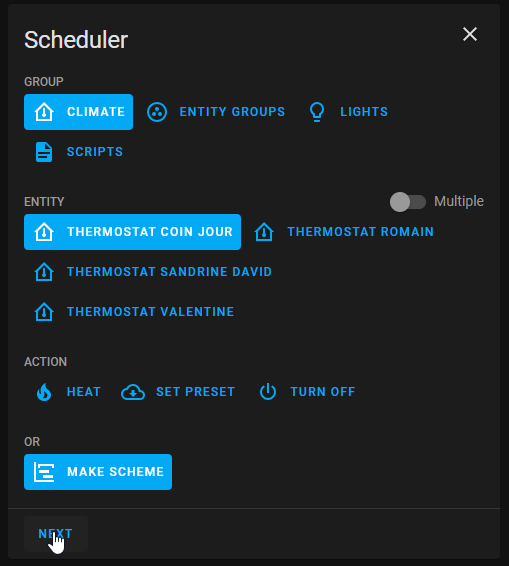
|
||||
|
||||
Définissez votre schéma de mode et enregistrez :
|
||||
|
||||
|
||||

|
||||
|
||||
Dans cet exemple, j'ai réglé le mode ECO pendant la nuit et le jour lorsqu'il n'y a personne à la maison BOOST le matin et CONFORT le soir.
|
||||
|
||||
|
||||
J'espère que cet exemple vous aidera, n'hésitez pas à me faire part de vos retours !
|
||||
|
||||
## Encore bien mieux avec la custom:simple-thermostat front integration
|
||||
Le ``custom:simple-thermostat`` [ici](https://github.com/nervetattoo/simple-thermostat) est une excellente intégration qui permet une certaine personnalisation qui s'adapte bien à ce thermostat.
|
||||
Vous pouvez avoir quelque chose comme ça très facilement 
|
||||
Exemple de configuration :
|
||||
|
||||
```
|
||||
type: custom:simple-thermostat
|
||||
entity: climate.thermostat_sam2
|
||||
layout:
|
||||
step: row
|
||||
label:
|
||||
temperature: T°
|
||||
state: Etat
|
||||
hide:
|
||||
state: false
|
||||
control:
|
||||
hvac:
|
||||
_name: Mode
|
||||
preset:
|
||||
_name: Preset
|
||||
sensors:
|
||||
- entity: sensor.total_puissance_radiateur_sam2
|
||||
icon: mdi:lightning-bolt-outline
|
||||
header:
|
||||
toggle:
|
||||
entity: input_boolean.etat_ouverture_porte_sam
|
||||
name: Porte sam
|
||||
```
|
||||
|
||||
Vous pouvez personnaliser ce composant à l'aide du composant HACS card-mod pour ajuster les couleurs des alertes. Exemple pour afficher en rouge les alertes sécurité et délestage :
|
||||
|
||||
```
|
||||
card_mod:
|
||||
style: |
|
||||
{% if is_state('binary_sensor.thermostat_chambre_security_state', 'on') %}
|
||||
ha-card .body .sensor-heading ha-icon[icon="mdi:alert-outline"] {
|
||||
color: red;
|
||||
}
|
||||
{% endif %}
|
||||
{% if is_state('binary_sensor.thermostat_chambre_overpowering_state', 'on') %}
|
||||
ha-card .body .sensor-heading ha-icon[icon="mdi:flash"] {
|
||||
color: red;
|
||||
}
|
||||
{% endif %}
|
||||
```
|
||||

|
||||
|
||||
## Toujours mieux avec Plotly pour régler votre thermostat
|
||||
Vous pouvez obtenir une courbe comme celle présentée dans [some results](#some-results) avec une sorte de configuration de graphique Plotly uniquement en utilisant les attributs personnalisés du thermostat décrits [ici](#custom-attributes) :
|
||||
|
||||
Remplacez les valeurs entre [[ ]] par les votres.
|
||||
```
|
||||
- type: custom:plotly-graph
|
||||
entities:
|
||||
- entity: '[[climate]]'
|
||||
attribute: temperature
|
||||
yaxis: y1
|
||||
name: Consigne
|
||||
- entity: '[[climate]]'
|
||||
attribute: current_temperature
|
||||
yaxis: y1
|
||||
name: T°
|
||||
- entity: '[[climate]]'
|
||||
attribute: ema_temp
|
||||
yaxis: y1
|
||||
name: Ema
|
||||
- entity: '[[climate]]'
|
||||
attribute: regulated_target_temperature
|
||||
yaxis: y1
|
||||
name: Regulated T°
|
||||
- entity: '[[slope]]'
|
||||
name: Slope
|
||||
fill: tozeroy
|
||||
yaxis: y9
|
||||
fillcolor: rgba(100, 100, 100, 0.3)
|
||||
line:
|
||||
color: rgba(100, 100, 100, 0.9)
|
||||
hours_to_show: 4
|
||||
refresh_interval: 10
|
||||
height: 800
|
||||
config:
|
||||
scrollZoom: true
|
||||
layout:
|
||||
margin:
|
||||
r: 50
|
||||
legend:
|
||||
x: 0
|
||||
'y': 1.2
|
||||
groupclick: togglegroup
|
||||
title:
|
||||
side: top right
|
||||
yaxis:
|
||||
visible: true
|
||||
position: 0
|
||||
yaxis9:
|
||||
visible: true
|
||||
fixedrange: false
|
||||
range:
|
||||
- -0.5
|
||||
- 0.5
|
||||
position: 1
|
||||
xaxis:
|
||||
rangeselector:
|
||||
'y': 1.1
|
||||
x: 0.7
|
||||
buttons:
|
||||
- count: 1
|
||||
step: hour
|
||||
- count: 12
|
||||
step: hour
|
||||
- count: 1
|
||||
step: day
|
||||
- count: 7
|
||||
step: day
|
||||
```
|
||||
|
||||
Exemple de courbes obtenues avec Plotly :
|
||||
|
||||

|
||||
|
||||
## Et toujours de mieux en mieux avec l'AappDaemon NOTIFIER pour notifier les évènements
|
||||
Cette automatisation utilise l'excellente App Daemon nommée NOTIFIER développée par Horizon Domotique que vous trouverez en démonstration [ici](https://www.youtube.com/watch?v=chJylIK0ASo&ab_channel=HorizonDomotique) et le code est [ici](https://github.com/jlpouffier/home-assistant-config/blob/master/appdaemon/apps/notifier.py). Elle permet de notifier les utilisateurs du logement lorsqu'un des évènements touchant à la sécurité survient sur un des Versatile Thermostats.
|
||||
|
||||
C'est un excellent exemple de l'utilisation des notifications décrites ici [notification](#notifications).
|
||||
|
||||
```
|
||||
alias: Surveillance Mode Sécurité chauffage
|
||||
description: Envoi une notification si un thermostat passe en mode sécurité ou power
|
||||
trigger:
|
||||
- platform: event
|
||||
event_type: versatile_thermostat_security_event
|
||||
id: versatile_thermostat_security_event
|
||||
- platform: event
|
||||
event_type: versatile_thermostat_power_event
|
||||
id: versatile_thermostat_power_event
|
||||
- platform: event
|
||||
event_type: versatile_thermostat_temperature_event
|
||||
id: versatile_thermostat_temperature_event
|
||||
condition: []
|
||||
action:
|
||||
- choose:
|
||||
- conditions:
|
||||
- condition: trigger
|
||||
id: versatile_thermostat_security_event
|
||||
sequence:
|
||||
- event: NOTIFIER
|
||||
event_data:
|
||||
action: send_to_jmc
|
||||
title: >-
|
||||
Radiateur {{ trigger.event.data.name }} - {{
|
||||
trigger.event.data.type }} Sécurité
|
||||
message: >-
|
||||
Le radiateur {{ trigger.event.data.name }} est passé en {{
|
||||
trigger.event.data.type }} sécurité car le thermomètre ne répond
|
||||
plus.\n{{ trigger.event.data }}
|
||||
callback:
|
||||
- title: Stopper chauffage
|
||||
event: stopper_chauffage
|
||||
image_url: /media/local/alerte-securite.jpg
|
||||
click_url: /lovelace-chauffage/4
|
||||
icon: mdi:radiator-off
|
||||
tag: radiateur_security_alerte
|
||||
persistent: true
|
||||
- conditions:
|
||||
- condition: trigger
|
||||
id: versatile_thermostat_power_event
|
||||
sequence:
|
||||
- event: NOTIFIER
|
||||
event_data:
|
||||
action: send_to_jmc
|
||||
title: >-
|
||||
Radiateur {{ trigger.event.data.name }} - {{
|
||||
trigger.event.data.type }} Délestage
|
||||
message: >-
|
||||
Le radiateur {{ trigger.event.data.name }} est passé en {{
|
||||
trigger.event.data.type }} délestage car la puissance max est
|
||||
dépassée.\n{{ trigger.event.data }}
|
||||
callback:
|
||||
- title: Stopper chauffage
|
||||
event: stopper_chauffage
|
||||
image_url: /media/local/alerte-delestage.jpg
|
||||
click_url: /lovelace-chauffage/4
|
||||
icon: mdi:radiator-off
|
||||
tag: radiateur_power_alerte
|
||||
persistent: true
|
||||
- conditions:
|
||||
- condition: trigger
|
||||
id: versatile_thermostat_temperature_event
|
||||
sequence:
|
||||
- event: NOTIFIER
|
||||
event_data:
|
||||
action: send_to_jmc
|
||||
title: >-
|
||||
Le thermomètre du radiateur {{ trigger.event.data.name }} ne
|
||||
répond plus
|
||||
message: >-
|
||||
Le thermomètre du radiateur {{ trigger.event.data.name }} ne
|
||||
répond plus depuis longtemps.\n{{ trigger.event.data }}
|
||||
image_url: /media/local/thermometre-alerte.jpg
|
||||
click_url: /lovelace-chauffage/4
|
||||
icon: mdi:radiator-disabled
|
||||
tag: radiateur_thermometre_alerte
|
||||
persistent: true
|
||||
mode: queued
|
||||
max: 30
|
||||
```
|
||||
69
documentation/fr/algorithms.md
Normal file
@@ -0,0 +1,69 @@
|
||||
# Les différents algorithmes utilisés
|
||||
|
||||
- [Les différents algorithmes utilisés](#les-différents-algorithmes-utilisés)
|
||||
- [L'algorithme TPI](#lalgorithme-tpi)
|
||||
- [Configurez les coefficients de l'algorithme TPI](#configurez-les-coefficients-de-lalgorithme-tpi)
|
||||
- [Principe](#principe)
|
||||
- [L'algorithme d'auto-régulation (sans contrôle de la vanne)](#lalgorithme-dauto-régulation-sans-contrôle-de-la-vanne)
|
||||
- [L'algorithme de la fonction d'auto-start/stop](#lalgorithme-de-la-fonction-dauto-startstop)
|
||||
|
||||
## L'algorithme TPI
|
||||
|
||||
### Configurez les coefficients de l'algorithme TPI
|
||||
|
||||
Si vous avez choisi un thermostat de type ```over_switch``` ou ```over_valve``` ou `over_climate` avec l'auto-régulation `Controle direct de la vanne` et que vous sélectionnez l'option "TPI" vous menu, vous arriverez sur cette page :
|
||||
|
||||

|
||||
|
||||
Vous devez donner :
|
||||
1. le coefficient coef_int de l'algorithme TPI,
|
||||
2. le coefficient coef_ext de l'algorithme TPI
|
||||
|
||||
|
||||
### Principe
|
||||
|
||||
L'algorithme TPI consiste à calculer à chaque cycle un pourcentage d'état On vs Off pour le radiateur en utilisant la température cible, la température actuelle dans la pièce et la température extérieure actuelle. Cet algorithme n'est donc valable que pour les Versatile Thermostat qui régulent : `over_switch` et `over_valve`.
|
||||
|
||||
Le pourcentage est calculé avec cette formule :
|
||||
|
||||
on_percent = coef_int * (température cible - température actuelle) + coef_ext * (température cible - température extérieure)
|
||||
Ensuite, l'algo fait en sorte que 0 <= on_percent <= 1
|
||||
|
||||
Les valeurs par défaut pour coef_int et coef_ext sont respectivement : ``0.6`` et ``0.01``. Ces valeurs par défaut conviennent à une pièce standard bien isolée.
|
||||
|
||||
Pour régler ces coefficients, gardez à l'esprit que :
|
||||
1. **si la température cible n'est pas atteinte** après une situation stable, vous devez augmenter le ``coef_ext`` (le ``on_percent`` est trop bas),
|
||||
2. **si la température cible est dépassée** après une situation stable, vous devez diminuer le ``coef_ext`` (le ``on_percent`` est trop haut),
|
||||
3. **si l'atteinte de la température cible est trop lente**, vous pouvez augmenter le ``coef_int`` pour donner plus de puissance au réchauffeur,
|
||||
4. **si l'atteinte de la température cible est trop rapide et que des oscillations apparaissent** autour de la cible, vous pouvez diminuer le ``coef_int`` pour donner moins de puissance au radiateur.
|
||||
|
||||
En type `over_valve` le `on_percent` est ramené à une valeur entre 0 et 100% et sert directement à commander l'ouverture de la vanne.
|
||||
|
||||
## L'algorithme d'auto-régulation (sans contrôle de la vanne)
|
||||
|
||||
L'algorithme d'auto-régulation peut être synthétisé comme suit:
|
||||
|
||||
1. initialiser la température cible comme la consigne du VTherm,
|
||||
1. Si l'auto-régulation est activée,
|
||||
1. calcule de la température régulée (valable pour un VTherm),
|
||||
2. prendre cette température comme cible,
|
||||
2. Pour chaque sous-jacent du VTherm,
|
||||
1. Si "utiliser la température interne" est cochée,
|
||||
1. calcule de la compensation (trv internal temp - room temp),
|
||||
2. ajout de l'écart à la température cible,
|
||||
3. envoie de la température cible ( = temp regulee + (temp interne - temp pièce)) au sous-jacent
|
||||
|
||||
## L'algorithme de la fonction d'auto-start/stop
|
||||
|
||||
L'algorithme utilisé dans la fonction d'auto-start/stop est le suivant :
|
||||
1. if enable aut-start/stop is off, stop here.
|
||||
2. If VTherm is on and in heating mode, when error_accumulated is < -error_threshold -> turn off and save hvac mode,
|
||||
3. If VTherm is on and in Cooling mode, when error_accumulated is > error_threshold -> turn off and save hvac mode,
|
||||
4. If VTherm is off and saved hvac mode is Heating and current_temperature + slope x dt <= target_temperature then turn on and set havc mode to the saved hvac_mode,
|
||||
5. If VTherm is off and saved hvac mode is Cooling and current_temperature + slope x dt >= target_temperature then turn on and set havc mode to the saved hvac_mode
|
||||
6. error_threshold is set to respectively 10 (° * min) in slow, 5 in medium and 2 in fast.
|
||||
|
||||
dt is set to respectively 30 min in slow, 15 min in medium and 7 min in fast detection level.
|
||||
|
||||
La fonction est décrite dans le détail [ici](https://github.com/jmcollin78/versatile_thermostat/issues/585).
|
||||
|
||||
43
documentation/fr/base-attributes.md
Normal file
@@ -0,0 +1,43 @@
|
||||
# Choix des attributs de base
|
||||
|
||||
Choisisez le menu "Principaux attributs".
|
||||
|
||||

|
||||
|
||||
Donnez les principaux attributs obligatoires. Ces attributs sont communs à tous les VTherms :
|
||||
1. un nom (sera le nom de l'intégration et aussi le nom de l'entité `climate`)
|
||||
4. un identifiant d'entité de capteur de température qui donne la température de la pièce dans laquelle le radiateur est installé,
|
||||
5. une entité facultative de capteur de donnant la date et heure de dernière vue du capteur (`last_seen`). Si vous avez ce capteur donnez le ici, il permet d'éviter des mises en sécurité lorsque la température est stable et que le capteur ne remonte plus de température pendant longtemps. (cf. [ici](troubleshooting.md#pourquoi-mon-versatile-thermostat-se-met-en-securite-)),
|
||||
6. une durée de cycle en minutes. A chaque cycle :
|
||||
1. `over_switch` : VTherm allumera/éteindra le radiateur en modulant la proportion de temps allumé,
|
||||
2. `over_valve` : VTherm calculera une nouvelle ouverture de la vanne et lui enverra si elle a changée,
|
||||
3. `over_climate` : le cycle permet d'effectuer les contrôles de base et recalcule les coefficients de l'auto-régulation. Le cycle peut déboucher sur une nouvelle consigne envoyée au sous-jacents ou sur une modification d'ouverture de la vanne dans le cas d'un _TRV_ dont la vanne est commandable.
|
||||
7. une puissance de l'équipement ce qui va activer les capteurs de puissance et énergie consommée par l'appareil. Si plusieurs équipements sont reliés au même VTherm, il faut indiquer ici le total des puissances max des équipements,
|
||||
8. la possibilité d'utiliser des paramètres complémentaires venant de la configuration centralisée :
|
||||
1. capteur de température extérieure,
|
||||
2. température minimale / maximale et pas de température
|
||||
9. la possibilité de controler le thermostat de façon centralisée. Cf [controle centralisé](#le-contrôle-centralisé),
|
||||
10. une case à cocher si ce VTherm est utilisé pour déclencher une éventuelle chaudière centrale.
|
||||
|
||||
>  _*Notes*_
|
||||
> 1. avec les types ```over_switch``` et ```over_valve```, les calculs sont effectués à chaque cycle. Donc en cas de changement de conditions, il faudra attendre le prochain cycle pour voir un changement. Pour cette raison, le cycle ne doit pas être trop long. **5 min est une bonne valeur** mais doit être adapté à votre type de chauffage. Plus l'inertie est grande et plus le cycle doit être long. Cf. 'TODO exemples de reglages,
|
||||
> 2. si le cycle est trop court, le radiateur ne pourra jamais atteindre la température cible. Pour le radiateur à accumulation par exemple il sera sollicité inutilement.
|
||||
|
||||
# Choix des fonctions utilisées
|
||||
|
||||
Choisissez le menu "Fonctions".
|
||||
|
||||

|
||||
|
||||
Les différentes fonctions que vous souhaitez utiliser pour ce VTherm :
|
||||
1. la détection d'ouvertures (portes, fenêtres) permettant de stopper le chauffage lorsque l'ouverture est ouverte. (cf. [gestion des ouvertures](feature-window.md))
|
||||
2. la détection de mouvement : VTherm peut adapter une consigne de température lorsqu'un mouvement est détecté dans la pièce. (cf. [détection du mouvement](feature-motion.md))
|
||||
3. la gestion de la puissance : VTherm peut stopper un équipement si la puissance consommée dans votre habitation dépasse un seuil. (cf. [gestion du délestage](feature-power.md))
|
||||
4. la détection de présence : si vous avez un capteur indiquant une présence ou non dans votre habitation, vous pouvez l'utiliser pour changer la température de consigne. Cf. [gestion de la présence](feature-presence.md). Attention de ne pas confondre cette fonction avec la détection de mouvement. La présence est plus faite pour être à l'échelle de l'habitation alors que le mouvement est plus fait pour être à l'échelle de la pièce.
|
||||
5. l'arrêt/démarrage automatique : pour les VTherm de type `over_climate` uniquement. Cette fonction permet d'arrêter un équipement lorsque VTherm détete qu'il ne sera plus néessaire pendant un certain temps. Il utilise la courbe de température pour prévoir quand l'équipement sera de nouveau utile et le rallumera à ce moment là. Cf. [gestion de l'arrêt/démarrage automatique](feature-auto-start-stop.md)
|
||||
|
||||
|
||||
>  _*Notes*_
|
||||
> 1. La liste des fonctions disponibles s'adapte à votre type de VTherm.
|
||||
> 2. Lorsque vous cochez une fonction, une nouvelle entrée menu s'ajoute pour configurer la fonction.
|
||||
> 3. Vous ne pourrez pas valider la création d'un VTherm si tous les paramètres de toutes les fonctions n'ont pas été saisis.
|
||||
61
documentation/fr/creation.md
Normal file
@@ -0,0 +1,61 @@
|
||||
# Choix du Vtherm
|
||||
|
||||
>  _*Notes*_
|
||||
>
|
||||
> Trois façons de travailler avec les VTherms sont disponibles :
|
||||
> 1. Chaque Versatile Thermostat est entièrement configurée de manière indépendante. Choisissez cette option si vous ne souhaitez avoir aucune configuration ou gestion centrale.
|
||||
> 2. Certains aspects sont configurés de manière centralisée. Cela permet par ex. définir la température min/max, la détection de fenêtre ouverte,… au niveau d'une instance centrale et unique. Pour chaque VTherm que vous configurez, vous pouvez alors choisir d'utiliser la configuration centrale ou de la remplacer par des paramètres personnalisés.
|
||||
> 3. En plus de cette configuration centralisée, tous les VTherm peuvent être contrôlées par une seule entité de type `select`. Cette fonction est nommé `central_mode`. Cela permet de stopper / démarrer / mettre en hors gel / etc tous les VTherms en une seule fois. Pour chaque VTherm, l'utilisateur indique si il est concerné par ce `central_mode`.
|
||||
|
||||
|
||||
## Création d'un nouveau Versatile Thermostat
|
||||
|
||||
Cliquez sur le bouton Ajouter une intégration dans la page d'intégration
|
||||
|
||||

|
||||
|
||||
puis
|
||||
|
||||

|
||||
|
||||
La configuration peut être modifiée via la même interface. Sélectionnez simplement le thermostat à modifier, appuyez sur "Configurer" et vous pourrez modifier certains paramètres ou la configuration.
|
||||
|
||||
Suivez ensuite les étapes de configuration en sélectionnant dans le menu l'option à configurer.
|
||||
|
||||
# Choix d'un type de VTherm
|
||||
|
||||
## Configuration centralisée
|
||||
Ce choix permet de configurer une fois pour tous les VTherms certains aspects qui peuvent être répétitifs comme :
|
||||
1. les paramètres des différents algorithmes (TPI, détection d'ouvertures, détection de mouvements, capteurs de puissance de votre habitation, la détection de présence). Tous ces paramètres sont transverses à tous les VTherms. Vous pouvez donc ne les saisir qu'une seule fois dans la `Configuration centralisée`. Cette configuration ne créé pas de VTherm à proprement parler. Elle permet juste de mettre en commun des paramètres qu'il serait fastidieux de resaisir pour chaque VTherm. Noter que vous pouvez surcharger les paramètres sur les VTherms pour les spécialisés au besoin,
|
||||
2. la configuration de la commande d'un chauffage central,
|
||||
3. certains paramètre avancés comme la mise en sécurité
|
||||
|
||||
## VTherm sur un switch
|
||||
Ce VTherm permet de contrôler un interrupteur qui allume ou étient un radiateur. Cet interrupteur peut être un interrupteur physique qui allume ou éteint directement un radiateur (souvent électrique) ou un interrupteur virtuel qui pourra effectuer les actions que vous voulez sur demande d'allumage ou extinction. Ce dernier type permet par exemple de commander des switchs avec fil pilote ou deu DIY avec diode pour fil pilote. VTherm va moduler la proportion de temps allumé vs éteint pour obtenir la température souhaitée. Si il fait froid, il allume plus souvent (jusqu'à 100%), si il fait chaud il baisse le pourcentage d'allumage. Ce pourcentage d'allumage en nommé `on_percent`.
|
||||
|
||||
Les entités sous-jacentes sont donc des `switchs` ou des `input_boolean`.
|
||||
|
||||
## Vtherm sur un autre thermostat
|
||||
Lorsque votre équipement est contrôlé par une entité de type `climate` dans Home Assistant et que vous n'avez que ça à disposition, vous devez utiliser ce type de VTherm. Dans ce cas, le VTherm va simplement commander la température de consigne du `climate` sous-jacent.
|
||||
Ce type est aussi équipé de fonction d' auto-régulations avancées permettant de moduler la consigne donnée aux sous-jacent pour atteindre plus vite la consigne et de s'affranchir de la régulation interne de ces équipements qui est parfois mauvaise. C'est le cas, si le thermomètre interne de l'équipement est trop proche du corps de chauffe. L'équipement peut croire qu'il fait chaud alors qu'au bout de la pièce, la consigne n'est pas du tout atteinte.
|
||||
|
||||
Depuis la version 6.8, ce type de VTherm permet aussi de réguler avec une action directe sur la vanne. Idéal pour les _TRV_ pour lesquels la vanne est commandable, ce type est recommandé si vous êtes équipés.
|
||||
|
||||
Les entités sous-jacentes de ce type de VTherm sont donc des `climate` exclusivement.
|
||||
|
||||
## VTherm sur une vanne
|
||||
Lorsque tout ce que vous avez à disposition pour réguler la température de votre radiateur est une entité de type `number` vous devez utiliser le type `over_valve`. VTherm ouvre ou ferme la vanne en fonction de l'écart entre la consigne et la température réelle de la pièce (et de la température extérieure).
|
||||
|
||||
Ce type peut être utilisé pour les _TRV_ qui n'ont pas de `climate` associé ou tout autre solution type DIY qui expose une entité `number`.
|
||||
|
||||
# Le bon choix
|
||||
>  _*Comment choisir le type*_
|
||||
> Le choix du type est important. Il n'est plus possible de le modifier via l'IHM de configuration. Pour bien chsoisir, il faut se poser les quelques questions suivantes :
|
||||
> 1. **quel type d'équipement je vais piloter ?** Dans l'ordre voici ce qu'il faut faire :
|
||||
> 1. si vous avez une vanne thermostatique (_TRV_) commandable dans Home Assistant via une entité de type ```number``` (par exemple une _Shelly TRV_), choisissez le type `over_valve`. C'est le type le plus direct et qui assure la meilleure régulation,
|
||||
> 2. si vous avez un radiateur électrique (avec ou sans fil pilote) et qu'une entité de type ```switch``` permet de l'allumer ou de l'éteindre, alors le type ```over_switch``` est préférable. La régulation sera faite par le Versatile Thermostat en fonction de la température mesuré par votre thermomètre, à l'endroit ou vous l'avez placé,
|
||||
> 3. dans tous les autres cas, utilisez le mode ```over_climate```. Vous gardez votre entité ```climate``` d'origine et le Versatile Thermostat "ne fait que" piloter le on/off et la température cible de votre thermostat d'origine. La régulation est faite par votre thermostat d'origine dans ce cas. Ce mode est particulièrement adapté aux climatisations réversible tout-en-un dont l'exposition dans Home Assistant se limite à une entité de type ```climate```. Une auto-régulation avancée permet d'atteindre la consigne en forçant la consigne ou un pilotant directement la vanne lorsque c'est possible.
|
||||
> 2. **quelle type de régulation je veux ?** Si l'équipement piloté possède son propre mécanisme de régulation (clim, certaine vanne TRV) et que cette régulation fonctionne bien, optez pour un ```over_climate```. Si l'équipement est de type _TRV_ avec une vanne pilotable sous HA, alors le type `over_climate` avec une auto-régulation `Contrôle direct de la vanne` est le meilleur choix.
|
||||
|
||||
# Article en référence
|
||||
Un article permettant d'aller plus loin sur les concepts est visible ici (en Français) : https://www.hacf.fr/optimisation-versatile-thermostat/#optimiser-vos-vtherm
|
||||
51
documentation/fr/feature-advanced.md
Normal file
@@ -0,0 +1,51 @@
|
||||
# La configuration avancée
|
||||
|
||||
- [La configuration avancée](#la-configuration-avancée)
|
||||
- [Configuration avancée](#configuration-avancée)
|
||||
- [Délai minimal d'activation](#délai-minimal-dactivation)
|
||||
- [La mise en sécurité](#la-mise-en-sécurité)
|
||||
|
||||
Ces paramètres permettent d'affiner le fonctionnement du thermostat et notamment la mise en sécurité d'un _VTherm_. L'absence d'un capteur de température (pièce ou extérieur) peut être dangereux pour votre logement. Supposez que le capteur de température soit bloqué sur 10°. Le _VTherm_ de type `over_climate` ou `over_valve` va alors commander un chauffage maximal des équipements sous-jacents, ce qui peut conduire à une surchauffe de la pièce voire des dommages sur le logement avec au pire un début d'incendie.
|
||||
|
||||
Pour éviter cela, _VTherm_ s'assure que les thermomètres répondent bien de façon régulière et met le _VTherm_ dans un mode particuliers nommée le mode sécurité si ce n'est plus le cas. Le mode sécurité consiste à assurer un minimum de chauffe pour éviter l'effet inverse : une habitation qui ne serait plus chauffée du tout en plein hiver par exemple.
|
||||
|
||||
Là où le problème devient compliqué, c'est que certain thermomètre - notamment à pile - n'envoie leur température que si elle change. Il est donc tout à fait possible de ne plus recevoir de mises à jour de température pendant plusieurs heures sans que le thermomètre soit en défaut. Les différents paramètres ci-dessous vont permettre de régler finement les seuils de passage en mode sécurité.
|
||||
|
||||
Si votre thermomètre est muni d'un capteur nommé `last seen` qui donne l'heure de son dernier contact, il est possible de le spécifier dans les attributs principaux du _VTherm_ pour limiter grandement les fausses mises en sécurité. Cf. [configuration](base-attributes.md#choix-des-attributs-de-base) et [dépannage](troubleshooting.md#pourquoi-mon-versatile-thermostat-se-met-en-securite-).
|
||||
|
||||
Pour les _VTherm_ `over_climate` et donc qui se régule lui-même, le mode sécurité est désactivé. En effet il n'y a pas de risque de danger si l'équipement se régule lui-même mais juste un risque de mauvaise température.
|
||||
|
||||
## Configuration avancée
|
||||
|
||||
Le formulaire de configuration avancée est le suivant :
|
||||
|
||||

|
||||
|
||||
### Délai minimal d'activation
|
||||
|
||||
Le premier délai (`minimal_activation_delay_sec`) en secondes est le délai minimum acceptable pour allumer le chauffage. Lorsque le calcul donne un délai de mise sous tension inférieur à cette valeur, le chauffage reste éteint. Ce paramètre ne sert qu'au _VTherm_ avec un déclenchement cyclique `over_switch`. Si le temps d'allumage est trop court, la, commutation rapide ne permettra pas à l'équipement de monter en température.
|
||||
|
||||
### La mise en sécurité
|
||||
|
||||
Le deuxième délai (`security_delay_min`) est le délai maximal entre deux mesures de température avant de passer le _VTherm_ en mode sécurité.
|
||||
|
||||
Le troisième paramètre (`security_min_on_percent`) est la valeur minimal de `on_percent` en dessous de laquelle le préréglage sécurité ne sera pas activé. Ce paramètre permet de ne pas mettre en sécurité un thermostat, si le radiateur piloté ne chauffe pas suffisament. En effet, il n'y a pas de risque physique pour le logement dans ce cas mais juste un risque de surchauffe ou de sous-chauffe.
|
||||
Mettre ce paramètre à ``0.00`` déclenchera le préréglage sécurité quelque soit la dernière consigne de chauffage, à l'inverse ``1.00`` ne déclenchera jamais le préréglage sécurité ( ce qui revient à désactiver la fonction). Ce peut ê
|
||||
|
||||
Le quatrième paramètre (`security_default_on_percent`) est la valeur de `on_percent` qui sera utilisée lorsque le thermostat passe en mode ``security``. Si vous mettez `0` alors le thermostat sera coupé lorsqu'il passe en mode `security`, mettre 0,2% par exemple permet de garder un peu de chauffage (20% dans ce cas), même en mode ``security``. Ca évite de retrouver son logement totalement gelé lors d'une panne de thermomètre.
|
||||
|
||||
Il est possible de désactiver la mise en sécurité suite à une absence de données du thermomètre extérieure. En effet, celui-ci ayant la plupart du temps un impact faible sur la régulation (dépendant de votre paramètrage), il est possible qu'il soit absent sans mettre en danger le logement. Pour cela, il faut ajouter les lignes suivantes dans votre `configuration.yaml` :
|
||||
```
|
||||
versatile_thermostat:
|
||||
...
|
||||
safety_mode:
|
||||
check_outdoor_sensor: false
|
||||
```
|
||||
Par défaut, le thermomètre extérieur peut déclencher une mise en sécurité si il n'envoit plus de valeur. N'oubliez pas que Home Assisstant doit être redémarré pour que ces modifications soient prises en compte. Ce réglage est commun à tous les _VTherm_ (qui devraient partager le thermomètre extérieur.
|
||||
|
||||
>  _*Notes*_
|
||||
> 1. Lorsque le capteur de température viendra à la vie et renverra les températures, le préréglage sera restauré à sa valeur précédente,
|
||||
> 2. Attention, deux températures sont nécessaires : la température interne et la température externe et chacune doit donner la température, sinon le thermostat sera en préréglage "security",
|
||||
> 3. Une action est disponible qui permet de régler les 3 paramètres de sécurité. Ca peut servir à adapter la fonction de sécurité à votre usage,
|
||||
> 4. Pour un usage naturel, le ``security_default_on_percent`` doit être inférieur à ``security_min_on_percent``,
|
||||
> 5. Si vous utilisez la carte Verstatile Thermostat UI (cf. [ici](additions.md#bien-mieux-avec-le-versatile-thermostat-ui-card)), un _Vtherm_ en mode sécurité est signalé par un voile grisatre qui donne le thermomètre en défaut et depuis combien de temps le thermomètre n'a pas remonté de valeur : .
|
||||
41
documentation/fr/feature-auto-start-stop.md
Normal file
@@ -0,0 +1,41 @@
|
||||
# Le démarrage / arrêt automatique (auto-start/stop)
|
||||
|
||||
- [Le démarrage / arrêt automatique (auto-start/stop)](#le-démarrage--arrêt-automatique-auto-startstop)
|
||||
- [Configurer l'auto-start/stop](#configurer-lauto-startstop)
|
||||
- [Usage](#usage)
|
||||
|
||||
Cette fonction permet d'autoriser VTherm a stopper un équipement qui n'a pas besoin d'être allumé et de le redémarrer lorsque les conditions le réclame. Cette fonction est munie de 3 réglages qui permettent d'arrêter / relancer plus ou moins rapidement l'équipement.
|
||||
Exclusiveme réservé au _VTherm_ de type `over_climate`, elle répond au cas d'usage suivant :
|
||||
1. votre équipement est allumé électriquement en permanence et consomme de l'électricité même lorsqu'il n'y a pas besoin de chauffer (resp. refroidir). C'est souvent le cas sur les _PAC_ qui consomment même en veille,
|
||||
2. les conditions de température font qu'il n'y a pas besoin de chauffer (resP. refroidir) pendant longtemps : la consigne est supérieure (resp. inférieur) à la température de la pièce,
|
||||
3. la température monte (resp. descend), est stable ou descend (resp. monte) doucement
|
||||
|
||||
Dans ce cas, il est préférable de demander à l'équipement de s'éteindre pour éviter la consommation électrique en mode veille.
|
||||
|
||||
## Configurer l'auto-start/stop
|
||||
|
||||
|
||||
Pour l'utiliser, vous devez :
|
||||
1. Ajouter la fonction `Avec démmarrage et extinction automatique` dans le menu 'Fonctions',
|
||||
2. Paramétrer le niveau de détection dans l'option 'Allumage/extinction automatique' qui s'affiche lorsque la fonction a été activée. Vous choisissez le niveau de détection entre 'Lent', 'Moyen' et 'Rapide'. Les arrêts/relances seront plus nombreux avec le niveau 'Rapide'.
|
||||
|
||||

|
||||
|
||||
Le réglage 'Lent' permet d'avoir environ 30 min entre un arrêt et une relance,
|
||||
Le réglage 'Moyen' met le seuil a environ 15 min et le réglage rapide le met à 7 min.
|
||||
|
||||
Attention, ce ne sont pas des réglages absolus puisque l'algorithme tient compte de la pente de la courbe température de la pièce pour réagir. Il est toujours possible qu'un démarrage ait lieu peu après une extinction si la chute de température est importante.
|
||||
|
||||
## Usage
|
||||
|
||||
Une fois la fonction paramétrée, vous aurez maintenant une nouvelle entité de type `switch` qui vous permet d'autoriser ou non l'arrêt/relance automatique sans toucher à la configuration. Cette entité est disponible sur l'appareil VTherm et se nomme `switch.<name>_enable_auto_start_stop`.
|
||||
|
||||

|
||||
|
||||
Cochez la pour autoriser le démarrage et extinction automatique et laissez là décocher si vous voulez désactiver la fonction auto-start/stop.
|
||||
|
||||
|
||||
>  _*Notes*_
|
||||
> 1. L'algorithme de détection est décrit [ici](algorithms.md#lalgorithme-de-la-fonction-dauto-startstop).
|
||||
> 2. Certains équipements (chaudière, chauffage au sol, _PAC_, ...) n'aiment pas forcément être arrêtés / stoppés trop souvent. Si vous êtes dans ce cas, il peut être préférable de desactiver la fonction lorsque vous savez qu'il va être utilisé. Par exemple, je désactive cette fonction en journée si il y a une présence de détectée car je sais que ma _PAC_ va s'allumer souvent. J'autorise l'auto-start/stop la nuit ou en cas d'absence puisque la consigne est abaissée et qu'elle se déclenche peu voir pas du tout.
|
||||
> 3. Si vous utilisez la carte Verstatile Thermostat UI (cf. [ici](additions.md#bien-mieux-avec-le-versatile-thermostat-ui-card)), une case à cocher est directement visible sur la carte pour désactiver l'auto-start/stop et un _Vtherm_ stoppé par l'auto-start/stop est signalé par l'icone : .
|
||||
109
documentation/fr/feature-central-boiler.md
Normal file
@@ -0,0 +1,109 @@
|
||||
# Le contrôle d'une chaudière centrale
|
||||
|
||||
- [Le contrôle d'une chaudière centrale](#le-contrôle-dune-chaudière-centrale)
|
||||
- [Principe](#principe)
|
||||
- [Configuration](#configuration)
|
||||
- [Comment trouver la bonne action ?](#comment-trouver-la-bonne-action-)
|
||||
- [Les évènements](#les-évènements)
|
||||
- [Avertissement](#avertissement)
|
||||
|
||||
Vous avez la possibilité de contrôler une chaudière centralisée. A partir du moment où il est possible de déclencher ou stopper cette chaudière depuis Home Assistant, alors Versatile Thermostat va pouvoir la commander directement.
|
||||
|
||||
## Principe
|
||||
Le principe mis en place est globalement le suivant :
|
||||
1. une nouvelle entité de type `binary_sensor` et nommée par défaut `binary_sensor.central_boiler` est ajoutée,
|
||||
2. dans la configuration des VTherms vous indiquez si le VTherm doit contrôler la chaudière. En effet, dans une installation hétérogène, certains VTherm doivent commander la chaudière et d'autres non. Vous devez donc indiquer dans chaque configuration de VTherm si il contrôle la chaudière ou pas,
|
||||
3. le `binary_sensor.central_boiler` écoute les changements d'états des équipements des VTherm marqués comme contrôlant la chaudière,
|
||||
4. dès que le nombre d'équipements pilotés par le VTherm demandant du chauffage (ie son `hvac_action` passe à `Heating`) dépasse un seuil paramétrable, alors le `binary_sensor.central_boiler` passe à `on` et **si un service d'activation a été configuré, alors ce service est appelé**,
|
||||
5. si le nombre d'équipements nécessitant du chauffage repasse en dessous du seuil, alors le `binary_sensor.central_boiler` passe à `off` et si **un service de désactivation a été configuré, alors ce service est appelé**,
|
||||
6. vous avez accès à deux entités :
|
||||
- une de type `number` nommé par défaut `number.boiler_activation_threshold`, donne le seuil de déclenchement. Ce seuil est en nombre d'équipements (radiateurs) qui demande du chauffage.
|
||||
- une de type `sensor` nommé par défaut `sensor.nb_device_active_for_boiler`, donne le nombre d'équipements qui demande du chauffage. Par exemple, un VTherm ayant 4 vannes dont 3 demandes du chauffage fera passé ce capteur à 3. Seuls les équipements des VTherms qui sont marqués pour contrôler la chaudière centrale sont comptabilisés.
|
||||
|
||||
Vous avez donc en permanence, les informations qui permettent de piloter et régler le déclenchement de la chaudière.
|
||||
|
||||
Toutes ces entités sont rattachés au service de configuration centrale :
|
||||
|
||||

|
||||
|
||||
## Configuration
|
||||
Pour configurer cette fonction, vous devez avoir une configuration centralisée (cf. [Configuration](#configuration)) et cochez la case 'Ajouter une chaudière centrale' :
|
||||
|
||||

|
||||
|
||||
Sur la page suivante vous pouvez donner la configuration des actions (ex services) à appeler lors de l'allumage / extinction de la chaudière :
|
||||
|
||||

|
||||
|
||||
Les actions (ex services) se configurent comme indiqués dans la page :
|
||||
1. le format général est `entity_id/service_id[/attribut:valeur]` (où `/attribut:valeur` est facultatif),
|
||||
2. `entity_id` est le nom de l'entité qui commande la chaudière sous la forme `domain.entity_name`. Par exemple: `switch.chaudiere` pour les chaudière commandée par un switch ou `climate.chaudière` pour une chaudière commandée par un thermostat ou tout autre entité qui permet le contrôle de la chaudière (il n'y a pas de limitation). On peut aussi commuter des entrées (`helpers`) comme des `input_boolean` ou `input_number`.
|
||||
3. `service_id` est le nom du service à appeler sous la forme `domain.service_name`. Par exemple: `switch.turn_on`, `switch.turn_off`, `climate.set_temperature`, `climate.set_hvac_mode` sont des exemples valides.
|
||||
4. pour certain service vous aurez besoin d'un paramètre. Cela peut être le 'Mode CVC' `climate.set_hvac_mode` ou la température cible pour `climate.set_temperature`. Ce paramètre doit être configuré sous la forme `attribut:valeur` en fin de chaine.
|
||||
|
||||
Exemples (à ajuster à votre cas) :
|
||||
- `climate.chaudiere/climate.set_hvac_mode/hvac_mode:heat` : pour allumer le thermostat de la chaudière en mode chauffage,
|
||||
- `climate.chaudiere/climate.set_hvac_mode/hvac_mode:off` : pour stopper le thermostat de la chaudière,
|
||||
- `switch.pompe_chaudiere/switch.turn_on` : pour allumer le swicth qui alimente la pompe de la chaudière,
|
||||
- `switch.pompe_chaudiere/switch.turn_off` : pour allumer le swicth qui alimente la pompe de la chaudière,
|
||||
- ...
|
||||
|
||||
### Comment trouver la bonne action ?
|
||||
Pour trouver l'action à utiliser, le mieux est d'aller dans "Outils de développement / Actions", chercher l'action à appeler, l'entité à commander et l'éventuel paramètre à donner.
|
||||
Cliquez sur 'Appeler l'action'. Si votre chaudière s'allume vous avez la bonne configuration. Passez alors en mode Yaml et recopiez les paramètres.
|
||||
|
||||
Exemple:
|
||||
|
||||
Sous "Outils de développement / Service" :
|
||||
|
||||

|
||||
|
||||
En mode yaml :
|
||||
|
||||

|
||||
|
||||
Le service à configurer est alors le suivant: `climate.empty_thermostast/climate.set_hvac_mode/hvac_mode:heat` (notez la suppression du blanc dans `hvac_mode:heat`)
|
||||
|
||||
Faite alors de même pour le service d'extinction et vous êtes parés.
|
||||
|
||||
## Les évènements
|
||||
|
||||
A chaque allumage ou extinction réussie de la chaudière un évènement est envoyé par Versatile Thermostat. Il peut avantageusement être capté par une automatisation, par exemple pour notifier un changement.
|
||||
Les évènements ressemblent à ça :
|
||||
|
||||
Un évènement d'allumage :
|
||||
```
|
||||
event_type: versatile_thermostat_central_boiler_event
|
||||
data:
|
||||
central_boiler: true
|
||||
entity_id: binary_sensor.central_boiler
|
||||
name: Central boiler
|
||||
state_attributes: null
|
||||
origin: LOCAL
|
||||
time_fired: "2024-01-14T11:33:52.342026+00:00"
|
||||
context:
|
||||
id: 01HM3VZRJP3WYYWPNSDAFARW1T
|
||||
parent_id: null
|
||||
user_id: null
|
||||
```
|
||||
|
||||
Un évènement d'extinction :
|
||||
```
|
||||
event_type: versatile_thermostat_central_boiler_event
|
||||
data:
|
||||
central_boiler: false
|
||||
entity_id: binary_sensor.central_boiler
|
||||
name: Central boiler
|
||||
state_attributes: null
|
||||
origin: LOCAL
|
||||
time_fired: "2024-01-14T11:43:52.342026+00:00"
|
||||
context:
|
||||
id: 01HM3VZRJP3WYYWPNSDAFBRW1T
|
||||
parent_id: null
|
||||
user_id: null
|
||||
```
|
||||
|
||||
## Avertissement
|
||||
|
||||
>  _*Notes*_
|
||||
> Le contrôle par du logiciel ou du matériel de type domotique d'une chaudière centrale peut induire des risques pour son bon fonctionnement. Assurez-vous avant d'utiliser ces fonctions, que votre chaudière possède bien des fonctions de sécurité et que celles-ci fonctionnent. Allumer une chaudière si tous les robinets sont fermés peut générer de la sur-pression par exemple.
|
||||
32
documentation/fr/feature-central-mode.md
Normal file
@@ -0,0 +1,32 @@
|
||||
|
||||
# Le contrôle centralisé
|
||||
|
||||
- [Le contrôle centralisé](#le-contrôle-centralisé)
|
||||
- [Configuration du contrôle centralisée](#configuration-du-contrôle-centralisée)
|
||||
- [Usage](#usage)
|
||||
|
||||
Cette fonction vous permet de contrôler tous vos _VTherm_ depuis un unique point de contrôle.
|
||||
Le cas d'usage typique est lorsque vous partez pour une longue durée, vous voulez mettre tous vos _VTherm_ en Hors-gel et lorsque vous rentrez, vous voulez les remettre dans l'état initial.
|
||||
|
||||
Le contrôle centralisé se fait depuis un _Vtherm_ spécial nommé configuration centralisée. Cf. [ici](creation.md#configuration-centralisée) pour plus d'informations.
|
||||
|
||||
## Configuration du contrôle centralisée
|
||||
|
||||
Si vous avez défini une configuration centralisée, vous avez une nouvelle entité nommée `select.central_mode` qui permet de piloter tous les VTherms avec une seule action.
|
||||
|
||||

|
||||
|
||||
Cette entité se présente sous la forme d'une liste de choix qui contient les choix suivants :
|
||||
1. `Auto` : le mode 'normal' dans lequel chaque VTherm se comporte de façon autonome,
|
||||
2. `Stooped` : tous les VTherms sont mis à l'arrêt (`hvac_off`),
|
||||
3. `Heat only` : tous les VTherms sont mis en mode chauffage lorsque ce mode est supporté par le VTherm, sinon il est stoppé,
|
||||
4. `Cool only` : tous les VTherms sont mis en mode climatisation lorsque ce mode est supporté par le VTherm, sinon il est stoppé,
|
||||
5. `Frost protection` : tous les VTherms sont mis en preset hors-gel lorsque ce preset est supporté par le VTherm, sinon il est stoppé.
|
||||
|
||||
## Usage
|
||||
|
||||
Pour qu'un VTherm soit contrôlable de façon centralisée, il faut que son attribut de configuration nommé `use_central_mode` soit vrai. Cet attribut est disponible dans la page de configuration `Principaux ttributs`
|
||||
|
||||

|
||||
|
||||
Il est donc possible de contrôler tous les VTherms (que ceux que l'on désigne explicitement) avec un seul contrôle.
|
||||
40
documentation/fr/feature-motion.md
Normal file
@@ -0,0 +1,40 @@
|
||||
# La détection de mouvement ou d'activité
|
||||
|
||||
- [La détection de mouvement ou d'activité](#la-détection-de-mouvement-ou-dactivité)
|
||||
- [Configurer le mode d'activité ou la détection de mouvement](#configurer-le-mode-dactivité-ou-la-détection-de-mouvement)
|
||||
- [Usage](#usage)
|
||||
|
||||
Cette fonction vous permet de changer de preset lorsqu'un mouvement est détectée dans une pièce. Si vous ne souhaitez chauffer votre bureau, lorsque la pièce est occupée et uniquement si la pièce est occupée, il vous faut un capteur de mouvement (ou de présence) dans la pièce et configurer cette fonction.
|
||||
|
||||
Cette fonction est souvent confondue avec la fonction de présence. Elles sont complémentaires mais ne se remplace pas. La fonction 'mouvement' est locale à une pièce équipe d'un capteur de mouvement alors que la fonction 'présence' est prévue pour être globale à tout le logement.
|
||||
|
||||
## Configurer le mode d'activité ou la détection de mouvement
|
||||
|
||||
Si vous avez choisi la fonctionnalité `Avec détection de mouvement`, :
|
||||
|
||||

|
||||
|
||||
Ce dont nous avons besoin:
|
||||
- un **capteur de mouvement**. ID d'entité d'un capteur de mouvement. Les états du capteur de mouvement doivent être « on » (mouvement détecté) ou « off » (aucun mouvement détecté)
|
||||
- une durée de **délai d'activation** (en secondes) définissant combien de temps nous attendons la confirmation du mouvement avant de considérer le mouvement. Ce paramètre peut être **supérieur à la temporisation de votre détecteur de mouvement**, sinon la détection se fera à chaque mouvement signalé par le détecteur,
|
||||
- une durée de fin **délai de désactivation** (en secondes) définissant combien de temps nous attendons la confirmation d'une fin de mouvement avant de ne plus considérer le mouvement.
|
||||
- un **préréglage de "mouvement"**. Nous utiliserons la température de ce préréglage lorsqu'une activité sera détectée.
|
||||
- un **préréglage "pas de mouvement"**. Nous utiliserons la température de ce deuxième préréglage lorsqu'aucune activité n'est détectée.
|
||||
|
||||
## Usage
|
||||
|
||||
Pour indiquer à un _VTherm_ qu'il doit écouter le capteur de mouvement, vous devez le mettre dans le preset spécial 'Activité'. Si vous avez installé la carte Versatile Thermostat UI (cf. [ici](additions.md#bien-mieux-avec-le-versatile-thermostat-ui-card)), ce preset est représenté comme suit : .
|
||||
|
||||
Vous pouvez ainsi, sur demande, mettre un _VTherm_ en mode détection de mouvement.
|
||||
|
||||
Le comportement va être le suivant :
|
||||
- nous avons une pièce avec un thermostat réglé en mode activité, le mode "mouvement" choisi est confort (21,5°C), le mode "pas de mouvement" choisi est Eco (18.5°C) et la temporisation du mouvement est de 30 sec lors de la détection et de 5 minutes sur fin de détection.
|
||||
- la pièce est vide depuis un moment (aucune activité détectée), la température de consigne de cette pièce est de 18,5°
|
||||
- quelqu'un entre dans la pièce, une activité est détectée si le mouvement est présent pendant au moins 30 sec. La température passe alors à 21,5°
|
||||
- si le mouvement est présent pendant moins de 30 sec (passage rapide), la température reste sur 18,5°,
|
||||
- imaginons que la température soit passée sur 21,5°, lorsque la personne quitte la pièce, au bout de 5 min la température est ramenée à 18,5°.
|
||||
- si la personne revient avant les 5 minutes, la température reste sur 21,5°
|
||||
|
||||
>  _*Notes*_
|
||||
> 1. Sachez que comme pour les autres preset, `Activité` ne sera proposé que s'il est correctement configuré. En d'autres termes, les 4 clés de configuration doivent être définies
|
||||
> 2. Si vous utilisez la carte Verstatile Thermostat UI (cf. [ici](additions.md#bien-mieux-avec-le-versatile-thermostat-ui-card)), une détection de mouvement est représenté comme suit : .
|
||||
44
documentation/fr/feature-power.md
Normal file
@@ -0,0 +1,44 @@
|
||||
# Gestion de la puissance - délestage
|
||||
|
||||
- [Gestion de la puissance - délestage](#gestion-de-la-puissance---délestage)
|
||||
- [Configurer la gestion de la puissance](#configurer-la-gestion-de-la-puissance)
|
||||
|
||||
Cette fonction vous permet de réguler la consommation électrique de vos radiateurs. Connue sous le nom de délestage, cette fonction vous permet de limiter la consommation électrique de votre appareil de chauffage si des conditions de surpuissance sont détectées.
|
||||
Vous aurez besoin d'un **capteur de la puissance totale instantanée consommée** de votre logement ainsi que d'un **capteur donnant la puissance maximale autorisée**.
|
||||
|
||||
Le comportement de cette fonction est basique :
|
||||
1. lorsque le _VTherm_ va allumer un équipement,
|
||||
2. il compare la dernière valeur connue du capteur de puissance consommée avec la dernière valeur de la puissance maximale autorisée. Si il reste une marge supérieure égale à la puissance déclarée des équipements du _VTherm_ alors le VTherm et ses équipements seront allumés. Sinon ils resteront éteints jusqu'au prochain cycle.
|
||||
|
||||
ATTENTION: ce fonctionnement très basique **n'est pas une fonction de sécurité** mais plus une fonction permettant une optimisation de la consommation au prix d'une dégradation du chauffage. Des dépassements sont possibles selon la fréquence de remontée de vos capteurs de consommation, la puissance réellement utilisée par votre équipements. Vous devez donc toujours garder une marge de sécurité.
|
||||
|
||||
Cas d'usage type:
|
||||
1. vous avez un compteur électrique limité à 11 kW,
|
||||
2. vous chargez de temps en temps un véhicle électrique à 5 kW,
|
||||
3. il reste donc 6 kW pour tout le reste y compris le chauffage,
|
||||
4. vous avez 1 kW d'autres équipements en cours,
|
||||
5. vous avez déclaré un capteur (`input_number`) de puissance max autorisée à 9 kW (= 11 kW - la réserve pour les autres équipements - marge)
|
||||
|
||||
Si la vehicle est en charge, la puissance totale consommé est de 6 kW (5+1) et un _VTherm_ ne s'allumera que si sa puissance déclarée est de 3 kW max (9 kW - 6 kW).
|
||||
Si la vehicle est en charge et qu'un autre _VTherm_ de 2 kW est allumé, la puissance totale consommé est de 8 kW (5+1+2) et un _VTherm_ ne s'allumera que si sa puissance déclarée est de 1 kW max (9 kW - 8 kW). Sinon il passe son tour (cycle).
|
||||
|
||||
Si le vehicle n'est pas en charge, la puissance totale consommé est de 1 kW, un _VTherm_ ne s'allumera que si sa puissance déclarée est de 8 kW max (9 kW - 1 kW).
|
||||
|
||||
## Configurer la gestion de la puissance
|
||||
|
||||
Si vous avez choisi la fonctionnalité `Avec détection de la puissance`, vous la configurez de la façon suivante :
|
||||

|
||||
|
||||
1. l'id d'entité du **capteur de puissance instantané consommé** de votre logement,
|
||||
2. l'id d'entité du **capteur de puissance maximale autorisée**,
|
||||
3. la température à appliquer si le délestage est appliqué.
|
||||
|
||||
Notez que toutes les valeurs de puissance doivent avoir les mêmes unités (kW ou W par exemple).
|
||||
Le fait d'avoir un **capteur de puissance maximale autorisée**, vous permet de modifier la puissance maximale au fil du temps à l'aide d'un planificateur ou d'une automatisation.
|
||||
|
||||
>  _*Notes*_
|
||||
> 1. En cas de délestage, le radiateur est réglé sur le préréglage nommé `power`. Il s'agit d'un préréglage caché, vous ne pouvez pas le sélectionner manuellement.
|
||||
> 2. Gardez toujours une marge, car la puissance max peut être brièvement dépassée en attendant le calcul du prochain cycle typiquement ou par des équipements non régulés.
|
||||
> 3. Si vous ne souhaitez pas utiliser cette fonctionnalité, décochez la dans le menu 'Fonctions'.
|
||||
> 4. Si une _VTherm_ controlez plusieurs équipements, la **consommation électrique de votre chauffage** renseigné doit correspondre à la somme des puissances.
|
||||
> 5. Si vous utilisez la carte Verstatile Thermostat UI (cf. [ici](additions.md#bien-mieux-avec-le-versatile-thermostat-ui-card)), le délestage est représenté comme suit : .
|
||||
24
documentation/fr/feature-presence.md
Normal file
@@ -0,0 +1,24 @@
|
||||
# Gestion de la présence / absence
|
||||
|
||||
- [Gestion de la présence / absence](#gestion-de-la-présence--absence)
|
||||
- [Configurer la présence (ou l'absence)](#configurer-la-présence-ou-labsence)
|
||||
|
||||
## Configurer la présence (ou l'absence)
|
||||
|
||||
Si cette fonction est sélectionnée, elle vous permet de modifier dynamiquement la température des préréglages du thermostat lorsqu'une présence (ou absence) est détectée. Pour cela, vous devez configurer la température qui sera utilisée pour chaque préréglage lorsque la présence est désactivée. Lorsque le capteur de présence s'éteint, ces températures seront utilisées. Lorsqu'il se rallume, la température "normale" configurée pour le préréglage est utilisée. Voir [gestion des préréglages](feature-presets.md).
|
||||
|
||||
Pour configurer la présence remplissez ce formulaire :
|
||||
|
||||

|
||||
|
||||
Pour cela, vous devez simplement configurer un **capteur d'occupation** dont l'état doit être 'on' ou 'home' si quelqu'un est présent ou 'off' ou 'not_home' sinon,
|
||||
|
||||
Les températures sont configurées dans les entités de l'équipement correspondant à votre _VTherm_ (Paramètres/Intégration/Versatile Thermostat/le vtherm)
|
||||
|
||||
ATTENTION : les groupes de personnes ne fonctionnent pas en tant que capteur de présence. Ils ne sont pas reconnus comme un capteur de présence. Vous devez utiliser, un template comme décrit ici [Utilisation d'un groupe de personnes comme capteur de présence](troubleshooting.md#utilisation-dun-groupe-de-personnes-comme-capteur-de-présence).
|
||||
|
||||
>  _*Notes*_
|
||||
> 1. le changement de température est immédiat et se répercute sur le volet avant. Le calcul prendra en compte la nouvelle température cible au prochain calcul du cycle,
|
||||
> 2. vous pouvez utiliser le capteur direct person.xxxx ou un groupe de capteurs de Home Assistant. Le capteur de présence gère les états ``on`` ou ``home`` comme présents et les états ``off`` ou ``not_home`` comme absents.
|
||||
> 3. pour pré-chauffer votre logement alors que tout le monde est absent, vous pouvez ajouter une entité de type `input_boolean` dans votre groupe de personne. Si vous passez cet `input_boolean` sur 'On' alors le capteur de présence sera forcé sur 'On' et les presets avec présence seront utilisés. Vous pouvez aussi positionner cet `input_boolean` sur 'On' via une automatisation par exemple lorsque vous quittez une zone pour lancer le préchauffage de votre logement.
|
||||
|
||||
30
documentation/fr/feature-presets.md
Normal file
@@ -0,0 +1,30 @@
|
||||
# Les pre-réglages (preset)
|
||||
|
||||
- [Les pre-réglages (preset)](#les-pre-réglages-preset)
|
||||
- [Configurer les températures préréglées](#configurer-les-températures-préréglées)
|
||||
|
||||
|
||||
## Configurer les températures préréglées
|
||||
|
||||
Le mode préréglé (preset) vous permet de préconfigurer la température ciblée. Utilisé en conjonction avec Scheduler (voir [scheduler](additions##encore-mieux-avec-le-composant-scheduler-)) vous aurez un moyen puissant et simple d'optimiser la température par rapport à la consommation électrique de votre maison. Les préréglages gérés sont les suivants :
|
||||
- **Eco** : l'appareil est en mode d'économie d'énergie
|
||||
- **Confort** : l'appareil est en mode confort
|
||||
- **Boost** : l'appareil tourne toutes les vannes à fond
|
||||
|
||||
Si le mode AC est utilisé, vous pourrez aussi configurer les températures lorsque l'équipement en mode climatisation.
|
||||
|
||||
**Aucun** est toujours ajouté dans la liste des modes, car c'est un moyen de ne pas utiliser les preset mais une **température manuelle** à la place.
|
||||
|
||||
Les pré-réglages se font directement depuis les entités du _VTherm_ ou de la configuration centrale si vous utilisez la configuration centrale. A la création du _VTherm_, vous aurez différentes entités qui vont vous permettre de fixer les températures de chaque preset :
|
||||
|
||||
.
|
||||
|
||||
La liste des entités varient en fonction de vos choix de fonction :
|
||||
1. si la fonction 'détection de présence' est activée vous aurez les presets en version absence préfixé par _abs_,
|
||||
2. si vous avez choisi l'option _AC_, vous aurez en plus les presets en version 'climatisation' préfixé par _clim_
|
||||
|
||||
>  _*Notes*_
|
||||
> 1. Lorsque vous modifiez manuellement la température cible, le préréglage passe sur Aucun (pas de préréglage),
|
||||
> 2. Le préréglage standard ``Away`` est un préréglage caché qui n'est pas directement sélectionnable. Versatile Thermostat utilise la gestion de présence ou la gestion de mouvement pour régler automatiquement et dynamiquement la température cible en fonction d'une présence dans le logement ou d'une activité dans la pièce. Voir [gestion de la présence](feature-presence.md).
|
||||
> 3. Si vous utilisez la gestion du délestage, vous verrez un préréglage caché nommé ``power``. Le préréglage de l'élément chauffant est réglé sur « puissance » lorsque des conditions de surpuissance sont rencontrées et que le délestage est actif pour cet élément chauffant. Voir [gestion de l'alimentation](feature-power.md).
|
||||
> 4. si vous utilisez la configuration avancée, vous verrez le préréglage défini sur ``sécurité`` si la température n'a pas pu être récupérée après un certain délai. Voir [Mise en sécurité](feature-advanced.md#la-mise-en-sécurité)
|
||||
66
documentation/fr/feature-window.md
Normal file
@@ -0,0 +1,66 @@
|
||||
# La détection d'ouverture - portes/fenêtres
|
||||
|
||||
- [La détection d'ouverture - portes/fenêtres](#la-détection-douverture---portesfenêtres)
|
||||
- [Le mode capteur](#le-mode-capteur)
|
||||
- [Le mode auto](#le-mode-auto)
|
||||
|
||||
Vous devez avoir choisi la fonctionnalité ```Avec détection des ouvertures``` dans la première page pour arriver sur cette page.
|
||||
La détection des ouvertures peut se faire de 2 manières:
|
||||
1. soit avec un capteur placé sur l'ouverture (mode capteur),
|
||||
2. soit en détectant une chute brutale de température (mode auto)
|
||||
|
||||
La configuration de la détection d'ouverture est la suivante :
|
||||
|
||||

|
||||
|
||||
## Le mode capteur
|
||||
Pour passer en mode capteur, vous devez donner une entité de type `binary_sensor` ou `input_boolean`.
|
||||
Dans ce mode, vous devez renseigner les informations suivantes:
|
||||
|
||||

|
||||
|
||||
1. un **délai en secondes** avant tout changement. Cela permet d'ouvrir rapidement une fenêtre sans arrêter le chauffage,
|
||||
2. l'action a réaliser lorsque l'ouverture est détectée ouverte. Les actions possibles sont :
|
||||
1. _Eteindre_ : le VTherm sera étient,
|
||||
2. _Ventilateur seul_ : le chauffage ou refroidissement sera coupé mais l'équipement continuera à ventiler (pour les équipements compatibles),
|
||||
3. _Hors gel_ : la température du preset 'Hors Gel' sera alors sélectionné sur le _VTherm_ sans changement du preset courant (cf. notes ci-dessous),
|
||||
4. _Eco_ : la température du preset _Eco_ sera appliquée sur le _VTherm_ sans changement du preset courant (cf. notes ci-dessous).
|
||||
|
||||
Lorsque le détecteur passe à ouvert :
|
||||
1. _VTherm_ attend le délai indiqué,
|
||||
2. si l'ouverture est toujours ouverte au bout du délai, l'état du _VTherm_ est mémorisée (mode Chauffe / Froid / ..., preset courant, temperature de consigne courante) et l'action est réalisée
|
||||
|
||||
Pareil, lorsque le détecteur passe à fermé :
|
||||
1. _VTherm_ attend le délai indiqué,
|
||||
2. si l'ouverture est toujours fermée au bout du délai, l'état avant ouverture mémorisé est restauré.
|
||||
|
||||
## Le mode auto
|
||||
En mode auto, la configuration est la suivante:
|
||||

|
||||
|
||||
1. un **délai en secondes** avant tout changement. Cela permet d'ouvrir rapidement une fenêtre sans arrêter le chauffage,
|
||||
2. un seuil de détection en degré par heure. Lorsque la température chute au delà de ce seuil, le thermostat s'éteindra. Plus cette valeur est faible et plus la détection sera rapide (en contre-partie d'un risque de faux positif),
|
||||
3. un seuil de fin de détection en degré par heure. Lorsque la chute de température repassera au-dessus cette valeur, le thermostat se remettra dans le mode précédent (mode et preset),
|
||||
4. une durée maximale de détection. Au delà de cette durée, le thermostat se remettra dans son mode et preset précédent même si la température continue de chuter
|
||||
5. l'action a réaliser lorsque l'ouverture est détectée ouverte. Les actions sont les mêmes qu'en mode capteur décrit ci-dessus.
|
||||
|
||||
Pour régler les seuils il est conseillé de commencer avec les valeurs de référence et d'ajuster les seuils de détection. Quelques essais m'ont donné les valeurs suivantes (pour un bureau):
|
||||
- seuil de détection : 3 °C/heure
|
||||
- seuil de non détection: 0 °C/heure
|
||||
- durée max : 30 min.
|
||||
|
||||
Un nouveau capteur nommé "slope" a été ajouté pour tous les thermostats. Il donne la pente de la courbe de température en °C/heure (ou °K/heure). Cette pente est lissée et filtrée pour éviter les valeurs abérrantes des thermomètres qui viendraient pertuber la mesure.
|
||||
|
||||

|
||||
|
||||
Pour bien régler il est conseillé d'affocher sur un même graphique historique la courbe de température et la pente de la courbe (le "slope") :
|
||||
|
||||

|
||||
|
||||
>  _*Notes*_
|
||||
> 1. Si vous souhaitez utiliser **plusieurs capteurs de porte/fenêtre** pour automatiser votre thermostat, créez simplement un groupe avec le comportement habituel (https://www.home-assistant.io/integrations/binary_sensor.group/)
|
||||
> 2. Si vous n'avez pas de capteur de fenêtre/porte dans votre chambre, laissez simplement l'identifiant de l'entité du capteur vide,
|
||||
> 3. **Un seul mode est permis**. On ne peut pas configurer un thermostat avec un capteur et une détection automatique. Les 2 modes risquant de se contredire, il n'est pas possible d'avoir les 2 modes en même temps,
|
||||
> 4. Il est déconseillé d'utiliser le mode automatique pour un équipement soumis à des variations de température fréquentes et normales (couloirs, zones ouvertes, ...)
|
||||
> 5. Pour éviter d'interférer avec votre réglage de preset courant, Les actions _Hors gel_ et _Eco_ change la température cible sans changer le preset. Donc, vous pouvez constater un écart entre le preset sélectionné et la consigne.
|
||||
> 6. Si vous utilisez la carte Verstatile Thermostat UI (cf. [ici](additions.md#bien-mieux-avec-le-versatile-thermostat-ui-card)), une détection d'ouverture est représenté comme suit : .
|
||||
BIN
documentation/fr/images/activity-preset-icon.png
Normal file

|
After Width: | Height: | Size: 1.5 KiB |
BIN
documentation/fr/images/add-an-integration.png
Normal file

|
After Width: | Height: | Size: 9.1 KiB |
BIN
documentation/fr/images/auto-start-stop-icon.png
Normal file

|
After Width: | Height: | Size: 1.3 KiB |
BIN
documentation/fr/images/central-mode.png
Normal file

|
After Width: | Height: | Size: 16 KiB |
BIN
documentation/fr/images/colored-thermostat-sensors.png
Normal file

|
After Width: | Height: | Size: 29 KiB |
BIN
documentation/fr/images/config-advanced.png
Normal file

|
After Width: | Height: | Size: 34 KiB |
BIN
documentation/fr/images/config-auto-start-stop.png
Normal file

|
After Width: | Height: | Size: 9.2 KiB |
BIN
documentation/fr/images/config-central-boiler-1.png
Normal file

|
After Width: | Height: | Size: 26 KiB |
BIN
documentation/fr/images/config-central-boiler-2.png
Normal file

|
After Width: | Height: | Size: 85 KiB |
BIN
documentation/fr/images/config-complete.png
Normal file

|
After Width: | Height: | Size: 3.1 KiB |
BIN
documentation/fr/images/config-features-old.png
Normal file

|
After Width: | Height: | Size: 23 KiB |
BIN
documentation/fr/images/config-features.png
Normal file

|
After Width: | Height: | Size: 23 KiB |
BIN
documentation/fr/images/config-linked-entity.png
Normal file

|
After Width: | Height: | Size: 36 KiB |
BIN
documentation/fr/images/config-linked-entity2.png
Normal file

|
After Width: | Height: | Size: 50 KiB |
BIN
documentation/fr/images/config-linked-entity3.png
Normal file

|
After Width: | Height: | Size: 26 KiB |
BIN
documentation/fr/images/config-main-old.png
Normal file

|
After Width: | Height: | Size: 45 KiB |
BIN
documentation/fr/images/config-main.png
Normal file

|
After Width: | Height: | Size: 54 KiB |
BIN
documentation/fr/images/config-main0.png
Normal file

|
After Width: | Height: | Size: 28 KiB |
BIN
documentation/fr/images/config-menu-all-options.png
Normal file

|
After Width: | Height: | Size: 40 KiB |
BIN
documentation/fr/images/config-menu.png
Normal file

|
After Width: | Height: | Size: 28 KiB |
BIN
documentation/fr/images/config-motion.png
Normal file

|
After Width: | Height: | Size: 42 KiB |
BIN
documentation/fr/images/config-not-complete.png
Normal file

|
After Width: | Height: | Size: 3.6 KiB |
BIN
documentation/fr/images/config-power.png
Normal file

|
After Width: | Height: | Size: 42 KiB |
BIN
documentation/fr/images/config-presence.png
Normal file

|
After Width: | Height: | Size: 21 KiB |
BIN
documentation/fr/images/config-preset-temp.png
Normal file

|
After Width: | Height: | Size: 38 KiB |
BIN
documentation/fr/images/config-self-regulation-valve-1.png
Normal file

|
After Width: | Height: | Size: 4.5 KiB |
BIN
documentation/fr/images/config-self-regulation-valve-2.png
Normal file

|
After Width: | Height: | Size: 71 KiB |
BIN
documentation/fr/images/config-terminate.png
Normal file

|
After Width: | Height: | Size: 19 KiB |
BIN
documentation/fr/images/config-tpi.png
Normal file

|
After Width: | Height: | Size: 14 KiB |
BIN
documentation/fr/images/config-use-internal-temp.png
Normal file

|
After Width: | Height: | Size: 5.0 KiB |
BIN
documentation/fr/images/config-window-auto.png
Normal file

|
After Width: | Height: | Size: 52 KiB |
BIN
documentation/fr/images/config-window-main.png
Normal file

|
After Width: | Height: | Size: 24 KiB |
BIN
documentation/fr/images/config-window-sensor.png
Normal file

|
After Width: | Height: | Size: 25 KiB |
BIN
documentation/fr/images/custom-css-thermostat.png
Normal file

|
After Width: | Height: | Size: 25 KiB |
BIN
documentation/fr/images/dev-tools-climate.png
Normal file

|
After Width: | Height: | Size: 104 KiB |
BIN
documentation/fr/images/dev-tools-turnon-boiler-1.png
Normal file

|
After Width: | Height: | Size: 47 KiB |
BIN
documentation/fr/images/dev-tools-turnon-boiler-2.png
Normal file

|
After Width: | Height: | Size: 31 KiB |
BIN
documentation/fr/images/en/config-linked-entity.png
Normal file

|
After Width: | Height: | Size: 50 KiB |
BIN
documentation/fr/images/enable-auto-start-stop-entity.png
Normal file

|
After Width: | Height: | Size: 4.1 KiB |
BIN
documentation/fr/images/entitites-central-boiler.png
Normal file

|
After Width: | Height: | Size: 24 KiB |
BIN
documentation/fr/images/icon.png
Normal file

|
After Width: | Height: | Size: 58 KiB |
BIN
documentation/fr/images/icon@2x.png
Normal file

|
After Width: | Height: | Size: 217 KiB |
BIN
documentation/fr/images/logos.xcf
Normal file
BIN
documentation/fr/images/motion-detection-icon.png
Normal file

|
After Width: | Height: | Size: 1.9 KiB |
BIN
documentation/fr/images/multi-switch-activation.png
Normal file

|
After Width: | Height: | Size: 22 KiB |
BIN
documentation/fr/images/my-tuning.png
Normal file

|
After Width: | Height: | Size: 49 KiB |
BIN
documentation/fr/images/new-icon.png
Normal file

|
After Width: | Height: | Size: 6.7 KiB |
BIN
documentation/fr/images/over-climate-schema.png
Normal file

|
After Width: | Height: | Size: 100 KiB |
BIN
documentation/fr/images/over-switch-schema.png
Normal file

|
After Width: | Height: | Size: 128 KiB |
BIN
documentation/fr/images/over-valve-schema.png
Normal file

|
After Width: | Height: | Size: 75 KiB |
BIN
documentation/fr/images/plotly-curves.png
Normal file

|
After Width: | Height: | Size: 50 KiB |
BIN
documentation/fr/images/power-exceeded-icon.png
Normal file

|
After Width: | Height: | Size: 1.6 KiB |