Compare commits
11 Commits
4.0.1
...
3.8.0.beta
| Author | SHA1 | Date | |
|---|---|---|---|

|
663a13809c | ||
|
|
3c497d24fb | ||
|
|
fe85ead916 | ||
|
|
7d5ced55d3 | ||
|
|
9d099e3169 | ||
|
|
49377de248 | ||
|
|
6886dd6fb5 | ||
|
|
dde622e632 | ||
|
|
076d9eae24 | ||
|
|
3356489f9d | ||
|
|
b323d676dc |
@@ -212,8 +212,6 @@ switch:
|
||||
entity_id: select.seche_serviettes_sdb_rdc_cable_outlet_mode
|
||||
|
||||
frontend:
|
||||
extra_module_url:
|
||||
- /config/www/community/versatile-thermostat-ui-card/versatile-thermostat-ui-card.js
|
||||
themes:
|
||||
versatile_thermostat_theme:
|
||||
state-binary_sensor-safety-on-color: "#FF0B0B"
|
||||
|
||||
@@ -10,9 +10,7 @@
|
||||
"postCreateCommand": "./container dev-setup",
|
||||
|
||||
"mounts": [
|
||||
"source=/Users/jmcollin/.ssh,target=/home/vscode/.ssh,type=bind,consistency=cached",
|
||||
// uncomment this to get the versatile-thermostat-ui-card
|
||||
"source=${localEnv:HOME}/SugarSync/Projets/home-assistant/versatile-thermostat-ui-card/dist,target=/workspaces/versatile_thermostat/config/www/community/versatile-thermostat-ui-card,type=bind,consistency=cached"
|
||||
"source=/Users/jmcollin/.ssh,target=/home/vscode/.ssh,type=bind,consistency=cached"
|
||||
],
|
||||
|
||||
"customizations": {
|
||||
@@ -21,12 +19,10 @@
|
||||
"ms-python.python",
|
||||
"github.vscode-pull-request-github",
|
||||
"ryanluker.vscode-coverage-gutters",
|
||||
"ms-python.black-formatter",
|
||||
"ms-python.pylint",
|
||||
"ferrierbenjamin.fold-unfold-all-icone"
|
||||
"ms-python.vscode-pylance"
|
||||
],
|
||||
// "mounts": [
|
||||
// "source=${localWorkspaceFolder}/.devcontainer/configuration.yaml,target=${localWorkspaceFolder}/config/www/community/,type=bind,consistency=cached",
|
||||
// "source=${localWorkspaceFolder}/.devcontainer/configuration.yaml,target=/home/vscode/core/config/configuration.yaml,type=bind,consistency=cached",
|
||||
// "source=${localWorkspaceFolder}/custom_components,target=/home/vscode/core/config/custom_components,type=bind,consistency=cached"
|
||||
// ],
|
||||
"settings": {
|
||||
@@ -42,7 +38,8 @@
|
||||
// "terminal.integrated.shell.linux": "/bin/bash",
|
||||
"python.pythonPath": "/usr/bin/python3",
|
||||
"python.analysis.autoSearchPaths": true,
|
||||
"pylint.lintOnChange": false,
|
||||
"python.linting.pylintEnabled": true,
|
||||
"python.linting.enabled": true,
|
||||
"python.formatting.provider": "black",
|
||||
"python.formatting.blackPath": "/usr/local/py-utils/bin/black",
|
||||
"editor.formatOnPaste": false,
|
||||
|
||||
108
.github/ISSUE_TEMPLATE/issue.md
vendored
108
.github/ISSUE_TEMPLATE/issue.md
vendored
@@ -6,11 +6,10 @@ about: Create a report to help us improve
|
||||
|
||||
<!-- Before you open a new issue, search through the existing issues to see if others have had the same problem.
|
||||
|
||||
If you have a simple question or you are not sure this is an issue, don't open an issue but open a new discussion [here](https://github.com/jmcollin78/versatile_thermostat/discussions).
|
||||
|
||||
Issues not containing the minimum requirements will be closed:
|
||||
|
||||
- Issues without a description (using the header is not good enough) will be closed.
|
||||
- Issues without debug logging will be closed.
|
||||
- Issues without configuration will be closed
|
||||
|
||||
-->
|
||||
@@ -22,116 +21,19 @@ If you are unsure about the version check the const.py file.
|
||||
|
||||
## Configuration
|
||||
|
||||
<!-- Copy / paste the attributes of the VTherm here. You can go to Development Tool / States, find and select your VTherm and the copy/paste the attributes.
|
||||
Without these attribute support is impossible due to the number of configuration attributes the VTherm have (more than 60). -->
|
||||
|
||||
My VTherm attributes are the following:
|
||||
```yaml
|
||||
hvac_modes:
|
||||
- heat
|
||||
- 'off'
|
||||
min_temp: 7
|
||||
max_temp: 35
|
||||
preset_modes:
|
||||
- none
|
||||
- eco
|
||||
- comfort
|
||||
- boost
|
||||
- activity
|
||||
current_temperature: 18.9
|
||||
temperature: 22
|
||||
hvac_action: 'off'
|
||||
preset_mode: security
|
||||
hvac_mode: 'off'
|
||||
type: null
|
||||
eco_temp: 17
|
||||
boost_temp: 20
|
||||
comfort_temp: 19
|
||||
eco_away_temp: 16.1
|
||||
boost_away_temp: 16.3
|
||||
comfort_away_temp: 16.2
|
||||
power_temp: 13
|
||||
ext_current_temperature: 11.6
|
||||
ac_mode: false
|
||||
current_power: 450
|
||||
current_power_max: 910
|
||||
saved_preset_mode: none
|
||||
saved_target_temp: 22
|
||||
saved_hvac_mode: heat
|
||||
window_state: 'on'
|
||||
motion_state: 'off'
|
||||
overpowering_state: false
|
||||
presence_state: 'on'
|
||||
window_auto_state: false
|
||||
window_bypass_state: false
|
||||
security_delay_min: 2
|
||||
security_min_on_percent: 0.5
|
||||
security_default_on_percent: 0.1
|
||||
last_temperature_datetime: '2023-11-05T00:48:54.873157+01:00'
|
||||
last_ext_temperature_datetime: '2023-11-05T00:48:53.240122+01:00'
|
||||
security_state: true
|
||||
minimal_activation_delay_sec: 1
|
||||
device_power: 300
|
||||
mean_cycle_power: 30
|
||||
total_energy: 137.5
|
||||
last_update_datetime: '2023-11-05T00:51:54.901140+01:00'
|
||||
timezone: Europe/Paris
|
||||
window_sensor_entity_id: input_boolean.fake_window_sensor1
|
||||
window_delay_sec: 20
|
||||
window_auto_open_threshold: null
|
||||
window_auto_close_threshold: null
|
||||
window_auto_max_duration: null
|
||||
motion_sensor_entity_id: input_boolean.fake_motion_sensor1
|
||||
presence_sensor_entity_id: input_boolean.fake_presence_sensor1
|
||||
power_sensor_entity_id: input_number.fake_current_power
|
||||
max_power_sensor_entity_id: input_number.fake_current_power_max
|
||||
is_over_switch: true
|
||||
underlying_switch_0: input_boolean.fake_heater_switch1
|
||||
underlying_switch_1: null
|
||||
underlying_switch_2: null
|
||||
underlying_switch_3: null
|
||||
on_percent: 0.1
|
||||
on_time_sec: 6
|
||||
off_time_sec: 54
|
||||
cycle_min: 1
|
||||
function: tpi
|
||||
tpi_coef_int: 0.6
|
||||
tpi_coef_ext: 0.01
|
||||
friendly_name: Thermostat switch 1
|
||||
supported_features: 17
|
||||
```
|
||||
|
||||
<!-- Please do not send an image but a copy / paste of the attributes in yaml format. -->
|
||||
Add your logs here.
|
||||
|
||||
```
|
||||
|
||||
## Describe the bug
|
||||
A clear and concise description of what the bug is.
|
||||
|
||||
I'm trying to:
|
||||
<!-- compleete the description -->
|
||||
|
||||
And I expect:
|
||||
<!-- complete the expectations -->
|
||||
|
||||
But I observe this ....
|
||||
<!-- complete what you observe and why you think it is erroneous. -->
|
||||
|
||||
I read the documentation on the README.md file and I don't find any relevant information about this issue.
|
||||
|
||||
|
||||
## Debug log
|
||||
|
||||
<!-- To enable debug logs check this https://www.home-assistant.io/components/logger/
|
||||
Add the following configuration into your `configuration.yaml` (or `logger.yaml` if you have one) to enable logs: -->
|
||||
|
||||
```yaml
|
||||
logger:
|
||||
default: info
|
||||
logs:
|
||||
custom_components.versatile_thermostat: info
|
||||
```
|
||||
|
||||
<!-- You can also switch to debug mode but be careful, in debug mode, the logs are verbose.
|
||||
Please copy/paste the releveant logs (around the failure) below: -->
|
||||
<!-- To enable debug logs check this https://www.home-assistant.io/components/logger/ -->
|
||||
|
||||
```text
|
||||
|
||||
|
||||
3
.gitignore
vendored
3
.gitignore
vendored
@@ -107,5 +107,4 @@ dist
|
||||
custom_components/__init__.py
|
||||
__pycache__
|
||||
|
||||
config/**
|
||||
custom_components/hacs
|
||||
config/**
|
||||
6
.vscode/settings.json
vendored
6
.vscode/settings.json
vendored
@@ -1,9 +1,9 @@
|
||||
{
|
||||
"[python]": {
|
||||
"editor.defaultFormatter": "ms-python.black-formatter",
|
||||
"editor.formatOnSave": true
|
||||
"editor.defaultFormatter": "ms-python.python"
|
||||
},
|
||||
"pylint.lintOnChange": false,
|
||||
"python.linting.pylintEnabled": true,
|
||||
"python.linting.enabled": true,
|
||||
"files.associations": {
|
||||
"*.yaml": "home-assistant"
|
||||
},
|
||||
|
||||
80
README-fr.md
80
README-fr.md
@@ -8,7 +8,6 @@
|
||||
|
||||
>  Cette intégration de thermostat vise à simplifier considérablement vos automatisations autour de la gestion du chauffage. Parce que tous les événements autour du chauffage classiques sont gérés nativement par le thermostat (personne à la maison ?, activité détectée dans une pièce ?, fenêtre ouverte ?, délestage de courant ?), vous n'avez pas à vous encombrer de scripts et d'automatismes compliqués pour gérer vos climats. ;-).
|
||||
|
||||
- [Changements majeurs dans la version 4.0.0](#changements-majeurs-dans-la-version-400)
|
||||
- [Merci pour la bière buymecoffee](#merci-pour-la-bière-buymecoffee)
|
||||
- [Quand l'utiliser et ne pas l'utiliser](#quand-lutiliser-et-ne-pas-lutiliser)
|
||||
- [Incompatibilités](#incompatibilités)
|
||||
@@ -21,7 +20,6 @@
|
||||
- [Sélectionnez des entités pilotées](#sélectionnez-des-entités-pilotées)
|
||||
- [Pour un thermostat de type ```thermostat_over_switch```](#pour-un-thermostat-de-type-thermostat_over_switch)
|
||||
- [Pour un thermostat de type ```thermostat_over_climate```:](#pour-un-thermostat-de-type-thermostat_over_climate)
|
||||
- [L'auto-régulation](#lauto-régulation)
|
||||
- [Pour un thermostat de type ```thermostat_over_valve```:](#pour-un-thermostat-de-type-thermostat_over_valve)
|
||||
- [Configurez les coefficients de l'algorithme TPI](#configurez-les-coefficients-de-lalgorithme-tpi)
|
||||
- [Configurer la température préréglée](#configurer-la-température-préréglée)
|
||||
@@ -46,12 +44,10 @@
|
||||
- [Forcer la présence/occupation](#forcer-la-présenceoccupation)
|
||||
- [Modifier la température des préréglages](#modifier-la-température-des-préréglages)
|
||||
- [Modifier les paramètres de sécurité](#modifier-les-paramètres-de-sécurité)
|
||||
- [ByPass Window Check](#bypass-window-check)
|
||||
- [Notifications](#notifications)
|
||||
- [Attributs personnalisés](#attributs-personnalisés)
|
||||
- [Quelques résultats](#quelques-résultats)
|
||||
- [Encore mieux](#encore-mieux)
|
||||
- [Bien mieux avec le Versatile Thermostat UI Card](#bien-mieux-avec-le-versatile-thermostat-ui-card)
|
||||
- [Encore mieux avec le composant Scheduler !](#encore-mieux-avec-le-composant-scheduler-)
|
||||
- [Encore bien mieux avec la custom:simple-thermostat front integration](#encore-bien-mieux-avec-la-customsimple-thermostat-front-integration)
|
||||
- [Toujours mieux avec Apex-chart pour régler votre thermostat](#toujours-mieux-avec-apex-chart-pour-régler-votre-thermostat)
|
||||
@@ -63,17 +59,15 @@ Ce composant personnalisé pour Home Assistant est une mise à niveau et est une
|
||||
|
||||
|
||||
>  _*Nouveautés*_
|
||||
> * **Release 4.0** : Ajout de la prise en charge de la **Versatile Thermostat UI Card**. Voir [Versatile Thermostat UI Card](https://github.com/jmcollin78/versatile-thermostat-ui-card). Ajout d'un mode de régulation **Slow** pour les appareils de chauffage à latence lente [#168](https://github.com/jmcollin78/versatile_thermostat/issues/168). Changement de la façon dont **la puissance est calculée** dans le cas de VTherm avec des équipements multi-sous-jacents [#146](https://github.com/jmcollin78/versatile_thermostat/issues/146). Ajout de la prise en charge de AC et Heat pour VTherm via un interrupteur également [#144](https://github.com/jmcollin78/versatile_thermostat/pull/144)
|
||||
> * **Release 3.8**: Ajout d'une **fonction d'auto-régulation** pour les thermostats `over climate` dont la régulation est faite par le climate sous-jacent. Cf. [L'auto-régulation](#lauto-régulation) et [#129](https://github.com/jmcollin78/versatile_thermostat/issues/129). Ajout de la **possibilité d'inverser la commande** pour un thermostat `over switch` pour adresser les installations avec fil pilote et diode [#124](https://github.com/jmcollin78/versatile_thermostat/issues/124).
|
||||
> * **Release 3.7**: Ajout du type de **Versatile Thermostat `over valve`** pour piloter une vanne TRV directement ou tout autre équipement type gradateur pour le chauffage. La régulation se fait alors directement en agissant sur le pourcentage d'ouverture de l'entité sous-jacente : 0 la vanne est coupée, 100 : la vanne est ouverte à fond. Cf. [#131](https://github.com/jmcollin78/versatile_thermostat/issues/131). Ajout d'une fonction permettant le bypass de la détection d'ouverture [#138](https://github.com/jmcollin78/versatile_thermostat/issues/138). Ajout de la langue Slovaque
|
||||
> * **Release 3.7**: Ajout du type de Versatile Thermostat `over valve` pour piloter une vanne TRV directement ou tout autre équipement type gradateur pour le chauffage. La régulation se fait alors directement en agissant sur le pourcentage d'ouverture de l'entité sous-jacente : 0 la vanne est coupée, 100 : la vanne est ouverte à fond. Cf. [#131](https://github.com/jmcollin78/versatile_thermostat/issues/131). Ajout d'une fonction permettant le bypass de la détection d'ouverture [#138](https://github.com/jmcollin78/versatile_thermostat/issues/138). Ajout de la langue Slovaque
|
||||
> * **Release 3.6**: Ajout du paramètre `motion_off_delay` pour améliorer la gestion de des mouvements [#116](https://github.com/jmcollin78/versatile_thermostat/issues/116), [#128](https://github.com/jmcollin78/versatile_thermostat/issues/128). Ajout du mode AC (air conditionné) pour un VTherm over switch. Préparation du projet Github pour faciliter les contributions [#127](https://github.com/jmcollin78/versatile_thermostat/issues/127)
|
||||
<details>
|
||||
<summary>Autres versions</summary>
|
||||
|
||||
> * **Release 3.5**: Plusieurs thermostats sont possibles en "thermostat over climate" mode [#113](https://github.com/jmcollin78/versatile_thermostat/issues/113)
|
||||
> * **Release 3.4**: bug fix et exposition des preset temperatures pour le mode AC [#103](https://github.com/jmcollin78/versatile_thermostat/issues/103)
|
||||
> * **Release 3.3**: ajout du mode Air Conditionné (AC). Cette fonction vous permet d'utiliser le mode AC de votre thermostat sous-jacent. Pour l'utiliser, vous devez cocher l'option "Uitliser le mode AC" et définir les valeurs de température pour les presets et pour les presets en cas d'absence
|
||||
> * **Release 3.2** : ajout de la possibilité de commander plusieurs switch à partir du même thermostat. Dans ce mode, les switchs sont déclenchés avec un délai pour minimiser la puissance nécessaire à un instant (on minimise les périodes de recouvrement). Voir [Configuration](#sélectionnez-des-entités-pilotées)
|
||||
<details>
|
||||
<summary>Autres versions</summary>
|
||||
|
||||
> * **Release 3.1** : ajout d'une détection de fenêtres/portes ouvertes par chute de température. Cette nouvelle fonction permet de stopper automatiquement un radiateur lorsque la température chute brutalement. Voir [Le mode auto](#le-mode-auto)
|
||||
> * **Release majeure 3.0** : ajout d'un équipement thermostat et de capteurs (binaires et non binaires) associés. Beaucoup plus proche de la philosphie Home Assistant, vous avez maintenant un accès direct à l'énergie consommée par le radiateur piloté par le thermostat et à plein d'autres capteurs qui seront utiles dans vos automatisations et dashboard.
|
||||
> * **release 2.3** : ajout de la mesure de puissance et d'énergie du radiateur piloté par le thermostat.
|
||||
@@ -81,15 +75,12 @@ Ce composant personnalisé pour Home Assistant est une mise à niveau et est une
|
||||
> * **release majeure 2.0** : ajout du thermostat "over climate" permettant de transformer n'importe quel thermostat en Versatile Thermostat et lui ajouter toutes les fonctions de ce dernier.
|
||||
</details>
|
||||
|
||||
# Changements majeurs dans la version 4.0.0
|
||||
La puissance de l'appareil doit maintenant être la puissance totale de tous les appareils controlée par le VTherm. Cela permet d'avoir des équipements hétérogènes de puissance différente. Dans le cas de plusieurs appareils contrôlés par un seul VTherm, vous devrez éditer et changer la valeur `device_power`. Vous devez configurer la puissance totale de tous les appareils.
|
||||
|
||||
# Merci pour la bière [buymecoffee](https://www.buymeacoffee.com/jmcollin78)
|
||||
Un grand merci à @salabur, @pvince83, @bergoglio, @EPicLURcher, @ecolorado66, @Kriss1670, @maia, @f.maymil, @moutte69, @Jerome pour les bières. Ca fait très plaisir et ça m'encourage à continuer !
|
||||
Un grand merci à @salabur, @pvince83, @bergoglio, @EPicLURcher, @ecolorado66, @Kriss1670, @maia, @f.maymil, @moutte69, @Jerome pour les bières. Ca fait très plaisir.
|
||||
|
||||
|
||||
# Quand l'utiliser et ne pas l'utiliser
|
||||
Ce thermostat peut piloter 3 types d'équipements :
|
||||
Ce thermostat peut piloter 3 types d'équipement:
|
||||
1. un radiateur qui ne fonctionne qu'en mode marche/arrêt (nommé ```thermostat_over_switch```). La configuration minimale nécessaire pour utiliser ce type thermostat est :
|
||||
1. un équipement comme un radiateur (un ```switch``` ou équivalent),
|
||||
2. une sonde de température pour la pièce (ou un input_number),
|
||||
@@ -98,9 +89,7 @@ Ce thermostat peut piloter 3 types d'équipements :
|
||||
1. un équipement - comme une climatisation, une valve thermostatique - qui est pilotée par sa propre entity de type ```climate```,
|
||||
3. un équipement qui peut prendre une valeur de 0 à 100% (nommée ```thermostat_over_valve```). A 0 le chauffage est coupé, 100% il est ouvert à fond. Ce type permet de piloter une valve thermostatique (cf. valve Shelly) qui expose une entité de type `number.` permetttant de piloter directement l'ouverture de la vanne. Versatile Thermostat régule la température de la pièce en jouant sur le pourcentage d'ouverture, à l'aide des capteurs de température intérieur et extérieur en utilisant l'algorithme TPI décrit ci-dessous.
|
||||
|
||||
Le type `over_climate` vous permet d'ajouter à votre équipement existant toutes les fonctionnalités apportées par VersatileThermostat. L'entité climate VersatileThermostat contrôlera votre entité climate sous-jacente, l'éteindra si les fenêtres sont ouvertes, la fera passer en mode Eco si personne n'est présent, etc. Voir [ici] (#pourquoi-un-nouveau-thermostat-implémentation). Pour ce type de thermostat, tous les cycles de chauffage sont contrôlés par l'entité climate sous-jacente et non par le thermostat polyvalent lui-même. Une fonction facultative d'auto-régulation permet au Versatile Thermostat d'ajuster la température donnée en consigne au sous-jacent afin d'atteindre la consigne.
|
||||
|
||||
Les installations avec fil pilote et diode d'activation bénéficie d'une option qui permet d'inverser la commande on/off du radiateur sous-jacent. Pour cela, utilisez le type `over switch` et cochez l'option d'inversion de la commande.
|
||||
The ```thermostat_over_climate``` type allows you to add to your existing equipment all the functionalities provided by VersatileThermostat. The VersatileThermostat climate entity will control your climate entity, turning it off if the windows are open, switching it to Eco mode if no one is present, etc. See [here](#why-a-new-thermostat-implementation). For this type of thermostat, any heating cycles are controlled by the underlying climate entity and not by the Versatile Thermostat itself.
|
||||
|
||||
## Incompatibilités
|
||||
Certains thermostat de type TRV sont réputés incompatibles avec le Versatile Thermostat. C'est le cas des vannes suivantes :
|
||||
@@ -192,40 +181,12 @@ Exemple de déclenchement synchronisé :
|
||||
|
||||
Il est possible de choisir un thermostat over switch qui commande une climatisation en cochant la case "AC Mode". Dans ce cas, seul le mode refroidissement sera visible.
|
||||
|
||||
Si votre équipement est commandé par un fil pilote avec un diode, vous aurez certainement besoin de cocher la case "Inverser la case". Elle permet de mettre le switch à On lorsqu'on doit étiendre l'équipement et à Off lorsqu'on doit l'allumer.
|
||||
|
||||
### Pour un thermostat de type ```thermostat_over_climate```:
|
||||
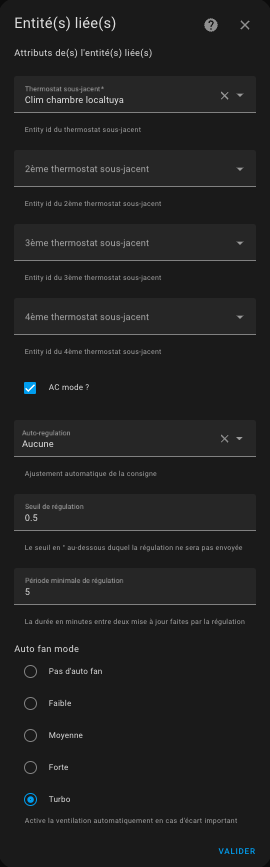
|
||||
|
||||
Il est possible de choisir un thermostat over climate qui commande une climatisation réversible en cochant la case "AC Mode". Dans ce cas, selon l'équipement commandé vous aurez accès au chauffage et/ou au réfroidissement.
|
||||
|
||||
#### L'auto-régulation
|
||||
Depuis la release 3.8, vous avez la possibilité d'activer la fonction d'auto-régulation. Cette fonction autorise VersatileThermostat à adapter la consigne de température donnée au climate sous-jacent afin que la température de la pièce atteigne réellement la consigne.
|
||||
Pour faire ça, le VersatileThermostat calcule un décalage basé sur les informations suivantes :
|
||||
1. la différence actuelle entre la température réelle et la température de consigne,
|
||||
2. l'accumulation des différences passées,
|
||||
3. la différence entre la température extérieure et la consigne
|
||||
|
||||
Ces trois informations sont combinées pour calculer le décalage qui sera ajouté à la consigne courante et envoyé au climate sous-jacent.
|
||||
|
||||
La fonction d'auto-régulation se paramètre avec :
|
||||
1. une dégré de régulation :
|
||||
1. Légère - pour des faibles besoin en auto-régulation. Dans ce mode, le décalage maximal sera de 1,5°,
|
||||
2. Medium - pour une auto-régulation moyenne. Un décalage maximal de 2° est possible dans ce mode,
|
||||
3. Forte - pour un fort besoin d'auto-régulation. Le décalage maximal est de 3° dans ce mode et l'auto-régulation réagira fortement aux changements de température.
|
||||
2. Un seuil d'auto-régulation : valeur en dessous de laquelle une nouvelle régulation ne sera pas appliquée. Imaginons qu'à un instant t, le décalage soit de 2°. Si au prochain calcul, le décalage est de 2.4°, il sera pas appliqué. Il ne sera appliqué que la différence entre 2 décalages sera au moins égal à ce seuil,
|
||||
3. Période minimal entre 2 auto-régulation : ce nombre, exprimé en minute, indique la durée entre 2 changements de régulation.
|
||||
|
||||
Ces trois paramètres permettent de moduler la régulation et éviter de multiplier les envois de régulation. Certains équipements comme les TRV, les chaudières n'aiment pas qu'on change la consigne de température trop souvent.
|
||||
|
||||
>  _*Conseil de mise en place*_
|
||||
> 1. Ne démarrez pas tout de suite l'auto-régulation. Regardez comment se passe la régulation naturelle de votre équipement. Si vous constatez que la température de consigne n'est pas atteinte ou qu'elle met trop de temps à être atteinte, démarrez la régulation,
|
||||
> 2. D'abord commencez par une légère auto-régulation et gardez les deux paramètres avec leur valeurs par défaut. Attendez quelques jours et vérifiez si la situation s'est améliorée,
|
||||
> 3. Si ce n'est pas suffisant, passez en auto-régulation Medium, attendez une stabilisation,
|
||||
> 4. Si ce n'est toujours pas suffisant, passez en auto-régulation Forte.
|
||||
|
||||
L'auto-régulation consiste à forcer l'équipement a aller plus loin en lui forçant sa température de consigne régulièrement. Sa consommation peut donc être augmentée, ainsi que son usure.
|
||||
|
||||
### Pour un thermostat de type ```thermostat_over_valve```:
|
||||

|
||||
Vous pouvez choisir jusqu'à entité du domaine ```number``` ou ```ìnput_number``` qui vont commander les vannes.
|
||||
@@ -350,7 +311,6 @@ Cela vous permet de modifier la puissance maximale au fil du temps à l'aide d'u
|
||||
> 2. Je l'utilise pour éviter de dépasser la limite de mon contrat d'électricité lorsqu'un véhicule électrique est en charge. Cela crée une sorte d'autorégulation.
|
||||
> 3. Gardez toujours une marge, car la puissance max peut être brièvement dépassée en attendant le calcul du prochain cycle typiquement ou par des équipements non régulés.
|
||||
> 4. Si vous ne souhaitez pas utiliser cette fonctionnalité, laissez simplement l'identifiant des entités vide
|
||||
> 5. Si vous controlez plusieurs radiateurs, la **consommation électrique de votre chauffage** renseigné doit correspondre à la somme des puissances.
|
||||
|
||||
## Configurer la présence ou l'occupation
|
||||
Si sélectionnée en première page, cette fonction vous permet de modifier dynamiquement la température de tous les préréglages du thermostat configurés lorsque personne n'est à la maison ou lorsque quelqu'un rentre à la maison. Pour cela, vous devez configurer la température qui sera utilisée pour chaque préréglage lorsque la présence est désactivée. Lorsque le capteur de présence s'éteint, ces températures seront utilisées. Lorsqu'il se rallume, la température "normale" configurée pour le préréglage est utilisée. Voir [gestion des préréglages](#configure-the-preset-temperature).
|
||||
@@ -392,7 +352,7 @@ Voir [exemple de réglages](#examples-tuning) pour avoir des exemples de réglag
|
||||
> 2. Attention, deux températures sont nécessaires : la température interne et la température externe et chacune doit donner la température, sinon le thermostat sera en préréglage "security",
|
||||
> 3. Un service est disponible qui permet de régler les 3 paramètres de sécurité. Ca peut servir à adapter la fonction de sécurité à votre usage,
|
||||
> 4. Pour un usage naturel, le ``security_default_on_percent`` doit être inférieur à ``security_min_on_percent``,
|
||||
> 5. Les thermostats de type ``thermostat_over_climate`` ne sont pas concernés par le mode security.
|
||||
> 5. Lorsqu'un thermostat de type ``thermostat_over_climate`` passe en mode ``security`` il est éteint. Les paramètres ``security_min_on_percent`` et ``security_default_on_percent`` ne sont alors pas utilisés.
|
||||
|
||||
## Synthèse des paramètres
|
||||
|
||||
@@ -455,10 +415,7 @@ Voir [exemple de réglages](#examples-tuning) pour avoir des exemples de réglag
|
||||
| ``minimal_activation_delay`` | Délai minimal d'activation | X | - | - |
|
||||
| ``security_delay_min`` | Délai maximal entre 2 mesures de températures | X | - | X |
|
||||
| ``security_min_on_percent`` | Pourcentage minimal de puissance pour passer en mode sécurité | X | - | X |
|
||||
| ``auto_regulation_mode`` | Le mode d'auto-régulation | - | X | - |
|
||||
| ``auto_regulation_dtemp`` | La seuil d'auto-régulation | - | X | - |
|
||||
| ``auto_regulation_period_min`` | La période minimale d'auto-régulation | - | X | - |
|
||||
| ``inverse_switch_command`` | Inverse la commande du switch (pour switch avec fil pilote) | X | - | - |
|
||||
| ``security_default_on_percent`` | Pourcentage de puissance a utiliser en mode securité | X | - | X |
|
||||
|
||||
# Exemples de réglage
|
||||
|
||||
@@ -707,8 +664,6 @@ Les attributs personnalisés sont les suivants :
|
||||
| ``friendly_name`` | Le nom du thermostat |
|
||||
| ``supported_features`` | Une combinaison de toutes les fonctionnalités prises en charge par ce thermostat. Voir la documentation officielle sur l'intégration climatique pour plus d'informations |
|
||||
| ``valve_open_percent`` | Le pourcentage d'ouverture de la vanne |
|
||||
| ``regulated_target_temperature`` | La température de consigne calculée par l'auto-régulation |
|
||||
| ``is_inversed`` | True si la commande est inversée (fil pilote avec diode) |
|
||||
|
||||
# Quelques résultats
|
||||
|
||||
@@ -735,11 +690,6 @@ Enjoy !
|
||||
|
||||
# Encore mieux
|
||||
|
||||
## Bien mieux avec le Versatile Thermostat UI Card
|
||||
Une carte spéciale pour le Versatile Thermostat a été développée (sur la base du Better Thermostat). Elle est dispo ici [Versatile Thermostat UI Card](https://github.com/jmcollin78/versatile-thermostat-ui-card) et propose une vision moderne de tous les status du VTherm :
|
||||
|
||||

|
||||
|
||||
## Encore mieux avec le composant Scheduler !
|
||||
|
||||
Afin de profiter de toute la puissance du Versatile Thermostat, je vous invite à l'utiliser avec https://github.com/nielsfaber/scheduler-component
|
||||
@@ -845,21 +795,11 @@ series:
|
||||
name: Current temp
|
||||
curve: smooth
|
||||
yaxis_id: left
|
||||
- entity: climate.thermostat_mythermostat <--- for over_switch
|
||||
- entity: climate.thermostat_mythermostat
|
||||
attribute: on_percent
|
||||
name: Power percent
|
||||
curve: stepline
|
||||
yaxis_id: right
|
||||
- entity: climate.thermostat_mythermostat <--- for over_thermostast
|
||||
attribute: regulated_target_temperature
|
||||
name: Regulated temperature
|
||||
curve: stepline
|
||||
yaxis_id: left
|
||||
- entity: climate.thermostat_mythermostat <--- for over_valve
|
||||
attribute: valve_open_percent
|
||||
name: Valve open percent
|
||||
curve: stepline
|
||||
yaxis_id: right
|
||||
```
|
||||
|
||||
## Et toujours de mieux en mieux avec l'AappDaemon NOTIFIER pour notifier les évènements
|
||||
|
||||
88
README.md
88
README.md
@@ -8,7 +8,6 @@
|
||||
|
||||
>  This thermostat integration aims to drastically simplify your automations around climate management. Because all classical events in climate are natively handled by the thermostat (nobody at home ?, activity detected in a room ?, window open ?, power shedding ?), you don't have to build over complicated scripts and automations to manage your climates ;-).
|
||||
|
||||
- [Breaking changes in 4.0.0](#breaking-changes-in-400)
|
||||
- [Thanks for the beer buymecoffee](#thanks-for-the-beer-buymecoffee)
|
||||
- [When to use / not use](#when-to-use--not-use)
|
||||
- [Incompatibilities](#incompatibilities)
|
||||
@@ -21,7 +20,6 @@
|
||||
- [Select the driven entity](#select-the-driven-entity)
|
||||
- [For a ```thermostat_over_switch``` type thermostat](#for-a-thermostat_over_switch-type-thermostat)
|
||||
- [For a thermostat of type ```thermostat_over_climate```:](#for-a-thermostat-of-type-thermostat_over_climate)
|
||||
- [Self-regulation](#self-regulation)
|
||||
- [For a thermostat of type ```thermostat_over_valve```:](#for-a-thermostat-of-type-thermostat_over_valve)
|
||||
- [Configure the TPI algorithm coefficients](#configure-the-tpi-algorithm-coefficients)
|
||||
- [Configure the preset temperature](#configure-the-preset-temperature)
|
||||
@@ -30,6 +28,7 @@
|
||||
- [Auto mode](#auto-mode)
|
||||
- [Configure the activity mode or motion detection](#configure-the-activity-mode-or-motion-detection)
|
||||
- [Configure the power management](#configure-the-power-management)
|
||||
- [Configure the presence or occupancy](#configure-the-presence-or-occupancy)
|
||||
- [Advanced configuration](#advanced-configuration)
|
||||
- [Parameters synthesis](#parameters-synthesis)
|
||||
- [Examples tuning](#examples-tuning)
|
||||
@@ -45,12 +44,10 @@
|
||||
- [Force the presence / occupancy](#force-the-presence--occupancy)
|
||||
- [Change the temperature of presets](#change-the-temperature-of-presets)
|
||||
- [Change security settings](#change-security-settings)
|
||||
- [ByPass Window Check](#bypass-window-check)
|
||||
- [Notifications](#notifications)
|
||||
- [Custom attributes](#custom-attributes)
|
||||
- [Some results](#some-results)
|
||||
- [Even better](#even-better)
|
||||
- [Much better with the Veersatile Thermostat UI Card](#much-better-with-the-veersatile-thermostat-ui-card)
|
||||
- [Even Better with Scheduler Component !](#even-better-with-scheduler-component-)
|
||||
- [Even-even better with custom:simple-thermostat front integration](#even-even-better-with-customsimple-thermostat-front-integration)
|
||||
- [Even better with Apex-chart to tune your Thermostat](#even-better-with-apex-chart-to-tune-your-thermostat)
|
||||
@@ -61,17 +58,15 @@
|
||||
This custom component for Home Assistant is an upgrade and is a complete rewrite of the component "Awesome thermostat" (see [Github](https://github.com/dadge/awesome_thermostat)) with addition of features.
|
||||
|
||||
> _*News*_
|
||||
> * **Release 4.0**: Added the support of **Versatile Thermostat UI Card**. See [Versatile Thermostat UI Card](https://github.com/jmcollin78/versatile-thermostat-ui-card). Added a **Slow** regulation mode for slow latency heating devices [#168](https://github.com/jmcollin78/versatile_thermostat/issues/168). Change the way **the power is calculated** in case of VTherm with multi-underlying equipements [#146](https://github.com/jmcollin78/versatile_thermostat/issues/146). Added the support of AC and Heat for VTherm over switch alse [#144](https://github.com/jmcollin78/versatile_thermostat/pull/144)
|
||||
> * **Release 3.8**: Added a **self-regulation function** for `over climate` thermostats whose regulation is done by the underlying climate. See [Self-regulation](#self-regulation) and [#129](https://github.com/jmcollin78/versatile_thermostat/issues/129). Added the possibility of **inverting the command** for an `over switch` thermostat to address installations with pilot wire and diode [#124](https://github.com/jmcollin78/versatile_thermostat/issues/124).
|
||||
> * **Release 3.7**: Addition of the **Versatile Thermostat type `over valve`** to control a TRV valve directly or any other dimmer type equipment for heating. Regulation is then done directly by acting on the opening percentage of the underlying entity: 0 the valve is cut off, 100: the valve is fully opened. See [#131](https://github.com/jmcollin78/versatile_thermostat/issues/131). Added a function allowing the bypass of opening detection [#138](https://github.com/jmcollin78/versatile_thermostat/issues/138). Added Slovak language
|
||||
> * **Release 3.6**: Added the `motion_off_delay` parameter to improve motion management [#116](https://github.com/jmcollin78/versatile_thermostat/issues/116), [#128](https://github.com/jmcollin78/versatile_thermostat/issues/128). Added AC (air conditioning) mode for a VTherm over switch. Preparing the Github project to facilitate contributions [#127](https://github.com/jmcollin78/versatile_thermostat/issues/127)
|
||||
<details>
|
||||
<summary>Others releases</summary>
|
||||
|
||||
> * **Release 3.7**: Addition of the Versatile Thermostat type `over valve` to control a TRV valve directly or any other dimmer type equipment for heating. Regulation is then done directly by acting on the opening percentage of the underlying entity: 0 the valve is cut off, 100: the valve is fully opened. See [#131](https://github.com/jmcollin78/versatile_thermostat/issues/131). Added a function allowing the bypass of opening detection [#138](https://github.com/jmcollin78/versatile_thermostat/issues/138). Added Slovak language
|
||||
> * **Release 3.6**: Added the `motion_off_delay` parameter to improve motion management [#116](https://github.com/jmcollin78/versatile_thermostat/issues/116), [#128](https ://github.com/jmcollin78/versatile_thermostat/issues/128). Added AC (air conditioning) mode for a VTherm over switch. Preparing the Github project to facilitate contributions [#127](https://github.com/jmcollin78/versatile_thermostat/issues/127)
|
||||
> * **Release 3.5**: Multiple thermostats when using "thermostat over another thermostat" mode [#113](https://github.com/jmcollin78/versatile_thermostat/issues/113)
|
||||
> * **Release 3.4**: bug fixes and expose preset temperatures for AC mode [#103](https://github.com/jmcollin78/versatile_thermostat/issues/103)
|
||||
> * **Release 3.3**: add the Air Conditionned mode (AC). This feature allow to use the eventual AC mode of your underlying climate entity. You have to check the "Use AC mode" checkbox in configuration and give preset temperature value for AC mode and AC mode when absent if absence is configured
|
||||
> * **Release 3.2**: add the ability to control multiple switches from the same thermostat. In this mode, the switches are triggered with a delay to minimize the power required at one time (we minimize the recovery periods). See [Configuration](#select-the-driven-entity)
|
||||
<details>
|
||||
<summary>Others releases</summary>
|
||||
|
||||
> * **Release 3.1**: added detection of open windows/doors by temperature drop. This new function makes it possible to automatically stop a radiator when the temperature drops suddenly. See [Auto mode](#auto-mode)
|
||||
> * **Major release 3.0**: addition of thermostat equipment and associated sensors (binary and non-binary). Much closer to the Home Assistant philosophy, you now have direct access to the energy consumed by the radiator controlled by the thermostat and many other sensors that will be useful in your automations and dashboard.
|
||||
> * **release 2.3**: addition of the power and energy measurement of the radiator controlled by the thermostat.
|
||||
@@ -79,11 +74,8 @@ This custom component for Home Assistant is an upgrade and is a complete rewrite
|
||||
> * **major release 2.0**: addition of the "over climate" thermostat allowing you to transform any thermostat into a Versatile Thermostat and add all the functions of the latter.
|
||||
</details>
|
||||
|
||||
# Breaking changes in 4.0.0
|
||||
The power of the device should now be the total power of all controler devices by the VTherm. This allow to have eterogeneous equipment with different power. In case of multi-devices controlled by a single VTherm you will have to edit and change the `device_power` value. Set the total power of all devices.
|
||||
|
||||
# Thanks for the beer [buymecoffee](https://www.buymeacoffee.com/jmcollin78)
|
||||
Many thanks to @salabur, @pvince83, @bergoglio, @EPicLURcher, @ecolorado66, @Kriss1670, @maia, @f.maymil, @moutte69, @Jerome for the beers. It's very nice and encourages me to continue!
|
||||
Many thanks to @salabur, @pvince83, @bergoglio, @EPicLURcher, @ecolorado66, @Kriss1670, @maia, @f.maymil, @moutte69, @Jerome for the beers. It's very pleasing.
|
||||
|
||||
# When to use / not use
|
||||
This thermostat can control 3 types of equipment:
|
||||
@@ -94,10 +86,7 @@ This thermostat can control 3 types of equipment:
|
||||
2. another thermostat which has its own operating modes (named ``thermostat_over_climate```). For this type of thermostat the minimum configuration requires:
|
||||
1. equipment - such as air conditioning, a thermostatic valve - which is controlled by its own ``climate'' type entity,
|
||||
3. equipment which can take a value from 0 to 100% (called `thermostat_over_valve`). At 0 the heating is cut off, 100% it is fully opened. This type allows you to control a thermostatic valve (see Shelly valve) which exposes an entity of type `number.` allowing you to directly control the opening of the valve. Versatile Thermostat regulates the room temperature by adjusting the opening percentage, using the interior and exterior temperature sensors using the TPI algorithm described below.
|
||||
|
||||
The ```thermostat_over_climate``` type allows you to add all the functionality provided by VersatileThermostat to your existing equipment. The climate VersatileThermostat entity will control your existing climate entity, turning it off if the windows are open, switching it to Eco mode if no one is present, etc. See [here](#why-a-new-implementation-of-the-thermostat). For this type of thermostat, any heating cycles are controlled by the underlying climate entity and not by the Versatile Thermostat itself. An optional self-regulation function allows the Versatile Thermostat to adjust the temperature given as a setpoint to the underlying in order to reach the setpoint.
|
||||
|
||||
Installations with pilot wire and activation diode benefit from an option which allows the on/off control of the underlying radiator to be reversed. To do this, use the `over switch` type and check the command inversion option.
|
||||
The ```thermostat_over_climate``` type allows you to add all the functionality provided by VersatileThermostat to your existing equipment. The climate VersatileThermostat entity will control your existing climate entity, turning it off if the windows are open, switching it to Eco mode if no one is present, etc. See [here](#why-a-new-implementation-of-the-thermostat). For this type of thermostat, any heating cycles are controlled by the underlying climate entity and not by the Versatile Thermostat itself.
|
||||
|
||||
## Incompatibilities
|
||||
|
||||
@@ -189,40 +178,12 @@ Example of synchronized triggering:
|
||||
|
||||
It is possible to choose an over switch thermostat which controls air conditioning by checking the "AC Mode" box. In this case, only the cooling mode will be visible.
|
||||
|
||||
If your equipment is controlled by a pilot wire with a diode, you will certainly need to check the "Invert Check" box. It allows you to set the switch to On when you need to turn the equipment off and to Off when you need to turn it on.
|
||||
|
||||
### For a thermostat of type ```thermostat_over_climate```:
|
||||

|
||||
|
||||
It is possible to choose an over climate thermostat which controls reversible air conditioning by checking the “AC Mode” box. In this case, depending on the equipment ordered, you will have access to heating and/or cooling.
|
||||
|
||||
#### Self-regulation
|
||||
Since release 3.8, you have the possibility to activate the self-regulation function. This function allows VersatileThermostat to adapt the temperature setpoint given to the underlying climate so that the room temperature actually reaches the setpoint.
|
||||
To do this, the VersatileThermostat calculates an offset based on the following information:
|
||||
1. the current difference between the actual temperature and the set temperature,
|
||||
2. the accumulation of past differences,
|
||||
3. the difference between the outside temperature and the setpoint
|
||||
|
||||
These three pieces of information are combined to calculate the offset which will be added to the current setpoint and sent to the underlying climate.
|
||||
|
||||
The self-regulation function is configured with:
|
||||
1. a degree of regulation:
|
||||
1. Light - for low self-regulation needs. In this mode, the maximum offset will be 1.5°,
|
||||
2. Medium - for average self-regulation. A maximum offset of 2° is possible in this mode,
|
||||
3. Strong - for a strong need for self-regulation. The maximum offset is 3° in this mode and the auto-regulation will react strongly to temperature changes.
|
||||
2. A self-regulation threshold: value below which new regulation will not be applied. Let us imagine that at a time t, the offset is 2°. If in the next calculation, the offset is 2.4°, it will not be applied. It will only be applied that the difference between 2 offsets will be at least equal to this threshold,
|
||||
3. Minimum period between 2 self-regulation changes: this number, expressed in minutes, indicates the duration between 2 regulation changes.
|
||||
|
||||
These three parameters make it possible to modulate the regulation and avoid multiplying the regulation sendings. Some equipment such as TRVs and boilers do not like the temperature setpoint to be changed too often.
|
||||
|
||||
>  _*Implementation tip*_
|
||||
> 1. Do not start self-regulation straight away. Watch how the natural regulation of your equipment works. If you notice that the set temperature is not reached or that it is taking too long to be reached, start the regulation,
|
||||
> 2. First start with a slight self-regulation and keep both parameters at their default values. Wait a few days and check if the situation has improved,
|
||||
> 3. If this is not sufficient, switch to Medium self-regulation, wait for stabilization,
|
||||
> 4. If this is still not sufficient, switch to Strong self-regulation.
|
||||
|
||||
Self-regulation consists of forcing the equipment to go further by forcing its set temperature regularly. Its consumption can therefore be increased, as well as its wear.
|
||||
|
||||
### For a thermostat of type ```thermostat_over_valve```:
|
||||

|
||||
You can choose up to domain entity ```number``` or ```ìnput_number``` which will control the valves.
|
||||
@@ -336,8 +297,8 @@ This allows you to change the max power along time using a Scheduler or whatever
|
||||
> 2. I use this to avoid exceeded the limit of my electrical power contract when an electrical vehicle is charging. This makes a kind of auto-regulation.
|
||||
> 3. Always keep a margin, because max power can be briefly exceeded while waiting for the next cycle calculation typically or by not regulated equipement.
|
||||
> 4. If you don't want to use this feature, just leave the entities id empty
|
||||
> 5. If you control several heaters, the **power consumption of your heater** setup should be the sum of the power.
|
||||
|
||||
## Configure the presence or occupancy
|
||||
If you choose the ```Presence management``` feature, this feature allows you to dynamically changes the temperature of all configured Versatile thermostat's presets when nobody is at home or when someone comes back home. For this, you have to configure the temperature that will be used for each preset when presence is off. When the occupancy sensor turns to off, those tempoeratures will be used. When it turns on again the "normal" temperature configured for the preset is used. See [preset management](#configure-the-preset-temperature).
|
||||
To configure presence fills this form:
|
||||
|
||||
@@ -377,7 +338,7 @@ See [example tuning](#examples-tuning) for common tuning examples
|
||||
> 2. Attention, two temperatures are needed: internal temperature and external temperature and each must give the temperature, otherwise the thermostat will be in "security" preset,
|
||||
> 3. A service is available that allows you to set the 3 security parameters. This can be used to adapt the security function to your use.
|
||||
> 4. For natural usage, the ``security_default_on_percent`` should be less than ``security_min_on_percent``,
|
||||
> 5. Thermostat of type ``thermostat_over_climate`` are not concerned by the security feature.
|
||||
> 5. When a ``thermostat_over_climate`` type thermostat goes into ``security`` mode it is turned off. The ``security_min_on_percent`` and ``security_default_on_percent`` parameters are then not used.
|
||||
|
||||
## Parameters synthesis
|
||||
|
||||
@@ -438,13 +399,9 @@ See [example tuning](#examples-tuning) for common tuning examples
|
||||
| ``comfort_ac_away_temp`` | Temperature in Comfort preset when no presence in AC mode | X | X | X |
|
||||
| ``boost_ac_away_temp`` | Temperature in Boost preset when no presence in AC mode | X | X | X |
|
||||
| ``minimal_activation_delay`` | Minimal activation delay | X | - | X |
|
||||
| ``security_delay_min`` | Security delay (in minutes) | X | - | X |
|
||||
| ``security_min_on_percent`` | Minimal power percent to enable security mode | X | - | X |
|
||||
| ``security_default_on_percent`` | Power percent to use in security mode | X | - | X |
|
||||
| ``auto_regulation_mode`` | Le mode d'auto-régulation | - | X | - |
|
||||
| ``auto_regulation_dtemp`` | La seuil d'auto-régulation | - | X | - |
|
||||
| ``auto_regulation_period_min`` | La période minimale d'auto-régulation | - | X | - |
|
||||
| ``inverse_switch_command`` | Inverse the switch command (for pilot wire switch) | X | - | - |
|
||||
| ``security_delay_min`` | Security delay (in minutes) | X | X | X |
|
||||
| ``security_min_on_percent`` | Minimal power percent to enable security mode | X | X | X |
|
||||
| ``security_default_on_percent`` | Power percent to use in security mode | X | X | X |
|
||||
|
||||
# Examples tuning
|
||||
|
||||
@@ -691,8 +648,6 @@ Custom attributes are the following:
|
||||
| ``friendly_name`` | The name of the thermostat |
|
||||
| ``supported_features`` | A combination of all features supported by this thermostat. See official climate integration documentation for more informations |
|
||||
| ``valve_open_percent`` | The opening percentage of the valve |
|
||||
| ``regulated_target_temperature`` | The self-regulated target temperature calculated |
|
||||
| ``is_inversed`` | True if the command is inversed (pilot wire with diode) |
|
||||
|
||||
# Some results
|
||||
|
||||
@@ -719,11 +674,6 @@ Enjoy !
|
||||
|
||||
# Even better
|
||||
|
||||
## Much better with the Veersatile Thermostat UI Card
|
||||
A special card for the Versatile Thermostat has been developed (based on the Better Thermostat). It is available here [Versatile Thermostat UI Card](https://github.com/jmcollin78/versatile-thermostat-ui-card) and offers a modern vision of all the VTherm statuses:
|
||||
|
||||

|
||||
|
||||
## Even Better with Scheduler Component !
|
||||
|
||||
In order to enjoy the full power of Versatile Thermostat, I invite you to use it with https://github.com/nielsfaber/scheduler-component
|
||||
@@ -828,21 +778,11 @@ series:
|
||||
name: Current temp
|
||||
curve: smooth
|
||||
yaxis_id: left
|
||||
- entity: climate.thermostat_mythermostat <--- for over_switch
|
||||
- entity: climate.thermostat_mythermostat
|
||||
attribute: on_percent
|
||||
name: Power percent
|
||||
curve: stepline
|
||||
yaxis_id: right
|
||||
- entity: climate.thermostat_mythermostat <--- for over_thermostast
|
||||
attribute: regulated_target_temperature
|
||||
name: Regulated temperature
|
||||
curve: stepline
|
||||
yaxis_id: left
|
||||
- entity: climate.thermostat_mythermostat <--- for over_valve
|
||||
attribute: valve_open_percent
|
||||
name: Valve open percent
|
||||
curve: stepline
|
||||
yaxis_id: right
|
||||
```
|
||||
|
||||
## And always better and better with the NOTIFIER daemon app to notify events
|
||||
|
||||
@@ -130,50 +130,47 @@ class BaseThermostat(ClimateEntity, RestoreEntity):
|
||||
_motion_state: bool
|
||||
_presence_state: bool
|
||||
_window_auto_state: bool
|
||||
#PR - Adding Window ByPass
|
||||
_window_bypass_state: bool
|
||||
_underlyings: list[UnderlyingEntity]
|
||||
_last_change_time: datetime
|
||||
|
||||
_entity_component_unrecorded_attributes = (
|
||||
ClimateEntity._entity_component_unrecorded_attributes.union(
|
||||
frozenset(
|
||||
{
|
||||
"type",
|
||||
"eco_temp",
|
||||
"boost_temp",
|
||||
"comfort_temp",
|
||||
"eco_away_temp",
|
||||
"boost_away_temp",
|
||||
"comfort_away_temp",
|
||||
"power_temp",
|
||||
"ac_mode",
|
||||
"current_power_max",
|
||||
"saved_preset_mode",
|
||||
"saved_target_temp",
|
||||
"saved_hvac_mode",
|
||||
"security_delay_min",
|
||||
"security_min_on_percent",
|
||||
"security_default_on_percent",
|
||||
"last_temperature_datetime",
|
||||
"last_ext_temperature_datetime",
|
||||
"minimal_activation_delay_sec",
|
||||
"device_power",
|
||||
"mean_cycle_power",
|
||||
"last_update_datetime",
|
||||
"timezone",
|
||||
"window_sensor_entity_id",
|
||||
"window_delay_sec",
|
||||
"window_auto_open_threshold",
|
||||
"window_auto_close_threshold",
|
||||
"window_auto_max_duration",
|
||||
"motion_sensor_entity_id",
|
||||
"presence_sensor_entity_id",
|
||||
"power_sensor_entity_id",
|
||||
"max_power_sensor_entity_id",
|
||||
}
|
||||
)
|
||||
)
|
||||
)
|
||||
_entity_component_unrecorded_attributes = ClimateEntity._entity_component_unrecorded_attributes.union(frozenset(
|
||||
{
|
||||
"type",
|
||||
"eco_temp",
|
||||
"boost_temp",
|
||||
"comfort_temp",
|
||||
"eco_away_temp",
|
||||
"boost_away_temp",
|
||||
"comfort_away_temp",
|
||||
"power_temp",
|
||||
"ac_mode",
|
||||
"current_power_max",
|
||||
"saved_preset_mode",
|
||||
"saved_target_temp",
|
||||
"saved_hvac_mode",
|
||||
"security_delay_min",
|
||||
"security_min_on_percent",
|
||||
"security_default_on_percent",
|
||||
"last_temperature_datetime",
|
||||
"last_ext_temperature_datetime",
|
||||
"minimal_activation_delay_sec",
|
||||
"device_power",
|
||||
"mean_cycle_power",
|
||||
"last_update_datetime",
|
||||
"timezone",
|
||||
"window_sensor_entity_id",
|
||||
"window_delay_sec",
|
||||
"window_auto_open_threshold",
|
||||
"window_auto_close_threshold",
|
||||
"window_auto_max_duration",
|
||||
"motion_sensor_entity_id",
|
||||
"presence_sensor_entity_id",
|
||||
"power_sensor_entity_id",
|
||||
"max_power_sensor_entity_id",
|
||||
}
|
||||
))
|
||||
|
||||
def __init__(self, hass: HomeAssistant, unique_id, name, entry_infos) -> None:
|
||||
"""Initialize the thermostat."""
|
||||
@@ -341,7 +338,7 @@ class BaseThermostat(ClimateEntity, RestoreEntity):
|
||||
self._presence_on = self._presence_sensor_entity_id is not None
|
||||
|
||||
if self._ac_mode:
|
||||
self._hvac_list = [HVACMode.HEAT, HVACMode.COOL, HVACMode.OFF]
|
||||
self._hvac_list = [HVACMode.COOL, HVACMode.OFF]
|
||||
else:
|
||||
self._hvac_list = [HVACMode.HEAT, HVACMode.OFF]
|
||||
|
||||
@@ -624,7 +621,7 @@ class BaseThermostat(ClimateEntity, RestoreEntity):
|
||||
STATE_UNAVAILABLE,
|
||||
STATE_UNKNOWN,
|
||||
):
|
||||
self._window_state = window_state.state == STATE_ON
|
||||
self._window_state = window_state.state
|
||||
_LOGGER.debug(
|
||||
"%s - Window state have been retrieved: %s",
|
||||
self,
|
||||
@@ -765,17 +762,17 @@ class BaseThermostat(ClimateEntity, RestoreEntity):
|
||||
|
||||
@property
|
||||
def is_over_climate(self) -> bool:
|
||||
"""True if the Thermostat is over_climate"""
|
||||
""" True if the Thermostat is over_climate"""
|
||||
return False
|
||||
|
||||
@property
|
||||
def is_over_switch(self) -> bool:
|
||||
"""True if the Thermostat is over_switch"""
|
||||
""" True if the Thermostat is over_switch"""
|
||||
return False
|
||||
|
||||
@property
|
||||
def is_over_valve(self) -> bool:
|
||||
"""True if the Thermostat is over_valve"""
|
||||
""" True if the Thermostat is over_valve"""
|
||||
return False
|
||||
|
||||
@property
|
||||
@@ -936,7 +933,11 @@ class BaseThermostat(ClimateEntity, RestoreEntity):
|
||||
if not self._device_power:
|
||||
return None
|
||||
|
||||
return float(self._device_power * self._prop_algorithm.on_percent)
|
||||
return float(
|
||||
self.nb_underlying_entities
|
||||
* self._device_power
|
||||
* self._prop_algorithm.on_percent
|
||||
)
|
||||
|
||||
@property
|
||||
def total_energy(self) -> float | None:
|
||||
@@ -954,15 +955,16 @@ class BaseThermostat(ClimateEntity, RestoreEntity):
|
||||
return self._overpowering_state
|
||||
|
||||
@property
|
||||
def window_state(self) -> str | None:
|
||||
def window_state(self) -> bool | None:
|
||||
"""Get the window_state"""
|
||||
return STATE_ON if self._window_state else STATE_OFF
|
||||
return self._window_state
|
||||
|
||||
@property
|
||||
def window_auto_state(self) -> str | None:
|
||||
def window_auto_state(self) -> bool | None:
|
||||
"""Get the window_auto_state"""
|
||||
return STATE_ON if self._window_auto_state else STATE_OFF
|
||||
|
||||
#PR - Adding Window ByPass
|
||||
@property
|
||||
def window_bypass_state(self) -> bool | None:
|
||||
"""Get the Window Bypass"""
|
||||
@@ -1218,7 +1220,7 @@ class BaseThermostat(ClimateEntity, RestoreEntity):
|
||||
|
||||
async def _async_internal_set_temperature(self, temperature):
|
||||
"""Set the target temperature and the target temperature of underlying climate if any
|
||||
For testing purpose you can pass an event_timestamp.
|
||||
For testing purpose you can pass an event_timestamp.
|
||||
"""
|
||||
self._target_temp = temperature
|
||||
return
|
||||
@@ -1306,34 +1308,33 @@ class BaseThermostat(ClimateEntity, RestoreEntity):
|
||||
_LOGGER.debug(
|
||||
"Window delay condition is not satisfied. Ignore window event"
|
||||
)
|
||||
self._window_state = old_state.state == STATE_ON
|
||||
self._window_state = old_state.state
|
||||
return
|
||||
|
||||
_LOGGER.debug("%s - Window delay condition is satisfied", self)
|
||||
# if not self._saved_hvac_mode:
|
||||
# self._saved_hvac_mode = self._hvac_mode
|
||||
|
||||
if self._window_state == (new_state.state == STATE_ON):
|
||||
if self._window_state == new_state.state:
|
||||
_LOGGER.debug("%s - no change in window state. Forget the event")
|
||||
return
|
||||
|
||||
self._window_state = new_state.state == STATE_ON
|
||||
|
||||
# PR - Adding Window ByPass
|
||||
self._window_state = new_state.state
|
||||
|
||||
#PR - Adding Window ByPass
|
||||
_LOGGER.debug("%s - Window ByPass is : %s", self, self._window_bypass_state)
|
||||
if self._window_bypass_state:
|
||||
_LOGGER.info(
|
||||
"%s - Window ByPass is activated. Ignore window event", self
|
||||
)
|
||||
_LOGGER.info("%s - Window ByPass is activated. Ignore window event", self)
|
||||
else:
|
||||
if not self._window_state:
|
||||
if self._window_state == STATE_OFF:
|
||||
_LOGGER.info(
|
||||
"%s - Window is closed. Restoring hvac_mode '%s'",
|
||||
self,
|
||||
self._saved_hvac_mode,
|
||||
)
|
||||
await self.restore_hvac_mode(True)
|
||||
elif self._window_state:
|
||||
elif self._window_state == STATE_ON:
|
||||
_LOGGER.info(
|
||||
"%s - Window is open. Set hvac_mode to '%s'", self, HVACMode.OFF
|
||||
)
|
||||
@@ -1827,15 +1828,7 @@ class BaseThermostat(ClimateEntity, RestoreEntity):
|
||||
self._device_power,
|
||||
)
|
||||
|
||||
if self.is_over_climate:
|
||||
power_consumption_max = self._device_power
|
||||
else:
|
||||
power_consumption_max = max(
|
||||
self._device_power / self.nb_underlying_entities,
|
||||
self._device_power * self._prop_algorithm.on_percent,
|
||||
)
|
||||
|
||||
ret = (self._current_power + power_consumption_max) >= self._current_power_max
|
||||
ret = self._current_power + self._device_power >= self._current_power_max
|
||||
if not self._overpowering_state and ret and self._hvac_mode != HVACMode.OFF:
|
||||
_LOGGER.warning(
|
||||
"%s - overpowering is detected. Heater preset will be set to 'power'",
|
||||
@@ -1853,7 +1846,6 @@ class BaseThermostat(ClimateEntity, RestoreEntity):
|
||||
"current_power": self._current_power,
|
||||
"device_power": self._device_power,
|
||||
"current_power_max": self._current_power_max,
|
||||
"current_power_consumption": power_consumption_max,
|
||||
},
|
||||
)
|
||||
|
||||
@@ -2133,11 +2125,12 @@ class BaseThermostat(ClimateEntity, RestoreEntity):
|
||||
"saved_preset_mode": self._saved_preset_mode,
|
||||
"saved_target_temp": self._saved_target_temp,
|
||||
"saved_hvac_mode": self._saved_hvac_mode,
|
||||
"window_state": self.window_state,
|
||||
"window_state": self._window_state,
|
||||
"motion_state": self._motion_state,
|
||||
"overpowering_state": self.overpowering_state,
|
||||
"overpowering_state": self._overpowering_state,
|
||||
"presence_state": self._presence_state,
|
||||
"window_auto_state": self.window_auto_state,
|
||||
"window_auto_state": self._window_auto_state,
|
||||
#PR - Adding Window ByPass
|
||||
"window_bypass_state": self._window_bypass_state,
|
||||
"security_delay_min": self._security_delay_min,
|
||||
"security_min_on_percent": self._security_min_on_percent,
|
||||
@@ -2264,25 +2257,14 @@ class BaseThermostat(ClimateEntity, RestoreEntity):
|
||||
target:
|
||||
entity_id: climate.thermostat_1
|
||||
"""
|
||||
_LOGGER.info(
|
||||
"%s - Calling service_set_window_bypass, window_bypass: %s",
|
||||
self,
|
||||
window_bypass,
|
||||
)
|
||||
_LOGGER.info("%s - Calling service_set_window_bypass, window_bypass: %s", self, window_bypass)
|
||||
self._window_bypass_state = window_bypass
|
||||
if not self._window_bypass_state and self._window_state:
|
||||
_LOGGER.info(
|
||||
"%s - Last window state was open & ByPass is now off. Set hvac_mode to '%s'",
|
||||
self,
|
||||
HVACMode.OFF,
|
||||
)
|
||||
if not self._window_bypass_state and self._window_state == STATE_ON:
|
||||
_LOGGER.info("%s - Last window state was open & ByPass is now off. Set hvac_mode to '%s'", self, HVACMode.OFF)
|
||||
self.save_hvac_mode()
|
||||
await self.async_set_hvac_mode(HVACMode.OFF)
|
||||
if self._window_bypass_state and self._window_state:
|
||||
_LOGGER.info(
|
||||
"%s - Last window state was open & ByPass is now on. Set hvac_mode to last available mode",
|
||||
self,
|
||||
)
|
||||
if self._window_bypass_state and self._window_state == STATE_ON:
|
||||
_LOGGER.info("%s - Last window state was open & ByPass is now on. Set hvac_mode to last available mode", self)
|
||||
await self.restore_hvac_mode(True)
|
||||
self.update_custom_attributes()
|
||||
|
||||
|
||||
@@ -111,7 +111,7 @@ async def async_setup_entry(
|
||||
platform.async_register_entity_service(
|
||||
SERVICE_SET_AUTO_REGULATION_MODE,
|
||||
{
|
||||
vol.Required("auto_regulation_mode"): vol.In(["None", "Light", "Medium", "Strong", "Slow"]),
|
||||
vol.Required("auto_regulation_mode"): vol.In(["None", "Light", "Medium", "Strong"]),
|
||||
},
|
||||
"service_set_auto_regulation_mode",
|
||||
)
|
||||
|
||||
@@ -104,7 +104,6 @@ from .const import (
|
||||
CONF_AUTO_REGULATION_NONE,
|
||||
CONF_AUTO_REGULATION_DTEMP,
|
||||
CONF_AUTO_REGULATION_PERIOD_MIN,
|
||||
CONF_INVERSE_SWITCH,
|
||||
UnknownEntity,
|
||||
WindowOpenDetectionMethod,
|
||||
)
|
||||
@@ -242,7 +241,6 @@ class VersatileThermostatBaseConfigFlow(FlowHandler):
|
||||
]
|
||||
),
|
||||
vol.Optional(CONF_AC_MODE, default=False): cv.boolean,
|
||||
vol.Optional(CONF_INVERSE_SWITCH, default=False): cv.boolean,
|
||||
}
|
||||
)
|
||||
|
||||
|
||||
@@ -85,13 +85,11 @@ CONF_VALVE_3 = "valve_entity3_id"
|
||||
CONF_VALVE_4 = "valve_entity4_id"
|
||||
CONF_AUTO_REGULATION_MODE= "auto_regulation_mode"
|
||||
CONF_AUTO_REGULATION_NONE= "auto_regulation_none"
|
||||
CONF_AUTO_REGULATION_SLOW= "auto_regulation_slow"
|
||||
CONF_AUTO_REGULATION_LIGHT= "auto_regulation_light"
|
||||
CONF_AUTO_REGULATION_MEDIUM= "auto_regulation_medium"
|
||||
CONF_AUTO_REGULATION_STRONG= "auto_regulation_strong"
|
||||
CONF_AUTO_REGULATION_DTEMP="auto_regulation_dtemp"
|
||||
CONF_AUTO_REGULATION_PERIOD_MIN="auto_regulation_periode_min"
|
||||
CONF_INVERSE_SWITCH="inverse_switch_command"
|
||||
|
||||
CONF_PRESETS = {
|
||||
p: f"{p}_temp"
|
||||
@@ -195,8 +193,7 @@ ALL_CONF = (
|
||||
CONF_VALVE_4,
|
||||
CONF_AUTO_REGULATION_MODE,
|
||||
CONF_AUTO_REGULATION_DTEMP,
|
||||
CONF_AUTO_REGULATION_PERIOD_MIN,
|
||||
CONF_INVERSE_SWITCH
|
||||
CONF_AUTO_REGULATION_PERIOD_MIN
|
||||
]
|
||||
+ CONF_PRESETS_VALUES
|
||||
+ CONF_PRESETS_AWAY_VALUES
|
||||
@@ -208,7 +205,7 @@ CONF_FUNCTIONS = [
|
||||
PROPORTIONAL_FUNCTION_TPI,
|
||||
]
|
||||
|
||||
CONF_AUTO_REGULATION_MODES = [CONF_AUTO_REGULATION_NONE, CONF_AUTO_REGULATION_LIGHT, CONF_AUTO_REGULATION_MEDIUM, CONF_AUTO_REGULATION_STRONG, CONF_AUTO_REGULATION_SLOW]
|
||||
CONF_AUTO_REGULATION_MODES = [CONF_AUTO_REGULATION_NONE, CONF_AUTO_REGULATION_LIGHT, CONF_AUTO_REGULATION_MEDIUM, CONF_AUTO_REGULATION_STRONG]
|
||||
|
||||
CONF_THERMOSTAT_TYPES = [CONF_THERMOSTAT_SWITCH, CONF_THERMOSTAT_CLIMATE, CONF_THERMOSTAT_VALVE]
|
||||
|
||||
@@ -226,16 +223,6 @@ DEFAULT_SECURITY_DEFAULT_ON_PERCENT = 0.1
|
||||
ATTR_TOTAL_ENERGY = "total_energy"
|
||||
ATTR_MEAN_POWER_CYCLE = "mean_cycle_power"
|
||||
|
||||
# A special regulation parameter suggested by @Maia here: https://github.com/jmcollin78/versatile_thermostat/discussions/154
|
||||
class RegulationParamSlow:
|
||||
""" Light parameters for slow latency regulation"""
|
||||
kp:float = 0.2 # 20% of the current internal regulation offset are caused by the current difference of target temperature and room temperature
|
||||
ki:float = 0.8 / 288.0 # 80% of the current internal regulation offset are caused by the average offset of the past 24 hours
|
||||
k_ext:float = 1.0 / 25.0 # this will add 1°C to the offset when it's 25°C colder outdoor than indoor
|
||||
offset_max:float = 2.0 # limit to a final offset of -2°C to +2°C
|
||||
stabilization_threshold:float = 0.0 # this needs to be disabled as otherwise the long term accumulated error will always be reset when the temp briefly crosses from/to below/above the target
|
||||
accumulated_error_threshold:float = 2.0 * 288 # this allows up to 2°C long term offset in both directions
|
||||
|
||||
class RegulationParamLight:
|
||||
""" Light parameters for regulation"""
|
||||
kp:float = 0.2
|
||||
|
||||
@@ -14,6 +14,6 @@
|
||||
"quality_scale": "silver",
|
||||
"requirements": [],
|
||||
"ssdp": [],
|
||||
"version": "4.0.0",
|
||||
"version": "3.7.0",
|
||||
"zeroconf": []
|
||||
}
|
||||
@@ -26,10 +26,6 @@ class PITemperatureRegulator:
|
||||
self.accumulated_error:float = 0
|
||||
self.accumulated_error_threshold:float = accumulated_error_threshold
|
||||
|
||||
def reset_accumulated_error(self):
|
||||
""" Reset the accumulated error """
|
||||
self.accumulated_error = 0
|
||||
|
||||
def set_target_temp(self, target_temp):
|
||||
""" Set the new target_temp"""
|
||||
self.target_temp = target_temp
|
||||
@@ -55,8 +51,7 @@ class PITemperatureRegulator:
|
||||
offset = self.kp * error + self.ki * self.accumulated_error
|
||||
|
||||
# Calculate the exterior offset
|
||||
# For Maia tests - use the internal_temp vs external_temp and not target_temp - external_temp
|
||||
offset_ext = self.k_ext * (internal_temp - external_temp)
|
||||
offset_ext = self.k_ext * (self.target_temp - external_temp)
|
||||
|
||||
# Capping of offset_ext
|
||||
total_offset = offset + offset_ext
|
||||
|
||||
@@ -159,4 +159,3 @@ set_auto_regulation_mode:
|
||||
- "Light"
|
||||
- "Medium"
|
||||
- "Strong"
|
||||
- "Slow"
|
||||
|
||||
@@ -41,8 +41,7 @@
|
||||
"valve_entity4_id": "4th valve number",
|
||||
"auto_regulation_mode": "Self-regulation",
|
||||
"auto_regulation_dtemp": "Regulation threshold",
|
||||
"auto_regulation_periode_min": "Regulation minimal period",
|
||||
"inverse_switch_command": "Inverse switch command"
|
||||
"auto_regulation_periode_min": "Regulation minimal period"
|
||||
},
|
||||
"data_description": {
|
||||
"heater_entity_id": "Mandatory heater entity id",
|
||||
@@ -61,8 +60,7 @@
|
||||
"valve_entity4_id": "4th valve number entity id",
|
||||
"auto_regulation_mode": "Auto adjustment of the target temperature",
|
||||
"auto_regulation_dtemp": "The threshold in ° under which the temperature change will not be send",
|
||||
"auto_regulation_periode_min": "Duration in minutes between two regulation update",
|
||||
"inverse_switch_command": "For switch with pilot wire and diode you may need to inverse the command"
|
||||
"auto_regulation_periode_min": "Duration in minutes between two regulation update"
|
||||
}
|
||||
},
|
||||
"tpi": {
|
||||
@@ -210,8 +208,7 @@
|
||||
"valve_entity4_id": "4th valve number",
|
||||
"auto_regulation_mode": "Self-regulation",
|
||||
"auto_regulation_dtemp": "Regulation threshold",
|
||||
"auto_regulation_periode_min": "Regulation minimal period",
|
||||
"inverse_switch_command": "Inverse switch command"
|
||||
"auto_regulation_periode_min": "Regulation minimal period"
|
||||
},
|
||||
"data_description": {
|
||||
"heater_entity_id": "Mandatory heater entity id",
|
||||
@@ -230,8 +227,7 @@
|
||||
"valve_entity4_id": "4th valve number entity id",
|
||||
"auto_regulation_mode": "Auto adjustment of the target temperature",
|
||||
"auto_regulation_dtemp": "The threshold in ° under which the temperature change will not be send",
|
||||
"auto_regulation_periode_min": "Duration in minutes between two regulation update",
|
||||
"inverse_switch_command": "For switch with pilot wire and diode you may need to inverse the command"
|
||||
"auto_regulation_periode_min": "Duration in minutes between two regulation update"
|
||||
}
|
||||
},
|
||||
"tpi": {
|
||||
@@ -348,7 +344,6 @@
|
||||
},
|
||||
"auto_regulation_mode": {
|
||||
"options": {
|
||||
"auto_regulation_slow": "Slow",
|
||||
"auto_regulation_strong": "Strong",
|
||||
"auto_regulation_medium": "Medium",
|
||||
"auto_regulation_light": "Light",
|
||||
|
||||
@@ -20,13 +20,11 @@ from .const import (
|
||||
CONF_CLIMATE_4,
|
||||
CONF_AUTO_REGULATION_MODE,
|
||||
CONF_AUTO_REGULATION_NONE,
|
||||
CONF_AUTO_REGULATION_SLOW,
|
||||
CONF_AUTO_REGULATION_LIGHT,
|
||||
CONF_AUTO_REGULATION_MEDIUM,
|
||||
CONF_AUTO_REGULATION_STRONG,
|
||||
CONF_AUTO_REGULATION_DTEMP,
|
||||
CONF_AUTO_REGULATION_PERIOD_MIN,
|
||||
RegulationParamSlow,
|
||||
RegulationParamLight,
|
||||
RegulationParamMedium,
|
||||
RegulationParamStrong
|
||||
@@ -178,15 +176,6 @@ class ThermostatOverClimate(BaseThermostat):
|
||||
RegulationParamStrong.offset_max,
|
||||
RegulationParamStrong.stabilization_threshold,
|
||||
RegulationParamStrong.accumulated_error_threshold)
|
||||
elif self._auto_regulation_mode == CONF_AUTO_REGULATION_SLOW:
|
||||
self._regulation_algo = PITemperatureRegulator(
|
||||
self.target_temperature,
|
||||
RegulationParamSlow.kp,
|
||||
RegulationParamSlow.ki,
|
||||
RegulationParamSlow.k_ext,
|
||||
RegulationParamSlow.offset_max,
|
||||
RegulationParamSlow.stabilization_threshold,
|
||||
RegulationParamSlow.accumulated_error_threshold)
|
||||
else:
|
||||
# A default empty algo (which does nothing)
|
||||
self._regulation_algo = PITemperatureRegulator(
|
||||
@@ -238,7 +227,7 @@ class ThermostatOverClimate(BaseThermostat):
|
||||
)
|
||||
|
||||
if self.is_regulated:
|
||||
self._attr_extra_state_attributes["regulated_target_temperature"] = self._regulated_target_temp
|
||||
self._attr_extra_state_attributes["regulated_target_temp"] = self._regulated_target_temp
|
||||
self._attr_extra_state_attributes["regulation_accumulated_error"] = self._regulation_algo.accumulated_error
|
||||
|
||||
self.async_write_ha_state()
|
||||
@@ -677,8 +666,6 @@ class ThermostatOverClimate(BaseThermostat):
|
||||
self.choose_auto_regulation_mode(CONF_AUTO_REGULATION_MEDIUM)
|
||||
elif auto_regulation_mode == "Strong":
|
||||
self.choose_auto_regulation_mode(CONF_AUTO_REGULATION_STRONG)
|
||||
elif auto_regulation_mode == "Slow":
|
||||
self.choose_auto_regulation_mode(CONF_AUTO_REGULATION_SLOW)
|
||||
|
||||
await self._send_regulated_temperature()
|
||||
self.update_custom_attributes()
|
||||
|
||||
@@ -11,7 +11,6 @@ from .const import (
|
||||
CONF_HEATER_2,
|
||||
CONF_HEATER_3,
|
||||
CONF_HEATER_4,
|
||||
CONF_INVERSE_SWITCH,
|
||||
overrides
|
||||
)
|
||||
|
||||
@@ -35,18 +34,12 @@ class ThermostatOverSwitch(BaseThermostat):
|
||||
# def __init__(self, hass: HomeAssistant, unique_id, name, entry_infos) -> None:
|
||||
# """Initialize the thermostat over switch."""
|
||||
# super().__init__(hass, unique_id, name, entry_infos)
|
||||
_is_inversed: bool = None
|
||||
|
||||
@property
|
||||
def is_over_switch(self) -> bool:
|
||||
""" True if the Thermostat is over_switch"""
|
||||
return True
|
||||
|
||||
@property
|
||||
def is_inversed(self) -> bool:
|
||||
""" True if the switch is inversed (for pilot wire and diode)"""
|
||||
return self._is_inversed is True
|
||||
|
||||
@overrides
|
||||
def post_init(self, entry_infos):
|
||||
""" Initialize the Thermostat"""
|
||||
@@ -80,7 +73,6 @@ class ThermostatOverSwitch(BaseThermostat):
|
||||
)
|
||||
)
|
||||
|
||||
self._is_inversed = entry_infos.get(CONF_INVERSE_SWITCH) is True
|
||||
self._should_relaunch_control_heating = False
|
||||
|
||||
@overrides
|
||||
|
||||
@@ -41,8 +41,7 @@
|
||||
"valve_entity4_id": "4th valve number",
|
||||
"auto_regulation_mode": "Self-regulation",
|
||||
"auto_regulation_dtemp": "Regulation threshold",
|
||||
"auto_regulation_periode_min": "Regulation minimal period",
|
||||
"inverse_switch_command": "Inverse switch command"
|
||||
"auto_regulation_periode_min": "Regulation minimal period"
|
||||
},
|
||||
"data_description": {
|
||||
"heater_entity_id": "Mandatory heater entity id",
|
||||
@@ -61,8 +60,7 @@
|
||||
"valve_entity4_id": "4th valve number entity id",
|
||||
"auto_regulation_mode": "Auto adjustment of the target temperature",
|
||||
"auto_regulation_dtemp": "The threshold in ° under which the temperature change will not be send",
|
||||
"auto_regulation_periode_min": "Duration in minutes between two regulation update",
|
||||
"inverse_switch_command": "For switch with pilot wire and diode you may need to inverse the command"
|
||||
"auto_regulation_periode_min": "Duration in minutes between two regulation update"
|
||||
}
|
||||
},
|
||||
"tpi": {
|
||||
@@ -210,8 +208,7 @@
|
||||
"valve_entity4_id": "4th valve number",
|
||||
"auto_regulation_mode": "Self-regulation",
|
||||
"auto_regulation_dtemp": "Regulation threshold",
|
||||
"auto_regulation_periode_min": "Regulation minimal period",
|
||||
"inverse_switch_command": "Inverse switch command"
|
||||
"auto_regulation_periode_min": "Regulation minimal period"
|
||||
},
|
||||
"data_description": {
|
||||
"heater_entity_id": "Mandatory heater entity id",
|
||||
@@ -230,8 +227,7 @@
|
||||
"valve_entity4_id": "4th valve number entity id",
|
||||
"auto_regulation_mode": "Auto adjustment of the target temperature",
|
||||
"auto_regulation_dtemp": "The threshold in ° under which the temperature change will not be send",
|
||||
"auto_regulation_periode_min": "Duration in minutes between two regulation update",
|
||||
"inverse_switch_command": "For switch with pilot wire and diode you may need to inverse the command"
|
||||
"auto_regulation_periode_min": "Duration in minutes between two regulation update"
|
||||
}
|
||||
},
|
||||
"tpi": {
|
||||
@@ -348,7 +344,6 @@
|
||||
},
|
||||
"auto_regulation_mode": {
|
||||
"options": {
|
||||
"auto_regulation_slow": "Slow",
|
||||
"auto_regulation_strong": "Strong",
|
||||
"auto_regulation_medium": "Medium",
|
||||
"auto_regulation_light": "Light",
|
||||
|
||||
@@ -41,8 +41,7 @@
|
||||
"valve_entity4_id": "4ème valve number",
|
||||
"auto_regulation_mode": "Auto-régulation",
|
||||
"auto_regulation_dtemp": "Seuil de régulation",
|
||||
"auto_regulation_periode_min": "Période minimale de régulation",
|
||||
"inverse_switch_command": "Inverser la commande"
|
||||
"auto_regulation_periode_min": "Période minimale de régulation"
|
||||
},
|
||||
"data_description": {
|
||||
"heater_entity_id": "Entity id du 1er radiateur obligatoire",
|
||||
@@ -61,8 +60,7 @@
|
||||
"valve_entity4_id": "Entity id de la 4ème valve",
|
||||
"auto_regulation_mode": "Ajustement automatique de la température cible",
|
||||
"auto_regulation_dtemp": "Le seuil en ° au-dessous duquel la régulation ne sera pas envoyée",
|
||||
"auto_regulation_periode_min": "La durée en minutes entre deux mise à jour faites par la régulation",
|
||||
"inverse_switch_command": "Inverse la commande du switch pour une installation avec fil pilote et diode"
|
||||
"auto_regulation_periode_min": "La durée en minutes entre deux mise à jour faites par la régulation"
|
||||
}
|
||||
},
|
||||
"tpi": {
|
||||
@@ -211,8 +209,7 @@
|
||||
"valve_entity4_id": "4ème valve",
|
||||
"auto_regulation_mode": "Auto-regulation",
|
||||
"auto_regulation_dtemp": "Seuil de régulation",
|
||||
"auto_regulation_periode_min": "Période minimale de régulation",
|
||||
"inverse_switch_command": "Inverser la commande"
|
||||
"auto_regulation_periode_min": "Période minimale de régulation"
|
||||
},
|
||||
"data_description": {
|
||||
"heater_entity_id": "Entity id du 1er radiateur obligatoire",
|
||||
@@ -231,8 +228,7 @@
|
||||
"valve_entity4_id": "Entity id de la 4ème valve",
|
||||
"auto_regulation_mode": "Ajustement automatique de la consigne",
|
||||
"auto_regulation_dtemp": "Le seuil en ° au-dessous duquel la régulation ne sera pas envoyée",
|
||||
"auto_regulation_periode_min": "La durée en minutes entre deux mise à jour faites par la régulation",
|
||||
"inverse_switch_command": "Inverse la commande du switch pour une installation avec fil pilote et diode"
|
||||
"auto_regulation_periode_min": "La durée en minutes entre deux mise à jour faites par la régulation"
|
||||
}
|
||||
},
|
||||
"tpi": {
|
||||
@@ -349,7 +345,6 @@
|
||||
},
|
||||
"auto_regulation_mode": {
|
||||
"options": {
|
||||
"auto_regulation_slow": "Lente",
|
||||
"auto_regulation_strong": "Forte",
|
||||
"auto_regulation_medium": "Moyenne",
|
||||
"auto_regulation_light": "Légère",
|
||||
|
||||
@@ -30,17 +30,16 @@
|
||||
"heater_entity3_id": "Terzo riscaldatore",
|
||||
"heater_entity4_id": "Quarto riscaldatore",
|
||||
"proportional_function": "Algoritmo",
|
||||
"climate_entity_id": "Primo termostato",
|
||||
"climate_entity2_id": "Secondo termostato",
|
||||
"climate_entity3_id": "Terzo termostato",
|
||||
"climate_entity4_id": "Quarto termostato",
|
||||
"climate_entity_id": "Termostato sottostante",
|
||||
"climate_entity2_id": "Secundo termostato sottostante",
|
||||
"climate_entity3_id": "Terzo termostato sottostante",
|
||||
"climate_entity4_id": "Quarto termostato sottostante",
|
||||
"ac_mode": "AC mode ?",
|
||||
"valve_entity_id": "Prima valvola",
|
||||
"valve_entity2_id": "Seconda valvolao",
|
||||
"valve_entity3_id": "Terza valvola",
|
||||
"valve_entity4_id": "Quarta valvola",
|
||||
"auto_regulation_mode": "Autoregolamentazione",
|
||||
"inverse_switch_command": "Comando inverso"
|
||||
"valve_entity_id": "Primo valvola numero",
|
||||
"valve_entity2_id": "Secondo valvola numero",
|
||||
"valve_entity3_id": "Terzo valvola numero",
|
||||
"valve_entity4_id": "Quarto valvola numero",
|
||||
"auto_regulation_mode": "Autoregolamentazione"
|
||||
},
|
||||
"data_description": {
|
||||
"heater_entity_id": "Entity id obbligatoria del primo riscaldatore",
|
||||
@@ -48,17 +47,16 @@
|
||||
"heater_entity3_id": "Entity id del terzo riscaldatore facoltativo. Lasciare vuoto se non utilizzato",
|
||||
"heater_entity4_id": "Entity id del quarto riscaldatore facoltativo. Lasciare vuoto se non utilizzato",
|
||||
"proportional_function": "Algoritmo da utilizzare (il TPI per adesso è l'unico)",
|
||||
"climate_entity_id": "Entity id del primo termostato",
|
||||
"climate_entity2_id": "Entity id del secondo termostato",
|
||||
"climate_entity3_id": "Entity id del terzo termostato",
|
||||
"climate_entity4_id": "Entity id del quarto termostato",
|
||||
"climate_entity_id": "Entity id del termostato sottostante",
|
||||
"climate_entity2_id": "Entity id del secundo termostato sottostante",
|
||||
"climate_entity3_id": "Entity id del terzo termostato sottostante",
|
||||
"climate_entity4_id": "Entity id del quarto termostato sottostante",
|
||||
"ac_mode": "Utilizzare la modalità AC (Air Conditioned) ?",
|
||||
"valve_entity_id": "Entity id della prima valvola",
|
||||
"valve_entity2_id": "Entity id della seconda valvola",
|
||||
"valve_entity3_id": "Entity id della terza valvola",
|
||||
"valve_entity4_id": "Entity id della quarta valvola",
|
||||
"auto_regulation_mode": "Regolazione automatica della temperatura target",
|
||||
"inverse_switch_command": "Inverte il controllo dell'interruttore per un'installazione con filo pilota e diodo"
|
||||
"valve_entity_id": "Entity id del primo valvola numero",
|
||||
"valve_entity2_id": "Entity id del secondo valvola numero",
|
||||
"valve_entity3_id": "Entity id del terzo valvola numero",
|
||||
"valve_entity4_id": "Entity id del quarto valvola numero",
|
||||
"auto_regulation_mode": "Regolazione automatica della temperatura target"
|
||||
}
|
||||
},
|
||||
"tpi": {
|
||||
@@ -188,17 +186,16 @@
|
||||
"heater_entity3_id": "Terzo riscaldatore",
|
||||
"heater_entity4_id": "Quarto riscaldatore",
|
||||
"proportional_function": "Algoritmo",
|
||||
"climate_entity_id": "Primo termostato",
|
||||
"climate_entity2_id": "Secondo termostato",
|
||||
"climate_entity3_id": "Terzo termostato",
|
||||
"climate_entity4_id": "Quarto termostato",
|
||||
"climate_entity_id": "Termostato sottostante",
|
||||
"climate_entity2_id": "Secundo termostato sottostante",
|
||||
"climate_entity3_id": "Terzo termostato sottostante",
|
||||
"climate_entity4_id": "Quarto termostato sottostante",
|
||||
"ac_mode": "AC mode ?",
|
||||
"valve_entity_id": "Prima valvola",
|
||||
"valve_entity2_id": "Seconda valvola",
|
||||
"valve_entity3_id": "Terza valvola",
|
||||
"valve_entity4_id": "Quarta valvola",
|
||||
"auto_regulation_mode": "Autoregolamentazione",
|
||||
"inverse_switch_command": "Comando inverso"
|
||||
"valve_entity_id": "Primo valvola numero",
|
||||
"valve_entity2_id": "Secondo valvola numero",
|
||||
"valve_entity3_id": "Terzo valvola numero",
|
||||
"valve_entity4_id": "Quarto valvola numero",
|
||||
"auto_regulation_mode": "Autoregolamentazione"
|
||||
},
|
||||
"data_description": {
|
||||
"heater_entity_id": "Entity id obbligatoria del primo riscaldatore",
|
||||
@@ -206,17 +203,16 @@
|
||||
"heater_entity3_id": "Entity id del terzo riscaldatore facoltativo. Lasciare vuoto se non utilizzato",
|
||||
"heater_entity4_id": "Entity id del quarto riscaldatore facoltativo. Lasciare vuoto se non utilizzato",
|
||||
"proportional_function": "Algoritmo da utilizzare (il TPI per adesso è l'unico)",
|
||||
"climate_entity_id": "Entity id del primo termostato",
|
||||
"climate_entity2_id": "Entity id del secondo termostato",
|
||||
"climate_entity3_id": "Entity id del terzo termostato",
|
||||
"climate_entity4_id": "Entity id del quarto termostato",
|
||||
"climate_entity_id": "Entity id del termostato sottostante",
|
||||
"climate_entity2_id": "Entity id del secundo termostato sottostante",
|
||||
"climate_entity3_id": "Entity id del terzo termostato sottostante",
|
||||
"climate_entity4_id": "Entity id del quarto termostato sottostante",
|
||||
"ac_mode": "Utilizzare la modalità AC (Air Conditioned) ?",
|
||||
"valve_entity_id": "Entity id della prima valvola",
|
||||
"valve_entity2_id": "Entity id della seconda valvola",
|
||||
"valve_entity3_id": "Entity id della terza valvola",
|
||||
"valve_entity4_id": "Entity id della quarta valvola",
|
||||
"auto_regulation_mode": "Autoregolamentazione",
|
||||
"inverse_switch_command": "Inverte il controllo dell'interruttore per un'installazione con filo pilota e diodo"
|
||||
"valve_entity_id": "Entity id del primo valvola numero",
|
||||
"valve_entity2_id": "Entity id del secondo valvola numero",
|
||||
"valve_entity3_id": "Entity id del terzo valvola numero",
|
||||
"valve_entity4_id": "Entity id del quarto valvola numero",
|
||||
"auto_regulation_mode": "Autoregolamentazione"
|
||||
}
|
||||
},
|
||||
"tpi": {
|
||||
@@ -252,9 +248,9 @@
|
||||
"data_description": {
|
||||
"window_sensor_entity_id": "Lasciare vuoto se non deve essere utilizzato alcun sensore finestra",
|
||||
"window_delay": "Ritardo in secondi prima che il rilevamento del sensore sia preso in considerazione",
|
||||
"window_auto_open_threshold": "Valore consigliato: tra 0.05 e 0.1 - Lasciare vuoto se il rilevamento automatico della finestra aperta non è utilizzato",
|
||||
"window_auto_close_threshold": "Valore consigliato: 0 - Lasciare vuoto se il rilevamento automatico della finestra aperta non è utilizzato",
|
||||
"window_auto_max_duration": "Valore consigliato: 60 minuti. Lasciare vuoto se il rilevamento automatico della finestra aperta non è utilizzato"
|
||||
"window_auto_open_threshold": "Valore consigliato: tra 0.05 e 0.1. Lasciare vuoto se il rilevamento automatico della finestra aperta non è utilizzato",
|
||||
"window_auto_close_threshold": "Valore consigliato: 0. Lasciare vuoto se il rilevamento automatico della finestra aperta non è utilizzato",
|
||||
"window_auto_max_duration": "Valore consigliato: 60 (un'ora). Lasciare vuoto se il rilevamento automatico della finestra aperta non è utilizzato"
|
||||
}
|
||||
},
|
||||
"motion": {
|
||||
@@ -320,13 +316,12 @@
|
||||
"thermostat_type": {
|
||||
"options": {
|
||||
"thermostat_over_switch": "Termostato su un interruttore",
|
||||
"thermostat_over_climate": "Termostato su un climatizzatore",
|
||||
"thermostat_over_valve": "Termostato su una valvola"
|
||||
"thermostat_over_climate": "Termostato sopra un altro termostato",
|
||||
"thermostat_over_valve": "Thermostato su una valvola"
|
||||
}
|
||||
},
|
||||
"auto_regulation_mode": {
|
||||
"options": {
|
||||
"auto_regulation_slow": "Lento",
|
||||
"auto_regulation_strong": "Forte",
|
||||
"auto_regulation_medium": "Media",
|
||||
"auto_regulation_light": "Leggera",
|
||||
|
||||
@@ -38,11 +38,7 @@
|
||||
"valve_entity_id": "1. ventil číslo",
|
||||
"valve_entity2_id": "2. ventil číslo",
|
||||
"valve_entity3_id": "3. ventil číslo",
|
||||
"valve_entity4_id": "4. ventil číslo",
|
||||
"auto_regulation_mode": "Self-regulation",
|
||||
"auto_regulation_dtemp": "Regulation threshold",
|
||||
"auto_regulation_periode_min": "Regulation minimal period",
|
||||
"inverse_switch_command": "Inverse switch command"
|
||||
"valve_entity4_id": "4. ventil číslo"
|
||||
},
|
||||
"data_description": {
|
||||
"heater_entity_id": "ID entity povinného ohrievača",
|
||||
@@ -58,11 +54,7 @@
|
||||
"valve_entity_id": "1. ventil číslo entity id",
|
||||
"valve_entity2_id": "2. ventil číslo entity id",
|
||||
"valve_entity3_id": "3. ventil číslo entity id",
|
||||
"valve_entity4_id": "4. ventil číslo entity id",
|
||||
"auto_regulation_mode": "Auto adjustment of the target temperature",
|
||||
"auto_regulation_dtemp": "The threshold in ° under which the temperature change will not be send",
|
||||
"auto_regulation_periode_min": "Duration in minutes between two regulation update",
|
||||
"inverse_switch_command": "For switch with pilot wire and diode you may need to inverse the command"
|
||||
"valve_entity4_id": "4. ventil číslo entity id"
|
||||
}
|
||||
},
|
||||
"tpi": {
|
||||
@@ -207,11 +199,7 @@
|
||||
"valve_entity_id": "1. ventil číslo",
|
||||
"valve_entity2_id": "2. ventil číslo",
|
||||
"valve_entity3_id": "3. ventil číslo",
|
||||
"valve_entity4_id": "4. ventil číslo",
|
||||
"auto_regulation_mode": "Self-regulation",
|
||||
"auto_regulation_dtemp": "Regulation threshold",
|
||||
"auto_regulation_periode_min": "Regulation minimal period",
|
||||
"inverse_switch_command": "Inverse switch command"
|
||||
"valve_entity4_id": "4. ventil číslo"
|
||||
},
|
||||
"data_description": {
|
||||
"heater_entity_id": "ID entity povinného ohrievača",
|
||||
@@ -227,11 +215,7 @@
|
||||
"valve_entity_id": "1. ventil číslo entity id",
|
||||
"valve_entity2_id": "2. ventil číslo entity id",
|
||||
"valve_entity3_id": "3. ventil číslo entity id",
|
||||
"valve_entity4_id": "4. ventil číslo entity id",
|
||||
"auto_regulation_mode": "Auto adjustment of the target temperature",
|
||||
"auto_regulation_dtemp": "The threshold in ° under which the temperature change will not be send",
|
||||
"auto_regulation_periode_min": "Duration in minutes between two regulation update",
|
||||
"inverse_switch_command": "For switch with pilot wire and diode you may need to inverse the command"
|
||||
"valve_entity4_id": "4. ventil číslo entity id"
|
||||
}
|
||||
},
|
||||
"tpi": {
|
||||
@@ -345,15 +329,6 @@
|
||||
"thermostat_over_climate": "Termostat nad iným termostatom",
|
||||
"thermostat_over_valve": "Thermostat over a valve"
|
||||
}
|
||||
},
|
||||
"auto_regulation_mode": {
|
||||
"options": {
|
||||
"auto_regulation_slow": "Slow",
|
||||
"auto_regulation_strong": "Strong",
|
||||
"auto_regulation_medium": "Medium",
|
||||
"auto_regulation_light": "Light",
|
||||
"auto_regulation_none": "No auto-regulation"
|
||||
}
|
||||
}
|
||||
},
|
||||
"entity": {
|
||||
|
||||
@@ -9,7 +9,7 @@ from homeassistant.const import ATTR_ENTITY_ID, STATE_ON, UnitOfTemperature
|
||||
|
||||
from homeassistant.exceptions import ServiceNotFound
|
||||
|
||||
from homeassistant.core import HomeAssistant, CALLBACK_TYPE
|
||||
from homeassistant.core import HomeAssistant, DOMAIN as HA_DOMAIN, CALLBACK_TYPE
|
||||
from homeassistant.components.climate import (
|
||||
ClimateEntity,
|
||||
ClimateEntityFeature,
|
||||
@@ -104,27 +104,37 @@ class UnderlyingEntity:
|
||||
"""If the toggleable device is currently active."""
|
||||
return None
|
||||
|
||||
async def turn_off(self):
|
||||
"""Turn heater toggleable device off."""
|
||||
_LOGGER.debug("%s - Stopping underlying entity %s", self, self._entity_id)
|
||||
# This may fails if called after shutdown
|
||||
try:
|
||||
data = {ATTR_ENTITY_ID: self._entity_id}
|
||||
await self._hass.services.async_call(
|
||||
HA_DOMAIN,
|
||||
SERVICE_TURN_OFF,
|
||||
data,
|
||||
)
|
||||
except ServiceNotFound as err:
|
||||
_LOGGER.error(err)
|
||||
|
||||
async def turn_on(self):
|
||||
"""Turn heater toggleable device on."""
|
||||
_LOGGER.debug("%s - Starting underlying entity %s", self, self._entity_id)
|
||||
try:
|
||||
data = {ATTR_ENTITY_ID: self._entity_id}
|
||||
await self._hass.services.async_call(
|
||||
HA_DOMAIN,
|
||||
SERVICE_TURN_ON,
|
||||
data,
|
||||
)
|
||||
except ServiceNotFound as err:
|
||||
_LOGGER.error(err)
|
||||
|
||||
async def set_temperature(self, temperature, max_temp, min_temp):
|
||||
"""Set the target temperature"""
|
||||
return
|
||||
|
||||
# This should be the correct way to handle turn_off and turn_on but this breaks the unit test
|
||||
# will an not understandable error: TypeError: object MagicMock can't be used in 'await' expression
|
||||
async def turn_off(self):
|
||||
""" Turn off the underlying equipement.
|
||||
Need to be overriden"""
|
||||
return NotImplementedError
|
||||
|
||||
async def turn_on(self):
|
||||
""" Turn off the underlying equipement.
|
||||
Need to be overriden"""
|
||||
return NotImplementedError
|
||||
|
||||
@property
|
||||
def is_inversed(self):
|
||||
""" Tells if the switch command should be inversed"""
|
||||
return False
|
||||
|
||||
def remove_entity(self):
|
||||
"""Remove the underlying entity"""
|
||||
return
|
||||
@@ -202,13 +212,6 @@ class UnderlyingSwitch(UnderlyingEntity):
|
||||
"""The initial delay for this class"""
|
||||
return self._initial_delay_sec
|
||||
|
||||
@overrides
|
||||
@property
|
||||
def is_inversed(self):
|
||||
""" Tells if the switch command should be inversed"""
|
||||
return self._thermostat.is_inversed
|
||||
|
||||
# @overrides this breaks some unit tests TypeError: object MagicMock can't be used in 'await' expression
|
||||
async def set_hvac_mode(self, hvac_mode: HVACMode) -> bool:
|
||||
"""Set the HVACmode. Returns true if something have change"""
|
||||
|
||||
@@ -226,41 +229,7 @@ class UnderlyingSwitch(UnderlyingEntity):
|
||||
@property
|
||||
def is_device_active(self):
|
||||
"""If the toggleable device is currently active."""
|
||||
real_state = self._hass.states.is_state(self._entity_id, STATE_ON)
|
||||
return (self.is_inversed and not real_state) or (not self.is_inversed and real_state)
|
||||
|
||||
# @overrides this breaks some unit tests TypeError: object MagicMock can't be used in 'await' expression
|
||||
async def turn_off(self):
|
||||
"""Turn heater toggleable device off."""
|
||||
_LOGGER.debug("%s - Stopping underlying entity %s", self, self._entity_id)
|
||||
command = SERVICE_TURN_OFF if not self.is_inversed else SERVICE_TURN_ON
|
||||
domain = self._entity_id.split('.')[0]
|
||||
# This may fails if called after shutdown
|
||||
try:
|
||||
data = {ATTR_ENTITY_ID: self._entity_id}
|
||||
await self._hass.services.async_call(
|
||||
domain,
|
||||
command,
|
||||
data,
|
||||
)
|
||||
except ServiceNotFound as err:
|
||||
_LOGGER.error(err)
|
||||
|
||||
async def turn_on(self):
|
||||
"""Turn heater toggleable device on."""
|
||||
_LOGGER.debug("%s - Starting underlying entity %s", self, self._entity_id)
|
||||
command = SERVICE_TURN_ON if not self.is_inversed else SERVICE_TURN_OFF
|
||||
domain = self._entity_id.split('.')[0]
|
||||
try:
|
||||
data = {ATTR_ENTITY_ID: self._entity_id}
|
||||
await self._hass.services.async_call(
|
||||
domain,
|
||||
command,
|
||||
data,
|
||||
)
|
||||
except ServiceNotFound as err:
|
||||
_LOGGER.error(err)
|
||||
|
||||
return self._hass.states.is_state(self._entity_id, STATE_ON)
|
||||
|
||||
@overrides
|
||||
async def start_cycle(
|
||||
@@ -411,7 +380,6 @@ class UnderlyingSwitch(UnderlyingEntity):
|
||||
# increment energy at the end of the cycle
|
||||
self._thermostat.incremente_energy()
|
||||
|
||||
@overrides
|
||||
def remove_entity(self):
|
||||
"""Remove the entity after stopping its cycle"""
|
||||
self._cancel_cycle()
|
||||
|
||||
@@ -3,5 +3,5 @@
|
||||
"content_in_root": false,
|
||||
"render_readme": true,
|
||||
"hide_default_branch": false,
|
||||
"homeassistant": "2023.11.0"
|
||||
"homeassistant": "2023.10.3"
|
||||
}
|
||||

Binary file not shown.
|
Before Width: | Height: | Size: 30 KiB After Width: | Height: | Size: 37 KiB |

Binary file not shown.
|
Before Width: | Height: | Size: 46 KiB After Width: | Height: | Size: 9.2 KiB |
@@ -54,8 +54,7 @@ from custom_components.versatile_thermostat.const import (
|
||||
CONF_AUTO_REGULATION_STRONG,
|
||||
CONF_AUTO_REGULATION_NONE,
|
||||
CONF_AUTO_REGULATION_DTEMP,
|
||||
CONF_AUTO_REGULATION_PERIOD_MIN,
|
||||
CONF_INVERSE_SWITCH
|
||||
CONF_AUTO_REGULATION_PERIOD_MIN
|
||||
)
|
||||
MOCK_TH_OVER_SWITCH_USER_CONFIG = {
|
||||
CONF_NAME: "TheOverSwitchMockName",
|
||||
@@ -102,15 +101,13 @@ MOCK_TH_OVER_CLIMATE_USER_CONFIG = {
|
||||
MOCK_TH_OVER_SWITCH_TYPE_CONFIG = {
|
||||
CONF_HEATER: "switch.mock_switch",
|
||||
CONF_PROP_FUNCTION: PROPORTIONAL_FUNCTION_TPI,
|
||||
CONF_AC_MODE: False,
|
||||
CONF_INVERSE_SWITCH: False
|
||||
CONF_AC_MODE: False
|
||||
}
|
||||
|
||||
MOCK_TH_OVER_SWITCH_AC_TYPE_CONFIG = {
|
||||
CONF_HEATER: "switch.mock_air_conditioner",
|
||||
CONF_PROP_FUNCTION: PROPORTIONAL_FUNCTION_TPI,
|
||||
CONF_AC_MODE: True,
|
||||
CONF_INVERSE_SWITCH: False
|
||||
}
|
||||
|
||||
MOCK_TH_OVER_4SWITCH_TYPE_CONFIG = {
|
||||
@@ -120,7 +117,6 @@ MOCK_TH_OVER_4SWITCH_TYPE_CONFIG = {
|
||||
CONF_HEATER_4: "switch.mock_4switch3",
|
||||
CONF_PROP_FUNCTION: PROPORTIONAL_FUNCTION_TPI,
|
||||
CONF_AC_MODE: False,
|
||||
CONF_INVERSE_SWITCH: False
|
||||
}
|
||||
|
||||
MOCK_TH_OVER_SWITCH_TPI_CONFIG = {
|
||||
|
||||
@@ -110,7 +110,7 @@ async def test_over_climate_regulation(hass: HomeAssistant, skip_hass_states_is_
|
||||
with patch(
|
||||
"custom_components.versatile_thermostat.commons.NowClass.get_now", return_value=event_timestamp
|
||||
):
|
||||
await send_temperature_change_event(entity, 23, event_timestamp)
|
||||
await send_temperature_change_event(entity, 22, event_timestamp)
|
||||
await send_ext_temperature_change_event(entity, 19, event_timestamp)
|
||||
|
||||
# the regulated temperature should be under
|
||||
@@ -212,14 +212,14 @@ async def test_over_climate_regulation_ac_mode(hass: HomeAssistant, skip_hass_st
|
||||
|
||||
# the regulated temperature should be under
|
||||
assert entity.regulated_target_temp < entity.target_temperature
|
||||
assert entity.regulated_target_temp == 25-2 # +2.3 without round_to_nearest
|
||||
assert entity.regulated_target_temp == 25-2.5 # +2.3 without round_to_nearest
|
||||
|
||||
# change temperature so that the regulated temperature should slow down
|
||||
event_timestamp = now - timedelta(minutes=3)
|
||||
with patch(
|
||||
"custom_components.versatile_thermostat.commons.NowClass.get_now", return_value=event_timestamp
|
||||
):
|
||||
await send_temperature_change_event(entity, 18, event_timestamp)
|
||||
await send_temperature_change_event(entity, 20, event_timestamp)
|
||||
await send_ext_temperature_change_event(entity, 25, event_timestamp)
|
||||
|
||||
# the regulated temperature should be greater
|
||||
@@ -331,4 +331,4 @@ async def test_over_climate_regulation_limitations(hass: HomeAssistant, skip_has
|
||||
# the regulated should have been done
|
||||
assert entity.regulated_target_temp != old_regulated_temp
|
||||
assert entity.regulated_target_temp > entity.target_temperature
|
||||
assert entity.regulated_target_temp == 17 + 1.5 # 0.7 without round_to_nearest
|
||||
assert entity.regulated_target_temp == 17 + 1 # 0.7 without round_to_nearest
|
||||
@@ -241,7 +241,7 @@ async def test_window_binary_sensors(
|
||||
await entity.async_set_preset_mode(PRESET_COMFORT)
|
||||
await entity.async_set_hvac_mode(HVACMode.HEAT)
|
||||
await send_temperature_change_event(entity, 15, now)
|
||||
assert entity.window_state is STATE_OFF
|
||||
assert entity.window_state is None
|
||||
|
||||
await window_binary_sensor.async_my_climate_changed()
|
||||
assert window_binary_sensor.state is STATE_OFF
|
||||
|
||||
@@ -243,7 +243,7 @@ async def test_bug_66(
|
||||
assert entity.hvac_mode is HVACMode.HEAT
|
||||
assert entity.preset_mode is PRESET_BOOST
|
||||
assert entity.target_temperature == 19
|
||||
assert entity.window_state is STATE_OFF
|
||||
assert entity.window_state is None
|
||||
|
||||
# Open the window and let the thermostat shut down
|
||||
with patch(
|
||||
|
||||
@@ -17,7 +17,7 @@ async def test_show_form(hass: HomeAssistant) -> None:
|
||||
# Init the API
|
||||
# hass.data["custom_components"] = None
|
||||
# loader.async_get_custom_components(hass)
|
||||
# BaseThermostatAPI(hass)
|
||||
# VersatileThermostatAPI(hass)
|
||||
|
||||
result = await hass.config_entries.flow.async_init(
|
||||
DOMAIN, context={"source": SOURCE_USER}
|
||||
@@ -369,7 +369,7 @@ async def test_user_config_flow_over_4_switches(
|
||||
CONF_USE_WINDOW_FEATURE: False,
|
||||
CONF_USE_MOTION_FEATURE: False,
|
||||
CONF_USE_POWER_FEATURE: False,
|
||||
CONF_USE_PRESENCE_FEATURE: False
|
||||
CONF_USE_PRESENCE_FEATURE: False,
|
||||
}
|
||||
|
||||
TYPE_CONFIG = { # pylint: disable=wildcard-import, invalid-name
|
||||
@@ -434,7 +434,6 @@ async def test_user_config_flow_over_4_switches(
|
||||
| MOCK_TH_OVER_SWITCH_TPI_CONFIG
|
||||
| MOCK_PRESETS_CONFIG
|
||||
| MOCK_ADVANCED_CONFIG
|
||||
| { CONF_INVERSE_SWITCH: False }
|
||||
)
|
||||
assert result["result"]
|
||||
assert result["result"].domain == DOMAIN
|
||||
|
||||
@@ -1,124 +0,0 @@
|
||||
# pylint: disable=unused-argument, line-too-long, protected-access
|
||||
""" Test the Window management """
|
||||
import asyncio
|
||||
import logging
|
||||
from unittest.mock import patch, call
|
||||
from datetime import datetime, timedelta
|
||||
|
||||
from custom_components.versatile_thermostat.thermostat_switch import ThermostatOverSwitch
|
||||
from .commons import * # pylint: disable=wildcard-import, unused-wildcard-import
|
||||
|
||||
logging.getLogger().setLevel(logging.DEBUG)
|
||||
|
||||
@pytest.mark.parametrize("expected_lingering_tasks", [True])
|
||||
@pytest.mark.parametrize("expected_lingering_timers", [True])
|
||||
async def test_inverted_switch(hass: HomeAssistant, skip_hass_states_is_state):
|
||||
"""Test the Window auto management"""
|
||||
|
||||
entry = MockConfigEntry(
|
||||
domain=DOMAIN,
|
||||
title="TheOverSwitchMockName",
|
||||
unique_id="uniqueId",
|
||||
data={
|
||||
CONF_NAME: "TheOverSwitchMockName",
|
||||
CONF_THERMOSTAT_TYPE: CONF_THERMOSTAT_SWITCH,
|
||||
CONF_TEMP_SENSOR: "sensor.mock_temp_sensor",
|
||||
CONF_EXTERNAL_TEMP_SENSOR: "sensor.mock_ext_temp_sensor",
|
||||
CONF_CYCLE_MIN: 5,
|
||||
CONF_TEMP_MIN: 15,
|
||||
CONF_TEMP_MAX: 30,
|
||||
"eco_temp": 17,
|
||||
"comfort_temp": 18,
|
||||
"boost_temp": 21,
|
||||
CONF_USE_WINDOW_FEATURE: False,
|
||||
CONF_USE_MOTION_FEATURE: False,
|
||||
CONF_USE_POWER_FEATURE: False,
|
||||
CONF_USE_PRESENCE_FEATURE: False,
|
||||
CONF_HEATER: "switch.mock_switch",
|
||||
CONF_PROP_FUNCTION: PROPORTIONAL_FUNCTION_TPI,
|
||||
CONF_TPI_COEF_INT: 0.3,
|
||||
CONF_TPI_COEF_EXT: 0.01,
|
||||
CONF_MINIMAL_ACTIVATION_DELAY: 30,
|
||||
CONF_SECURITY_DELAY_MIN: 5,
|
||||
CONF_SECURITY_MIN_ON_PERCENT: 0.3,
|
||||
CONF_WINDOW_AUTO_OPEN_THRESHOLD: 0.1,
|
||||
CONF_WINDOW_AUTO_CLOSE_THRESHOLD: 0.1,
|
||||
CONF_WINDOW_AUTO_MAX_DURATION: 0, # Should be 0 for test
|
||||
CONF_INVERSE_SWITCH: True
|
||||
},
|
||||
)
|
||||
|
||||
with patch(
|
||||
"homeassistant.core.ServiceRegistry.async_call"
|
||||
) as mock_service_call, patch(
|
||||
"homeassistant.core.StateMachine.is_state", return_value=True # switch is On
|
||||
):
|
||||
entity: ThermostatOverSwitch = await create_thermostat(
|
||||
hass, entry, "climate.theoverswitchmockname"
|
||||
)
|
||||
assert entity
|
||||
assert entity.is_inversed
|
||||
|
||||
tz = get_tz(hass) # pylint: disable=invalid-name
|
||||
now = datetime.now(tz)
|
||||
|
||||
tpi_algo = entity._prop_algorithm
|
||||
assert tpi_algo
|
||||
|
||||
await entity.async_set_hvac_mode(HVACMode.HEAT)
|
||||
await entity.async_set_preset_mode(PRESET_BOOST)
|
||||
assert entity.hvac_mode is HVACMode.HEAT
|
||||
assert entity.preset_mode is PRESET_BOOST
|
||||
assert entity.target_temperature == 21
|
||||
assert entity.is_device_active is False
|
||||
|
||||
assert mock_service_call.call_count == 0
|
||||
|
||||
# 1. Make the temperature down to activate the switch
|
||||
with patch(
|
||||
"custom_components.versatile_thermostat.base_thermostat.BaseThermostat.send_event"
|
||||
), patch(
|
||||
"homeassistant.core.ServiceRegistry.async_call"
|
||||
) as mock_service_call, patch(
|
||||
"homeassistant.core.StateMachine.is_state", return_value=True # switch is Off
|
||||
):
|
||||
event_timestamp = now - timedelta(minutes=4)
|
||||
await send_temperature_change_event(entity, 19, event_timestamp)
|
||||
|
||||
# The heater turns on
|
||||
assert entity.hvac_mode is HVACMode.HEAT
|
||||
# not updated cause mocked assert entity.is_device_active is True
|
||||
|
||||
assert mock_service_call.call_count == 1
|
||||
mock_service_call.assert_has_calls([
|
||||
call.async_call('switch', SERVICE_TURN_OFF, {'entity_id': 'switch.mock_switch'}),
|
||||
])
|
||||
|
||||
# 2. Make the temperature up to deactivate the switch
|
||||
with patch(
|
||||
"custom_components.versatile_thermostat.base_thermostat.BaseThermostat.send_event"
|
||||
), patch(
|
||||
"homeassistant.core.ServiceRegistry.async_call"
|
||||
) as mock_service_call, patch(
|
||||
"homeassistant.core.StateMachine.is_state", return_value=False # switch is On -> it should turned off
|
||||
):
|
||||
event_timestamp = now - timedelta(minutes=3)
|
||||
await send_temperature_change_event(entity, 25, event_timestamp)
|
||||
|
||||
# The heater turns on
|
||||
assert entity.hvac_mode is HVACMode.HEAT
|
||||
# not updated cause mocked assert entity.is_device_active is False
|
||||
|
||||
# there is no change because the cycle is currenlty running.
|
||||
# we should simulate the end of the cycle to see oif underlying switch turns on
|
||||
await entity._underlyings[0].turn_off()
|
||||
|
||||
assert mock_service_call.call_count == 1
|
||||
mock_service_call.assert_has_calls([
|
||||
call.async_call('switch', SERVICE_TURN_ON, {'entity_id': 'switch.mock_switch'}),
|
||||
])
|
||||
|
||||
|
||||
|
||||
# Clean the entity
|
||||
entity.remove_thermostat()
|
||||
@@ -1,13 +1,11 @@
|
||||
# pylint: disable=wildcard-import, unused-wildcard-import, protected-access, unused-argument, line-too-long, unused-variable
|
||||
|
||||
""" Test the Window management """
|
||||
import asyncio
|
||||
from datetime import datetime, timedelta
|
||||
import logging
|
||||
from unittest.mock import patch
|
||||
|
||||
from custom_components.versatile_thermostat.base_thermostat import BaseThermostat
|
||||
from unittest.mock import patch, call, PropertyMock
|
||||
from .commons import * # pylint: disable=wildcard-import, unused-wildcard-import
|
||||
|
||||
|
||||
logging.getLogger().setLevel(logging.DEBUG)
|
||||
|
||||
|
||||
@@ -56,7 +54,7 @@ async def test_movement_management_time_not_enough(
|
||||
},
|
||||
)
|
||||
|
||||
entity: BaseThermostat = await create_thermostat(
|
||||
entity: VersatileThermostat = await create_thermostat(
|
||||
hass, entry, "climate.theoverswitchmockname"
|
||||
)
|
||||
assert entity
|
||||
@@ -253,7 +251,7 @@ async def test_movement_management_time_enough_and_presence(
|
||||
},
|
||||
)
|
||||
|
||||
entity: BaseThermostat = await create_thermostat(
|
||||
entity: VersatileThermostat = await create_thermostat(
|
||||
hass, entry, "climate.theoverswitchmockname"
|
||||
)
|
||||
assert entity
|
||||
@@ -385,7 +383,7 @@ async def test_movement_management_time_enoughand_not_presence(
|
||||
},
|
||||
)
|
||||
|
||||
entity: BaseThermostat = await create_thermostat(
|
||||
entity: VersatileThermostat = await create_thermostat(
|
||||
hass, entry, "climate.theoverswitchmockname"
|
||||
)
|
||||
assert entity
|
||||
@@ -519,7 +517,7 @@ async def test_movement_management_with_stop_during_condition(
|
||||
},
|
||||
)
|
||||
|
||||
entity: BaseThermostat = await create_thermostat(
|
||||
entity: VersatileThermostat = await create_thermostat(
|
||||
hass, entry, "climate.theoverswitchmockname"
|
||||
)
|
||||
assert entity
|
||||
@@ -599,3 +597,4 @@ async def test_movement_management_with_stop_during_condition(
|
||||
assert entity.target_temperature == 19 # Boost
|
||||
assert entity.motion_state is "on" # switch to movement on
|
||||
assert entity.presence_state is "off" # Non change
|
||||
|
||||
|
||||
@@ -1,12 +1,9 @@
|
||||
# pylint: disable=wildcard-import, unused-wildcard-import, protected-access, unused-argument, line-too-long, unused-variable
|
||||
|
||||
""" Test the Multiple switch management """
|
||||
import asyncio
|
||||
from unittest.mock import patch, call, ANY
|
||||
from datetime import datetime, timedelta
|
||||
import logging
|
||||
|
||||
from custom_components.versatile_thermostat.base_thermostat import BaseThermostat
|
||||
from .commons import * # pylint: disable=wildcard-import, unused-wildcard-import
|
||||
|
||||
logging.getLogger().setLevel(logging.DEBUG)
|
||||
@@ -53,7 +50,7 @@ async def test_one_switch_cycle(
|
||||
},
|
||||
)
|
||||
|
||||
entity: BaseThermostat = await create_thermostat(
|
||||
entity: VersatileThermostat = await create_thermostat(
|
||||
hass, entry, "climate.theover4switchmockname"
|
||||
)
|
||||
assert entity
|
||||
@@ -69,7 +66,7 @@ async def test_one_switch_cycle(
|
||||
assert entity.hvac_mode is HVACMode.HEAT
|
||||
assert entity.preset_mode is PRESET_BOOST
|
||||
assert entity.target_temperature == 19
|
||||
assert entity.window_state is STATE_OFF
|
||||
assert entity.window_state is None
|
||||
|
||||
event_timestamp = now - timedelta(minutes=4)
|
||||
await send_temperature_change_event(entity, 15, event_timestamp)
|
||||
@@ -163,9 +160,7 @@ async def test_one_switch_cycle(
|
||||
# assert entity.underlying_entity(0)._should_relaunch_control_heating is True
|
||||
|
||||
# Simulate the relaunch
|
||||
await entity.underlying_entity(
|
||||
0
|
||||
)._turn_on_later( # pylint: disable=protected-access
|
||||
await entity.underlying_entity(0)._turn_on_later( # pylint: disable=protected-access
|
||||
None
|
||||
)
|
||||
# wait restart
|
||||
@@ -186,9 +181,7 @@ async def test_one_switch_cycle(
|
||||
"custom_components.versatile_thermostat.underlyings.UnderlyingSwitch.is_device_active",
|
||||
return_value=True,
|
||||
) as mock_device_active:
|
||||
await entity.underlying_entity(
|
||||
0
|
||||
)._turn_off_later( # pylint: disable=protected-access
|
||||
await entity.underlying_entity(0)._turn_off_later( # pylint: disable=protected-access
|
||||
None
|
||||
)
|
||||
|
||||
@@ -211,9 +204,7 @@ async def test_one_switch_cycle(
|
||||
"custom_components.versatile_thermostat.underlyings.UnderlyingSwitch.is_device_active",
|
||||
return_value=True,
|
||||
) as mock_device_active:
|
||||
await entity.underlying_entity(
|
||||
0
|
||||
)._turn_on_later( # pylint: disable=protected-access
|
||||
await entity.underlying_entity(0)._turn_on_later( # pylint: disable=protected-access
|
||||
None
|
||||
)
|
||||
|
||||
@@ -269,7 +260,7 @@ async def test_multiple_switchs(
|
||||
},
|
||||
)
|
||||
|
||||
entity: BaseThermostat = await create_thermostat(
|
||||
entity: VersatileThermostat = await create_thermostat(
|
||||
hass, entry, "climate.theover4switchmockname"
|
||||
)
|
||||
assert entity
|
||||
@@ -288,7 +279,7 @@ async def test_multiple_switchs(
|
||||
assert entity.hvac_mode is HVACMode.HEAT
|
||||
assert entity.preset_mode is PRESET_BOOST
|
||||
assert entity.target_temperature == 19
|
||||
assert entity.window_state is STATE_OFF
|
||||
assert entity.window_state is None
|
||||
|
||||
event_timestamp = now - timedelta(minutes=4)
|
||||
await send_temperature_change_event(entity, 15, event_timestamp)
|
||||
@@ -405,7 +396,7 @@ async def test_multiple_climates(
|
||||
},
|
||||
)
|
||||
|
||||
entity: BaseThermostat = await create_thermostat(
|
||||
entity: VersatileThermostat = await create_thermostat(
|
||||
hass, entry, "climate.theover4climatemockname"
|
||||
)
|
||||
assert entity
|
||||
@@ -424,7 +415,7 @@ async def test_multiple_climates(
|
||||
assert entity.hvac_mode is HVACMode.HEAT
|
||||
assert entity.preset_mode is PRESET_BOOST
|
||||
assert entity.target_temperature == 19
|
||||
assert entity.window_state is STATE_OFF
|
||||
assert entity.window_state is None
|
||||
|
||||
event_timestamp = now - timedelta(minutes=4)
|
||||
await send_temperature_change_event(entity, 15, event_timestamp)
|
||||
@@ -449,7 +440,7 @@ async def test_multiple_climates(
|
||||
assert entity.hvac_mode is HVACMode.OFF
|
||||
assert entity.preset_mode is PRESET_BOOST
|
||||
assert entity.target_temperature == 19
|
||||
assert entity.window_state is STATE_OFF
|
||||
assert entity.window_state is None
|
||||
|
||||
event_timestamp = now - timedelta(minutes=4)
|
||||
await send_temperature_change_event(entity, 15, event_timestamp)
|
||||
@@ -505,7 +496,7 @@ async def test_multiple_climates_underlying_changes(
|
||||
},
|
||||
)
|
||||
|
||||
entity: BaseThermostat = await create_thermostat(
|
||||
entity: VersatileThermostat = await create_thermostat(
|
||||
hass, entry, "climate.theover4climatemockname"
|
||||
)
|
||||
assert entity
|
||||
@@ -524,7 +515,7 @@ async def test_multiple_climates_underlying_changes(
|
||||
assert entity.hvac_mode is HVACMode.HEAT
|
||||
assert entity.preset_mode is PRESET_BOOST
|
||||
assert entity.target_temperature == 19
|
||||
assert entity.window_state is STATE_OFF
|
||||
assert entity.window_state is None
|
||||
|
||||
event_timestamp = now - timedelta(minutes=4)
|
||||
await send_temperature_change_event(entity, 15, event_timestamp)
|
||||
@@ -597,139 +588,3 @@ async def test_multiple_climates_underlying_changes(
|
||||
assert entity.hvac_mode == HVACMode.HEAT
|
||||
assert entity.hvac_action == HVACAction.IDLE
|
||||
assert entity.is_device_active is False # pylint: disable=protected-access
|
||||
|
||||
|
||||
@pytest.mark.parametrize("expected_lingering_tasks", [True])
|
||||
@pytest.mark.parametrize("expected_lingering_timers", [True])
|
||||
async def test_multiple_switch_power_management(
|
||||
hass: HomeAssistant, skip_hass_states_is_state
|
||||
):
|
||||
"""Test the Power management"""
|
||||
|
||||
entry = MockConfigEntry(
|
||||
domain=DOMAIN,
|
||||
title="TheOverSwitchMockName",
|
||||
unique_id="uniqueId",
|
||||
data={
|
||||
CONF_NAME: "TheOver4SwitchMockName",
|
||||
CONF_THERMOSTAT_TYPE: CONF_THERMOSTAT_SWITCH,
|
||||
CONF_TEMP_SENSOR: "sensor.mock_temp_sensor",
|
||||
CONF_EXTERNAL_TEMP_SENSOR: "sensor.mock_ext_temp_sensor",
|
||||
CONF_CYCLE_MIN: 8,
|
||||
CONF_TEMP_MIN: 15,
|
||||
CONF_TEMP_MAX: 30,
|
||||
"eco_temp": 17,
|
||||
"comfort_temp": 18,
|
||||
"boost_temp": 19,
|
||||
CONF_USE_WINDOW_FEATURE: False,
|
||||
CONF_USE_MOTION_FEATURE: False,
|
||||
CONF_USE_POWER_FEATURE: True,
|
||||
CONF_USE_PRESENCE_FEATURE: False,
|
||||
CONF_HEATER: "switch.mock_switch1",
|
||||
CONF_HEATER_2: "switch.mock_switch2",
|
||||
CONF_HEATER_3: "switch.mock_switch3",
|
||||
CONF_HEATER_4: "switch.mock_switch4",
|
||||
CONF_MINIMAL_ACTIVATION_DELAY: 30,
|
||||
CONF_SECURITY_DELAY_MIN: 5,
|
||||
CONF_SECURITY_MIN_ON_PERCENT: 0.3,
|
||||
CONF_PROP_FUNCTION: PROPORTIONAL_FUNCTION_TPI,
|
||||
CONF_TPI_COEF_INT: 0.3,
|
||||
CONF_TPI_COEF_EXT: 0.01,
|
||||
CONF_POWER_SENSOR: "sensor.mock_power_sensor",
|
||||
CONF_MAX_POWER_SENSOR: "sensor.mock_power_max_sensor",
|
||||
CONF_DEVICE_POWER: 100,
|
||||
CONF_PRESET_POWER: 12,
|
||||
},
|
||||
)
|
||||
|
||||
entity: BaseThermostat = await create_thermostat(
|
||||
hass, entry, "climate.theover4switchmockname"
|
||||
)
|
||||
assert entity
|
||||
assert entity.is_over_climate is False
|
||||
assert entity.nb_underlying_entities == 4
|
||||
|
||||
tpi_algo = entity._prop_algorithm
|
||||
assert tpi_algo
|
||||
|
||||
await entity.async_set_hvac_mode(HVACMode.HEAT)
|
||||
await entity.async_set_preset_mode(PRESET_BOOST)
|
||||
assert entity.hvac_mode is HVACMode.HEAT
|
||||
assert entity.preset_mode is PRESET_BOOST
|
||||
assert entity.overpowering_state is None
|
||||
assert entity.target_temperature == 19
|
||||
|
||||
# 1. Send power mesurement
|
||||
await send_power_change_event(entity, 50, datetime.now())
|
||||
# Send power max mesurement
|
||||
await send_max_power_change_event(entity, 300, datetime.now())
|
||||
assert await entity.check_overpowering() is False
|
||||
# All configuration is complete and power is < power_max
|
||||
assert entity.preset_mode is PRESET_BOOST
|
||||
assert entity.overpowering_state is False
|
||||
|
||||
# 2. Send power max mesurement too low and HVACMode is on
|
||||
with patch(
|
||||
"custom_components.versatile_thermostat.base_thermostat.BaseThermostat.send_event"
|
||||
) as mock_send_event, patch(
|
||||
"custom_components.versatile_thermostat.underlyings.UnderlyingSwitch.turn_on"
|
||||
) as mock_heater_on, patch(
|
||||
"custom_components.versatile_thermostat.underlyings.UnderlyingSwitch.turn_off"
|
||||
) as mock_heater_off:
|
||||
# 100 of the device / 4 -> 25, current power 50 so max is 75
|
||||
await send_max_power_change_event(entity, 74, datetime.now())
|
||||
assert await entity.check_overpowering() is True
|
||||
# All configuration is complete and power is > power_max we switch to POWER preset
|
||||
assert entity.preset_mode is PRESET_POWER
|
||||
assert entity.overpowering_state is True
|
||||
assert entity.target_temperature == 12
|
||||
|
||||
assert mock_send_event.call_count == 2
|
||||
mock_send_event.assert_has_calls(
|
||||
[
|
||||
call.send_event(EventType.PRESET_EVENT, {"preset": PRESET_POWER}),
|
||||
call.send_event(
|
||||
EventType.POWER_EVENT,
|
||||
{
|
||||
"type": "start",
|
||||
"current_power": 50,
|
||||
"device_power": 100,
|
||||
"current_power_max": 74,
|
||||
"current_power_consumption": 25.0,
|
||||
},
|
||||
),
|
||||
],
|
||||
any_order=True,
|
||||
)
|
||||
assert mock_heater_on.call_count == 0
|
||||
assert mock_heater_off.call_count == 4 # The fourth are shutdown
|
||||
|
||||
# 3. change PRESET
|
||||
with patch(
|
||||
"custom_components.versatile_thermostat.base_thermostat.BaseThermostat.send_event"
|
||||
) as mock_send_event:
|
||||
await entity.async_set_preset_mode(PRESET_ECO)
|
||||
assert entity.preset_mode is PRESET_ECO
|
||||
# No change
|
||||
assert entity.overpowering_state is True
|
||||
|
||||
# 4. Send hugh power max mesurement to release overpowering
|
||||
with patch(
|
||||
"custom_components.versatile_thermostat.base_thermostat.BaseThermostat.send_event"
|
||||
) as mock_send_event, patch(
|
||||
"custom_components.versatile_thermostat.underlyings.UnderlyingSwitch.turn_on"
|
||||
) as mock_heater_on, patch(
|
||||
"custom_components.versatile_thermostat.underlyings.UnderlyingSwitch.turn_off"
|
||||
) as mock_heater_off:
|
||||
# 100 of the device / 4 -> 25, current power 50 so max is 75. With 150 no overheating
|
||||
await send_max_power_change_event(entity, 150, datetime.now())
|
||||
assert await entity.check_overpowering() is False
|
||||
# All configuration is complete and power is > power_max we switch to POWER preset
|
||||
assert entity.preset_mode is PRESET_ECO
|
||||
assert entity.overpowering_state is False
|
||||
assert entity.target_temperature == 17
|
||||
|
||||
assert (
|
||||
mock_heater_on.call_count == 0
|
||||
) # The fourth are not restarted because temperature is enought
|
||||
assert mock_heater_off.call_count == 0
|
||||
|
||||
@@ -16,7 +16,6 @@ def test_pi_algorithm_basics():
|
||||
|
||||
# to reset the accumulated erro
|
||||
the_algo.set_target_temp(20)
|
||||
the_algo.reset_accumulated_error()
|
||||
|
||||
# Test the accumulator threshold effect and offset_max
|
||||
assert the_algo.calculate_regulated_temperature(10, 10) == 22 # +2
|
||||
@@ -24,17 +23,17 @@ def test_pi_algorithm_basics():
|
||||
assert the_algo.calculate_regulated_temperature(10, 10) == 22
|
||||
# Will keep infinitly 22.0
|
||||
|
||||
# to reset the accumulated error
|
||||
the_algo.reset_accumulated_error()
|
||||
assert the_algo.calculate_regulated_temperature(18, 10) == 21.3 # +1.5
|
||||
assert the_algo.calculate_regulated_temperature(18.1, 10) == 21.4 # +1.6
|
||||
assert the_algo.calculate_regulated_temperature(18.3, 10) == 21.4 # +1.6
|
||||
assert the_algo.calculate_regulated_temperature(18.5, 10) == 21.5 # +1.7
|
||||
assert the_algo.calculate_regulated_temperature(18.7, 10) == 21.6 # +1.7
|
||||
assert the_algo.calculate_regulated_temperature(19, 10) == 21.6 # +1.7
|
||||
# to reset the accumulated erro
|
||||
the_algo.set_target_temp(20)
|
||||
assert the_algo.calculate_regulated_temperature(18, 10) == 21.5 # +1.5
|
||||
assert the_algo.calculate_regulated_temperature(18.1, 10) == 21.6 # +1.6
|
||||
assert the_algo.calculate_regulated_temperature(18.3, 10) == 21.6 # +1.6
|
||||
assert the_algo.calculate_regulated_temperature(18.5, 10) == 21.7 # +1.7
|
||||
assert the_algo.calculate_regulated_temperature(18.7, 10) == 21.7 # +1.7
|
||||
assert the_algo.calculate_regulated_temperature(19, 10) == 21.7 # +1.7
|
||||
assert the_algo.calculate_regulated_temperature(20, 10) == 21.5 # +1.5
|
||||
assert the_algo.calculate_regulated_temperature(21, 10) == 20.9 # +0.8
|
||||
assert the_algo.calculate_regulated_temperature(21, 10) == 20.8 # +0.7
|
||||
assert the_algo.calculate_regulated_temperature(21, 10) == 20.8 # +0.8
|
||||
assert the_algo.calculate_regulated_temperature(21, 10) == 20.7 # +0.7
|
||||
assert the_algo.calculate_regulated_temperature(20, 10) == 20.9 # +0.7
|
||||
|
||||
# Test temperature external
|
||||
@@ -54,15 +53,15 @@ def test_pi_algorithm_light():
|
||||
# to reset the accumulated erro
|
||||
the_algo.set_target_temp(20)
|
||||
|
||||
assert the_algo.calculate_regulated_temperature(18, 10) == 21.3 # +1.5
|
||||
assert the_algo.calculate_regulated_temperature(18.1, 10) == 21.4 # +1.6
|
||||
assert the_algo.calculate_regulated_temperature(18.3, 10) == 21.4 # +1.6
|
||||
assert the_algo.calculate_regulated_temperature(18.5, 10) == 21.5 # +1.7
|
||||
assert the_algo.calculate_regulated_temperature(18.7, 10) == 21.6 # +1.7
|
||||
assert the_algo.calculate_regulated_temperature(19, 10) == 21.6 # +1.7
|
||||
assert the_algo.calculate_regulated_temperature(18, 10) == 21.5 # +1.5
|
||||
assert the_algo.calculate_regulated_temperature(18.1, 10) == 21.6 # +1.6
|
||||
assert the_algo.calculate_regulated_temperature(18.3, 10) == 21.6 # +1.6
|
||||
assert the_algo.calculate_regulated_temperature(18.5, 10) == 21.7 # +1.7
|
||||
assert the_algo.calculate_regulated_temperature(18.7, 10) == 21.7 # +1.7
|
||||
assert the_algo.calculate_regulated_temperature(19, 10) == 21.7 # +1.7
|
||||
assert the_algo.calculate_regulated_temperature(20, 10) == 21.5 # +1.5
|
||||
assert the_algo.calculate_regulated_temperature(21, 10) == 20.9 # +0.8
|
||||
assert the_algo.calculate_regulated_temperature(21, 10) == 20.8 # +0.7
|
||||
assert the_algo.calculate_regulated_temperature(21, 10) == 20.8 # +0.8
|
||||
assert the_algo.calculate_regulated_temperature(21, 10) == 20.7 # +0.7
|
||||
assert the_algo.calculate_regulated_temperature(20, 10) == 20.9 # +0.7
|
||||
|
||||
# Test temperature external
|
||||
@@ -81,15 +80,15 @@ def test_pi_algorithm_medium():
|
||||
# to reset the accumulated erro
|
||||
the_algo.set_target_temp(20)
|
||||
|
||||
assert the_algo.calculate_regulated_temperature(18, 10) == 22.0
|
||||
assert the_algo.calculate_regulated_temperature(18.1, 10) == 22.1
|
||||
assert the_algo.calculate_regulated_temperature(18.3, 10) == 22.2
|
||||
assert the_algo.calculate_regulated_temperature(18.5, 10) == 22.3
|
||||
assert the_algo.calculate_regulated_temperature(18.7, 10) == 22.4
|
||||
assert the_algo.calculate_regulated_temperature(19, 10) == 22.3
|
||||
assert the_algo.calculate_regulated_temperature(18, 10) == 22.2
|
||||
assert the_algo.calculate_regulated_temperature(18.1, 10) == 22.3
|
||||
assert the_algo.calculate_regulated_temperature(18.3, 10) == 22.4
|
||||
assert the_algo.calculate_regulated_temperature(18.5, 10) == 22.5
|
||||
assert the_algo.calculate_regulated_temperature(18.7, 10) == 22.5
|
||||
assert the_algo.calculate_regulated_temperature(19, 10) == 22.4
|
||||
assert the_algo.calculate_regulated_temperature(20, 10) == 21.9
|
||||
assert the_algo.calculate_regulated_temperature(21, 10) == 20.5
|
||||
assert the_algo.calculate_regulated_temperature(21, 10) == 20.4
|
||||
assert the_algo.calculate_regulated_temperature(21, 10) == 20.3
|
||||
assert the_algo.calculate_regulated_temperature(20, 10) == 20.8
|
||||
|
||||
# Test temperature external
|
||||
@@ -105,9 +104,7 @@ def test_pi_algorithm_medium():
|
||||
|
||||
# to reset the accumulated erro
|
||||
the_algo.set_target_temp(20)
|
||||
the_algo.reset_accumulated_error()
|
||||
# Test the error acculation effect
|
||||
assert the_algo.calculate_regulated_temperature(19, 5) == 22.0
|
||||
assert the_algo.calculate_regulated_temperature(19, 5) == 22.1
|
||||
assert the_algo.calculate_regulated_temperature(19, 5) == 22.2
|
||||
assert the_algo.calculate_regulated_temperature(19, 5) == 22.3
|
||||
@@ -120,6 +117,7 @@ def test_pi_algorithm_medium():
|
||||
assert the_algo.calculate_regulated_temperature(19, 5) == 23
|
||||
assert the_algo.calculate_regulated_temperature(19, 5) == 23
|
||||
assert the_algo.calculate_regulated_temperature(19, 5) == 23
|
||||
assert the_algo.calculate_regulated_temperature(19, 5) == 23
|
||||
|
||||
def test_pi_algorithm_strong():
|
||||
""" Test the PI algorithm """
|
||||
@@ -131,20 +129,20 @@ def test_pi_algorithm_strong():
|
||||
# to reset the accumulated erro
|
||||
the_algo.set_target_temp(20)
|
||||
|
||||
assert the_algo.calculate_regulated_temperature(18, 10) == 23.2
|
||||
assert the_algo.calculate_regulated_temperature(18.1, 10) == 23.5
|
||||
assert the_algo.calculate_regulated_temperature(18.3, 10) == 23.8
|
||||
assert the_algo.calculate_regulated_temperature(18, 10) == 23.6
|
||||
assert the_algo.calculate_regulated_temperature(18.1, 10) == 23.9
|
||||
assert the_algo.calculate_regulated_temperature(18.3, 10) == 24.0
|
||||
assert the_algo.calculate_regulated_temperature(18.5, 10) == 24
|
||||
assert the_algo.calculate_regulated_temperature(18.7, 10) == 24
|
||||
assert the_algo.calculate_regulated_temperature(19, 10) == 24
|
||||
assert the_algo.calculate_regulated_temperature(20, 10) == 23.9
|
||||
assert the_algo.calculate_regulated_temperature(21, 10) == 21.4
|
||||
assert the_algo.calculate_regulated_temperature(21, 10) == 21.2
|
||||
assert the_algo.calculate_regulated_temperature(21, 10) == 21
|
||||
assert the_algo.calculate_regulated_temperature(21, 10) == 20.8
|
||||
assert the_algo.calculate_regulated_temperature(21, 10) == 20.6
|
||||
assert the_algo.calculate_regulated_temperature(21, 10) == 20.4
|
||||
assert the_algo.calculate_regulated_temperature(21, 10) == 20.2
|
||||
assert the_algo.calculate_regulated_temperature(21, 10) == 20
|
||||
|
||||
# Test temperature external
|
||||
assert the_algo.calculate_regulated_temperature(20, 8) == 21.0
|
||||
@@ -159,16 +157,15 @@ def test_pi_algorithm_strong():
|
||||
|
||||
# to reset the accumulated erro
|
||||
the_algo.set_target_temp(20)
|
||||
the_algo.reset_accumulated_error()
|
||||
# Test the error acculation effect
|
||||
assert the_algo.calculate_regulated_temperature(19, 10) == 22.6
|
||||
assert the_algo.calculate_regulated_temperature(19, 10) == 22.8
|
||||
assert the_algo.calculate_regulated_temperature(19, 10) == 23.0
|
||||
assert the_algo.calculate_regulated_temperature(19, 10) == 23
|
||||
assert the_algo.calculate_regulated_temperature(19, 10) == 23.2
|
||||
assert the_algo.calculate_regulated_temperature(19, 10) == 23.4
|
||||
assert the_algo.calculate_regulated_temperature(19, 10) == 23.6
|
||||
assert the_algo.calculate_regulated_temperature(19, 10) == 23.8
|
||||
assert the_algo.calculate_regulated_temperature(19, 10) == 24.0
|
||||
assert the_algo.calculate_regulated_temperature(19, 10) == 24.0
|
||||
assert the_algo.calculate_regulated_temperature(19, 10) == 24.0
|
||||
assert the_algo.calculate_regulated_temperature(19, 10) == 24.0
|
||||
assert the_algo.calculate_regulated_temperature(19, 10) == 24
|
||||
assert the_algo.calculate_regulated_temperature(19, 10) == 24
|
||||
assert the_algo.calculate_regulated_temperature(19, 10) == 24
|
||||
assert the_algo.calculate_regulated_temperature(19, 10) == 24
|
||||
assert the_algo.calculate_regulated_temperature(19, 10) == 24
|
||||
|
||||
@@ -4,11 +4,8 @@ from unittest.mock import patch, call
|
||||
from datetime import datetime, timedelta
|
||||
import logging
|
||||
|
||||
from custom_components.versatile_thermostat.thermostat_switch import (
|
||||
ThermostatOverSwitch,
|
||||
)
|
||||
from custom_components.versatile_thermostat.thermostat_switch import ThermostatOverSwitch
|
||||
from .commons import * # pylint: disable=wildcard-import, unused-wildcard-import
|
||||
|
||||
logging.getLogger().setLevel(logging.DEBUG)
|
||||
|
||||
|
||||
@@ -188,7 +185,6 @@ async def test_power_management_hvac_on(hass: HomeAssistant, skip_hass_states_is
|
||||
"current_power": 50,
|
||||
"device_power": 100,
|
||||
"current_power_max": 149,
|
||||
"current_power_consumption": 100.0,
|
||||
},
|
||||
),
|
||||
],
|
||||
@@ -260,7 +256,6 @@ async def test_power_management_energy_over_switch(
|
||||
CONF_USE_POWER_FEATURE: True,
|
||||
CONF_USE_PRESENCE_FEATURE: False,
|
||||
CONF_HEATER: "switch.mock_switch",
|
||||
CONF_HEATER_2: "switch.mock_switch2",
|
||||
CONF_PROP_FUNCTION: PROPORTIONAL_FUNCTION_TPI,
|
||||
CONF_TPI_COEF_INT: 0.3,
|
||||
CONF_TPI_COEF_EXT: 0.01,
|
||||
@@ -283,7 +278,6 @@ async def test_power_management_energy_over_switch(
|
||||
assert tpi_algo
|
||||
|
||||
assert entity.total_energy == 0
|
||||
assert entity.nb_underlying_entities == 2
|
||||
|
||||
# set temperature to 15 so that on_percent will be set
|
||||
with patch(
|
||||
@@ -303,7 +297,7 @@ async def test_power_management_energy_over_switch(
|
||||
assert entity.current_temperature == 15
|
||||
assert tpi_algo.on_percent == 1
|
||||
|
||||
assert entity.device_power == 100.0
|
||||
assert entity.mean_cycle_power == 100.0
|
||||
|
||||
assert mock_send_event.call_count == 2
|
||||
assert mock_heater_on.call_count == 1
|
||||
|
||||
@@ -56,7 +56,7 @@ async def test_over_switch_ac_full_start(hass: HomeAssistant, skip_hass_states_i
|
||||
assert entity.ac_mode is True
|
||||
assert entity.hvac_action is HVACAction.OFF
|
||||
assert entity.hvac_mode is HVACMode.OFF
|
||||
assert entity.hvac_modes == [HVACMode.HEAT, HVACMode.COOL, HVACMode.OFF]
|
||||
assert entity.hvac_modes == [HVACMode.COOL, HVACMode.OFF]
|
||||
assert entity.target_temperature == entity.max_temp
|
||||
assert entity.preset_modes == [
|
||||
PRESET_NONE,
|
||||
@@ -138,15 +138,3 @@ async def test_over_switch_ac_full_start(hass: HomeAssistant, skip_hass_states_i
|
||||
assert entity.hvac_mode is HVACMode.COOL
|
||||
assert (entity.hvac_action is HVACAction.OFF or entity.hvac_action is HVACAction.IDLE)
|
||||
assert entity.target_temperature == 27 # eco_ac_away
|
||||
|
||||
await entity.async_set_hvac_mode(HVACMode.HEAT)
|
||||
assert entity.hvac_mode is HVACMode.HEAT
|
||||
|
||||
await entity.async_set_preset_mode(PRESET_COMFORT)
|
||||
assert entity.preset_mode is PRESET_COMFORT
|
||||
assert entity.target_temperature == 26
|
||||
|
||||
# switch to Eco
|
||||
await entity.async_set_preset_mode(PRESET_ECO)
|
||||
assert entity.preset_mode is PRESET_ECO
|
||||
assert entity.target_temperature == 27
|
||||
|
||||
@@ -64,7 +64,7 @@ async def test_window_management_time_not_enough(
|
||||
assert entity.overpowering_state is None
|
||||
assert entity.target_temperature == 19
|
||||
|
||||
assert entity.window_state is STATE_OFF
|
||||
assert entity.window_state is None
|
||||
|
||||
# Open the window, but condition of time is not satisfied and check the thermostat don't turns off
|
||||
with patch(
|
||||
@@ -152,7 +152,7 @@ async def test_window_management_time_enough(
|
||||
assert entity.overpowering_state is None
|
||||
assert entity.target_temperature == 19
|
||||
|
||||
assert entity.window_state is STATE_OFF
|
||||
assert entity.window_state is None
|
||||
|
||||
# change temperature to force turning on the heater
|
||||
with patch(
|
||||
@@ -294,7 +294,7 @@ async def test_window_auto_fast(hass: HomeAssistant, skip_hass_states_is_state):
|
||||
assert entity.overpowering_state is None
|
||||
assert entity.target_temperature == 21
|
||||
|
||||
assert entity.window_state is STATE_OFF
|
||||
assert entity.window_state is None
|
||||
|
||||
# Make the temperature down
|
||||
with patch(
|
||||
@@ -478,7 +478,7 @@ async def test_window_auto_auto_stop(hass: HomeAssistant, skip_hass_states_is_st
|
||||
assert entity.overpowering_state is None
|
||||
assert entity.target_temperature == 21
|
||||
|
||||
assert entity.window_state is STATE_OFF
|
||||
assert entity.window_state is None
|
||||
|
||||
# Make the temperature down
|
||||
with patch(
|
||||
@@ -623,7 +623,7 @@ async def test_window_auto_no_on_percent(
|
||||
assert entity.overpowering_state is None
|
||||
assert entity.target_temperature == 21
|
||||
|
||||
assert entity.window_state is STATE_OFF
|
||||
assert entity.window_state is None
|
||||
|
||||
# Make the temperature down
|
||||
with patch(
|
||||
@@ -728,7 +728,7 @@ async def test_window_bypass(
|
||||
assert entity.overpowering_state is None
|
||||
assert entity.target_temperature == 19
|
||||
|
||||
assert entity.window_state is STATE_OFF
|
||||
assert entity.window_state is None
|
||||
|
||||
# change temperature to force turning on the heater
|
||||
with patch(
|
||||
@@ -866,7 +866,7 @@ async def test_window_auto_bypass(hass: HomeAssistant, skip_hass_states_is_state
|
||||
assert entity.overpowering_state is None
|
||||
assert entity.target_temperature == 21
|
||||
|
||||
assert entity.window_state is STATE_OFF
|
||||
assert entity.window_state is None
|
||||
|
||||
# Make the temperature down
|
||||
with patch(
|
||||
@@ -973,7 +973,7 @@ async def test_window_bypass_reactivate(hass: HomeAssistant, skip_hass_states_is
|
||||
assert entity.overpowering_state is None
|
||||
assert entity.target_temperature == 19
|
||||
|
||||
assert entity.window_state is STATE_OFF
|
||||
assert entity.window_state is None
|
||||
|
||||
# change temperature to force turning on the heater
|
||||
with patch(
|
||||
|
||||
Reference in New Issue
Block a user