Compare commits
6 Commits
6.8.0.beta
...
5.3.3.beta
| Author | SHA1 | Date | |
|---|---|---|---|

|
67844d4ae8 | ||
|
|
513e65f79c | ||
|
|
31f782ffa3 | ||
|
|
2831257732 | ||
|
|
0343d0f0e8 | ||
|
|
208c80752c |
@@ -1,2 +0,0 @@
|
||||
FROM mcr.microsoft.com/devcontainers/python:1-3.12
|
||||
RUN apt update && apt install -y ffmpeg
|
||||
@@ -1,30 +1,14 @@
|
||||
default_config:
|
||||
|
||||
recorder:
|
||||
auto_purge: true
|
||||
purge_keep_days: 1
|
||||
commit_interval: 5
|
||||
include:
|
||||
domains:
|
||||
- input_boolean
|
||||
- input_number
|
||||
- switch
|
||||
- climate
|
||||
- sensor
|
||||
- binary_sensor
|
||||
- number
|
||||
- input_select
|
||||
- versatile_thermostat
|
||||
# ffmeg
|
||||
ffmpeg:
|
||||
|
||||
logger:
|
||||
default: warning
|
||||
default: info
|
||||
logs:
|
||||
custom_components.versatile_thermostat: debug
|
||||
# custom_components.versatile_thermostat.underlyings: info
|
||||
# custom_components.versatile_thermostat.climate: info
|
||||
# custom_components.versatile_thermostat.base_thermostat: debug
|
||||
custom_components.versatile_thermostat.sensor: info
|
||||
custom_components.versatile_thermostat.binary_sensor: info
|
||||
custom_components.versatile_thermostat.underlyings: debug
|
||||
custom_components.versatile_thermostat.climate: debug
|
||||
|
||||
# If you need to debug uncommment the line below (doc: https://www.home-assistant.io/integrations/debugpy/)
|
||||
debugpy:
|
||||
@@ -44,8 +28,6 @@ versatile_thermostat:
|
||||
max_alpha: 0.6
|
||||
halflife_sec: 301
|
||||
precision: 3
|
||||
safety_mode:
|
||||
check_outdoor_sensor: false
|
||||
|
||||
input_number:
|
||||
fake_temperature_sensor1:
|
||||
@@ -85,54 +67,12 @@ input_number:
|
||||
icon: mdi:pipe-valve
|
||||
unit_of_measurement: percentage
|
||||
fake_boiler_temperature:
|
||||
name: Central thermostat temp
|
||||
name: Boiler temperature
|
||||
min: 0
|
||||
max: 30
|
||||
icon: mdi:thermostat
|
||||
icon: mdi:water-boiler
|
||||
unit_of_measurement: °C
|
||||
mode: box
|
||||
fake_offset_calibration1:
|
||||
name: Sonoff offset calibration 1
|
||||
min: -12
|
||||
max: 12
|
||||
icon: mdi:tune
|
||||
unit_of_measurement: °C
|
||||
mode: box
|
||||
fake_opening_degree1:
|
||||
name: Sonoff Opening degree 1
|
||||
min: 0
|
||||
max: 100
|
||||
icon: mdi:valve-open
|
||||
unit_of_measurement: "%"
|
||||
mode: box
|
||||
fake_closing_degree1:
|
||||
name: Sonoff Closing degree 1
|
||||
min: 0
|
||||
max: 100
|
||||
icon: mdi:valve-closed
|
||||
unit_of_measurement: "%"
|
||||
mode: box
|
||||
fake_offset_calibration2:
|
||||
name: Sonoff offset calibration 2
|
||||
min: -12
|
||||
max: 12
|
||||
icon: mdi:tune
|
||||
unit_of_measurement: °C
|
||||
mode: box
|
||||
fake_opening_degree2:
|
||||
name: Sonoff Opening degree 2
|
||||
min: 0
|
||||
max: 100
|
||||
icon: mdi:valve-open
|
||||
unit_of_measurement: "%"
|
||||
mode: box
|
||||
fake_closing_degree2:
|
||||
name: Sonoff Closing degree 2
|
||||
min: 0
|
||||
max: 100
|
||||
icon: mdi:valve-closed
|
||||
unit_of_measurement: "%"
|
||||
mode: box
|
||||
|
||||
input_boolean:
|
||||
# input_boolean to simulate the windows entity. Only for development environment.
|
||||
@@ -184,12 +124,6 @@ input_boolean:
|
||||
fake_presence_sensor1:
|
||||
name: Presence Sensor 1
|
||||
icon: mdi:home
|
||||
fake_valve_sonoff_trvzb1:
|
||||
name: Valve Sonoff TRVZB1
|
||||
icon: mdi:valve
|
||||
fake_valve_sonoff_trvzb2:
|
||||
name: Valve Sonoff TRVZB2
|
||||
icon: mdi:valve
|
||||
|
||||
climate:
|
||||
- platform: generic_thermostat
|
||||
@@ -200,7 +134,6 @@ climate:
|
||||
name: Underlying thermostat2
|
||||
heater: input_boolean.fake_heater_switch3
|
||||
target_sensor: input_number.fake_temperature_sensor1
|
||||
ac_mode: false
|
||||
- platform: generic_thermostat
|
||||
name: Underlying thermostat3
|
||||
heater: input_boolean.fake_heater_switch3
|
||||
@@ -233,23 +166,17 @@ climate:
|
||||
name: Underlying thermostat9
|
||||
heater: input_boolean.fake_heater_switch3
|
||||
target_sensor: input_number.fake_temperature_sensor1
|
||||
- platform: generic_thermostat
|
||||
name: Underlying Sonoff TRVZB1
|
||||
heater: input_boolean.fake_valve_sonoff_trvzb1
|
||||
target_sensor: input_number.fake_temperature_sensor1
|
||||
ac_mode: false
|
||||
- platform: generic_thermostat
|
||||
name: Underlying Sonoff TRVZB2
|
||||
heater: input_boolean.fake_valve_sonoff_trvzb2
|
||||
target_sensor: input_number.fake_temperature_sensor1
|
||||
ac_mode: false
|
||||
|
||||
input_datetime:
|
||||
fake_last_seen:
|
||||
name: Last seen temp sensor
|
||||
icon: mdi:update
|
||||
has_date: true
|
||||
has_time: true
|
||||
recorder:
|
||||
commit_interval: 1
|
||||
include:
|
||||
domains:
|
||||
- input_boolean
|
||||
- input_number
|
||||
- switch
|
||||
- climate
|
||||
- sensor
|
||||
- binary_sensor
|
||||
|
||||
template:
|
||||
- binary_sensor:
|
||||
@@ -296,14 +223,14 @@ switch:
|
||||
friendly_name: "Pilote chauffage SDB RDC"
|
||||
value_template: "{{ is_state_attr('switch_seche_serviettes_sdb_rdc', 'sensor_state', 'on') }}"
|
||||
turn_on:
|
||||
action: select.select_option
|
||||
service: select.select_option
|
||||
data:
|
||||
option: comfort
|
||||
target:
|
||||
entity_id: select.seche_serviettes_sdb_rdc_cable_outlet_mode
|
||||
|
||||
turn_off:
|
||||
action: select.select_option
|
||||
service: select.select_option
|
||||
data:
|
||||
option: comfort-2
|
||||
target:
|
||||
|
||||
@@ -1,9 +1,7 @@
|
||||
// See https://aka.ms/vscode-remote/devcontainer.json for format details.
|
||||
// "image": "ghcr.io/ludeeus/devcontainer/integration:latest",
|
||||
{
|
||||
"build": {
|
||||
"dockerfile": "Dockerfile"
|
||||
},
|
||||
"image": "mcr.microsoft.com/devcontainers/python:1-3.11-bullseye",
|
||||
"name": "Versatile Thermostat integration",
|
||||
"appPort": [
|
||||
"8123:8123"
|
||||
@@ -11,34 +9,28 @@
|
||||
// "postCreateCommand": "container install",
|
||||
"postCreateCommand": "./container dev-setup",
|
||||
|
||||
"mounts": [
|
||||
"source=${localEnv:HOME}/.ssh,target=/home/vscode/.ssh,type=bind,consistency=cached",
|
||||
// uncomment this to get the versatile-thermostat-ui-card
|
||||
"source=${localEnv:HOME}/SugarSync/Projets/home-assistant/versatile-thermostat-ui-card/dist,target=/workspaces/versatile_thermostat/config/www/community/versatile-thermostat-ui-card,type=bind,consistency=cached"
|
||||
],
|
||||
"mounts": [
|
||||
"source=/Users/jmcollin/.ssh,target=/home/vscode/.ssh,type=bind,consistency=cached",
|
||||
// uncomment this to get the versatile-thermostat-ui-card
|
||||
"source=${localEnv:HOME}/SugarSync/Projets/home-assistant/versatile-thermostat-ui-card/dist,target=/workspaces/versatile_thermostat/config/www/community/versatile-thermostat-ui-card,type=bind,consistency=cached"
|
||||
],
|
||||
|
||||
"customizations": {
|
||||
"vscode": {
|
||||
"extensions": [
|
||||
"ms-python.python",
|
||||
"ms-python.pylint",
|
||||
// Doesn't work (crash). Default in python is to use Jedi see Settings / Python / Default Language
|
||||
// "ms-python.vscode-pylance",
|
||||
"ms-python.isort",
|
||||
"ms-python.black-formatter",
|
||||
"visualstudioexptteam.vscodeintellicode",
|
||||
"redhat.vscode-yaml",
|
||||
"github.vscode-pull-request-github",
|
||||
"ryanluker.vscode-coverage-gutters",
|
||||
"ms-python.black-formatter",
|
||||
"ms-python.pylint",
|
||||
"ferrierbenjamin.fold-unfold-all-icone",
|
||||
"ms-python.isort",
|
||||
"LittleFoxTeam.vscode-python-test-adapter",
|
||||
"donjayamanne.githistory",
|
||||
"waderyan.gitblame",
|
||||
"keesschollaart.vscode-home-assistant",
|
||||
"vscode.markdown-math",
|
||||
"yzhang.markdown-all-in-one",
|
||||
"github.vscode-github-actions",
|
||||
"azuretools.vscode-docker"
|
||||
"yzhang.markdown-all-in-one"
|
||||
],
|
||||
"settings": {
|
||||
"files.eol": "\n",
|
||||
@@ -59,10 +51,10 @@
|
||||
"editor.formatOnPaste": false,
|
||||
"editor.formatOnSave": true,
|
||||
"editor.formatOnType": true,
|
||||
"files.trimTrailingWhitespace": true
|
||||
// "python.experiments.optOutFrom": ["pythonTestAdapter"],
|
||||
// "python.analysis.logLevel": "Trace"
|
||||
"files.trimTrailingWhitespace": true,
|
||||
"python.experiments.optOutFrom": ["pythonTestAdapter"],
|
||||
"python.analysis.logLevel": "Trace"
|
||||
}
|
||||
}
|
||||
}
|
||||
}
|
||||
}
|
||||
2
.github/ISSUE_TEMPLATE/issue.md
vendored
@@ -4,8 +4,6 @@ about: Create a report to help us improve
|
||||
|
||||
---
|
||||
|
||||
> Please read carefuly this instructions and fill this form before writing an issue. It helps me to help you.
|
||||
|
||||
<!-- This template will allow the maintainer to be efficient and post the more accurante response as possible. There is many types / modes / configuration possible, so the analysis can be very tricky. If don't follow this template, your issue could be rejected without any message. Please help me to help you. -->
|
||||
|
||||
<!-- Before you open a new issue, search through the existing issues to see if others have had the same problem.
|
||||
|
||||
49
.github/workflows/testus.yaml
vendored
@@ -1,49 +0,0 @@
|
||||
name: Run Tests
|
||||
|
||||
on:
|
||||
push:
|
||||
branches:
|
||||
- main
|
||||
pull_request:
|
||||
|
||||
jobs:
|
||||
testu:
|
||||
runs-on: ubuntu-latest
|
||||
|
||||
steps:
|
||||
- name: Checkout Repository
|
||||
uses: actions/checkout@v2
|
||||
|
||||
- name: Set up Python
|
||||
uses: actions/setup-python@v2
|
||||
with:
|
||||
python-version: 3.12
|
||||
|
||||
- name: Install dependencies
|
||||
run: |
|
||||
python -m pip install --upgrade pip
|
||||
pip3 install -r requirements_test.txt
|
||||
|
||||
- name: Run Tests
|
||||
run: |
|
||||
pytest \
|
||||
-qq \
|
||||
--timeout=9 \
|
||||
--durations=10 \
|
||||
-n auto \
|
||||
-o console_output_style=count \
|
||||
-p no:sugar \
|
||||
tests
|
||||
|
||||
- name: Coverage
|
||||
run: |
|
||||
coverage run -m pytest tests/
|
||||
coverage report
|
||||
|
||||
- name: Generate HTML Coverage Report
|
||||
run: coverage html
|
||||
# - name: Deploy to GitHub Pages
|
||||
# uses: peaceiris/actions-gh-pages@v3
|
||||
# with:
|
||||
# github_token: ${{ secrets.GITHUB_TOKEN }}
|
||||
# publish_dir: ./htmlcov
|
||||
3
.gitignore
vendored
@@ -110,6 +110,3 @@ __pycache__
|
||||
config/**
|
||||
custom_components/hacs
|
||||
custom_components/localtuya
|
||||
|
||||
.coverage
|
||||
htmlcov
|
||||
30
.vscode/launch.json
vendored
@@ -1,14 +1,18 @@
|
||||
{
|
||||
// For more information, visit: https://go.microsoft.com/fwlink/?linkid=830387
|
||||
"version": "0.2.0",
|
||||
"configurations": [
|
||||
{
|
||||
"name": "Home Assistant (debug)",
|
||||
"type": "debugpy",
|
||||
"request": "launch",
|
||||
"module": "homeassistant",
|
||||
"justMyCode": false,
|
||||
"args": ["--debug", "-c", "config"]
|
||||
}
|
||||
]
|
||||
}
|
||||
// For more information, visit: https://go.microsoft.com/fwlink/?linkid=830387
|
||||
"version": "0.2.0",
|
||||
"configurations": [
|
||||
{
|
||||
"name": "Home Assistant (debug)",
|
||||
"type": "python",
|
||||
"request": "launch",
|
||||
"module": "homeassistant",
|
||||
"justMyCode": false,
|
||||
"args": [
|
||||
"--debug",
|
||||
"-c",
|
||||
"config"
|
||||
]
|
||||
}
|
||||
]
|
||||
}
|
||||
13
.vscode/settings.json
vendored
@@ -1,18 +1,21 @@
|
||||
{
|
||||
"[python]": {
|
||||
"editor.defaultFormatter": "ms-python.black-formatter",
|
||||
"editor.formatOnSave": true,
|
||||
"editor.formatOnSaveMode": "modifications"
|
||||
"editor.formatOnSave": true
|
||||
},
|
||||
"pylint.lintOnChange": false,
|
||||
"files.associations": {
|
||||
"*.yaml": "home-assistant"
|
||||
},
|
||||
"python.testing.pytestArgs": [],
|
||||
"python.testing.pytestArgs": [
|
||||
"tests"
|
||||
],
|
||||
"python.testing.unittestEnabled": false,
|
||||
"python.testing.pytestEnabled": true,
|
||||
"python.analysis.extraPaths": [
|
||||
// "/home/vscode/core",
|
||||
"/workspaces/versatile_thermostat/custom_components/versatile_thermostat",
|
||||
"/home/vscode/.local/lib/python3.12/site-packages/homeassistant"
|
||||
]
|
||||
"/home/vscode/.local/lib/python3.11/site-packages/homeassistant"
|
||||
],
|
||||
"python.formatting.provider": "none"
|
||||
}
|
||||
6
.vscode/tasks.json
vendored
@@ -13,12 +13,6 @@
|
||||
"command": "./container restart",
|
||||
"problemMatcher": []
|
||||
},
|
||||
{
|
||||
"label": "Start coverage",
|
||||
"type": "shell",
|
||||
"command": "./container coverage",
|
||||
"problemMatcher": []
|
||||
},
|
||||
{
|
||||
"label": "Home Assistant translations update",
|
||||
"type": "shell",
|
||||
|
||||
461
README-fr.md
@@ -4,37 +4,40 @@
|
||||
[![hacs][hacs_badge]][hacs]
|
||||
[![BuyMeCoffee][buymecoffeebadge]][buymecoffee]
|
||||
|
||||

|
||||
|
||||
|
||||
>  Cette intégration de thermostat vise à simplifier considérablement vos automatisations autour de la gestion du chauffage. Parce que tous les événements autour du chauffage classiques sont gérés nativement par le thermostat (personne à la maison ?, activité détectée dans une pièce ?, fenêtre ouverte ?, délestage de courant ?), vous n'avez pas à vous encombrer de scripts et d'automatismes compliqués pour gérer vos thermostats. ;-).
|
||||
>  Cette intégration de thermostat vise à simplifier considérablement vos automatisations autour de la gestion du chauffage. Parce que tous les événements autour du chauffage classiques sont gérés nativement par le thermostat (personne à la maison ?, activité détectée dans une pièce ?, fenêtre ouverte ?, délestage de courant ?), vous n'avez pas à vous encombrer de scripts et d'automatismes compliqués pour gérer vos climats. ;-).
|
||||
|
||||
- [Merci pour les bières buymecoffee](#merci-pour-les-bières-buymecoffee)
|
||||
- [Glossaire](#glossaire)
|
||||
- [Documentation](#documentation)
|
||||
- [Comment installer Versatile Thermostat ?](#comment-installer-versatile-thermostat-)
|
||||
- [Changements majeurs dans la version 5.0](#changements-majeurs-dans-la-version-50)
|
||||
- [Merci pour la bière buymecoffee](#merci-pour-la-bière-buymecoffee)
|
||||
- [Quand l'utiliser et ne pas l'utiliser](#quand-lutiliser-et-ne-pas-lutiliser)
|
||||
- [Incompatibilités](#incompatibilités)
|
||||
- [Pourquoi une nouvelle implémentation du thermostat ?](#pourquoi-une-nouvelle-implémentation-du-thermostat-)
|
||||
- [Comment installer cet incroyable Thermostat Versatile ?](#comment-installer-cet-incroyable-thermostat-versatile-)
|
||||
- [HACS installation (recommendé)](#hacs-installation-recommendé)
|
||||
- [Installation manuelle](#installation-manuelle)
|
||||
- [Configuration](#configuration)
|
||||
- [Création d'un nouveau Versatile Thermostat](#création-dun-nouveau-versatile-thermostat)
|
||||
- [Choix des attributs de base](#choix-des-attributs-de-base)
|
||||
- [Sélectionnez des entités pilotées](#sélectionnez-des-entités-pilotées)
|
||||
- [Pour un thermostat de type ```thermostat_over_switch```](#pour-un-thermostat-de-type-thermostat_over_switch)
|
||||
- [Pour un thermostat de type ```thermostat_over_climate```:](#pour-un-thermostat-de-type-thermostat_over_climate)
|
||||
- [L'auto-régulation](#lauto-régulation)
|
||||
- [L'auto-régulation en mode Expert](#lauto-régulation-en-mode-expert)
|
||||
- [Compensation de la température interne](#compensation-de-la-température-interne)
|
||||
- [Synthèse de l'algorithme d'auto-régulation](#synthèse-de-lalgorithme-dauto-régulation)
|
||||
- [Le mode auto-fan](#le-mode-auto-fan)
|
||||
- [Le démarrage / arrêt automatique](#le-démarrage--arrêt-automatique)
|
||||
- [Pour un thermostat de type ```thermostat_over_valve```:](#pour-un-thermostat-de-type-thermostat_over_valve)
|
||||
- [Configurez les coefficients de l'algorithme TPI](#configurez-les-coefficients-de-lalgorithme-tpi)
|
||||
- [Configurer les températures préréglées](#configurer-les-températures-préréglées)
|
||||
- [Configurer la température préréglée](#configurer-la-température-préréglée)
|
||||
- [Configurer les portes/fenêtres en allumant/éteignant les thermostats](#configurer-les-portesfenêtres-en-allumantéteignant-les-thermostats)
|
||||
- [Le mode capteur](#le-mode-capteur)
|
||||
- [Le mode auto](#le-mode-auto)
|
||||
- [Configurer le mode d'activité ou la détection de mouvement](#configurer-le-mode-dactivité-ou-la-détection-de-mouvement)
|
||||
- [Configurer la gestion de la puissance](#configurer-la-gestion-de-la-puissance)
|
||||
- [Configurer la présence (ou l'absence)](#configurer-la-présence-ou-labsence)
|
||||
- [Configurer la présence ou l'occupation](#configurer-la-présence-ou-loccupation)
|
||||
- [Configuration avancée](#configuration-avancée)
|
||||
- [Le contrôle centralisé](#le-contrôle-centralisé)
|
||||
- [Le contrôle d'une chaudière centrale](#le-contrôle-dune-chaudière-centrale)
|
||||
- [Configuration](#configuration)
|
||||
- [Configuration](#configuration-1)
|
||||
- [Comment trouver le bon service ?](#comment-trouver-le-bon-service-)
|
||||
- [Les évènements](#les-évènements)
|
||||
- [Avertissement](#avertissement)
|
||||
@@ -66,7 +69,6 @@
|
||||
- [Dépannages](#dépannages)
|
||||
- [Utilisation d'un Heatzy](#utilisation-dun-heatzy)
|
||||
- [Utilisation d'un radiateur avec un fil pilote](#utilisation-dun-radiateur-avec-un-fil-pilote)
|
||||
- [Utilisation d'un radiateur avec un fil pilote](#utilisation-dun-radiateur-avec-un-fil-pilote-1)
|
||||
- [Seul le premier radiateur chauffe](#seul-le-premier-radiateur-chauffe)
|
||||
- [Le radiateur chauffe alors que la température de consigne est dépassée ou ne chauffe pas alors que la température de la pièce est bien en-dessous de la consigne](#le-radiateur-chauffe-alors-que-la-température-de-consigne-est-dépassée-ou-ne-chauffe-pas-alors-que-la-température-de-la-pièce-est-bien-en-dessous-de-la-consigne)
|
||||
- [Type `over_switch` ou `over_valve`](#type-over_switch-ou-over_valve)
|
||||
@@ -77,26 +79,95 @@
|
||||
- [Comment être averti lorsque cela se produit ?](#comment-être-averti-lorsque-cela-se-produit-)
|
||||
- [Comment réparer ?](#comment-réparer-)
|
||||
- [Utilisation d'un groupe de personnes comme capteur de présence](#utilisation-dun-groupe-de-personnes-comme-capteur-de-présence)
|
||||
- [Activer les logs du Versatile Thermostat](#activer-les-logs-du-versatile-thermostat)
|
||||
|
||||
Ce composant personnalisé pour Home Assistant est une mise à niveau et est une réécriture complète du composant "Awesome thermostat" (voir [Github](https://github.com/dadge/awesome_thermostat)) avec l'ajout de fonctionnalités.
|
||||
|
||||
# Merci pour les bières [buymecoffee](https://www.buymeacoffee.com/jmcollin78)
|
||||
Un grand merci à @salabur, @pvince83, @bergoglio, @EPicLURcher, @ecolorado66, @Kriss1670, @maia, @f.maymil, @moutte69, @Jerome, @Gunnar M, @Greg.o, @John Burgess, @abyssmal, @capinfo26, @Helge, @MattG @Mexx62, @Someone, @Lajull, @giopeco, @fredericselier, @philpagan, @studiogriffanti, @Edwin, @Sebbou, @Gerard R., @John Burgess, @Sylvoliv, @cdenfert, @stephane.l, @jms92100, ... pour les bières. Ca fait très plaisir et ça m'encourage à continuer ! Si cette intégration vous a fait économiser, payez moi une p'tite bière !
|
||||
|
||||
# Glossaire
|
||||
>  _*Nouveautés*_
|
||||
> * **Release 5.3** : Ajout d'une fonction de pilotage d'une chaudière centrale [#234](https://github.com/jmcollin78/versatile_thermostat/issues/234). Plus d'infos ici: [Le contrôle d'une chaudière centrale](#le-contrôle-dune-chaudière-centrale),
|
||||
> * **Release 5.2** : Ajout d'un `central_mode` permettant de piloter tous les VTherms de façon centralisée [#158](https://github.com/jmcollin78/versatile_thermostat/issues/158).
|
||||
> * **Release 5.1** : Limitation des valeurs envoyées aux valves et au température envoyées au climate sous-jacent.
|
||||
> * **Release 5.0** : Ajout d'une configuration centrale permettant de mettre en commun les attributs qui peuvent l'être [#239](https://github.com/jmcollin78/versatile_thermostat/issues/239).
|
||||
> * **Release 4.3** : Ajout d'un mode auto-fan pour le type `over_climate` permettant d'activer la ventilation si l'écart de température est important [#223](https://github.com/jmcollin78/versatile_thermostat/issues/223).
|
||||
<details>
|
||||
<summary>Autres versions</summary>
|
||||
|
||||
_VTherm_ : Versatile Thermostat dans la suite de ce document
|
||||
_TRV_ : tête thermostatique équipée d'une vanne. La vanne s'ouvre ou se ferme permettant le passage de l'eau chaude
|
||||
> * **Release 4.2** : Le calcul de la pente de la courbe de température se fait maintenant en °/heure et non plus en °/min [#242](https://github.com/jmcollin78/versatile_thermostat/issues/242). Correction de la détection automatique des ouvertures par l'ajout d'un lissage de la courbe de température .
|
||||
> * **Release 4.1** : Ajout d'un mode de régulation **Expert** dans lequel l'utilisateur peut spécifier ses propres paramètres d'auto-régulation au lieu d'utiliser les pre-programmés [#194](https://github.com/jmcollin78/versatile_thermostat/issues/194).
|
||||
> * **Release 4.0** : Ajout de la prise en charge de la **Versatile Thermostat UI Card**. Voir [Versatile Thermostat UI Card](https://github.com/jmcollin78/versatile-thermostat-ui-card). Ajout d'un mode de régulation **Slow** pour les appareils de chauffage à latence lente [#168](https://github.com/jmcollin78/versatile_thermostat/issues/168). Changement de la façon dont **la puissance est calculée** dans le cas de VTherm avec des équipements multi-sous-jacents [#146](https://github.com/jmcollin78/versatile_thermostat/issues/146). Ajout de la prise en charge de AC et Heat pour VTherm via un interrupteur également [#144](https://github.com/jmcollin78/versatile_thermostat/pull/144)
|
||||
> * **Release 3.8**: Ajout d'une **fonction d'auto-régulation** pour les thermostats `over climate` dont la régulation est faite par le climate sous-jacent. Cf. [L'auto-régulation](#lauto-régulation) et [#129](https://github.com/jmcollin78/versatile_thermostat/issues/129). Ajout de la **possibilité d'inverser la commande** pour un thermostat `over switch` pour adresser les installations avec fil pilote et diode [#124](https://github.com/jmcollin78/versatile_thermostat/issues/124).
|
||||
> * **Release 3.7**: Ajout du type de **Versatile Thermostat `over valve`** pour piloter une vanne TRV directement ou tout autre équipement type gradateur pour le chauffage. La régulation se fait alors directement en agissant sur le pourcentage d'ouverture de l'entité sous-jacente : 0 la vanne est coupée, 100 : la vanne est ouverte à fond. Cf. [#131](https://github.com/jmcollin78/versatile_thermostat/issues/131). Ajout d'une fonction permettant le bypass de la détection d'ouverture [#138](https://github.com/jmcollin78/versatile_thermostat/issues/138). Ajout de la langue Slovaque
|
||||
> * **Release 3.6**: Ajout du paramètre `motion_off_delay` pour améliorer la gestion de des mouvements [#116](https://github.com/jmcollin78/versatile_thermostat/issues/116), [#128](https://github.com/jmcollin78/versatile_thermostat/issues/128). Ajout du mode AC (air conditionné) pour un VTherm over switch. Préparation du projet Github pour faciliter les contributions [#127](https://github.com/jmcollin78/versatile_thermostat/issues/127)
|
||||
> * **Release 3.5**: Plusieurs thermostats sont possibles en "thermostat over climate" mode [#113](https://github.com/jmcollin78/versatile_thermostat/issues/113)
|
||||
> * **Release 3.4**: bug fix et exposition des preset temperatures pour le mode AC [#103](https://github.com/jmcollin78/versatile_thermostat/issues/103)
|
||||
> * **Release 3.3**: ajout du mode Air Conditionné (AC). Cette fonction vous permet d'utiliser le mode AC de votre thermostat sous-jacent. Pour l'utiliser, vous devez cocher l'option "Uitliser le mode AC" et définir les valeurs de température pour les presets et pour les presets en cas d'absence
|
||||
> * **Release 3.2** : ajout de la possibilité de commander plusieurs switch à partir du même thermostat. Dans ce mode, les switchs sont déclenchés avec un délai pour minimiser la puissance nécessaire à un instant (on minimise les périodes de recouvrement). Voir [Configuration](#sélectionnez-des-entités-pilotées)
|
||||
> * **Release 3.1** : ajout d'une détection de fenêtres/portes ouvertes par chute de température. Cette nouvelle fonction permet de stopper automatiquement un radiateur lorsque la température chute brutalement. Voir [Le mode auto](#le-mode-auto)
|
||||
> * **Release majeure 3.0** : ajout d'un équipement thermostat et de capteurs (binaires et non binaires) associés. Beaucoup plus proche de la philosphie Home Assistant, vous avez maintenant un accès direct à l'énergie consommée par le radiateur piloté par le thermostat et à plein d'autres capteurs qui seront utiles dans vos automatisations et dashboard.
|
||||
> * **release 2.3** : ajout de la mesure de puissance et d'énergie du radiateur piloté par le thermostat.
|
||||
> * **release 2.2** : ajout de fonction de sécurité permettant de ne pas laisser éternellement en chauffe un radiateur en cas de panne du thermomètre
|
||||
> * **release majeure 2.0** : ajout du thermostat "over climate" permettant de transformer n'importe quel thermostat en Versatile Thermostat et lui ajouter toutes les fonctions de ce dernier.
|
||||
</details>
|
||||
|
||||
# Documentation
|
||||
# Changements majeurs dans la version 5.0
|
||||

|
||||
|
||||
La documentation est maintenant découpée en plusieurs pages pour faciliter la lecture et la recherche d'informations :
|
||||
1. [présentation](documentation/fr/presentation.md),
|
||||
2. [choisir un type de VTherm](documentation/fr/creation.md),
|
||||
3. [les attributs de base](documentation/fr/base-attributes.md)
|
||||
Vous pouvez maintenant définir une configuration centrale qui va vous permettre de mettre en commun sur tous vos VTherms (ou seulement une partie), certains attributs. Pour utiliser cette possibilité, vous devez :
|
||||
1. Créer un VTherm de type "Configuration Centrale",
|
||||
2. Saisir les attributs de cette configuration centrale
|
||||
|
||||
# Comment installer Versatile Thermostat ?
|
||||
Pour l'utiliser ensuite dans les autres VTherms, vous devez les reconfigurer et à chaque fois que c'est possible cocher la case "Utiliser la configuration centrale". Cette case à cocher apparait dans tous les groupes d'attributs qui peuvent avoir recours à la configuration centrale : attributs principaux, TPI, ouvertures, mouvement, puissance, présence et paramètres avancés.
|
||||
|
||||
Les attributs configurable dans la configuration centrale est listée ici : [Synthèse des paramètres](#synthèse-des-paramètres).
|
||||
|
||||
Lors d'un changement sur la configuration centrale, tous les VTherms seront rechargés pour tenir compte de ces changements.
|
||||
|
||||
En conséquence toute la phase de paramètrage d'un VTherm a été profondemment modifiée pour pouvoir utiliser la configuration centrale ou surcharger les valeurs de la configuration centrale par des valeurs propre au VTherm en cours de configuration.
|
||||
|
||||
**Note :** les copies d'écran de la configuration d'un VTherm n'ont pas été mises à jour.
|
||||
|
||||
# Merci pour la bière [buymecoffee](https://www.buymeacoffee.com/jmcollin78)
|
||||
Un grand merci à @salabur, @pvince83, @bergoglio, @EPicLURcher, @ecolorado66, @Kriss1670, @maia, @f.maymil, @moutte69, @Jerome, @Gunnar M, @Greg.o, @John Burgess, @abyssmal, @capinfo26, @Helge, @MattG @Mexx62, @Someone, @Lajull pour les bières. Ca fait très plaisir et ça m'encourage à continuer !
|
||||
|
||||
|
||||
# Quand l'utiliser et ne pas l'utiliser
|
||||
Ce thermostat peut piloter 3 types d'équipements :
|
||||
1. un radiateur qui ne fonctionne qu'en mode marche/arrêt (nommé ```thermostat_over_switch```). La configuration minimale nécessaire pour utiliser ce type thermostat est :
|
||||
1. un équipement comme un radiateur (un ```switch``` ou équivalent),
|
||||
2. une sonde de température pour la pièce (ou un input_number),
|
||||
3. un capteur de température externe (pensez à l'intégration météo si vous n'en avez pas)
|
||||
2. un autre thermostat qui a ses propres modes de fonctionnement (nommé ```thermostat_over_climate```). Pour ce type de thermostat la configuration minimale nécessite :
|
||||
1. un équipement - comme une climatisation, une valve thermostatique - qui est pilotée par sa propre entity de type ```climate```,
|
||||
3. un équipement qui peut prendre une valeur de 0 à 100% (nommée ```thermostat_over_valve```). A 0 le chauffage est coupé, 100% il est ouvert à fond. Ce type permet de piloter une valve thermostatique (cf. valve Shelly) qui expose une entité de type `number.` permetttant de piloter directement l'ouverture de la vanne. Versatile Thermostat régule la température de la pièce en jouant sur le pourcentage d'ouverture, à l'aide des capteurs de température intérieur et extérieur en utilisant l'algorithme TPI décrit ci-dessous.
|
||||
|
||||
Le type `over_climate` vous permet d'ajouter à votre équipement existant toutes les fonctionnalités apportées par VersatileThermostat. L'entité climate VersatileThermostat contrôlera votre entité climate sous-jacente, l'éteindra si les fenêtres sont ouvertes, la fera passer en mode Eco si personne n'est présent, etc. Voir [ici] (#pourquoi-un-nouveau-thermostat-implémentation). Pour ce type de thermostat, tous les cycles de chauffage sont contrôlés par l'entité climate sous-jacente et non par le thermostat polyvalent lui-même. Une fonction facultative d'auto-régulation permet au Versatile Thermostat d'ajuster la température donnée en consigne au sous-jacent afin d'atteindre la consigne.
|
||||
|
||||
Les installations avec fil pilote et diode d'activation bénéficie d'une option qui permet d'inverser la commande on/off du radiateur sous-jacent. Pour cela, utilisez le type `over switch` et cochez l'option d'inversion de la commande.
|
||||
|
||||
## Incompatibilités
|
||||
Certains thermostat de type TRV sont réputés incompatibles avec le Versatile Thermostat. C'est le cas des vannes suivantes :
|
||||
1. les vannes POPP de Danfoss avec retour de température. Il est impossible d'éteindre cette vanne et elle s'auto-régule d'elle-même causant des conflits avec le VTherm,
|
||||
2. Les thermostats « Homematic » (et éventuellement Homematic IP) sont connus pour rencontrer des problèmes avec le Versatile Thermostat en raison des limitations du protocole RF sous-jacent. Ce problème se produit particulièrement lorsque vous essayez de contrôler plusieurs thermostats Homematic à la fois dans une seule instance de VTherm. Afin de réduire la charge du cycle de service, vous pouvez par ex. regroupez les thermostats avec des procédures spécifiques à Homematic (par exemple en utilisant un thermostat mural) et laissez Versatile Thermostat contrôler uniquement le thermostat mural directement. Une autre option consiste à contrôler un seul thermostat et à propager les changements de mode CVC et de température par un automatisme,
|
||||
3. les thermostats de type Heatzy qui ne supportent pas les commandes de type set_temperature
|
||||
4. les thermostats de type Rointe ont tendance a se réveiller tout seul. Le reste fonctionne normalement.
|
||||
|
||||
# Pourquoi une nouvelle implémentation du thermostat ?
|
||||
|
||||
Ce composant nommé __Versatile thermostat__ gère les cas d'utilisation suivants :
|
||||
- Configuration via l'interface graphique d'intégration standard (à l'aide du flux Config Entry),
|
||||
- Utilisations complètes du **mode préréglages**,
|
||||
- Désactiver le mode préréglé lorsque la température est **définie manuellement** sur un thermostat,
|
||||
- Éteindre/allumer un thermostat lorsqu'une **porte ou des fenêtres sont ouvertes/fermées** après un certain délai,
|
||||
- Changer de preset lorsqu'une **activité est détectée** ou non dans une pièce pendant un temps défini,
|
||||
- Utiliser un algorithme **TPI (Time Proportional Interval)** grâce à l'algorithme [[Argonaute](https://forum.hacf.fr/u/argonaute/summary)] ,
|
||||
- Ajouter une **gestion de délestage** ou une régulation pour ne pas dépasser une puissance totale définie. Lorsque la puissance maximale est dépassée, un préréglage caché de « puissance » est défini sur l'entité climatique. Lorsque la puissance passe en dessous du maximum, le préréglage précédent est restauré.
|
||||
- La **gestion de la présence à domicile**. Cette fonctionnalité vous permet de modifier dynamiquement la température du préréglage en tenant compte d'un capteur de présence de votre maison.
|
||||
- Des **services pour interagir avec le thermostat** à partir d'autres intégrations : vous pouvez forcer la présence / la non-présence à l'aide d'un service, et vous pouvez modifier dynamiquement la température des préréglages et changer les paramètres de sécurité.
|
||||
- Ajouter des capteurs pour voir les états internes du thermostat,
|
||||
- Contrôle centralisé de tous les Versatile Thermostat pour les stopper tous, les passer tous en hors-gel, les forcer en mode Chauffage (l'hiver), les forcer en mode Climatisation (l'été).
|
||||
- Contrôle d'une chaudière centrale et des VTherm qui doivent contrôler cette chaudière.
|
||||
|
||||
# Comment installer cet incroyable Thermostat Versatile ?
|
||||
|
||||
## HACS installation (recommendé)
|
||||
|
||||
@@ -117,23 +188,72 @@ La documentation est maintenant découpée en plusieurs pages pour faciliter la
|
||||
6. Redémarrez l'assistant domestique
|
||||
7. Configurer la nouvelle intégration du Versatile Thermostat
|
||||
|
||||
# Configuration
|
||||
|
||||
-- VTherm = Versatile Thermostat dans la suite de ce document --
|
||||
|
||||
>  _*Notes*_
|
||||
>
|
||||
> Trois façons de configurer les VTherms sont disponibles :
|
||||
> 1. Chaque Versatile Thermostat est entièrement configurée de manière indépendante. Choisissez cette option si vous ne souhaitez avoir aucune configuration ou gestion centrale.
|
||||
> 2. Certains aspects sont configurés de manière centralisée. Cela permet par ex. définir la température min/max, la détection de fenêtre ouverte,… au niveau d'une instance centrale et unique. Pour chaque VTherm que vous configurez, vous pouvez alors choisir d'utiliser la configuration centrale ou de la remplacer par des paramètres personnalisés.
|
||||
> 3. En plus de cette configuration centralisée, tous les VTherm peuvent être contrôlées par une seule entité de type `select`. Cette fonction est nommé `central_mode`. Cela permet de stopper / démarrer / mettre en hors gel / etc tous les VTherms en une seule fois. Pour chaque VTherm, l'utilisateur indique si il est concerné par ce `central_mode`.
|
||||
|
||||
|
||||
## Création d'un nouveau Versatile Thermostat
|
||||
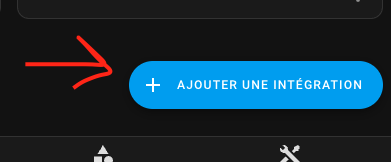
Cliquez sur le bouton Ajouter une intégration dans la page d'intégration
|
||||
|
||||
|
||||
|
||||
La configuration peut être modifiée via la même interface. Sélectionnez simplement le thermostat à modifier, appuyez sur "Configurer" et vous pourrez modifier certains paramètres ou la configuration.
|
||||
|
||||
Suivez ensuite les étapes de configuration comme suit :
|
||||
|
||||
## Choix des attributs de base
|
||||
|
||||

|
||||
|
||||

|
||||
|
||||
Donnez les principaux attributs obligatoires :
|
||||
1. un nom (sera le nom de l'intégration et aussi le nom de l'entité climate)
|
||||
2. le type de thermostat ```thermostat_over_switch``` pour piloter un radiateur commandé par un switch ou ```thermostat_over_climate``` pour piloter un autre thermostat, ou ```thermostat_over_valve``` Cf. [ci-dessus](#pourquoi-une-nouvelle-implémentation-du-thermostat)
|
||||
4. un identifiant d'entité de capteur de température qui donne la température de la pièce dans laquelle le radiateur est installé,
|
||||
5. une entité capteur de température donnant la température extérieure. Si vous n'avez pas de capteur externe, vous pouvez utiliser l'intégration météo locale
|
||||
6. une durée de cycle en minutes. A chaque cycle, le radiateur s'allumera puis s'éteindra pendant une durée calculée afin d'atteindre la température ciblée (voir [preset](#configure-the-preset-temperature) ci-dessous). En mode ```over_climate```, le cycle ne sert qu'à faire des controles de base mais ne régule pas directement la température. C'est le ```climate``` sous-jacent qui le fait,
|
||||
7. les températures minimales et maximales du thermostat,
|
||||
8. une puissance de l'équipement ce qui va activer les capteurs de puissance et énergie consommée par l'appareil,
|
||||
9. la possibilité de controler le thermostat de façon centralisée. Cf [controle centralisé](#le-contrôle-centralisé),
|
||||
10. la liste des fonctionnalités qui seront utilisées pour ce thermostat. En fonction de vos choix, les écrans de configuration suivants s'afficheront ou pas.
|
||||
|
||||
>  _*Notes*_
|
||||
> 1. avec les types ```over_switch``` et ```over_valve```, les calculs sont effectués à chaque cycle. Donc en cas de changement de conditions, il faudra attendre le prochain cycle pour voir un changement. Pour cette raison, le cycle ne doit pas être trop long. **5 min est une bonne valeur**,
|
||||
> 2. si le cycle est trop court, le radiateur ne pourra jamais atteindre la température cible. Pour le radiateur à accumulation par exemple il sera sollicité inutilement.
|
||||
|
||||
## Sélectionnez des entités pilotées
|
||||
En fonction de votre choix sur le type de thermostat, vous devrez choisir une ou plusieurs entités de type `switch`, `climate` ou `number`. Seules les entités compatibles avec le type sont présentées.
|
||||
|
||||
>  _*Comment choisir le type*_
|
||||
> Le choix du type est important. Même si il toujours possible de le modifier ensuite via l'IHM de configuration, il est préférable de se poser les quelques questions suivantes :
|
||||
> 1. **quel type d'équipement je vais piloter ?** Dans l'ordre voici ce qu'il faut faire :
|
||||
> 1. si vous avez une vanne thermostatique (TRV) commandable dans Home Assistant via une entité de type ```number``` (par exemple une _Shelly TRV_), choisissez le type `over_valve`. C'est le type le plus direct et qui assure la meilleure régulation,
|
||||
> 2. si vous avez un radiateur électrique (avec ou sans fil pilote) et qu'une entité de type ```switch``` permet de l'allumer ou de l'éteindre, alors le type ```over_switch``` est préférable. La régulation sera faite par le Versatile Thermostat en fonction de la température mesuré par votre thermomètre, à l'endroit ou vous l'avez placé,
|
||||
> 3. dans tous les autres cas, utilisez le mode ```over_climate```. Vous gardez votre entité ```climate``` d'origine et le Versatile Thermostat "ne fait que" piloter le on/off et la température cible de votre thermostat d'origine. La régulation est faite par votre thermostat d'origine dans ce cas. Ce mode est particulièrement adapté aux climatisations réversible tout-en-un dont l'exposition dans Home Assistant se limite à une entité de type ```climate```
|
||||
> 2. **quelle type de régulation je veux ?** Si l'équipement piloté possède son propre mécanisme de régulation (clim, certaine vanne TRV) et que cette régulation fonctionne bien, optez pour un ```over_climate```
|
||||
|
||||
### Pour un thermostat de type ```thermostat_over_switch```
|
||||

|
||||
|
||||
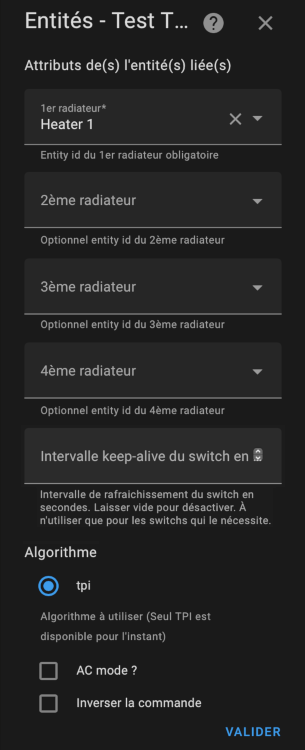
Certains équipements nécessitent d'être périodiquement sollicités pour empêcher un arrêt de sécurité. Connu sous le nom de "keep-alive" cette fonction est activable en entrant un nombre de secondes non nul dans le champ d'intervalle keep-alive du thermostat. Pour désactiver la fonction ou en cas de doute, laissez-le vide ou entrez zéro (valeur par défaut).
|
||||
|
||||
|
||||
L'algorithme à utiliser est aujourd'hui limité à TPI est disponible. Voir [algorithme](#algorithme).
|
||||
Si plusieurs entités de type sont configurées, la thermostat décale les activations afin de minimiser le nombre de switch actif à un instant t. Ca permet une meilleure répartition de la puissance puisque chaque radiateur va s'allumer à son tour.
|
||||
Exemple de déclenchement synchronisé :
|
||||

|
||||

|
||||
|
||||
Il est possible de choisir un thermostat over switch qui commande une climatisation en cochant la case "AC Mode". Dans ce cas, seul le mode refroidissement sera visible.
|
||||
|
||||
Si votre équipement est commandé par un fil pilote avec un diode, vous aurez certainement besoin de cocher la case "Inverser la case". Elle permet de mettre le switch à On lorsqu'on doit étiendre l'équipement et à Off lorsqu'on doit l'allumer.
|
||||
|
||||
### Pour un thermostat de type ```thermostat_over_climate```:
|
||||

|
||||
|
||||
|
||||
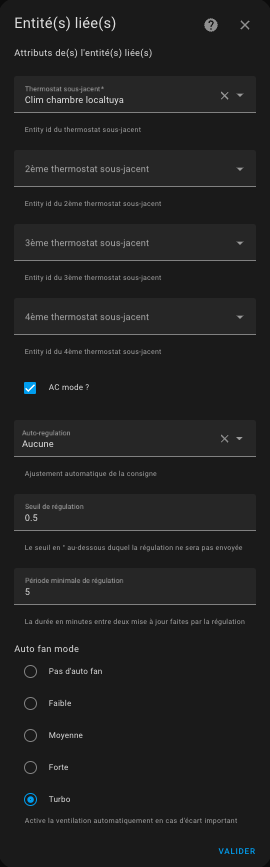
Il est possible de choisir un thermostat over climate qui commande une climatisation réversible en cochant la case "AC Mode". Dans ce cas, selon l'équipement commandé vous aurez accès au chauffage et/ou au réfroidissement.
|
||||
|
||||
@@ -156,7 +276,7 @@ La fonction d'auto-régulation se paramètre avec :
|
||||
|
||||
Ces trois paramètres permettent de moduler la régulation et éviter de multiplier les envois de régulation. Certains équipements comme les TRV, les chaudières n'aiment pas qu'on change la consigne de température trop souvent.
|
||||
|
||||
>  _*Conseil de mise en place*_
|
||||
>  _*Conseil de mise en place*_
|
||||
> 1. Ne démarrez pas tout de suite l'auto-régulation. Regardez comment se passe la régulation naturelle de votre équipement. Si vous constatez que la température de consigne n'est pas atteinte ou qu'elle met trop de temps à être atteinte, démarrez la régulation,
|
||||
> 2. D'abord commencez par une légère auto-régulation et gardez les deux paramètres avec leur valeurs par défaut. Attendez quelques jours et vérifiez si la situation s'est améliorée,
|
||||
> 3. Si ce n'est pas suffisant, passez en auto-régulation Medium, attendez une stabilisation,
|
||||
@@ -243,37 +363,6 @@ et bien sur, configurer le mode auto-régulation du VTherm en mode Expert. Tous
|
||||
|
||||
Pour que les modifications soient prises en compte, il faut soit **relancer totalement Home Assistant** soit juste l'intégration Versatile Thermostat (Outils de dev / Yaml / rechargement de la configuration / Versatile Thermostat).
|
||||
|
||||
#### Compensation de la température interne
|
||||
Quelque fois, il arrive que le thermomètre interne du sous-jacent (TRV, climatisation, ...) soit tellement faux que l' auto-régulation ne suffise pas à réguler.
|
||||
Cela arrive lorsque le thermomètre interne est trop près de la source de chaleur. La température interne monte alors beaucoup plus vite que la température de la pièce, ce qui génère des défauts dans la régulation.
|
||||
Exemple :
|
||||
1. la température de la pièce est 18°, la consigne est à 20°,
|
||||
2. la température interne de l'équipement est de 22°,
|
||||
3. si VTherm envoie 21° comme consigne (= 20° + 1° d'auto-regulation), alors l'équipement ne chauffera pas car sa température interne (22°) est au-dessus de la consigne (21°)
|
||||
|
||||
Pour palier à ça, une nouvelle option facultative a été ajoutée en version 5.4 : 
|
||||
|
||||
Lorsqu'elle est activée, cette fonction ajoutera l'écart entre la température interne et la température de la pièce à la consigne pour forcer le chauffage.
|
||||
Dans l'exemple ci-dessus, l'écart est de +4° (22° - 18°), donc VTherm enverra 25° (21°+4°) à l'équipement le forçant ainsi à chauffer.
|
||||
|
||||
Cet écart est calculé pour chaque sous-jacent car chacun à sa propre température interne. Pensez à un VTherm qui serait relié à 3 TRV chacun avec sa température interne par exemple.
|
||||
|
||||
On obtient alors une auto-régulation bien plus efficace qui évite l'eccueil des gros écarts de température interne défaillante.
|
||||
|
||||
#### Synthèse de l'algorithme d'auto-régulation
|
||||
L'algorithme d'auto-régulation peut être synthétisé comme suit:
|
||||
|
||||
1. initialiser la température cible comme la consigne du VTherm,
|
||||
1. Si l'auto-régulation est activée,
|
||||
1. calcule de la température régulée (valable pour un VTherm),
|
||||
2. prendre cette température comme cible,
|
||||
2. Pour chaque sous-jacent du VTherm,
|
||||
1. Si "utiliser la température interne" est cochée,
|
||||
1. calcule de l'écart (trv internal temp - room temp),
|
||||
2. ajout de l'écart à la température cible,
|
||||
3. envoie de la température cible ( = temp regulee + (temp interne - temp pièce)) au sous-jacent
|
||||
|
||||
|
||||
|
||||
#### Le mode auto-fan
|
||||
Ce mode introduit en 4.3 permet de forcer l'usage de la ventilation si l'écart de température est important. En effet, en activant la ventilation, la répartition se fait plus rapidement ce qui permet de gagner du temps dans l'atteinte de la température cible.
|
||||
@@ -283,19 +372,8 @@ Il faut évidemment que votre équipement sous-jacent soit équipée d'une venti
|
||||
Si votre équipement ne comprend pas le mode Turbo, le mode Forte` sera utilisé en remplacement.
|
||||
Une fois l'écart de température redevenu faible, la ventilation se mettra dans un mode "normal" qui dépend de votre équipement à savoir (dans l'ordre) : `Silence (mute)`, `Auto (auto)`, `Faible (low)`. La première valeur qui est possible pour votre équipement sera choisie.
|
||||
|
||||
#### Le démarrage / arrêt automatique
|
||||
Cette fonction a été introduite en 6.5.0. Elle permet d'autoriser VTherm a stopper un équipement qui n'a pas besoin d'être allumé et de le redémarrer lorsque les conditions le réclame. Cette fonction est munie de 3 réglages qui permettent d'arrêter / relancer plus ou moins rapidement l'équipement.
|
||||
|
||||
Pour l'utiliser, vous devez :
|
||||
1. Ajouter la fonction `Avec démmarrage et extinction automatique` dans le menu 'Fonctions',
|
||||
2. Paramétrer le niveau de détection dans l'option 'Allumage/extinction automatique' qui s'affiche lorsque la fonction a été activée. Vous choisissez le niveau de détection entre 'Lent', 'Moyen' et 'Rapide'. Les arrêts/relances seront plus nombreux avec le niveau 'Rapide'.
|
||||
|
||||
Une fois paramétré, vous aurez maintenant une nouvelle entité de type `switch` qui vous permet d'autoriser ou non l'arrêt/relance automatique sans toucher à la configuration. Cette entité est disponible sur l'appareil VTherm et se nomme `switch.<name>_enable_auto_start_stop`. Cochez la pour autoriser le démarrage et extinction automatique.
|
||||
|
||||
L'algorithme de détection est décrit [ici](https://github.com/jmcollin78/versatile_thermostat/issues/585).
|
||||
|
||||
### Pour un thermostat de type ```thermostat_over_valve```:
|
||||

|
||||

|
||||
Vous pouvez choisir jusqu'à entité du domaine ```number``` ou ```ìnput_number``` qui vont commander les vannes.
|
||||
L'algorithme à utiliser est aujourd'hui limité à TPI est disponible. Voir [algorithme](#algorithme).
|
||||
|
||||
@@ -303,9 +381,9 @@ Il est possible de choisir un thermostat over valve qui commande une climatisati
|
||||
|
||||
## Configurez les coefficients de l'algorithme TPI
|
||||
|
||||
Si vous avez choisi un thermostat de type ```over_switch``` ou ```over_valve``` et que vous sélectionnez l'option "TPI" vous menu, vous arriverez sur cette page :
|
||||
Si vous avez choisi un thermostat de type ```over_switch``` ou ```over_valve``` vous arriverez sur cette page :
|
||||
|
||||

|
||||
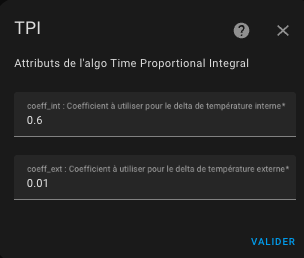
|
||||
|
||||
Vous devez donner :
|
||||
1. le coefficient coef_int de l'algorithme TPI,
|
||||
@@ -314,7 +392,10 @@ Vous devez donner :
|
||||
|
||||
Pour plus d'informations sur l'algorithme TPI et son réglage, veuillez vous référer à [algorithm](#algorithm).
|
||||
|
||||
## Configurer les températures préréglées
|
||||
## Configurer la température préréglée
|
||||
Cliquez sur 'Valider' sur la page précédente et vous y arriverez :
|
||||
|
||||
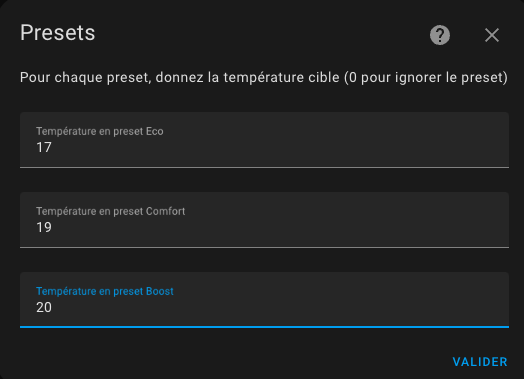
|
||||
|
||||
Le mode préréglé (preset) vous permet de préconfigurer la température ciblée. Utilisé en conjonction avec Scheduler (voir [scheduler](#even-better-with-scheduler-component) vous aurez un moyen puissant et simple d'optimiser la température par rapport à la consommation électrique de votre maison. Les préréglages gérés sont les suivants :
|
||||
- **Eco** : l'appareil est en mode d'économie d'énergie
|
||||
@@ -325,9 +406,7 @@ Le mode préréglé (preset) vous permet de préconfigurer la température cibl
|
||||
|
||||
**Aucun** est toujours ajouté dans la liste des modes, car c'est un moyen de ne pas utiliser les preset mais une **température manuelle** à la place.
|
||||
|
||||
Les pré-réglages se font (depuis v6.0) directement depuis les entités du VTherm ou de la configuration centrale si vous utilisez la configuration centrale.
|
||||
|
||||
>  _*Notes*_
|
||||
>  _*Notes*_
|
||||
> 1. En modifiant manuellement la température cible, réglez le préréglage sur Aucun (pas de préréglage). De cette façon, vous pouvez toujours définir une température cible même si aucun préréglage n'est disponible.
|
||||
> 2. Le préréglage standard ``Away`` est un préréglage caché qui n'est pas directement sélectionnable. Versatile Thermostat utilise la gestion de présence ou la gestion de mouvement pour régler automatiquement et dynamiquement la température cible en fonction d'une présence dans le logement ou d'une activité dans la pièce. Voir [gestion de la présence](#configure-the-presence-management).
|
||||
> 3. Si vous utilisez la gestion du délestage, vous verrez un préréglage caché nommé ``power``. Le préréglage de l'élément chauffant est réglé sur « puissance » lorsque des conditions de surpuissance sont rencontrées et que le délestage est actif pour cet élément chauffant. Voir [gestion de l'alimentation](#configure-the-power-management).
|
||||
@@ -335,7 +414,6 @@ Les pré-réglages se font (depuis v6.0) directement depuis les entités du VThe
|
||||
> 5. Si vous ne souhaitez pas utiliser le préréglage, indiquez 0 comme température. Le préréglage sera alors ignoré et ne s'affichera pas dans le composant front
|
||||
|
||||
## Configurer les portes/fenêtres en allumant/éteignant les thermostats
|
||||
|
||||
Vous devez avoir choisi la fonctionnalité ```Avec détection des ouvertures``` dans la première page pour arriver sur cette page.
|
||||
La détecttion des ouvertures peut se faire de 2 manières:
|
||||
1. soit avec un capteur placé sur l'ouverture (mode capteur),
|
||||
@@ -343,7 +421,7 @@ La détecttion des ouvertures peut se faire de 2 manières:
|
||||
|
||||
### Le mode capteur
|
||||
En mode capteur, vous devez renseigner les informations suivantes:
|
||||

|
||||
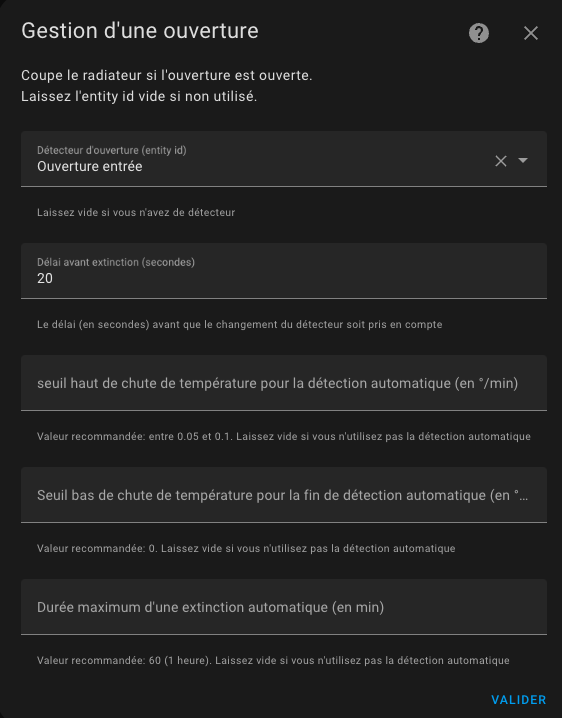
|
||||
|
||||
1. un identifiant d'entité d'un **capteur de fenêtre/porte**. Cela devrait être un binary_sensor ou un input_boolean. L'état de l'entité doit être 'on' lorsque la fenêtre est ouverte ou 'off' lorsqu'elle est fermée
|
||||
2. un **délai en secondes** avant tout changement. Cela permet d'ouvrir rapidement une fenêtre sans arrêter le chauffage.
|
||||
@@ -351,7 +429,7 @@ En mode capteur, vous devez renseigner les informations suivantes:
|
||||
|
||||
### Le mode auto
|
||||
En mode auto, la configuration est la suivante:
|
||||

|
||||
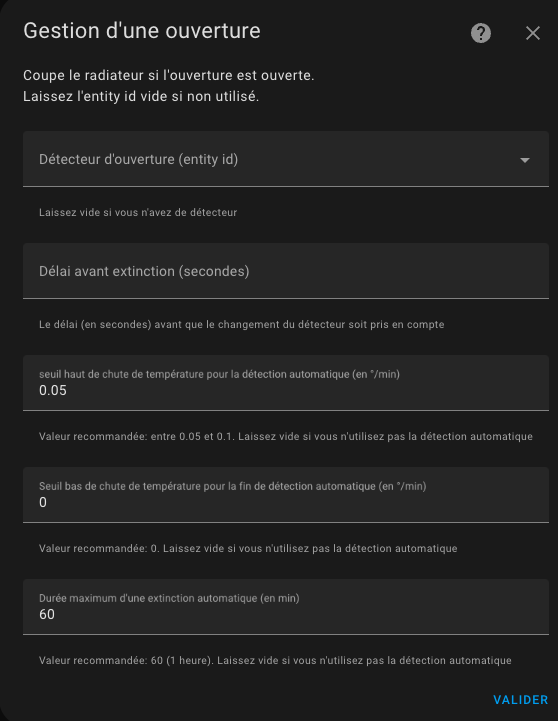
|
||||
|
||||
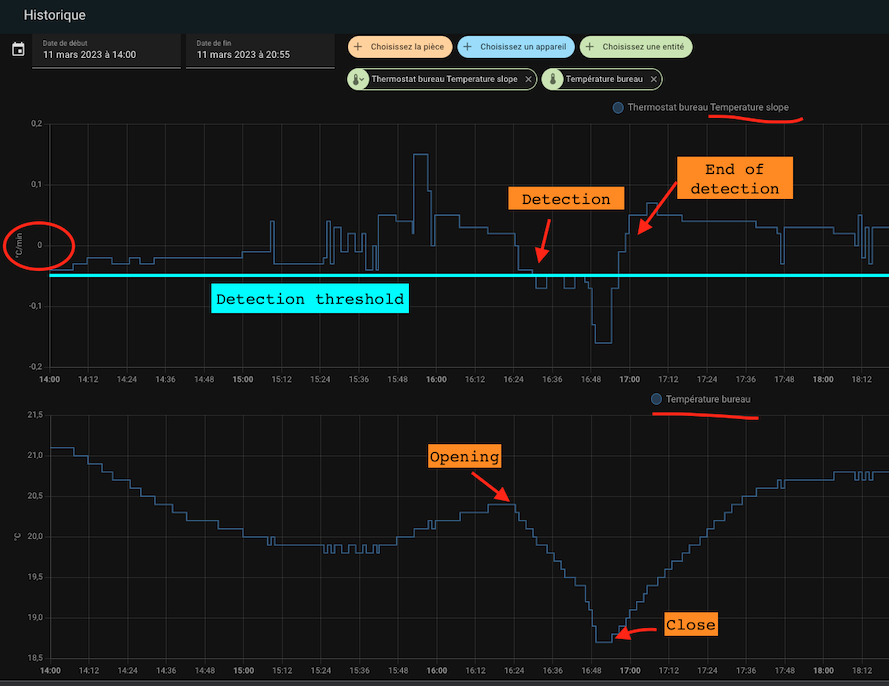
1. un seuil de détection en degré par minute. Lorsque la température chute au delà de ce seuil, le thermostat s'éteindra. Plus cette valeur est faible et plus la détection sera rapide (en contre-partie d'un risque de faux positif),
|
||||
2. un seuil de fin de détection en degré par minute. Lorsque la chute de température repassera au-dessus cette valeur, le thermostat se remettra dans le mode précédent (mode et preset),
|
||||
@@ -363,24 +441,23 @@ Pour régler les seuils il est conseillé de commencer avec les valeurs de réf
|
||||
- durée max : 60 min.
|
||||
|
||||
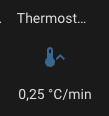
Un nouveau capteur "slope" a été ajouté pour tous les thermostats. Il donne la pente de la courbe de température en °C/min (ou °K/min). Cette pente est lissée et filtrée pour éviter les valeurs abérrantes des thermomètres qui viendraient pertuber la mesure.
|
||||

|
||||
|
||||
|
||||
Pour bien régler il est conseillé d'affocher sur un même graphique historique la courbe de température et la pente de la courbe (le "slope") :
|
||||

|
||||
|
||||
|
||||
Et c'est tout ! votre thermostat s'éteindra lorsque les fenêtres seront ouvertes et se rallumera lorsqu'il sera fermé.
|
||||
|
||||
>  _*Notes*_
|
||||
>  _*Notes*_
|
||||
> 1. Si vous souhaitez utiliser **plusieurs capteurs de porte/fenêtre** pour automatiser votre thermostat, créez simplement un groupe avec le comportement habituel (https://www.home-assistant.io/integrations/binary_sensor.group/)
|
||||
> 2. Si vous n'avez pas de capteur de fenêtre/porte dans votre chambre, laissez simplement l'identifiant de l'entité du capteur vide,
|
||||
> 3. **Un seul mode est permis**. On ne peut pas configurer un thermostat avec un capteur et une détection automatique. Les 2 modes risquant de se contredire, il n'est pas possible d'avoir les 2 modes en même temps,
|
||||
> 4. Il est déconseillé d'utiliser le mode automatique pour un équipement soumis à des variations de température fréquentes et normales (couloirs, zones ouvertes, ...)
|
||||
|
||||
## Configurer le mode d'activité ou la détection de mouvement
|
||||
|
||||
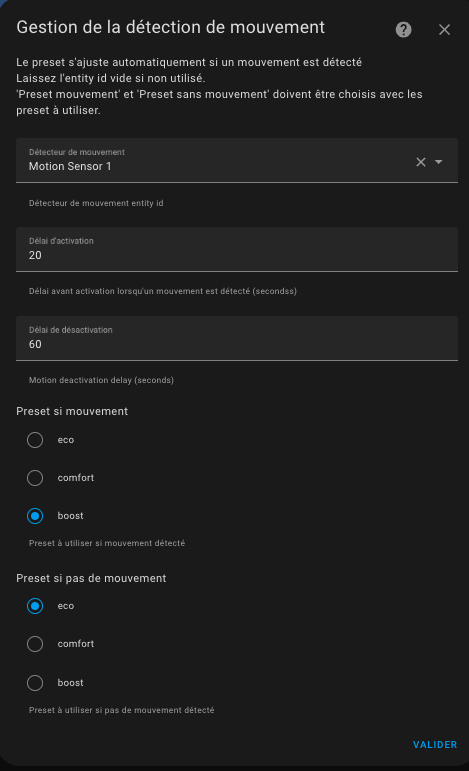
Si vous avez choisi la fonctionnalité ```Avec détection de mouvement```, cliquez sur 'Valider' sur la page précédente et vous y arriverez :
|
||||
|
||||

|
||||
|
||||
|
||||
Nous allons maintenant voir comment configurer le nouveau mode Activité.
|
||||
Ce dont nous avons besoin:
|
||||
@@ -400,33 +477,32 @@ Alors imaginons que nous voulions avoir le comportement suivant :
|
||||
|
||||
Pour que cela fonctionne, le thermostat doit être en mode préréglé « Activité ».
|
||||
|
||||
>  _*Notes*_
|
||||
>  _*Notes*_
|
||||
1. Sachez que comme pour les autres modes prédéfinis, ``Activity`` ne sera proposé que s'il est correctement configuré. En d'autres termes, les 4 clés de configuration doivent être définies si vous souhaitez voir l'activité dans l'interface de l'assistant domestique
|
||||
|
||||
## Configurer la gestion de la puissance
|
||||
|
||||
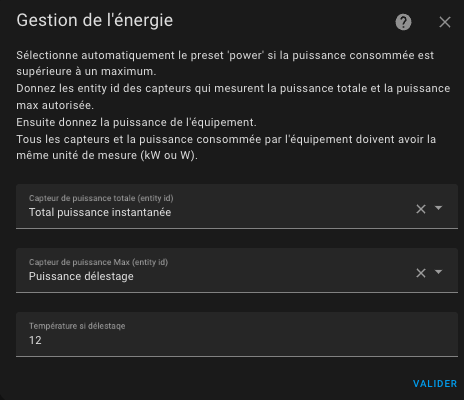
Si vous avez choisi la fonctionnalité ```Avec détection de la puissance```, cliquez sur 'Valider' sur la page précédente et vous arriverez ici :
|
||||
|
||||

|
||||
|
||||
|
||||
Cette fonction vous permet de réguler la consommation électrique de vos radiateurs. Connue sous le nom de délestage, cette fonction vous permet de limiter la consommation électrique de votre appareil de chauffage si des conditions de surpuissance sont détectées. Donnez un **capteur à la consommation électrique actuelle de votre maison**, un **capteur à la puissance max** qu'il ne faut pas dépasser, la **consommation électrique totale des équipements du VTherm** (en étape 1 de la configuration) et l'algorithme ne démarrera pas un radiateur si la puissance maximale sera dépassée après le démarrage du radiateur.
|
||||
|
||||
Notez que toutes les valeurs de puissance doivent avoir les mêmes unités (kW ou W par exemple).
|
||||
Cela vous permet de modifier la puissance maximale au fil du temps à l'aide d'un planificateur ou de ce que vous voulez.
|
||||
|
||||
>  _*Notes*_
|
||||
>  _*Notes*_
|
||||
> 1. En cas de délestage, le radiateur est réglé sur le préréglage nommé ```power```. Il s'agit d'un préréglage caché, vous ne pouvez pas le sélectionner manuellement.
|
||||
> 2. Je l'utilise pour éviter de dépasser la limite de mon contrat d'électricité lorsqu'un véhicule électrique est en charge. Cela crée une sorte d'autorégulation.
|
||||
> 3. Gardez toujours une marge, car la puissance max peut être brièvement dépassée en attendant le calcul du prochain cycle typiquement ou par des équipements non régulés.
|
||||
> 4. Si vous ne souhaitez pas utiliser cette fonctionnalité, laissez simplement l'identifiant des entités vide
|
||||
> 5. Si vous controlez plusieurs radiateurs, la **consommation électrique de votre chauffage** renseigné doit correspondre à la somme des puissances.
|
||||
|
||||
## Configurer la présence (ou l'absence)
|
||||
|
||||
## Configurer la présence ou l'occupation
|
||||
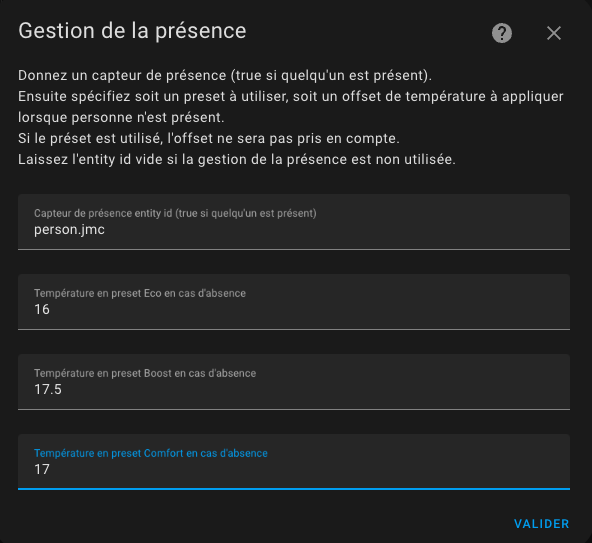
Si sélectionnée en première page, cette fonction vous permet de modifier dynamiquement la température de tous les préréglages du thermostat configurés lorsque personne n'est à la maison ou lorsque quelqu'un rentre à la maison. Pour cela, vous devez configurer la température qui sera utilisée pour chaque préréglage lorsque la présence est désactivée. Lorsque le capteur de présence s'éteint, ces températures seront utilisées. Lorsqu'il se rallume, la température "normale" configurée pour le préréglage est utilisée. Voir [gestion des préréglages](#configure-the-preset-temperature).
|
||||
Pour configurer la présence remplissez ce formulaire :
|
||||
|
||||

|
||||
|
||||
|
||||
Pour cela, vous devez configurer :
|
||||
1. Un **capteur d'occupation** dont l'état doit être 'on' ou 'home' si quelqu'un est présent ou 'off' ou 'not_home' sinon,
|
||||
@@ -438,16 +514,15 @@ Si le mode AC est utilisé, vous pourrez aussi configurer les températures lors
|
||||
|
||||
ATTENTION : les groupes de personnes ne fonctionnent pas en tant que capteur de présence. Ils ne sont pas reconnus comme un capteur de présence. Vous devez utiliser, un template comme décrit ici [Utilisation d'un groupe de personnes comme capteur de présence](#utilisation-dun-groupe-de-personnes-comme-capteur-de-présence).
|
||||
|
||||
>  _*Notes*_
|
||||
>  _*Notes*_
|
||||
> 1. le changement de température est immédiat et se répercute sur le volet avant. Le calcul prendra en compte la nouvelle température cible au prochain calcul du cycle,
|
||||
> 2. vous pouvez utiliser le capteur direct person.xxxx ou un groupe de capteurs de Home Assistant. Le capteur de présence gère les états ``on`` ou ``home`` comme présents et les états ``off`` ou ``not_home`` comme absents.
|
||||
|
||||
## Configuration avancée
|
||||
|
||||
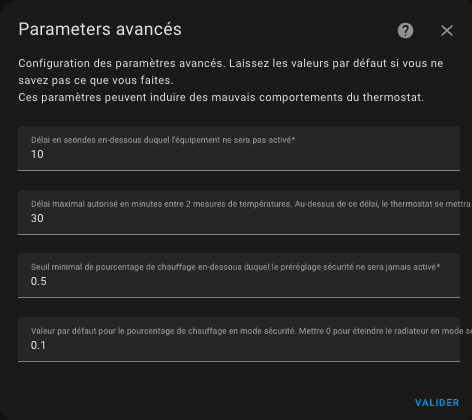
Ces paramètres permettent d'affiner le réglage du thermostat.
|
||||
Le formulaire de configuration avancée est le suivant :
|
||||
|
||||

|
||||
|
||||
|
||||
Le premier délai (minimal_activation_delay_sec) en secondes est le délai minimum acceptable pour allumer le chauffage. Lorsque le calcul donne un délai de mise sous tension inférieur à cette valeur, le chauffage reste éteint.
|
||||
|
||||
@@ -458,20 +533,9 @@ Mettre ce paramètre à ``0.00`` déclenchera le préréglage sécurité quelque
|
||||
|
||||
Le quatrième param§tre (``security_default_on_percent``) est la valeur de ``on_percent`` qui sera utilisée lorsque le thermostat passe en mode ``security``. Si vous mettez ``0`` alors le thermostat sera coupé lorsqu'il passe en mode ``security``, mettre 0,2% par exemple permet de garder un peu de chauffage (20% dans ce cas), même en mode ``security``. Ca évite de retrouver son logement totalement gelé lors d'une panne de thermomètre.
|
||||
|
||||
Note: les paramètres `security_min_on_percent` et `security_default_on_percent` ne s'applique pas aux VTherms `over_climate`.
|
||||
|
||||
Depuis la version 5.3 il est possible de désactiver la mise en sécurité suite à une absence de données du thermomètre extérieure. En effet, celui-ci ayant la plupart du temps un impact faible sur la régulation (dépendant de votre paramètrage), il est possible qu'il soit absent sans mettre en danger le logement. Pour cela, il faut ajouter les lignes suivantes dans votre `configuration.yaml` :
|
||||
```
|
||||
versatile_thermostat:
|
||||
...
|
||||
safety_mode:
|
||||
check_outdoor_sensor: false
|
||||
```
|
||||
Par défaut, le thermomètre extérieur peut déclencher une mise en sécurité si il n'envoit plus de valeur.
|
||||
|
||||
Voir [exemple de réglages](#examples-tuning) pour avoir des exemples de réglage communs
|
||||
|
||||
>  _*Notes*_
|
||||
>  _*Notes*_
|
||||
> 1. Lorsque le capteur de température viendra à la vie et renverra les températures, le préréglage sera restauré à sa valeur précédente,
|
||||
> 2. Attention, deux températures sont nécessaires : la température interne et la température externe et chacune doit donner la température, sinon le thermostat sera en préréglage "security",
|
||||
> 3. Un service est disponible qui permet de régler les 3 paramètres de sécurité. Ca peut servir à adapter la fonction de sécurité à votre usage,
|
||||
@@ -479,7 +543,6 @@ Voir [exemple de réglages](#examples-tuning) pour avoir des exemples de réglag
|
||||
> 5. Les thermostats de type ``thermostat_over_climate`` ne sont pas concernés par le mode security.
|
||||
|
||||
## Le contrôle centralisé
|
||||
|
||||
Depuis la release 5.2, si vous avez défini une configuration centralisée, vous avez une nouvelle entité nommée `select.central_mode` qui permet de piloter tous les VTherms avec une seule action. Pour qu'un VTherm soit contrôlable de façon centralisée, il faut que son attribut de configuration nommé `use_central_mode` soit vrai.
|
||||
|
||||
Cette entité se présente sous la forme d'une liste de choix qui contient les choix suivants :
|
||||
@@ -492,35 +555,28 @@ Cette entité se présente sous la forme d'une liste de choix qui contient les c
|
||||
Il est donc possible de contrôler tous les VTherms (que ceux que l'on désigne explicitement) avec un seul contrôle.
|
||||
Exemple de rendu :
|
||||
|
||||

|
||||

|
||||
|
||||
## Le contrôle d'une chaudière centrale
|
||||
|
||||
Depuis la release 5.3, vous avez la possibilité de contrôler une chaudière centralisée. A partir du moment où il est possible de déclencher ou stopper cette chaudière depuis Home Assistant, alors Versatile Thermostat va pouvoir la commander directement.
|
||||
|
||||
Le principe mis en place est globalement le suivant :
|
||||
1. une nouvelle entité de type `binary_sensor` et nommée par défaut `binary_sensor.central_boiler` est ajoutée,
|
||||
2. dans la configuration des VTherms vous indiquez si le VTherm doit contrôler la chaudière. En effet, dans une installation hétérogène, certains VTherm doivent commander la chaudière et d'autres non. Vous devez donc indiquer dans chaque configuration de VTherm si il contrôle la chaudière ou pas,
|
||||
3. le `binary_sensor.central_boiler` écoute les changements d'états des équipements des VTherm marqués comme contrôlant la chaudière,
|
||||
4. dès que le nombre d'équipements pilotés par le VTherm demandant du chauffage (ie son `hvac_action` passe à `Heating`) dépasse un seuil paramétrable, alors le `binary_sensor.central_boiler` passe à `on` et **si un service d'activation a été configuré, alors ce service est appelé**,
|
||||
5. si le nombre d'équipements nécessitant du chauffage repasse en dessous du seuil, alors le `binary_sensor.central_boiler` passe à `off` et si **un service de désactivation a été configuré, alors ce service est appelé**,
|
||||
6. vous avez accès à deux entités :
|
||||
- une de type `number` nommé par défaut `number.boiler_activation_threshold`, donne le seuil de déclenchement. Ce seuil est en nombre d'équipements (radiateurs) qui demande du chauffage.
|
||||
- une de type `sensor` nommé par défaut `sensor.nb_device_active_for_boiler`, donne le nombre d'équipements qui demande du chauffage. Par exemple, un VTherm ayant 4 vannes dont 3 demandes du chauffage fera passé ce capteur à 3. Seuls les équipements des VTherms qui sont marqués pour contrôler la chaudière centrale sont comptabilisés.
|
||||
2. dans la configuration des VTherms vous indiqué si le VTherm doit contrôler la chaudière. En effet, dans une installation hétérogène, certains VTherm doivent commander la chaudière et d'autres non. Vous devez donc indiqué dans chaque configuration de VTherm si il contrôle la chaudière ou pas,
|
||||
3. le `binary_sensor.central_boiler` écoute les changements d'états des VTherm marqués comme contrôlant la chaudière,
|
||||
4. si l'un des VTherm écoutés demande du chauffage (ie son `hvac_action` passe à `Heating`), alors le `binary_sensor.central_boiler` passe à `on` et si un service d'activation a été configuré, alors ce service est appelé,
|
||||
5. si plus aucun VTherm écoutés ne demande du chauffage (ie aucun `hvac_action` n'est `Heating`), alors le `binary_sensor.central_boiler` passe à `off` et si un service de désactivation a été configuré, alors ce service est appelé.
|
||||
|
||||
Vous avez donc en permanence, les informations qui permettent de piloter et régler le déclenchement de la chaudière.
|
||||
|
||||
Toutes ces entités sont rattachés au service de configuration centrale :
|
||||

|
||||
Vous avez donc en permanence, un indicateur qui donne l'info que au moins un des radiateurs est à besoin de chauffer.
|
||||
|
||||
### Configuration
|
||||
Pour configurer cette fonction, vous devez avoir une configuration centralisée (cf. [Configuration](#configuration)) et cochez la case 'Ajouter une chuadière centrale' :
|
||||
|
||||

|
||||

|
||||
|
||||
Sur la page suivante vous pouvez donner la configuration des services à appeler lors de l'allumage / extinction de la chaudière :
|
||||
|
||||

|
||||

|
||||
|
||||
Les services se configurent comme indiqués dans la page :
|
||||
1. le format général est `entity_id/service_id[/attribut:valeur]` (où `/attribut:valeur` est facultatif),
|
||||
@@ -543,11 +599,11 @@ Exemple:
|
||||
|
||||
Sous "Outils de développement / Service" :
|
||||
|
||||

|
||||

|
||||
|
||||
En mode yaml :
|
||||
|
||||

|
||||

|
||||
|
||||
Le service à configurer est alors le suivant: `climate.empty_thermostast/climate.set_hvac_mode/hvac_mode:heat` (notez la suppression du blanc dans `hvac_mode:heat`)
|
||||
|
||||
@@ -592,12 +648,9 @@ context:
|
||||
|
||||
### Avertissement
|
||||
|
||||
>  _*Notes*_
|
||||
>  _*Notes*_
|
||||
> Le contrôle par du logiciel ou du matériel de type domotique d'une chaudière centrale peut induire des risques pour son bon fonctionnement. Assurez-vous avant d'utiliser ces fonctions, que votre chaudière possède bien des fonctions de sécurité et que celles-ci fonctionnent. Allumer une chaudière si tous les robinets sont fermés peut générer de la sur-pression par exemple.
|
||||
|
||||
<details>
|
||||
<summary>Synthèse des paramètres</summary>
|
||||
|
||||
## Synthèse des paramètres
|
||||
|
||||
| Paramètre | Libellé | "over switch" | "over climate" | "over valve" | "configuration centrale" |
|
||||
@@ -619,7 +672,6 @@ context:
|
||||
| ``heater_entity2_id`` | 2ème radiateur | X | - | - | - |
|
||||
| ``heater_entity3_id`` | 3ème radiateur | X | - | - | - |
|
||||
| ``heater_entity4_id`` | 4ème radiateur | X | - | - | - |
|
||||
| ``heater_keep_alive`` | Intervalle de rafraichissement du switch | X | - | - | - |
|
||||
| ``proportional_function`` | Algorithme | X | - | - | - |
|
||||
| ``climate_entity1_id`` | Thermostat sous-jacent | - | X | - | - |
|
||||
| ``climate_entity2_id`` | 2ème thermostat sous-jacent | - | X | - | - |
|
||||
@@ -632,7 +684,13 @@ context:
|
||||
| ``ac_mode`` | utilisation de l'air conditionné (AC) ? | X | X | X | - |
|
||||
| ``tpi_coef_int`` | Coefficient à utiliser pour le delta de température interne | X | - | X | X |
|
||||
| ``tpi_coef_ext`` | Coefficient à utiliser pour le delta de température externe | X | - | X | X |
|
||||
| ``frost_temp`` | Température en preset Hors-gel | X | X | X | X |
|
||||
| ``frost_tp`` | Température en preset Hors-gel | X | X | X | X |
|
||||
| ``eco_temp`` | Température en preset Eco | X | X | X | X |
|
||||
| ``comfort_temp`` | Température en preset Confort | X | X | X | X |
|
||||
| ``boost_temp`` | Température en preset Boost | X | X | X | X |
|
||||
| ``eco_ac_temp`` | Température en preset Eco en mode AC | X | X | X | X |
|
||||
| ``comfort_ac_temp`` | Température en preset Confort en mode AC | X | X | X | X |
|
||||
| ``boost_ac_temp`` | Température en preset Boost en mode AC | X | X | X | X |
|
||||
| ``window_sensor_entity_id`` | Détecteur d'ouverture (entity id) | X | X | X | - |
|
||||
| ``window_delay`` | Délai avant extinction (secondes) | X | X | X | X |
|
||||
| ``window_auto_open_threshold`` | Seuil haut de chute de température pour la détection automatique (en °/min) | X | X | X | X |
|
||||
@@ -647,6 +705,13 @@ context:
|
||||
| ``max_power_sensor_entity_id`` | Capteur de puissance Max (entity id) | X | X | X | X |
|
||||
| ``power_temp`` | Température si délestaqe | X | X | X | X |
|
||||
| ``presence_sensor_entity_id`` | Capteur de présence entity id (true si quelqu'un est présent) | X | X | X | - |
|
||||
| ``frost_ay_temp`` | Température en preset Hors-gel en cas d'absence | X | X | X | X |
|
||||
| ``eco_away_temp`` | Température en preset Eco en cas d'absence | X | X | X | X |
|
||||
| ``comfort_away_temp`` | Température en preset Comfort en cas d'absence | X | X | X | X |
|
||||
| ``boost_away_temp`` | Température en preset Boost en cas d'absence | X | X | X | X |
|
||||
| ``eco_ac_away_temp`` | Température en preset Eco en cas d'absence en mode AC | X | X | X | X |
|
||||
| ``comfort_ac_away_temp`` | Température en preset Comfort en cas d'absence en mode AC | X | X | X | X |
|
||||
| ``boost_ac_away_temp`` | Température en preset Boost en cas d'absence en mode AC | X | X | X | X |
|
||||
| ``minimal_activation_delay`` | Délai minimal d'activation | X | - | - | X |
|
||||
| ``security_delay_min`` | Délai maximal entre 2 mesures de températures | X | - | X | X |
|
||||
| ``security_min_on_percent`` | Pourcentage minimal de puissance pour passer en mode sécurité | X | - | X | X |
|
||||
@@ -655,14 +720,10 @@ context:
|
||||
| ``auto_regulation_period_min`` | La période minimale d'auto-régulation | - | X | - | - |
|
||||
| ``inverse_switch_command`` | Inverse la commande du switch (pour switch avec fil pilote) | X | - | - | - |
|
||||
| ``auto_fan_mode`` | Mode de ventilation automatique | - | X | - | - |
|
||||
| ``auto_regulation_use_device_temp`` | Utilisation de la température interne du sous-jacent | - | X | - | - |
|
||||
| ``use_central_boiler_feature`` | Ajout du controle d'une chaudière centrale | - | - | - | X |
|
||||
| ``add_central_boiler_control`` | Ajout du controle d'une chaudière centrale | - | - | - | X |
|
||||
| ``central_boiler_activation_service`` | Service d'activation de la chaudière | - | - | - | X |
|
||||
| ``central_boiler_deactivation_service`` | Service de desactivation de la chaudière | - | - | - | X |
|
||||
| ``used_by_controls_central_boiler`` | Indique si le VTherm contrôle la chaudière centrale | X | X | X | - |
|
||||
| ``use_auto_start_stop_feature`` | Indique si la fonction de démarrage/extinction automatique est activée | - | X | - | - |
|
||||
| ``auto_start_stop_lvel`` | Le niveau de détection de l'auto start/stop | - | X | - | - |
|
||||
</details>
|
||||
|
||||
# Exemples de réglage
|
||||
|
||||
@@ -738,7 +799,7 @@ Voir quelques situations à [examples](#some-results).
|
||||
|
||||
Avec le thermostat sont disponibles des capteurs qui permettent de visualiser les alertes et l'état interne du thermostat. Ils sont disponibles dans les entités de l'appareil associé au thermostat :
|
||||
|
||||

|
||||
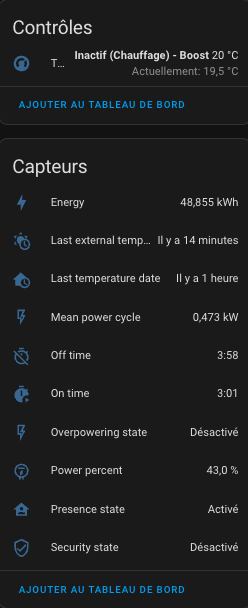
|
||||
|
||||
Dans l'ordre, il y a :
|
||||
1. l'entité principale climate de commande du thermostat,
|
||||
@@ -771,7 +832,7 @@ frontend:
|
||||
```
|
||||
et choisissez le thème ```versatile_thermostat_theme``` dans la configuration du panel. Vous obtiendrez quelque-chose qui va ressembler à ça :
|
||||
|
||||

|
||||
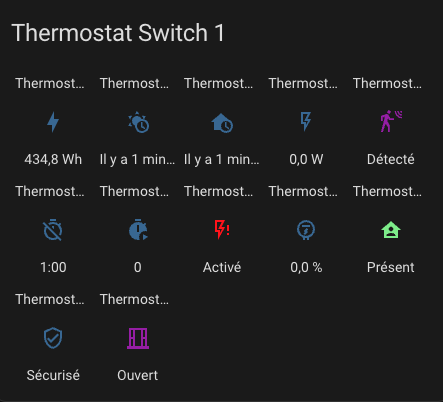
|
||||
|
||||
# Services
|
||||
|
||||
@@ -817,7 +878,7 @@ target:
|
||||
entity_id: climate.my_thermostat
|
||||
```
|
||||
|
||||
>  _*Notes*_
|
||||
>  _*Notes*_
|
||||
- après un redémarrage, les préréglages sont réinitialisés à la température configurée. Si vous souhaitez que votre changement soit permanent, vous devez modifier le préréglage de la température dans la configuration de l'intégration.
|
||||
|
||||
## Modifier les paramètres de sécurité
|
||||
@@ -872,7 +933,7 @@ Vous pouvez très facilement capter ses évènements dans une automatisation par
|
||||
# Attributs personnalisés
|
||||
|
||||
Pour régler l'algorithme, vous avez accès à tout le contexte vu et calculé par le thermostat via des attributs dédiés. Vous pouvez voir (et utiliser) ces attributs dans l'IHM "Outils de développement / états" de HA. Entrez votre thermostat et vous verrez quelque chose comme ceci :
|
||||

|
||||
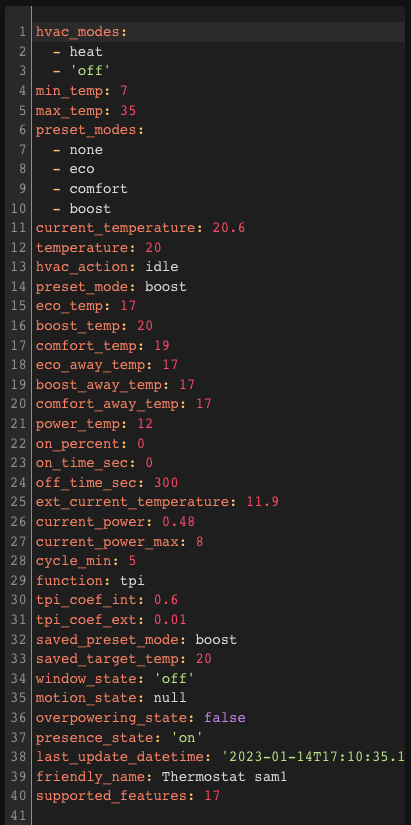
|
||||
|
||||
Les attributs personnalisés sont les suivants :
|
||||
|
||||
@@ -919,30 +980,27 @@ Les attributs personnalisés sont les suivants :
|
||||
| ``is_controlled_by_central_mode`` | True si le VTherm peut être controlé de façon centrale |
|
||||
| ``last_central_mode`` | Le dernier mode central utilisé (None si le VTherm n'est pas controlé en central) |
|
||||
| ``is_used_by_central_boiler`` | Indique si le VTherm peut contrôler la chaudière centrale |
|
||||
| ``auto_start_stop_enable`` | Indique si le VTherm est autorisé à s'auto démarrer/arrêter |
|
||||
| ``auto_start_stop_level`` | Indique le niveau d'auto start/stop |
|
||||
| ``hvac_off_reason`` | Indique la raison de l'arrêt (hvac_off) du VTherm. Ce peut être Window, Auto-start/stop ou Manuel |
|
||||
|
||||
# Quelques résultats
|
||||
|
||||
**Convergence de la température vers la cible configurée par preset:**
|
||||

|
||||

|
||||
|
||||
[Cycle de marche/arrêt calculé par l'intégration :](https://)
|
||||

|
||||

|
||||
|
||||
**Coef_int trop élevé (oscillations autour de la cible)**
|
||||

|
||||
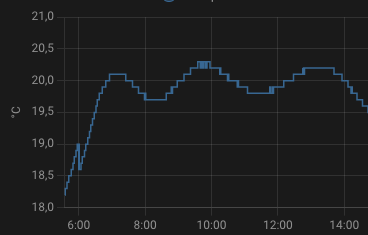
|
||||
|
||||
**Évolution du calcul de l'algorithme**
|
||||

|
||||
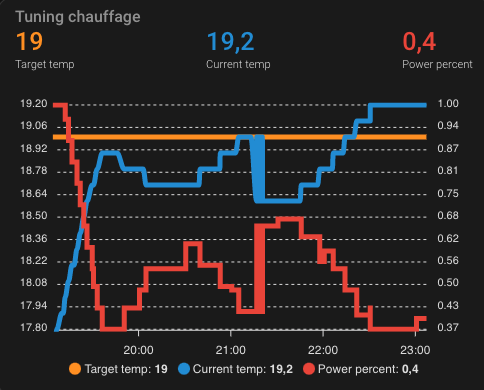
|
||||
Voir le code de ce composant [[ci-dessous](#even-better-with-apex-chart-to-tune-your-thermostat)]
|
||||
|
||||
**Thermostat finement réglé**
|
||||
Merci [impuR_Shozz](https://forum.hacf.fr/u/impur_shozz/summary) !
|
||||
On peut voir une stabilité autour de la température cible (consigne) et lorsqu'à cible le on_percent (puissance) est proche de 0,3 ce qui semble une très bonne valeur.
|
||||
|
||||

|
||||
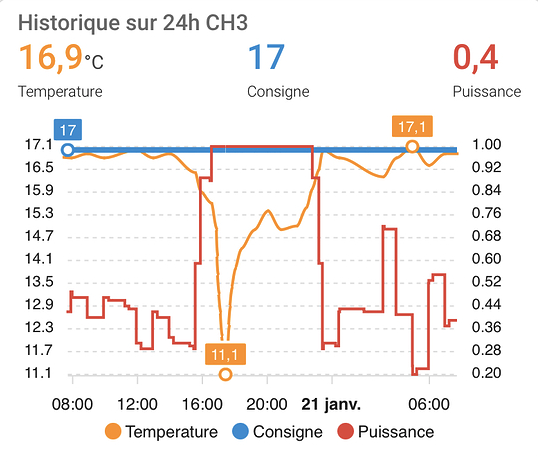
|
||||
|
||||
Enjoy !
|
||||
|
||||
@@ -956,9 +1014,9 @@ Une carte spéciale pour le Versatile Thermostat a été développée (sur la ba
|
||||
## Encore mieux avec le composant Scheduler !
|
||||
|
||||
Afin de profiter de toute la puissance du Versatile Thermostat, je vous invite à l'utiliser avec https://github.com/nielsfaber/scheduler-component
|
||||
En effet, le composant scheduler propose une gestion de la base climatique sur les modes prédéfinis. Cette fonctionnalité a un intérêt limité avec le thermostat générique mais elle devient très puissante avec le Versatile Thermostat :
|
||||
En effet, le composant scheduler propose une gestion de la base climatique sur les modes prédéfinis. Cette fonctionnalité a un intérêt limité avec le thermostat générique mais elle devient très puissante avec le thermostat Awesome :
|
||||
|
||||
À partir d'ici, je suppose que vous avez installé Versatile Thermostat et Scheduler Component.
|
||||
À partir d'ici, je suppose que vous avez installé Awesome Thermostat et Scheduler Component.
|
||||
|
||||
Dans Scheduler, ajoutez un planning :
|
||||
|
||||
@@ -981,7 +1039,7 @@ J'espère que cet exemple vous aidera, n'hésitez pas à me faire part de vos re
|
||||
|
||||
## Encore bien mieux avec la custom:simple-thermostat front integration
|
||||
Le ``custom:simple-thermostat`` [ici](https://github.com/nervetattoo/simple-thermostat) est une excellente intégration qui permet une certaine personnalisation qui s'adapte bien à ce thermostat.
|
||||
Vous pouvez avoir quelque chose comme ça très facilement 
|
||||
Vous pouvez avoir quelque chose comme ça très facilement 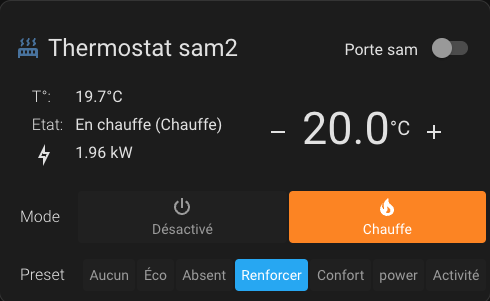
|
||||
Exemple de configuration :
|
||||
|
||||
```
|
||||
@@ -1024,7 +1082,7 @@ Vous pouvez personnaliser ce composant à l'aide du composant HACS card-mod pour
|
||||
}
|
||||
{% endif %}
|
||||
```
|
||||

|
||||
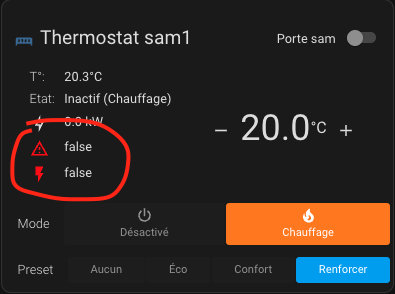
|
||||
|
||||
## Toujours mieux avec Plotly pour régler votre thermostat
|
||||
Vous pouvez obtenir une courbe comme celle présentée dans [some results](#some-results) avec une sorte de configuration de graphique Plotly uniquement en utilisant les attributs personnalisés du thermostat décrits [ici](#custom-attributes) :
|
||||
@@ -1097,7 +1155,7 @@ Remplacez les valeurs entre [[ ]] par les votres.
|
||||
|
||||
Exemple de courbes obtenues avec Plotly :
|
||||
|
||||

|
||||

|
||||
|
||||
## Et toujours de mieux en mieux avec l'AappDaemon NOTIFIER pour notifier les évènements
|
||||
Cette automatisation utilise l'excellente App Daemon nommée NOTIFIER développée par Horizon Domotique que vous trouverez en démonstration [ici](https://www.youtube.com/watch?v=chJylIK0ASo&ab_channel=HorizonDomotique) et le code est [ici](https://github.com/jlpouffier/home-assistant-config/blob/master/appdaemon/apps/notifier.py). Elle permet de notifier les utilisateurs du logement lorsqu'un des évènements touchant à la sécurité survient sur un des Versatile Thermostats.
|
||||
@@ -1193,11 +1251,7 @@ Si vous souhaitez contribuer, veuillez lire les [directives de contribution](CON
|
||||
|
||||
# Dépannages
|
||||
|
||||
<details>
|
||||
<summary>Utilisation d'un Heatzy</summary>
|
||||
|
||||
## Utilisation d'un Heatzy
|
||||
|
||||
L'utilisation d'un Heatzy est possible à la condition d'utiliser un switch virtuel sur ce modèle :
|
||||
```
|
||||
- platform: template
|
||||
@@ -1226,10 +1280,6 @@ L'utilisation d'un Heatzy est possible à la condition d'utiliser un switch virt
|
||||
preset_mode: "eco"
|
||||
```
|
||||
Merci à @gael pour cet exemple.
|
||||
</details>
|
||||
|
||||
<details>
|
||||
<summary>Utilisation d'un radiateur avec un fil pilote</summary>
|
||||
|
||||
## Utilisation d'un radiateur avec un fil pilote
|
||||
Comme pour le Heatzy ci-dessus vous pouvez utiliser un switch virtuel qui va changer le preset de votre radiateur en fonction de l'état d'allumage du VTherm.
|
||||
@@ -1251,58 +1301,10 @@ Exemple :
|
||||
icon_template: "{% if is_state('switch.radiateur_soan', 'on') %}mdi:radiator-disabled{% else %}mdi:radiator{% endif %}"
|
||||
```
|
||||
|
||||
</details>
|
||||
|
||||
<details>
|
||||
<summary>Utilisation d'un radiateur avec un module Nodon</summary>
|
||||
|
||||
## Utilisation d'un radiateur avec un fil pilote
|
||||
Comme pour le Heatzy ci-dessus vous pouvez utiliser un switch virtuel qui va changer le preset de votre radiateur en fonction de l'état d'allumage du VTherm.
|
||||
Exemple :
|
||||
```
|
||||
- platform: template
|
||||
switches:
|
||||
chauffage_chb_parents:
|
||||
unique_id: chauffage_chb_parents
|
||||
friendly_name: Chauffage chambre parents
|
||||
value_template: "{{ is_state('select.fp_chb_parents_pilot_wire_mode', 'comfort') }}"
|
||||
icon_template: >-
|
||||
{% if is_state('select.fp_chb_parents_pilot_wire_mode', 'comfort') %}
|
||||
mdi:radiator
|
||||
{% elif is_state('select.fp_chb_parents_pilot_wire_mode', 'frost_protection') %}
|
||||
mdi:snowflake
|
||||
{% else %}
|
||||
mdi:radiator-disabled
|
||||
{% endif %}
|
||||
turn_on:
|
||||
service: select.select_option
|
||||
target:
|
||||
entity_id: select.fp_chb_parents_pilot_wire_mode
|
||||
data:
|
||||
option: comfort
|
||||
turn_off:
|
||||
service: select.select_option
|
||||
target:
|
||||
entity_id: select.fp_chb_parents_pilot_wire_mode
|
||||
data:
|
||||
option: eco
|
||||
```
|
||||
|
||||
</details>
|
||||
|
||||
<details>
|
||||
<summary>Seul le premier radiateur chauffe</summary>
|
||||
|
||||
## Seul le premier radiateur chauffe
|
||||
|
||||
En mode `over_switch` si plusieurs radiateurs sont configurés pour un même VTherm, l'alllumage va se faire de façon séquentiel pour lisser au plus possible les pics de consommation.
|
||||
Cela est tout à fait normal et voulu. C'est décrit ici : [Pour un thermostat de type ```thermostat_over_switch```](#pour-un-thermostat-de-type-thermostat_over_switch)
|
||||
|
||||
</details>
|
||||
|
||||
<details>
|
||||
<summary>Le radiateur chauffe alors que la température de consigne est dépassée ou ne chauffe pas alors que la température de la pièce est bien en-dessous de la consigne</summary>
|
||||
|
||||
## Le radiateur chauffe alors que la température de consigne est dépassée ou ne chauffe pas alors que la température de la pièce est bien en-dessous de la consigne
|
||||
|
||||
### Type `over_switch` ou `over_valve`
|
||||
@@ -1311,13 +1313,10 @@ Avec un VTherm de type `over_switch` ou `over_valve`, ce défaut montre juste qu
|
||||
### Type `over_climate`
|
||||
Avec un VTherm de type `over_climate`, la régulation est faite par le `climate` sous-jacent directement et VTherm se contente de lui transmettre les consignes. Donc si le radiateur chauffe alors que la température de consigne est dépassée, c'est certainement que sa mesure de température interne est biaisée. Ca arrive très souvent avec les TRV et les clims réversibles qui ont un capteur de température interne, soit trop près de l'élément de chauffe (donc trop froid l'hiver).
|
||||
|
||||
Exemple de discussion autour de ces sujets: [#348](https://github.com/jmcollin78/versatile_thermostat/issues/348), [#316](https://github.com/jmcollin78/versatile_thermostat/issues/316), [#312](https://github.com/jmcollin78/versatile_thermostat/discussions/312), [#278](https://github.com/jmcollin78/versatile_thermostat/discussions/278)
|
||||
Exemple de discussion autour de ces sujets: [#316](https://github.com/jmcollin78/versatile_thermostat/issues/316), [#312](https://github.com/jmcollin78/versatile_thermostat/discussions/312), [#278](https://github.com/jmcollin78/versatile_thermostat/discussions/278)
|
||||
|
||||
Pour s'en sortir, VTherm est équipé d'une fonction nommée auto-régulation qui permet d'adapter la consigne envoyée au sous-jacent jusqu'à ce que la consigne soit respectée. Cette fonction permet de compenser le biais de mesure des thermomètres internes. Si le biais est important la régulation doit être importante. Voir [L'auto-régulation](#lauto-régulation) pour configurer l'auto-régulation.
|
||||
</details>
|
||||
|
||||
<details>
|
||||
<summary>Régler les paramètres de détection d'ouverture de fenêtre en mode auto</summary>
|
||||
|
||||
## Régler les paramètres de détection d'ouverture de fenêtre en mode auto
|
||||
|
||||
@@ -1338,13 +1337,9 @@ versatile_thermostat:
|
||||
```
|
||||
|
||||
Ces paramètres sont sensibles et assez difficiles à régler. Merci de ne les utiliser que si vous savez ce que vous faites et que vos mesures de température ne sont pas déjà lisses.
|
||||
</details>
|
||||
|
||||
<details>
|
||||
<summary>Pourquoi mon Versatile Thermostat se met en Securite ?</summary>
|
||||
|
||||
## Pourquoi mon Versatile Thermostat se met en Securite ?
|
||||
Le mode sécurité est possible sur tous les types de VTherm . Il survient lorsqu'un des 2 thermomètres qui donne la température de la pièce ou la température extérieure n'a pas envoyé de valeur depuis plus de `security_delay_min` minutes et que le radiateur chauffait à au moins `security_min_on_percent`.
|
||||
Le mode sécurité n'est possible que sur les VTherm `over_switch` et `over_valve`. Il survient lorsqu'un des 2 thermomètres qui donne la température de la pièce ou la température extérieure n'a pas envoyé de valeur depuis plus de `security_delay_min` minutes et que le radiateur chauffait à au moins `security_min_on_percent`.
|
||||
|
||||
Comme l'algorithme est basé sur les mesures de température, si elles ne sont plus reçues par le VTherm, il y a un risque de surchauffe et d'incendie. Pour éviter ça, lorsque les conditions rappelées ci-dessus sont détectées, la chauffe est limité au paramètre `security_default_on_percent`. Cette valeur doit donc être raisonnablement faible (10% est une bonne valeur). Elle permet d'éviter un incendie tout en évitant de couper totalement le radiateur (risque de gel).
|
||||
|
||||
@@ -1354,11 +1349,11 @@ Tous ces paramètres se règlent dans la dernière page de la configuration du V
|
||||
Le premier symptôme est une température anormalement basse avec un temps de chauffe faible à chaque cycle et régulier.
|
||||
Exemple:
|
||||
|
||||
[security mode](images/security-mode-symptome1.png)
|
||||
[security mode](https://github.com/jmcollin78/versatile_thermostat/blob/main/images/security-mode-symptome1.png?raw=true)
|
||||
|
||||
Si vous avez installé la carte [Versatile Thermostat UI Card](https://github.com/jmcollin78/versatile-thermostat-ui-card), le VTherm en question aura cette forme là :
|
||||
|
||||
[security mode UI Card](images/security-mode-symptome2.png)
|
||||
[security mode UI Card](https://github.com/jmcollin78/versatile_thermostat/blob/main/images/security-mode-symptome2.png?raw=true)
|
||||
|
||||
Vous pouvez aussi vérifier dans les attributs du VTherm les dates de réception des différentes dates. **Les attributs sont disponibles dans les Outils de développement / Etats**.
|
||||
|
||||
@@ -1389,13 +1384,8 @@ Cela va dépendre de la cause du problème :
|
||||
2. Si le paramètre `security_delay_min` est trop petit, cela rsique de générer beaucoup de fausses alertes. Une valeur correcte est de l'ordre de 60 min, surtout si vous avez des capteurs de température à pile.
|
||||
3. Certains capteurs de température, n'envoie pas de mesure si la température n'a pas changée. Donc en cas de température très stable pendant longtemps, le mode sécurité peut se déclencher. Ce n'est pas très grave puisqu'il s'enlève dès que le VTherm reçoit à nouveau une température. Sur certain thermomètre (TuYA par exemple), on peut forcer le délai max entre 2 mesures. Il conviendra de mettre un délai max < `security_delay_min`,
|
||||
4. Dès que la température sera a nouveau reçue le mode sécurité s'enlèvera et les valeurs précédentes de preset, température cible et mode seront restaurées.
|
||||
</details>
|
||||
|
||||
<details>
|
||||
<summary>Utilisation d'un groupe de personnes comme capteur de présence</summary>
|
||||
|
||||
## Utilisation d'un groupe de personnes comme capteur de présence
|
||||
|
||||
Malheureusement, les groupes de personnes ne sont pas reconnus comme des capteurs de présence. On ne peut donc pas les utiliser directement dans VTherm.
|
||||
Le contournement est de créer un template de binary_sensor avec le code suivant :
|
||||
|
||||
@@ -1416,21 +1406,6 @@ Fichier `configuration.yaml`:
|
||||
template: !include templates.yaml
|
||||
...
|
||||
```
|
||||
</details>
|
||||
|
||||
<details>
|
||||
<summary>Activer les logs du Versatile Thermostat</summary>
|
||||
|
||||
## Activer les logs du Versatile Thermostat
|
||||
Des fois, vous aurez besoin d'activer les logs pour afiner les analyses. Pour cela, éditer le fichier `logger.yaml` de votre configuration et configurer les logs comme suit :
|
||||
```
|
||||
default: xxxx
|
||||
logs:
|
||||
custom_components.versatile_thermostat: info
|
||||
```
|
||||
Vous devez recharger la configuration yaml (Outils de dev / Yaml / Toute la configuration Yaml) ou redémarrer Home Assistant pour que ce changement soit pris en compte.
|
||||
|
||||
</details>
|
||||
|
||||
***
|
||||
|
||||
|
||||
@@ -43,13 +43,4 @@ case $1 in
|
||||
pwd
|
||||
./scripts/starts_ha.sh
|
||||
;;
|
||||
coverage)
|
||||
rm -rf htmlcov/*
|
||||
echo "Starting coverage tests"
|
||||
coverage run -m pytest tests/
|
||||
echo "Starting coverage report"
|
||||
coverage report
|
||||
echo "Starting coverage html"
|
||||
coverage html
|
||||
;;
|
||||
esac
|
||||
|
||||
@@ -1,7 +0,0 @@
|
||||
Before copying to forum you need to replace relative images by this command into VSCode:
|
||||
|
||||
Search :
|
||||
\(images/(.*).png\)
|
||||
|
||||
Replace with:
|
||||
(https://github.com/jmcollin78/versatile_thermostat/blob/main/images/$1.png?raw=true)
|
||||
@@ -1,5 +1,4 @@
|
||||
"""The Versatile Thermostat integration."""
|
||||
|
||||
from __future__ import annotations
|
||||
|
||||
from typing import Dict
|
||||
@@ -9,52 +8,24 @@ import logging
|
||||
import voluptuous as vol
|
||||
import homeassistant.helpers.config_validation as cv
|
||||
|
||||
from homeassistant.const import SERVICE_RELOAD, EVENT_HOMEASSISTANT_STARTED
|
||||
from homeassistant.const import SERVICE_RELOAD
|
||||
|
||||
from homeassistant.config_entries import ConfigEntry, ConfigType
|
||||
from homeassistant.core import HomeAssistant, CoreState, callback
|
||||
from homeassistant.helpers.service import async_register_admin_service
|
||||
from homeassistant.core import HomeAssistant
|
||||
|
||||
from .base_thermostat import BaseThermostat
|
||||
|
||||
from .const import (
|
||||
DOMAIN,
|
||||
PLATFORMS,
|
||||
CONFIG_VERSION,
|
||||
CONFIG_MINOR_VERSION,
|
||||
CONF_AUTO_REGULATION_LIGHT,
|
||||
CONF_AUTO_REGULATION_MEDIUM,
|
||||
CONF_AUTO_REGULATION_STRONG,
|
||||
CONF_AUTO_REGULATION_SLOW,
|
||||
CONF_AUTO_REGULATION_EXPERT,
|
||||
CONF_SHORT_EMA_PARAMS,
|
||||
CONF_SAFETY_MODE,
|
||||
CONF_THERMOSTAT_CENTRAL_CONFIG,
|
||||
CONF_THERMOSTAT_TYPE,
|
||||
CONF_USE_WINDOW_FEATURE,
|
||||
CONF_USE_MOTION_FEATURE,
|
||||
CONF_USE_PRESENCE_FEATURE,
|
||||
CONF_USE_POWER_FEATURE,
|
||||
CONF_USE_CENTRAL_BOILER_FEATURE,
|
||||
CONF_POWER_SENSOR,
|
||||
CONF_PRESENCE_SENSOR,
|
||||
CONF_UNDERLYING_LIST,
|
||||
CONF_HEATER,
|
||||
CONF_HEATER_2,
|
||||
CONF_HEATER_3,
|
||||
CONF_HEATER_4,
|
||||
CONF_CLIMATE,
|
||||
CONF_CLIMATE_2,
|
||||
CONF_CLIMATE_3,
|
||||
CONF_CLIMATE_4,
|
||||
CONF_VALVE,
|
||||
CONF_VALVE_2,
|
||||
CONF_VALVE_3,
|
||||
CONF_VALVE_4,
|
||||
CONF_THERMOSTAT_SWITCH,
|
||||
CONF_THERMOSTAT_CLIMATE,
|
||||
CONF_THERMOSTAT_VALVE,
|
||||
CONF_MAX_ON_PERCENT,
|
||||
)
|
||||
|
||||
from .vtherm_api import VersatileThermostatAPI
|
||||
@@ -76,18 +47,12 @@ EMA_PARAM_SCHEMA = {
|
||||
vol.Required("precision"): cv.positive_int,
|
||||
}
|
||||
|
||||
SAFETY_MODE_PARAM_SCHEMA = {
|
||||
vol.Required("check_outdoor_sensor"): bool,
|
||||
}
|
||||
|
||||
CONFIG_SCHEMA = vol.Schema(
|
||||
{
|
||||
DOMAIN: vol.Schema(
|
||||
{
|
||||
CONF_AUTO_REGULATION_EXPERT: vol.Schema(SELF_REGULATION_PARAM_SCHEMA),
|
||||
CONF_SHORT_EMA_PARAMS: vol.Schema(EMA_PARAM_SCHEMA),
|
||||
CONF_SAFETY_MODE: vol.Schema(SAFETY_MODE_PARAM_SCHEMA),
|
||||
vol.Optional(CONF_MAX_ON_PERCENT): vol.Coerce(float),
|
||||
}
|
||||
),
|
||||
},
|
||||
@@ -111,31 +76,16 @@ async def async_setup(
|
||||
|
||||
hass.data.setdefault(DOMAIN, {})
|
||||
|
||||
api: VersatileThermostatAPI = VersatileThermostatAPI.get_vtherm_api(hass)
|
||||
# L'argument config contient votre fichier configuration.yaml
|
||||
vtherm_config = config.get(DOMAIN)
|
||||
|
||||
if vtherm_config is not None:
|
||||
api: VersatileThermostatAPI = VersatileThermostatAPI.get_vtherm_api(hass)
|
||||
api.set_global_config(vtherm_config)
|
||||
else:
|
||||
_LOGGER.info("No global config from configuration.yaml available")
|
||||
|
||||
# Listen HA starts to initialize all links between
|
||||
@callback
|
||||
async def _async_startup_internal(*_):
|
||||
_LOGGER.info(
|
||||
"VersatileThermostat - HA is started, initialize all links between VTherm entities"
|
||||
)
|
||||
await api.init_vtherm_links()
|
||||
await api.notify_central_mode_change()
|
||||
await api.reload_central_boiler_entities_list()
|
||||
|
||||
if hass.state == CoreState.running:
|
||||
await _async_startup_internal()
|
||||
else:
|
||||
hass.bus.async_listen_once(EVENT_HOMEASSISTANT_STARTED, _async_startup_internal)
|
||||
|
||||
async_register_admin_service(
|
||||
hass,
|
||||
hass.helpers.service.async_register_admin_service(
|
||||
DOMAIN,
|
||||
SERVICE_RELOAD,
|
||||
_handle_reload,
|
||||
@@ -158,7 +108,6 @@ async def reload_all_vtherm(hass):
|
||||
api: VersatileThermostatAPI = VersatileThermostatAPI.get_vtherm_api(hass)
|
||||
if api:
|
||||
await api.reload_central_boiler_entities_list()
|
||||
await api.init_vtherm_links()
|
||||
|
||||
|
||||
async def async_setup_entry(hass: HomeAssistant, entry: ConfigEntry) -> bool:
|
||||
@@ -178,22 +127,11 @@ async def async_setup_entry(hass: HomeAssistant, entry: ConfigEntry) -> bool:
|
||||
|
||||
await hass.config_entries.async_forward_entry_setups(entry, PLATFORMS)
|
||||
|
||||
if hass.state == CoreState.running:
|
||||
await api.reload_central_boiler_entities_list()
|
||||
await api.init_vtherm_links(entry.entry_id)
|
||||
|
||||
return True
|
||||
|
||||
|
||||
async def update_listener(hass: HomeAssistant, entry: ConfigEntry) -> None:
|
||||
"""Update listener."""
|
||||
|
||||
_LOGGER.debug(
|
||||
"Calling update_listener entry: entry_id='%s', value='%s'",
|
||||
entry.entry_id,
|
||||
entry.data,
|
||||
)
|
||||
|
||||
if entry.data.get(CONF_THERMOSTAT_TYPE) == CONF_THERMOSTAT_CENTRAL_CONFIG:
|
||||
await reload_all_vtherm(hass)
|
||||
else:
|
||||
@@ -202,7 +140,6 @@ async def update_listener(hass: HomeAssistant, entry: ConfigEntry) -> None:
|
||||
api: VersatileThermostatAPI = VersatileThermostatAPI.get_vtherm_api(hass)
|
||||
if api is not None:
|
||||
await api.reload_central_boiler_entities_list()
|
||||
await api.init_vtherm_links(entry.entry_id)
|
||||
|
||||
|
||||
async def async_unload_entry(hass: HomeAssistant, entry: ConfigEntry) -> bool:
|
||||
@@ -220,83 +157,15 @@ async def async_unload_entry(hass: HomeAssistant, entry: ConfigEntry) -> bool:
|
||||
# Example migration function
|
||||
async def async_migrate_entry(hass: HomeAssistant, config_entry: ConfigEntry):
|
||||
"""Migrate old entry."""
|
||||
_LOGGER.debug(
|
||||
"Migrating from version %s/%s", config_entry.version, config_entry.minor_version
|
||||
)
|
||||
_LOGGER.debug("Migrating from version %s", config_entry.version)
|
||||
|
||||
if (
|
||||
config_entry.version != CONFIG_VERSION
|
||||
or config_entry.minor_version != CONFIG_MINOR_VERSION
|
||||
):
|
||||
_LOGGER.debug(
|
||||
"Migration to %s/%s is needed", CONFIG_VERSION, CONFIG_MINOR_VERSION
|
||||
)
|
||||
if config_entry.version == 1:
|
||||
new = {**config_entry.data}
|
||||
# TO DO: modify Config Entry data if there will be something to migrate
|
||||
|
||||
thermostat_type = config_entry.data.get(CONF_THERMOSTAT_TYPE)
|
||||
config_entry.version = 2
|
||||
hass.config_entries.async_update_entry(config_entry, data=new)
|
||||
|
||||
if thermostat_type == CONF_THERMOSTAT_CENTRAL_CONFIG:
|
||||
new[CONF_USE_WINDOW_FEATURE] = True
|
||||
new[CONF_USE_MOTION_FEATURE] = True
|
||||
new[CONF_USE_POWER_FEATURE] = new.get(CONF_POWER_SENSOR, None) is not None
|
||||
new[CONF_USE_PRESENCE_FEATURE] = (
|
||||
new.get(CONF_PRESENCE_SENSOR, None) is not None
|
||||
)
|
||||
|
||||
new[CONF_USE_CENTRAL_BOILER_FEATURE] = new.get(
|
||||
"add_central_boiler_control", False
|
||||
) or new.get(CONF_USE_CENTRAL_BOILER_FEATURE, False)
|
||||
|
||||
if config_entry.data.get(CONF_UNDERLYING_LIST, None) is None:
|
||||
underlying_list = []
|
||||
if thermostat_type == CONF_THERMOSTAT_SWITCH:
|
||||
underlying_list = [
|
||||
config_entry.data.get(CONF_HEATER, None),
|
||||
config_entry.data.get(CONF_HEATER_2, None),
|
||||
config_entry.data.get(CONF_HEATER_3, None),
|
||||
config_entry.data.get(CONF_HEATER_4, None),
|
||||
]
|
||||
elif thermostat_type == CONF_THERMOSTAT_CLIMATE:
|
||||
underlying_list = [
|
||||
config_entry.data.get(CONF_CLIMATE, None),
|
||||
config_entry.data.get(CONF_CLIMATE_2, None),
|
||||
config_entry.data.get(CONF_CLIMATE_3, None),
|
||||
config_entry.data.get(CONF_CLIMATE_4, None),
|
||||
]
|
||||
elif thermostat_type == CONF_THERMOSTAT_VALVE:
|
||||
underlying_list = [
|
||||
config_entry.data.get(CONF_VALVE, None),
|
||||
config_entry.data.get(CONF_VALVE_2, None),
|
||||
config_entry.data.get(CONF_VALVE_3, None),
|
||||
config_entry.data.get(CONF_VALVE_4, None),
|
||||
]
|
||||
|
||||
new[CONF_UNDERLYING_LIST] = [
|
||||
entity for entity in underlying_list if entity is not None
|
||||
]
|
||||
|
||||
for key in [
|
||||
CONF_HEATER,
|
||||
CONF_HEATER_2,
|
||||
CONF_HEATER_3,
|
||||
CONF_HEATER_4,
|
||||
CONF_CLIMATE,
|
||||
CONF_CLIMATE_2,
|
||||
CONF_CLIMATE_3,
|
||||
CONF_CLIMATE_4,
|
||||
CONF_VALVE,
|
||||
CONF_VALVE_2,
|
||||
CONF_VALVE_3,
|
||||
CONF_VALVE_4,
|
||||
]:
|
||||
new.pop(key, None)
|
||||
|
||||
hass.config_entries.async_update_entry(
|
||||
config_entry,
|
||||
data=new,
|
||||
version=CONFIG_VERSION,
|
||||
minor_version=CONFIG_MINOR_VERSION,
|
||||
)
|
||||
_LOGGER.info("Migration to version %s successful", config_entry.version)
|
||||
_LOGGER.info("Migration to version %s successful", config_entry.version)
|
||||
|
||||
return True
|
||||
|
||||
@@ -1,239 +0,0 @@
|
||||
# pylint: disable=line-too-long
|
||||
""" This file implements the Auto start/stop algorithm as described here: https://github.com/jmcollin78/versatile_thermostat/issues/585
|
||||
"""
|
||||
|
||||
import logging
|
||||
from datetime import datetime
|
||||
from typing import Literal
|
||||
|
||||
from homeassistant.components.climate import HVACMode
|
||||
|
||||
from .const import (
|
||||
AUTO_START_STOP_LEVEL_NONE,
|
||||
AUTO_START_STOP_LEVEL_FAST,
|
||||
AUTO_START_STOP_LEVEL_MEDIUM,
|
||||
AUTO_START_STOP_LEVEL_SLOW,
|
||||
TYPE_AUTO_START_STOP_LEVELS,
|
||||
)
|
||||
|
||||
|
||||
_LOGGER = logging.getLogger(__name__)
|
||||
|
||||
# Some constant to make algorithm depending of level
|
||||
DT_MIN = {
|
||||
AUTO_START_STOP_LEVEL_NONE: 0, # Not used
|
||||
AUTO_START_STOP_LEVEL_SLOW: 30,
|
||||
AUTO_START_STOP_LEVEL_MEDIUM: 15,
|
||||
AUTO_START_STOP_LEVEL_FAST: 7,
|
||||
}
|
||||
|
||||
# the measurement cycle (2 min)
|
||||
CYCLE_SEC = 120
|
||||
|
||||
# A temp hysteresis to avoid rapid OFF/ON
|
||||
TEMP_HYSTERESIS = 0.5
|
||||
|
||||
ERROR_THRESHOLD = {
|
||||
AUTO_START_STOP_LEVEL_NONE: 0, # Not used
|
||||
AUTO_START_STOP_LEVEL_SLOW: 10, # 10 cycle above 1° or 5 cycle above 2°, ...
|
||||
AUTO_START_STOP_LEVEL_MEDIUM: 5, # 5 cycle above 1° or 3 cycle above 2°, ..., 1 cycle above 5°
|
||||
AUTO_START_STOP_LEVEL_FAST: 2, # 2 cycle above 1° or 1 cycle above 2°
|
||||
}
|
||||
|
||||
AUTO_START_STOP_ACTION_OFF = "turnOff"
|
||||
AUTO_START_STOP_ACTION_ON = "turnOn"
|
||||
AUTO_START_STOP_ACTION_NOTHING = "nothing"
|
||||
AUTO_START_STOP_ACTIONS = Literal[ # pylint: disable=invalid-name
|
||||
AUTO_START_STOP_ACTION_OFF,
|
||||
AUTO_START_STOP_ACTION_ON,
|
||||
AUTO_START_STOP_ACTION_NOTHING,
|
||||
]
|
||||
|
||||
class AutoStartStopDetectionAlgorithm:
|
||||
"""The class that implements the algorithm listed above"""
|
||||
|
||||
_dt: float | None = None
|
||||
_level: str = AUTO_START_STOP_LEVEL_NONE
|
||||
_accumulated_error: float = 0
|
||||
_error_threshold: float | None = None
|
||||
_last_calculation_date: datetime | None = None
|
||||
|
||||
def __init__(self, level: TYPE_AUTO_START_STOP_LEVELS, vtherm_name) -> None:
|
||||
"""Initalize a new algorithm with the right constants"""
|
||||
self._vtherm_name = vtherm_name
|
||||
self._init_level(level)
|
||||
|
||||
def _init_level(self, level: TYPE_AUTO_START_STOP_LEVELS):
|
||||
"""Initialize a new level"""
|
||||
if level == self._level:
|
||||
return
|
||||
|
||||
self._level = level
|
||||
if self._level != AUTO_START_STOP_LEVEL_NONE:
|
||||
self._dt = DT_MIN[level]
|
||||
self._error_threshold = ERROR_THRESHOLD[level]
|
||||
# reset accumulated error if we change the level
|
||||
self._accumulated_error = 0
|
||||
|
||||
def calculate_action(
|
||||
self,
|
||||
hvac_mode: HVACMode | None,
|
||||
saved_hvac_mode: HVACMode | None,
|
||||
target_temp: float,
|
||||
current_temp: float,
|
||||
slope_min: float | None,
|
||||
now: datetime,
|
||||
) -> AUTO_START_STOP_ACTIONS:
|
||||
"""Calculate an eventual action to do depending of the value in parameter"""
|
||||
if self._level == AUTO_START_STOP_LEVEL_NONE:
|
||||
_LOGGER.debug(
|
||||
"%s - auto-start/stop is disabled",
|
||||
self,
|
||||
)
|
||||
return AUTO_START_STOP_ACTION_NOTHING
|
||||
|
||||
_LOGGER.debug(
|
||||
"%s - calculate_action: hvac_mode=%s, saved_hvac_mode=%s, target_temp=%s, current_temp=%s, slope_min=%s at %s",
|
||||
self,
|
||||
hvac_mode,
|
||||
saved_hvac_mode,
|
||||
target_temp,
|
||||
current_temp,
|
||||
slope_min,
|
||||
now,
|
||||
)
|
||||
|
||||
if hvac_mode is None or target_temp is None or current_temp is None:
|
||||
_LOGGER.debug(
|
||||
"%s - No all mandatory parameters are set. Disable auto-start/stop",
|
||||
self,
|
||||
)
|
||||
return AUTO_START_STOP_ACTION_NOTHING
|
||||
|
||||
# Calculate the error factor (P)
|
||||
error = target_temp - current_temp
|
||||
|
||||
# reduce the error considering the dt between the last measurement
|
||||
if self._last_calculation_date is not None:
|
||||
dtmin = (now - self._last_calculation_date).total_seconds() / CYCLE_SEC
|
||||
# ignore two calls too near (< 24 sec)
|
||||
if dtmin <= 0.2:
|
||||
_LOGGER.debug(
|
||||
"%s - new calculation of auto_start_stop (%s) is too near of the last one (%s). Forget it",
|
||||
self,
|
||||
now,
|
||||
self._last_calculation_date,
|
||||
)
|
||||
return AUTO_START_STOP_ACTION_NOTHING
|
||||
error = error * dtmin
|
||||
|
||||
# If the error have change its sign, reset smoothly the accumulated error
|
||||
if error * self._accumulated_error < 0:
|
||||
self._accumulated_error = self._accumulated_error / 2.0
|
||||
|
||||
self._accumulated_error += error
|
||||
|
||||
# Capping of the error
|
||||
self._accumulated_error = min(
|
||||
self._error_threshold,
|
||||
max(-self._error_threshold, self._accumulated_error),
|
||||
)
|
||||
|
||||
self._last_calculation_date = now
|
||||
|
||||
temp_at_dt = current_temp + slope_min * self._dt
|
||||
|
||||
# Check to turn-off
|
||||
# When we hit the threshold, that mean we can turn off
|
||||
if hvac_mode == HVACMode.HEAT:
|
||||
if (
|
||||
self._accumulated_error <= -self._error_threshold
|
||||
and temp_at_dt >= target_temp + TEMP_HYSTERESIS
|
||||
):
|
||||
_LOGGER.info(
|
||||
"%s - We need to stop, there is no need for heating for a long time.",
|
||||
self,
|
||||
)
|
||||
return AUTO_START_STOP_ACTION_OFF
|
||||
else:
|
||||
_LOGGER.debug("%s - nothing to do, we are heating", self)
|
||||
return AUTO_START_STOP_ACTION_NOTHING
|
||||
|
||||
if hvac_mode == HVACMode.COOL:
|
||||
if (
|
||||
self._accumulated_error >= self._error_threshold
|
||||
and temp_at_dt <= target_temp - TEMP_HYSTERESIS
|
||||
):
|
||||
_LOGGER.info(
|
||||
"%s - We need to stop, there is no need for cooling for a long time.",
|
||||
self,
|
||||
)
|
||||
return AUTO_START_STOP_ACTION_OFF
|
||||
else:
|
||||
_LOGGER.debug(
|
||||
"%s - nothing to do, we are cooling",
|
||||
self,
|
||||
)
|
||||
return AUTO_START_STOP_ACTION_NOTHING
|
||||
|
||||
# check to turn on
|
||||
if hvac_mode == HVACMode.OFF and saved_hvac_mode == HVACMode.HEAT:
|
||||
if temp_at_dt <= target_temp - TEMP_HYSTERESIS:
|
||||
_LOGGER.info(
|
||||
"%s - We need to start, because it will be time to heat",
|
||||
self,
|
||||
)
|
||||
return AUTO_START_STOP_ACTION_ON
|
||||
else:
|
||||
_LOGGER.debug(
|
||||
"%s - nothing to do, we don't need to heat soon",
|
||||
self,
|
||||
)
|
||||
return AUTO_START_STOP_ACTION_NOTHING
|
||||
|
||||
if hvac_mode == HVACMode.OFF and saved_hvac_mode == HVACMode.COOL:
|
||||
if temp_at_dt >= target_temp + TEMP_HYSTERESIS:
|
||||
_LOGGER.info(
|
||||
"%s - We need to start, because it will be time to cool",
|
||||
self,
|
||||
)
|
||||
return AUTO_START_STOP_ACTION_ON
|
||||
else:
|
||||
_LOGGER.debug(
|
||||
"%s - nothing to do, we don't need to cool soon",
|
||||
self,
|
||||
)
|
||||
return AUTO_START_STOP_ACTION_NOTHING
|
||||
|
||||
_LOGGER.debug(
|
||||
"%s - nothing to do, no conditions applied",
|
||||
self,
|
||||
)
|
||||
return AUTO_START_STOP_ACTION_NOTHING
|
||||
|
||||
def set_level(self, level: TYPE_AUTO_START_STOP_LEVELS):
|
||||
"""Set a new level"""
|
||||
self._init_level(level)
|
||||
|
||||
@property
|
||||
def dt_min(self) -> float:
|
||||
"""Get the dt value"""
|
||||
return self._dt
|
||||
|
||||
@property
|
||||
def accumulated_error(self) -> float:
|
||||
"""Get the accumulated error value"""
|
||||
return self._accumulated_error
|
||||
|
||||
@property
|
||||
def accumulated_error_threshold(self) -> float:
|
||||
"""Get the accumulated error threshold value"""
|
||||
return self._error_threshold
|
||||
|
||||
@property
|
||||
def level(self) -> TYPE_AUTO_START_STOP_LEVELS:
|
||||
"""Get the level value"""
|
||||
return self._level
|
||||
|
||||
def __str__(self) -> str:
|
||||
return f"AutoStartStopDetectionAlgorithm-{self._vtherm_name}"
|
||||
@@ -1,5 +1,5 @@
|
||||
""" Implements the VersatileThermostat binary sensors component """
|
||||
# pylint: disable=unused-argument, line-too-long
|
||||
# pylint: disable=unused-argument
|
||||
|
||||
import logging
|
||||
|
||||
@@ -7,13 +7,14 @@ from homeassistant.core import (
|
||||
HomeAssistant,
|
||||
callback,
|
||||
Event,
|
||||
# CoreState,
|
||||
CoreState,
|
||||
HomeAssistantError,
|
||||
)
|
||||
|
||||
from homeassistant.const import STATE_ON, STATE_OFF # , EVENT_HOMEASSISTANT_START
|
||||
from homeassistant.const import STATE_ON, STATE_OFF, EVENT_HOMEASSISTANT_START
|
||||
|
||||
from homeassistant.helpers.device_registry import DeviceInfo, DeviceEntryType
|
||||
from homeassistant.helpers.entity_component import EntityComponent
|
||||
from homeassistant.helpers.event import async_track_state_change_event
|
||||
|
||||
from homeassistant.components.binary_sensor import (
|
||||
@@ -24,6 +25,14 @@ from homeassistant.config_entries import ConfigEntry
|
||||
|
||||
from homeassistant.helpers.entity_platform import AddEntitiesCallback
|
||||
|
||||
from homeassistant.components.climate import (
|
||||
ClimateEntity,
|
||||
HVACMode,
|
||||
HVACAction,
|
||||
DOMAIN as CLIMATE_DOMAIN,
|
||||
)
|
||||
|
||||
from custom_components.versatile_thermostat.base_thermostat import BaseThermostat
|
||||
from .vtherm_api import VersatileThermostatAPI
|
||||
from .commons import (
|
||||
VersatileThermostatBaseEntity,
|
||||
@@ -39,7 +48,6 @@ from .const import (
|
||||
CONF_USE_WINDOW_FEATURE,
|
||||
CONF_THERMOSTAT_TYPE,
|
||||
CONF_THERMOSTAT_CENTRAL_CONFIG,
|
||||
CONF_USE_CENTRAL_BOILER_FEATURE,
|
||||
CONF_CENTRAL_BOILER_ACTIVATION_SRV,
|
||||
CONF_CENTRAL_BOILER_DEACTIVATION_SRV,
|
||||
overrides,
|
||||
@@ -64,13 +72,10 @@ async def async_setup_entry(
|
||||
name = entry.data.get(CONF_NAME)
|
||||
vt_type = entry.data.get(CONF_THERMOSTAT_TYPE)
|
||||
|
||||
entities = None
|
||||
|
||||
if vt_type == CONF_THERMOSTAT_CENTRAL_CONFIG:
|
||||
if entry.data.get(CONF_USE_CENTRAL_BOILER_FEATURE):
|
||||
entities = [
|
||||
CentralBoilerBinarySensor(hass, unique_id, name, entry.data),
|
||||
]
|
||||
entities = [
|
||||
CentralBoilerBinarySensor(hass, unique_id, name, entry.data),
|
||||
]
|
||||
else:
|
||||
entities = [
|
||||
SecurityBinarySensor(hass, unique_id, name, entry.data),
|
||||
@@ -85,8 +90,7 @@ async def async_setup_entry(
|
||||
if entry.data.get(CONF_USE_POWER_FEATURE):
|
||||
entities.append(OverpoweringBinarySensor(hass, unique_id, name, entry.data))
|
||||
|
||||
if entities:
|
||||
async_add_entities(entities, True)
|
||||
async_add_entities(entities, True)
|
||||
|
||||
|
||||
class SecurityBinarySensor(VersatileThermostatBaseEntity, BinarySensorEntity):
|
||||
@@ -100,7 +104,7 @@ class SecurityBinarySensor(VersatileThermostatBaseEntity, BinarySensorEntity):
|
||||
entry_infos,
|
||||
) -> None:
|
||||
"""Initialize the SecurityState Binary sensor"""
|
||||
super().__init__(hass, unique_id, name)
|
||||
super().__init__(hass, unique_id, entry_infos.get(CONF_NAME))
|
||||
self._attr_name = "Security state"
|
||||
self._attr_unique_id = f"{self._device_name}_security_state"
|
||||
self._attr_is_on = False
|
||||
@@ -108,7 +112,7 @@ class SecurityBinarySensor(VersatileThermostatBaseEntity, BinarySensorEntity):
|
||||
@callback
|
||||
async def async_my_climate_changed(self, event: Event = None):
|
||||
"""Called when my climate have change"""
|
||||
# _LOGGER.debug("%s - climate state change", self._attr_unique_id)
|
||||
_LOGGER.debug("%s - climate state change", self._attr_unique_id)
|
||||
|
||||
old_state = self._attr_is_on
|
||||
self._attr_is_on = self.my_climate.security_state is True
|
||||
@@ -147,7 +151,7 @@ class OverpoweringBinarySensor(VersatileThermostatBaseEntity, BinarySensorEntity
|
||||
@callback
|
||||
async def async_my_climate_changed(self, event: Event = None):
|
||||
"""Called when my climate have change"""
|
||||
# _LOGGER.debug("%s - climate state change", self._attr_unique_id)
|
||||
_LOGGER.debug("%s - climate state change", self._attr_unique_id)
|
||||
|
||||
old_state = self._attr_is_on
|
||||
self._attr_is_on = self.my_climate.overpowering_state is True
|
||||
@@ -186,7 +190,7 @@ class WindowBinarySensor(VersatileThermostatBaseEntity, BinarySensorEntity):
|
||||
@callback
|
||||
async def async_my_climate_changed(self, event: Event = None):
|
||||
"""Called when my climate have change"""
|
||||
# _LOGGER.debug("%s - climate state change", self._attr_unique_id)
|
||||
_LOGGER.debug("%s - climate state change", self._attr_unique_id)
|
||||
|
||||
old_state = self._attr_is_on
|
||||
# Issue 120 - only take defined presence value
|
||||
@@ -236,7 +240,7 @@ class MotionBinarySensor(VersatileThermostatBaseEntity, BinarySensorEntity):
|
||||
@callback
|
||||
async def async_my_climate_changed(self, event: Event = None):
|
||||
"""Called when my climate have change"""
|
||||
# _LOGGER.debug("%s - climate state change", self._attr_unique_id)
|
||||
_LOGGER.debug("%s - climate state change", self._attr_unique_id)
|
||||
old_state = self._attr_is_on
|
||||
# Issue 120 - only take defined presence value
|
||||
if self.my_climate.motion_state in [STATE_ON, STATE_OFF]:
|
||||
@@ -277,7 +281,7 @@ class PresenceBinarySensor(VersatileThermostatBaseEntity, BinarySensorEntity):
|
||||
async def async_my_climate_changed(self, event: Event = None):
|
||||
"""Called when my climate have change"""
|
||||
|
||||
# _LOGGER.debug("%s - climate state change", self._attr_unique_id)
|
||||
_LOGGER.debug("%s - climate state change", self._attr_unique_id)
|
||||
old_state = self._attr_is_on
|
||||
# Issue 120 - only take defined presence value
|
||||
if self.my_climate.presence_state in [STATE_ON, STATE_OFF]:
|
||||
@@ -317,7 +321,7 @@ class WindowByPassBinarySensor(VersatileThermostatBaseEntity, BinarySensorEntity
|
||||
@callback
|
||||
async def async_my_climate_changed(self, event: Event = None):
|
||||
"""Called when my climate have change"""
|
||||
# _LOGGER.debug("%s - climate state change", self._attr_unique_id)
|
||||
_LOGGER.debug("%s - climate state change", self._attr_unique_id)
|
||||
old_state = self._attr_is_on
|
||||
if self.my_climate.window_bypass_state in [True, False]:
|
||||
self._attr_is_on = self.my_climate.window_bypass_state
|
||||
@@ -388,44 +392,45 @@ class CentralBoilerBinarySensor(BinarySensorEntity):
|
||||
async def async_added_to_hass(self) -> None:
|
||||
await super().async_added_to_hass()
|
||||
|
||||
api: VersatileThermostatAPI = VersatileThermostatAPI.get_vtherm_api(self._hass)
|
||||
api.register_central_boiler(self)
|
||||
@callback
|
||||
async def _async_startup_internal(*_):
|
||||
_LOGGER.debug("%s - Calling async_startup_internal", self)
|
||||
api: VersatileThermostatAPI = VersatileThermostatAPI.get_vtherm_api(
|
||||
self._hass
|
||||
)
|
||||
api.register_central_boiler(self)
|
||||
await self.listen_vtherms_entities()
|
||||
|
||||
# Should be not more needed and replaced by vtherm_api.init_vtherm_links
|
||||
# @callback
|
||||
# async def _async_startup_internal(*_):
|
||||
# _LOGGER.debug("%s - Calling async_startup_internal", self)
|
||||
# await self.listen_nb_active_vtherm_entity()
|
||||
#
|
||||
# if self.hass.state == CoreState.running:
|
||||
# await _async_startup_internal()
|
||||
# else:
|
||||
# self.hass.bus.async_listen_once(
|
||||
# EVENT_HOMEASSISTANT_START, _async_startup_internal
|
||||
# )
|
||||
if self.hass.state == CoreState.running:
|
||||
await _async_startup_internal()
|
||||
else:
|
||||
self.hass.bus.async_listen_once(
|
||||
EVENT_HOMEASSISTANT_START, _async_startup_internal
|
||||
)
|
||||
|
||||
async def listen_nb_active_vtherm_entity(self):
|
||||
async def listen_vtherms_entities(self):
|
||||
"""Initialize the listening of state change of VTherms"""
|
||||
|
||||
# Listen to all VTherm state change
|
||||
api: VersatileThermostatAPI = VersatileThermostatAPI.get_vtherm_api(self._hass)
|
||||
self._entities = []
|
||||
entities_id = []
|
||||
|
||||
if (
|
||||
api.nb_active_device_for_boiler_entity
|
||||
and api.nb_active_device_for_boiler_threshold_entity
|
||||
):
|
||||
component: EntityComponent[ClimateEntity] = self.hass.data[CLIMATE_DOMAIN]
|
||||
for entity in component.entities:
|
||||
if isinstance(entity, BaseThermostat) and entity.is_used_by_central_boiler:
|
||||
self._entities.append(entity)
|
||||
entities_id.append(entity.entity_id)
|
||||
if len(self._entities) > 0:
|
||||
# Arme l'écoute de la première entité
|
||||
listener_cancel = async_track_state_change_event(
|
||||
self._hass,
|
||||
[
|
||||
api.nb_active_device_for_boiler_entity.entity_id,
|
||||
api.nb_active_device_for_boiler_threshold_entity.entity_id,
|
||||
],
|
||||
entities_id,
|
||||
self.calculate_central_boiler_state,
|
||||
)
|
||||
_LOGGER.debug(
|
||||
"%s - entity to get the nb of active VTherm is %s",
|
||||
_LOGGER.info(
|
||||
"%s - VTherm that could controls the central boiler are %s",
|
||||
self,
|
||||
api.nb_active_device_for_boiler_entity.entity_id,
|
||||
entities_id,
|
||||
)
|
||||
self.async_on_remove(listener_cancel)
|
||||
else:
|
||||
@@ -438,20 +443,18 @@ class CentralBoilerBinarySensor(BinarySensorEntity):
|
||||
controls this central boiler"""
|
||||
|
||||
_LOGGER.debug("%s - calculating the new central boiler state", self)
|
||||
api: VersatileThermostatAPI = VersatileThermostatAPI.get_vtherm_api(self._hass)
|
||||
if (
|
||||
api.nb_active_device_for_boiler is None
|
||||
or api.nb_active_device_for_boiler_threshold is None
|
||||
):
|
||||
_LOGGER.warning(
|
||||
"%s - the entities to calculate the boiler state are not initialized. Boiler state cannot be calculated",
|
||||
self,
|
||||
active = False
|
||||
for entity in self._entities:
|
||||
_LOGGER.debug(
|
||||
"Examining the hvac_action of %s",
|
||||
entity.name,
|
||||
)
|
||||
return False
|
||||
|
||||
active = (
|
||||
api.nb_active_device_for_boiler >= api.nb_active_device_for_boiler_threshold
|
||||
)
|
||||
if (
|
||||
entity.hvac_mode == HVACMode.HEAT
|
||||
and entity.hvac_action == HVACAction.HEATING
|
||||
):
|
||||
active = True
|
||||
break
|
||||
|
||||
if self._attr_is_on != active:
|
||||
try:
|
||||
|
||||
@@ -1,5 +1,4 @@
|
||||
""" Implements the VersatileThermostat climate component """
|
||||
|
||||
import logging
|
||||
|
||||
|
||||
@@ -22,15 +21,32 @@ from homeassistant.const import (
|
||||
STATE_NOT_HOME,
|
||||
)
|
||||
|
||||
from .const import * # pylint: disable=wildcard-import,unused-wildcard-import
|
||||
from .const import (
|
||||
DOMAIN,
|
||||
PLATFORMS,
|
||||
CONF_PRESETS_WITH_AC,
|
||||
SERVICE_SET_PRESENCE,
|
||||
SERVICE_SET_PRESET_TEMPERATURE,
|
||||
SERVICE_SET_SECURITY,
|
||||
SERVICE_SET_WINDOW_BYPASS,
|
||||
SERVICE_SET_AUTO_REGULATION_MODE,
|
||||
SERVICE_SET_AUTO_FAN_MODE,
|
||||
CONF_THERMOSTAT_TYPE,
|
||||
CONF_THERMOSTAT_SWITCH,
|
||||
CONF_THERMOSTAT_CLIMATE,
|
||||
CONF_THERMOSTAT_VALVE,
|
||||
CONF_THERMOSTAT_CENTRAL_CONFIG,
|
||||
)
|
||||
|
||||
from .thermostat_switch import ThermostatOverSwitch
|
||||
from .thermostat_climate import ThermostatOverClimate
|
||||
from .thermostat_valve import ThermostatOverValve
|
||||
from .thermostat_climate_valve import ThermostatOverClimateValve
|
||||
|
||||
_LOGGER = logging.getLogger(__name__)
|
||||
|
||||
# _LOGGER.setLevel(logging.DEBUG)
|
||||
|
||||
|
||||
async def async_setup_entry(
|
||||
hass: HomeAssistant,
|
||||
entry: ConfigEntry,
|
||||
@@ -46,9 +62,6 @@ async def async_setup_entry(
|
||||
unique_id = entry.entry_id
|
||||
name = entry.data.get(CONF_NAME)
|
||||
vt_type = entry.data.get(CONF_THERMOSTAT_TYPE)
|
||||
have_valve_regulation = (
|
||||
entry.data.get(CONF_AUTO_REGULATION_MODE) == CONF_AUTO_REGULATION_VALVE
|
||||
)
|
||||
|
||||
if vt_type == CONF_THERMOSTAT_CENTRAL_CONFIG:
|
||||
return
|
||||
@@ -58,19 +71,9 @@ async def async_setup_entry(
|
||||
if vt_type == CONF_THERMOSTAT_SWITCH:
|
||||
entity = ThermostatOverSwitch(hass, unique_id, name, entry.data)
|
||||
elif vt_type == CONF_THERMOSTAT_CLIMATE:
|
||||
if have_valve_regulation is True:
|
||||
entity = ThermostatOverClimateValve(hass, unique_id, name, entry.data)
|
||||
else:
|
||||
entity = ThermostatOverClimate(hass, unique_id, name, entry.data)
|
||||
entity = ThermostatOverClimate(hass, unique_id, name, entry.data)
|
||||
elif vt_type == CONF_THERMOSTAT_VALVE:
|
||||
entity = ThermostatOverValve(hass, unique_id, name, entry.data)
|
||||
else:
|
||||
_LOGGER.error(
|
||||
"Cannot create Versatile Thermostat name=%s of type %s which is unknown",
|
||||
name,
|
||||
vt_type,
|
||||
)
|
||||
return
|
||||
|
||||
async_add_entities([entity], True)
|
||||
|
||||
|
||||
@@ -1,22 +1,40 @@
|
||||
""" Some usefull commons class """
|
||||
|
||||
# pylint: disable=line-too-long
|
||||
|
||||
import logging
|
||||
from datetime import timedelta
|
||||
from datetime import timedelta, datetime
|
||||
from homeassistant.core import HomeAssistant, callback, Event
|
||||
from homeassistant.components.climate import ClimateEntity, DOMAIN as CLIMATE_DOMAIN
|
||||
from homeassistant.helpers.entity_component import EntityComponent
|
||||
from homeassistant.helpers.entity import Entity
|
||||
from homeassistant.helpers.device_registry import DeviceInfo, DeviceEntryType
|
||||
from homeassistant.helpers.event import async_track_state_change_event, async_call_later
|
||||
|
||||
from homeassistant.util import dt as dt_util
|
||||
|
||||
from .base_thermostat import BaseThermostat
|
||||
from .const import DOMAIN, DEVICE_MANUFACTURER, ServiceConfigurationError
|
||||
|
||||
_LOGGER = logging.getLogger(__name__)
|
||||
|
||||
|
||||
def get_tz(hass: HomeAssistant):
|
||||
"""Get the current timezone"""
|
||||
|
||||
return dt_util.get_time_zone(hass.config.time_zone)
|
||||
|
||||
|
||||
class NowClass:
|
||||
"""For testing purpose only"""
|
||||
|
||||
@staticmethod
|
||||
def get_now(hass: HomeAssistant) -> datetime:
|
||||
"""A test function to get the now.
|
||||
For testing purpose this method can be overriden to get a specific
|
||||
timestamp.
|
||||
"""
|
||||
return datetime.now(get_tz(hass))
|
||||
|
||||
|
||||
def round_to_nearest(n: float, x: float) -> float:
|
||||
"""Round a number to the nearest x (which should be decimal but not null)
|
||||
Example:
|
||||
@@ -164,9 +182,6 @@ class VersatileThermostatBaseEntity(Entity):
|
||||
"""Returns my climate if found"""
|
||||
if not self._my_climate:
|
||||
self._my_climate = self.find_my_versatile_thermostat()
|
||||
if self._my_climate:
|
||||
# Only the first time
|
||||
self.my_climate_is_initialized()
|
||||
return self._my_climate
|
||||
|
||||
@property
|
||||
@@ -216,18 +231,13 @@ class VersatileThermostatBaseEntity(Entity):
|
||||
)
|
||||
)
|
||||
else:
|
||||
_LOGGER.debug("%s - no entity to listen. Try later", self)
|
||||
_LOGGER.warning("%s - no entity to listen. Try later", self)
|
||||
self._cancel_call = async_call_later(
|
||||
self.hass, timedelta(seconds=1), try_find_climate
|
||||
)
|
||||
|
||||
await try_find_climate(None)
|
||||
|
||||
@callback
|
||||
def my_climate_is_initialized(self):
|
||||
"""Called when the associated climate is initialized"""
|
||||
return
|
||||
|
||||
@callback
|
||||
async def async_my_climate_changed(
|
||||
self, event: Event
|
||||
|
||||
@@ -16,10 +16,6 @@ from homeassistant.components.input_number import (
|
||||
DOMAIN as INPUT_NUMBER_DOMAIN,
|
||||
)
|
||||
|
||||
from homeassistant.components.input_datetime import (
|
||||
DOMAIN as INPUT_DATETIME_DOMAIN,
|
||||
)
|
||||
|
||||
from homeassistant.components.person import DOMAIN as PERSON_DOMAIN
|
||||
from homeassistant.components.binary_sensor import DOMAIN as BINARY_SENSOR_DOMAIN
|
||||
|
||||
@@ -32,9 +28,7 @@ STEP_USER_DATA_SCHEMA = vol.Schema( # pylint: disable=invalid-name
|
||||
CONF_THERMOSTAT_TYPE, default=CONF_THERMOSTAT_SWITCH
|
||||
): selector.SelectSelector(
|
||||
selector.SelectSelectorConfig(
|
||||
options=CONF_THERMOSTAT_TYPES,
|
||||
translation_key="thermostat_type",
|
||||
mode="list",
|
||||
options=CONF_THERMOSTAT_TYPES, translation_key="thermostat_type"
|
||||
)
|
||||
)
|
||||
}
|
||||
@@ -46,48 +40,18 @@ STEP_MAIN_DATA_SCHEMA = vol.Schema( # pylint: disable=invalid-name
|
||||
vol.Required(CONF_TEMP_SENSOR): selector.EntitySelector(
|
||||
selector.EntitySelectorConfig(domain=[SENSOR_DOMAIN, INPUT_NUMBER_DOMAIN]),
|
||||
),
|
||||
vol.Optional(CONF_LAST_SEEN_TEMP_SENSOR): selector.EntitySelector(
|
||||
selector.EntitySelectorConfig(
|
||||
domain=[SENSOR_DOMAIN, INPUT_DATETIME_DOMAIN]
|
||||
),
|
||||
),
|
||||
vol.Required(CONF_CYCLE_MIN, default=5): cv.positive_int,
|
||||
vol.Optional(CONF_DEVICE_POWER, default="1"): vol.Coerce(float),
|
||||
vol.Required(CONF_USE_MAIN_CENTRAL_CONFIG, default=True): cv.boolean,
|
||||
vol.Optional(CONF_USE_CENTRAL_MODE, default=True): cv.boolean,
|
||||
vol.Required(CONF_USE_MAIN_CENTRAL_CONFIG, default=True): cv.boolean,
|
||||
vol.Optional(CONF_USE_WINDOW_FEATURE, default=False): cv.boolean,
|
||||
vol.Optional(CONF_USE_MOTION_FEATURE, default=False): cv.boolean,
|
||||
vol.Optional(CONF_USE_POWER_FEATURE, default=False): cv.boolean,
|
||||
vol.Optional(CONF_USE_PRESENCE_FEATURE, default=False): cv.boolean,
|
||||
vol.Required(CONF_USED_BY_CENTRAL_BOILER, default=False): cv.boolean,
|
||||
}
|
||||
)
|
||||
|
||||
STEP_FEATURES_DATA_SCHEMA = vol.Schema( # pylint: disable=invalid-name
|
||||
{
|
||||
vol.Optional(CONF_USE_WINDOW_FEATURE, default=False): cv.boolean,
|
||||
vol.Optional(CONF_USE_MOTION_FEATURE, default=False): cv.boolean,
|
||||
vol.Optional(CONF_USE_POWER_FEATURE, default=False): cv.boolean,
|
||||
vol.Optional(CONF_USE_PRESENCE_FEATURE, default=False): cv.boolean,
|
||||
}
|
||||
)
|
||||
|
||||
STEP_CLIMATE_FEATURES_DATA_SCHEMA = vol.Schema( # pylint: disable=invalid-name
|
||||
{
|
||||
vol.Optional(CONF_USE_WINDOW_FEATURE, default=False): cv.boolean,
|
||||
vol.Optional(CONF_USE_MOTION_FEATURE, default=False): cv.boolean,
|
||||
vol.Optional(CONF_USE_POWER_FEATURE, default=False): cv.boolean,
|
||||
vol.Optional(CONF_USE_PRESENCE_FEATURE, default=False): cv.boolean,
|
||||
vol.Optional(CONF_USE_AUTO_START_STOP_FEATURE, default=False): cv.boolean,
|
||||
}
|
||||
)
|
||||
|
||||
STEP_CENTRAL_FEATURES_DATA_SCHEMA = vol.Schema( # pylint: disable=invalid-name
|
||||
{
|
||||
vol.Optional(CONF_USE_WINDOW_FEATURE, default=False): cv.boolean,
|
||||
vol.Optional(CONF_USE_MOTION_FEATURE, default=False): cv.boolean,
|
||||
vol.Optional(CONF_USE_POWER_FEATURE, default=False): cv.boolean,
|
||||
vol.Optional(CONF_USE_PRESENCE_FEATURE, default=False): cv.boolean,
|
||||
vol.Optional(CONF_USE_CENTRAL_BOILER_FEATURE, default=False): cv.boolean,
|
||||
}
|
||||
)
|
||||
|
||||
STEP_CENTRAL_MAIN_DATA_SCHEMA = vol.Schema( # pylint: disable=invalid-name
|
||||
{
|
||||
vol.Required(CONF_EXTERNAL_TEMP_SENSOR): selector.EntitySelector(
|
||||
@@ -95,7 +59,7 @@ STEP_CENTRAL_MAIN_DATA_SCHEMA = vol.Schema( # pylint: disable=invalid-name
|
||||
),
|
||||
vol.Required(CONF_TEMP_MIN, default=7): vol.Coerce(float),
|
||||
vol.Required(CONF_TEMP_MAX, default=35): vol.Coerce(float),
|
||||
vol.Required(CONF_STEP_TEMPERATURE, default=0.1): vol.Coerce(float),
|
||||
vol.Required(CONF_ADD_CENTRAL_BOILER_CONTROL, default=False): cv.boolean,
|
||||
}
|
||||
)
|
||||
|
||||
@@ -106,7 +70,6 @@ STEP_CENTRAL_SPEC_MAIN_DATA_SCHEMA = vol.Schema( # pylint: disable=invalid-name
|
||||
),
|
||||
vol.Required(CONF_TEMP_MIN, default=7): vol.Coerce(float),
|
||||
vol.Required(CONF_TEMP_MAX, default=35): vol.Coerce(float),
|
||||
vol.Required(CONF_STEP_TEMPERATURE, default=0.1): vol.Coerce(float),
|
||||
}
|
||||
)
|
||||
|
||||
@@ -119,12 +82,18 @@ STEP_CENTRAL_BOILER_SCHEMA = vol.Schema(
|
||||
|
||||
STEP_THERMOSTAT_SWITCH = vol.Schema( # pylint: disable=invalid-name
|
||||
{
|
||||
vol.Required(CONF_UNDERLYING_LIST): selector.EntitySelector(
|
||||
selector.EntitySelectorConfig(
|
||||
domain=[SWITCH_DOMAIN, INPUT_BOOLEAN_DOMAIN], multiple=True
|
||||
),
|
||||
vol.Required(CONF_HEATER): selector.EntitySelector(
|
||||
selector.EntitySelectorConfig(domain=[SWITCH_DOMAIN, INPUT_BOOLEAN_DOMAIN]),
|
||||
),
|
||||
vol.Optional(CONF_HEATER_2): selector.EntitySelector(
|
||||
selector.EntitySelectorConfig(domain=[SWITCH_DOMAIN, INPUT_BOOLEAN_DOMAIN]),
|
||||
),
|
||||
vol.Optional(CONF_HEATER_3): selector.EntitySelector(
|
||||
selector.EntitySelectorConfig(domain=[SWITCH_DOMAIN, INPUT_BOOLEAN_DOMAIN]),
|
||||
),
|
||||
vol.Optional(CONF_HEATER_4): selector.EntitySelector(
|
||||
selector.EntitySelectorConfig(domain=[SWITCH_DOMAIN, INPUT_BOOLEAN_DOMAIN]),
|
||||
),
|
||||
vol.Optional(CONF_HEATER_KEEP_ALIVE): cv.positive_int,
|
||||
vol.Required(CONF_PROP_FUNCTION, default=PROPORTIONAL_FUNCTION_TPI): vol.In(
|
||||
[
|
||||
PROPORTIONAL_FUNCTION_TPI,
|
||||
@@ -137,8 +106,17 @@ STEP_THERMOSTAT_SWITCH = vol.Schema( # pylint: disable=invalid-name
|
||||
|
||||
STEP_THERMOSTAT_CLIMATE = vol.Schema( # pylint: disable=invalid-name
|
||||
{
|
||||
vol.Required(CONF_UNDERLYING_LIST): selector.EntitySelector(
|
||||
selector.EntitySelectorConfig(domain=CLIMATE_DOMAIN, multiple=True),
|
||||
vol.Required(CONF_CLIMATE): selector.EntitySelector(
|
||||
selector.EntitySelectorConfig(domain=CLIMATE_DOMAIN),
|
||||
),
|
||||
vol.Optional(CONF_CLIMATE_2): selector.EntitySelector(
|
||||
selector.EntitySelectorConfig(domain=CLIMATE_DOMAIN),
|
||||
),
|
||||
vol.Optional(CONF_CLIMATE_3): selector.EntitySelector(
|
||||
selector.EntitySelectorConfig(domain=CLIMATE_DOMAIN),
|
||||
),
|
||||
vol.Optional(CONF_CLIMATE_4): selector.EntitySelector(
|
||||
selector.EntitySelectorConfig(domain=CLIMATE_DOMAIN),
|
||||
),
|
||||
vol.Optional(CONF_AC_MODE, default=False): cv.boolean,
|
||||
vol.Optional(
|
||||
@@ -147,7 +125,6 @@ STEP_THERMOSTAT_CLIMATE = vol.Schema( # pylint: disable=invalid-name
|
||||
selector.SelectSelectorConfig(
|
||||
options=CONF_AUTO_REGULATION_MODES,
|
||||
translation_key="auto_regulation_mode",
|
||||
mode="dropdown",
|
||||
)
|
||||
),
|
||||
vol.Optional(CONF_AUTO_REGULATION_DTEMP, default=0.5): vol.Coerce(float),
|
||||
@@ -158,19 +135,24 @@ STEP_THERMOSTAT_CLIMATE = vol.Schema( # pylint: disable=invalid-name
|
||||
selector.SelectSelectorConfig(
|
||||
options=CONF_AUTO_FAN_MODES,
|
||||
translation_key="auto_fan_mode",
|
||||
mode="dropdown",
|
||||
)
|
||||
),
|
||||
vol.Optional(CONF_AUTO_REGULATION_USE_DEVICE_TEMP, default=False): cv.boolean,
|
||||
}
|
||||
)
|
||||
|
||||
STEP_THERMOSTAT_VALVE = vol.Schema( # pylint: disable=invalid-name
|
||||
{
|
||||
vol.Required(CONF_UNDERLYING_LIST): selector.EntitySelector(
|
||||
selector.EntitySelectorConfig(
|
||||
domain=[NUMBER_DOMAIN, INPUT_NUMBER_DOMAIN], multiple=True
|
||||
),
|
||||
vol.Required(CONF_VALVE): selector.EntitySelector(
|
||||
selector.EntitySelectorConfig(domain=[NUMBER_DOMAIN, INPUT_NUMBER_DOMAIN]),
|
||||
),
|
||||
vol.Optional(CONF_VALVE_2): selector.EntitySelector(
|
||||
selector.EntitySelectorConfig(domain=[NUMBER_DOMAIN, INPUT_NUMBER_DOMAIN]),
|
||||
),
|
||||
vol.Optional(CONF_VALVE_3): selector.EntitySelector(
|
||||
selector.EntitySelectorConfig(domain=[NUMBER_DOMAIN, INPUT_NUMBER_DOMAIN]),
|
||||
),
|
||||
vol.Optional(CONF_VALVE_4): selector.EntitySelector(
|
||||
selector.EntitySelectorConfig(domain=[NUMBER_DOMAIN, INPUT_NUMBER_DOMAIN]),
|
||||
),
|
||||
vol.Required(CONF_PROP_FUNCTION, default=PROPORTIONAL_FUNCTION_TPI): vol.In(
|
||||
[
|
||||
@@ -178,47 +160,6 @@ STEP_THERMOSTAT_VALVE = vol.Schema( # pylint: disable=invalid-name
|
||||
]
|
||||
),
|
||||
vol.Optional(CONF_AC_MODE, default=False): cv.boolean,
|
||||
vol.Optional(CONF_AUTO_REGULATION_DTEMP, default=10): vol.Coerce(float),
|
||||
vol.Optional(CONF_AUTO_REGULATION_PERIOD_MIN, default=5): cv.positive_int,
|
||||
}
|
||||
)
|
||||
|
||||
STEP_AUTO_START_STOP = vol.Schema( # pylint: disable=invalid-name
|
||||
{
|
||||
vol.Optional(
|
||||
CONF_AUTO_START_STOP_LEVEL, default=AUTO_START_STOP_LEVEL_NONE
|
||||
): selector.SelectSelector(
|
||||
selector.SelectSelectorConfig(
|
||||
options=CONF_AUTO_START_STOP_LEVELS,
|
||||
translation_key="auto_start_stop",
|
||||
mode="dropdown",
|
||||
)
|
||||
),
|
||||
}
|
||||
)
|
||||
|
||||
STEP_VALVE_REGULATION = vol.Schema( # pylint: disable=invalid-name
|
||||
{
|
||||
vol.Required(CONF_OPENING_DEGREE_LIST): selector.EntitySelector(
|
||||
selector.EntitySelectorConfig(
|
||||
domain=[NUMBER_DOMAIN, INPUT_NUMBER_DOMAIN], multiple=True
|
||||
),
|
||||
),
|
||||
vol.Optional(CONF_OFFSET_CALIBRATION_LIST): selector.EntitySelector(
|
||||
selector.EntitySelectorConfig(
|
||||
domain=[NUMBER_DOMAIN, INPUT_NUMBER_DOMAIN], multiple=True
|
||||
),
|
||||
),
|
||||
vol.Optional(CONF_CLOSING_DEGREE_LIST): selector.EntitySelector(
|
||||
selector.EntitySelectorConfig(
|
||||
domain=[NUMBER_DOMAIN, INPUT_NUMBER_DOMAIN], multiple=True
|
||||
),
|
||||
),
|
||||
vol.Required(CONF_PROP_FUNCTION, default=PROPORTIONAL_FUNCTION_TPI): vol.In(
|
||||
[
|
||||
PROPORTIONAL_FUNCTION_TPI,
|
||||
]
|
||||
),
|
||||
}
|
||||
)
|
||||
|
||||
@@ -241,6 +182,18 @@ STEP_PRESETS_DATA_SCHEMA = vol.Schema( # pylint: disable=invalid-name
|
||||
}
|
||||
)
|
||||
|
||||
STEP_CENTRAL_PRESETS_DATA_SCHEMA = vol.Schema( # pylint: disable=invalid-name
|
||||
{vol.Optional(v, default=0): vol.Coerce(float) for (k, v) in CONF_PRESETS.items()}
|
||||
)
|
||||
|
||||
STEP_CENTRAL_PRESETS_WITH_AC_DATA_SCHEMA = (
|
||||
vol.Schema( # pylint: disable=invalid-name # pylint: disable=invalid-name
|
||||
{
|
||||
vol.Optional(v, default=0): vol.Coerce(float)
|
||||
for (k, v) in CONF_PRESETS_WITH_AC.items()
|
||||
}
|
||||
)
|
||||
)
|
||||
|
||||
STEP_WINDOW_DATA_SCHEMA = vol.Schema( # pylint: disable=invalid-name
|
||||
{
|
||||
@@ -259,36 +212,18 @@ STEP_CENTRAL_WINDOW_DATA_SCHEMA = vol.Schema( # pylint: disable=invalid-name
|
||||
vol.Optional(CONF_WINDOW_AUTO_OPEN_THRESHOLD, default=3): vol.Coerce(float),
|
||||
vol.Optional(CONF_WINDOW_AUTO_CLOSE_THRESHOLD, default=0): vol.Coerce(float),
|
||||
vol.Optional(CONF_WINDOW_AUTO_MAX_DURATION, default=30): cv.positive_int,
|
||||
vol.Optional(
|
||||
CONF_WINDOW_ACTION, default=CONF_WINDOW_TURN_OFF
|
||||
): selector.SelectSelector(
|
||||
selector.SelectSelectorConfig(
|
||||
options=CONF_WINDOW_ACTIONS,
|
||||
translation_key="window_action",
|
||||
mode="dropdown",
|
||||
)
|
||||
),
|
||||
}
|
||||
)
|
||||
|
||||
STEP_CENTRAL_WINDOW_WO_AUTO_DATA_SCHEMA = vol.Schema( # pylint: disable=invalid-name
|
||||
{
|
||||
vol.Optional(CONF_WINDOW_DELAY, default=30): cv.positive_int,
|
||||
vol.Optional(
|
||||
CONF_WINDOW_ACTION, default=CONF_WINDOW_TURN_OFF
|
||||
): selector.SelectSelector(
|
||||
selector.SelectSelectorConfig(
|
||||
options=CONF_WINDOW_ACTIONS,
|
||||
translation_key="window_action",
|
||||
mode="dropdown",
|
||||
)
|
||||
),
|
||||
}
|
||||
)
|
||||
|
||||
STEP_MOTION_DATA_SCHEMA = vol.Schema( # pylint: disable=invalid-name
|
||||
{
|
||||
vol.Required(CONF_MOTION_SENSOR): selector.EntitySelector(
|
||||
vol.Optional(CONF_MOTION_SENSOR): selector.EntitySelector(
|
||||
selector.EntitySelectorConfig(
|
||||
domain=[BINARY_SENSOR_DOMAIN, INPUT_BOOLEAN_DOMAIN]
|
||||
),
|
||||
@@ -301,29 +236,21 @@ STEP_CENTRAL_MOTION_DATA_SCHEMA = vol.Schema( # pylint: disable=invalid-name
|
||||
{
|
||||
vol.Optional(CONF_MOTION_DELAY, default=30): cv.positive_int,
|
||||
vol.Optional(CONF_MOTION_OFF_DELAY, default=300): cv.positive_int,
|
||||
vol.Optional(CONF_MOTION_PRESET, default="comfort"): selector.SelectSelector(
|
||||
selector.SelectSelectorConfig(
|
||||
options=CONF_PRESETS_SELECTIONABLE,
|
||||
translation_key="presets",
|
||||
mode="dropdown",
|
||||
)
|
||||
vol.Optional(CONF_MOTION_PRESET, default="comfort"): vol.In(
|
||||
CONF_PRESETS_SELECTIONABLE
|
||||
),
|
||||
vol.Optional(CONF_NO_MOTION_PRESET, default="eco"): selector.SelectSelector(
|
||||
selector.SelectSelectorConfig(
|
||||
options=CONF_PRESETS_SELECTIONABLE,
|
||||
translation_key="presets",
|
||||
mode="dropdown",
|
||||
)
|
||||
vol.Optional(CONF_NO_MOTION_PRESET, default="eco"): vol.In(
|
||||
CONF_PRESETS_SELECTIONABLE
|
||||
),
|
||||
}
|
||||
)
|
||||
|
||||
STEP_CENTRAL_POWER_DATA_SCHEMA = vol.Schema( # pylint: disable=invalid-name
|
||||
{
|
||||
vol.Required(CONF_POWER_SENSOR): selector.EntitySelector(
|
||||
vol.Optional(CONF_POWER_SENSOR): selector.EntitySelector(
|
||||
selector.EntitySelectorConfig(domain=[SENSOR_DOMAIN, INPUT_NUMBER_DOMAIN]),
|
||||
),
|
||||
vol.Required(CONF_MAX_POWER_SENSOR): selector.EntitySelector(
|
||||
vol.Optional(CONF_MAX_POWER_SENSOR): selector.EntitySelector(
|
||||
selector.EntitySelectorConfig(domain=[SENSOR_DOMAIN, INPUT_NUMBER_DOMAIN]),
|
||||
),
|
||||
vol.Optional(CONF_PRESET_POWER, default="13"): vol.Coerce(float),
|
||||
@@ -338,7 +265,19 @@ STEP_POWER_DATA_SCHEMA = vol.Schema( # pylint: disable=invalid-name
|
||||
|
||||
STEP_CENTRAL_PRESENCE_DATA_SCHEMA = vol.Schema( # pylint: disable=invalid-name
|
||||
{
|
||||
vol.Required(CONF_PRESENCE_SENSOR): selector.EntitySelector(
|
||||
vol.Optional(v, default=17): vol.Coerce(float)
|
||||
for (k, v) in CONF_PRESETS_AWAY.items()
|
||||
}
|
||||
)
|
||||
|
||||
STEP_CENTRAL_PRESENCE_WITH_AC_DATA_SCHEMA = { # pylint: disable=invalid-name
|
||||
vol.Optional(v, default=17): vol.Coerce(float)
|
||||
for (k, v) in CONF_PRESETS_AWAY_WITH_AC.items()
|
||||
}
|
||||
|
||||
STEP_PRESENCE_DATA_SCHEMA = vol.Schema( # pylint: disable=invalid-name
|
||||
{
|
||||
vol.Optional(CONF_PRESENCE_SENSOR): selector.EntitySelector(
|
||||
selector.EntitySelectorConfig(
|
||||
domain=[
|
||||
PERSON_DOMAIN,
|
||||
@@ -346,12 +285,7 @@ STEP_CENTRAL_PRESENCE_DATA_SCHEMA = vol.Schema( # pylint: disable=invalid-name
|
||||
INPUT_BOOLEAN_DOMAIN,
|
||||
]
|
||||
),
|
||||
)
|
||||
},
|
||||
)
|
||||
|
||||
STEP_PRESENCE_DATA_SCHEMA = vol.Schema( # pylint: disable=invalid-name
|
||||
{
|
||||
),
|
||||
vol.Required(CONF_USE_PRESENCE_CENTRAL_CONFIG, default=True): cv.boolean,
|
||||
}
|
||||
)
|
||||
|
||||
@@ -2,12 +2,8 @@
|
||||
"""Constants for the Versatile Thermostat integration."""
|
||||
|
||||
import logging
|
||||
import math
|
||||
from typing import Literal
|
||||
from datetime import datetime
|
||||
|
||||
from enum import Enum
|
||||
from homeassistant.core import HomeAssistant
|
||||
from homeassistant.const import CONF_NAME, Platform
|
||||
|
||||
from homeassistant.components.climate import (
|
||||
@@ -19,7 +15,6 @@ from homeassistant.components.climate import (
|
||||
)
|
||||
|
||||
from homeassistant.exceptions import HomeAssistantError
|
||||
from homeassistant.util import dt as dt_util
|
||||
|
||||
from .prop_algorithm import (
|
||||
PROPORTIONAL_FUNCTION_TPI,
|
||||
@@ -27,10 +22,6 @@ from .prop_algorithm import (
|
||||
|
||||
_LOGGER = logging.getLogger(__name__)
|
||||
|
||||
CONFIG_VERSION = 2
|
||||
CONFIG_MINOR_VERSION = 0
|
||||
|
||||
PRESET_TEMP_SUFFIX = "_temp"
|
||||
PRESET_AC_SUFFIX = "_ac"
|
||||
PRESET_ECO_AC = PRESET_ECO + PRESET_AC_SUFFIX
|
||||
PRESET_COMFORT_AC = PRESET_COMFORT + PRESET_AC_SUFFIX
|
||||
@@ -48,21 +39,18 @@ HIDDEN_PRESETS = [PRESET_POWER, PRESET_SECURITY]
|
||||
|
||||
DOMAIN = "versatile_thermostat"
|
||||
|
||||
# The order is important.
|
||||
PLATFORMS: list[Platform] = [
|
||||
Platform.SELECT,
|
||||
Platform.CLIMATE,
|
||||
Platform.SENSOR,
|
||||
# Number should be after CLIMATE
|
||||
Platform.NUMBER,
|
||||
Platform.BINARY_SENSOR,
|
||||
Platform.SWITCH,
|
||||
Platform.SENSOR,
|
||||
Platform.SELECT,
|
||||
]
|
||||
|
||||
CONF_UNDERLYING_LIST = "underlying_entity_ids"
|
||||
CONF_HEATER_KEEP_ALIVE = "heater_keep_alive"
|
||||
CONF_HEATER = "heater_entity_id"
|
||||
CONF_HEATER_2 = "heater_entity2_id"
|
||||
CONF_HEATER_3 = "heater_entity3_id"
|
||||
CONF_HEATER_4 = "heater_entity4_id"
|
||||
CONF_TEMP_SENSOR = "temperature_sensor_entity_id"
|
||||
CONF_LAST_SEEN_TEMP_SENSOR = "last_seen_temperature_sensor_entity_id"
|
||||
CONF_EXTERNAL_TEMP_SENSOR = "external_temperature_sensor_entity_id"
|
||||
CONF_POWER_SENSOR = "power_sensor_entity_id"
|
||||
CONF_MAX_POWER_SENSOR = "max_power_sensor_entity_id"
|
||||
@@ -91,19 +79,24 @@ CONF_THERMOSTAT_CENTRAL_CONFIG = "thermostat_central_config"
|
||||
CONF_THERMOSTAT_SWITCH = "thermostat_over_switch"
|
||||
CONF_THERMOSTAT_CLIMATE = "thermostat_over_climate"
|
||||
CONF_THERMOSTAT_VALVE = "thermostat_over_valve"
|
||||
CONF_CLIMATE = "climate_entity_id"
|
||||
CONF_CLIMATE_2 = "climate_entity2_id"
|
||||
CONF_CLIMATE_3 = "climate_entity3_id"
|
||||
CONF_CLIMATE_4 = "climate_entity4_id"
|
||||
CONF_USE_WINDOW_FEATURE = "use_window_feature"
|
||||
CONF_USE_MOTION_FEATURE = "use_motion_feature"
|
||||
CONF_USE_PRESENCE_FEATURE = "use_presence_feature"
|
||||
CONF_USE_POWER_FEATURE = "use_power_feature"
|
||||
CONF_USE_CENTRAL_BOILER_FEATURE = "use_central_boiler_feature"
|
||||
CONF_USE_AUTO_START_STOP_FEATURE = "use_auto_start_stop_feature"
|
||||
CONF_AC_MODE = "ac_mode"
|
||||
CONF_WINDOW_AUTO_OPEN_THRESHOLD = "window_auto_open_threshold"
|
||||
CONF_WINDOW_AUTO_CLOSE_THRESHOLD = "window_auto_close_threshold"
|
||||
CONF_WINDOW_AUTO_MAX_DURATION = "window_auto_max_duration"
|
||||
CONF_VALVE = "valve_entity_id"
|
||||
CONF_VALVE_2 = "valve_entity2_id"
|
||||
CONF_VALVE_3 = "valve_entity3_id"
|
||||
CONF_VALVE_4 = "valve_entity4_id"
|
||||
CONF_AUTO_REGULATION_MODE = "auto_regulation_mode"
|
||||
CONF_AUTO_REGULATION_NONE = "auto_regulation_none"
|
||||
CONF_AUTO_REGULATION_VALVE = "auto_regulation_valve"
|
||||
CONF_AUTO_REGULATION_SLOW = "auto_regulation_slow"
|
||||
CONF_AUTO_REGULATION_LIGHT = "auto_regulation_light"
|
||||
CONF_AUTO_REGULATION_MEDIUM = "auto_regulation_medium"
|
||||
@@ -111,37 +104,14 @@ CONF_AUTO_REGULATION_STRONG = "auto_regulation_strong"
|
||||
CONF_AUTO_REGULATION_EXPERT = "auto_regulation_expert"
|
||||
CONF_AUTO_REGULATION_DTEMP = "auto_regulation_dtemp"
|
||||
CONF_AUTO_REGULATION_PERIOD_MIN = "auto_regulation_periode_min"
|
||||
CONF_AUTO_REGULATION_USE_DEVICE_TEMP = "auto_regulation_use_device_temp"
|
||||
CONF_INVERSE_SWITCH = "inverse_switch_command"
|
||||
CONF_SHORT_EMA_PARAMS = "short_ema_params"
|
||||
CONF_AUTO_FAN_MODE = "auto_fan_mode"
|
||||
CONF_AUTO_FAN_NONE = "auto_fan_none"
|
||||
CONF_AUTO_FAN_LOW = "auto_fan_low"
|
||||
CONF_AUTO_FAN_MEDIUM = "auto_fan_medium"
|
||||
CONF_AUTO_FAN_HIGH = "auto_fan_high"
|
||||
CONF_AUTO_FAN_TURBO = "auto_fan_turbo"
|
||||
CONF_STEP_TEMPERATURE = "step_temperature"
|
||||
CONF_OFFSET_CALIBRATION_LIST = "offset_calibration_entity_ids"
|
||||
CONF_OPENING_DEGREE_LIST = "opening_degree_entity_ids"
|
||||
CONF_CLOSING_DEGREE_LIST = "closing_degree_entity_ids"
|
||||
|
||||
# Deprecated
|
||||
CONF_HEATER = "heater_entity_id"
|
||||
CONF_HEATER_2 = "heater_entity2_id"
|
||||
CONF_HEATER_3 = "heater_entity3_id"
|
||||
CONF_HEATER_4 = "heater_entity4_id"
|
||||
CONF_CLIMATE = "climate_entity_id"
|
||||
CONF_CLIMATE_2 = "climate_entity2_id"
|
||||
CONF_CLIMATE_3 = "climate_entity3_id"
|
||||
CONF_CLIMATE_4 = "climate_entity4_id"
|
||||
CONF_VALVE = "valve_entity_id"
|
||||
CONF_VALVE_2 = "valve_entity2_id"
|
||||
CONF_VALVE_3 = "valve_entity3_id"
|
||||
CONF_VALVE_4 = "valve_entity4_id"
|
||||
|
||||
# Global params into configuration.yaml
|
||||
CONF_SHORT_EMA_PARAMS = "short_ema_params"
|
||||
CONF_SAFETY_MODE = "safety_mode"
|
||||
CONF_MAX_ON_PERCENT = "max_on_percent"
|
||||
|
||||
CONF_USE_MAIN_CENTRAL_CONFIG = "use_main_central_config"
|
||||
CONF_USE_TPI_CENTRAL_CONFIG = "use_tpi_central_config"
|
||||
@@ -154,41 +124,11 @@ CONF_USE_ADVANCED_CENTRAL_CONFIG = "use_advanced_central_config"
|
||||
|
||||
CONF_USE_CENTRAL_MODE = "use_central_mode"
|
||||
|
||||
CONF_ADD_CENTRAL_BOILER_CONTROL = "add_central_boiler_control"
|
||||
CONF_CENTRAL_BOILER_ACTIVATION_SRV = "central_boiler_activation_service"
|
||||
CONF_CENTRAL_BOILER_DEACTIVATION_SRV = "central_boiler_deactivation_service"
|
||||
|
||||
CONF_USED_BY_CENTRAL_BOILER = "used_by_controls_central_boiler"
|
||||
CONF_WINDOW_ACTION = "window_action"
|
||||
|
||||
CONF_AUTO_START_STOP_LEVEL = "auto_start_stop_level"
|
||||
AUTO_START_STOP_LEVEL_NONE = "auto_start_stop_none"
|
||||
AUTO_START_STOP_LEVEL_SLOW = "auto_start_stop_slow"
|
||||
AUTO_START_STOP_LEVEL_MEDIUM = "auto_start_stop_medium"
|
||||
AUTO_START_STOP_LEVEL_FAST = "auto_start_stop_fast"
|
||||
CONF_AUTO_START_STOP_LEVELS = [
|
||||
AUTO_START_STOP_LEVEL_NONE,
|
||||
AUTO_START_STOP_LEVEL_SLOW,
|
||||
AUTO_START_STOP_LEVEL_MEDIUM,
|
||||
AUTO_START_STOP_LEVEL_FAST,
|
||||
]
|
||||
|
||||
# For explicit typing purpose only
|
||||
TYPE_AUTO_START_STOP_LEVELS = Literal[ # pylint: disable=invalid-name
|
||||
AUTO_START_STOP_LEVEL_FAST,
|
||||
AUTO_START_STOP_LEVEL_MEDIUM,
|
||||
AUTO_START_STOP_LEVEL_SLOW,
|
||||
AUTO_START_STOP_LEVEL_NONE,
|
||||
]
|
||||
|
||||
HVAC_OFF_REASON_NAME = "hvac_off_reason"
|
||||
HVAC_OFF_REASON_MANUAL = "manual"
|
||||
HVAC_OFF_REASON_AUTO_START_STOP = "auto_start_stop"
|
||||
HVAC_OFF_REASON_WINDOW_DETECTION = "window_detection"
|
||||
HVAC_OFF_REASONS = Literal[ # pylint: disable=invalid-name
|
||||
HVAC_OFF_REASON_MANUAL,
|
||||
HVAC_OFF_REASON_AUTO_START_STOP,
|
||||
HVAC_OFF_REASON_WINDOW_DETECTION,
|
||||
]
|
||||
|
||||
DEFAULT_SHORT_EMA_PARAMS = {
|
||||
"max_alpha": 0.5,
|
||||
@@ -198,7 +138,7 @@ DEFAULT_SHORT_EMA_PARAMS = {
|
||||
}
|
||||
|
||||
CONF_PRESETS = {
|
||||
p: f"{p}{PRESET_TEMP_SUFFIX}"
|
||||
p: f"{p}_temp"
|
||||
for p in (
|
||||
PRESET_FROST_PROTECTION,
|
||||
PRESET_ECO,
|
||||
@@ -208,7 +148,7 @@ CONF_PRESETS = {
|
||||
}
|
||||
|
||||
CONF_PRESETS_WITH_AC = {
|
||||
p: f"{p}{PRESET_TEMP_SUFFIX}"
|
||||
p: f"{p}_temp"
|
||||
for p in (
|
||||
PRESET_FROST_PROTECTION,
|
||||
PRESET_ECO,
|
||||
@@ -224,7 +164,7 @@ CONF_PRESETS_WITH_AC = {
|
||||
PRESET_AWAY_SUFFIX = "_away"
|
||||
|
||||
CONF_PRESETS_AWAY = {
|
||||
p: f"{p}{PRESET_TEMP_SUFFIX}"
|
||||
p: f"{p}_temp"
|
||||
for p in (
|
||||
PRESET_FROST_PROTECTION + PRESET_AWAY_SUFFIX,
|
||||
PRESET_ECO + PRESET_AWAY_SUFFIX,
|
||||
@@ -234,7 +174,7 @@ CONF_PRESETS_AWAY = {
|
||||
}
|
||||
|
||||
CONF_PRESETS_AWAY_WITH_AC = {
|
||||
p: f"{p}{PRESET_TEMP_SUFFIX}"
|
||||
p: f"{p}_temp"
|
||||
for p in (
|
||||
PRESET_FROST_PROTECTION + PRESET_AWAY_SUFFIX,
|
||||
PRESET_ECO + PRESET_AWAY_SUFFIX,
|
||||
@@ -261,7 +201,10 @@ CONF_PRESETS_AWAY_WITH_AC_VALUES = list(CONF_PRESETS_AWAY_WITH_AC.values())
|
||||
ALL_CONF = (
|
||||
[
|
||||
CONF_NAME,
|
||||
CONF_HEATER_KEEP_ALIVE,
|
||||
CONF_HEATER,
|
||||
CONF_HEATER_2,
|
||||
CONF_HEATER_3,
|
||||
CONF_HEATER_4,
|
||||
CONF_TEMP_SENSOR,
|
||||
CONF_EXTERNAL_TEMP_SENSOR,
|
||||
CONF_POWER_SENSOR,
|
||||
@@ -290,16 +233,22 @@ ALL_CONF = (
|
||||
CONF_THERMOSTAT_TYPE,
|
||||
CONF_THERMOSTAT_SWITCH,
|
||||
CONF_THERMOSTAT_CLIMATE,
|
||||
CONF_CLIMATE,
|
||||
CONF_CLIMATE_2,
|
||||
CONF_CLIMATE_3,
|
||||
CONF_CLIMATE_4,
|
||||
CONF_USE_WINDOW_FEATURE,
|
||||
CONF_USE_MOTION_FEATURE,
|
||||
CONF_USE_PRESENCE_FEATURE,
|
||||
CONF_USE_POWER_FEATURE,
|
||||
CONF_USE_CENTRAL_BOILER_FEATURE,
|
||||
CONF_AC_MODE,
|
||||
CONF_VALVE,
|
||||
CONF_VALVE_2,
|
||||
CONF_VALVE_3,
|
||||
CONF_VALVE_4,
|
||||
CONF_AUTO_REGULATION_MODE,
|
||||
CONF_AUTO_REGULATION_DTEMP,
|
||||
CONF_AUTO_REGULATION_PERIOD_MIN,
|
||||
CONF_AUTO_REGULATION_USE_DEVICE_TEMP,
|
||||
CONF_INVERSE_SWITCH,
|
||||
CONF_AUTO_FAN_MODE,
|
||||
CONF_USE_MAIN_CENTRAL_CONFIG,
|
||||
@@ -311,11 +260,10 @@ ALL_CONF = (
|
||||
CONF_USE_PRESENCE_CENTRAL_CONFIG,
|
||||
CONF_USE_ADVANCED_CENTRAL_CONFIG,
|
||||
CONF_USE_CENTRAL_MODE,
|
||||
CONF_ADD_CENTRAL_BOILER_CONTROL,
|
||||
CONF_USED_BY_CENTRAL_BOILER,
|
||||
CONF_CENTRAL_BOILER_ACTIVATION_SRV,
|
||||
CONF_CENTRAL_BOILER_DEACTIVATION_SRV,
|
||||
CONF_WINDOW_ACTION,
|
||||
CONF_STEP_TEMPERATURE,
|
||||
]
|
||||
+ CONF_PRESETS_VALUES
|
||||
+ CONF_PRESETS_AWAY_VALUES
|
||||
@@ -329,7 +277,6 @@ CONF_FUNCTIONS = [
|
||||
|
||||
CONF_AUTO_REGULATION_MODES = [
|
||||
CONF_AUTO_REGULATION_NONE,
|
||||
CONF_AUTO_REGULATION_VALVE,
|
||||
CONF_AUTO_REGULATION_LIGHT,
|
||||
CONF_AUTO_REGULATION_MEDIUM,
|
||||
CONF_AUTO_REGULATION_STRONG,
|
||||
@@ -352,23 +299,7 @@ CONF_AUTO_FAN_MODES = [
|
||||
CONF_AUTO_FAN_TURBO,
|
||||
]
|
||||
|
||||
CONF_WINDOW_TURN_OFF = "window_turn_off"
|
||||
CONF_WINDOW_FAN_ONLY = "window_fan_only"
|
||||
CONF_WINDOW_FROST_TEMP = "window_frost_temp"
|
||||
CONF_WINDOW_ECO_TEMP = "window_eco_temp"
|
||||
|
||||
CONF_WINDOW_ACTIONS = [
|
||||
CONF_WINDOW_TURN_OFF,
|
||||
CONF_WINDOW_FAN_ONLY,
|
||||
CONF_WINDOW_FROST_TEMP,
|
||||
CONF_WINDOW_ECO_TEMP,
|
||||
]
|
||||
|
||||
SUPPORT_FLAGS = (
|
||||
ClimateEntityFeature.TARGET_TEMPERATURE
|
||||
| ClimateEntityFeature.TURN_OFF
|
||||
| ClimateEntityFeature.TURN_ON
|
||||
)
|
||||
SUPPORT_FLAGS = ClimateEntityFeature.TARGET_TEMPERATURE
|
||||
|
||||
SERVICE_SET_PRESENCE = "set_presence"
|
||||
SERVICE_SET_PRESET_TEMPERATURE = "set_preset_temperature"
|
||||
@@ -406,9 +337,7 @@ CENTRAL_MODES = [
|
||||
class RegulationParamSlow:
|
||||
"""Light parameters for slow latency regulation"""
|
||||
|
||||
kp: float = (
|
||||
0.2 # 20% of the current internal regulation offset are caused by the current difference of target temperature and room temperature
|
||||
)
|
||||
kp: float = 0.2 # 20% of the current internal regulation offset are caused by the current difference of target temperature and room temperature
|
||||
ki: float = (
|
||||
0.8 / 288.0
|
||||
) # 80% of the current internal regulation offset are caused by the average offset of the past 24 hours
|
||||
@@ -416,9 +345,7 @@ class RegulationParamSlow:
|
||||
1.0 / 25.0
|
||||
) # this will add 1°C to the offset when it's 25°C colder outdoor than indoor
|
||||
offset_max: float = 2.0 # limit to a final offset of -2°C to +2°C
|
||||
stabilization_threshold: float = (
|
||||
0.0 # this needs to be disabled as otherwise the long term accumulated error will always be reset when the temp briefly crosses from/to below/above the target
|
||||
)
|
||||
stabilization_threshold: float = 0.0 # this needs to be disabled as otherwise the long term accumulated error will always be reset when the temp briefly crosses from/to below/above the target
|
||||
accumulated_error_threshold: float = (
|
||||
2.0 * 288
|
||||
) # this allows up to 2°C long term offset in both directions
|
||||
@@ -468,9 +395,9 @@ class RegulationParamVeryStrong:
|
||||
kp: float = 0.6
|
||||
ki: float = 0.1
|
||||
k_ext: float = 0.2
|
||||
offset_max: float = 8
|
||||
offset_max: float = 4
|
||||
stabilization_threshold: float = 0.1
|
||||
accumulated_error_threshold: float = 80
|
||||
accumulated_error_threshold: float = 30
|
||||
|
||||
|
||||
class EventType(Enum):
|
||||
@@ -483,7 +410,6 @@ class EventType(Enum):
|
||||
CENTRAL_BOILER_EVENT: str = "versatile_thermostat_central_boiler_event"
|
||||
PRESET_EVENT: str = "versatile_thermostat_preset_event"
|
||||
WINDOW_AUTO_EVENT: str = "versatile_thermostat_window_auto_event"
|
||||
AUTO_START_STOP_EVENT: str = "versatile_thermostat_auto_start_stop_event"
|
||||
|
||||
|
||||
def send_vtherm_event(hass, event_type: EventType, entity, data: dict):
|
||||
@@ -495,38 +421,6 @@ def send_vtherm_event(hass, event_type: EventType, entity, data: dict):
|
||||
hass.bus.fire(event_type.value, data)
|
||||
|
||||
|
||||
def get_safe_float(hass, entity_id: str):
|
||||
"""Get a safe float state value for an entity.
|
||||
Return None if entity is not available"""
|
||||
if (
|
||||
entity_id is None
|
||||
or not (state := hass.states.get(entity_id))
|
||||
or state.state == "unknown"
|
||||
or state.state == "unavailable"
|
||||
):
|
||||
return None
|
||||
float_val = float(state.state)
|
||||
return None if math.isinf(float_val) or not math.isfinite(float_val) else float_val
|
||||
|
||||
|
||||
def get_tz(hass: HomeAssistant):
|
||||
"""Get the current timezone"""
|
||||
|
||||
return dt_util.get_time_zone(hass.config.time_zone)
|
||||
|
||||
|
||||
class NowClass:
|
||||
"""For testing purpose only"""
|
||||
|
||||
@staticmethod
|
||||
def get_now(hass: HomeAssistant) -> datetime:
|
||||
"""A test function to get the now.
|
||||
For testing purpose this method can be overriden to get a specific
|
||||
timestamp.
|
||||
"""
|
||||
return datetime.now(get_tz(hass))
|
||||
|
||||
|
||||
class UnknownEntity(HomeAssistantError):
|
||||
"""Error to indicate there is an unknown entity_id given."""
|
||||
|
||||
@@ -543,15 +437,6 @@ class ServiceConfigurationError(HomeAssistantError):
|
||||
"""Error in the service configuration to control the central boiler"""
|
||||
|
||||
|
||||
class ConfigurationNotCompleteError(HomeAssistantError):
|
||||
"""Error the configuration is not complete"""
|
||||
|
||||
|
||||
class ValveRegulationNbEntitiesIncorrect(HomeAssistantError):
|
||||
"""Error to indicate there is an error in the configuration of the TRV with valve regulation.
|
||||
The number of specific entities is incorrect."""
|
||||
|
||||
|
||||
class overrides: # pylint: disable=invalid-name
|
||||
"""An annotation to inform overrides"""
|
||||
|
||||
|
||||
@@ -1,18 +0,0 @@
|
||||
{
|
||||
"entity": {
|
||||
"climate": {
|
||||
"versatile_thermostat": {
|
||||
"state_attributes": {
|
||||
"preset_mode": {
|
||||
"state": {
|
||||
"shedding": "mdi:power-plug-off",
|
||||
"safety": "mdi:shield-alert",
|
||||
"none": "mdi:knob",
|
||||
"frost": "mdi:snowflake"
|
||||
}
|
||||
}
|
||||
}
|
||||
}
|
||||
}
|
||||
}
|
||||
}
|
||||
@@ -1,138 +0,0 @@
|
||||
"""Building blocks for the heater switch keep-alive feature.
|
||||
|
||||
The heater switch keep-alive feature consists of regularly refreshing the state
|
||||
of directly controlled switches at a configurable interval (regularly turning the
|
||||
switch 'on' or 'off' again even if it is already turned 'on' or 'off'), just like
|
||||
the keep_alive setting of Home Assistant's Generic Thermostat integration:
|
||||
https://www.home-assistant.io/integrations/generic_thermostat/
|
||||
"""
|
||||
|
||||
import logging
|
||||
from collections.abc import Awaitable, Callable
|
||||
from datetime import timedelta, datetime
|
||||
from time import monotonic
|
||||
|
||||
from homeassistant.core import HomeAssistant, CALLBACK_TYPE
|
||||
from homeassistant.helpers.event import async_track_time_interval
|
||||
|
||||
|
||||
_LOGGER = logging.getLogger(__name__)
|
||||
|
||||
|
||||
class BackoffTimer:
|
||||
"""Exponential backoff timer with a non-blocking polling-style implementation.
|
||||
|
||||
Usage example:
|
||||
timer = BackoffTimer(multiplier=1.5, upper_limit_sec=600)
|
||||
while some_condition:
|
||||
if timer.is_ready():
|
||||
do_something()
|
||||
"""
|
||||
|
||||
def __init__(
|
||||
self,
|
||||
*,
|
||||
multiplier=2.0,
|
||||
lower_limit_sec=30,
|
||||
upper_limit_sec=86400,
|
||||
initially_ready=True,
|
||||
):
|
||||
"""Initialize a BackoffTimer instance.
|
||||
|
||||
Args:
|
||||
multiplier (int, optional): Period multiplier applied when is_ready() is True.
|
||||
lower_limit_sec (int, optional): Initial backoff period in seconds.
|
||||
upper_limit_sec (int, optional): Maximum backoff period in seconds.
|
||||
initially_ready (bool, optional): Whether is_ready() should return True the
|
||||
first time it is called, or after a call to reset().
|
||||
"""
|
||||
self._multiplier = multiplier
|
||||
self._lower_limit_sec = lower_limit_sec
|
||||
self._upper_limit_sec = upper_limit_sec
|
||||
self._initially_ready = initially_ready
|
||||
|
||||
self._timestamp = 0
|
||||
self._period_sec = self._lower_limit_sec
|
||||
|
||||
@property
|
||||
def in_progress(self) -> bool:
|
||||
"""Whether the backoff timer is in progress (True after a call to is_ready())."""
|
||||
return bool(self._timestamp)
|
||||
|
||||
def reset(self):
|
||||
"""Reset a BackoffTimer instance."""
|
||||
self._timestamp = 0
|
||||
self._period_sec = self._lower_limit_sec
|
||||
|
||||
def is_ready(self) -> bool:
|
||||
"""Check whether an exponentially increasing period of time has passed.
|
||||
|
||||
Whenever is_ready() returns True, the timer period is multiplied so that
|
||||
it takes longer until is_ready() returns True again.
|
||||
Returns:
|
||||
bool: True if enough time has passed since one of the following events,
|
||||
in relation to an instance of this class:
|
||||
- The last time when this method returned True, if it ever did.
|
||||
- Or else, when this method was first called after a call to reset().
|
||||
- Or else, when this method was first called.
|
||||
False otherwise.
|
||||
"""
|
||||
now = monotonic()
|
||||
if self._timestamp == 0:
|
||||
self._timestamp = now
|
||||
return self._initially_ready
|
||||
elif now - self._timestamp >= self._period_sec:
|
||||
self._timestamp = now
|
||||
self._period_sec = max(
|
||||
self._lower_limit_sec,
|
||||
min(self._upper_limit_sec, self._period_sec * self._multiplier),
|
||||
)
|
||||
return True
|
||||
|
||||
return False
|
||||
|
||||
|
||||
class IntervalCaller:
|
||||
"""Repeatedly call a given async action function at a given regular interval.
|
||||
|
||||
Convenience wrapper around Home Assistant's `async_track_time_interval` function.
|
||||
"""
|
||||
|
||||
def __init__(self, hass: HomeAssistant, interval_sec: float) -> None:
|
||||
self._hass = hass
|
||||
self._interval_sec = interval_sec
|
||||
self._remove_handle: CALLBACK_TYPE | None = None
|
||||
self.backoff_timer = BackoffTimer()
|
||||
|
||||
@property
|
||||
def interval_sec(self) -> float:
|
||||
"""Return the calling interval in seconds."""
|
||||
return self._interval_sec
|
||||
|
||||
def cancel(self):
|
||||
"""Cancel the regular calls to the action function."""
|
||||
if self._remove_handle:
|
||||
self._remove_handle()
|
||||
self._remove_handle = None
|
||||
|
||||
def set_async_action(self, action: Callable[[], Awaitable[None]]):
|
||||
"""Set the async action function to be called at regular intervals."""
|
||||
if not self._interval_sec:
|
||||
return
|
||||
self.cancel()
|
||||
|
||||
async def callback(_time: datetime):
|
||||
try:
|
||||
_LOGGER.debug(
|
||||
"Calling keep-alive action '%s' (%ss interval)",
|
||||
action.__name__,
|
||||
self._interval_sec,
|
||||
)
|
||||
await action()
|
||||
except Exception as e: # pylint: disable=broad-exception-caught
|
||||
_LOGGER.error(e)
|
||||
self.cancel()
|
||||
|
||||
self._remove_handle = async_track_time_interval(
|
||||
self._hass, callback, timedelta(seconds=self._interval_sec)
|
||||
)
|
||||
@@ -14,6 +14,6 @@
|
||||
"quality_scale": "silver",
|
||||
"requirements": [],
|
||||
"ssdp": [],
|
||||
"version": "6.8.0",
|
||||
"version": "5.3.0",
|
||||
"zeroconf": []
|
||||
}
|
||||
@@ -1,524 +0,0 @@
|
||||
# pylint: disable=unused-argument
|
||||
|
||||
""" Implements the VersatileThermostat select component """
|
||||
import logging
|
||||
|
||||
# from homeassistant.const import EVENT_HOMEASSISTANT_START
|
||||
from homeassistant.core import HomeAssistant, CoreState # , callback
|
||||
|
||||
from homeassistant.components.number import (
|
||||
NumberEntity,
|
||||
NumberMode,
|
||||
NumberDeviceClass,
|
||||
DOMAIN as NUMBER_DOMAIN,
|
||||
DEFAULT_MAX_VALUE,
|
||||
DEFAULT_MIN_VALUE,
|
||||
DEFAULT_STEP,
|
||||
)
|
||||
from homeassistant.components.climate import (
|
||||
PRESET_BOOST,
|
||||
PRESET_COMFORT,
|
||||
PRESET_ECO,
|
||||
)
|
||||
|
||||
from homeassistant.helpers.device_registry import DeviceInfo, DeviceEntryType
|
||||
from homeassistant.config_entries import ConfigEntry
|
||||
from homeassistant.helpers.restore_state import RestoreEntity
|
||||
from homeassistant.helpers.entity_platform import AddEntitiesCallback
|
||||
from homeassistant.util import slugify
|
||||
|
||||
from .vtherm_api import VersatileThermostatAPI
|
||||
from .commons import VersatileThermostatBaseEntity
|
||||
|
||||
from .const import (
|
||||
DOMAIN,
|
||||
DEVICE_MANUFACTURER,
|
||||
CONF_NAME,
|
||||
CONF_THERMOSTAT_TYPE,
|
||||
CONF_THERMOSTAT_CENTRAL_CONFIG,
|
||||
CONF_TEMP_MIN,
|
||||
CONF_TEMP_MAX,
|
||||
CONF_STEP_TEMPERATURE,
|
||||
CONF_AC_MODE,
|
||||
PRESET_FROST_PROTECTION,
|
||||
PRESET_ECO_AC,
|
||||
PRESET_COMFORT_AC,
|
||||
PRESET_BOOST_AC,
|
||||
PRESET_AWAY_SUFFIX,
|
||||
PRESET_TEMP_SUFFIX,
|
||||
CONF_PRESETS_VALUES,
|
||||
CONF_PRESETS_WITH_AC_VALUES,
|
||||
CONF_PRESETS_AWAY_VALUES,
|
||||
CONF_PRESETS_AWAY_WITH_AC_VALUES,
|
||||
CONF_USE_PRESETS_CENTRAL_CONFIG,
|
||||
CONF_USE_PRESENCE_CENTRAL_CONFIG,
|
||||
CONF_USE_PRESENCE_FEATURE,
|
||||
CONF_USE_CENTRAL_BOILER_FEATURE,
|
||||
overrides,
|
||||
CONF_USE_MAIN_CENTRAL_CONFIG,
|
||||
)
|
||||
|
||||
PRESET_ICON_MAPPING = {
|
||||
PRESET_FROST_PROTECTION + PRESET_TEMP_SUFFIX: "mdi:snowflake-thermometer",
|
||||
PRESET_ECO + PRESET_TEMP_SUFFIX: "mdi:leaf",
|
||||
PRESET_COMFORT + PRESET_TEMP_SUFFIX: "mdi:sofa",
|
||||
PRESET_BOOST + PRESET_TEMP_SUFFIX: "mdi:rocket-launch",
|
||||
PRESET_ECO_AC + PRESET_TEMP_SUFFIX: "mdi:leaf-circle-outline",
|
||||
PRESET_COMFORT_AC + PRESET_TEMP_SUFFIX: "mdi:sofa-outline",
|
||||
PRESET_BOOST_AC + PRESET_TEMP_SUFFIX: "mdi:rocket-launch-outline",
|
||||
PRESET_FROST_PROTECTION
|
||||
+ PRESET_AWAY_SUFFIX
|
||||
+ PRESET_TEMP_SUFFIX: "mdi:snowflake-thermometer",
|
||||
PRESET_ECO + PRESET_AWAY_SUFFIX + PRESET_TEMP_SUFFIX: "mdi:leaf",
|
||||
PRESET_COMFORT + PRESET_AWAY_SUFFIX + PRESET_TEMP_SUFFIX: "mdi:sofa",
|
||||
PRESET_BOOST + PRESET_AWAY_SUFFIX + PRESET_TEMP_SUFFIX: "mdi:rocket-launch",
|
||||
PRESET_ECO_AC + PRESET_AWAY_SUFFIX + PRESET_TEMP_SUFFIX: "mdi:leaf-circle-outline",
|
||||
PRESET_COMFORT_AC + PRESET_AWAY_SUFFIX + PRESET_TEMP_SUFFIX: "mdi:sofa-outline",
|
||||
PRESET_BOOST_AC
|
||||
+ PRESET_AWAY_SUFFIX
|
||||
+ PRESET_TEMP_SUFFIX: "mdi:rocket-launch-outline",
|
||||
}
|
||||
|
||||
_LOGGER = logging.getLogger(__name__)
|
||||
|
||||
|
||||
async def async_setup_entry(
|
||||
hass: HomeAssistant,
|
||||
entry: ConfigEntry,
|
||||
async_add_entities: AddEntitiesCallback,
|
||||
) -> None:
|
||||
"""Set up the VersatileThermostat selects with config flow."""
|
||||
_LOGGER.debug(
|
||||
"Calling async_setup_entry entry=%s, data=%s", entry.entry_id, entry.data
|
||||
)
|
||||
|
||||
unique_id = entry.entry_id
|
||||
name = entry.data.get(CONF_NAME)
|
||||
vt_type = entry.data.get(CONF_THERMOSTAT_TYPE)
|
||||
# is_central_boiler = entry.data.get(CONF_USE_CENTRAL_BOILER_FEATURE)
|
||||
|
||||
entities = []
|
||||
|
||||
if vt_type != CONF_THERMOSTAT_CENTRAL_CONFIG:
|
||||
# Creates non central temperature entities
|
||||
if not entry.data.get(CONF_USE_PRESETS_CENTRAL_CONFIG, False):
|
||||
if entry.data.get(CONF_AC_MODE, False):
|
||||
for preset in CONF_PRESETS_WITH_AC_VALUES:
|
||||
_LOGGER.debug(
|
||||
"%s - configuring Number non central, AC, non AWAY for preset %s",
|
||||
name,
|
||||
preset,
|
||||
)
|
||||
entities.append(
|
||||
TemperatureNumber(
|
||||
hass, unique_id, name, preset, True, False, entry.data
|
||||
)
|
||||
)
|
||||
else:
|
||||
for preset in CONF_PRESETS_VALUES:
|
||||
_LOGGER.debug(
|
||||
"%s - configuring Number non central, non AC, non AWAY for preset %s",
|
||||
name,
|
||||
preset,
|
||||
)
|
||||
entities.append(
|
||||
TemperatureNumber(
|
||||
hass, unique_id, name, preset, False, False, entry.data
|
||||
)
|
||||
)
|
||||
|
||||
if entry.data.get(
|
||||
CONF_USE_PRESENCE_FEATURE, False
|
||||
) is True and not entry.data.get(CONF_USE_PRESENCE_CENTRAL_CONFIG, False):
|
||||
if entry.data.get(CONF_AC_MODE, False):
|
||||
for preset in CONF_PRESETS_AWAY_WITH_AC_VALUES:
|
||||
_LOGGER.debug(
|
||||
"%s - configuring Number non central, AC, AWAY for preset %s",
|
||||
name,
|
||||
preset,
|
||||
)
|
||||
entities.append(
|
||||
TemperatureNumber(
|
||||
hass, unique_id, name, preset, True, True, entry.data
|
||||
)
|
||||
)
|
||||
else:
|
||||
for preset in CONF_PRESETS_AWAY_VALUES:
|
||||
_LOGGER.debug(
|
||||
"%s - configuring Number non central, non AC, AWAY for preset %s",
|
||||
name,
|
||||
preset,
|
||||
)
|
||||
entities.append(
|
||||
TemperatureNumber(
|
||||
hass, unique_id, name, preset, False, True, entry.data
|
||||
)
|
||||
)
|
||||
|
||||
# For central config only
|
||||
else:
|
||||
if entry.data.get(CONF_USE_CENTRAL_BOILER_FEATURE):
|
||||
entities.append(
|
||||
ActivateBoilerThresholdNumber(hass, unique_id, name, entry.data)
|
||||
)
|
||||
for preset in CONF_PRESETS_WITH_AC_VALUES:
|
||||
_LOGGER.debug(
|
||||
"%s - configuring Number central, AC, non AWAY for preset %s",
|
||||
name,
|
||||
preset,
|
||||
)
|
||||
entities.append(
|
||||
CentralConfigTemperatureNumber(
|
||||
hass, unique_id, name, preset, True, False, entry.data
|
||||
)
|
||||
)
|
||||
|
||||
for preset in CONF_PRESETS_AWAY_WITH_AC_VALUES:
|
||||
_LOGGER.debug(
|
||||
"%s - configuring Number central, AC, AWAY for preset %s", name, preset
|
||||
)
|
||||
entities.append(
|
||||
CentralConfigTemperatureNumber(
|
||||
hass, unique_id, name, preset, True, True, entry.data
|
||||
)
|
||||
)
|
||||
|
||||
if len(entities) > 0:
|
||||
async_add_entities(entities, True)
|
||||
|
||||
|
||||
class ActivateBoilerThresholdNumber(
|
||||
NumberEntity, RestoreEntity
|
||||
): # pylint: disable=abstract-method
|
||||
"""Representation of the threshold of the number of VTherm
|
||||
which should be active to activate the boiler"""
|
||||
|
||||
def __init__(self, hass: HomeAssistant, unique_id, name, entry_infos) -> None:
|
||||
"""Initialize the energy sensor"""
|
||||
self._hass = hass
|
||||
self._config_id = unique_id
|
||||
self._device_name = entry_infos.get(CONF_NAME)
|
||||
self._attr_name = "Boiler Activation threshold"
|
||||
self._attr_unique_id = "boiler_activation_threshold"
|
||||
self._attr_value = self._attr_native_value = 1 # default value
|
||||
self._attr_native_min_value = 1
|
||||
self._attr_native_max_value = 9
|
||||
self._attr_step = 1 # default value
|
||||
self._attr_mode = NumberMode.AUTO
|
||||
|
||||
@property
|
||||
def icon(self) -> str | None:
|
||||
if isinstance(self._attr_native_value, int):
|
||||
val = int(self._attr_native_value)
|
||||
return f"mdi:numeric-{val}-box-outline"
|
||||
else:
|
||||
return "mdi:numeric-0-box-outline"
|
||||
|
||||
@property
|
||||
def device_info(self) -> DeviceInfo:
|
||||
"""Return the device info."""
|
||||
return DeviceInfo(
|
||||
entry_type=DeviceEntryType.SERVICE,
|
||||
identifiers={(DOMAIN, self._config_id)},
|
||||
name=self._device_name,
|
||||
manufacturer=DEVICE_MANUFACTURER,
|
||||
model=DOMAIN,
|
||||
)
|
||||
|
||||
@overrides
|
||||
async def async_added_to_hass(self) -> None:
|
||||
await super().async_added_to_hass()
|
||||
|
||||
api: VersatileThermostatAPI = VersatileThermostatAPI.get_vtherm_api(self._hass)
|
||||
api.register_central_boiler_activation_number_threshold(self)
|
||||
|
||||
old_state: CoreState = await self.async_get_last_state()
|
||||
_LOGGER.debug(
|
||||
"%s - Calling async_added_to_hass old_state is %s", self, old_state
|
||||
)
|
||||
if old_state is not None:
|
||||
self._attr_value = self._attr_native_value = int(float(old_state.state))
|
||||
|
||||
@overrides
|
||||
def set_native_value(self, value: float) -> None:
|
||||
"""Change the value"""
|
||||
int_value = int(value)
|
||||
old_value = int(self._attr_native_value)
|
||||
|
||||
if int_value == old_value:
|
||||
return
|
||||
|
||||
self._attr_value = self._attr_native_value = int_value
|
||||
|
||||
def __str__(self):
|
||||
return f"VersatileThermostat-{self.name}"
|
||||
|
||||
|
||||
class CentralConfigTemperatureNumber(
|
||||
NumberEntity, RestoreEntity
|
||||
): # pylint: disable=abstract-method
|
||||
"""Representation of one temperature number"""
|
||||
|
||||
_attr_has_entity_name = True
|
||||
|
||||
def __init__(
|
||||
self,
|
||||
hass: HomeAssistant,
|
||||
unique_id,
|
||||
name,
|
||||
preset_name,
|
||||
is_ac,
|
||||
is_away,
|
||||
entry_infos,
|
||||
) -> None:
|
||||
"""Initialize the temperature with entry_infos if available. Else
|
||||
the restoration will do the trick."""
|
||||
|
||||
self._config_id = unique_id
|
||||
self._device_name = name
|
||||
# self._attr_name = name
|
||||
|
||||
self._attr_translation_key = preset_name
|
||||
self.entity_id = f"{NUMBER_DOMAIN}.{slugify(name)}_preset_{preset_name}"
|
||||
self._attr_unique_id = f"central_configuration_preset_{preset_name}"
|
||||
self._attr_device_class = NumberDeviceClass.TEMPERATURE
|
||||
self._attr_native_unit_of_measurement = hass.config.units.temperature_unit
|
||||
|
||||
self._attr_native_step = entry_infos.get(CONF_STEP_TEMPERATURE, 0.5)
|
||||
self._attr_native_min_value = entry_infos.get(CONF_TEMP_MIN)
|
||||
self._attr_native_max_value = entry_infos.get(CONF_TEMP_MAX)
|
||||
|
||||
# Initialize the values if included into the entry_infos. This will do
|
||||
# the temperature migration. Else the temperature will be restored from
|
||||
# previous value
|
||||
# TODO remove this after the next major release and just keep the init min/max
|
||||
temp = None
|
||||
if (temp := entry_infos.get(preset_name, None)) is not None:
|
||||
self._attr_value = self._attr_native_value = temp
|
||||
else:
|
||||
if entry_infos.get(CONF_AC_MODE) is True:
|
||||
self._attr_native_value = self._attr_native_max_value
|
||||
else:
|
||||
self._attr_native_value = self._attr_native_min_value
|
||||
|
||||
self._attr_mode = NumberMode.BOX
|
||||
self._preset_name = preset_name
|
||||
self._is_away = is_away
|
||||
self._is_ac = is_ac
|
||||
|
||||
@property
|
||||
def icon(self) -> str | None:
|
||||
return PRESET_ICON_MAPPING[self._preset_name]
|
||||
|
||||
@property
|
||||
def device_info(self) -> DeviceInfo:
|
||||
"""Return the device info."""
|
||||
return DeviceInfo(
|
||||
entry_type=DeviceEntryType.SERVICE,
|
||||
identifiers={(DOMAIN, self._config_id)},
|
||||
name=self._device_name,
|
||||
manufacturer=DEVICE_MANUFACTURER,
|
||||
model=DOMAIN,
|
||||
)
|
||||
|
||||
@overrides
|
||||
async def async_added_to_hass(self) -> None:
|
||||
await super().async_added_to_hass()
|
||||
|
||||
# register the temp entity for this device and preset
|
||||
api: VersatileThermostatAPI = VersatileThermostatAPI.get_vtherm_api(self.hass)
|
||||
api.register_temperature_number(self._config_id, self._preset_name, self)
|
||||
|
||||
# Restore value from previous one if exists
|
||||
old_state: CoreState = await self.async_get_last_state()
|
||||
_LOGGER.debug(
|
||||
"%s - Calling async_added_to_hass old_state is %s", self, old_state
|
||||
)
|
||||
try:
|
||||
if old_state is not None and ((value := float(old_state.state)) > 0):
|
||||
self._attr_value = self._attr_native_value = value
|
||||
except ValueError:
|
||||
pass
|
||||
|
||||
@overrides
|
||||
async def async_set_native_value(self, value: float) -> None:
|
||||
"""The value have change from the Number Entity in UI"""
|
||||
float_value = float(value)
|
||||
old_value = (
|
||||
None if self._attr_native_value is None else float(self._attr_native_value)
|
||||
)
|
||||
|
||||
if float_value == old_value:
|
||||
return
|
||||
|
||||
self._attr_value = self._attr_native_value = float_value
|
||||
|
||||
# persist the value
|
||||
self.async_write_ha_state()
|
||||
|
||||
# We have to reload all VTherm for which uses the central configuration
|
||||
api: VersatileThermostatAPI = VersatileThermostatAPI.get_vtherm_api(self.hass)
|
||||
# Update the VTherms which have temperature in central config
|
||||
self.hass.create_task(api.init_vtherm_preset_with_central())
|
||||
|
||||
def __str__(self):
|
||||
return f"VersatileThermostat-{self.name}"
|
||||
|
||||
@property
|
||||
def native_unit_of_measurement(self) -> str | None:
|
||||
"""The unit of measurement"""
|
||||
# TODO Kelvin ? It seems not because all internal values are stored in
|
||||
# ° Celsius but only the render in front can be in °K depending on the
|
||||
# user configuration.
|
||||
return self.hass.config.units.temperature_unit
|
||||
|
||||
|
||||
class TemperatureNumber( # pylint: disable=abstract-method
|
||||
VersatileThermostatBaseEntity, NumberEntity, RestoreEntity
|
||||
):
|
||||
"""Representation of one temperature number"""
|
||||
|
||||
_attr_has_entity_name = True
|
||||
|
||||
def __init__(
|
||||
self,
|
||||
hass: HomeAssistant,
|
||||
unique_id,
|
||||
name,
|
||||
preset_name,
|
||||
is_ac,
|
||||
is_away,
|
||||
entry_infos,
|
||||
) -> None:
|
||||
"""Initialize the temperature with entry_infos if available. Else
|
||||
the restoration will do the trick."""
|
||||
super().__init__(hass, unique_id, name)
|
||||
|
||||
self._attr_translation_key = preset_name
|
||||
self.entity_id = f"{NUMBER_DOMAIN}.{slugify(name)}_preset_{preset_name}"
|
||||
|
||||
self._attr_unique_id = f"{self._device_name}_preset_{preset_name}"
|
||||
self._attr_device_class = NumberDeviceClass.TEMPERATURE
|
||||
self._attr_native_unit_of_measurement = hass.config.units.temperature_unit
|
||||
|
||||
self._has_central_main_attributes = entry_infos.get(
|
||||
CONF_USE_MAIN_CENTRAL_CONFIG, False
|
||||
)
|
||||
|
||||
self.init_min_max_step(entry_infos)
|
||||
|
||||
# Initialize the values if included into the entry_infos. This will do
|
||||
# the temperature migration.
|
||||
temp = None
|
||||
if (temp := entry_infos.get(preset_name, None)) is not None:
|
||||
self._attr_value = self._attr_native_value = temp
|
||||
else:
|
||||
if entry_infos.get(CONF_AC_MODE) is True:
|
||||
self._attr_native_value = self._attr_native_max_value
|
||||
else:
|
||||
self._attr_native_value = self._attr_native_min_value
|
||||
|
||||
self._attr_mode = NumberMode.BOX
|
||||
self._preset_name = preset_name
|
||||
self._canonical_preset_name = preset_name.replace(
|
||||
PRESET_TEMP_SUFFIX, ""
|
||||
).replace(PRESET_AWAY_SUFFIX, "")
|
||||
self._is_away = is_away
|
||||
self._is_ac = is_ac
|
||||
|
||||
@property
|
||||
def icon(self) -> str | None:
|
||||
return PRESET_ICON_MAPPING[self._preset_name]
|
||||
|
||||
@overrides
|
||||
async def async_added_to_hass(self) -> None:
|
||||
await super().async_added_to_hass()
|
||||
|
||||
# register the temp entity for this device and preset
|
||||
api: VersatileThermostatAPI = VersatileThermostatAPI.get_vtherm_api(self.hass)
|
||||
api.register_temperature_number(self._config_id, self._preset_name, self)
|
||||
|
||||
old_state: CoreState = await self.async_get_last_state()
|
||||
_LOGGER.debug(
|
||||
"%s - Calling async_added_to_hass old_state is %s", self, old_state
|
||||
)
|
||||
try:
|
||||
if old_state is not None and ((value := float(old_state.state)) > 0):
|
||||
self._attr_value = self._attr_native_value = value
|
||||
except ValueError:
|
||||
pass
|
||||
|
||||
@overrides
|
||||
def my_climate_is_initialized(self):
|
||||
"""Called when the associated climate is initialized"""
|
||||
self._attr_native_step = self.my_climate.target_temperature_step
|
||||
self._attr_native_min_value = self.my_climate.min_temp
|
||||
self._attr_native_max_value = self.my_climate.max_temp
|
||||
return
|
||||
|
||||
@overrides
|
||||
async def async_set_native_value(self, value: float) -> None:
|
||||
"""Change the value"""
|
||||
|
||||
if self.my_climate is None:
|
||||
_LOGGER.warning(
|
||||
"%s - cannot change temperature because VTherm is not initialized", self
|
||||
)
|
||||
return
|
||||
|
||||
float_value = float(value)
|
||||
old_value = (
|
||||
None if self._attr_native_value is None else float(self._attr_native_value)
|
||||
)
|
||||
|
||||
if float_value == old_value:
|
||||
return
|
||||
|
||||
self._attr_value = self._attr_native_value = float_value
|
||||
self.async_write_ha_state()
|
||||
|
||||
# Update the VTherm temp
|
||||
self.hass.create_task(
|
||||
self.my_climate.service_set_preset_temperature(
|
||||
self._canonical_preset_name,
|
||||
self._attr_native_value if not self._is_away else None,
|
||||
self._attr_native_value if self._is_away else None,
|
||||
)
|
||||
)
|
||||
|
||||
# We set the min, max and step from central config if relevant because it is possible
|
||||
# that central config was not loaded at startup
|
||||
self.init_min_max_step()
|
||||
|
||||
def __str__(self):
|
||||
return f"VersatileThermostat-{self.name}"
|
||||
|
||||
@property
|
||||
def native_unit_of_measurement(self) -> str | None:
|
||||
"""The unit of measurement"""
|
||||
if not self.my_climate:
|
||||
return self.hass.config.units.temperature_unit
|
||||
return self.my_climate.temperature_unit
|
||||
|
||||
def init_min_max_step(self, entry_infos=None):
|
||||
"""Initialize min, max and step value from config or from central config"""
|
||||
if self._has_central_main_attributes:
|
||||
vthermapi: VersatileThermostatAPI = VersatileThermostatAPI.get_vtherm_api()
|
||||
central_config = vthermapi.find_central_configuration()
|
||||
if central_config:
|
||||
self._attr_native_step = central_config.data.get(CONF_STEP_TEMPERATURE)
|
||||
self._attr_native_min_value = central_config.data.get(CONF_TEMP_MIN)
|
||||
self._attr_native_max_value = central_config.data.get(CONF_TEMP_MAX)
|
||||
|
||||
return
|
||||
|
||||
if entry_infos:
|
||||
self._attr_native_step = entry_infos.get(
|
||||
CONF_STEP_TEMPERATURE, DEFAULT_STEP
|
||||
)
|
||||
self._attr_native_min_value = entry_infos.get(
|
||||
CONF_TEMP_MIN, DEFAULT_MIN_VALUE
|
||||
)
|
||||
self._attr_native_max_value = entry_infos.get(
|
||||
CONF_TEMP_MAX, DEFAULT_MAX_VALUE
|
||||
)
|
||||
@@ -47,16 +47,16 @@ class PITemperatureRegulator:
|
||||
def set_target_temp(self, target_temp):
|
||||
"""Set the new target_temp"""
|
||||
self.target_temp = target_temp
|
||||
# Do not reset the accumulated error
|
||||
# Discussion #191. After a target change we should reset the accumulated error which is certainly wrong now.
|
||||
# Discussion #384. Finally don't reset the accumulated error but smoothly reset it if the sign is inversed
|
||||
# if self.accumulated_error < 0:
|
||||
# self.accumulated_error = 0
|
||||
if self.accumulated_error < 0:
|
||||
self.accumulated_error = 0
|
||||
|
||||
def calculate_regulated_temperature(
|
||||
self, room_temp: float, external_temp: float
|
||||
self, internal_temp: float, external_temp: float
|
||||
): # pylint: disable=unused-argument
|
||||
"""Calculate a new target_temp given some temperature"""
|
||||
if room_temp is None:
|
||||
if internal_temp is None:
|
||||
_LOGGER.warning(
|
||||
"Temporarily skipping the self-regulation algorithm while the configured sensor for room temperature is unavailable"
|
||||
)
|
||||
@@ -68,14 +68,9 @@ class PITemperatureRegulator:
|
||||
return self.target_temp
|
||||
|
||||
# Calculate the error factor (P)
|
||||
error = self.target_temp - room_temp
|
||||
error = self.target_temp - internal_temp
|
||||
|
||||
# Calculate the sum of error (I)
|
||||
# Discussion #384. Finally don't reset the accumulated error but smoothly reset it if the sign is inversed
|
||||
# If the error have change its sign, reset smoothly the accumulated error
|
||||
if error * self.accumulated_error < 0:
|
||||
self.accumulated_error = self.accumulated_error / 2.0
|
||||
|
||||
self.accumulated_error += error
|
||||
|
||||
# Capping of the error
|
||||
@@ -88,12 +83,19 @@ class PITemperatureRegulator:
|
||||
offset = self.kp * error + self.ki * self.accumulated_error
|
||||
|
||||
# Calculate the exterior offset
|
||||
offset_ext = self.k_ext * (room_temp - external_temp)
|
||||
# For Maia tests - use the internal_temp vs external_temp and not target_temp - external_temp
|
||||
offset_ext = self.k_ext * (internal_temp - external_temp)
|
||||
|
||||
# Capping of offset
|
||||
# Capping of offset_ext
|
||||
total_offset = offset + offset_ext
|
||||
total_offset = min(self.offset_max, max(-self.offset_max, total_offset))
|
||||
|
||||
# If temperature is near the target_temp, reset the accumulated_error
|
||||
# Issue #199 - don't reset the accumulation error
|
||||
# if abs(error) < self.stabilization_threshold:
|
||||
# _LOGGER.debug("Stabilisation")
|
||||
# self.accumulated_error = 0
|
||||
|
||||
result = round(self.target_temp + total_offset, 1)
|
||||
|
||||
_LOGGER.debug(
|
||||
|
||||
@@ -1,9 +1,6 @@
|
||||
""" The TPI calculation module """
|
||||
# pylint: disable='line-too-long'
|
||||
import logging
|
||||
|
||||
from homeassistant.components.climate import HVACMode
|
||||
|
||||
_LOGGER = logging.getLogger(__name__)
|
||||
|
||||
PROPORTIONAL_FUNCTION_ATAN = "atan"
|
||||
@@ -15,11 +12,6 @@ PROPORTIONAL_MIN_DURATION_SEC = 10
|
||||
FUNCTION_TYPE = [PROPORTIONAL_FUNCTION_ATAN, PROPORTIONAL_FUNCTION_LINEAR]
|
||||
|
||||
|
||||
def is_number(value):
|
||||
"""check if value is a number"""
|
||||
return isinstance(value, (int, float))
|
||||
|
||||
|
||||
class PropAlgorithm:
|
||||
"""This class aims to do all calculation of the Proportional alogorithm"""
|
||||
|
||||
@@ -30,44 +22,16 @@ class PropAlgorithm:
|
||||
tpi_coef_ext,
|
||||
cycle_min: int,
|
||||
minimal_activation_delay: int,
|
||||
vtherm_entity_id: str = None,
|
||||
max_on_percent: float = None,
|
||||
) -> None:
|
||||
"""Initialisation of the Proportional Algorithm"""
|
||||
_LOGGER.debug(
|
||||
"%s - Creation new PropAlgorithm function_type: %s, tpi_coef_int: %s, tpi_coef_ext: %s, cycle_min:%d, minimal_activation_delay:%d", # pylint: disable=line-too-long
|
||||
vtherm_entity_id,
|
||||
"Creation new PropAlgorithm function_type: %s, tpi_coef_int: %s, tpi_coef_ext: %s, cycle_min:%d, minimal_activation_delay:%d", # pylint: disable=line-too-long
|
||||
function_type,
|
||||
tpi_coef_int,
|
||||
tpi_coef_ext,
|
||||
cycle_min,
|
||||
minimal_activation_delay,
|
||||
)
|
||||
|
||||
# Issue 506 - check parameters
|
||||
if (
|
||||
vtherm_entity_id is None
|
||||
or not is_number(tpi_coef_int)
|
||||
or not is_number(tpi_coef_ext)
|
||||
or not is_number(cycle_min)
|
||||
or not is_number(minimal_activation_delay)
|
||||
or function_type != PROPORTIONAL_FUNCTION_TPI
|
||||
):
|
||||
_LOGGER.error(
|
||||
"%s - configuration is wrong. function_type=%s, entity_id is %s, tpi_coef_int is %s, tpi_coef_ext is %s, cycle_min is %s, minimal_activation_delay is %s",
|
||||
vtherm_entity_id,
|
||||
function_type,
|
||||
vtherm_entity_id,
|
||||
tpi_coef_int,
|
||||
tpi_coef_ext,
|
||||
cycle_min,
|
||||
minimal_activation_delay,
|
||||
)
|
||||
raise TypeError(
|
||||
"TPI parameters are not set correctly. VTherm will not work as expected. Please reconfigure it correctly. See previous log for values"
|
||||
)
|
||||
|
||||
self._vtherm_entity_id = vtherm_entity_id
|
||||
self._function = function_type
|
||||
self._tpi_coef_int = tpi_coef_int
|
||||
self._tpi_coef_ext = tpi_coef_ext
|
||||
@@ -79,32 +43,27 @@ class PropAlgorithm:
|
||||
self._off_time_sec = self._cycle_min * 60
|
||||
self._security = False
|
||||
self._default_on_percent = 0
|
||||
self._max_on_percent = max_on_percent
|
||||
|
||||
def calculate(
|
||||
self,
|
||||
target_temp: float | None,
|
||||
current_temp: float | None,
|
||||
ext_current_temp: float | None,
|
||||
hvac_mode: HVACMode,
|
||||
target_temp: float,
|
||||
current_temp: float,
|
||||
ext_current_temp: float,
|
||||
cooling=False,
|
||||
):
|
||||
"""Do the calculation of the duration"""
|
||||
if target_temp is None or current_temp is None:
|
||||
log = _LOGGER.debug if hvac_mode == HVACMode.OFF else _LOGGER.warning
|
||||
log(
|
||||
"%s - Proportional algorithm: calculation is not possible cause target_temp (%s) or current_temp (%s) is null. Heating/cooling will be disabled. This could be normal at startup", # pylint: disable=line-too-long
|
||||
self._vtherm_entity_id,
|
||||
target_temp,
|
||||
current_temp,
|
||||
_LOGGER.warning(
|
||||
"Proportional algorithm: calculation is not possible cause target_temp or current_temp is null. Heating/cooling will be disabled" # pylint: disable=line-too-long
|
||||
)
|
||||
self._calculated_on_percent = 0
|
||||
else:
|
||||
if hvac_mode == HVACMode.COOL:
|
||||
if cooling:
|
||||
delta_temp = current_temp - target_temp
|
||||
delta_ext_temp = (
|
||||
ext_current_temp - target_temp
|
||||
ext_current_temp
|
||||
if ext_current_temp is not None
|
||||
else 0
|
||||
else 0 - target_temp
|
||||
)
|
||||
else:
|
||||
delta_temp = target_temp - current_temp
|
||||
@@ -121,8 +80,7 @@ class PropAlgorithm:
|
||||
)
|
||||
else:
|
||||
_LOGGER.warning(
|
||||
"%s - Proportional algorithm: unknown %s function. Heating will be disabled",
|
||||
self._vtherm_entity_id,
|
||||
"Proportional algorithm: unknown %s function. Heating will be disabled",
|
||||
self._function,
|
||||
)
|
||||
self._calculated_on_percent = 0
|
||||
@@ -130,8 +88,7 @@ class PropAlgorithm:
|
||||
self._calculate_internal()
|
||||
|
||||
_LOGGER.debug(
|
||||
"%s - heating percent calculated for current_temp %.1f, ext_current_temp %.1f and target_temp %.1f is %.2f, on_time is %d (sec), off_time is %d (sec)", # pylint: disable=line-too-long
|
||||
self._vtherm_entity_id,
|
||||
"heating percent calculated for current_temp %.1f, ext_current_temp %.1f and target_temp %.1f is %.2f, on_time is %d (sec), off_time is %d (sec)", # pylint: disable=line-too-long
|
||||
current_temp if current_temp else -9999.0,
|
||||
ext_current_temp if ext_current_temp else -9999.0,
|
||||
target_temp if target_temp else -9999.0,
|
||||
@@ -150,12 +107,11 @@ class PropAlgorithm:
|
||||
self._calculated_on_percent = 0
|
||||
|
||||
if self._security:
|
||||
self._on_percent = self._default_on_percent
|
||||
_LOGGER.info(
|
||||
"%s - Security is On using the default_on_percent %f",
|
||||
self._vtherm_entity_id,
|
||||
self._on_percent,
|
||||
_LOGGER.debug(
|
||||
"Security is On using the default_on_percent %f",
|
||||
self._default_on_percent,
|
||||
)
|
||||
self._on_percent = self._default_on_percent
|
||||
else:
|
||||
_LOGGER.debug(
|
||||
"Security is Off using the calculated_on_percent %f",
|
||||
@@ -163,23 +119,19 @@ class PropAlgorithm:
|
||||
)
|
||||
self._on_percent = self._calculated_on_percent
|
||||
|
||||
if self._max_on_percent is not None and self._on_percent > self._max_on_percent:
|
||||
_LOGGER.debug(
|
||||
"%s - Heating period clamped to %s (instead of %s) due to max_on_percent setting.",
|
||||
self._vtherm_entity_id,
|
||||
self._max_on_percent,
|
||||
self._on_percent,
|
||||
)
|
||||
self._on_percent = self._max_on_percent
|
||||
|
||||
self._on_time_sec = self._on_percent * self._cycle_min * 60
|
||||
|
||||
# Do not heat for less than xx sec
|
||||
if self._on_time_sec < self._minimal_activation_delay:
|
||||
if self._on_time_sec > 0:
|
||||
_LOGGER.info(
|
||||
"%s - No heating period due to heating period too small (%f < %f)",
|
||||
self._vtherm_entity_id,
|
||||
"No heating period due to heating period too small (%f < %f)",
|
||||
self._on_time_sec,
|
||||
self._minimal_activation_delay,
|
||||
)
|
||||
else:
|
||||
_LOGGER.debug(
|
||||
"No heating period due to heating period too small (%f < %f)",
|
||||
self._on_time_sec,
|
||||
self._minimal_activation_delay,
|
||||
)
|
||||
@@ -189,18 +141,12 @@ class PropAlgorithm:
|
||||
|
||||
def set_security(self, default_on_percent: float):
|
||||
"""Set a default value for on_percent (used for safety mode)"""
|
||||
_LOGGER.info(
|
||||
"%s - Proportional Algo - set security to ON", self._vtherm_entity_id
|
||||
)
|
||||
self._security = True
|
||||
self._default_on_percent = default_on_percent
|
||||
self._calculate_internal()
|
||||
|
||||
def unset_security(self):
|
||||
"""Unset the safety mode"""
|
||||
_LOGGER.info(
|
||||
"%s - Proportional Algo - set security to OFF", self._vtherm_entity_id
|
||||
)
|
||||
self._security = False
|
||||
self._calculate_internal()
|
||||
|
||||
|
||||
@@ -3,20 +3,19 @@
|
||||
""" Implements the VersatileThermostat select component """
|
||||
import logging
|
||||
|
||||
from homeassistant.core import HomeAssistant
|
||||
from homeassistant.const import EVENT_HOMEASSISTANT_START
|
||||
from homeassistant.core import HomeAssistant, CoreState, callback
|
||||
|
||||
from homeassistant.components.climate import ClimateEntity, DOMAIN as CLIMATE_DOMAIN
|
||||
from homeassistant.components.select import SelectEntity
|
||||
from homeassistant.helpers.device_registry import DeviceInfo, DeviceEntryType
|
||||
from homeassistant.config_entries import ConfigEntry
|
||||
from homeassistant.helpers.restore_state import RestoreEntity
|
||||
from homeassistant.helpers.entity_platform import AddEntitiesCallback
|
||||
from homeassistant.helpers.entity_component import EntityComponent
|
||||
|
||||
from custom_components.versatile_thermostat.base_thermostat import (
|
||||
ConfigData,
|
||||
)
|
||||
|
||||
from custom_components.versatile_thermostat.vtherm_api import VersatileThermostatAPI
|
||||
|
||||
from custom_components.versatile_thermostat.base_thermostat import BaseThermostat
|
||||
from .const import (
|
||||
DOMAIN,
|
||||
DEVICE_MANUFACTURER,
|
||||
@@ -56,11 +55,9 @@ async def async_setup_entry(
|
||||
|
||||
|
||||
class CentralModeSelect(SelectEntity, RestoreEntity):
|
||||
"""Representation of the central mode choice"""
|
||||
"""Representation of a Energy sensor which exposes the energy"""
|
||||
|
||||
def __init__(
|
||||
self, hass: HomeAssistant, unique_id: str, name: str, entry_infos: ConfigData
|
||||
):
|
||||
def __init__(self, hass: HomeAssistant, unique_id, name, entry_infos) -> None:
|
||||
"""Initialize the energy sensor"""
|
||||
self._config_id = unique_id
|
||||
self._device_name = entry_infos.get(CONF_NAME)
|
||||
@@ -70,7 +67,7 @@ class CentralModeSelect(SelectEntity, RestoreEntity):
|
||||
self._attr_current_option = CENTRAL_MODE_AUTO
|
||||
|
||||
@property
|
||||
def icon(self) -> str:
|
||||
def icon(self) -> str | None:
|
||||
return "mdi:form-select"
|
||||
|
||||
@property
|
||||
@@ -95,20 +92,17 @@ class CentralModeSelect(SelectEntity, RestoreEntity):
|
||||
if old_state is not None:
|
||||
self._attr_current_option = old_state.state
|
||||
|
||||
api: VersatileThermostatAPI = VersatileThermostatAPI.get_vtherm_api(self.hass)
|
||||
api.register_central_mode_select(self)
|
||||
@callback
|
||||
async def _async_startup_internal(*_):
|
||||
_LOGGER.debug("%s - Calling async_startup_internal", self)
|
||||
await self.notify_central_mode_change()
|
||||
|
||||
# @callback
|
||||
# async def _async_startup_internal(*_):
|
||||
# _LOGGER.debug("%s - Calling async_startup_internal", self)
|
||||
# await self.notify_central_mode_change()
|
||||
#
|
||||
# if self.hass.state == CoreState.running:
|
||||
# await _async_startup_internal()
|
||||
# else:
|
||||
# self.hass.bus.async_listen_once(
|
||||
# EVENT_HOMEASSISTANT_START, _async_startup_internal
|
||||
# )
|
||||
if self.hass.state == CoreState.running:
|
||||
await _async_startup_internal()
|
||||
else:
|
||||
self.hass.bus.async_listen_once(
|
||||
EVENT_HOMEASSISTANT_START, _async_startup_internal
|
||||
)
|
||||
|
||||
@overrides
|
||||
async def async_select_option(self, option: str) -> None:
|
||||
@@ -122,17 +116,19 @@ class CentralModeSelect(SelectEntity, RestoreEntity):
|
||||
self._attr_current_option = option
|
||||
await self.notify_central_mode_change(old_central_mode=old_option)
|
||||
|
||||
@overrides
|
||||
def select_option(self, option: str) -> None:
|
||||
"""Change the selected option"""
|
||||
# Update the VTherms which have temperature in central config
|
||||
self.hass.create_task(self.async_select_option(option))
|
||||
|
||||
async def notify_central_mode_change(self, old_central_mode: str | None = None):
|
||||
async def notify_central_mode_change(self, old_central_mode=None):
|
||||
"""Notify all VTherm that the central_mode have change"""
|
||||
api: VersatileThermostatAPI = VersatileThermostatAPI.get_vtherm_api(self.hass)
|
||||
# Update all VTherm states
|
||||
await api.notify_central_mode_change(old_central_mode)
|
||||
component: EntityComponent[ClimateEntity] = self.hass.data[CLIMATE_DOMAIN]
|
||||
for entity in component.entities:
|
||||
if isinstance(entity, BaseThermostat):
|
||||
_LOGGER.debug(
|
||||
"Changing the central_mode. We have find %s to update",
|
||||
entity.name,
|
||||
)
|
||||
await entity.check_central_mode(
|
||||
self._attr_current_option, old_central_mode
|
||||
)
|
||||
|
||||
def __str__(self) -> str:
|
||||
def __str__(self):
|
||||
return f"VersatileThermostat-{self.name}"
|
||||
|
||||
@@ -3,42 +3,22 @@
|
||||
import logging
|
||||
import math
|
||||
|
||||
from homeassistant.core import HomeAssistant, callback, Event, CoreState
|
||||
from homeassistant.core import HomeAssistant, callback, Event
|
||||
|
||||
from homeassistant.const import (
|
||||
UnitOfTime,
|
||||
UnitOfPower,
|
||||
UnitOfEnergy,
|
||||
PERCENTAGE,
|
||||
EVENT_HOMEASSISTANT_START,
|
||||
)
|
||||
from homeassistant.const import UnitOfTime, UnitOfPower, UnitOfEnergy, PERCENTAGE
|
||||
|
||||
from homeassistant.components.sensor import (
|
||||
SensorEntity,
|
||||
SensorDeviceClass,
|
||||
SensorStateClass,
|
||||
UnitOfTemperature,
|
||||
)
|
||||
from homeassistant.config_entries import ConfigEntry
|
||||
|
||||
from homeassistant.helpers.entity_platform import AddEntitiesCallback
|
||||
from homeassistant.helpers.device_registry import DeviceInfo, DeviceEntryType
|
||||
from homeassistant.helpers.entity_component import EntityComponent
|
||||
from homeassistant.helpers.event import async_track_state_change_event
|
||||
|
||||
from homeassistant.components.climate import (
|
||||
ClimateEntity,
|
||||
DOMAIN as CLIMATE_DOMAIN,
|
||||
HVACAction,
|
||||
HVACMode,
|
||||
)
|
||||
|
||||
|
||||
from .base_thermostat import BaseThermostat
|
||||
from .vtherm_api import VersatileThermostatAPI
|
||||
from .commons import VersatileThermostatBaseEntity
|
||||
from .const import (
|
||||
DOMAIN,
|
||||
DEVICE_MANUFACTURER,
|
||||
CONF_NAME,
|
||||
CONF_DEVICE_POWER,
|
||||
CONF_PROP_FUNCTION,
|
||||
@@ -48,10 +28,6 @@ from .const import (
|
||||
CONF_THERMOSTAT_CLIMATE,
|
||||
CONF_THERMOSTAT_TYPE,
|
||||
CONF_THERMOSTAT_CENTRAL_CONFIG,
|
||||
CONF_USE_CENTRAL_BOILER_FEATURE,
|
||||
CONF_AUTO_REGULATION_VALVE,
|
||||
CONF_AUTO_REGULATION_MODE,
|
||||
overrides,
|
||||
)
|
||||
|
||||
THRESHOLD_WATT_KILO = 100
|
||||
@@ -72,53 +48,36 @@ async def async_setup_entry(
|
||||
unique_id = entry.entry_id
|
||||
name = entry.data.get(CONF_NAME)
|
||||
vt_type = entry.data.get(CONF_THERMOSTAT_TYPE)
|
||||
have_valve_regulation = (
|
||||
entry.data.get(CONF_AUTO_REGULATION_MODE) == CONF_AUTO_REGULATION_VALVE
|
||||
)
|
||||
|
||||
entities = None
|
||||
|
||||
if vt_type == CONF_THERMOSTAT_CENTRAL_CONFIG:
|
||||
if entry.data.get(CONF_USE_CENTRAL_BOILER_FEATURE):
|
||||
entities = [
|
||||
NbActiveDeviceForBoilerSensor(hass, unique_id, name, entry.data)
|
||||
]
|
||||
else:
|
||||
entities = [
|
||||
LastTemperatureSensor(hass, unique_id, name, entry.data),
|
||||
LastExtTemperatureSensor(hass, unique_id, name, entry.data),
|
||||
TemperatureSlopeSensor(hass, unique_id, name, entry.data),
|
||||
EMATemperatureSensor(hass, unique_id, name, entry.data),
|
||||
]
|
||||
if entry.data.get(CONF_DEVICE_POWER):
|
||||
entities.append(EnergySensor(hass, unique_id, name, entry.data))
|
||||
if entry.data.get(CONF_THERMOSTAT_TYPE) in [
|
||||
CONF_THERMOSTAT_SWITCH,
|
||||
CONF_THERMOSTAT_VALVE,
|
||||
]:
|
||||
entities.append(MeanPowerSensor(hass, unique_id, name, entry.data))
|
||||
return
|
||||
|
||||
if entry.data.get(CONF_PROP_FUNCTION) == PROPORTIONAL_FUNCTION_TPI:
|
||||
entities.append(OnPercentSensor(hass, unique_id, name, entry.data))
|
||||
entities.append(OnTimeSensor(hass, unique_id, name, entry.data))
|
||||
entities.append(OffTimeSensor(hass, unique_id, name, entry.data))
|
||||
entities = [
|
||||
LastTemperatureSensor(hass, unique_id, name, entry.data),
|
||||
LastExtTemperatureSensor(hass, unique_id, name, entry.data),
|
||||
TemperatureSlopeSensor(hass, unique_id, name, entry.data),
|
||||
EMATemperatureSensor(hass, unique_id, name, entry.data),
|
||||
]
|
||||
if entry.data.get(CONF_DEVICE_POWER):
|
||||
entities.append(EnergySensor(hass, unique_id, name, entry.data))
|
||||
if entry.data.get(CONF_THERMOSTAT_TYPE) in [
|
||||
CONF_THERMOSTAT_SWITCH,
|
||||
CONF_THERMOSTAT_VALVE,
|
||||
]:
|
||||
entities.append(MeanPowerSensor(hass, unique_id, name, entry.data))
|
||||
|
||||
if (
|
||||
entry.data.get(CONF_THERMOSTAT_TYPE) == CONF_THERMOSTAT_VALVE
|
||||
or have_valve_regulation
|
||||
):
|
||||
entities.append(ValveOpenPercentSensor(hass, unique_id, name, entry.data))
|
||||
if entry.data.get(CONF_PROP_FUNCTION) == PROPORTIONAL_FUNCTION_TPI:
|
||||
entities.append(OnPercentSensor(hass, unique_id, name, entry.data))
|
||||
entities.append(OnTimeSensor(hass, unique_id, name, entry.data))
|
||||
entities.append(OffTimeSensor(hass, unique_id, name, entry.data))
|
||||
|
||||
if (
|
||||
entry.data.get(CONF_THERMOSTAT_TYPE) == CONF_THERMOSTAT_CLIMATE
|
||||
and not have_valve_regulation
|
||||
):
|
||||
entities.append(
|
||||
RegulatedTemperatureSensor(hass, unique_id, name, entry.data)
|
||||
)
|
||||
if entry.data.get(CONF_THERMOSTAT_TYPE) == CONF_THERMOSTAT_VALVE:
|
||||
entities.append(ValveOpenPercentSensor(hass, unique_id, name, entry.data))
|
||||
|
||||
if entities:
|
||||
async_add_entities(entities, True)
|
||||
if entry.data.get(CONF_THERMOSTAT_TYPE) == CONF_THERMOSTAT_CLIMATE:
|
||||
entities.append(RegulatedTemperatureSensor(hass, unique_id, name, entry.data))
|
||||
|
||||
async_add_entities(entities, True)
|
||||
|
||||
|
||||
class EnergySensor(VersatileThermostatBaseEntity, SensorEntity):
|
||||
@@ -133,17 +92,17 @@ class EnergySensor(VersatileThermostatBaseEntity, SensorEntity):
|
||||
@callback
|
||||
async def async_my_climate_changed(self, event: Event = None):
|
||||
"""Called when my climate have change"""
|
||||
# _LOGGER.debug("%s - climate state change", self._attr_unique_id)
|
||||
_LOGGER.debug("%s - climate state change", self._attr_unique_id)
|
||||
|
||||
energy = self.my_climate.total_energy
|
||||
if energy is None:
|
||||
return
|
||||
|
||||
if math.isnan(energy) or math.isinf(energy):
|
||||
if math.isnan(self.my_climate.total_energy) or math.isinf(
|
||||
self.my_climate.total_energy
|
||||
):
|
||||
raise ValueError(f"Sensor has illegal state {self.my_climate.total_energy}")
|
||||
|
||||
old_state = self._attr_native_value
|
||||
self._attr_native_value = round(energy, self.suggested_display_precision)
|
||||
self._attr_native_value = round(
|
||||
self.my_climate.total_energy, self.suggested_display_precision
|
||||
)
|
||||
if old_state != self._attr_native_value:
|
||||
self.async_write_ha_state()
|
||||
return
|
||||
@@ -188,7 +147,7 @@ class MeanPowerSensor(VersatileThermostatBaseEntity, SensorEntity):
|
||||
@callback
|
||||
async def async_my_climate_changed(self, event: Event = None):
|
||||
"""Called when my climate have change"""
|
||||
# _LOGGER.debug("%s - climate state change", self._attr_unique_id)
|
||||
_LOGGER.debug("%s - climate state change", self._attr_unique_id)
|
||||
|
||||
if math.isnan(float(self.my_climate.mean_cycle_power)) or math.isinf(
|
||||
self.my_climate.mean_cycle_power
|
||||
@@ -245,7 +204,7 @@ class OnPercentSensor(VersatileThermostatBaseEntity, SensorEntity):
|
||||
@callback
|
||||
async def async_my_climate_changed(self, event: Event = None):
|
||||
"""Called when my climate have change"""
|
||||
# _LOGGER.debug("%s - climate state change", self._attr_unique_id)
|
||||
_LOGGER.debug("%s - climate state change", self._attr_unique_id)
|
||||
|
||||
on_percent = (
|
||||
float(self.my_climate.proportional_algorithm.on_percent)
|
||||
@@ -294,13 +253,13 @@ class ValveOpenPercentSensor(VersatileThermostatBaseEntity, SensorEntity):
|
||||
def __init__(self, hass: HomeAssistant, unique_id, name, entry_infos) -> None:
|
||||
"""Initialize the energy sensor"""
|
||||
super().__init__(hass, unique_id, entry_infos.get(CONF_NAME))
|
||||
self._attr_name = "Valve open percent"
|
||||
self._attr_name = "Vave open percent"
|
||||
self._attr_unique_id = f"{self._device_name}_valve_open_percent"
|
||||
|
||||
@callback
|
||||
async def async_my_climate_changed(self, event: Event = None):
|
||||
"""Called when my climate have change"""
|
||||
# _LOGGER.debug("%s - climate state change", self._attr_unique_id)
|
||||
_LOGGER.debug("%s - climate state change", self._attr_unique_id)
|
||||
|
||||
old_state = self._attr_native_value
|
||||
self._attr_native_value = self.my_climate.valve_open_percent
|
||||
@@ -342,7 +301,7 @@ class OnTimeSensor(VersatileThermostatBaseEntity, SensorEntity):
|
||||
@callback
|
||||
async def async_my_climate_changed(self, event: Event = None):
|
||||
"""Called when my climate have change"""
|
||||
# _LOGGER.debug("%s - climate state change", self._attr_unique_id)
|
||||
_LOGGER.debug("%s - climate state change", self._attr_unique_id)
|
||||
|
||||
on_time = (
|
||||
float(self.my_climate.proportional_algorithm.on_time_sec)
|
||||
@@ -391,7 +350,7 @@ class OffTimeSensor(VersatileThermostatBaseEntity, SensorEntity):
|
||||
@callback
|
||||
async def async_my_climate_changed(self, event: Event = None):
|
||||
"""Called when my climate have change"""
|
||||
# _LOGGER.debug("%s - climate state change", self._attr_unique_id)
|
||||
_LOGGER.debug("%s - climate state change", self._attr_unique_id)
|
||||
|
||||
off_time = (
|
||||
float(self.my_climate.proportional_algorithm.off_time_sec)
|
||||
@@ -439,7 +398,7 @@ class LastTemperatureSensor(VersatileThermostatBaseEntity, SensorEntity):
|
||||
@callback
|
||||
async def async_my_climate_changed(self, event: Event = None):
|
||||
"""Called when my climate have change"""
|
||||
# _LOGGER.debug("%s - climate state change", self._attr_unique_id)
|
||||
_LOGGER.debug("%s - climate state change", self._attr_unique_id)
|
||||
|
||||
old_state = self._attr_native_value
|
||||
self._attr_native_value = self.my_climate.last_temperature_measure
|
||||
@@ -468,7 +427,7 @@ class LastExtTemperatureSensor(VersatileThermostatBaseEntity, SensorEntity):
|
||||
@callback
|
||||
async def async_my_climate_changed(self, event: Event = None):
|
||||
"""Called when my climate have change"""
|
||||
# _LOGGER.debug("%s - climate state change", self._attr_unique_id)
|
||||
_LOGGER.debug("%s - climate state change", self._attr_unique_id)
|
||||
|
||||
old_state = self._attr_native_value
|
||||
self._attr_native_value = self.my_climate.last_ext_temperature_measure
|
||||
@@ -497,7 +456,7 @@ class TemperatureSlopeSensor(VersatileThermostatBaseEntity, SensorEntity):
|
||||
@callback
|
||||
async def async_my_climate_changed(self, event: Event = None):
|
||||
"""Called when my climate have change"""
|
||||
# _LOGGER.debug("%s - climate state change", self._attr_unique_id)
|
||||
_LOGGER.debug("%s - climate state change", self._attr_unique_id)
|
||||
|
||||
last_slope = self.my_climate.last_temperature_slope
|
||||
if last_slope is None:
|
||||
@@ -550,7 +509,7 @@ class RegulatedTemperatureSensor(VersatileThermostatBaseEntity, SensorEntity):
|
||||
@callback
|
||||
async def async_my_climate_changed(self, event: Event = None):
|
||||
"""Called when my climate have change"""
|
||||
# _LOGGER.debug("%s - climate state change", self._attr_unique_id)
|
||||
_LOGGER.debug("%s - climate state change", self._attr_unique_id)
|
||||
|
||||
new_temp = self.my_climate.regulated_target_temp
|
||||
if new_temp is None:
|
||||
@@ -580,7 +539,7 @@ class RegulatedTemperatureSensor(VersatileThermostatBaseEntity, SensorEntity):
|
||||
@property
|
||||
def native_unit_of_measurement(self) -> str | None:
|
||||
if not self.my_climate:
|
||||
return self.hass.config.units.temperature_unit
|
||||
return UnitOfTemperature.CELSIUS
|
||||
return self.my_climate.temperature_unit
|
||||
|
||||
@property
|
||||
@@ -601,7 +560,7 @@ class EMATemperatureSensor(VersatileThermostatBaseEntity, SensorEntity):
|
||||
@callback
|
||||
async def async_my_climate_changed(self, event: Event = None):
|
||||
"""Called when my climate have change"""
|
||||
# _LOGGER.debug("%s - climate state change", self._attr_unique_id)
|
||||
_LOGGER.debug("%s - climate state change", self._attr_unique_id)
|
||||
|
||||
new_ema = self.my_climate.ema_temperature
|
||||
if new_ema is None:
|
||||
@@ -631,125 +590,10 @@ class EMATemperatureSensor(VersatileThermostatBaseEntity, SensorEntity):
|
||||
@property
|
||||
def native_unit_of_measurement(self) -> str | None:
|
||||
if not self.my_climate:
|
||||
return self.hass.config.units.temperature_unit
|
||||
return UnitOfTemperature.CELSIUS
|
||||
return self.my_climate.temperature_unit
|
||||
|
||||
@property
|
||||
def suggested_display_precision(self) -> int | None:
|
||||
"""Return the suggested number of decimal digits for display."""
|
||||
return 2
|
||||
|
||||
|
||||
class NbActiveDeviceForBoilerSensor(SensorEntity):
|
||||
"""Representation of the threshold of the number of VTherm
|
||||
which should be active to activate the boiler"""
|
||||
|
||||
def __init__(self, hass: HomeAssistant, unique_id, name, entry_infos) -> None:
|
||||
"""Initialize the energy sensor"""
|
||||
self._hass = hass
|
||||
self._config_id = unique_id
|
||||
self._device_name = entry_infos.get(CONF_NAME)
|
||||
self._attr_name = "Nb device active for boiler"
|
||||
self._attr_unique_id = "nb_device_active_boiler"
|
||||
self._attr_value = self._attr_native_value = None # default value
|
||||
self._entities = []
|
||||
|
||||
@property
|
||||
def icon(self) -> str | None:
|
||||
return "mdi:heat-wave"
|
||||
|
||||
@property
|
||||
def device_info(self) -> DeviceInfo:
|
||||
"""Return the device info."""
|
||||
return DeviceInfo(
|
||||
entry_type=DeviceEntryType.SERVICE,
|
||||
identifiers={(DOMAIN, self._config_id)},
|
||||
name=self._device_name,
|
||||
manufacturer=DEVICE_MANUFACTURER,
|
||||
model=DOMAIN,
|
||||
)
|
||||
|
||||
@property
|
||||
def state_class(self) -> SensorStateClass | None:
|
||||
return SensorStateClass.MEASUREMENT
|
||||
|
||||
@property
|
||||
def suggested_display_precision(self) -> int | None:
|
||||
"""Return the suggested number of decimal digits for display."""
|
||||
return 0
|
||||
|
||||
@overrides
|
||||
async def async_added_to_hass(self) -> None:
|
||||
await super().async_added_to_hass()
|
||||
|
||||
api: VersatileThermostatAPI = VersatileThermostatAPI.get_vtherm_api(self._hass)
|
||||
api.register_nb_device_active_boiler(self)
|
||||
|
||||
@callback
|
||||
async def _async_startup_internal(*_):
|
||||
_LOGGER.debug("%s - Calling async_startup_internal", self)
|
||||
await self.listen_vtherms_entities()
|
||||
|
||||
if self.hass.state == CoreState.running:
|
||||
await _async_startup_internal()
|
||||
else:
|
||||
self.hass.bus.async_listen_once(
|
||||
EVENT_HOMEASSISTANT_START, _async_startup_internal
|
||||
)
|
||||
|
||||
async def listen_vtherms_entities(self):
|
||||
"""Initialize the listening of state change of VTherms"""
|
||||
|
||||
# Listen to all VTherm state change
|
||||
self._entities = []
|
||||
underlying_entities_id = []
|
||||
|
||||
component: EntityComponent[ClimateEntity] = self.hass.data[CLIMATE_DOMAIN]
|
||||
for entity in component.entities:
|
||||
if isinstance(entity, BaseThermostat) and entity.is_used_by_central_boiler:
|
||||
self._entities.append(entity)
|
||||
for under in entity.underlying_entities:
|
||||
underlying_entities_id.append(under.entity_id)
|
||||
if len(underlying_entities_id) > 0:
|
||||
# Arme l'écoute de la première entité
|
||||
listener_cancel = async_track_state_change_event(
|
||||
self._hass,
|
||||
underlying_entities_id,
|
||||
self.calculate_nb_active_devices,
|
||||
)
|
||||
_LOGGER.info(
|
||||
"%s - the underlyings that could controls the central boiler are %s",
|
||||
self,
|
||||
underlying_entities_id,
|
||||
)
|
||||
self.async_on_remove(listener_cancel)
|
||||
else:
|
||||
_LOGGER.debug("%s - no VTherm could controls the central boiler", self)
|
||||
|
||||
await self.calculate_nb_active_devices(None)
|
||||
|
||||
async def calculate_nb_active_devices(self, _):
|
||||
"""Calculate the number of active VTherm that have an
|
||||
influence on central boiler"""
|
||||
|
||||
_LOGGER.debug(
|
||||
"%s - calculating the number of active underlying device for boiler activation",
|
||||
self,
|
||||
)
|
||||
nb_active = 0
|
||||
for entity in self._entities:
|
||||
_LOGGER.debug(
|
||||
"Examining the hvac_action of %s",
|
||||
entity.name,
|
||||
)
|
||||
nb_active += entity.nb_device_actives
|
||||
|
||||
self._attr_native_value = nb_active
|
||||
_LOGGER.debug(
|
||||
"%s - Number of active underlying entities is %s", self, nb_active
|
||||
)
|
||||
|
||||
self.async_write_ha_state()
|
||||
|
||||
def __str__(self):
|
||||
return f"VersatileThermostat-{self.name}"
|
||||
|
||||
@@ -12,89 +12,75 @@
|
||||
"thermostat_type": "Only one central configuration type is possible"
|
||||
}
|
||||
},
|
||||
"menu": {
|
||||
"title": "Menu",
|
||||
"description": "Configure your thermostat. You will be able to finalize the configuration when all required parameters are entered.",
|
||||
"menu_options": {
|
||||
"main": "Main attributes",
|
||||
"central_boiler": "Central boiler",
|
||||
"type": "Underlyings",
|
||||
"tpi": "TPI parameters",
|
||||
"features": "Features",
|
||||
"presets": "Presets",
|
||||
"window": "Window detection",
|
||||
"motion": "Motion detection",
|
||||
"power": "Power management",
|
||||
"presence": "Presence detection",
|
||||
"advanced": "Advanced parameters",
|
||||
"auto_start_stop": "Auto start and stop",
|
||||
"valve_regulation": "Valve regulation configuration",
|
||||
"finalize": "All done",
|
||||
"configuration_not_complete": "Configuration not complete"
|
||||
}
|
||||
},
|
||||
"main": {
|
||||
"title": "Add new Versatile Thermostat",
|
||||
"description": "Main mandatory attributes",
|
||||
"data": {
|
||||
"name": "Name",
|
||||
"thermostat_type": "Thermostat type",
|
||||
"temperature_sensor_entity_id": "Room temperature",
|
||||
"last_seen_temperature_sensor_entity_id": "Last seen room temperature datetime",
|
||||
"temperature_sensor_entity_id": "Temperature sensor entity id",
|
||||
"external_temperature_sensor_entity_id": "Outdoor temperature sensor entity id",
|
||||
"cycle_min": "Cycle duration (minutes)",
|
||||
"temp_min": "Minimum temperature allowed",
|
||||
"temp_max": "Maximum temperature allowed",
|
||||
"step_temperature": "Temperature step",
|
||||
"temp_min": "Minimal temperature allowed",
|
||||
"temp_max": "Maximal temperature allowed",
|
||||
"device_power": "Device power",
|
||||
"use_central_mode": "Enable the control by central entity (requires central config). Check to enable the control of the VTherm with the select central_mode entities.",
|
||||
"use_main_central_config": "Use additional central main configuration. Check to use the central main configuration (outdoor temperature, min, max, step, ...).",
|
||||
"used_by_controls_central_boiler": "Used by central boiler. Check if this VTherm should have control on the central boiler"
|
||||
},
|
||||
"data_description": {
|
||||
"temperature_sensor_entity_id": "Room temperature sensor entity id",
|
||||
"last_seen_temperature_sensor_entity_id": "Last seen room temperature sensor entity id. Should be datetime sensor",
|
||||
"external_temperature_sensor_entity_id": "Outdoor temperature sensor entity id. Not used if central configuration is selected"
|
||||
}
|
||||
},
|
||||
"features": {
|
||||
"title": "Features",
|
||||
"description": "Thermostat features",
|
||||
"data": {
|
||||
"use_central_mode": "Enable the control by central entity (need central config). Check to enable the control of the VTherm with the select central_mode entities.",
|
||||
"use_window_feature": "Use window detection",
|
||||
"use_motion_feature": "Use motion detection",
|
||||
"use_power_feature": "Use power management",
|
||||
"use_presence_feature": "Use presence detection",
|
||||
"use_central_boiler_feature": "Use a central boiler. Check to add a control to your central boiler. You will have to configure the VTherm which will have a control of the central boiler after selecting this checkbox to take effect. If one VTherm requires heating, the boiler will be turned on. If no VTherm requires heating, the boiler will be turned off. Commands for turning on/off the central boiler are given in the related configuration page",
|
||||
"use_auto_start_stop_feature": "Use the auto start and stop feature"
|
||||
"use_main_central_config": "Use central main configuration. Check to use the central main configuration. Uncheck to use a specific main configuration for this VTherm",
|
||||
"add_central_boiler_control": "Add a central boiler. Check to add a control to your central boiler. You will have to configure the VTherm which will have a control of the central boiler after seecting this checkbox to take effect. If one VTherm need heating, the boiler will be turned on. If no VTherm needs heating, the boiler will be turned off. Commands for turning on/off the central boiler are given in the next configuration page",
|
||||
"used_by_controls_central_boiler": "Used by central boiler. Check if this VTherm should have control on the central boiler"
|
||||
},
|
||||
"data_description": {
|
||||
"external_temperature_sensor_entity_id": "Outdoor temperature sensor entity id. Not used if central configuration is selected"
|
||||
}
|
||||
},
|
||||
"type": {
|
||||
"title": "Linked entities",
|
||||
"description": "Linked entities attributes",
|
||||
"data": {
|
||||
"underlying_entity_ids": "The device(s) to be controlled",
|
||||
"heater_keep_alive": "Switch keep-alive interval in seconds",
|
||||
"heater_entity_id": "1st heater switch",
|
||||
"heater_entity2_id": "2nd heater switch",
|
||||
"heater_entity3_id": "3rd heater switch",
|
||||
"heater_entity4_id": "4th heater switch",
|
||||
"proportional_function": "Algorithm",
|
||||
"climate_entity_id": "1st underlying climate",
|
||||
"climate_entity2_id": "2nd underlying climate",
|
||||
"climate_entity3_id": "3rd underlying climate",
|
||||
"climate_entity4_id": "4th underlying climate",
|
||||
"ac_mode": "AC mode",
|
||||
"valve_entity_id": "1st valve number",
|
||||
"valve_entity2_id": "2nd valve number",
|
||||
"valve_entity3_id": "3rd valve number",
|
||||
"valve_entity4_id": "4th valve number",
|
||||
"auto_regulation_mode": "Self-regulation",
|
||||
"auto_regulation_dtemp": "Regulation threshold",
|
||||
"auto_regulation_periode_min": "Regulation minimum period",
|
||||
"auto_regulation_use_device_temp": "Use internal temperature of the underlying",
|
||||
"auto_regulation_periode_min": "Regulation minimal period",
|
||||
"inverse_switch_command": "Inverse switch command",
|
||||
"auto_fan_mode": "Auto fan mode"
|
||||
"auto_fan_mode": " Auto fan mode"
|
||||
},
|
||||
"data_description": {
|
||||
"underlying_entity_ids": "The device(s) to be controlled - 1 is required",
|
||||
"heater_keep_alive": "Optional heater switch state refresh interval. Leave empty if not required.",
|
||||
"heater_entity_id": "Mandatory heater entity id",
|
||||
"heater_entity2_id": "Optional 2nd Heater entity id. Leave empty if not used",
|
||||
"heater_entity3_id": "Optional 3rd Heater entity id. Leave empty if not used",
|
||||
"heater_entity4_id": "Optional 4th Heater entity id. Leave empty if not used",
|
||||
"proportional_function": "Algorithm to use (TPI is the only one for now)",
|
||||
"climate_entity_id": "Underlying climate entity id",
|
||||
"climate_entity2_id": "2nd underlying climate entity id",
|
||||
"climate_entity3_id": "3rd underlying climate entity id",
|
||||
"climate_entity4_id": "4th underlying climate entity id",
|
||||
"ac_mode": "Use the Air Conditioning (AC) mode",
|
||||
"valve_entity_id": "1st valve number entity id",
|
||||
"valve_entity2_id": "2nd valve number entity id",
|
||||
"valve_entity3_id": "3rd valve number entity id",
|
||||
"valve_entity4_id": "4th valve number entity id",
|
||||
"auto_regulation_mode": "Auto adjustment of the target temperature",
|
||||
"auto_regulation_dtemp": "The threshold in ° (or % for valve) under which the temperature change will not be sent",
|
||||
"auto_regulation_dtemp": "The threshold in ° under which the temperature change will not be sent",
|
||||
"auto_regulation_periode_min": "Duration in minutes between two regulation update",
|
||||
"auto_regulation_use_device_temp": "Use the eventual internal temperature sensor of the underlying to speedup the self-regulation",
|
||||
"inverse_switch_command": "For switch with pilot wire and diode you may need to inverse the command",
|
||||
"auto_fan_mode": "Automatically activate fan when huge heating/cooling is necessary"
|
||||
"auto_fan_mode": " Automatically activate fan when huge heating/cooling is necessary"
|
||||
}
|
||||
},
|
||||
"tpi": {
|
||||
@@ -113,9 +99,26 @@
|
||||
},
|
||||
"presets": {
|
||||
"title": "Presets",
|
||||
"description": "Select if the thermostat will use central preset - deselect for the thermostat to have its own presets",
|
||||
"description": "For each preset set the target temperature (0 to ignore preset)",
|
||||
"data": {
|
||||
"eco_temp": "Eco preset",
|
||||
"comfort_temp": "Comfort preset",
|
||||
"boost_temp": "Boost preset",
|
||||
"frost_temp": "Frost protection preset",
|
||||
"eco_ac_temp": "Eco preset for AC mode",
|
||||
"comfort_ac_temp": "Comfort preset for AC mode",
|
||||
"boost_ac_temp": "Boost preset for AC mode",
|
||||
"use_presets_central_config": "Use central presets configuration"
|
||||
},
|
||||
"data_description": {
|
||||
"eco_temp": "Temperature in Eco preset",
|
||||
"comfort_temp": "Temperature in Comfort preset",
|
||||
"boost_temp": "Temperature in Boost preset",
|
||||
"frost_temp": "Temperature in Frost protection preset",
|
||||
"eco_ac_temp": "Temperature in Eco preset for AC mode",
|
||||
"comfort_ac_temp": "Temperature in Comfort preset for AC mode",
|
||||
"boost_ac_temp": "Temperature in Boost preset for AC mode",
|
||||
"use_presets_central_config": "Check to use the central presets configuration. Uncheck to use a specific presets configuration for this VTherm"
|
||||
}
|
||||
},
|
||||
"window": {
|
||||
@@ -127,8 +130,7 @@
|
||||
"window_auto_open_threshold": "Temperature decrease threshold for automatic window open detection (in °/hours)",
|
||||
"window_auto_close_threshold": "Temperature increase threshold for end of automatic detection (in °/hours)",
|
||||
"window_auto_max_duration": "Maximum duration of automatic window open detection (in min)",
|
||||
"use_window_central_config": "Use central window configuration",
|
||||
"window_action": "Action"
|
||||
"use_window_central_config": "Use central window configuration"
|
||||
},
|
||||
"data_description": {
|
||||
"window_sensor_entity_id": "Leave empty if no window sensor should be used and to use the automatic detection",
|
||||
@@ -136,8 +138,7 @@
|
||||
"window_auto_open_threshold": "Recommended value: between 3 and 10. Leave empty if automatic window open detection is not used",
|
||||
"window_auto_close_threshold": "Recommended value: 0. Leave empty if automatic window open detection is not used",
|
||||
"window_auto_max_duration": "Recommended value: 60 (one hour). Leave empty if automatic window open detection is not used",
|
||||
"use_window_central_config": "Select to use the central window configuration. Deselect to use a specific window configuration for this VTherm",
|
||||
"window_action": "Action to perform if window is deteted as open"
|
||||
"use_window_central_config": "Check to use the central window configuration. Uncheck to use a specific window configuration for this VTherm"
|
||||
}
|
||||
},
|
||||
"motion": {
|
||||
@@ -162,7 +163,7 @@
|
||||
},
|
||||
"power": {
|
||||
"title": "Power management",
|
||||
"description": "Power management attributes.\nGives the power and max power sensor of your home.\nSpecify the power consumption of the heater when on.\nAll sensors and device power should use the same unit (kW or W).",
|
||||
"description": "Power management attributes.\nGives the power and max power sensor of your home.\nThen specify the power consumption of the heater when on.\nAll sensors and device power should have the same unit (kW or W).",
|
||||
"data": {
|
||||
"power_sensor_entity_id": "Power",
|
||||
"max_power_sensor_entity_id": "Max power",
|
||||
@@ -181,64 +182,51 @@
|
||||
"description": "Presence management attributes.\nGives the a presence sensor of your home (true is someone is present) and give the corresponding temperature preset setting.",
|
||||
"data": {
|
||||
"presence_sensor_entity_id": "Presence sensor",
|
||||
"use_presence_central_config": "Use central presence temperature configuration. Deselect to use specific temperature entities"
|
||||
"eco_away_temp": "Eco preset",
|
||||
"comfort_away_temp": "Comfort preset",
|
||||
"boost_away_temp": "Boost preset",
|
||||
"frost_away_temp": "Frost protection preset",
|
||||
"eco_ac_away_temp": "Eco preset in AC mode",
|
||||
"comfort_ac_away_temp": "Comfort preset in AC mode",
|
||||
"boost_ac_away_temp": "Boost pres et in AC mode",
|
||||
"use_presence_central_config": "Use central presence configuration"
|
||||
},
|
||||
"data_description": {
|
||||
"presence_sensor_entity_id": "Presence sensor entity id"
|
||||
"presence_sensor_entity_id": "Presence sensor entity id",
|
||||
"eco_away_temp": "Temperature in Eco preset when no presence",
|
||||
"comfort_away_temp": "Temperature in Comfort preset when no presence",
|
||||
"boost_away_temp": "Temperature in Boost preset when no presence",
|
||||
"frost_away_temp": "Temperature in Frost protection preset when no presence",
|
||||
"eco_ac_away_temp": "Temperature in Eco preset when no presence in AC mode",
|
||||
"comfort_ac_away_temp": "Temperature in Comfort preset when no presence in AC mode",
|
||||
"boost_ac_away_temp": "Temperature in Boost preset when no presence in AC mode",
|
||||
"use_presence_central_config": "Check to use the central presence configuration. Uncheck to use a specific presence configuration for this VTherm"
|
||||
}
|
||||
},
|
||||
"advanced": {
|
||||
"title": "Advanced parameters",
|
||||
"description": "Configuration of advanced parameters. Leave the default values if you don't know what you are doing.\nThese parameters can lead to very poor temperature control or bad power regulation.",
|
||||
"data": {
|
||||
"minimal_activation_delay": "Minimum activation delay",
|
||||
"minimal_activation_delay": "Minimal activation delay",
|
||||
"security_delay_min": "Safety delay (in minutes)",
|
||||
"security_min_on_percent": "Minimum power percent to enable safety mode",
|
||||
"security_min_on_percent": "Minimal power percent to enable safety mode",
|
||||
"security_default_on_percent": "Power percent to use in safety mode",
|
||||
"use_advanced_central_config": "Use central advanced configuration"
|
||||
},
|
||||
"data_description": {
|
||||
"minimal_activation_delay": "Delay in seconds under which the equipment will not be activated",
|
||||
"security_delay_min": "Maximum allowed delay in minutes between two temperature measurements. Above this delay the thermostat will turn to a safety off state",
|
||||
"security_min_on_percent": "Minimum heating percent value for safety preset activation. Below this amount of power percent the thermostat won't go into safety preset",
|
||||
"security_min_on_percent": "Minimal heating percent value for safety preset activation. Below this amount of power percent the thermostat won't go into safety preset",
|
||||
"security_default_on_percent": "The default heating power percent value in safety preset. Set to 0 to switch off heater in safety preset",
|
||||
"use_advanced_central_config": "Check to use the central advanced configuration. Uncheck to use a specific advanced configuration for this VTherm"
|
||||
}
|
||||
},
|
||||
"central_boiler": {
|
||||
"title": "Control of the central boiler",
|
||||
"description": "Enter the services to call to turn on/off the central boiler. Leave blank if no service call is to be made (in this case, you will have to manage the turning on/off of your central boiler yourself). The service called must be formatted as follows: `entity_id/service_name[/attribute:value]` (/attribute:value is optional)\nFor example:\n- to turn on a switch: `switch.controle_chaudiere/switch.turn_on`\n- to turn off a switch: `switch.controle_chaudiere/switch.turn_off`\n- to program the boiler to 25° and thus force its ignition: `climate.thermostat_chaudiere/climate.set_temperature/temperature:25`\n- to send 10° to the boiler and thus force its extinction: `climate.thermostat_chaudiere/climate.set_temperature/temperature:10`",
|
||||
"data": {
|
||||
"central_boiler_activation_service": "Command to turn-on",
|
||||
"central_boiler_deactivation_service": "Command to turn-off"
|
||||
},
|
||||
"data_description": {
|
||||
"central_boiler_activation_service": "Command to turn-on the central boiler formatted like entity_id/service_name[/attribut:valeur]",
|
||||
"central_boiler_deactivation_service": "Command to turn-off the central boiler formatted like entity_id/service_name[/attribut:valeur]"
|
||||
}
|
||||
},
|
||||
"valve_regulation": {
|
||||
"title": "Self-regulation with valve",
|
||||
"description": "Configuration for self-regulation with direct control of the valve",
|
||||
"data": {
|
||||
"offset_calibration_entity_ids": "Offset calibration entities",
|
||||
"opening_degree_entity_ids": "Opening degree entities",
|
||||
"closing_degree_entity_ids": "Closing degree entities",
|
||||
"proportional_function": "Algorithm"
|
||||
},
|
||||
"data_description": {
|
||||
"offset_calibration_entity_ids": "The list of the 'offset calibration' entities. Set it if your TRV have the entity for better regulation. There should be one per underlying climate entities",
|
||||
"opening_degree_entity_ids": "The list of the 'opening degree' entities. There should be one per underlying climate entities",
|
||||
"closing_degree_entity_ids": "The list of the 'closing degree' entities. Set it if your TRV have the entity for better regulation. There should be one per underlying climate entities",
|
||||
"proportional_function": "Algorithm to use (TPI is the only one for now)"
|
||||
}
|
||||
}
|
||||
},
|
||||
"error": {
|
||||
"unknown": "Unexpected error",
|
||||
"unknown_entity": "Unknown entity id",
|
||||
"window_open_detection_method": "Only one window open detection method should be used. Use either window sensor or automatic detection through temperature threshold but not both",
|
||||
"no_central_config": "You cannot select 'use central configuration' because no central configuration was found. You need to create a Versatile Thermostat of type 'Central Configuration' to use it."
|
||||
"no_central_config": "You cannot check 'use central configuration' because no central configuration was found. You need to create a Versatile Thermostat of type 'Central Configuration' to use it."
|
||||
},
|
||||
"abort": {
|
||||
"already_configured": "Device is already configured"
|
||||
@@ -256,89 +244,75 @@
|
||||
"thermostat_type": "Only one central configuration type is possible"
|
||||
}
|
||||
},
|
||||
"menu": {
|
||||
"title": "Menu",
|
||||
"description": "Configure your thermostat. You will be able to finalize the configuration when all required parameters are entered.",
|
||||
"menu_options": {
|
||||
"main": "Main attributes",
|
||||
"central_boiler": "Central boiler",
|
||||
"type": "Underlyings",
|
||||
"tpi": "TPI parameters",
|
||||
"features": "Features",
|
||||
"presets": "Presets",
|
||||
"window": "Window detection",
|
||||
"motion": "Motion detection",
|
||||
"power": "Power management",
|
||||
"presence": "Presence detection",
|
||||
"advanced": "Advanced parameters",
|
||||
"auto_start_stop": "Auto start and stop",
|
||||
"valve_regulation": "Valve regulation configuration",
|
||||
"finalize": "All done",
|
||||
"configuration_not_complete": "Configuration not complete"
|
||||
}
|
||||
},
|
||||
"main": {
|
||||
"title": "Main - {name}",
|
||||
"description": "Main mandatory attributes",
|
||||
"data": {
|
||||
"name": "Name",
|
||||
"thermostat_type": "Thermostat type",
|
||||
"temperature_sensor_entity_id": "Room temperature",
|
||||
"last_seen_temperature_sensor_entity_id": "Last seen room temperature datetime",
|
||||
"temperature_sensor_entity_id": "Room temperature sensor entity id",
|
||||
"external_temperature_sensor_entity_id": "Outdoor temperature sensor entity id",
|
||||
"cycle_min": "Cycle duration (minutes)",
|
||||
"temp_min": "Minimum temperature allowed",
|
||||
"temp_max": "Maximum temperature allowed",
|
||||
"step_temperature": "Temperature step",
|
||||
"temp_min": "Minimal temperature allowed",
|
||||
"temp_max": "Maximal temperature allowed",
|
||||
"device_power": "Device power",
|
||||
"use_central_mode": "Enable the control by central entity (requires central config). Check to enable the control of the VTherm with the select central_mode entities.",
|
||||
"use_main_central_config": "Use additional central main configuration. Check to use the central main configuration (outdoor temperature, min, max, step, ...).",
|
||||
"used_by_controls_central_boiler": "Used by central boiler. Check if this VTherm should have control on the central boiler"
|
||||
},
|
||||
"data_description": {
|
||||
"temperature_sensor_entity_id": "Room temperature sensor entity id",
|
||||
"last_seen_temperature_sensor_entity_id": "Last seen room temperature sensor entity id. Should be datetime sensor",
|
||||
"external_temperature_sensor_entity_id": "Outdoor temperature sensor entity id. Not used if central configuration is selected"
|
||||
}
|
||||
},
|
||||
"features": {
|
||||
"title": "Features - {name}",
|
||||
"description": "Thermostat features",
|
||||
"data": {
|
||||
"use_central_mode": "Enable the control by central entity (need central config). Check to enable the control of the VTherm with the select central_mode entities.",
|
||||
"use_window_feature": "Use window detection",
|
||||
"use_motion_feature": "Use motion detection",
|
||||
"use_power_feature": "Use power management",
|
||||
"use_presence_feature": "Use presence detection",
|
||||
"use_central_boiler_feature": "Use a central boiler. Check to add a control to your central boiler. You will have to configure the VTherm which will have a control of the central boiler after selecting this checkbox to take effect. If one VTherm requires heating, the boiler will be turned on. If no VTherm requires heating, the boiler will be turned off. Commands for turning on/off the central boiler are given in the related configuration page",
|
||||
"use_auto_start_stop_feature": "Use the auto start and stop feature"
|
||||
"use_main_central_config": "Use central main configuration. Check to use the central main configuration. Uncheck to use a specific main configuration for this VTherm",
|
||||
"add_central_boiler_control": "Add a central boiler. Check to add a control to your central boiler. You will have to configure the VTherm which will have a control of the central boiler after seecting this checkbox to take effect. If one VTherm need heating, the boiler will be turned on. If no VTherm needs heating, the boiler will be turned off. Commands for turning on/off the central boiler are given in the next configuration page",
|
||||
"used_by_controls_central_boiler": "Used by central boiler. Check if this VTherm should have control on the central boiler"
|
||||
},
|
||||
"data_description": {
|
||||
"external_temperature_sensor_entity_id": "Outdoor temperature sensor entity id. Not used if central configuration is selected"
|
||||
}
|
||||
},
|
||||
"type": {
|
||||
"title": "Entities - {name}",
|
||||
"description": "Linked entities attributes",
|
||||
"data": {
|
||||
"underlying_entity_ids": "The device(s) to be controlled",
|
||||
"heater_keep_alive": "Switch keep-alive interval in seconds",
|
||||
"heater_entity_id": "1st heater switch",
|
||||
"heater_entity2_id": "2nd heater switch",
|
||||
"heater_entity3_id": "3rd heater switch",
|
||||
"heater_entity4_id": "4th heater switch",
|
||||
"proportional_function": "Algorithm",
|
||||
"climate_entity_id": "1st underlying climate",
|
||||
"climate_entity2_id": "2nd underlying climate",
|
||||
"climate_entity3_id": "3rd underlying climate",
|
||||
"climate_entity4_id": "4th underlying climate",
|
||||
"ac_mode": "AC mode",
|
||||
"valve_entity_id": "1st valve number",
|
||||
"valve_entity2_id": "2nd valve number",
|
||||
"valve_entity3_id": "3rd valve number",
|
||||
"valve_entity4_id": "4th valve number",
|
||||
"auto_regulation_mode": "Self-regulation",
|
||||
"auto_regulation_dtemp": "Regulation threshold",
|
||||
"auto_regulation_periode_min": "Regulation minimum period",
|
||||
"auto_regulation_use_device_temp": "Use internal temperature of the underlying",
|
||||
"auto_regulation_periode_min": "Regulation minimal period",
|
||||
"inverse_switch_command": "Inverse switch command",
|
||||
"auto_fan_mode": "Auto fan mode"
|
||||
"auto_fan_mode": " Auto fan mode"
|
||||
},
|
||||
"data_description": {
|
||||
"underlying_entity_ids": "The device(s) to be controlled - 1 is required",
|
||||
"heater_keep_alive": "Optional heater switch state refresh interval. Leave empty if not required.",
|
||||
"heater_entity_id": "Mandatory heater entity id",
|
||||
"heater_entity2_id": "Optional 2nd Heater entity id. Leave empty if not used",
|
||||
"heater_entity3_id": "Optional 3rd Heater entity id. Leave empty if not used",
|
||||
"heater_entity4_id": "Optional 4th Heater entity id. Leave empty if not used",
|
||||
"proportional_function": "Algorithm to use (TPI is the only one for now)",
|
||||
"climate_entity_id": "Underlying climate entity id",
|
||||
"climate_entity2_id": "2nd underlying climate entity id",
|
||||
"climate_entity3_id": "3rd underlying climate entity id",
|
||||
"climate_entity4_id": "4th underlying climate entity id",
|
||||
"ac_mode": "Use the Air Conditioning (AC) mode",
|
||||
"valve_entity_id": "1st valve number entity id",
|
||||
"valve_entity2_id": "2nd valve number entity id",
|
||||
"valve_entity3_id": "3rd valve number entity id",
|
||||
"valve_entity4_id": "4th valve number entity id",
|
||||
"auto_regulation_mode": "Auto adjustment of the target temperature",
|
||||
"auto_regulation_dtemp": "The threshold in ° (or % for valve) under which the temperature change will not be sent",
|
||||
"auto_regulation_dtemp": "The threshold in ° under which the temperature change will not be sent",
|
||||
"auto_regulation_periode_min": "Duration in minutes between two regulation update",
|
||||
"auto_regulation_use_device_temp": "Use the eventual internal temperature sensor of the underlying to speedup the self-regulation",
|
||||
"inverse_switch_command": "For switch with pilot wire and diode you may need to invert the command",
|
||||
"auto_fan_mode": "Automatically activate fan when huge heating/cooling is necessary"
|
||||
"auto_fan_mode": " Automatically activate fan when huge heating/cooling is necessary"
|
||||
}
|
||||
},
|
||||
"tpi": {
|
||||
@@ -357,9 +331,26 @@
|
||||
},
|
||||
"presets": {
|
||||
"title": "Presets - {name}",
|
||||
"description": "Check if the thermostat will use central presets. Uncheck and the thermostat will have its own preset entities",
|
||||
"description": "For each preset set the target temperature (0 to ignore preset)",
|
||||
"data": {
|
||||
"eco_temp": "Eco preset",
|
||||
"comfort_temp": "Comfort preset",
|
||||
"boost_temp": "Boost preset",
|
||||
"frost_temp": "Frost protection preset",
|
||||
"eco_ac_temp": "Eco preset for AC mode",
|
||||
"comfort_ac_temp": "Comfort preset for AC mode",
|
||||
"boost_ac_temp": "Boost preset for AC mode",
|
||||
"use_presets_central_config": "Use central presets configuration"
|
||||
},
|
||||
"data_description": {
|
||||
"eco_temp": "Temperature in Eco preset",
|
||||
"comfort_temp": "Temperature in Comfort preset",
|
||||
"boost_temp": "Temperature in Boost preset",
|
||||
"frost_temp": "Temperature in Frost protection preset",
|
||||
"eco_ac_temp": "Temperature in Eco preset for AC mode",
|
||||
"comfort_ac_temp": "Temperature in Comfort preset for AC mode",
|
||||
"boost_ac_temp": "Temperature in Boost preset for AC mode",
|
||||
"use_presets_central_config": "Check to use the central presets configuration. Uncheck to use a specific presets configuration for this VTherm"
|
||||
}
|
||||
},
|
||||
"window": {
|
||||
@@ -371,8 +362,7 @@
|
||||
"window_auto_open_threshold": "Temperature decrease threshold for automatic window open detection (in °/hours)",
|
||||
"window_auto_close_threshold": "Temperature increase threshold for end of automatic detection (in °/hours)",
|
||||
"window_auto_max_duration": "Maximum duration of automatic window open detection (in min)",
|
||||
"use_window_central_config": "Use central window configuration",
|
||||
"window_action": "Action"
|
||||
"use_window_central_config": "Use central window configuration"
|
||||
},
|
||||
"data_description": {
|
||||
"window_sensor_entity_id": "Leave empty if no window sensor should be used and to use the automatic detection",
|
||||
@@ -380,8 +370,7 @@
|
||||
"window_auto_open_threshold": "Recommended value: between 3 and 10. Leave empty if automatic window open detection is not used",
|
||||
"window_auto_close_threshold": "Recommended value: 0. Leave empty if automatic window open detection is not used",
|
||||
"window_auto_max_duration": "Recommended value: 60 (one hour). Leave empty if automatic window open detection is not used",
|
||||
"use_window_central_config": "Check to use the central window configuration. Uncheck to use a specific window configuration for this VTherm",
|
||||
"window_action": "Action to do if window is deteted as open"
|
||||
"use_window_central_config": "Check to use the central window configuration. Uncheck to use a specific window configuration for this VTherm"
|
||||
}
|
||||
},
|
||||
"motion": {
|
||||
@@ -425,57 +414,44 @@
|
||||
"description": "Presence management attributes.\nGives the a presence sensor of your home (true is someone is present) and give the corresponding temperature preset setting.",
|
||||
"data": {
|
||||
"presence_sensor_entity_id": "Presence sensor",
|
||||
"use_presence_central_config": "Use central presence temperature configuration. Uncheck to use specific temperature entities"
|
||||
"eco_away_temp": "Eco away preset",
|
||||
"comfort_away_temp": "Comfort away preset",
|
||||
"boost_away_temp": "Boost away preset",
|
||||
"frost_away_temp": "Frost protection preset",
|
||||
"eco_ac_away_temp": "Eco away preset in AC mode",
|
||||
"comfort_ac_away_temp": "Comfort away preset in AC mode",
|
||||
"boost_ac_away_temp": "Boost away preset in AC mode",
|
||||
"use_presence_central_config": "Use central presence configuration"
|
||||
},
|
||||
"data_description": {
|
||||
"presence_sensor_entity_id": "Presence sensor entity id"
|
||||
"presence_sensor_entity_id": "Presence sensor entity id",
|
||||
"eco_away_temp": "Temperature in Eco preset when no presence",
|
||||
"comfort_away_temp": "Temperature in Comfort preset when no presence",
|
||||
"boost_away_temp": "Temperature in Boost preset when no presence",
|
||||
"frost_away_temp": "Temperature in Frost protection preset when no presence",
|
||||
"eco_ac_away_temp": "Temperature in Eco preset when no presence in AC mode",
|
||||
"comfort_ac_away_temp": "Temperature in Comfort preset when no presence in AC mode",
|
||||
"boost_ac_away_temp": "Temperature in Boost preset when no presence in AC mode",
|
||||
"use_presence_central_config": "Check to use the central presence configuration. Uncheck to use a specific presence configuration for this VTherm"
|
||||
}
|
||||
},
|
||||
"advanced": {
|
||||
"title": "Advanced - {name}",
|
||||
"description": "Advanced parameters. Leave the default values if you don't know what you are doing.\nThese parameters can lead to very poor temperature control or bad power regulation.",
|
||||
"data": {
|
||||
"minimal_activation_delay": "Minimum activation delay",
|
||||
"minimal_activation_delay": "Minimal activation delay",
|
||||
"security_delay_min": "Safety delay (in minutes)",
|
||||
"security_min_on_percent": "Minimum power percent to enable safety mode",
|
||||
"security_min_on_percent": "Minimal power percent to enable safety mode",
|
||||
"security_default_on_percent": "Power percent to use in safety mode",
|
||||
"use_advanced_central_config": "Use central advanced configuration"
|
||||
},
|
||||
"data_description": {
|
||||
"minimal_activation_delay": "Delay in seconds under which the equipment will not be activated",
|
||||
"security_delay_min": "Maximum allowed delay in minutes between two temperature measurements. Above this delay the thermostat will turn to a safety off state",
|
||||
"security_min_on_percent": "Minimum heating percent value for safety preset activation. Below this amount of power percent the thermostat won't go into safety preset",
|
||||
"security_min_on_percent": "Minimal heating percent value for safety preset activation. Below this amount of power percent the thermostat won't go into safety preset",
|
||||
"security_default_on_percent": "The default heating power percent value in safety preset. Set to 0 to switch off heater in safety preset",
|
||||
"use_advanced_central_config": "Check to use the central advanced configuration. Uncheck to use a specific advanced configuration for this VTherm"
|
||||
}
|
||||
},
|
||||
"central_boiler": {
|
||||
"title": "Control of the central boiler - {name}",
|
||||
"description": "Enter the services to call to turn on/off the central boiler. Leave blank if no service call is to be made (in this case, you will have to manage the turning on/off of your central boiler yourself). The service called must be formatted as follows: `entity_id/service_name[/attribute:value]` (/attribute:value is optional)\nFor example:\n- to turn on a switch: `switch.controle_chaudiere/switch.turn_on`\n- to turn off a switch: `switch.controle_chaudiere/switch.turn_off`\n- to program the boiler to 25° and thus force its ignition: `climate.thermostat_chaudiere/climate.set_temperature/temperature:25`\n- to send 10° to the boiler and thus force its extinction: `climate.thermostat_chaudiere/climate.set_temperature/temperature:10`",
|
||||
"data": {
|
||||
"central_boiler_activation_service": "Command to turn-on",
|
||||
"central_boiler_deactivation_service": "Command to turn-off"
|
||||
},
|
||||
"data_description": {
|
||||
"central_boiler_activation_service": "Command to turn-on the central boiler formatted like entity_id/service_name[/attribut:valeur]",
|
||||
"central_boiler_deactivation_service": "Command to turn-off the central boiler formatted like entity_id/service_name[/attribut:valeur]"
|
||||
}
|
||||
},
|
||||
"valve_regulation": {
|
||||
"title": "Self-regulation with valve - {name}",
|
||||
"description": "Configuration for self-regulation with direct control of the valve",
|
||||
"data": {
|
||||
"offset_calibration_entity_ids": "Offset calibration entities",
|
||||
"opening_degree_entity_ids": "Opening degree entities",
|
||||
"closing_degree_entity_ids": "Closing degree entities",
|
||||
"proportional_function": "Algorithm"
|
||||
},
|
||||
"data_description": {
|
||||
"offset_calibration_entity_ids": "The list of the 'offset calibration' entities. Set it if your TRV have the entity for better regulation. There should be one per underlying climate entities",
|
||||
"opening_degree_entity_ids": "The list of the 'opening degree' entities. There should be one per underlying climate entities",
|
||||
"closing_degree_entity_ids": "The list of the 'closing degree' entities. Set it if your TRV have the entity for better regulation. There should be one per underlying climate entities",
|
||||
"proportional_function": "Algorithm to use (TPI is the only one for now)"
|
||||
}
|
||||
}
|
||||
},
|
||||
"error": {
|
||||
@@ -483,8 +459,7 @@
|
||||
"unknown_entity": "Unknown entity id",
|
||||
"window_open_detection_method": "Only one window open detection method should be used. Use either window sensor or automatic detection through temperature threshold but not both",
|
||||
"no_central_config": "You cannot check 'use central configuration' because no central configuration was found. You need to create a Versatile Thermostat of type 'Central Configuration' to use it.",
|
||||
"service_configuration_format": "The format of the service configuration is wrong",
|
||||
"valve_regulation_nb_entities_incorrect": "The number of valve entities for valve regulation should be equal to the number of underlyings"
|
||||
"service_configuration_format": "The format of the service configuration is wrong"
|
||||
},
|
||||
"abort": {
|
||||
"already_configured": "Device is already configured"
|
||||
@@ -506,8 +481,7 @@
|
||||
"auto_regulation_medium": "Medium",
|
||||
"auto_regulation_light": "Light",
|
||||
"auto_regulation_expert": "Expert",
|
||||
"auto_regulation_none": "No auto-regulation",
|
||||
"auto_regulation_valve": "Direct control of valve"
|
||||
"auto_regulation_none": "No auto-regulation"
|
||||
}
|
||||
},
|
||||
"auto_fan_mode": {
|
||||
@@ -518,30 +492,6 @@
|
||||
"auto_fan_high": "High",
|
||||
"auto_fan_turbo": "Turbo"
|
||||
}
|
||||
},
|
||||
"window_action": {
|
||||
"options": {
|
||||
"window_turn_off": "Turn off",
|
||||
"window_fan_only": "Fan only",
|
||||
"window_frost_temp": "Frost protect",
|
||||
"window_eco_temp": "Eco"
|
||||
}
|
||||
},
|
||||
"presets": {
|
||||
"options": {
|
||||
"frost": "Frost protect",
|
||||
"eco": "Eco",
|
||||
"comfort": "Comfort",
|
||||
"boost": "Boost"
|
||||
}
|
||||
},
|
||||
"auto_start_stop": {
|
||||
"options": {
|
||||
"auto_start_stop_none": "No auto start/stop",
|
||||
"auto_start_stop_slow": "Slow detection",
|
||||
"auto_start_stop_medium": "Medium detection",
|
||||
"auto_start_stop_fast": "Fast detection"
|
||||
}
|
||||
}
|
||||
},
|
||||
"entity": {
|
||||
@@ -552,59 +502,11 @@
|
||||
"state": {
|
||||
"power": "Shedding",
|
||||
"security": "Safety",
|
||||
"none": "Manual",
|
||||
"frost": "Frost"
|
||||
"none": "Manual"
|
||||
}
|
||||
}
|
||||
}
|
||||
}
|
||||
},
|
||||
"number": {
|
||||
"frost_temp": {
|
||||
"name": "Frost"
|
||||
},
|
||||
"eco_temp": {
|
||||
"name": "Eco"
|
||||
},
|
||||
"comfort_temp": {
|
||||
"name": "Comfort"
|
||||
},
|
||||
"boost_temp": {
|
||||
"name": "Boost"
|
||||
},
|
||||
"frost_ac_temp": {
|
||||
"name": "Frost ac"
|
||||
},
|
||||
"eco_ac_temp": {
|
||||
"name": "Eco ac"
|
||||
},
|
||||
"comfort_ac_temp": {
|
||||
"name": "Comfort ac"
|
||||
},
|
||||
"boost_ac_temp": {
|
||||
"name": "Boost ac"
|
||||
},
|
||||
"frost_away_temp": {
|
||||
"name": "Frost away"
|
||||
},
|
||||
"eco_away_temp": {
|
||||
"name": "Eco away"
|
||||
},
|
||||
"comfort_away_temp": {
|
||||
"name": "Comfort away"
|
||||
},
|
||||
"boost_away_temp": {
|
||||
"name": "Boost away"
|
||||
},
|
||||
"eco_ac_away_temp": {
|
||||
"name": "Eco ac away"
|
||||
},
|
||||
"comfort_ac_away_temp": {
|
||||
"name": "Comfort ac away"
|
||||
},
|
||||
"boost_ac_away_temp": {
|
||||
"name": "Boost ac away"
|
||||
}
|
||||
}
|
||||
}
|
||||
}
|
||||
@@ -1,168 +0,0 @@
|
||||
## pylint: disable=unused-argument
|
||||
|
||||
""" Implements the VersatileThermostat select component """
|
||||
import logging
|
||||
from typing import Any
|
||||
|
||||
from homeassistant.core import HomeAssistant, callback
|
||||
|
||||
from homeassistant.components.switch import SwitchEntity
|
||||
|
||||
from homeassistant.config_entries import ConfigEntry
|
||||
from homeassistant.helpers.restore_state import RestoreEntity
|
||||
from homeassistant.helpers.entity_platform import AddEntitiesCallback
|
||||
|
||||
from .commons import VersatileThermostatBaseEntity
|
||||
|
||||
from .const import * # pylint: disable=unused-wildcard-import,wildcard-import
|
||||
|
||||
_LOGGER = logging.getLogger(__name__)
|
||||
|
||||
|
||||
async def async_setup_entry(
|
||||
hass: HomeAssistant,
|
||||
entry: ConfigEntry,
|
||||
async_add_entities: AddEntitiesCallback,
|
||||
) -> None:
|
||||
"""Set up the VersatileThermostat switches with config flow."""
|
||||
_LOGGER.debug(
|
||||
"Calling async_setup_entry entry=%s, data=%s", entry.entry_id, entry.data
|
||||
)
|
||||
|
||||
unique_id = entry.entry_id
|
||||
name = entry.data.get(CONF_NAME)
|
||||
vt_type = entry.data.get(CONF_THERMOSTAT_TYPE)
|
||||
auto_start_stop_feature = entry.data.get(CONF_USE_AUTO_START_STOP_FEATURE)
|
||||
|
||||
entities = []
|
||||
if vt_type == CONF_THERMOSTAT_CLIMATE:
|
||||
entities.append(FollowUnderlyingTemperatureChange(hass, unique_id, name, entry))
|
||||
|
||||
if auto_start_stop_feature is True:
|
||||
# Creates a switch to enable the auto-start/stop
|
||||
enable_entity = AutoStartStopEnable(hass, unique_id, name, entry)
|
||||
entities.append(enable_entity)
|
||||
|
||||
async_add_entities(entities, True)
|
||||
|
||||
|
||||
class AutoStartStopEnable(VersatileThermostatBaseEntity, SwitchEntity, RestoreEntity):
|
||||
"""The that enables the ManagedDevice optimisation with"""
|
||||
|
||||
def __init__(
|
||||
self, hass: HomeAssistant, unique_id: str, name: str, entry_infos: ConfigEntry
|
||||
):
|
||||
super().__init__(hass, unique_id, name)
|
||||
self._attr_name = "Enable auto start/stop"
|
||||
self._attr_unique_id = f"{self._device_name}_enable_auto_start_stop"
|
||||
self._default_value = (
|
||||
entry_infos.data.get(CONF_AUTO_START_STOP_LEVEL)
|
||||
!= AUTO_START_STOP_LEVEL_NONE
|
||||
)
|
||||
self._attr_is_on = self._default_value
|
||||
|
||||
@property
|
||||
def icon(self) -> str | None:
|
||||
"""The icon"""
|
||||
return "mdi:power-sleep"
|
||||
|
||||
async def async_added_to_hass(self):
|
||||
await super().async_added_to_hass()
|
||||
|
||||
# Récupérer le dernier état sauvegardé de l'entité
|
||||
last_state = await self.async_get_last_state()
|
||||
|
||||
# Si l'état précédent existe, vous pouvez l'utiliser
|
||||
if last_state is not None:
|
||||
self._attr_is_on = last_state.state == "on"
|
||||
else:
|
||||
# If no previous state set it to false by default
|
||||
self._attr_is_on = self._default_value
|
||||
|
||||
self.update_my_state_and_vtherm()
|
||||
|
||||
def update_my_state_and_vtherm(self):
|
||||
"""Update the auto_start_stop_enable flag in my VTherm"""
|
||||
self.async_write_ha_state()
|
||||
if self.my_climate is not None:
|
||||
self.my_climate.set_auto_start_stop_enable(self._attr_is_on)
|
||||
|
||||
@callback
|
||||
async def async_turn_on(self, **kwargs: Any) -> None:
|
||||
"""Turn the entity on."""
|
||||
self.turn_on()
|
||||
|
||||
@callback
|
||||
async def async_turn_off(self, **kwargs: Any) -> None:
|
||||
"""Turn the entity off."""
|
||||
self.turn_off()
|
||||
|
||||
@overrides
|
||||
def turn_off(self, **kwargs: Any):
|
||||
self._attr_is_on = False
|
||||
self.update_my_state_and_vtherm()
|
||||
|
||||
@overrides
|
||||
def turn_on(self, **kwargs: Any):
|
||||
self._attr_is_on = True
|
||||
self.update_my_state_and_vtherm()
|
||||
|
||||
|
||||
class FollowUnderlyingTemperatureChange(
|
||||
VersatileThermostatBaseEntity, SwitchEntity, RestoreEntity
|
||||
):
|
||||
"""The that enables the ManagedDevice optimisation with"""
|
||||
|
||||
def __init__(
|
||||
self, hass: HomeAssistant, unique_id: str, name: str, entry_infos: ConfigEntry
|
||||
):
|
||||
super().__init__(hass, unique_id, name)
|
||||
self._attr_name = "Follow underlying temp change"
|
||||
self._attr_unique_id = f"{self._device_name}_follow_underlying_temp_change"
|
||||
self._attr_is_on = False
|
||||
|
||||
@property
|
||||
def icon(self) -> str | None:
|
||||
"""The icon"""
|
||||
return "mdi:content-copy"
|
||||
|
||||
async def async_added_to_hass(self):
|
||||
await super().async_added_to_hass()
|
||||
|
||||
# Récupérer le dernier état sauvegardé de l'entité
|
||||
last_state = await self.async_get_last_state()
|
||||
|
||||
# Si l'état précédent existe, vous pouvez l'utiliser
|
||||
if last_state is not None:
|
||||
self._attr_is_on = last_state.state == "on"
|
||||
else:
|
||||
# If no previous state set it to false by default
|
||||
self._attr_is_on = False
|
||||
|
||||
self.update_my_state_and_vtherm()
|
||||
|
||||
def update_my_state_and_vtherm(self):
|
||||
"""Update the follow flag in my VTherm"""
|
||||
self.async_write_ha_state()
|
||||
if self.my_climate is not None:
|
||||
self.my_climate.set_follow_underlying_temp_change(self._attr_is_on)
|
||||
|
||||
@callback
|
||||
async def async_turn_on(self, **kwargs: Any) -> None:
|
||||
"""Turn the entity on."""
|
||||
self.turn_on()
|
||||
|
||||
@callback
|
||||
async def async_turn_off(self, **kwargs: Any) -> None:
|
||||
"""Turn the entity off."""
|
||||
self.turn_off()
|
||||
|
||||
@overrides
|
||||
def turn_off(self, **kwargs: Any):
|
||||
self._attr_is_on = False
|
||||
self.update_my_state_and_vtherm()
|
||||
|
||||
@overrides
|
||||
def turn_on(self, **kwargs: Any):
|
||||
self._attr_is_on = True
|
||||
self.update_my_state_and_vtherm()
|
||||
@@ -1,289 +0,0 @@
|
||||
# pylint: disable=line-too-long, too-many-lines, abstract-method
|
||||
""" A climate with a direct valve regulation class """
|
||||
|
||||
import logging
|
||||
from datetime import datetime
|
||||
|
||||
from homeassistant.core import HomeAssistant
|
||||
from homeassistant.components.climate import HVACMode, HVACAction
|
||||
|
||||
from .underlyings import UnderlyingValveRegulation
|
||||
|
||||
# from .commons import NowClass, round_to_nearest
|
||||
from .base_thermostat import ConfigData
|
||||
from .thermostat_climate import ThermostatOverClimate
|
||||
from .prop_algorithm import PropAlgorithm
|
||||
|
||||
from .const import * # pylint: disable=wildcard-import, unused-wildcard-import
|
||||
|
||||
# from .vtherm_api import VersatileThermostatAPI
|
||||
|
||||
_LOGGER = logging.getLogger(__name__)
|
||||
|
||||
|
||||
class ThermostatOverClimateValve(ThermostatOverClimate):
|
||||
"""This class represent a VTherm over a climate with a direct valve regulation"""
|
||||
|
||||
_entity_component_unrecorded_attributes = ThermostatOverClimate._entity_component_unrecorded_attributes.union( # pylint: disable=protected-access
|
||||
frozenset(
|
||||
{
|
||||
"is_over_climate",
|
||||
"have_valve_regulation",
|
||||
"underlying_entities",
|
||||
"on_time_sec",
|
||||
"off_time_sec",
|
||||
"cycle_min",
|
||||
"function",
|
||||
"tpi_coef_int",
|
||||
"tpi_coef_ext",
|
||||
"power_percent",
|
||||
}
|
||||
)
|
||||
)
|
||||
_underlyings_valve_regulation: list[UnderlyingValveRegulation] = []
|
||||
_valve_open_percent: int | None = None
|
||||
_last_calculation_timestamp: datetime | None = None
|
||||
_auto_regulation_dpercent: float | None = None
|
||||
_auto_regulation_period_min: int | None = None
|
||||
|
||||
def __init__(
|
||||
self, hass: HomeAssistant, unique_id: str, name: str, entry_infos: ConfigData
|
||||
):
|
||||
"""Initialize the ThermostatOverClimateValve class"""
|
||||
_LOGGER.debug("%s - creating a ThermostatOverClimateValve VTherm", name)
|
||||
super().__init__(hass, unique_id, name, entry_infos)
|
||||
|
||||
@overrides
|
||||
def post_init(self, config_entry: ConfigData):
|
||||
"""Initialize the Thermostat and underlyings
|
||||
Beware that the underlyings list contains the climate which represent the TRV
|
||||
but also the UnderlyingValveRegulation which reprensent the valve"""
|
||||
|
||||
super().post_init(config_entry)
|
||||
|
||||
self._auto_regulation_dpercent = (
|
||||
config_entry.get(CONF_AUTO_REGULATION_DTEMP)
|
||||
if config_entry.get(CONF_AUTO_REGULATION_DTEMP) is not None
|
||||
else 0.0
|
||||
)
|
||||
self._auto_regulation_period_min = (
|
||||
config_entry.get(CONF_AUTO_REGULATION_PERIOD_MIN)
|
||||
if config_entry.get(CONF_AUTO_REGULATION_PERIOD_MIN) is not None
|
||||
else 0
|
||||
)
|
||||
|
||||
# Initialization of the TPI algo
|
||||
self._prop_algorithm = PropAlgorithm(
|
||||
self._proportional_function,
|
||||
self._tpi_coef_int,
|
||||
self._tpi_coef_ext,
|
||||
self._cycle_min,
|
||||
self._minimal_activation_delay,
|
||||
self.name,
|
||||
)
|
||||
|
||||
offset_list = config_entry.get(CONF_OFFSET_CALIBRATION_LIST)
|
||||
opening_list = config_entry.get(CONF_OPENING_DEGREE_LIST)
|
||||
closing_list = config_entry.get(CONF_CLOSING_DEGREE_LIST)
|
||||
for idx, _ in enumerate(config_entry.get(CONF_UNDERLYING_LIST)):
|
||||
offset = offset_list[idx] if idx < len(offset_list) else None
|
||||
# number of opening should equal number of underlying
|
||||
opening = opening_list[idx]
|
||||
closing = closing_list[idx] if idx < len(closing_list) else None
|
||||
under = UnderlyingValveRegulation(
|
||||
hass=self._hass,
|
||||
thermostat=self,
|
||||
offset_calibration_entity_id=offset,
|
||||
opening_degree_entity_id=opening,
|
||||
closing_degree_entity_id=closing,
|
||||
climate_underlying=self._underlyings[idx],
|
||||
)
|
||||
self._underlyings_valve_regulation.append(under)
|
||||
|
||||
@overrides
|
||||
def update_custom_attributes(self):
|
||||
"""Custom attributes"""
|
||||
super().update_custom_attributes()
|
||||
|
||||
self._attr_extra_state_attributes["have_valve_regulation"] = (
|
||||
self.have_valve_regulation
|
||||
)
|
||||
|
||||
self._attr_extra_state_attributes["underlyings_valve_regulation"] = [
|
||||
underlying.valve_entity_ids
|
||||
for underlying in self._underlyings_valve_regulation
|
||||
]
|
||||
|
||||
self._attr_extra_state_attributes["on_percent"] = (
|
||||
self._prop_algorithm.on_percent
|
||||
)
|
||||
self._attr_extra_state_attributes["power_percent"] = self.power_percent
|
||||
self._attr_extra_state_attributes["on_time_sec"] = (
|
||||
self._prop_algorithm.on_time_sec
|
||||
)
|
||||
self._attr_extra_state_attributes["off_time_sec"] = (
|
||||
self._prop_algorithm.off_time_sec
|
||||
)
|
||||
self._attr_extra_state_attributes["cycle_min"] = self._cycle_min
|
||||
self._attr_extra_state_attributes["function"] = self._proportional_function
|
||||
self._attr_extra_state_attributes["tpi_coef_int"] = self._tpi_coef_int
|
||||
self._attr_extra_state_attributes["tpi_coef_ext"] = self._tpi_coef_ext
|
||||
|
||||
self._attr_extra_state_attributes["valve_open_percent"] = (
|
||||
self.valve_open_percent
|
||||
)
|
||||
|
||||
self._attr_extra_state_attributes["auto_regulation_dpercent"] = (
|
||||
self._auto_regulation_dpercent
|
||||
)
|
||||
self._attr_extra_state_attributes["auto_regulation_period_min"] = (
|
||||
self._auto_regulation_period_min
|
||||
)
|
||||
self._attr_extra_state_attributes["last_calculation_timestamp"] = (
|
||||
self._last_calculation_timestamp.astimezone(self._current_tz).isoformat()
|
||||
if self._last_calculation_timestamp
|
||||
else None
|
||||
)
|
||||
|
||||
self.async_write_ha_state()
|
||||
_LOGGER.debug(
|
||||
"%s - Calling update_custom_attributes: %s",
|
||||
self,
|
||||
self._attr_extra_state_attributes,
|
||||
)
|
||||
|
||||
@overrides
|
||||
def recalculate(self):
|
||||
"""A utility function to force the calculation of a the algo and
|
||||
update the custom attributes and write the state
|
||||
"""
|
||||
_LOGGER.debug("%s - recalculate the open percent", self)
|
||||
|
||||
# TODO this is exactly the same method as the thermostat_valve recalculate. Put that in common
|
||||
|
||||
# For testing purpose. Should call _set_now() before
|
||||
now = self.now
|
||||
|
||||
if self._last_calculation_timestamp is not None:
|
||||
period = (now - self._last_calculation_timestamp).total_seconds() / 60
|
||||
if period < self._auto_regulation_period_min:
|
||||
_LOGGER.info(
|
||||
"%s - do not calculate TPI because regulation_period (%d) is not exceeded",
|
||||
self,
|
||||
period,
|
||||
)
|
||||
return
|
||||
|
||||
self._prop_algorithm.calculate(
|
||||
self._target_temp,
|
||||
self._cur_temp,
|
||||
self._cur_ext_temp,
|
||||
self._hvac_mode or HVACMode.OFF,
|
||||
)
|
||||
|
||||
new_valve_percent = round(
|
||||
max(0, min(self.proportional_algorithm.on_percent, 1)) * 100
|
||||
)
|
||||
|
||||
# Issue 533 - don't filter with dtemp if valve should be close. Else it will never close
|
||||
if new_valve_percent < self._auto_regulation_dpercent:
|
||||
new_valve_percent = 0
|
||||
|
||||
dpercent = (
|
||||
new_valve_percent - self._valve_open_percent
|
||||
if self._valve_open_percent is not None
|
||||
else 0
|
||||
)
|
||||
if (
|
||||
self._last_calculation_timestamp is not None
|
||||
and new_valve_percent > 0
|
||||
and -1 * self._auto_regulation_dpercent
|
||||
<= dpercent
|
||||
< self._auto_regulation_dpercent
|
||||
):
|
||||
_LOGGER.debug(
|
||||
"%s - do not calculate TPI because regulation_dpercent (%.1f) is not exceeded",
|
||||
self,
|
||||
dpercent,
|
||||
)
|
||||
|
||||
return
|
||||
|
||||
if (
|
||||
self._last_calculation_timestamp is not None
|
||||
and self._valve_open_percent == new_valve_percent
|
||||
):
|
||||
_LOGGER.debug("%s - no change in valve_open_percent.", self)
|
||||
return
|
||||
|
||||
self._valve_open_percent = new_valve_percent
|
||||
|
||||
self._last_calculation_timestamp = now
|
||||
|
||||
super().recalculate()
|
||||
|
||||
async def _send_regulated_temperature(self, force=False):
|
||||
"""Sends the regulated temperature to all underlying"""
|
||||
if self.target_temperature is None:
|
||||
return
|
||||
|
||||
for under in self._underlyings:
|
||||
if self.target_temperature != under.last_sent_temperature:
|
||||
await under.set_temperature(
|
||||
self.target_temperature,
|
||||
self._attr_max_temp,
|
||||
self._attr_min_temp,
|
||||
)
|
||||
|
||||
for under in self._underlyings_valve_regulation:
|
||||
await under.set_valve_open_percent()
|
||||
|
||||
@property
|
||||
def have_valve_regulation(self) -> bool:
|
||||
"""True if the Thermostat is regulated by valve"""
|
||||
return True
|
||||
|
||||
@property
|
||||
def power_percent(self) -> float | None:
|
||||
"""Get the current on_percent value"""
|
||||
if self._prop_algorithm:
|
||||
return round(self._prop_algorithm.on_percent * 100, 0)
|
||||
else:
|
||||
return None
|
||||
|
||||
# @property
|
||||
# def hvac_modes(self) -> list[HVACMode]:
|
||||
# """Get the hvac_modes"""
|
||||
# return self._hvac_list
|
||||
|
||||
@property
|
||||
def valve_open_percent(self) -> int:
|
||||
"""Gives the percentage of valve needed"""
|
||||
if self._hvac_mode == HVACMode.OFF or self._valve_open_percent is None:
|
||||
return 0
|
||||
else:
|
||||
return self._valve_open_percent
|
||||
|
||||
@property
|
||||
def hvac_action(self) -> HVACAction | None:
|
||||
"""Returns the current hvac_action by checking all hvac_action of the _underlyings_valve_regulation"""
|
||||
|
||||
return self.calculate_hvac_action(self._underlyings_valve_regulation)
|
||||
|
||||
@property
|
||||
def is_device_active(self) -> bool:
|
||||
"""A hack to overrides the state from underlyings"""
|
||||
return self.valve_open_percent > 0
|
||||
|
||||
@property
|
||||
def nb_device_actives(self) -> int:
|
||||
"""Calculate the number of active devices"""
|
||||
if self.is_device_active:
|
||||
return len(self._underlyings_valve_regulation)
|
||||
else:
|
||||
return 0
|
||||
|
||||
@overrides
|
||||
async def service_set_auto_regulation_mode(self, auto_regulation_mode: str):
|
||||
"""This should not be possible in valve regulation mode"""
|
||||
return
|
||||
@@ -1,28 +1,28 @@
|
||||
# pylint: disable=line-too-long, abstract-method
|
||||
# pylint: disable=line-too-long
|
||||
|
||||
""" A climate over switch classe """
|
||||
import logging
|
||||
from homeassistant.core import Event, callback
|
||||
from homeassistant.helpers.event import (
|
||||
async_track_state_change_event,
|
||||
EventStateChangedData,
|
||||
)
|
||||
from homeassistant.core import callback
|
||||
from homeassistant.helpers.event import async_track_state_change_event
|
||||
from homeassistant.components.climate import HVACMode
|
||||
|
||||
from .const import (
|
||||
CONF_UNDERLYING_LIST,
|
||||
CONF_HEATER_KEEP_ALIVE,
|
||||
CONF_HEATER,
|
||||
CONF_HEATER_2,
|
||||
CONF_HEATER_3,
|
||||
CONF_HEATER_4,
|
||||
CONF_INVERSE_SWITCH,
|
||||
overrides,
|
||||
)
|
||||
|
||||
from .base_thermostat import BaseThermostat, ConfigData
|
||||
from .base_thermostat import BaseThermostat
|
||||
from .underlyings import UnderlyingSwitch
|
||||
from .prop_algorithm import PropAlgorithm
|
||||
|
||||
_LOGGER = logging.getLogger(__name__)
|
||||
|
||||
class ThermostatOverSwitch(BaseThermostat[UnderlyingSwitch]):
|
||||
|
||||
class ThermostatOverSwitch(BaseThermostat):
|
||||
"""Representation of a base class for a Versatile Thermostat over a switch."""
|
||||
|
||||
_entity_component_unrecorded_attributes = (
|
||||
@@ -31,7 +31,10 @@ class ThermostatOverSwitch(BaseThermostat[UnderlyingSwitch]):
|
||||
{
|
||||
"is_over_switch",
|
||||
"is_inversed",
|
||||
"underlying_entities",
|
||||
"underlying_switch_0",
|
||||
"underlying_switch_1",
|
||||
"underlying_switch_2",
|
||||
"underlying_switch_3",
|
||||
"on_time_sec",
|
||||
"off_time_sec",
|
||||
"cycle_min",
|
||||
@@ -39,7 +42,6 @@ class ThermostatOverSwitch(BaseThermostat[UnderlyingSwitch]):
|
||||
"tpi_coef_int",
|
||||
"tpi_coef_ext",
|
||||
"power_percent",
|
||||
"calculated_on_percent",
|
||||
}
|
||||
)
|
||||
)
|
||||
@@ -49,7 +51,7 @@ class ThermostatOverSwitch(BaseThermostat[UnderlyingSwitch]):
|
||||
# def __init__(self, hass: HomeAssistant, unique_id, name, config_entry) -> None:
|
||||
# """Initialize the thermostat over switch."""
|
||||
# super().__init__(hass, unique_id, name, config_entry)
|
||||
_is_inversed: bool | None = None
|
||||
_is_inversed: bool = None
|
||||
|
||||
@property
|
||||
def is_over_switch(self) -> bool:
|
||||
@@ -70,7 +72,7 @@ class ThermostatOverSwitch(BaseThermostat[UnderlyingSwitch]):
|
||||
return None
|
||||
|
||||
@overrides
|
||||
def post_init(self, config_entry: ConfigData):
|
||||
def post_init(self, config_entry):
|
||||
"""Initialize the Thermostat"""
|
||||
|
||||
super().post_init(config_entry)
|
||||
@@ -81,11 +83,15 @@ class ThermostatOverSwitch(BaseThermostat[UnderlyingSwitch]):
|
||||
self._tpi_coef_ext,
|
||||
self._cycle_min,
|
||||
self._minimal_activation_delay,
|
||||
self.name,
|
||||
max_on_percent=self._max_on_percent,
|
||||
)
|
||||
|
||||
lst_switches = config_entry.get(CONF_UNDERLYING_LIST)
|
||||
lst_switches = [config_entry.get(CONF_HEATER)]
|
||||
if config_entry.get(CONF_HEATER_2):
|
||||
lst_switches.append(config_entry.get(CONF_HEATER_2))
|
||||
if config_entry.get(CONF_HEATER_3):
|
||||
lst_switches.append(config_entry.get(CONF_HEATER_3))
|
||||
if config_entry.get(CONF_HEATER_4):
|
||||
lst_switches.append(config_entry.get(CONF_HEATER_4))
|
||||
|
||||
delta_cycle = self._cycle_min * 60 / len(lst_switches)
|
||||
for idx, switch in enumerate(lst_switches):
|
||||
@@ -95,7 +101,6 @@ class ThermostatOverSwitch(BaseThermostat[UnderlyingSwitch]):
|
||||
thermostat=self,
|
||||
switch_entity_id=switch,
|
||||
initial_delay_sec=idx * delta_cycle,
|
||||
keep_alive_sec=config_entry.get(CONF_HEATER_KEEP_ALIVE, 0),
|
||||
)
|
||||
)
|
||||
|
||||
@@ -116,7 +121,6 @@ class ThermostatOverSwitch(BaseThermostat[UnderlyingSwitch]):
|
||||
self.hass, [switch.entity_id], self._async_switch_changed
|
||||
)
|
||||
)
|
||||
switch.startup()
|
||||
|
||||
self.hass.create_task(self.async_control_heating())
|
||||
|
||||
@@ -125,14 +129,20 @@ class ThermostatOverSwitch(BaseThermostat[UnderlyingSwitch]):
|
||||
"""Custom attributes"""
|
||||
super().update_custom_attributes()
|
||||
|
||||
under0: UnderlyingSwitch = self._underlyings[0]
|
||||
self._attr_extra_state_attributes["is_over_switch"] = self.is_over_switch
|
||||
self._attr_extra_state_attributes["is_inversed"] = self.is_inversed
|
||||
self._attr_extra_state_attributes["keep_alive_sec"] = under0.keep_alive_sec
|
||||
|
||||
self._attr_extra_state_attributes["underlying_entities"] = [
|
||||
underlying.entity_id for underlying in self._underlyings
|
||||
]
|
||||
self._attr_extra_state_attributes["underlying_switch_0"] = self._underlyings[
|
||||
0
|
||||
].entity_id
|
||||
self._attr_extra_state_attributes["underlying_switch_1"] = (
|
||||
self._underlyings[1].entity_id if len(self._underlyings) > 1 else None
|
||||
)
|
||||
self._attr_extra_state_attributes["underlying_switch_2"] = (
|
||||
self._underlyings[2].entity_id if len(self._underlyings) > 2 else None
|
||||
)
|
||||
self._attr_extra_state_attributes["underlying_switch_3"] = (
|
||||
self._underlyings[3].entity_id if len(self._underlyings) > 3 else None
|
||||
)
|
||||
|
||||
self._attr_extra_state_attributes[
|
||||
"on_percent"
|
||||
@@ -148,9 +158,6 @@ class ThermostatOverSwitch(BaseThermostat[UnderlyingSwitch]):
|
||||
self._attr_extra_state_attributes["function"] = self._proportional_function
|
||||
self._attr_extra_state_attributes["tpi_coef_int"] = self._tpi_coef_int
|
||||
self._attr_extra_state_attributes["tpi_coef_ext"] = self._tpi_coef_ext
|
||||
self._attr_extra_state_attributes[
|
||||
"calculated_on_percent"
|
||||
] = self._prop_algorithm.calculated_on_percent
|
||||
|
||||
self.async_write_ha_state()
|
||||
_LOGGER.debug(
|
||||
@@ -169,11 +176,10 @@ class ThermostatOverSwitch(BaseThermostat[UnderlyingSwitch]):
|
||||
self._target_temp,
|
||||
self._cur_temp,
|
||||
self._cur_ext_temp,
|
||||
self._hvac_mode or HVACMode.OFF,
|
||||
self._hvac_mode == HVACMode.COOL,
|
||||
)
|
||||
self.update_custom_attributes()
|
||||
# already done bu update_custom_attributes
|
||||
# self.async_write_ha_state()
|
||||
self.async_write_ha_state()
|
||||
|
||||
@overrides
|
||||
def incremente_energy(self):
|
||||
@@ -185,23 +191,7 @@ class ThermostatOverSwitch(BaseThermostat[UnderlyingSwitch]):
|
||||
if not self.is_over_climate and self.mean_cycle_power is not None:
|
||||
added_energy = self.mean_cycle_power * float(self._cycle_min) / 60.0
|
||||
|
||||
if self._total_energy is None:
|
||||
self._total_energy = added_energy
|
||||
_LOGGER.debug(
|
||||
"%s - incremente_energy set energy is %s",
|
||||
self,
|
||||
self._total_energy,
|
||||
)
|
||||
else:
|
||||
self._total_energy += added_energy
|
||||
_LOGGER.debug(
|
||||
"%s - incremente_energy increment energy is %s",
|
||||
self,
|
||||
self._total_energy,
|
||||
)
|
||||
|
||||
self.update_custom_attributes()
|
||||
|
||||
self._total_energy += added_energy
|
||||
_LOGGER.debug(
|
||||
"%s - added energy is %.3f . Total energy is now: %.3f",
|
||||
self,
|
||||
@@ -210,7 +200,7 @@ class ThermostatOverSwitch(BaseThermostat[UnderlyingSwitch]):
|
||||
)
|
||||
|
||||
@callback
|
||||
def _async_switch_changed(self, event: Event[EventStateChangedData]):
|
||||
def _async_switch_changed(self, event):
|
||||
"""Handle heater switch state changes."""
|
||||
new_state = event.data.get("new_state")
|
||||
old_state = event.data.get("old_state")
|
||||
|
||||
@@ -1,24 +1,23 @@
|
||||
# pylint: disable=line-too-long, abstract-method
|
||||
# pylint: disable=line-too-long
|
||||
""" A climate over switch classe """
|
||||
import logging
|
||||
from datetime import timedelta, datetime
|
||||
from datetime import timedelta
|
||||
|
||||
from homeassistant.helpers.event import (
|
||||
async_track_state_change_event,
|
||||
async_track_time_interval,
|
||||
EventStateChangedData,
|
||||
)
|
||||
from homeassistant.core import Event, HomeAssistant, callback
|
||||
from homeassistant.core import callback
|
||||
from homeassistant.components.climate import HVACMode
|
||||
|
||||
from .base_thermostat import BaseThermostat, ConfigData
|
||||
from .base_thermostat import BaseThermostat
|
||||
from .prop_algorithm import PropAlgorithm
|
||||
|
||||
from .const import (
|
||||
CONF_UNDERLYING_LIST,
|
||||
# This is not really self-regulation but regulation here
|
||||
CONF_AUTO_REGULATION_DTEMP,
|
||||
CONF_AUTO_REGULATION_PERIOD_MIN,
|
||||
CONF_VALVE,
|
||||
CONF_VALVE_2,
|
||||
CONF_VALVE_3,
|
||||
CONF_VALVE_4,
|
||||
overrides,
|
||||
)
|
||||
|
||||
@@ -26,39 +25,34 @@ from .underlyings import UnderlyingValve
|
||||
|
||||
_LOGGER = logging.getLogger(__name__)
|
||||
|
||||
class ThermostatOverValve(BaseThermostat[UnderlyingValve]): # pylint: disable=abstract-method
|
||||
|
||||
class ThermostatOverValve(BaseThermostat):
|
||||
"""Representation of a class for a Versatile Thermostat over a Valve"""
|
||||
|
||||
_entity_component_unrecorded_attributes = BaseThermostat._entity_component_unrecorded_attributes.union( # pylint: disable=protected-access
|
||||
frozenset(
|
||||
{
|
||||
"is_over_valve",
|
||||
"underlying_entities",
|
||||
"on_time_sec",
|
||||
"off_time_sec",
|
||||
"cycle_min",
|
||||
"function",
|
||||
"tpi_coef_int",
|
||||
"tpi_coef_ext",
|
||||
"auto_regulation_dpercent",
|
||||
"auto_regulation_period_min",
|
||||
"last_calculation_timestamp",
|
||||
"calculated_on_percent",
|
||||
}
|
||||
_entity_component_unrecorded_attributes = (
|
||||
BaseThermostat._entity_component_unrecorded_attributes.union(
|
||||
frozenset(
|
||||
{
|
||||
"is_over_valve",
|
||||
"underlying_valve_0",
|
||||
"underlying_valve_1",
|
||||
"underlying_valve_2",
|
||||
"underlying_valve_3",
|
||||
"on_time_sec",
|
||||
"off_time_sec",
|
||||
"cycle_min",
|
||||
"function",
|
||||
"tpi_coef_int",
|
||||
"tpi_coef_ext",
|
||||
}
|
||||
)
|
||||
)
|
||||
)
|
||||
|
||||
def __init__(
|
||||
self, hass: HomeAssistant, unique_id: str, name: str, config_entry: ConfigData
|
||||
):
|
||||
"""Initialize the thermostat over switch."""
|
||||
self._valve_open_percent: int = 0
|
||||
self._last_calculation_timestamp: datetime | None = None
|
||||
self._auto_regulation_dpercent: float | None = None
|
||||
self._auto_regulation_period_min: int | None = None
|
||||
|
||||
# Call to super must be done after initialization because it calls post_init at the end
|
||||
super().__init__(hass, unique_id, name, config_entry)
|
||||
# Useless for now
|
||||
# def __init__(self, hass: HomeAssistant, unique_id, name, config_entry) -> None:
|
||||
# """Initialize the thermostat over switch."""
|
||||
# super().__init__(hass, unique_id, name, config_entry)
|
||||
|
||||
@property
|
||||
def is_over_valve(self) -> bool:
|
||||
@@ -71,36 +65,28 @@ class ThermostatOverValve(BaseThermostat[UnderlyingValve]): # pylint: disable=a
|
||||
if self._hvac_mode == HVACMode.OFF:
|
||||
return 0
|
||||
else:
|
||||
return self._valve_open_percent
|
||||
return round(max(0, min(self.proportional_algorithm.on_percent, 1)) * 100)
|
||||
|
||||
@overrides
|
||||
def post_init(self, config_entry: ConfigData):
|
||||
def post_init(self, config_entry):
|
||||
"""Initialize the Thermostat"""
|
||||
|
||||
super().post_init(config_entry)
|
||||
|
||||
self._auto_regulation_dpercent = (
|
||||
config_entry.get(CONF_AUTO_REGULATION_DTEMP)
|
||||
if config_entry.get(CONF_AUTO_REGULATION_DTEMP) is not None
|
||||
else 0.0
|
||||
)
|
||||
self._auto_regulation_period_min = (
|
||||
config_entry.get(CONF_AUTO_REGULATION_PERIOD_MIN)
|
||||
if config_entry.get(CONF_AUTO_REGULATION_PERIOD_MIN) is not None
|
||||
else 0
|
||||
)
|
||||
|
||||
self._prop_algorithm = PropAlgorithm(
|
||||
self._proportional_function,
|
||||
self._tpi_coef_int,
|
||||
self._tpi_coef_ext,
|
||||
self._cycle_min,
|
||||
self._minimal_activation_delay,
|
||||
self.name,
|
||||
max_on_percent=self._max_on_percent,
|
||||
)
|
||||
|
||||
lst_valves = config_entry.get(CONF_UNDERLYING_LIST)
|
||||
lst_valves = [config_entry.get(CONF_VALVE)]
|
||||
if config_entry.get(CONF_VALVE_2):
|
||||
lst_valves.append(config_entry.get(CONF_VALVE_2))
|
||||
if config_entry.get(CONF_VALVE_3):
|
||||
lst_valves.append(config_entry.get(CONF_VALVE_3))
|
||||
if config_entry.get(CONF_VALVE_4):
|
||||
lst_valves.append(config_entry.get(CONF_VALVE_4))
|
||||
|
||||
for _, valve in enumerate(lst_valves):
|
||||
self._underlyings.append(
|
||||
@@ -135,7 +121,7 @@ class ThermostatOverValve(BaseThermostat[UnderlyingValve]): # pylint: disable=a
|
||||
)
|
||||
|
||||
@callback
|
||||
async def _async_valve_changed(self, event: Event[EventStateChangedData]):
|
||||
async def _async_valve_changed(self, event):
|
||||
"""Handle unerdlying valve state changes.
|
||||
This method just log the change. It changes nothing to avoid loops.
|
||||
"""
|
||||
@@ -152,10 +138,18 @@ class ThermostatOverValve(BaseThermostat[UnderlyingValve]): # pylint: disable=a
|
||||
"valve_open_percent"
|
||||
] = self.valve_open_percent
|
||||
self._attr_extra_state_attributes["is_over_valve"] = self.is_over_valve
|
||||
|
||||
self._attr_extra_state_attributes["underlying_entities"] = [
|
||||
underlying.entity_id for underlying in self._underlyings
|
||||
]
|
||||
self._attr_extra_state_attributes["underlying_valve_0"] = self._underlyings[
|
||||
0
|
||||
].entity_id
|
||||
self._attr_extra_state_attributes["underlying_valve_1"] = (
|
||||
self._underlyings[1].entity_id if len(self._underlyings) > 1 else None
|
||||
)
|
||||
self._attr_extra_state_attributes["underlying_valve_2"] = (
|
||||
self._underlyings[2].entity_id if len(self._underlyings) > 2 else None
|
||||
)
|
||||
self._attr_extra_state_attributes["underlying_valve_3"] = (
|
||||
self._underlyings[3].entity_id if len(self._underlyings) > 3 else None
|
||||
)
|
||||
|
||||
self._attr_extra_state_attributes[
|
||||
"on_percent"
|
||||
@@ -170,20 +164,6 @@ class ThermostatOverValve(BaseThermostat[UnderlyingValve]): # pylint: disable=a
|
||||
self._attr_extra_state_attributes["function"] = self._proportional_function
|
||||
self._attr_extra_state_attributes["tpi_coef_int"] = self._tpi_coef_int
|
||||
self._attr_extra_state_attributes["tpi_coef_ext"] = self._tpi_coef_ext
|
||||
self._attr_extra_state_attributes[
|
||||
"auto_regulation_dpercent"
|
||||
] = self._auto_regulation_dpercent
|
||||
self._attr_extra_state_attributes[
|
||||
"auto_regulation_period_min"
|
||||
] = self._auto_regulation_period_min
|
||||
self._attr_extra_state_attributes["last_calculation_timestamp"] = (
|
||||
self._last_calculation_timestamp.astimezone(self._current_tz).isoformat()
|
||||
if self._last_calculation_timestamp
|
||||
else None
|
||||
)
|
||||
self._attr_extra_state_attributes[
|
||||
"calculated_on_percent"
|
||||
] = self._prop_algorithm.calculated_on_percent
|
||||
|
||||
self.async_write_ha_state()
|
||||
_LOGGER.debug(
|
||||
@@ -197,66 +177,19 @@ class ThermostatOverValve(BaseThermostat[UnderlyingValve]): # pylint: disable=a
|
||||
"""A utility function to force the calculation of a the algo and
|
||||
update the custom attributes and write the state
|
||||
"""
|
||||
_LOGGER.debug("%s - recalculate the open percent", self)
|
||||
|
||||
# For testing purpose. Should call _set_now() before
|
||||
now = self.now
|
||||
|
||||
if self._last_calculation_timestamp is not None:
|
||||
period = (now - self._last_calculation_timestamp).total_seconds() / 60
|
||||
if period < self._auto_regulation_period_min:
|
||||
_LOGGER.info(
|
||||
"%s - do not calculate TPI because regulation_period (%d) is not exceeded",
|
||||
self,
|
||||
period,
|
||||
)
|
||||
return
|
||||
|
||||
_LOGGER.debug("%s - recalculate all", self)
|
||||
self._prop_algorithm.calculate(
|
||||
self._target_temp,
|
||||
self._cur_temp,
|
||||
self._cur_ext_temp,
|
||||
self._hvac_mode or HVACMode.OFF,
|
||||
self._hvac_mode == HVACMode.COOL,
|
||||
)
|
||||
|
||||
new_valve_percent = round(
|
||||
max(0, min(self.proportional_algorithm.on_percent, 1)) * 100
|
||||
)
|
||||
|
||||
# Issue 533 - don't filter with dtemp if valve should be close. Else it will never close
|
||||
if new_valve_percent < self._auto_regulation_dpercent:
|
||||
new_valve_percent = 0
|
||||
|
||||
dpercent = new_valve_percent - self.valve_open_percent
|
||||
if (
|
||||
new_valve_percent > 0
|
||||
and -1 * self._auto_regulation_dpercent
|
||||
<= dpercent
|
||||
< self._auto_regulation_dpercent
|
||||
):
|
||||
_LOGGER.debug(
|
||||
"%s - do not calculate TPI because regulation_dpercent (%.1f) is not exceeded",
|
||||
self,
|
||||
dpercent,
|
||||
)
|
||||
|
||||
return
|
||||
|
||||
if self._valve_open_percent == new_valve_percent:
|
||||
_LOGGER.debug("%s - no change in valve_open_percent.", self)
|
||||
return
|
||||
|
||||
self._valve_open_percent = new_valve_percent
|
||||
|
||||
# is one in start_cycle now
|
||||
# for under in self._underlyings:
|
||||
# under.set_valve_open_percent()
|
||||
|
||||
self._last_calculation_timestamp = now
|
||||
for under in self._underlyings:
|
||||
under.set_valve_open_percent()
|
||||
|
||||
self.update_custom_attributes()
|
||||
# already done in update_custom_attributes
|
||||
# self.async_write_ha_state()
|
||||
self.async_write_ha_state()
|
||||
|
||||
@overrides
|
||||
def incremente_energy(self):
|
||||
@@ -268,23 +201,7 @@ class ThermostatOverValve(BaseThermostat[UnderlyingValve]): # pylint: disable=a
|
||||
if not self.is_over_climate and self.mean_cycle_power is not None:
|
||||
added_energy = self.mean_cycle_power * float(self._cycle_min) / 60.0
|
||||
|
||||
if self._total_energy is None:
|
||||
self._total_energy = added_energy
|
||||
_LOGGER.debug(
|
||||
"%s - incremente_energy set energy is %s",
|
||||
self,
|
||||
self._total_energy,
|
||||
)
|
||||
else:
|
||||
self._total_energy += added_energy
|
||||
_LOGGER.debug(
|
||||
"%s - get_my_previous_state increment energy is %s",
|
||||
self,
|
||||
self._total_energy,
|
||||
)
|
||||
|
||||
self.update_custom_attributes()
|
||||
|
||||
self._total_energy += added_energy
|
||||
_LOGGER.debug(
|
||||
"%s - added energy is %.3f . Total energy is now: %.3f",
|
||||
self,
|
||||
|
||||
@@ -43,7 +43,7 @@
|
||||
"auto_regulation_dtemp": "Όριο ρύθμισης",
|
||||
"auto_regulation_periode_min": "Ελάχιστη περίοδος ρύθμισης",
|
||||
"inverse_switch_command": "Αντίστροφη εντολή διακόπτη",
|
||||
"auto_fan_mode": "Auto fan mode"
|
||||
"auto_fan_mode": " Auto fan mode"
|
||||
},
|
||||
"data_description": {
|
||||
"heater_entity_id": "Υποχρεωτική ταυτότητα οντότητας θερμαντήρα",
|
||||
@@ -64,7 +64,7 @@
|
||||
"auto_regulation_dtemp": "Το όριο σε ° κάτω από το οποίο η αλλαγή θερμοκρασίας δεν θα αποστέλλεται",
|
||||
"auto_regulation_periode_min": "Διάρκεια σε λεπτά μεταξύ δύο ενημερώσεων ρύθμισης",
|
||||
"inverse_switch_command": "Για διακόπτη με πιλοτικό καλώδιο και δίοδο μπορεί να χρειαστεί να αντιστρέψετε την εντολή",
|
||||
"auto_fan_mode": "Automatically activate fan when huge heating/cooling is necessary"
|
||||
"auto_fan_mode": " Automatically activate fan when huge heating/cooling is necessary"
|
||||
}
|
||||
},
|
||||
"tpi": {
|
||||
@@ -216,7 +216,7 @@
|
||||
"auto_regulation_dtemp": "Όριο ρύθμισης",
|
||||
"auto_regulation_periode_min": "Ελάχιστη περίοδος ρύθμισης",
|
||||
"inverse_switch_command": "Αντίστροφη εντολή διακόπτη",
|
||||
"auto_fan_mode": "Auto fan mode"
|
||||
"auto_fan_mode": " Auto fan mode"
|
||||
},
|
||||
"data_description": {
|
||||
"heater_entity_id": "Υποχρεωτική ταυτότητα οντότητας θερμαντήρα",
|
||||
@@ -237,7 +237,7 @@
|
||||
"auto_regulation_dtemp": "Το κατώφλι σε °C κάτω από το οποίο η αλλαγή της θερμοκρασίας δεν θα αποστέλλεται",
|
||||
"auto_regulation_periode_min": "Διάρκεια σε λεπτά μεταξύ δύο ενημερώσεων ρύθμισης",
|
||||
"inverse_switch_command": "Για διακόπτες με πιλοτικό καλώδιο και δίοδο μπορεί να χρειαστεί να αντιστραφεί η εντολή",
|
||||
"auto_fan_mode": "Automatically activate fan when huge heating/cooling is necessary"
|
||||
"auto_fan_mode": " Automatically activate fan when huge heating/cooling is necessary"
|
||||
}
|
||||
},
|
||||
"tpi": {
|
||||
|
||||
@@ -12,89 +12,75 @@
|
||||
"thermostat_type": "Only one central configuration type is possible"
|
||||
}
|
||||
},
|
||||
"menu": {
|
||||
"title": "Menu",
|
||||
"description": "Configure your thermostat. You will be able to finalize the configuration when all required parameters are entered.",
|
||||
"menu_options": {
|
||||
"main": "Main attributes",
|
||||
"central_boiler": "Central boiler",
|
||||
"type": "Underlyings",
|
||||
"tpi": "TPI parameters",
|
||||
"features": "Features",
|
||||
"presets": "Presets",
|
||||
"window": "Window detection",
|
||||
"motion": "Motion detection",
|
||||
"power": "Power management",
|
||||
"presence": "Presence detection",
|
||||
"advanced": "Advanced parameters",
|
||||
"auto_start_stop": "Auto start and stop",
|
||||
"valve_regulation": "Valve regulation configuration",
|
||||
"finalize": "All done",
|
||||
"configuration_not_complete": "Configuration not complete"
|
||||
}
|
||||
},
|
||||
"main": {
|
||||
"title": "Add new Versatile Thermostat",
|
||||
"description": "Main mandatory attributes",
|
||||
"data": {
|
||||
"name": "Name",
|
||||
"thermostat_type": "Thermostat type",
|
||||
"temperature_sensor_entity_id": "Room temperature",
|
||||
"last_seen_temperature_sensor_entity_id": "Last seen room temperature datetime",
|
||||
"temperature_sensor_entity_id": "Temperature sensor entity id",
|
||||
"external_temperature_sensor_entity_id": "Outdoor temperature sensor entity id",
|
||||
"cycle_min": "Cycle duration (minutes)",
|
||||
"temp_min": "Minimum temperature allowed",
|
||||
"temp_max": "Maximum temperature allowed",
|
||||
"step_temperature": "Temperature step",
|
||||
"temp_min": "Minimal temperature allowed",
|
||||
"temp_max": "Maximal temperature allowed",
|
||||
"device_power": "Device power",
|
||||
"use_central_mode": "Enable the control by central entity (requires central config). Check to enable the control of the VTherm with the select central_mode entities.",
|
||||
"use_main_central_config": "Use additional central main configuration. Check to use the central main configuration (outdoor temperature, min, max, step, ...).",
|
||||
"used_by_controls_central_boiler": "Used by central boiler. Check if this VTherm should have control on the central boiler"
|
||||
},
|
||||
"data_description": {
|
||||
"temperature_sensor_entity_id": "Room temperature sensor entity id",
|
||||
"last_seen_temperature_sensor_entity_id": "Last seen room temperature sensor entity id. Should be datetime sensor",
|
||||
"external_temperature_sensor_entity_id": "Outdoor temperature sensor entity id. Not used if central configuration is selected"
|
||||
}
|
||||
},
|
||||
"features": {
|
||||
"title": "Features",
|
||||
"description": "Thermostat features",
|
||||
"data": {
|
||||
"use_central_mode": "Enable the control by central entity (need central config). Check to enable the control of the VTherm with the select central_mode entities.",
|
||||
"use_window_feature": "Use window detection",
|
||||
"use_motion_feature": "Use motion detection",
|
||||
"use_power_feature": "Use power management",
|
||||
"use_presence_feature": "Use presence detection",
|
||||
"use_central_boiler_feature": "Use a central boiler. Check to add a control to your central boiler. You will have to configure the VTherm which will have a control of the central boiler after selecting this checkbox to take effect. If one VTherm requires heating, the boiler will be turned on. If no VTherm requires heating, the boiler will be turned off. Commands for turning on/off the central boiler are given in the related configuration page",
|
||||
"use_auto_start_stop_feature": "Use the auto start and stop feature"
|
||||
"use_main_central_config": "Use central main configuration. Check to use the central main configuration. Uncheck to use a specific main configuration for this VTherm",
|
||||
"add_central_boiler_control": "Add a central boiler. Check to add a control to your central boiler. You will have to configure the VTherm which will have a control of the central boiler after seecting this checkbox to take effect. If one VTherm need heating, the boiler will be turned on. If no VTherm needs heating, the boiler will be turned off. Commands for turning on/off the central boiler are given in the next configuration page",
|
||||
"used_by_controls_central_boiler": "Used by central boiler. Check if this VTherm should have control on the central boiler"
|
||||
},
|
||||
"data_description": {
|
||||
"external_temperature_sensor_entity_id": "Outdoor temperature sensor entity id. Not used if central configuration is selected"
|
||||
}
|
||||
},
|
||||
"type": {
|
||||
"title": "Linked entities",
|
||||
"description": "Linked entities attributes",
|
||||
"data": {
|
||||
"underlying_entity_ids": "The device(s) to be controlled",
|
||||
"heater_keep_alive": "Switch keep-alive interval in seconds",
|
||||
"heater_entity_id": "1st heater switch",
|
||||
"heater_entity2_id": "2nd heater switch",
|
||||
"heater_entity3_id": "3rd heater switch",
|
||||
"heater_entity4_id": "4th heater switch",
|
||||
"proportional_function": "Algorithm",
|
||||
"climate_entity_id": "1st underlying climate",
|
||||
"climate_entity2_id": "2nd underlying climate",
|
||||
"climate_entity3_id": "3rd underlying climate",
|
||||
"climate_entity4_id": "4th underlying climate",
|
||||
"ac_mode": "AC mode",
|
||||
"valve_entity_id": "1st valve number",
|
||||
"valve_entity2_id": "2nd valve number",
|
||||
"valve_entity3_id": "3rd valve number",
|
||||
"valve_entity4_id": "4th valve number",
|
||||
"auto_regulation_mode": "Self-regulation",
|
||||
"auto_regulation_dtemp": "Regulation threshold",
|
||||
"auto_regulation_periode_min": "Regulation minimum period",
|
||||
"auto_regulation_use_device_temp": "Use internal temperature of the underlying",
|
||||
"auto_regulation_periode_min": "Regulation minimal period",
|
||||
"inverse_switch_command": "Inverse switch command",
|
||||
"auto_fan_mode": "Auto fan mode"
|
||||
"auto_fan_mode": " Auto fan mode"
|
||||
},
|
||||
"data_description": {
|
||||
"underlying_entity_ids": "The device(s) to be controlled - 1 is required",
|
||||
"heater_keep_alive": "Optional heater switch state refresh interval. Leave empty if not required.",
|
||||
"heater_entity_id": "Mandatory heater entity id",
|
||||
"heater_entity2_id": "Optional 2nd Heater entity id. Leave empty if not used",
|
||||
"heater_entity3_id": "Optional 3rd Heater entity id. Leave empty if not used",
|
||||
"heater_entity4_id": "Optional 4th Heater entity id. Leave empty if not used",
|
||||
"proportional_function": "Algorithm to use (TPI is the only one for now)",
|
||||
"climate_entity_id": "Underlying climate entity id",
|
||||
"climate_entity2_id": "2nd underlying climate entity id",
|
||||
"climate_entity3_id": "3rd underlying climate entity id",
|
||||
"climate_entity4_id": "4th underlying climate entity id",
|
||||
"ac_mode": "Use the Air Conditioning (AC) mode",
|
||||
"valve_entity_id": "1st valve number entity id",
|
||||
"valve_entity2_id": "2nd valve number entity id",
|
||||
"valve_entity3_id": "3rd valve number entity id",
|
||||
"valve_entity4_id": "4th valve number entity id",
|
||||
"auto_regulation_mode": "Auto adjustment of the target temperature",
|
||||
"auto_regulation_dtemp": "The threshold in ° (or % for valve) under which the temperature change will not be sent",
|
||||
"auto_regulation_dtemp": "The threshold in ° under which the temperature change will not be sent",
|
||||
"auto_regulation_periode_min": "Duration in minutes between two regulation update",
|
||||
"auto_regulation_use_device_temp": "Use the eventual internal temperature sensor of the underlying to speedup the self-regulation",
|
||||
"inverse_switch_command": "For switch with pilot wire and diode you may need to inverse the command",
|
||||
"auto_fan_mode": "Automatically activate fan when huge heating/cooling is necessary"
|
||||
"auto_fan_mode": " Automatically activate fan when huge heating/cooling is necessary"
|
||||
}
|
||||
},
|
||||
"tpi": {
|
||||
@@ -113,9 +99,26 @@
|
||||
},
|
||||
"presets": {
|
||||
"title": "Presets",
|
||||
"description": "Select if the thermostat will use central preset - deselect for the thermostat to have its own presets",
|
||||
"description": "For each preset set the target temperature (0 to ignore preset)",
|
||||
"data": {
|
||||
"eco_temp": "Eco preset",
|
||||
"comfort_temp": "Comfort preset",
|
||||
"boost_temp": "Boost preset",
|
||||
"frost_temp": "Frost protection preset",
|
||||
"eco_ac_temp": "Eco preset for AC mode",
|
||||
"comfort_ac_temp": "Comfort preset for AC mode",
|
||||
"boost_ac_temp": "Boost preset for AC mode",
|
||||
"use_presets_central_config": "Use central presets configuration"
|
||||
},
|
||||
"data_description": {
|
||||
"eco_temp": "Temperature in Eco preset",
|
||||
"comfort_temp": "Temperature in Comfort preset",
|
||||
"boost_temp": "Temperature in Boost preset",
|
||||
"frost_temp": "Temperature in Frost protection preset",
|
||||
"eco_ac_temp": "Temperature in Eco preset for AC mode",
|
||||
"comfort_ac_temp": "Temperature in Comfort preset for AC mode",
|
||||
"boost_ac_temp": "Temperature in Boost preset for AC mode",
|
||||
"use_presets_central_config": "Check to use the central presets configuration. Uncheck to use a specific presets configuration for this VTherm"
|
||||
}
|
||||
},
|
||||
"window": {
|
||||
@@ -127,8 +130,7 @@
|
||||
"window_auto_open_threshold": "Temperature decrease threshold for automatic window open detection (in °/hours)",
|
||||
"window_auto_close_threshold": "Temperature increase threshold for end of automatic detection (in °/hours)",
|
||||
"window_auto_max_duration": "Maximum duration of automatic window open detection (in min)",
|
||||
"use_window_central_config": "Use central window configuration",
|
||||
"window_action": "Action"
|
||||
"use_window_central_config": "Use central window configuration"
|
||||
},
|
||||
"data_description": {
|
||||
"window_sensor_entity_id": "Leave empty if no window sensor should be used and to use the automatic detection",
|
||||
@@ -136,8 +138,7 @@
|
||||
"window_auto_open_threshold": "Recommended value: between 3 and 10. Leave empty if automatic window open detection is not used",
|
||||
"window_auto_close_threshold": "Recommended value: 0. Leave empty if automatic window open detection is not used",
|
||||
"window_auto_max_duration": "Recommended value: 60 (one hour). Leave empty if automatic window open detection is not used",
|
||||
"use_window_central_config": "Select to use the central window configuration. Deselect to use a specific window configuration for this VTherm",
|
||||
"window_action": "Action to perform if window is deteted as open"
|
||||
"use_window_central_config": "Check to use the central window configuration. Uncheck to use a specific window configuration for this VTherm"
|
||||
}
|
||||
},
|
||||
"motion": {
|
||||
@@ -162,7 +163,7 @@
|
||||
},
|
||||
"power": {
|
||||
"title": "Power management",
|
||||
"description": "Power management attributes.\nGives the power and max power sensor of your home.\nSpecify the power consumption of the heater when on.\nAll sensors and device power should use the same unit (kW or W).",
|
||||
"description": "Power management attributes.\nGives the power and max power sensor of your home.\nThen specify the power consumption of the heater when on.\nAll sensors and device power should have the same unit (kW or W).",
|
||||
"data": {
|
||||
"power_sensor_entity_id": "Power",
|
||||
"max_power_sensor_entity_id": "Max power",
|
||||
@@ -181,64 +182,51 @@
|
||||
"description": "Presence management attributes.\nGives the a presence sensor of your home (true is someone is present) and give the corresponding temperature preset setting.",
|
||||
"data": {
|
||||
"presence_sensor_entity_id": "Presence sensor",
|
||||
"use_presence_central_config": "Use central presence temperature configuration. Deselect to use specific temperature entities"
|
||||
"eco_away_temp": "Eco preset",
|
||||
"comfort_away_temp": "Comfort preset",
|
||||
"boost_away_temp": "Boost preset",
|
||||
"frost_away_temp": "Frost protection preset",
|
||||
"eco_ac_away_temp": "Eco preset in AC mode",
|
||||
"comfort_ac_away_temp": "Comfort preset in AC mode",
|
||||
"boost_ac_away_temp": "Boost pres et in AC mode",
|
||||
"use_presence_central_config": "Use central presence configuration"
|
||||
},
|
||||
"data_description": {
|
||||
"presence_sensor_entity_id": "Presence sensor entity id"
|
||||
"presence_sensor_entity_id": "Presence sensor entity id",
|
||||
"eco_away_temp": "Temperature in Eco preset when no presence",
|
||||
"comfort_away_temp": "Temperature in Comfort preset when no presence",
|
||||
"boost_away_temp": "Temperature in Boost preset when no presence",
|
||||
"frost_away_temp": "Temperature in Frost protection preset when no presence",
|
||||
"eco_ac_away_temp": "Temperature in Eco preset when no presence in AC mode",
|
||||
"comfort_ac_away_temp": "Temperature in Comfort preset when no presence in AC mode",
|
||||
"boost_ac_away_temp": "Temperature in Boost preset when no presence in AC mode",
|
||||
"use_presence_central_config": "Check to use the central presence configuration. Uncheck to use a specific presence configuration for this VTherm"
|
||||
}
|
||||
},
|
||||
"advanced": {
|
||||
"title": "Advanced parameters",
|
||||
"description": "Configuration of advanced parameters. Leave the default values if you don't know what you are doing.\nThese parameters can lead to very poor temperature control or bad power regulation.",
|
||||
"data": {
|
||||
"minimal_activation_delay": "Minimum activation delay",
|
||||
"minimal_activation_delay": "Minimal activation delay",
|
||||
"security_delay_min": "Safety delay (in minutes)",
|
||||
"security_min_on_percent": "Minimum power percent to enable safety mode",
|
||||
"security_min_on_percent": "Minimal power percent to enable safety mode",
|
||||
"security_default_on_percent": "Power percent to use in safety mode",
|
||||
"use_advanced_central_config": "Use central advanced configuration"
|
||||
},
|
||||
"data_description": {
|
||||
"minimal_activation_delay": "Delay in seconds under which the equipment will not be activated",
|
||||
"security_delay_min": "Maximum allowed delay in minutes between two temperature measurements. Above this delay the thermostat will turn to a safety off state",
|
||||
"security_min_on_percent": "Minimum heating percent value for safety preset activation. Below this amount of power percent the thermostat won't go into safety preset",
|
||||
"security_min_on_percent": "Minimal heating percent value for safety preset activation. Below this amount of power percent the thermostat won't go into safety preset",
|
||||
"security_default_on_percent": "The default heating power percent value in safety preset. Set to 0 to switch off heater in safety preset",
|
||||
"use_advanced_central_config": "Check to use the central advanced configuration. Uncheck to use a specific advanced configuration for this VTherm"
|
||||
}
|
||||
},
|
||||
"central_boiler": {
|
||||
"title": "Control of the central boiler",
|
||||
"description": "Enter the services to call to turn on/off the central boiler. Leave blank if no service call is to be made (in this case, you will have to manage the turning on/off of your central boiler yourself). The service called must be formatted as follows: `entity_id/service_name[/attribute:value]` (/attribute:value is optional)\nFor example:\n- to turn on a switch: `switch.controle_chaudiere/switch.turn_on`\n- to turn off a switch: `switch.controle_chaudiere/switch.turn_off`\n- to program the boiler to 25° and thus force its ignition: `climate.thermostat_chaudiere/climate.set_temperature/temperature:25`\n- to send 10° to the boiler and thus force its extinction: `climate.thermostat_chaudiere/climate.set_temperature/temperature:10`",
|
||||
"data": {
|
||||
"central_boiler_activation_service": "Command to turn-on",
|
||||
"central_boiler_deactivation_service": "Command to turn-off"
|
||||
},
|
||||
"data_description": {
|
||||
"central_boiler_activation_service": "Command to turn-on the central boiler formatted like entity_id/service_name[/attribut:valeur]",
|
||||
"central_boiler_deactivation_service": "Command to turn-off the central boiler formatted like entity_id/service_name[/attribut:valeur]"
|
||||
}
|
||||
},
|
||||
"valve_regulation": {
|
||||
"title": "Self-regulation with valve",
|
||||
"description": "Configuration for self-regulation with direct control of the valve",
|
||||
"data": {
|
||||
"offset_calibration_entity_ids": "Offset calibration entities",
|
||||
"opening_degree_entity_ids": "Opening degree entities",
|
||||
"closing_degree_entity_ids": "Closing degree entities",
|
||||
"proportional_function": "Algorithm"
|
||||
},
|
||||
"data_description": {
|
||||
"offset_calibration_entity_ids": "The list of the 'offset calibration' entities. Set it if your TRV have the entity for better regulation. There should be one per underlying climate entities",
|
||||
"opening_degree_entity_ids": "The list of the 'opening degree' entities. There should be one per underlying climate entities",
|
||||
"closing_degree_entity_ids": "The list of the 'closing degree' entities. Set it if your TRV have the entity for better regulation. There should be one per underlying climate entities",
|
||||
"proportional_function": "Algorithm to use (TPI is the only one for now)"
|
||||
}
|
||||
}
|
||||
},
|
||||
"error": {
|
||||
"unknown": "Unexpected error",
|
||||
"unknown_entity": "Unknown entity id",
|
||||
"window_open_detection_method": "Only one window open detection method should be used. Use either window sensor or automatic detection through temperature threshold but not both",
|
||||
"no_central_config": "You cannot select 'use central configuration' because no central configuration was found. You need to create a Versatile Thermostat of type 'Central Configuration' to use it."
|
||||
"no_central_config": "You cannot check 'use central configuration' because no central configuration was found. You need to create a Versatile Thermostat of type 'Central Configuration' to use it."
|
||||
},
|
||||
"abort": {
|
||||
"already_configured": "Device is already configured"
|
||||
@@ -256,89 +244,75 @@
|
||||
"thermostat_type": "Only one central configuration type is possible"
|
||||
}
|
||||
},
|
||||
"menu": {
|
||||
"title": "Menu",
|
||||
"description": "Configure your thermostat. You will be able to finalize the configuration when all required parameters are entered.",
|
||||
"menu_options": {
|
||||
"main": "Main attributes",
|
||||
"central_boiler": "Central boiler",
|
||||
"type": "Underlyings",
|
||||
"tpi": "TPI parameters",
|
||||
"features": "Features",
|
||||
"presets": "Presets",
|
||||
"window": "Window detection",
|
||||
"motion": "Motion detection",
|
||||
"power": "Power management",
|
||||
"presence": "Presence detection",
|
||||
"advanced": "Advanced parameters",
|
||||
"auto_start_stop": "Auto start and stop",
|
||||
"valve_regulation": "Valve regulation configuration",
|
||||
"finalize": "All done",
|
||||
"configuration_not_complete": "Configuration not complete"
|
||||
}
|
||||
},
|
||||
"main": {
|
||||
"title": "Main - {name}",
|
||||
"description": "Main mandatory attributes",
|
||||
"data": {
|
||||
"name": "Name",
|
||||
"thermostat_type": "Thermostat type",
|
||||
"temperature_sensor_entity_id": "Room temperature",
|
||||
"last_seen_temperature_sensor_entity_id": "Last seen room temperature datetime",
|
||||
"temperature_sensor_entity_id": "Room temperature sensor entity id",
|
||||
"external_temperature_sensor_entity_id": "Outdoor temperature sensor entity id",
|
||||
"cycle_min": "Cycle duration (minutes)",
|
||||
"temp_min": "Minimum temperature allowed",
|
||||
"temp_max": "Maximum temperature allowed",
|
||||
"step_temperature": "Temperature step",
|
||||
"temp_min": "Minimal temperature allowed",
|
||||
"temp_max": "Maximal temperature allowed",
|
||||
"device_power": "Device power",
|
||||
"use_central_mode": "Enable the control by central entity (requires central config). Check to enable the control of the VTherm with the select central_mode entities.",
|
||||
"use_main_central_config": "Use additional central main configuration. Check to use the central main configuration (outdoor temperature, min, max, step, ...).",
|
||||
"used_by_controls_central_boiler": "Used by central boiler. Check if this VTherm should have control on the central boiler"
|
||||
},
|
||||
"data_description": {
|
||||
"temperature_sensor_entity_id": "Room temperature sensor entity id",
|
||||
"last_seen_temperature_sensor_entity_id": "Last seen room temperature sensor entity id. Should be datetime sensor",
|
||||
"external_temperature_sensor_entity_id": "Outdoor temperature sensor entity id. Not used if central configuration is selected"
|
||||
}
|
||||
},
|
||||
"features": {
|
||||
"title": "Features - {name}",
|
||||
"description": "Thermostat features",
|
||||
"data": {
|
||||
"use_central_mode": "Enable the control by central entity (need central config). Check to enable the control of the VTherm with the select central_mode entities.",
|
||||
"use_window_feature": "Use window detection",
|
||||
"use_motion_feature": "Use motion detection",
|
||||
"use_power_feature": "Use power management",
|
||||
"use_presence_feature": "Use presence detection",
|
||||
"use_central_boiler_feature": "Use a central boiler. Check to add a control to your central boiler. You will have to configure the VTherm which will have a control of the central boiler after selecting this checkbox to take effect. If one VTherm requires heating, the boiler will be turned on. If no VTherm requires heating, the boiler will be turned off. Commands for turning on/off the central boiler are given in the related configuration page",
|
||||
"use_auto_start_stop_feature": "Use the auto start and stop feature"
|
||||
"use_main_central_config": "Use central main configuration. Check to use the central main configuration. Uncheck to use a specific main configuration for this VTherm",
|
||||
"add_central_boiler_control": "Add a central boiler. Check to add a control to your central boiler. You will have to configure the VTherm which will have a control of the central boiler after seecting this checkbox to take effect. If one VTherm need heating, the boiler will be turned on. If no VTherm needs heating, the boiler will be turned off. Commands for turning on/off the central boiler are given in the next configuration page",
|
||||
"used_by_controls_central_boiler": "Used by central boiler. Check if this VTherm should have control on the central boiler"
|
||||
},
|
||||
"data_description": {
|
||||
"external_temperature_sensor_entity_id": "Outdoor temperature sensor entity id. Not used if central configuration is selected"
|
||||
}
|
||||
},
|
||||
"type": {
|
||||
"title": "Entities - {name}",
|
||||
"description": "Linked entities attributes",
|
||||
"data": {
|
||||
"underlying_entity_ids": "The device(s) to be controlled",
|
||||
"heater_keep_alive": "Switch keep-alive interval in seconds",
|
||||
"heater_entity_id": "1st heater switch",
|
||||
"heater_entity2_id": "2nd heater switch",
|
||||
"heater_entity3_id": "3rd heater switch",
|
||||
"heater_entity4_id": "4th heater switch",
|
||||
"proportional_function": "Algorithm",
|
||||
"climate_entity_id": "1st underlying climate",
|
||||
"climate_entity2_id": "2nd underlying climate",
|
||||
"climate_entity3_id": "3rd underlying climate",
|
||||
"climate_entity4_id": "4th underlying climate",
|
||||
"ac_mode": "AC mode",
|
||||
"valve_entity_id": "1st valve number",
|
||||
"valve_entity2_id": "2nd valve number",
|
||||
"valve_entity3_id": "3rd valve number",
|
||||
"valve_entity4_id": "4th valve number",
|
||||
"auto_regulation_mode": "Self-regulation",
|
||||
"auto_regulation_dtemp": "Regulation threshold",
|
||||
"auto_regulation_periode_min": "Regulation minimum period",
|
||||
"auto_regulation_use_device_temp": "Use internal temperature of the underlying",
|
||||
"auto_regulation_periode_min": "Regulation minimal period",
|
||||
"inverse_switch_command": "Inverse switch command",
|
||||
"auto_fan_mode": "Auto fan mode"
|
||||
"auto_fan_mode": " Auto fan mode"
|
||||
},
|
||||
"data_description": {
|
||||
"underlying_entity_ids": "The device(s) to be controlled - 1 is required",
|
||||
"heater_keep_alive": "Optional heater switch state refresh interval. Leave empty if not required.",
|
||||
"heater_entity_id": "Mandatory heater entity id",
|
||||
"heater_entity2_id": "Optional 2nd Heater entity id. Leave empty if not used",
|
||||
"heater_entity3_id": "Optional 3rd Heater entity id. Leave empty if not used",
|
||||
"heater_entity4_id": "Optional 4th Heater entity id. Leave empty if not used",
|
||||
"proportional_function": "Algorithm to use (TPI is the only one for now)",
|
||||
"climate_entity_id": "Underlying climate entity id",
|
||||
"climate_entity2_id": "2nd underlying climate entity id",
|
||||
"climate_entity3_id": "3rd underlying climate entity id",
|
||||
"climate_entity4_id": "4th underlying climate entity id",
|
||||
"ac_mode": "Use the Air Conditioning (AC) mode",
|
||||
"valve_entity_id": "1st valve number entity id",
|
||||
"valve_entity2_id": "2nd valve number entity id",
|
||||
"valve_entity3_id": "3rd valve number entity id",
|
||||
"valve_entity4_id": "4th valve number entity id",
|
||||
"auto_regulation_mode": "Auto adjustment of the target temperature",
|
||||
"auto_regulation_dtemp": "The threshold in ° (or % for valve) under which the temperature change will not be sent",
|
||||
"auto_regulation_dtemp": "The threshold in ° under which the temperature change will not be sent",
|
||||
"auto_regulation_periode_min": "Duration in minutes between two regulation update",
|
||||
"auto_regulation_use_device_temp": "Use the eventual internal temperature sensor of the underlying to speedup the self-regulation",
|
||||
"inverse_switch_command": "For switch with pilot wire and diode you may need to invert the command",
|
||||
"auto_fan_mode": "Automatically activate fan when huge heating/cooling is necessary"
|
||||
"auto_fan_mode": " Automatically activate fan when huge heating/cooling is necessary"
|
||||
}
|
||||
},
|
||||
"tpi": {
|
||||
@@ -357,9 +331,26 @@
|
||||
},
|
||||
"presets": {
|
||||
"title": "Presets - {name}",
|
||||
"description": "Check if the thermostat will use central presets. Uncheck and the thermostat will have its own preset entities",
|
||||
"description": "For each preset set the target temperature (0 to ignore preset)",
|
||||
"data": {
|
||||
"eco_temp": "Eco preset",
|
||||
"comfort_temp": "Comfort preset",
|
||||
"boost_temp": "Boost preset",
|
||||
"frost_temp": "Frost protection preset",
|
||||
"eco_ac_temp": "Eco preset for AC mode",
|
||||
"comfort_ac_temp": "Comfort preset for AC mode",
|
||||
"boost_ac_temp": "Boost preset for AC mode",
|
||||
"use_presets_central_config": "Use central presets configuration"
|
||||
},
|
||||
"data_description": {
|
||||
"eco_temp": "Temperature in Eco preset",
|
||||
"comfort_temp": "Temperature in Comfort preset",
|
||||
"boost_temp": "Temperature in Boost preset",
|
||||
"frost_temp": "Temperature in Frost protection preset",
|
||||
"eco_ac_temp": "Temperature in Eco preset for AC mode",
|
||||
"comfort_ac_temp": "Temperature in Comfort preset for AC mode",
|
||||
"boost_ac_temp": "Temperature in Boost preset for AC mode",
|
||||
"use_presets_central_config": "Check to use the central presets configuration. Uncheck to use a specific presets configuration for this VTherm"
|
||||
}
|
||||
},
|
||||
"window": {
|
||||
@@ -371,8 +362,7 @@
|
||||
"window_auto_open_threshold": "Temperature decrease threshold for automatic window open detection (in °/hours)",
|
||||
"window_auto_close_threshold": "Temperature increase threshold for end of automatic detection (in °/hours)",
|
||||
"window_auto_max_duration": "Maximum duration of automatic window open detection (in min)",
|
||||
"use_window_central_config": "Use central window configuration",
|
||||
"window_action": "Action"
|
||||
"use_window_central_config": "Use central window configuration"
|
||||
},
|
||||
"data_description": {
|
||||
"window_sensor_entity_id": "Leave empty if no window sensor should be used and to use the automatic detection",
|
||||
@@ -380,8 +370,7 @@
|
||||
"window_auto_open_threshold": "Recommended value: between 3 and 10. Leave empty if automatic window open detection is not used",
|
||||
"window_auto_close_threshold": "Recommended value: 0. Leave empty if automatic window open detection is not used",
|
||||
"window_auto_max_duration": "Recommended value: 60 (one hour). Leave empty if automatic window open detection is not used",
|
||||
"use_window_central_config": "Check to use the central window configuration. Uncheck to use a specific window configuration for this VTherm",
|
||||
"window_action": "Action to do if window is deteted as open"
|
||||
"use_window_central_config": "Check to use the central window configuration. Uncheck to use a specific window configuration for this VTherm"
|
||||
}
|
||||
},
|
||||
"motion": {
|
||||
@@ -425,57 +414,44 @@
|
||||
"description": "Presence management attributes.\nGives the a presence sensor of your home (true is someone is present) and give the corresponding temperature preset setting.",
|
||||
"data": {
|
||||
"presence_sensor_entity_id": "Presence sensor",
|
||||
"use_presence_central_config": "Use central presence temperature configuration. Uncheck to use specific temperature entities"
|
||||
"eco_away_temp": "Eco away preset",
|
||||
"comfort_away_temp": "Comfort away preset",
|
||||
"boost_away_temp": "Boost away preset",
|
||||
"frost_away_temp": "Frost protection preset",
|
||||
"eco_ac_away_temp": "Eco away preset in AC mode",
|
||||
"comfort_ac_away_temp": "Comfort away preset in AC mode",
|
||||
"boost_ac_away_temp": "Boost away preset in AC mode",
|
||||
"use_presence_central_config": "Use central presence configuration"
|
||||
},
|
||||
"data_description": {
|
||||
"presence_sensor_entity_id": "Presence sensor entity id"
|
||||
"presence_sensor_entity_id": "Presence sensor entity id",
|
||||
"eco_away_temp": "Temperature in Eco preset when no presence",
|
||||
"comfort_away_temp": "Temperature in Comfort preset when no presence",
|
||||
"boost_away_temp": "Temperature in Boost preset when no presence",
|
||||
"frost_away_temp": "Temperature in Frost protection preset when no presence",
|
||||
"eco_ac_away_temp": "Temperature in Eco preset when no presence in AC mode",
|
||||
"comfort_ac_away_temp": "Temperature in Comfort preset when no presence in AC mode",
|
||||
"boost_ac_away_temp": "Temperature in Boost preset when no presence in AC mode",
|
||||
"use_presence_central_config": "Check to use the central presence configuration. Uncheck to use a specific presence configuration for this VTherm"
|
||||
}
|
||||
},
|
||||
"advanced": {
|
||||
"title": "Advanced - {name}",
|
||||
"description": "Advanced parameters. Leave the default values if you don't know what you are doing.\nThese parameters can lead to very poor temperature control or bad power regulation.",
|
||||
"data": {
|
||||
"minimal_activation_delay": "Minimum activation delay",
|
||||
"minimal_activation_delay": "Minimal activation delay",
|
||||
"security_delay_min": "Safety delay (in minutes)",
|
||||
"security_min_on_percent": "Minimum power percent to enable safety mode",
|
||||
"security_min_on_percent": "Minimal power percent to enable safety mode",
|
||||
"security_default_on_percent": "Power percent to use in safety mode",
|
||||
"use_advanced_central_config": "Use central advanced configuration"
|
||||
},
|
||||
"data_description": {
|
||||
"minimal_activation_delay": "Delay in seconds under which the equipment will not be activated",
|
||||
"security_delay_min": "Maximum allowed delay in minutes between two temperature measurements. Above this delay the thermostat will turn to a safety off state",
|
||||
"security_min_on_percent": "Minimum heating percent value for safety preset activation. Below this amount of power percent the thermostat won't go into safety preset",
|
||||
"security_min_on_percent": "Minimal heating percent value for safety preset activation. Below this amount of power percent the thermostat won't go into safety preset",
|
||||
"security_default_on_percent": "The default heating power percent value in safety preset. Set to 0 to switch off heater in safety preset",
|
||||
"use_advanced_central_config": "Check to use the central advanced configuration. Uncheck to use a specific advanced configuration for this VTherm"
|
||||
}
|
||||
},
|
||||
"central_boiler": {
|
||||
"title": "Control of the central boiler - {name}",
|
||||
"description": "Enter the services to call to turn on/off the central boiler. Leave blank if no service call is to be made (in this case, you will have to manage the turning on/off of your central boiler yourself). The service called must be formatted as follows: `entity_id/service_name[/attribute:value]` (/attribute:value is optional)\nFor example:\n- to turn on a switch: `switch.controle_chaudiere/switch.turn_on`\n- to turn off a switch: `switch.controle_chaudiere/switch.turn_off`\n- to program the boiler to 25° and thus force its ignition: `climate.thermostat_chaudiere/climate.set_temperature/temperature:25`\n- to send 10° to the boiler and thus force its extinction: `climate.thermostat_chaudiere/climate.set_temperature/temperature:10`",
|
||||
"data": {
|
||||
"central_boiler_activation_service": "Command to turn-on",
|
||||
"central_boiler_deactivation_service": "Command to turn-off"
|
||||
},
|
||||
"data_description": {
|
||||
"central_boiler_activation_service": "Command to turn-on the central boiler formatted like entity_id/service_name[/attribut:valeur]",
|
||||
"central_boiler_deactivation_service": "Command to turn-off the central boiler formatted like entity_id/service_name[/attribut:valeur]"
|
||||
}
|
||||
},
|
||||
"valve_regulation": {
|
||||
"title": "Self-regulation with valve - {name}",
|
||||
"description": "Configuration for self-regulation with direct control of the valve",
|
||||
"data": {
|
||||
"offset_calibration_entity_ids": "Offset calibration entities",
|
||||
"opening_degree_entity_ids": "Opening degree entities",
|
||||
"closing_degree_entity_ids": "Closing degree entities",
|
||||
"proportional_function": "Algorithm"
|
||||
},
|
||||
"data_description": {
|
||||
"offset_calibration_entity_ids": "The list of the 'offset calibration' entities. Set it if your TRV have the entity for better regulation. There should be one per underlying climate entities",
|
||||
"opening_degree_entity_ids": "The list of the 'opening degree' entities. There should be one per underlying climate entities",
|
||||
"closing_degree_entity_ids": "The list of the 'closing degree' entities. Set it if your TRV have the entity for better regulation. There should be one per underlying climate entities",
|
||||
"proportional_function": "Algorithm to use (TPI is the only one for now)"
|
||||
}
|
||||
}
|
||||
},
|
||||
"error": {
|
||||
@@ -483,8 +459,7 @@
|
||||
"unknown_entity": "Unknown entity id",
|
||||
"window_open_detection_method": "Only one window open detection method should be used. Use either window sensor or automatic detection through temperature threshold but not both",
|
||||
"no_central_config": "You cannot check 'use central configuration' because no central configuration was found. You need to create a Versatile Thermostat of type 'Central Configuration' to use it.",
|
||||
"service_configuration_format": "The format of the service configuration is wrong",
|
||||
"valve_regulation_nb_entities_incorrect": "The number of valve entities for valve regulation should be equal to the number of underlyings"
|
||||
"service_configuration_format": "The format of the service configuration is wrong"
|
||||
},
|
||||
"abort": {
|
||||
"already_configured": "Device is already configured"
|
||||
@@ -506,8 +481,7 @@
|
||||
"auto_regulation_medium": "Medium",
|
||||
"auto_regulation_light": "Light",
|
||||
"auto_regulation_expert": "Expert",
|
||||
"auto_regulation_none": "No auto-regulation",
|
||||
"auto_regulation_valve": "Direct control of valve"
|
||||
"auto_regulation_none": "No auto-regulation"
|
||||
}
|
||||
},
|
||||
"auto_fan_mode": {
|
||||
@@ -518,30 +492,6 @@
|
||||
"auto_fan_high": "High",
|
||||
"auto_fan_turbo": "Turbo"
|
||||
}
|
||||
},
|
||||
"window_action": {
|
||||
"options": {
|
||||
"window_turn_off": "Turn off",
|
||||
"window_fan_only": "Fan only",
|
||||
"window_frost_temp": "Frost protect",
|
||||
"window_eco_temp": "Eco"
|
||||
}
|
||||
},
|
||||
"presets": {
|
||||
"options": {
|
||||
"frost": "Frost protect",
|
||||
"eco": "Eco",
|
||||
"comfort": "Comfort",
|
||||
"boost": "Boost"
|
||||
}
|
||||
},
|
||||
"auto_start_stop": {
|
||||
"options": {
|
||||
"auto_start_stop_none": "No auto start/stop",
|
||||
"auto_start_stop_slow": "Slow detection",
|
||||
"auto_start_stop_medium": "Medium detection",
|
||||
"auto_start_stop_fast": "Fast detection"
|
||||
}
|
||||
}
|
||||
},
|
||||
"entity": {
|
||||
@@ -552,59 +502,11 @@
|
||||
"state": {
|
||||
"power": "Shedding",
|
||||
"security": "Safety",
|
||||
"none": "Manual",
|
||||
"frost": "Frost"
|
||||
"none": "Manual"
|
||||
}
|
||||
}
|
||||
}
|
||||
}
|
||||
},
|
||||
"number": {
|
||||
"frost_temp": {
|
||||
"name": "Frost"
|
||||
},
|
||||
"eco_temp": {
|
||||
"name": "Eco"
|
||||
},
|
||||
"comfort_temp": {
|
||||
"name": "Comfort"
|
||||
},
|
||||
"boost_temp": {
|
||||
"name": "Boost"
|
||||
},
|
||||
"frost_ac_temp": {
|
||||
"name": "Frost ac"
|
||||
},
|
||||
"eco_ac_temp": {
|
||||
"name": "Eco ac"
|
||||
},
|
||||
"comfort_ac_temp": {
|
||||
"name": "Comfort ac"
|
||||
},
|
||||
"boost_ac_temp": {
|
||||
"name": "Boost ac"
|
||||
},
|
||||
"frost_away_temp": {
|
||||
"name": "Frost away"
|
||||
},
|
||||
"eco_away_temp": {
|
||||
"name": "Eco away"
|
||||
},
|
||||
"comfort_away_temp": {
|
||||
"name": "Comfort away"
|
||||
},
|
||||
"boost_away_temp": {
|
||||
"name": "Boost away"
|
||||
},
|
||||
"eco_ac_away_temp": {
|
||||
"name": "Eco ac away"
|
||||
},
|
||||
"comfort_ac_away_temp": {
|
||||
"name": "Comfort ac away"
|
||||
},
|
||||
"boost_ac_away_temp": {
|
||||
"name": "Boost ac away"
|
||||
}
|
||||
}
|
||||
}
|
||||
}
|
||||
@@ -12,87 +12,73 @@
|
||||
"thermostat_type": "Un seul thermostat de type Configuration centrale est possible."
|
||||
}
|
||||
},
|
||||
"menu": {
|
||||
"title": "Menu",
|
||||
"description": "Paramétrez votre thermostat. Vous pourrez finaliser la configuration quand tous les paramètres auront été saisis.",
|
||||
"menu_options": {
|
||||
"main": "Principaux Attributs",
|
||||
"central_boiler": "Chauffage central",
|
||||
"type": "Sous-jacents",
|
||||
"tpi": "Paramètres TPI",
|
||||
"features": "Fonctions",
|
||||
"presets": "Pre-réglages",
|
||||
"window": "Détection d'ouverture",
|
||||
"motion": "Détection de mouvement",
|
||||
"power": "Gestion de la puissance",
|
||||
"presence": "Détection de présence",
|
||||
"advanced": "Paramètres avancés",
|
||||
"auto_start_stop": "Allumage/extinction automatique",
|
||||
"valve_regulation": "Configuration de la regulation par vanne",
|
||||
"finalize": "Finaliser la création",
|
||||
"configuration_not_complete": "Configuration incomplète"
|
||||
}
|
||||
},
|
||||
"main": {
|
||||
"title": "Ajout d'un nouveau thermostat",
|
||||
"description": "Principaux attributs obligatoires",
|
||||
"data": {
|
||||
"name": "Nom",
|
||||
"thermostat_type": "Type de thermostat",
|
||||
"temperature_sensor_entity_id": "Capteur de température",
|
||||
"last_seen_temperature_sensor_entity_id": "Dernière vue capteur de température",
|
||||
"external_temperature_sensor_entity_id": "Capteur de température exterieure",
|
||||
"temperature_sensor_entity_id": "Température sensor entity id",
|
||||
"external_temperature_sensor_entity_id": "Température exterieure sensor entity id",
|
||||
"cycle_min": "Durée du cycle (minutes)",
|
||||
"temp_min": "Température minimale permise",
|
||||
"temp_max": "Température maximale permise",
|
||||
"step_temperature": "Pas de température",
|
||||
"device_power": "Puissance de l'équipement",
|
||||
"use_central_mode": "Autoriser le controle par une entity centrale ('nécessite une config. centrale`). Cochez pour autoriser le contrôle du VTherm par la liste déroulante 'central_mode' de l'entité configuration centrale.",
|
||||
"use_main_central_config": "Utiliser la configuration centrale supplémentaire. Cochez pour utiliser la configuration centrale supplémentaire (température externe, min, max, pas, ...)",
|
||||
"used_by_controls_central_boiler": "Utilisé par la chaudière centrale. Cochez si ce VTherm doit contrôler la chaudière centrale."
|
||||
},
|
||||
"data_description": {
|
||||
"temperature_sensor_entity_id": "Id d'entité du capteur de température",
|
||||
"last_seen_temperature_sensor_entity_id": "Id d'entité du capteur donnant la date et heure de dernière vue capteur de température. L'état doit être au format date heure (ex: 2024-03-31T17:07:03+00:00)",
|
||||
"external_temperature_sensor_entity_id": "Entity id du capteur de température extérieure. Non utilisé si une configuration centrale est définie"
|
||||
}
|
||||
},
|
||||
"features": {
|
||||
"title": "Fonctions",
|
||||
"description": "Fonctions du thermostat à utiliser",
|
||||
"data": {
|
||||
"use_window_feature": "Avec détection des ouvertures",
|
||||
"use_motion_feature": "Avec détection de mouvement",
|
||||
"use_power_feature": "Avec gestion de la puissance",
|
||||
"use_presence_feature": "Avec détection de présence",
|
||||
"use_central_boiler_feature": "Ajouter une chaudière centrale. Cochez pour ajouter un controle sur une chaudière centrale. Vous devrez ensuite configurer les VTherms qui commande la chaudière centrale pour que cette option prenne effet. Si au moins un des VTherm a besoin de chauffer, la chaudière centrale sera activée. Si aucun VTherm n'a besoin de chauffer, elle sera éteinte. Les commandes pour allumer/éteindre la chaudière centrale sont données dans la page de configuration suivante.",
|
||||
"use_auto_start_stop_feature": "Avec démarrage et extinction automatique"
|
||||
"use_main_central_config": "Utiliser la configuration centrale. Cochez pour utiliser la configuration centrale. Décochez et saisissez les attributs pour utiliser une configuration spécifique.",
|
||||
"add_central_boiler_control": "Ajouter une chaudière centrale. Cochez pour ajouter un controle sur une chaudière centrale. Vous devrez ensuite configurer les VTherms qui commande la chaudière centrale pour que cette option prenne effet. Si au moins un des VTherm a besoin de chauffer, la chaudière centrale sera activée. Si aucun VTherm n'a besoin de chauffer, elle sera éteinte. Les commandes pour allumer/éteindre la chaudière centrale sont données dans la page de configuration suivante.",
|
||||
"used_by_controls_central_boiler": "Utilisé par la chaudière centrale. Cochez si ce VTherm doit contrôler la chaudière centrale."
|
||||
},
|
||||
"data_description": {
|
||||
"external_temperature_sensor_entity_id": "Entity id du capteur de température extérieure."
|
||||
}
|
||||
},
|
||||
"type": {
|
||||
"title": "Entité(s) liée(s)",
|
||||
"description": "Attributs de(s) l'entité(s) liée(s)",
|
||||
"data": {
|
||||
"underlying_entity_ids": "Les équipements à controller",
|
||||
"heater_keep_alive": "keep-alive (sec)",
|
||||
"heater_entity_id": "1er radiateur",
|
||||
"heater_entity2_id": "2ème radiateur",
|
||||
"heater_entity3_id": "3ème radiateur",
|
||||
"heater_entity4_id": "4ème radiateur",
|
||||
"proportional_function": "Algorithme",
|
||||
"climate_entity_id": "Thermostat sous-jacent",
|
||||
"climate_entity2_id": "2ème thermostat sous-jacent",
|
||||
"climate_entity3_id": "3ème thermostat sous-jacent",
|
||||
"climate_entity4_id": "4ème thermostat sous-jacent",
|
||||
"ac_mode": "AC mode ?",
|
||||
"valve_entity_id": "1ère valve number",
|
||||
"valve_entity2_id": "2ème valve number",
|
||||
"valve_entity3_id": "3ème valve number",
|
||||
"valve_entity4_id": "4ème valve number",
|
||||
"auto_regulation_mode": "Auto-régulation",
|
||||
"auto_regulation_dtemp": "Seuil de régulation",
|
||||
"auto_regulation_periode_min": "Période minimale de régulation",
|
||||
"auto_regulation_use_device_temp": "Compenser la température interne du sous-jacent",
|
||||
"inverse_switch_command": "Inverser la commande",
|
||||
"auto_fan_mode": " Auto ventilation mode"
|
||||
},
|
||||
"data_description": {
|
||||
"underlying_entity_ids": "La liste des équipements qui seront controlés par ce VTherm",
|
||||
"heater_keep_alive": "Intervalle de rafraichissement du switch en secondes. Laisser vide pour désactiver. À n'utiliser que pour les switchs qui le nécessite.",
|
||||
"heater_entity_id": "Entity id du 1er radiateur obligatoire",
|
||||
"heater_entity2_id": "Optionnel entity id du 2ème radiateur",
|
||||
"heater_entity3_id": "Optionnel entity id du 3ème radiateur",
|
||||
"heater_entity4_id": "Optionnel entity id du 4ème radiateur",
|
||||
"proportional_function": "Algorithme à utiliser (Seul TPI est disponible pour l'instant)",
|
||||
"climate_entity_id": "Entity id du thermostat sous-jacent",
|
||||
"climate_entity2_id": "Entity id du 2ème thermostat sous-jacent",
|
||||
"climate_entity3_id": "Entity id du 3ème thermostat sous-jacent",
|
||||
"climate_entity4_id": "Entity id du 4ème thermostat sous-jacent",
|
||||
"ac_mode": "Utilisation du mode Air Conditionné (AC)",
|
||||
"auto_regulation_mode": "Utilisation de l'auto-régulation faite par VTherm",
|
||||
"auto_regulation_dtemp": "Le seuil en ° (ou % pour les vannes) en-dessous duquel la régulation ne sera pas envoyée",
|
||||
"valve_entity_id": "Entity id de la 1ère valve",
|
||||
"valve_entity2_id": "Entity id de la 2ème valve",
|
||||
"valve_entity3_id": "Entity id de la 3ème valve",
|
||||
"valve_entity4_id": "Entity id de la 4ème valve",
|
||||
"auto_regulation_mode": "Ajustement automatique de la température cible",
|
||||
"auto_regulation_dtemp": "Le seuil en ° au-dessous duquel la régulation ne sera pas envoyée",
|
||||
"auto_regulation_periode_min": "La durée en minutes entre deux mise à jour faites par la régulation",
|
||||
"auto_regulation_use_device_temp": "Compenser la temperature interne du sous-jacent pour accélérer l'auto-régulation",
|
||||
"inverse_switch_command": "Inverse la commande du switch pour une installation avec fil pilote et diode",
|
||||
"auto_fan_mode": "Active la ventilation automatiquement en cas d'écart important"
|
||||
}
|
||||
@@ -112,10 +98,27 @@
|
||||
}
|
||||
},
|
||||
"presets": {
|
||||
"title": "Pre-réglages",
|
||||
"description": "Cochez pour que ce thermostat utilise les pré-réglages de la configuration centrale. Décochez pour utiliser des entités de température spécifiques",
|
||||
"title": "Presets",
|
||||
"description": "Pour chaque preset, donnez la température cible (0 pour ignorer le preset)",
|
||||
"data": {
|
||||
"use_presets_central_config": "Utiliser la configuration des pré-réglages centrale"
|
||||
"eco_temp": "Preset Eco",
|
||||
"comfort_temp": "Preset Comfort",
|
||||
"boost_temp": "Preset Boost",
|
||||
"frost_temp": "Preset Hors-gel",
|
||||
"eco_ac_temp": "Preset Eco en mode AC",
|
||||
"comfort_ac_temp": "Preset Comfort en mode AC",
|
||||
"boost_ac_temp": "Preset Boost en mode AC",
|
||||
"use_presets_central_config": "Utiliser la configuration des presets centrale"
|
||||
},
|
||||
"data_description": {
|
||||
"eco_temp": "Température en preset Eco",
|
||||
"comfort_temp": "Température en preset Comfort",
|
||||
"boost_temp": "Température en preset Boost",
|
||||
"frost_temp": "Température en preset Hors-gel",
|
||||
"eco_ac_temp": "Température en preset Eco en mode AC",
|
||||
"comfort_ac_temp": "Température en preset Comfort en mode AC",
|
||||
"boost_ac_temp": "Température en preset Boost en mode AC",
|
||||
"use_presets_central_config": "Cochez pour utiliser la configuration des presets centrale. Décochez et saisissez les attributs pour utiliser une configuration des presets spécifique"
|
||||
}
|
||||
},
|
||||
"window": {
|
||||
@@ -127,8 +130,7 @@
|
||||
"window_auto_open_threshold": "Seuil haut de chute de température pour la détection automatique (en °/heure)",
|
||||
"window_auto_close_threshold": "Seuil bas de chute de température pour la fin de détection automatique (en °/heure)",
|
||||
"window_auto_max_duration": "Durée maximum d'une extinction automatique (en min)",
|
||||
"use_window_central_config": "Utiliser la configuration centrale des ouvertures",
|
||||
"window_action": "Action"
|
||||
"use_window_central_config": "Utiliser la configuration centrale des ouvertures"
|
||||
},
|
||||
"data_description": {
|
||||
"window_sensor_entity_id": "Laissez vide si vous n'avez de détecteur et pour utiliser la détection automatique",
|
||||
@@ -136,8 +138,7 @@
|
||||
"window_auto_open_threshold": "Valeur recommandée: entre 3 et 10. Laissez vide si vous n'utilisez pas la détection automatique",
|
||||
"window_auto_close_threshold": "Valeur recommandée: 0. Laissez vide si vous n'utilisez pas la détection automatique",
|
||||
"window_auto_max_duration": "Valeur recommandée: 60 (1 heure). Laissez vide si vous n'utilisez pas la détection automatique",
|
||||
"use_window_central_config": "Cochez pour utiliser la configuration centrale des ouvertures. Décochez et saisissez les attributs pour utiliser une configuration spécifique des ouvertures",
|
||||
"window_action": "Action a effectuer si la fenêtre est détectée comme ouverte"
|
||||
"use_window_central_config": "Cochez pour utiliser la configuration centrale des ouvertures. Décochez et saisissez les attributs pour utiliser une configuration spécifique des ouvertures"
|
||||
}
|
||||
},
|
||||
"motion": {
|
||||
@@ -178,13 +179,28 @@
|
||||
},
|
||||
"presence": {
|
||||
"title": "Gestion de la présence",
|
||||
"description": "Donnez un capteur de présence (true si quelqu'un est présent) et les températures cibles à utiliser en cas d'abs.",
|
||||
"description": "Donnez un capteur de présence (true si quelqu'un est présent) et les températures cibles à utiliser en cas d'absence.",
|
||||
"data": {
|
||||
"presence_sensor_entity_id": "Capteur de présence",
|
||||
"use_presence_central_config": "Utiliser la configuration centrale des températures en cas d'absence. Décochez pour avoir des entités de température dédiées"
|
||||
"eco_away_temp": "preset Eco",
|
||||
"comfort_away_temp": "preset Comfort",
|
||||
"boost_away_temp": "preset Boost",
|
||||
"frost_away_temp": "preset Hors-gel",
|
||||
"eco_ac_away_temp": "preset Eco en mode AC",
|
||||
"comfort_ac_away_temp": "preset Comfort en mode AC",
|
||||
"boost_ac_away_temp": "preset Boost en mode AC",
|
||||
"use_presence_central_config": "Utiliser la configuration centrale de la présence"
|
||||
},
|
||||
"data_description": {
|
||||
"presence_sensor_entity_id": "Id d'entité du capteur de présence"
|
||||
"presence_sensor_entity_id": "Id d'entité du capteur de présence",
|
||||
"eco_away_temp": "Température en preset Eco en cas d'absence",
|
||||
"comfort_away_temp": "Température en preset Comfort en cas d'absence",
|
||||
"boost_away_temp": "Température en preset Boost en cas d'absence",
|
||||
"frost_away_temp": "Température en preset Hors-gel en cas d'absence",
|
||||
"eco_ac_away_temp": "Température en preset Eco en cas d'absence en mode AC",
|
||||
"comfort_ac_away_temp": "Température en preset Comfort en cas d'absence en mode AC",
|
||||
"boost_ac_away_temp": "Température en preset Boost en cas d'absence en mode AC",
|
||||
"use_presence_central_config": "Cochez pour utiliser la configuration centrale de la présence. Décochez et saisissez les attributs pour utiliser une configuration spécifique de la présence"
|
||||
}
|
||||
},
|
||||
"advanced": {
|
||||
@@ -216,22 +232,6 @@
|
||||
"central_boiler_activation_service": "Commande à éxecuter pour allumer la chaudière centrale au format entity_id/service_name[/attribut:valeur]",
|
||||
"central_boiler_deactivation_service": "Commande à éxecuter pour étiendre la chaudière centrale au format entity_id/service_name[/attribut:valeur]"
|
||||
}
|
||||
},
|
||||
"valve_regulation": {
|
||||
"title": "Auto-régulation par vanne - {name}",
|
||||
"description": "Configuration de l'auto-régulation par controle direct de la vanne",
|
||||
"data": {
|
||||
"offset_calibration_entity_ids": "Entités de 'calibrage du décalage''",
|
||||
"opening_degree_entity_ids": "Entités 'ouverture de vanne'",
|
||||
"closing_degree_entity_ids": "Entités 'fermeture de la vanne'",
|
||||
"proportional_function": "Algorithme"
|
||||
},
|
||||
"data_description": {
|
||||
"offset_calibration_entity_ids": "La liste des entités 'calibrage du décalage' (offset calibration). Configurez le si votre TRV possède cette fonction pour une meilleure régulation. Il doit y en avoir une par entité climate sous-jacente",
|
||||
"opening_degree_entity_ids": "La liste des entités 'ouverture de vanne'. Il doit y en avoir une par entité climate sous-jacente",
|
||||
"closing_degree_entity_ids": "La liste des entités 'fermeture de la vanne'. Configurez le si votre TRV possède cette fonction pour une meilleure régulation. Il doit y en avoir une par entité climate sous-jacente",
|
||||
"proportional_function": "Algorithme à utiliser (seulement TPI est disponible)"
|
||||
}
|
||||
}
|
||||
},
|
||||
"error": {
|
||||
@@ -256,87 +256,73 @@
|
||||
"thermostat_type": "Un seul thermostat de type Configuration centrale est possible."
|
||||
}
|
||||
},
|
||||
"menu": {
|
||||
"title": "Menu - {name}",
|
||||
"description": "Paramétrez votre thermostat. Vous pourrez finaliser la configuration quand tous les paramètres auront été saisis.",
|
||||
"menu_options": {
|
||||
"main": "Principaux Attributs",
|
||||
"central_boiler": "Chauffage central",
|
||||
"type": "Sous-jacents",
|
||||
"tpi": "Paramètres TPI",
|
||||
"features": "Fonctions",
|
||||
"presets": "Pre-réglages",
|
||||
"window": "Détection d'ouvertures",
|
||||
"motion": "Détection de mouvement",
|
||||
"power": "Gestion de la puissance",
|
||||
"presence": "Détection de présence",
|
||||
"advanced": "Paramètres avancés",
|
||||
"auto_start_stop": "Allumage/extinction automatique",
|
||||
"valve_regulation": "Configuration de la regulation par vanne",
|
||||
"finalize": "Finaliser les modifications",
|
||||
"configuration_not_complete": "Configuration incomplète"
|
||||
}
|
||||
},
|
||||
"main": {
|
||||
"title": "Attributs - {name}",
|
||||
"description": "Principaux attributs obligatoires",
|
||||
"data": {
|
||||
"name": "Nom",
|
||||
"thermostat_type": "Type de thermostat",
|
||||
"temperature_sensor_entity_id": "Capteur de température",
|
||||
"last_seen_temperature_sensor_entity_id": "Dernière vue capteur de température",
|
||||
"external_temperature_sensor_entity_id": "Capteur de température exterieure",
|
||||
"temperature_sensor_entity_id": "Température sensor entity id",
|
||||
"external_temperature_sensor_entity_id": "Température exterieure sensor entity id",
|
||||
"cycle_min": "Durée du cycle (minutes)",
|
||||
"temp_min": "Température minimale permise",
|
||||
"temp_max": "Température maximale permise",
|
||||
"step_temperature": "Pas de température",
|
||||
"device_power": "Puissance de l'équipement",
|
||||
"use_central_mode": "Autoriser le controle par une entity centrale ('nécessite une config. centrale`). Cochez pour autoriser le contrôle du VTherm par la liste déroulante 'central_mode' de l'entité configuration centrale.",
|
||||
"use_main_central_config": "Utiliser la configuration centrale supplémentaire. Cochez pour utiliser la configuration centrale supplémentaire (température externe, min, max, pas, ...)",
|
||||
"used_by_controls_central_boiler": "Utilisé par la chaudière centrale. Cochez si ce VTherm doit contrôler la chaudière centrale."
|
||||
},
|
||||
"data_description": {
|
||||
"temperature_sensor_entity_id": "Id d'entité du capteur de température",
|
||||
"last_seen_temperature_sensor_entity_id": "Id d'entité du capteur donnant la date et heure de dernière vue capteur de température. L'état doit être au format date heure (ex: 2024-03-31T17:07:03+00:00)",
|
||||
"external_temperature_sensor_entity_id": "Entity id du capteur de température extérieure. Non utilisé si une configuration centrale est définie"
|
||||
}
|
||||
},
|
||||
"features": {
|
||||
"title": "Fonctions - {name}",
|
||||
"description": "Fonctions du thermostat à utiliser",
|
||||
"data": {
|
||||
"use_window_feature": "Avec détection des ouvertures",
|
||||
"use_motion_feature": "Avec détection de mouvement",
|
||||
"use_power_feature": "Avec gestion de la puissance",
|
||||
"use_presence_feature": "Avec détection de présence",
|
||||
"use_central_boiler_feature": "Ajouter une chaudière centrale. Cochez pour ajouter un controle sur une chaudière centrale. Vous devrez ensuite configurer les VTherms qui commande la chaudière centrale pour que cette option prenne effet. Si au moins un des VTherm a besoin de chauffer, la chaudière centrale sera activée. Si aucun VTherm n'a besoin de chauffer, elle sera éteinte. Les commandes pour allumer/éteindre la chaudière centrale sont données dans la page de configuration suivante.",
|
||||
"use_auto_start_stop_feature": "Avec démarrage et extinction automatique"
|
||||
"use_main_central_config": "Utiliser la configuration centrale. Cochez pour utiliser la configuration centrale. Décochez et saisissez les attributs pour utiliser une configuration spécifique.",
|
||||
"add_central_boiler_control": "Ajouter une chaudière centrale. Cochez pour ajouter un controle sur une chaudière centrale. Vous devrez ensuite configurer les VTherms qui commande la chaudière centrale pour que cette option prenne effet. Si au moins un des VTherm a besoin de chauffer, la chaudière centrale sera activée. Si aucun VTherm n'a besoin de chauffer, elle sera éteinte. Les commandes pour allumer/éteindre la chaudière centrale sont données dans la page de configuration suivante.",
|
||||
"used_by_controls_central_boiler": "Utilisé par la chaudière centrale. Cochez si ce VTherm doit contrôler la chaudière centrale."
|
||||
},
|
||||
"data_description": {
|
||||
"external_temperature_sensor_entity_id": "Entity id du capteur de température extérieure. N'est pas utilisé si la configuration centrale est utilisée."
|
||||
}
|
||||
},
|
||||
"type": {
|
||||
"title": "Entité(s) liée(s) - {name}",
|
||||
"title": "Entités - {name}",
|
||||
"description": "Attributs de(s) l'entité(s) liée(s)",
|
||||
"data": {
|
||||
"underlying_entity_ids": "Les équipements à controller",
|
||||
"heater_keep_alive": "keep-alive (sec)",
|
||||
"heater_entity_id": "1er radiateur",
|
||||
"heater_entity2_id": "2ème radiateur",
|
||||
"heater_entity3_id": "3ème radiateur",
|
||||
"heater_entity4_id": "4ème radiateur",
|
||||
"proportional_function": "Algorithme",
|
||||
"climate_entity_id": "Thermostat sous-jacent",
|
||||
"climate_entity2_id": "2ème thermostat sous-jacent",
|
||||
"climate_entity3_id": "3ème thermostat sous-jacent",
|
||||
"climate_entity4_id": "4ème thermostat sous-jacent",
|
||||
"ac_mode": "AC mode ?",
|
||||
"auto_regulation_mode": "Auto-régulation",
|
||||
"valve_entity_id": "1ère valve",
|
||||
"valve_entity2_id": "2ème valve",
|
||||
"valve_entity3_id": "3ème valve",
|
||||
"valve_entity4_id": "4ème valve",
|
||||
"auto_regulation_mode": "Auto-regulation",
|
||||
"auto_regulation_dtemp": "Seuil de régulation",
|
||||
"auto_regulation_periode_min": "Période minimale de régulation",
|
||||
"auto_regulation_use_device_temp": "Compenser la température interne du sous-jacent",
|
||||
"inverse_switch_command": "Inverser la commande",
|
||||
"auto_fan_mode": " Auto ventilation mode"
|
||||
"auto_fan_mode": " Auto fan mode"
|
||||
},
|
||||
"data_description": {
|
||||
"underlying_entity_ids": "La liste des équipements qui seront controlés par ce VTherm",
|
||||
"heater_keep_alive": "Intervalle de rafraichissement du switch en secondes. Laisser vide pour désactiver. À n'utiliser que pour les switchs qui le nécessite.",
|
||||
"heater_entity_id": "Entity id du 1er radiateur obligatoire",
|
||||
"heater_entity2_id": "Optionnel entity id du 2ème radiateur",
|
||||
"heater_entity3_id": "Optionnel entity id du 3ème radiateur",
|
||||
"heater_entity4_id": "Optionnel entity id du 4ème radiateur",
|
||||
"proportional_function": "Algorithme à utiliser (Seul TPI est disponible pour l'instant)",
|
||||
"climate_entity_id": "Entity id du thermostat sous-jacent",
|
||||
"climate_entity2_id": "Entity id du 2ème thermostat sous-jacent",
|
||||
"climate_entity3_id": "Entity id du 3ème thermostat sous-jacent",
|
||||
"climate_entity4_id": "Entity id du 4ème thermostat sous-jacent",
|
||||
"ac_mode": "Utilisation du mode Air Conditionné (AC)",
|
||||
"auto_regulation_mode": "Utilisation de l'auto-régulation faite par VTherm",
|
||||
"auto_regulation_dtemp": "Le seuil en ° (ou % pour les vannes) en-dessous duquel la régulation ne sera pas envoyée",
|
||||
"valve_entity_id": "Entity id de la 1ère valve",
|
||||
"valve_entity2_id": "Entity id de la 2ème valve",
|
||||
"valve_entity3_id": "Entity id de la 3ème valve",
|
||||
"valve_entity4_id": "Entity id de la 4ème valve",
|
||||
"auto_regulation_mode": "Ajustement automatique de la consigne",
|
||||
"auto_regulation_dtemp": "Le seuil en ° au-dessous duquel la régulation ne sera pas envoyée",
|
||||
"auto_regulation_periode_min": "La durée en minutes entre deux mise à jour faites par la régulation",
|
||||
"auto_regulation_use_device_temp": "Compenser la temperature interne du sous-jacent pour accélérer l'auto-régulation",
|
||||
"inverse_switch_command": "Inverse la commande du switch pour une installation avec fil pilote et diode",
|
||||
"auto_fan_mode": "Active la ventilation automatiquement en cas d'écart important"
|
||||
}
|
||||
@@ -351,9 +337,26 @@
|
||||
},
|
||||
"presets": {
|
||||
"title": "Pre-réglages - {name}",
|
||||
"description": "Cochez pour que ce thermostat utilise les pré-réglages de la configuration centrale. Décochez pour utiliser des entités de température spécifiques",
|
||||
"description": "Réglage des presets. Donnez la température cible (0 pour ignorer le preset)",
|
||||
"data": {
|
||||
"use_presets_central_config": "Utiliser la configuration des pré-réglages centrale"
|
||||
"eco_temp": "Preset Eco",
|
||||
"comfort_temp": "Preset Comfort",
|
||||
"boost_temp": "Preset Boost",
|
||||
"frost_temp": "Preset Hors-gel",
|
||||
"eco_ac_temp": "Preset Eco en mode AC",
|
||||
"comfort_ac_temp": "Preset Comfort en mode AC",
|
||||
"boost_ac_temp": "Preset Boost en mode AC",
|
||||
"use_presets_central_config": "Utiliser la configuration centrale des presets"
|
||||
},
|
||||
"data_description": {
|
||||
"eco_temp": "Température en preset Eco",
|
||||
"comfort_temp": "Température en preset Comfort",
|
||||
"boost_temp": "Température en preset Boost",
|
||||
"frost_temp": "Température en preset Hors-gel",
|
||||
"eco_ac_temp": "Température en preset Eco en mode AC",
|
||||
"comfort_ac_temp": "Température en preset Comfort en mode AC",
|
||||
"boost_ac_temp": "Température en preset Boost en mode AC",
|
||||
"use_presets_central_config": "Cochez pour utiliser la configuration centrale des presets. Décochez et saisissez les attributs pour utiliser une configuration des presets spécifique"
|
||||
}
|
||||
},
|
||||
"window": {
|
||||
@@ -365,8 +368,7 @@
|
||||
"window_auto_open_threshold": "Seuil haut de chute de température pour la détection automatique (en °/heure)",
|
||||
"window_auto_close_threshold": "Seuil bas de chute de température pour la fin de détection automatique (en °/heure)",
|
||||
"window_auto_max_duration": "Durée maximum d'une extinction automatique (en min)",
|
||||
"use_window_central_config": "Utiliser la configuration centrale des ouvertures",
|
||||
"window_action": "Action"
|
||||
"use_window_central_config": "Utiliser la configuration centrale des ouvertures"
|
||||
},
|
||||
"data_description": {
|
||||
"window_sensor_entity_id": "Laissez vide si vous n'avez de détecteur et pour utiliser la détection automatique",
|
||||
@@ -374,8 +376,7 @@
|
||||
"window_auto_open_threshold": "Valeur recommandée: entre 3 et 10. Laissez vide si vous n'utilisez pas la détection automatique",
|
||||
"window_auto_close_threshold": "Valeur recommandée: 0. Laissez vide si vous n'utilisez pas la détection automatique",
|
||||
"window_auto_max_duration": "Valeur recommandée: 60 (1 heure). Laissez vide si vous n'utilisez pas la détection automatique",
|
||||
"use_window_central_config": "Cochez pour utiliser la configuration centrale des ouvertures. Décochez et saisissez les attributs pour utiliser une configuration spécifique des ouvertures",
|
||||
"window_action": "Action a effectuer si la fenêtre est détectée comme ouverte"
|
||||
"use_window_central_config": "Cochez pour utiliser la configuration centrale des ouvertures. Décochez et saisissez les attributs pour utiliser une configuration spécifique des ouvertures"
|
||||
}
|
||||
},
|
||||
"motion": {
|
||||
@@ -416,13 +417,28 @@
|
||||
},
|
||||
"presence": {
|
||||
"title": "Présence - {name}",
|
||||
"description": "Donnez un capteur de présence (true si quelqu'un est présent) et les températures cibles à utiliser en cas d'abs.",
|
||||
"description": "Donnez un capteur de présence (true si quelqu'un est présent) et les températures cibles à utiliser en cas d'absence.",
|
||||
"data": {
|
||||
"presence_sensor_entity_id": "Capteur de présence",
|
||||
"use_presence_central_config": "Utiliser la configuration centrale des températures en cas d'absence. Décochez pour avoir des entités de température dédiées"
|
||||
"eco_away_temp": "preset Eco",
|
||||
"comfort_away_temp": "preset Comfort",
|
||||
"boost_away_temp": "preset Boost",
|
||||
"frost_away_temp": "preset Hors-gel",
|
||||
"eco_ac_away_temp": "preset Eco en mode AC",
|
||||
"comfort_ac_away_temp": "preset Comfort en mode AC",
|
||||
"boost_ac_away_temp": "preset Boost en mode AC",
|
||||
"use_presence_central_config": "Utiliser la configuration centrale de la présence"
|
||||
},
|
||||
"data_description": {
|
||||
"presence_sensor_entity_id": "Id d'entité du capteur de présence"
|
||||
"presence_sensor_entity_id": "Id d'entité du capteur de présence",
|
||||
"eco_away_temp": "Température en preset Eco en cas d'absence",
|
||||
"comfort_away_temp": "Température en preset Comfort en cas d'absence",
|
||||
"boost_away_temp": "Température en preset Boost en cas d'absence",
|
||||
"frost_away_temp": "Température en preset Hors-gel en cas d'absence",
|
||||
"eco_ac_away_temp": "Température en preset Eco en cas d'absence en mode AC",
|
||||
"comfort_ac_away_temp": "Température en preset Comfort en cas d'absence en mode AC",
|
||||
"boost_ac_away_temp": "Température en preset Boost en cas d'absence en mode AC",
|
||||
"use_presence_central_config": "Cochez pour utiliser la configuration centrale de la présence. Décochez et saisissez les attributs pour utiliser une configuration spécifique de la présence"
|
||||
}
|
||||
},
|
||||
"advanced": {
|
||||
@@ -454,22 +470,6 @@
|
||||
"central_boiler_activation_service": "Commande à éxecuter pour allumer la chaudière centrale au format entity_id/service_name[/attribut:valeur]",
|
||||
"central_boiler_deactivation_service": "Commande à éxecuter pour étiendre la chaudière centrale au format entity_id/service_name[/attribut:valeur]"
|
||||
}
|
||||
},
|
||||
"valve_regulation": {
|
||||
"title": "Auto-régulation par vanne - {name}",
|
||||
"description": "Configuration de l'auto-régulation par controle direct de la vanne",
|
||||
"data": {
|
||||
"offset_calibration_entity_ids": "Entités de 'calibrage du décalage''",
|
||||
"opening_degree_entity_ids": "Entités 'ouverture de vanne'",
|
||||
"closing_degree_entity_ids": "Entités 'fermeture de la vanne'",
|
||||
"proportional_function": "Algorithme"
|
||||
},
|
||||
"data_description": {
|
||||
"offset_calibration_entity_ids": "La liste des entités 'calibrage du décalage' (offset calibration). Configurez le si votre TRV possède cette fonction pour une meilleure régulation. Il doit y en avoir une par entité climate sous-jacente",
|
||||
"opening_degree_entity_ids": "La liste des entités 'ouverture de vanne'. Il doit y en avoir une par entité climate sous-jacente",
|
||||
"closing_degree_entity_ids": "La liste des entités 'fermeture de la vanne'. Configurez le si votre TRV possède cette fonction pour une meilleure régulation. Il doit y en avoir une par entité climate sous-jacente",
|
||||
"proportional_function": "Algorithme à utiliser (seulement TPI est disponible)"
|
||||
}
|
||||
}
|
||||
},
|
||||
"error": {
|
||||
@@ -477,8 +477,7 @@
|
||||
"unknown_entity": "entity id inconnu",
|
||||
"window_open_detection_method": "Une seule méthode de détection des ouvertures ouvertes doit être utilisée. Utilisez le détecteur d'ouverture ou les seuils de température mais pas les deux.",
|
||||
"no_central_config": "Vous ne pouvez pas cocher 'Utiliser la configuration centrale' car aucune configuration centrale n'a été trouvée. Vous devez créer un Versatile Thermostat de type 'Central Configuration' pour pouvoir l'utiliser.",
|
||||
"service_configuration_format": "Mauvais format de la configuration du service",
|
||||
"valve_regulation_nb_entities_incorrect": "Le nombre d'entités pour la régulation par vanne doit être égal au nombre d'entité sous-jacentes"
|
||||
"service_configuration_format": "Mauvais format de la configuration du service"
|
||||
},
|
||||
"abort": {
|
||||
"already_configured": "Le device est déjà configuré"
|
||||
@@ -500,8 +499,7 @@
|
||||
"auto_regulation_medium": "Moyenne",
|
||||
"auto_regulation_light": "Légère",
|
||||
"auto_regulation_expert": "Expert",
|
||||
"auto_regulation_none": "Aucune",
|
||||
"auto_regulation_valve": "Contrôle direct de la vanne"
|
||||
"auto_regulation_none": "Aucune"
|
||||
}
|
||||
},
|
||||
"auto_fan_mode": {
|
||||
@@ -512,30 +510,6 @@
|
||||
"auto_fan_high": "Forte",
|
||||
"auto_fan_turbo": "Turbo"
|
||||
}
|
||||
},
|
||||
"window_action": {
|
||||
"options": {
|
||||
"window_turn_off": "Eteindre",
|
||||
"window_fan_only": "Ventilateur seul",
|
||||
"window_frost_temp": "Hors gel",
|
||||
"window_eco_temp": "Eco"
|
||||
}
|
||||
},
|
||||
"presets": {
|
||||
"options": {
|
||||
"frost": "Hors-gel",
|
||||
"eco": "Eco",
|
||||
"comfort": "Confort",
|
||||
"boost": "Renforcé (boost)"
|
||||
}
|
||||
},
|
||||
"auto_start_stop": {
|
||||
"options": {
|
||||
"auto_start_stop_none": "No auto start/stop",
|
||||
"auto_start_stop_slow": "Slow detection",
|
||||
"auto_start_stop_medium": "Medium detection",
|
||||
"auto_start_stop_fast": "Fast detection"
|
||||
}
|
||||
}
|
||||
},
|
||||
"entity": {
|
||||
@@ -546,59 +520,11 @@
|
||||
"state": {
|
||||
"power": "Délestage",
|
||||
"security": "Sécurité",
|
||||
"none": "Manuel",
|
||||
"frost": "Hors Gel"
|
||||
"none": "Manuel"
|
||||
}
|
||||
}
|
||||
}
|
||||
}
|
||||
},
|
||||
"number": {
|
||||
"frost_temp": {
|
||||
"name": "Hors gel "
|
||||
},
|
||||
"eco_temp": {
|
||||
"name": "Eco"
|
||||
},
|
||||
"comfort_temp": {
|
||||
"name": "Confort"
|
||||
},
|
||||
"boost_temp": {
|
||||
"name": "Boost"
|
||||
},
|
||||
"frost_ac_temp": {
|
||||
"name": "Hors gel clim"
|
||||
},
|
||||
"eco_ac_temp": {
|
||||
"name": "Eco clim"
|
||||
},
|
||||
"comfort_ac_temp": {
|
||||
"name": "Confort clim"
|
||||
},
|
||||
"boost_ac_temp": {
|
||||
"name": "Boost clim"
|
||||
},
|
||||
"frost_away_temp": {
|
||||
"name": "Hors gel abs"
|
||||
},
|
||||
"eco_away_temp": {
|
||||
"name": "Eco abs"
|
||||
},
|
||||
"comfort_away_temp": {
|
||||
"name": "Confort abs"
|
||||
},
|
||||
"boost_away_temp": {
|
||||
"name": "Boost abs"
|
||||
},
|
||||
"eco_ac_away_temp": {
|
||||
"name": "Eco clim abs"
|
||||
},
|
||||
"comfort_ac_away_temp": {
|
||||
"name": "Confort clim abs"
|
||||
},
|
||||
"boost_ac_away_temp": {
|
||||
"name": "Boost clim abs"
|
||||
}
|
||||
}
|
||||
}
|
||||
}
|
||||
@@ -29,7 +29,6 @@
|
||||
"heater_entity2_id": "Secondo riscaldatore",
|
||||
"heater_entity3_id": "Terzo riscaldatore",
|
||||
"heater_entity4_id": "Quarto riscaldatore",
|
||||
"heater_keep_alive": "Intervallo keep-alive dell'interruttore in secondi",
|
||||
"proportional_function": "Algoritmo",
|
||||
"climate_entity_id": "Primo termostato",
|
||||
"climate_entity2_id": "Secondo termostato",
|
||||
@@ -42,14 +41,13 @@
|
||||
"valve_entity4_id": "Quarta valvola",
|
||||
"auto_regulation_mode": "Autoregolamentazione",
|
||||
"inverse_switch_command": "Comando inverso",
|
||||
"auto_fan_mode": "Auto fan mode"
|
||||
"auto_fan_mode": " Auto fan mode"
|
||||
},
|
||||
"data_description": {
|
||||
"heater_entity_id": "Entity id obbligatoria del primo riscaldatore",
|
||||
"heater_entity2_id": "Entity id del secondo riscaldatore facoltativo. Lasciare vuoto se non utilizzato",
|
||||
"heater_entity3_id": "Entity id del terzo riscaldatore facoltativo. Lasciare vuoto se non utilizzato",
|
||||
"heater_entity4_id": "Entity id del quarto riscaldatore facoltativo. Lasciare vuoto se non utilizzato",
|
||||
"heater_keep_alive": "Frequenza di aggiornamento dell'interruttore (facoltativo). Lasciare vuoto se non richiesto.",
|
||||
"proportional_function": "Algoritmo da utilizzare (il TPI per adesso è l'unico)",
|
||||
"climate_entity_id": "Entity id del primo termostato",
|
||||
"climate_entity2_id": "Entity id del secondo termostato",
|
||||
@@ -62,7 +60,7 @@
|
||||
"valve_entity4_id": "Entity id della quarta valvola",
|
||||
"auto_regulation_mode": "Regolazione automatica della temperatura target",
|
||||
"inverse_switch_command": "Inverte il controllo dell'interruttore per un'installazione con filo pilota e diodo",
|
||||
"auto_fan_mode": "Automatically activate fan when huge heating/cooling is necessary"
|
||||
"auto_fan_mode": " Automatically activate fan when huge heating/cooling is necessary"
|
||||
}
|
||||
},
|
||||
"tpi": {
|
||||
@@ -193,7 +191,6 @@
|
||||
"heater_entity2_id": "Secondo riscaldatore",
|
||||
"heater_entity3_id": "Terzo riscaldatore",
|
||||
"heater_entity4_id": "Quarto riscaldatore",
|
||||
"heater_keep_alive": "Intervallo keep-alive dell'interruttore in secondi",
|
||||
"proportional_function": "Algoritmo",
|
||||
"climate_entity_id": "Primo termostato",
|
||||
"climate_entity2_id": "Secondo termostato",
|
||||
@@ -206,14 +203,13 @@
|
||||
"valve_entity4_id": "Quarta valvola",
|
||||
"auto_regulation_mode": "Autoregolamentazione",
|
||||
"inverse_switch_command": "Comando inverso",
|
||||
"auto_fan_mode": "Auto fan mode"
|
||||
"auto_fan_mode": " Auto fan mode"
|
||||
},
|
||||
"data_description": {
|
||||
"heater_entity_id": "Entity id obbligatoria del primo riscaldatore",
|
||||
"heater_entity2_id": "Entity id del secondo riscaldatore facoltativo. Lasciare vuoto se non utilizzato",
|
||||
"heater_entity3_id": "Entity id del terzo riscaldatore facoltativo. Lasciare vuoto se non utilizzato",
|
||||
"heater_entity4_id": "Entity id del quarto riscaldatore facoltativo. Lasciare vuoto se non utilizzato",
|
||||
"heater_keep_alive": "Frequenza di aggiornamento dell'interruttore (facoltativo). Lasciare vuoto se non richiesto.",
|
||||
"proportional_function": "Algoritmo da utilizzare (il TPI per adesso è l'unico)",
|
||||
"climate_entity_id": "Entity id del primo termostato",
|
||||
"climate_entity2_id": "Entity id del secondo termostato",
|
||||
@@ -226,7 +222,7 @@
|
||||
"valve_entity4_id": "Entity id della quarta valvola",
|
||||
"auto_regulation_mode": "Autoregolamentazione",
|
||||
"inverse_switch_command": "Inverte il controllo dell'interruttore per un'installazione con filo pilota e diodo",
|
||||
"auto_fan_mode": "Automatically activate fan when huge heating/cooling is necessary"
|
||||
"auto_fan_mode": " Automatically activate fan when huge heating/cooling is necessary"
|
||||
}
|
||||
},
|
||||
"tpi": {
|
||||
@@ -364,8 +360,7 @@
|
||||
"state": {
|
||||
"power": "Ripartizione",
|
||||
"security": "Sicurezza",
|
||||
"none": "Manuale",
|
||||
"frost": "Gelo"
|
||||
"none": "Manuale"
|
||||
}
|
||||
}
|
||||
}
|
||||
|
||||
@@ -12,25 +12,6 @@
|
||||
"thermostat_type": "Len jeden centrálny typ konfigurácie je možný"
|
||||
}
|
||||
},
|
||||
"menu": {
|
||||
"title": "Menu",
|
||||
"description": "Nakonfigurujte si termostat. Po zadaní všetkých požadovaných parametrov budete môcť dokončiť konfiguráciu.",
|
||||
"menu_options": {
|
||||
"main": "Hlavné atribúty",
|
||||
"central_boiler": "Centrálny kotol",
|
||||
"type": "Podklady",
|
||||
"tpi": "TPI parametre",
|
||||
"features": "Vlastnosti",
|
||||
"presets": "Predvoľby",
|
||||
"window": "Detekcia okien",
|
||||
"motion": "Detekcia pohybu",
|
||||
"power": "Správa napájania",
|
||||
"presence": "Detekcia prítomnosti",
|
||||
"advanced": "Pokročilé parametre",
|
||||
"finalize": "Všetko hotové",
|
||||
"configuration_not_complete": "Konfigurácia nie je dokončená"
|
||||
}
|
||||
},
|
||||
"main": {
|
||||
"title": "Pridajte nový všestranný termostat",
|
||||
"description": "Hlavné povinné atribúty",
|
||||
@@ -38,32 +19,22 @@
|
||||
"name": "Názov",
|
||||
"thermostat_type": "Termostat typ",
|
||||
"temperature_sensor_entity_id": "ID entity snímača teploty",
|
||||
"last_seen_temperature_sensor_entity_id": "Dátum posledného zobrazenia izbovej teploty",
|
||||
"external_temperature_sensor_entity_id": "ID entity externého snímača teploty",
|
||||
"cycle_min": "Trvanie cyklu (minúty)",
|
||||
"temp_min": "Minimálna povolená teplota",
|
||||
"temp_max": "Maximálna povolená teplota",
|
||||
"step_temperature": "Krok teploty",
|
||||
"device_power": "Napájanie zariadenia",
|
||||
"use_central_mode": "Povoliť ovládanie centrálnou entitou (potrebná centrálna konfigurácia)",
|
||||
"use_main_central_config": "Použite dodatočnú centrálnu hlavnú konfiguráciu. Začiarknite, ak chcete použiť centrálnu hlavnú konfiguráciu (vonkajšia teplota, min, max, krok, ...).",
|
||||
"used_by_controls_central_boiler": "Používa sa centrálnym kotlom. Skontrolujte, či má mať tento VTherm ovládanie na centrálnom kotli"
|
||||
},
|
||||
"data_description": {
|
||||
"temperature_sensor_entity_id": "ID entity snímača izbovej teploty",
|
||||
"last_seen_temperature_sensor_entity_id": "Naposledy videný snímač izbovej teploty ID entity. Mal by to byť snímač dátumu a času",
|
||||
"external_temperature_sensor_entity_id": "ID entity snímača vonkajšej teploty. Nepoužíva sa, ak je zvolená centrálna konfigurácia"
|
||||
}
|
||||
},
|
||||
"features": {
|
||||
"title": "Vlastnosti",
|
||||
"description": "Vlastnosti termostatu",
|
||||
"data": {
|
||||
"use_window_feature": "Použite detekciu okien",
|
||||
"use_motion_feature": "Použite detekciu pohybu",
|
||||
"use_power_feature": "Použite správu napájania",
|
||||
"use_presence_feature": "Použite detekciu prítomnosti",
|
||||
"use_central_boiler_feature": "Použite centrálny kotol. Začiarknutím tohto políčka pridáte ovládanie do centrálneho kotla. Po zaškrtnutí tohto políčka budete musieť nakonfigurovať VTherm, ktorý bude mať ovládanie centrálneho kotla, aby sa prejavilo. Ak jeden VTherm vyžaduje ohrev, kotol sa zapne. Ak žiadny VTherm nevyžaduje ohrev, kotol sa vypne. Príkazy na zapnutie/vypnutie centrálneho kotla sú uvedené na príslušnej konfiguračnej stránke"
|
||||
"use_main_central_config": "Použite centrálnu hlavnú konfiguráciu"
|
||||
},
|
||||
"data_description": {
|
||||
"use_central_mode": "Zaškrtnutím povolíte ovládanie VTherm pomocou vybraných entít central_mode",
|
||||
"use_main_central_config": "Začiarknite, ak chcete použiť centrálnu hlavnú konfiguráciu. Zrušte začiarknutie, ak chcete použiť špecifickú hlavnú konfiguráciu pre tento VTherm",
|
||||
"external_temperature_sensor_entity_id": "ID entity snímača vonkajšej teploty. Nepoužíva sa, ak je zvolená centrálna konfigurácia"
|
||||
}
|
||||
},
|
||||
"type": {
|
||||
@@ -74,7 +45,6 @@
|
||||
"heater_entity2_id": "2. spínač ohrievača",
|
||||
"heater_entity3_id": "3. spínač ohrievača",
|
||||
"heater_entity4_id": "4. spínač ohrievača",
|
||||
"heater_keep_alive": "Prepnite interval udržiavania v sekundách",
|
||||
"proportional_function": "Algoritmus",
|
||||
"climate_entity_id": "1. základná klíma",
|
||||
"climate_entity2_id": "2. základná klíma",
|
||||
@@ -88,7 +58,6 @@
|
||||
"auto_regulation_mode": "Samoregulácia",
|
||||
"auto_regulation_dtemp": "Regulačný prah",
|
||||
"auto_regulation_periode_min": "Regulačné minimálne obdobie",
|
||||
"auto_regulation_use_device_temp": "Použite vnútornú teplotu podkladu",
|
||||
"inverse_switch_command": "Inverzný prepínací príkaz",
|
||||
"auto_fan_mode": "Režim automatického ventilátora"
|
||||
},
|
||||
@@ -97,7 +66,6 @@
|
||||
"heater_entity2_id": "Voliteľné ID entity 2. ohrievača. Ak sa nepoužíva, nechajte prázdne",
|
||||
"heater_entity3_id": "Voliteľné ID entity 3. ohrievača. Ak sa nepoužíva, nechajte prázdne",
|
||||
"heater_entity4_id": "Voliteľné ID entity 4. ohrievača. Ak sa nepoužíva, nechajte prázdne",
|
||||
"heater_keep_alive": "Voliteľný interval obnovy stavu spínača ohrievača. Ak to nie je potrebné, nechajte prázdne.",
|
||||
"proportional_function": "Algoritmus, ktorý sa má použiť (TPI je zatiaľ jediný)",
|
||||
"climate_entity_id": "ID základnej klimatickej entity",
|
||||
"climate_entity2_id": "2. základné identifikačné číslo klimatickej entity",
|
||||
@@ -111,7 +79,6 @@
|
||||
"auto_regulation_mode": "Automatické nastavenie cieľovej teploty",
|
||||
"auto_regulation_dtemp": "Hranica v °, pod ktorou sa zmena teploty neodošle",
|
||||
"auto_regulation_periode_min": "Trvanie v minútach medzi dvoma aktualizáciami predpisov",
|
||||
"auto_regulation_use_device_temp": "Na urýchlenie samoregulácie použite prípadný vnútorný snímač teploty podkladu",
|
||||
"inverse_switch_command": "V prípade spínača s pilotným vodičom a diódou možno budete musieť príkaz invertovať",
|
||||
"auto_fan_mode": "Automaticky aktivujte ventilátor, keď je potrebné veľké vykurovanie/chladenie"
|
||||
}
|
||||
@@ -134,7 +101,24 @@
|
||||
"title": "Predvoľby",
|
||||
"description": "Pre každú predvoľbu zadajte cieľovú teplotu (0, ak chcete predvoľbu ignorovať)",
|
||||
"data": {
|
||||
"eco_temp": "Teplota v predvoľbe Eco",
|
||||
"comfort_temp": "Prednastavená teplota v komfortnom režime",
|
||||
"boost_temp": "Teplota v prednastavení Boost",
|
||||
"frost_temp": "Teplota v prednastavení Frost protection",
|
||||
"eco_ac_temp": "Teplota v režime Eco prednastavená pre režim AC",
|
||||
"comfort_ac_temp": "Teplota v režime Comfort je prednastavená pre režim AC",
|
||||
"boost_ac_temp": "Prednastavená teplota v režime Boost pre režim AC",
|
||||
"use_presets_central_config": "Použite konfiguráciu centrálnych predvolieb"
|
||||
},
|
||||
"data_description": {
|
||||
"eco_temp": "Teplota v predvoľbe Eco",
|
||||
"comfort_temp": "Prednastavená teplota v komfortnom režime",
|
||||
"boost_temp": "Teplota v prednastavení Boost",
|
||||
"frost_temp": "Teplota v prednastavenej ochrane proti mrazu",
|
||||
"eco_ac_temp": "Teplota v režime Eco prednastavená pre režim AC",
|
||||
"comfort_ac_temp": "Teplota v režime Comfort je prednastavená pre režim AC",
|
||||
"boost_ac_temp": "Prednastavená teplota v režime Boost pre režim AC",
|
||||
"use_presets_central_config": "Začiarknite, ak chcete použiť konfiguráciu centrálnych predvolieb. Zrušte začiarknutie, ak chcete použiť špecifickú konfiguráciu predvolieb pre tento VTherm"
|
||||
}
|
||||
},
|
||||
"window": {
|
||||
@@ -146,8 +130,7 @@
|
||||
"window_auto_open_threshold": "Prah poklesu teploty pre automatickú detekciu otvoreného okna (v °/hodina)",
|
||||
"window_auto_close_threshold": "Prahová hodnota zvýšenia teploty pre koniec automatickej detekcie (v °/hodina)",
|
||||
"window_auto_max_duration": "Maximálne trvanie automatickej detekcie otvoreného okna (v min)",
|
||||
"use_window_central_config": "Použite centrálnu konfiguráciu okna",
|
||||
"window_action": "Akcia"
|
||||
"use_window_central_config": "Použite centrálnu konfiguráciu okna"
|
||||
},
|
||||
"data_description": {
|
||||
"window_sensor_entity_id": "Nechajte prázdne, ak nemáte použiť žiadny okenný senzor",
|
||||
@@ -155,8 +138,7 @@
|
||||
"window_auto_open_threshold": "Odporúčaná hodnota: medzi 3 a 10. Ak sa nepoužíva automatická detekcia otvoreného okna, nechajte prázdne",
|
||||
"window_auto_close_threshold": "Odporúčaná hodnota: 0. Ak sa nepoužíva automatická detekcia otvoreného okna, nechajte prázdne",
|
||||
"window_auto_max_duration": "Odporúčaná hodnota: 60 (jedna hodina). Ak sa nepoužíva automatická detekcia otvoreného okna, nechajte prázdne",
|
||||
"use_window_central_config": "Začiarknite, ak chcete použiť konfiguráciu centrálneho okna. Zrušte začiarknutie, ak chcete použiť špecifickú konfiguráciu okna pre tento VTherm",
|
||||
"window_action": "Akcia, ktorá sa má vykonať, ak sa okno zistí ako otvorené"
|
||||
"use_window_central_config": "Začiarknite, ak chcete použiť konfiguráciu centrálneho okna. Zrušte začiarknutie, ak chcete použiť špecifickú konfiguráciu okna pre tento VTherm"
|
||||
}
|
||||
},
|
||||
"motion": {
|
||||
@@ -199,11 +181,26 @@
|
||||
"title": "Riadenie prítomnosti",
|
||||
"description": "Atribúty správy prítomnosti.\nPoskytuje senzor prítomnosti vášho domova (pravda, ak je niekto prítomný).\nPotom zadajte buď predvoľbu, ktorá sa má použiť, keď je senzor prítomnosti nepravdivý, alebo posun teploty, ktorý sa má použiť.\nAk je zadaná predvoľba, posun sa nepoužije.\nAk sa nepoužije, ponechajte zodpovedajúce entity_id prázdne.",
|
||||
"data": {
|
||||
"presence_sensor_entity_id": "Senzora prítomnosti",
|
||||
"use_presence_central_config": "Použite konfiguráciu centrálnej prítomnosti teploty. Ak chcete použiť špecifické teplotné entity, zrušte výber"
|
||||
"presence_sensor_entity_id": "ID entity senzora prítomnosti",
|
||||
"eco_away_temp": "Teplota v prednastavenej Eco, keď nie je žiadna prítomnosť",
|
||||
"comfort_away_temp": "Teplota v režime Comfort je prednastavená, keď nie je prítomný",
|
||||
"boost_away_temp": "Prednastavená teplota v režime Boost, keď nie je prítomný",
|
||||
"frost_away_temp": "Prednastavená teplota v režime Frost protection, keď nie je prítomný",
|
||||
"eco_ac_away_temp": "Teplota v prednastavenej Eco, keď nie je prítomná v režime AC",
|
||||
"comfort_ac_away_temp": "Teplota v režime Comfort je prednastavená, keď nie je prítomný v režime AC",
|
||||
"boost_ac_away_temp": "Teplota v prednastavenom Boost, keď nie je prítomný v režime AC",
|
||||
"use_presence_central_config": "Použite centrálnu konfiguráciu prítomnosti"
|
||||
},
|
||||
"data_description": {
|
||||
"presence_sensor_entity_id": "ID entity senzora prítomnosti"
|
||||
"presence_sensor_entity_id": "ID entity senzora prítomnosti",
|
||||
"eco_away_temp": "Teplota v prednastavenej Eco, keď nie je žiadna prítomnosť",
|
||||
"comfort_away_temp": "Teplota v režime Comfort je prednastavená, keď nie je prítomný",
|
||||
"boost_away_temp": "Prednastavená teplota v režime Boost, keď nie je prítomný",
|
||||
"frost_away_temp": "Teplota v Prednastavená ochrana pred mrazom, keď nie je prítomný",
|
||||
"eco_ac_away_temp": "Teplota v prednastavenej Eco, keď nie je prítomná v režime AC",
|
||||
"comfort_ac_away_temp": "Teplota v režime Comfort je prednastavená, keď nie je prítomný v režime AC",
|
||||
"boost_ac_away_temp": "Teplota v prednastavenom Boost, keď nie je prítomný v režime AC",
|
||||
"use_presence_central_config": "Začiarknite, ak chcete použiť konfiguráciu centrálnej prítomnosti. Zrušte začiarknutie, ak chcete použiť špecifickú konfiguráciu prítomnosti pre tento VTherm"
|
||||
}
|
||||
},
|
||||
"advanced": {
|
||||
@@ -247,25 +244,6 @@
|
||||
"thermostat_type": "Je možný len jeden centrálny typ konfigurácie"
|
||||
}
|
||||
},
|
||||
"menu": {
|
||||
"title": "Menu",
|
||||
"description": "Nakonfigurujte si termostat. Po zadaní všetkých požadovaných parametrov budete môcť dokončiť konfiguráciu.",
|
||||
"menu_options": {
|
||||
"main": "Hlavné atribúty",
|
||||
"central_boiler": "Centrálny kotol",
|
||||
"type": "Podklady",
|
||||
"tpi": "TPI parametre",
|
||||
"features": "Vlastnosti",
|
||||
"presets": "Predvoľby",
|
||||
"window": "Detekcia okien",
|
||||
"motion": "Detekcia pohybu",
|
||||
"power": "Správa napájania",
|
||||
"presence": "Detekcia prítomnosti",
|
||||
"advanced": "Pokročilé parametre",
|
||||
"finalize": "Všetko hotové",
|
||||
"configuration_not_complete": "Konfigurácia nie je dokončená"
|
||||
}
|
||||
},
|
||||
"main": {
|
||||
"title": "Hlavný - {name}",
|
||||
"description": "Hlavné povinné atribúty",
|
||||
@@ -273,32 +251,22 @@
|
||||
"name": "Názov",
|
||||
"thermostat_type": "Termostat typ",
|
||||
"temperature_sensor_entity_id": "ID entity snímača teploty",
|
||||
"last_seen_temperature_sensor_entity_id": "Dátum posledného zobrazenia izbovej teploty",
|
||||
"external_temperature_sensor_entity_id": "ID entity externého snímača teploty",
|
||||
"cycle_min": "Trvanie cyklu (minúty)",
|
||||
"temp_min": "Minimálna povolená teplota",
|
||||
"temp_max": "Maximálna povolená teplota",
|
||||
"step_temperature": "Krok teploty",
|
||||
"device_power": "Výkon zariadenia (kW)",
|
||||
"use_central_mode": "Povoliť ovládanie centrálnou entitou (vyžaduje centrálnu konfiguráciu). Zaškrtnutím povolíte ovládanie VTherm pomocou vybraných entít central_mode.",
|
||||
"use_main_central_config": "Použite dodatočnú centrálnu hlavnú konfiguráciu. Začiarknite, ak chcete použiť centrálnu hlavnú konfiguráciu (vonkajšia teplota, min, max, krok, ...).",
|
||||
"used_by_controls_central_boiler": "Používa sa centrálnym kotlom. Skontrolujte, či má mať tento VTherm ovládanie na centrálnom kotli"
|
||||
},
|
||||
"data_description": {
|
||||
"temperature_sensor_entity_id": "ID entity snímača izbovej teploty",
|
||||
"last_seen_temperature_sensor_entity_id": "Naposledy videný snímač izbovej teploty ID entity. Mal by to byť snímač dátumu a času",
|
||||
"external_temperature_sensor_entity_id": "ID entity snímača vonkajšej teploty. Nepoužíva sa, ak je zvolená centrálna konfigurácia"
|
||||
}
|
||||
},
|
||||
"features": {
|
||||
"title": "Vlastnosti - {name}",
|
||||
"description": "Vlastnosti termostatu",
|
||||
"data": {
|
||||
"use_central_mode": "Povoliť ovládanie centrálnou entitou (potrebná centrálna konfigurácia)",
|
||||
"use_window_feature": "Použite detekciu okien",
|
||||
"use_motion_feature": "Použite detekciu pohybu",
|
||||
"use_power_feature": "Použite správu napájania",
|
||||
"use_presence_feature": "Použite detekciu prítomnosti",
|
||||
"use_central_boiler_feature": "Použite centrálny kotol. Začiarknutím tohto políčka pridáte ovládanie do centrálneho kotla. Po zaškrtnutí tohto políčka budete musieť nakonfigurovať VTherm, ktorý bude mať ovládanie centrálneho kotla, aby sa prejavilo. Ak jeden VTherm vyžaduje ohrev, kotol sa zapne. Ak žiadny VTherm nevyžaduje ohrev, kotol sa vypne. Príkazy na zapnutie/vypnutie centrálneho kotla sú uvedené na príslušnej konfiguračnej stránke"
|
||||
"use_main_central_config": "Použite centrálnu hlavnú konfiguráciu"
|
||||
},
|
||||
"data_description": {
|
||||
"use_central_mode": "Zaškrtnutím povolíte ovládanie VTherm pomocou vybraných entít central_mode",
|
||||
"use_main_central_config": "Začiarknite, ak chcete použiť centrálnu hlavnú konfiguráciu. Ak chcete použiť špecifickú konfiguráciu pre tento VTherm, zrušte začiarknutie",
|
||||
"external_temperature_sensor_entity_id": "ID entity snímača vonkajšej teploty. Nepoužíva sa, ak je zvolená centrálna konfigurácia"
|
||||
}
|
||||
},
|
||||
"type": {
|
||||
@@ -309,7 +277,6 @@
|
||||
"heater_entity2_id": "2. spínač ohrievača",
|
||||
"heater_entity3_id": "3. spínač ohrievača",
|
||||
"heater_entity4_id": "4. spínač ohrievača",
|
||||
"heater_keep_alive": "Prepnite interval udržiavania v sekundách",
|
||||
"proportional_function": "Algoritmus",
|
||||
"climate_entity_id": "Základná klíma",
|
||||
"climate_entity2_id": "2. základná klíma",
|
||||
@@ -323,7 +290,6 @@
|
||||
"auto_regulation_mode": "Samoregulácia",
|
||||
"auto_regulation_dtemp": "Regulačný prah",
|
||||
"auto_regulation_periode_min": "Regulačné minimálne obdobie",
|
||||
"auto_regulation_use_device_temp": "Použite vnútornú teplotu podkladu",
|
||||
"inverse_switch_command": "Inverzný prepínací príkaz",
|
||||
"auto_fan_mode": "Režim automatického ventilátora"
|
||||
},
|
||||
@@ -332,7 +298,6 @@
|
||||
"heater_entity2_id": "Voliteľné ID entity 2. ohrievača. Ak sa nepoužíva, nechajte prázdne",
|
||||
"heater_entity3_id": "Voliteľné ID entity 3. ohrievača. Ak sa nepoužíva, nechajte prázdne",
|
||||
"heater_entity4_id": "Voliteľné ID entity 4. ohrievača. Ak sa nepoužíva, nechajte prázdne",
|
||||
"heater_keep_alive": "Voliteľný interval obnovy stavu spínača ohrievača. Ak to nie je potrebné, nechajte prázdne.",
|
||||
"proportional_function": "Algoritmus, ktorý sa má použiť (TPI je zatiaľ jediný)",
|
||||
"climate_entity_id": "ID základnej klimatickej entity",
|
||||
"climate_entity2_id": "2. základný identifikátor klimatickej entity",
|
||||
@@ -346,7 +311,6 @@
|
||||
"auto_regulation_mode": "Automatické nastavenie cieľovej teploty",
|
||||
"auto_regulation_dtemp": "Hranica v °, pod ktorou sa zmena teploty neodošle",
|
||||
"auto_regulation_periode_min": "Trvanie v minútach medzi dvoma aktualizáciami predpisov",
|
||||
"auto_regulation_use_device_temp": "Na urýchlenie samoregulácie použite prípadný vnútorný snímač teploty podkladu",
|
||||
"inverse_switch_command": "V prípade spínača s pilotným vodičom a diódou možno budete musieť príkaz invertovať",
|
||||
"auto_fan_mode": "Automaticky aktivujte ventilátor, keď je potrebné veľké vykurovanie/chladenie"
|
||||
}
|
||||
@@ -369,7 +333,24 @@
|
||||
"title": "Predvoľby - {name}",
|
||||
"description": "Pre každú predvoľbu zadajte cieľovú teplotu (0, ak chcete predvoľbu ignorovať)",
|
||||
"data": {
|
||||
"eco_temp": "Teplota v predvoľbe Eco",
|
||||
"comfort_temp": "Prednastavená teplota v komfortnom režime",
|
||||
"boost_temp": "Teplota v prednastavení Boost",
|
||||
"frost_temp": "Teplota v prednastavení Frost protection",
|
||||
"eco_ac_temp": "Teplota v režime Eco prednastavená pre režim AC",
|
||||
"comfort_ac_temp": "Teplota v režime Comfort je prednastavená pre režim AC",
|
||||
"boost_ac_temp": "Prednastavená teplota v režime Boost pre režim AC",
|
||||
"use_presets_central_config": "Použite konfiguráciu centrálnych predvolieb"
|
||||
},
|
||||
"data_description": {
|
||||
"eco_temp": "Teplota v predvoľbe Eco",
|
||||
"comfort_temp": "Prednastavená teplota v komfortnom režime",
|
||||
"boost_temp": "Teplota v prednastavení Boost",
|
||||
"frost_temp": "Teplota v prednastavenej ochrane proti mrazu",
|
||||
"eco_ac_temp": "Teplota v režime Eco prednastavená pre režim AC",
|
||||
"comfort_ac_temp": "Teplota v režime Comfort je prednastavená pre režim AC",
|
||||
"boost_ac_temp": "Prednastavená teplota v režime Boost pre režim AC",
|
||||
"use_presets_central_config": "Začiarknite, ak chcete použiť konfiguráciu centrálnych predvolieb. Zrušte začiarknutie, ak chcete použiť špecifickú konfiguráciu predvolieb pre tento VTherm"
|
||||
}
|
||||
},
|
||||
"window": {
|
||||
@@ -381,8 +362,7 @@
|
||||
"window_auto_open_threshold": "Prah poklesu teploty pre automatickú detekciu otvoreného okna (v °/hodina)",
|
||||
"window_auto_close_threshold": "Prahová hodnota zvýšenia teploty pre koniec automatickej detekcie (v °/hodina)",
|
||||
"window_auto_max_duration": "Maximálne trvanie automatickej detekcie otvoreného okna (v min)",
|
||||
"use_window_central_config": "Použite centrálnu konfiguráciu okna",
|
||||
"window_action": "Akcia"
|
||||
"use_window_central_config": "Použite centrálnu konfiguráciu okna"
|
||||
},
|
||||
"data_description": {
|
||||
"window_sensor_entity_id": "Nechajte prázdne, ak nemáte použiť žiadny okenný senzor",
|
||||
@@ -390,8 +370,7 @@
|
||||
"window_auto_open_threshold": "Odporúčaná hodnota: medzi 3 a 10. Ak sa nepoužíva automatická detekcia otvoreného okna, nechajte prázdne",
|
||||
"window_auto_close_threshold": "Odporúčaná hodnota: 0. Ak sa nepoužíva automatická detekcia otvoreného okna, nechajte prázdne",
|
||||
"window_auto_max_duration": "Odporúčaná hodnota: 60 (jedna hodina). Ak sa nepoužíva automatická detekcia otvoreného okna, nechajte prázdne",
|
||||
"use_window_central_config": "Začiarknite, ak chcete použiť konfiguráciu centrálneho okna. Zrušte začiarknutie, ak chcete použiť špecifickú konfiguráciu okna pre tento VTherm",
|
||||
"window_action": "Akcia, ktorá sa má vykonať, ak sa okno zistí ako otvorené"
|
||||
"use_window_central_config": "Začiarknite, ak chcete použiť konfiguráciu centrálneho okna. Zrušte začiarknutie, ak chcete použiť špecifickú konfiguráciu okna pre tento VTherm"
|
||||
}
|
||||
},
|
||||
"motion": {
|
||||
@@ -431,14 +410,29 @@
|
||||
}
|
||||
},
|
||||
"presence": {
|
||||
"title": "Prítommnosť - {name}",
|
||||
"description": "Atribúty riadenia prítomnosti.\nPoskytuje senzor prítomnosti vášho domova (pravda, je niekto prítomný) a poskytuje zodpovedajúce prednastavené nastavenie teploty.",
|
||||
"title": "Riadenie prítomnosti",
|
||||
"description": "Atribúty správy prítomnosti.\nPoskytuje senzor prítomnosti vášho domova (pravda, ak je niekto prítomný).\nPotom zadajte buď predvoľbu, ktorá sa má použiť, keď je senzor prítomnosti nepravdivý, alebo posun teploty, ktorý sa má použiť.\nAk je zadaná predvoľba, posun sa nepoužije.\nAk sa nepoužije, ponechajte zodpovedajúce entity_id prázdne.",
|
||||
"data": {
|
||||
"presence_sensor_entity_id": "Senzor prítomnosti",
|
||||
"use_presence_central_config": "Použite konfiguráciu centrálnej prítomnosti teploty. Ak chcete použiť špecifické entity teploty, zrušte začiarknutie"
|
||||
"presence_sensor_entity_id": "ID entity senzora prítomnosti (pravda je prítomná)",
|
||||
"eco_away_temp": "Teplota v prednastavenej Eco, keď nie je žiadna prítomnosť",
|
||||
"comfort_away_temp": "Teplota v režime Comfort je prednastavená, keď nie je prítomný",
|
||||
"boost_away_temp": "Prednastavená teplota v režime Boost, keď nie je prítomný",
|
||||
"frost_away_temp": "Prednastavená teplota v režime Frost protection, keď nie je prítomný",
|
||||
"eco_ac_away_temp": "Teplota v prednastavenej Eco, keď nie je prítomná v režime AC",
|
||||
"comfort_ac_away_temp": "Teplota v režime Comfort je prednastavená, keď nie je prítomný v režime AC",
|
||||
"boost_ac_away_temp": "Teplota v prednastavenom Boost, keď nie je prítomný v režime AC",
|
||||
"use_presence_central_config": "Použite centrálnu konfiguráciu prítomnosti"
|
||||
},
|
||||
"data_description": {
|
||||
"presence_sensor_entity_id": "ID entity senzora prítomnosti"
|
||||
"presence_sensor_entity_id": "ID entity senzora prítomnosti",
|
||||
"eco_away_temp": "Teplota v prednastavenej Eco, keď nie je žiadna prítomnosť",
|
||||
"comfort_away_temp": "Teplota v režime Comfort je prednastavená, keď nie je prítomný",
|
||||
"boost_away_temp": "Prednastavená teplota v režime Boost, keď nie je prítomný",
|
||||
"frost_away_temp": "Teplota v Prednastavená ochrana pred mrazom, keď nie je prítomný",
|
||||
"eco_ac_away_temp": "Teplota v prednastavenej Eco, keď nie je prítomná v režime AC",
|
||||
"comfort_ac_away_temp": "Teplota v režime Comfort je prednastavená, keď nie je prítomný v režime AC",
|
||||
"boost_ac_away_temp": "Teplota v prednastavenom Boost, keď nie je prítomný v režime AC",
|
||||
"use_presence_central_config": "Začiarknite, ak chcete použiť konfiguráciu centrálnej prítomnosti. Zrušte začiarknutie, ak chcete použiť špecifickú konfiguráciu prítomnosti pre tento VTherm"
|
||||
}
|
||||
},
|
||||
"advanced": {
|
||||
@@ -464,8 +458,7 @@
|
||||
"unknown": "Neočakávaná chyba",
|
||||
"unknown_entity": "Neznáme ID entity",
|
||||
"window_open_detection_method": "Mala by sa použiť iba jedna metóda detekcie otvoreného okna. Použite senzor alebo automatickú detekciu cez teplotný prah, ale nie oboje",
|
||||
"no_central_config": "Nemôžete zaškrtnúť „použiť centrálnu konfiguráciu“, pretože sa nenašla žiadna centrálna konfigurácia. Aby ste ho mohli používať, musíte si vytvoriť všestranný termostat typu „Central Configuration“.",
|
||||
"service_configuration_format": "Formát konfigurácie služby je nesprávny"
|
||||
"no_central_config": "Nemôžete zaškrtnúť „použiť centrálnu konfiguráciu“, pretože sa nenašla žiadna centrálna konfigurácia. Aby ste ho mohli používať, musíte si vytvoriť všestranný termostat typu „Central Configuration“."
|
||||
},
|
||||
"abort": {
|
||||
"already_configured": "Zariadenie je už nakonfigurované"
|
||||
@@ -498,22 +491,6 @@
|
||||
"auto_fan_high": "Vysoký",
|
||||
"auto_fan_turbo": "Turbo"
|
||||
}
|
||||
},
|
||||
"window_action": {
|
||||
"options": {
|
||||
"window_turn_off": "Vypnúť",
|
||||
"window_fan_only": "Len ventilátor",
|
||||
"window_frost_temp": "Ochrana pred mrazom",
|
||||
"window_eco_temp": "Eco"
|
||||
}
|
||||
},
|
||||
"presets": {
|
||||
"options": {
|
||||
"frost": "Ochrana proti mrazu",
|
||||
"eco": "Eco",
|
||||
"comfort": "Komfort",
|
||||
"boost": "Boost"
|
||||
}
|
||||
}
|
||||
},
|
||||
"entity": {
|
||||
@@ -529,53 +506,6 @@
|
||||
}
|
||||
}
|
||||
}
|
||||
},
|
||||
"number": {
|
||||
"frost_temp": {
|
||||
"name": "Mráz"
|
||||
},
|
||||
"eco_temp": {
|
||||
"name": "Eco"
|
||||
},
|
||||
"comfort_temp": {
|
||||
"name": "Komfort"
|
||||
},
|
||||
"boost_temp": {
|
||||
"name": "Boost"
|
||||
},
|
||||
"frost_ac_temp": {
|
||||
"name": "Mráz ac"
|
||||
},
|
||||
"eco_ac_temp": {
|
||||
"name": "Eco ac"
|
||||
},
|
||||
"comfort_ac_temp": {
|
||||
"name": "Komfort ac"
|
||||
},
|
||||
"boost_ac_temp": {
|
||||
"name": "Boost ac"
|
||||
},
|
||||
"frost_away_temp": {
|
||||
"name": "Mráz mimo"
|
||||
},
|
||||
"eco_away_temp": {
|
||||
"name": "Eko mimo"
|
||||
},
|
||||
"comfort_away_temp": {
|
||||
"name": "Komfort mimo"
|
||||
},
|
||||
"boost_away_temp": {
|
||||
"name": "Boost mimo"
|
||||
},
|
||||
"eco_ac_away_temp": {
|
||||
"name": "Eco ac mimo"
|
||||
},
|
||||
"comfort_ac_away_temp": {
|
||||
"name": "Komfort ac mimo"
|
||||
},
|
||||
"boost_ac_away_temp": {
|
||||
"name": "Boost ac mimo"
|
||||
}
|
||||
}
|
||||
}
|
||||
}
|
||||
|
||||
@@ -1,11 +1,11 @@
|
||||
# pylint: disable=unused-argument, line-too-long, too-many-lines
|
||||
# pylint: disable=unused-argument, line-too-long
|
||||
|
||||
""" Underlying entities classes """
|
||||
import logging
|
||||
from typing import Any
|
||||
from enum import StrEnum
|
||||
|
||||
from homeassistant.const import ATTR_ENTITY_ID, STATE_ON, STATE_UNAVAILABLE
|
||||
from homeassistant.const import ATTR_ENTITY_ID, STATE_ON, UnitOfTemperature
|
||||
from homeassistant.core import State
|
||||
|
||||
from homeassistant.exceptions import ServiceNotFound
|
||||
@@ -30,10 +30,8 @@ from homeassistant.components.number import SERVICE_SET_VALUE
|
||||
|
||||
from homeassistant.helpers.entity_component import EntityComponent
|
||||
from homeassistant.helpers.event import async_call_later
|
||||
from homeassistant.util.unit_conversion import TemperatureConverter
|
||||
|
||||
from .const import UnknownEntity, overrides, get_safe_float
|
||||
from .keep_alive import IntervalCaller
|
||||
from .const import UnknownEntity, overrides
|
||||
|
||||
_LOGGER = logging.getLogger(__name__)
|
||||
|
||||
@@ -53,9 +51,6 @@ class UnderlyingEntityType(StrEnum):
|
||||
# a valve
|
||||
VALVE = "valve"
|
||||
|
||||
# a direct valve regulation
|
||||
VALVE_REGULATION = "valve_regulation"
|
||||
|
||||
|
||||
class UnderlyingEntity:
|
||||
"""Represent a underlying device which could be a switch or a climate"""
|
||||
@@ -65,7 +60,6 @@ class UnderlyingEntity:
|
||||
_thermostat: Any
|
||||
_entity_id: str
|
||||
_type: UnderlyingEntityType
|
||||
_hvac_mode: HVACMode | None
|
||||
|
||||
def __init__(
|
||||
self,
|
||||
@@ -79,7 +73,6 @@ class UnderlyingEntity:
|
||||
self._thermostat = thermostat
|
||||
self._type = entity_type
|
||||
self._entity_id = entity_id
|
||||
self._hvac_mode = None
|
||||
|
||||
def __str__(self):
|
||||
return str(self._thermostat) + "-" + self._entity_id
|
||||
@@ -105,24 +98,13 @@ class UnderlyingEntity:
|
||||
|
||||
async def set_hvac_mode(self, hvac_mode: HVACMode):
|
||||
"""Set the HVACmode"""
|
||||
self._hvac_mode = hvac_mode
|
||||
return
|
||||
|
||||
@property
|
||||
def hvac_mode(self) -> HVACMode | None:
|
||||
"""Return the current hvac_mode"""
|
||||
return self._hvac_mode
|
||||
|
||||
@property
|
||||
def is_device_active(self) -> bool | None:
|
||||
"""If the toggleable device is currently active."""
|
||||
return None
|
||||
|
||||
@property
|
||||
def hvac_action(self) -> HVACAction:
|
||||
"""Calculate a hvac_action"""
|
||||
return HVACAction.HEATING if self.is_device_active is True else HVACAction.OFF
|
||||
|
||||
async def set_temperature(self, temperature, max_temp, min_temp):
|
||||
"""Set the target temperature"""
|
||||
return
|
||||
@@ -151,14 +133,14 @@ class UnderlyingEntity:
|
||||
async def check_initial_state(self, hvac_mode: HVACMode):
|
||||
"""Prevent the underlying to be on but thermostat is off"""
|
||||
if hvac_mode == HVACMode.OFF and self.is_device_active:
|
||||
_LOGGER.info(
|
||||
_LOGGER.warning(
|
||||
"%s - The hvac mode is OFF, but the underlying device is ON. Turning off device %s",
|
||||
self,
|
||||
self._entity_id,
|
||||
)
|
||||
await self.set_hvac_mode(hvac_mode)
|
||||
elif hvac_mode != HVACMode.OFF and not self.is_device_active:
|
||||
_LOGGER.info(
|
||||
_LOGGER.warning(
|
||||
"%s - The hvac mode is %s, but the underlying device is not ON. Turning on device %s if needed",
|
||||
self,
|
||||
hvac_mode,
|
||||
@@ -197,6 +179,7 @@ class UnderlyingSwitch(UnderlyingEntity):
|
||||
_initialDelaySec: int
|
||||
_on_time_sec: int
|
||||
_off_time_sec: int
|
||||
_hvac_mode: HVACMode
|
||||
|
||||
def __init__(
|
||||
self,
|
||||
@@ -204,7 +187,6 @@ class UnderlyingSwitch(UnderlyingEntity):
|
||||
thermostat: Any,
|
||||
switch_entity_id: str,
|
||||
initial_delay_sec: int,
|
||||
keep_alive_sec: float,
|
||||
) -> None:
|
||||
"""Initialize the underlying switch"""
|
||||
|
||||
@@ -219,7 +201,7 @@ class UnderlyingSwitch(UnderlyingEntity):
|
||||
self._should_relaunch_control_heating = False
|
||||
self._on_time_sec = 0
|
||||
self._off_time_sec = 0
|
||||
self._keep_alive = IntervalCaller(hass, keep_alive_sec)
|
||||
self._hvac_mode = None
|
||||
|
||||
@property
|
||||
def initial_delay_sec(self):
|
||||
@@ -232,16 +214,6 @@ class UnderlyingSwitch(UnderlyingEntity):
|
||||
"""Tells if the switch command should be inversed"""
|
||||
return self._thermostat.is_inversed
|
||||
|
||||
@property
|
||||
def keep_alive_sec(self) -> float:
|
||||
"""Return the switch keep-alive interval in seconds."""
|
||||
return self._keep_alive.interval_sec
|
||||
|
||||
@overrides
|
||||
def startup(self):
|
||||
super().startup()
|
||||
self._keep_alive.set_async_action(self._keep_alive_callback)
|
||||
|
||||
# @overrides this breaks some unit tests TypeError: object MagicMock can't be used in 'await' expression
|
||||
async def set_hvac_mode(self, hvac_mode: HVACMode) -> bool:
|
||||
"""Set the HVACmode. Returns true if something have change"""
|
||||
@@ -251,8 +223,8 @@ class UnderlyingSwitch(UnderlyingEntity):
|
||||
await self.turn_off()
|
||||
self._cancel_cycle()
|
||||
|
||||
if self.hvac_mode != hvac_mode:
|
||||
super().set_hvac_mode(hvac_mode)
|
||||
if self._hvac_mode != hvac_mode:
|
||||
self._hvac_mode = hvac_mode
|
||||
return True
|
||||
else:
|
||||
return False
|
||||
@@ -265,64 +237,35 @@ class UnderlyingSwitch(UnderlyingEntity):
|
||||
not self.is_inversed and real_state
|
||||
)
|
||||
|
||||
async def _keep_alive_callback(self):
|
||||
"""Keep alive: Turn on if already turned on, turn off if already turned off."""
|
||||
timer = self._keep_alive.backoff_timer
|
||||
state: State | None = self._hass.states.get(self._entity_id)
|
||||
# Normal, expected state.state values are "on" and "off". An absent
|
||||
# underlying MQTT switch was observed to produce either state == None
|
||||
# or state.state == STATE_UNAVAILABLE ("unavailable").
|
||||
if state is None or state.state == STATE_UNAVAILABLE:
|
||||
if timer.is_ready():
|
||||
_LOGGER.warning(
|
||||
"Entity %s is not available (state: %s). Will keep trying "
|
||||
"keep alive calls, but won't log this condition every time.",
|
||||
self._entity_id,
|
||||
state.state if state else "None",
|
||||
)
|
||||
else:
|
||||
if timer.in_progress:
|
||||
timer.reset()
|
||||
_LOGGER.warning(
|
||||
"Entity %s has recovered (state: %s).",
|
||||
self._entity_id,
|
||||
state.state,
|
||||
)
|
||||
await (self.turn_on() if self.is_device_active else self.turn_off())
|
||||
|
||||
# @overrides this breaks some unit tests TypeError: object MagicMock can't be used in 'await' expression
|
||||
async def turn_off(self):
|
||||
"""Turn heater toggleable device off."""
|
||||
self._keep_alive.cancel() # Cancel early to avoid a turn_on/turn_off race condition
|
||||
_LOGGER.debug("%s - Stopping underlying entity %s", self, self._entity_id)
|
||||
command = SERVICE_TURN_OFF if not self.is_inversed else SERVICE_TURN_ON
|
||||
domain = self._entity_id.split(".")[0]
|
||||
# This may fails if called after shutdown
|
||||
try:
|
||||
try:
|
||||
data = {ATTR_ENTITY_ID: self._entity_id}
|
||||
await self._hass.services.async_call(domain, command, data)
|
||||
self._keep_alive.set_async_action(self._keep_alive_callback)
|
||||
except Exception:
|
||||
self._keep_alive.cancel()
|
||||
raise
|
||||
data = {ATTR_ENTITY_ID: self._entity_id}
|
||||
await self._hass.services.async_call(
|
||||
domain,
|
||||
command,
|
||||
data,
|
||||
)
|
||||
except ServiceNotFound as err:
|
||||
_LOGGER.error(err)
|
||||
|
||||
async def turn_on(self):
|
||||
"""Turn heater toggleable device on."""
|
||||
self._keep_alive.cancel() # Cancel early to avoid a turn_on/turn_off race condition
|
||||
_LOGGER.debug("%s - Starting underlying entity %s", self, self._entity_id)
|
||||
command = SERVICE_TURN_ON if not self.is_inversed else SERVICE_TURN_OFF
|
||||
domain = self._entity_id.split(".")[0]
|
||||
try:
|
||||
try:
|
||||
data = {ATTR_ENTITY_ID: self._entity_id}
|
||||
await self._hass.services.async_call(domain, command, data)
|
||||
self._keep_alive.set_async_action(self._keep_alive_callback)
|
||||
except Exception:
|
||||
self._keep_alive.cancel()
|
||||
raise
|
||||
data = {ATTR_ENTITY_ID: self._entity_id}
|
||||
await self._hass.services.async_call(
|
||||
domain,
|
||||
command,
|
||||
data,
|
||||
)
|
||||
except ServiceNotFound as err:
|
||||
_LOGGER.error(err)
|
||||
|
||||
@@ -413,7 +356,7 @@ class UnderlyingSwitch(UnderlyingEntity):
|
||||
_LOGGER.debug("%s - End of cycle (3)", self)
|
||||
return
|
||||
# safety mode could have change the on_time percent
|
||||
await self._thermostat.check_safety()
|
||||
await self._thermostat.check_security()
|
||||
time = self._on_time_sec
|
||||
|
||||
action_label = "start"
|
||||
@@ -479,7 +422,6 @@ class UnderlyingSwitch(UnderlyingEntity):
|
||||
def remove_entity(self):
|
||||
"""Remove the entity after stopping its cycle"""
|
||||
self._cancel_cycle()
|
||||
self._keep_alive.cancel()
|
||||
|
||||
|
||||
class UnderlyingClimate(UnderlyingEntity):
|
||||
@@ -502,7 +444,6 @@ class UnderlyingClimate(UnderlyingEntity):
|
||||
entity_id=climate_entity_id,
|
||||
)
|
||||
self._underlying_climate = None
|
||||
self._last_sent_temperature = None
|
||||
|
||||
def find_underlying_climate(self) -> ClimateEntity:
|
||||
"""Find the underlying climate entity"""
|
||||
@@ -523,8 +464,8 @@ class UnderlyingClimate(UnderlyingEntity):
|
||||
self._underlying_climate,
|
||||
)
|
||||
else:
|
||||
_LOGGER.info(
|
||||
"%s - Cannot find the underlying climate entity: %s. Thermostat will not be operational. Will try later.",
|
||||
_LOGGER.error(
|
||||
"%s - Cannot find the underlying climate entity: %s. Thermostat will not be operational",
|
||||
self,
|
||||
self.entity_id,
|
||||
)
|
||||
@@ -564,11 +505,14 @@ class UnderlyingClimate(UnderlyingEntity):
|
||||
def is_device_active(self):
|
||||
"""If the toggleable device is currently active."""
|
||||
if self.is_initialized:
|
||||
return self.hvac_mode != HVACMode.OFF and self.hvac_action not in [
|
||||
HVACAction.IDLE,
|
||||
HVACAction.OFF,
|
||||
None,
|
||||
]
|
||||
return (
|
||||
self._underlying_climate.hvac_mode != HVACMode.OFF
|
||||
and self._underlying_climate.hvac_action
|
||||
not in [
|
||||
HVACAction.IDLE,
|
||||
HVACAction.OFF,
|
||||
]
|
||||
)
|
||||
else:
|
||||
return None
|
||||
|
||||
@@ -623,25 +567,12 @@ class UnderlyingClimate(UnderlyingEntity):
|
||||
"""Set the target temperature"""
|
||||
if not self.is_initialized:
|
||||
return
|
||||
|
||||
# Issue 508 we have to take care of service set_temperature or set_range
|
||||
target_temp = self.cap_sent_value(temperature)
|
||||
if (
|
||||
ClimateEntityFeature.TARGET_TEMPERATURE_RANGE
|
||||
in self._underlying_climate.supported_features
|
||||
):
|
||||
data = {
|
||||
ATTR_ENTITY_ID: self._entity_id,
|
||||
"target_temp_high": target_temp,
|
||||
"target_temp_low": target_temp,
|
||||
# issue 518 - we should send also the target temperature, even in TARGET RANGE
|
||||
"temperature": target_temp,
|
||||
}
|
||||
else:
|
||||
data = {
|
||||
ATTR_ENTITY_ID: self._entity_id,
|
||||
"temperature": target_temp,
|
||||
}
|
||||
data = {
|
||||
ATTR_ENTITY_ID: self._entity_id,
|
||||
"temperature": self.cap_sent_value(temperature),
|
||||
"target_temp_high": max_temp,
|
||||
"target_temp_low": min_temp,
|
||||
}
|
||||
|
||||
await self._hass.services.async_call(
|
||||
CLIMATE_DOMAIN,
|
||||
@@ -649,48 +580,12 @@ class UnderlyingClimate(UnderlyingEntity):
|
||||
data,
|
||||
)
|
||||
|
||||
self._last_sent_temperature = target_temp
|
||||
|
||||
@property
|
||||
def last_sent_temperature(self) -> float | None:
|
||||
"""Get the last send temperature. None if no temperature have been sent yet"""
|
||||
return self._last_sent_temperature
|
||||
|
||||
@property
|
||||
def hvac_action(self) -> HVACAction | None:
|
||||
"""Get the hvac action of the underlying"""
|
||||
if not self.is_initialized:
|
||||
return None
|
||||
|
||||
hvac_action = self._underlying_climate.hvac_action
|
||||
if hvac_action is None:
|
||||
target = (
|
||||
self.underlying_target_temperature
|
||||
or self._thermostat.target_temperature
|
||||
)
|
||||
current = (
|
||||
self.underlying_current_temperature
|
||||
or self._thermostat.current_temperature
|
||||
)
|
||||
hvac_mode = self.hvac_mode
|
||||
|
||||
_LOGGER.debug(
|
||||
"%s - hvac_action simulation target=%s, current=%s, hvac_mode=%s",
|
||||
self,
|
||||
target,
|
||||
current,
|
||||
hvac_mode,
|
||||
)
|
||||
hvac_action = HVACAction.IDLE
|
||||
if target is not None and current is not None:
|
||||
dtemp = target - current
|
||||
|
||||
if hvac_mode == HVACMode.COOL and dtemp < 0:
|
||||
hvac_action = HVACAction.COOLING
|
||||
elif hvac_mode in [HVACMode.HEAT, HVACMode.HEAT_COOL] and dtemp > 0:
|
||||
hvac_action = HVACAction.HEATING
|
||||
|
||||
return hvac_action
|
||||
return self._underlying_climate.hvac_action
|
||||
|
||||
@property
|
||||
def hvac_mode(self) -> HVACMode | None:
|
||||
@@ -727,13 +622,6 @@ class UnderlyingClimate(UnderlyingEntity):
|
||||
return []
|
||||
return self._underlying_climate.hvac_modes
|
||||
|
||||
@property
|
||||
def current_humidity(self) -> float | None:
|
||||
"""Get the humidity"""
|
||||
if not self.is_initialized:
|
||||
return None
|
||||
return self._underlying_climate.current_humidity
|
||||
|
||||
@property
|
||||
def fan_modes(self) -> list[str]:
|
||||
"""Get the fan_modes"""
|
||||
@@ -752,7 +640,7 @@ class UnderlyingClimate(UnderlyingEntity):
|
||||
def temperature_unit(self) -> str:
|
||||
"""Get the temperature_unit"""
|
||||
if not self.is_initialized:
|
||||
return self._hass.config.units.temperature_unit
|
||||
return UnitOfTemperature.CELSIUS
|
||||
return self._underlying_climate.temperature_unit
|
||||
|
||||
@property
|
||||
@@ -776,35 +664,6 @@ class UnderlyingClimate(UnderlyingEntity):
|
||||
return 15
|
||||
return self._underlying_climate.target_temperature_low
|
||||
|
||||
@property
|
||||
def underlying_target_temperature(self) -> float:
|
||||
"""Get the target_temperature"""
|
||||
if not self.is_initialized:
|
||||
return None
|
||||
|
||||
if not hasattr(self._underlying_climate, "target_temperature"):
|
||||
return None
|
||||
else:
|
||||
return self._underlying_climate.target_temperature
|
||||
|
||||
# return self._hass.states.get(self._entity_id).attributes.get(
|
||||
# "target_temperature"
|
||||
# )
|
||||
|
||||
@property
|
||||
def underlying_current_temperature(self) -> float | None:
|
||||
"""Get the underlying current_temperature if it exists
|
||||
and if initialized"""
|
||||
if not self.is_initialized:
|
||||
return None
|
||||
|
||||
if not hasattr(self._underlying_climate, "current_temperature"):
|
||||
return None
|
||||
else:
|
||||
return self._underlying_climate.current_temperature
|
||||
|
||||
# return self._hass.states.get(self._entity_id).attributes.get("current_temperature")
|
||||
|
||||
@property
|
||||
def is_aux_heat(self) -> bool:
|
||||
"""Get the is_aux_heat"""
|
||||
@@ -837,12 +696,8 @@ class UnderlyingClimate(UnderlyingEntity):
|
||||
self._underlying_climate.min_temp is not None
|
||||
and self._underlying_climate is not None
|
||||
):
|
||||
min_val = TemperatureConverter.convert(
|
||||
self._underlying_climate.min_temp, self._underlying_climate.temperature_unit, self._hass.config.units.temperature_unit
|
||||
)
|
||||
max_val = TemperatureConverter.convert(
|
||||
self._underlying_climate.max_temp, self._underlying_climate.temperature_unit, self._hass.config.units.temperature_unit
|
||||
)
|
||||
min_val = self._underlying_climate.min_temp
|
||||
max_val = self._underlying_climate.max_temp
|
||||
|
||||
new_value = max(min_val, min(value, max_val))
|
||||
else:
|
||||
@@ -868,16 +723,11 @@ class UnderlyingValve(UnderlyingEntity):
|
||||
_hvac_mode: HVACMode
|
||||
# This is the percentage of opening int integer (from 0 to 100)
|
||||
_percent_open: int
|
||||
_last_sent_temperature = None
|
||||
|
||||
def __init__(
|
||||
self,
|
||||
hass: HomeAssistant,
|
||||
thermostat: Any,
|
||||
valve_entity_id: str,
|
||||
entity_type: UnderlyingEntityType = UnderlyingEntityType.VALVE,
|
||||
self, hass: HomeAssistant, thermostat: Any, valve_entity_id: str
|
||||
) -> None:
|
||||
"""Initialize the underlying valve"""
|
||||
"""Initialize the underlying switch"""
|
||||
|
||||
super().__init__(
|
||||
hass=hass,
|
||||
@@ -888,30 +738,22 @@ class UnderlyingValve(UnderlyingEntity):
|
||||
self._async_cancel_cycle = None
|
||||
self._should_relaunch_control_heating = False
|
||||
self._hvac_mode = None
|
||||
self._percent_open = None # self._thermostat.valve_open_percent
|
||||
self._percent_open = self._thermostat.valve_open_percent
|
||||
self._valve_entity_id = valve_entity_id
|
||||
|
||||
async def _send_value_to_number(self, number_entity_id: str, value: int):
|
||||
"""Send a value to a number entity"""
|
||||
try:
|
||||
data = {"value": value}
|
||||
target = {ATTR_ENTITY_ID: number_entity_id}
|
||||
domain = number_entity_id.split(".")[0]
|
||||
await self._hass.services.async_call(
|
||||
domain=domain,
|
||||
service=SERVICE_SET_VALUE,
|
||||
service_data=data,
|
||||
target=target,
|
||||
)
|
||||
except ServiceNotFound as err:
|
||||
_LOGGER.error(err)
|
||||
# This could happens in unit test if input_number domain is not yet loaded
|
||||
# raise err
|
||||
|
||||
async def send_percent_open(self):
|
||||
"""Send the percent open to the underlying valve"""
|
||||
# This may fails if called after shutdown
|
||||
return await self._send_value_to_number(self._entity_id, self._percent_open)
|
||||
try:
|
||||
data = {ATTR_ENTITY_ID: self._entity_id, "value": self._percent_open}
|
||||
domain = self._entity_id.split(".")[0]
|
||||
await self._hass.services.async_call(
|
||||
domain,
|
||||
SERVICE_SET_VALUE,
|
||||
data,
|
||||
)
|
||||
except ServiceNotFound as err:
|
||||
_LOGGER.error(err)
|
||||
|
||||
async def turn_off(self):
|
||||
"""Turn heater toggleable device off."""
|
||||
@@ -923,20 +765,18 @@ class UnderlyingValve(UnderlyingEntity):
|
||||
await self.send_percent_open()
|
||||
|
||||
async def turn_on(self):
|
||||
"""Nothing to do for Valve because it cannot be turned on"""
|
||||
await self.set_valve_open_percent()
|
||||
"""Nothing to do for Valve because it cannot be turned off"""
|
||||
self.set_valve_open_percent()
|
||||
|
||||
async def set_hvac_mode(self, hvac_mode: HVACMode) -> bool:
|
||||
"""Set the HVACmode. Returns true if something have change"""
|
||||
|
||||
if hvac_mode == HVACMode.OFF and self.is_device_active:
|
||||
await self.turn_off()
|
||||
|
||||
if hvac_mode != HVACMode.OFF and not self.is_device_active:
|
||||
await self.turn_on()
|
||||
|
||||
if self._hvac_mode != hvac_mode:
|
||||
self._hvac_mode = hvac_mode
|
||||
if hvac_mode == HVACMode.OFF:
|
||||
await self.turn_off()
|
||||
else:
|
||||
await self.turn_on()
|
||||
return True
|
||||
else:
|
||||
return False
|
||||
@@ -962,8 +802,9 @@ class UnderlyingValve(UnderlyingEntity):
|
||||
force=False,
|
||||
):
|
||||
"""We use this function to change the on_percent"""
|
||||
# if force:
|
||||
await self.set_valve_open_percent()
|
||||
if force:
|
||||
self._percent_open = self.cap_sent_value(self._percent_open)
|
||||
await self.send_percent_open()
|
||||
|
||||
@overrides
|
||||
def cap_sent_value(self, value) -> float:
|
||||
@@ -979,7 +820,7 @@ class UnderlyingValve(UnderlyingEntity):
|
||||
min_val = valve_state.attributes["min"]
|
||||
max_val = valve_state.attributes["max"]
|
||||
|
||||
new_value = round(max(min_val, min(value / 100 * max_val, max_val)))
|
||||
new_value = round(max(min_val, min(value, max_val)))
|
||||
else:
|
||||
_LOGGER.debug("%s - no min and max attributes on underlying", self)
|
||||
new_value = value
|
||||
@@ -996,7 +837,7 @@ class UnderlyingValve(UnderlyingEntity):
|
||||
|
||||
return new_value
|
||||
|
||||
async def set_valve_open_percent(self):
|
||||
def set_valve_open_percent(self):
|
||||
"""Update the valve open percent"""
|
||||
caped_val = self.cap_sent_value(self._thermostat.valve_open_percent)
|
||||
if self._percent_open == caped_val:
|
||||
@@ -1010,185 +851,8 @@ class UnderlyingValve(UnderlyingEntity):
|
||||
"%s - Setting valve ouverture percent to %s", self, self._percent_open
|
||||
)
|
||||
# Send the change to the valve, in background
|
||||
# self._hass.create_task(self.send_percent_open())
|
||||
await self.send_percent_open()
|
||||
self._hass.create_task(self.send_percent_open())
|
||||
|
||||
def remove_entity(self):
|
||||
"""Remove the entity after stopping its cycle"""
|
||||
self._cancel_cycle()
|
||||
|
||||
|
||||
class UnderlyingValveRegulation(UnderlyingValve):
|
||||
"""A specific underlying class for Valve regulation"""
|
||||
|
||||
_offset_calibration_entity_id: str
|
||||
_opening_degree_entity_id: str
|
||||
_closing_degree_entity_id: str
|
||||
|
||||
def __init__(
|
||||
self,
|
||||
hass: HomeAssistant,
|
||||
thermostat: Any,
|
||||
offset_calibration_entity_id: str,
|
||||
opening_degree_entity_id: str,
|
||||
closing_degree_entity_id: str,
|
||||
climate_underlying: UnderlyingClimate,
|
||||
) -> None:
|
||||
"""Initialize the underlying TRV with valve regulation"""
|
||||
super().__init__(
|
||||
hass,
|
||||
thermostat,
|
||||
opening_degree_entity_id,
|
||||
entity_type=UnderlyingEntityType.VALVE_REGULATION,
|
||||
)
|
||||
self._offset_calibration_entity_id = offset_calibration_entity_id
|
||||
self._opening_degree_entity_id = opening_degree_entity_id
|
||||
self._closing_degree_entity_id = closing_degree_entity_id
|
||||
self._climate_underlying = climate_underlying
|
||||
self._is_min_max_initialized = False
|
||||
self._max_opening_degree = None
|
||||
self._min_offset_calibration = None
|
||||
self._max_offset_calibration = None
|
||||
|
||||
async def send_percent_open(self):
|
||||
"""Send the percent open to the underlying valve"""
|
||||
if not self._is_min_max_initialized:
|
||||
_LOGGER.debug(
|
||||
"%s - initialize min offset_calibration and max open_degree", self
|
||||
)
|
||||
self._max_opening_degree = self._hass.states.get(
|
||||
self._opening_degree_entity_id
|
||||
).attributes.get("max")
|
||||
|
||||
if self.have_offset_calibration_entity:
|
||||
self._min_offset_calibration = self._hass.states.get(
|
||||
self._offset_calibration_entity_id
|
||||
).attributes.get("min")
|
||||
self._max_offset_calibration = self._hass.states.get(
|
||||
self._offset_calibration_entity_id
|
||||
).attributes.get("max")
|
||||
|
||||
self._is_min_max_initialized = self._max_opening_degree is not None and (
|
||||
not self.have_offset_calibration_entity
|
||||
or (
|
||||
self._min_offset_calibration is not None
|
||||
and self._max_offset_calibration is not None
|
||||
)
|
||||
)
|
||||
|
||||
if not self._is_min_max_initialized:
|
||||
_LOGGER.warning(
|
||||
"%s - impossible to initialize max_opening_degree or min_offset_calibration. Abort sending percent open to the valve. This could be a temporary message at startup."
|
||||
)
|
||||
return
|
||||
|
||||
# Send opening_degree
|
||||
await super().send_percent_open()
|
||||
|
||||
# Send closing_degree if set
|
||||
closing_degree = None
|
||||
if self.have_closing_degree_entity:
|
||||
await self._send_value_to_number(
|
||||
self._closing_degree_entity_id,
|
||||
closing_degree := self._max_opening_degree - self._percent_open,
|
||||
)
|
||||
|
||||
# send offset_calibration to the difference between target temp and local temp
|
||||
offset = None
|
||||
if self.have_offset_calibration_entity:
|
||||
if (
|
||||
(local_temp := self._climate_underlying.underlying_current_temperature)
|
||||
is not None
|
||||
and (room_temp := self._thermostat.current_temperature) is not None
|
||||
and (
|
||||
current_offset := get_safe_float(
|
||||
self._hass, self._offset_calibration_entity_id
|
||||
)
|
||||
)
|
||||
is not None
|
||||
):
|
||||
offset = min(
|
||||
self._max_offset_calibration,
|
||||
max(
|
||||
self._min_offset_calibration,
|
||||
room_temp - (local_temp - current_offset),
|
||||
),
|
||||
)
|
||||
|
||||
await self._send_value_to_number(
|
||||
self._offset_calibration_entity_id, offset
|
||||
)
|
||||
|
||||
_LOGGER.debug(
|
||||
"%s - valve regulation - I have sent offset_calibration=%s opening_degree=%s closing_degree=%s",
|
||||
self,
|
||||
offset,
|
||||
self._percent_open,
|
||||
closing_degree,
|
||||
)
|
||||
|
||||
@property
|
||||
def offset_calibration_entity_id(self) -> str:
|
||||
"""The offset_calibration_entity_id"""
|
||||
return self._offset_calibration_entity_id
|
||||
|
||||
@property
|
||||
def opening_degree_entity_id(self) -> str:
|
||||
"""The offset_calibration_entity_id"""
|
||||
return self._opening_degree_entity_id
|
||||
|
||||
@property
|
||||
def closing_degree_entity_id(self) -> str:
|
||||
"""The offset_calibration_entity_id"""
|
||||
return self._closing_degree_entity_id
|
||||
|
||||
@property
|
||||
def have_closing_degree_entity(self) -> bool:
|
||||
"""Return True if the underlying have a closing_degree entity"""
|
||||
return self._closing_degree_entity_id is not None
|
||||
|
||||
@property
|
||||
def have_offset_calibration_entity(self) -> bool:
|
||||
"""Return True if the underlying have a offset_calibration entity"""
|
||||
return self._offset_calibration_entity_id is not None
|
||||
|
||||
@property
|
||||
def hvac_modes(self) -> list[HVACMode]:
|
||||
"""Get the hvac_modes"""
|
||||
if not self.is_initialized:
|
||||
return []
|
||||
return [HVACMode.OFF, HVACMode.HEAT]
|
||||
|
||||
@overrides
|
||||
async def start_cycle(
|
||||
self,
|
||||
hvac_mode: HVACMode,
|
||||
_1,
|
||||
_2,
|
||||
_3,
|
||||
force=False,
|
||||
):
|
||||
"""We use this function to change the on_percent"""
|
||||
# if force:
|
||||
await self.set_valve_open_percent()
|
||||
|
||||
@property
|
||||
def is_device_active(self):
|
||||
"""If the opening valve is open."""
|
||||
try:
|
||||
return get_safe_float(self._hass, self._opening_degree_entity_id) > 0
|
||||
except Exception: # pylint: disable=broad-exception-caught
|
||||
return False
|
||||
|
||||
@property
|
||||
def valve_entity_ids(self) -> [str]:
|
||||
"""get an arrary with all entityd id of the valve"""
|
||||
ret = []
|
||||
for entity in [
|
||||
self.opening_degree_entity_id,
|
||||
self.closing_degree_entity_id,
|
||||
self.offset_calibration_entity_id,
|
||||
]:
|
||||
if entity:
|
||||
ret.append(entity)
|
||||
return ret
|
||||
|
||||
@@ -1,21 +1,14 @@
|
||||
""" The API of Versatile Thermostat"""
|
||||
|
||||
import logging
|
||||
from homeassistant.core import HomeAssistant
|
||||
from homeassistant.config_entries import ConfigEntry
|
||||
|
||||
from homeassistant.helpers.entity_component import EntityComponent
|
||||
from homeassistant.components.climate import ClimateEntity, DOMAIN as CLIMATE_DOMAIN
|
||||
from homeassistant.components.number import NumberEntity
|
||||
|
||||
from .const import (
|
||||
DOMAIN,
|
||||
CONF_AUTO_REGULATION_EXPERT,
|
||||
CONF_SHORT_EMA_PARAMS,
|
||||
CONF_SAFETY_MODE,
|
||||
CONF_THERMOSTAT_TYPE,
|
||||
CONF_THERMOSTAT_CENTRAL_CONFIG,
|
||||
CONF_MAX_ON_PERCENT,
|
||||
)
|
||||
|
||||
VTHERM_API_NAME = "vtherm_api"
|
||||
@@ -53,30 +46,20 @@ class VersatileThermostatAPI(dict):
|
||||
super().__init__()
|
||||
self._expert_params = None
|
||||
self._short_ema_params = None
|
||||
self._safety_mode = None
|
||||
self._central_boiler_entity = None
|
||||
self._threshold_number_entity = None
|
||||
self._nb_active_number_entity = None
|
||||
self._central_configuration = None
|
||||
self._central_mode_select = None
|
||||
# A dict that will store all Number entities which holds the temperature
|
||||
self._number_temperatures = dict()
|
||||
self._max_on_percent = None
|
||||
|
||||
def find_central_configuration(self):
|
||||
"""Search for a central configuration"""
|
||||
if not self._central_configuration:
|
||||
for (
|
||||
config_entry
|
||||
) in VersatileThermostatAPI._hass.config_entries.async_entries(DOMAIN):
|
||||
if (
|
||||
config_entry.data.get(CONF_THERMOSTAT_TYPE)
|
||||
== CONF_THERMOSTAT_CENTRAL_CONFIG
|
||||
):
|
||||
self._central_configuration = config_entry
|
||||
break
|
||||
# return self._central_configuration
|
||||
return self._central_configuration
|
||||
for config_entry in VersatileThermostatAPI._hass.config_entries.async_entries(
|
||||
DOMAIN
|
||||
):
|
||||
if (
|
||||
config_entry.data.get(CONF_THERMOSTAT_TYPE)
|
||||
== CONF_THERMOSTAT_CENTRAL_CONFIG
|
||||
):
|
||||
central_config = config_entry
|
||||
return central_config
|
||||
return None
|
||||
|
||||
def add_entry(self, entry: ConfigEntry):
|
||||
"""Add a new entry"""
|
||||
@@ -105,135 +88,15 @@ class VersatileThermostatAPI(dict):
|
||||
if self._short_ema_params:
|
||||
_LOGGER.debug("We have found short ema params %s", self._short_ema_params)
|
||||
|
||||
self._safety_mode = config.get(CONF_SAFETY_MODE)
|
||||
if self._safety_mode:
|
||||
_LOGGER.debug("We have found safet_mode params %s", self._safety_mode)
|
||||
|
||||
self._max_on_percent = config.get(CONF_MAX_ON_PERCENT)
|
||||
if self._max_on_percent:
|
||||
_LOGGER.debug(
|
||||
"We have found max_on_percent setting %s", self._max_on_percent
|
||||
)
|
||||
|
||||
def register_central_boiler(self, central_boiler_entity):
|
||||
"""Register the central boiler entity. This is used by the CentralBoilerBinarySensor
|
||||
class to register itself at creation"""
|
||||
self._central_boiler_entity = central_boiler_entity
|
||||
|
||||
def register_central_boiler_activation_number_threshold(
|
||||
self, threshold_number_entity
|
||||
):
|
||||
"""register the two number entities needed for boiler activation"""
|
||||
self._threshold_number_entity = threshold_number_entity
|
||||
# If sensor and threshold number are initialized, reload the listener
|
||||
# if self._nb_active_number_entity and self._central_boiler_entity:
|
||||
# self._hass.async_add_job(self.reload_central_boiler_binary_listener)
|
||||
|
||||
def register_nb_device_active_boiler(self, nb_active_number_entity):
|
||||
"""register the two number entities needed for boiler activation"""
|
||||
self._nb_active_number_entity = nb_active_number_entity
|
||||
# if self._threshold_number_entity and self._central_boiler_entity:
|
||||
# self._hass.async_add_job(self.reload_central_boiler_binary_listener)
|
||||
|
||||
def register_temperature_number(
|
||||
self,
|
||||
config_id: str,
|
||||
preset_name: str,
|
||||
number_entity: NumberEntity,
|
||||
):
|
||||
"""Register the NumberEntity for a particular device / preset."""
|
||||
# Search for device_name into the _number_temperatures dict
|
||||
if not self._number_temperatures.get(config_id):
|
||||
self._number_temperatures[config_id] = dict()
|
||||
|
||||
self._number_temperatures.get(config_id)[preset_name] = number_entity
|
||||
|
||||
def get_temperature_number_value(self, config_id, preset_name) -> float | None:
|
||||
"""Returns the value of a previously registred NumberEntity which represent
|
||||
a temperature. If no NumberEntity was previously registred, then returns None"""
|
||||
entities = self._number_temperatures.get(config_id, None)
|
||||
if entities:
|
||||
entity = entities.get(preset_name, None)
|
||||
if entity:
|
||||
return entity.state
|
||||
return None
|
||||
|
||||
async def init_vtherm_links(self, entry_id=None):
|
||||
"""Initialize all VTherms entities links
|
||||
This method is called when HA is fully started (and all entities should be initialized)
|
||||
Or when we need to reload all VTherm links (with Number temp entities, central boiler, ...)
|
||||
If entry_id is set, only the VTherm of this entry will be reloaded
|
||||
"""
|
||||
await self.reload_central_boiler_binary_listener()
|
||||
await self.reload_central_boiler_entities_list()
|
||||
# Initialization of all preset for all VTherm
|
||||
component: EntityComponent[ClimateEntity] = self._hass.data.get(
|
||||
CLIMATE_DOMAIN, None
|
||||
)
|
||||
if component:
|
||||
for entity in component.entities:
|
||||
# if hasattr(entity, "init_presets"):
|
||||
# if (
|
||||
# only_use_central is False
|
||||
# or entity.use_central_config_temperature
|
||||
# ):
|
||||
# await entity.init_presets(self.find_central_configuration())
|
||||
|
||||
# A little hack to test if the climate is a VTherm. Cannot use isinstance
|
||||
# due to circular dependency of BaseThermostat
|
||||
if (
|
||||
entity.device_info
|
||||
and entity.device_info.get("model", None) == DOMAIN
|
||||
):
|
||||
if entry_id is None or entry_id == entity.unique_id:
|
||||
await entity.async_startup(self.find_central_configuration())
|
||||
|
||||
async def init_vtherm_preset_with_central(self):
|
||||
"""Init all VTherm presets when the VTherm uses central temperature"""
|
||||
# Initialization of all preset for all VTherm
|
||||
component: EntityComponent[ClimateEntity] = self._hass.data.get(
|
||||
CLIMATE_DOMAIN, None
|
||||
)
|
||||
if component:
|
||||
for entity in component.entities:
|
||||
if (
|
||||
entity.device_info
|
||||
and entity.device_info.get("model", None) == DOMAIN
|
||||
and entity.use_central_config_temperature
|
||||
):
|
||||
await entity.init_presets(self.find_central_configuration())
|
||||
|
||||
async def reload_central_boiler_binary_listener(self):
|
||||
"""Reloads the BinarySensor entity which listen to the number of
|
||||
active devices and the thresholds entities"""
|
||||
if self._central_boiler_entity:
|
||||
await self._central_boiler_entity.listen_nb_active_vtherm_entity()
|
||||
|
||||
async def reload_central_boiler_entities_list(self):
|
||||
"""Reload the central boiler list of entities if a central boiler is used"""
|
||||
if self._nb_active_number_entity is not None:
|
||||
await self._nb_active_number_entity.listen_vtherms_entities()
|
||||
|
||||
def register_central_mode_select(self, central_mode_select):
|
||||
"""Register the select entity which holds the central_mode"""
|
||||
self._central_mode_select = central_mode_select
|
||||
|
||||
async def notify_central_mode_change(self, old_central_mode: str | None = None):
|
||||
"""Notify all VTherm that the central_mode have change"""
|
||||
if self._central_mode_select is None:
|
||||
return
|
||||
|
||||
# Update all VTherm states
|
||||
component: EntityComponent[ClimateEntity] = self.hass.data[CLIMATE_DOMAIN]
|
||||
for entity in component.entities:
|
||||
if entity.device_info and entity.device_info.get("model", None) == DOMAIN:
|
||||
_LOGGER.debug(
|
||||
"Changing the central_mode. We have find %s to update",
|
||||
entity.name,
|
||||
)
|
||||
await entity.check_central_mode(
|
||||
self._central_mode_select.state, old_central_mode
|
||||
)
|
||||
if self._central_boiler_entity is not None:
|
||||
await self._central_boiler_entity.listen_vtherms_entities()
|
||||
|
||||
@property
|
||||
def self_regulation_expert(self):
|
||||
@@ -242,61 +105,9 @@ class VersatileThermostatAPI(dict):
|
||||
|
||||
@property
|
||||
def short_ema_params(self):
|
||||
"""Get the short EMA params in expert mode"""
|
||||
"""Get the self regulation params"""
|
||||
return self._short_ema_params
|
||||
|
||||
@property
|
||||
def safety_mode(self):
|
||||
"""Get the safety_mode params"""
|
||||
return self._safety_mode
|
||||
|
||||
@property
|
||||
def max_on_percent(self):
|
||||
"""Get the max_open_percent params"""
|
||||
return self._max_on_percent
|
||||
|
||||
@property
|
||||
def central_boiler_entity(self):
|
||||
"""Get the central boiler binary_sensor entity"""
|
||||
return self._central_boiler_entity
|
||||
|
||||
@property
|
||||
def nb_active_device_for_boiler(self):
|
||||
"""Returns the number of active VTherm which have an
|
||||
influence on boiler"""
|
||||
if self._nb_active_number_entity is None:
|
||||
return None
|
||||
else:
|
||||
return self._nb_active_number_entity.native_value
|
||||
|
||||
@property
|
||||
def nb_active_device_for_boiler_entity(self):
|
||||
"""Returns the number of active VTherm entity which have an
|
||||
influence on boiler"""
|
||||
return self._nb_active_number_entity
|
||||
|
||||
@property
|
||||
def nb_active_device_for_boiler_threshold_entity(self):
|
||||
"""Returns the number of active VTherm entity which have an
|
||||
influence on boiler"""
|
||||
return self._threshold_number_entity
|
||||
|
||||
@property
|
||||
def nb_active_device_for_boiler_threshold(self):
|
||||
"""Returns the number of active VTherm entity which have an
|
||||
influence on boiler"""
|
||||
if self._threshold_number_entity is None:
|
||||
return None
|
||||
return int(self._threshold_number_entity.native_value)
|
||||
|
||||
@property
|
||||
def central_mode(self) -> str | None:
|
||||
"""Get the current central mode or None"""
|
||||
if self._central_mode_select:
|
||||
return self._central_mode_select.state
|
||||
else:
|
||||
return None
|
||||
|
||||
@property
|
||||
def hass(self):
|
||||
"""Get the HomeAssistant object"""
|
||||
|
||||
@@ -1,42 +0,0 @@
|
||||
# Choix des attributs de base
|
||||
|
||||
Choisisez le menu "Principaux attributs".
|
||||
|
||||

|
||||
|
||||
Donnez les principaux attributs obligatoires. Ces attributs sont communs à tous les VTherms :
|
||||
1. un nom (sera le nom de l'intégration et aussi le nom de l'entité `climate`)
|
||||
4. un identifiant d'entité de capteur de température qui donne la température de la pièce dans laquelle le radiateur est installé,
|
||||
5. une entité facultative de capteur de donnant la date et heure de dernière vue du capteur (`last_seen`). Si vous avez ce capteur donnez le ici, il permet d'éviter des mises en sécurité lorsque la température est stable et que le capteur ne remonte plus de température pendant longtemps. (cf. TODO),
|
||||
6. une durée de cycle en minutes. A chaque cycle :
|
||||
1. `over_switch` : VTherm allumera/éteindra le radiateur en modulant la proportion de temps allumé,
|
||||
2. `over_valve` : VTherm calculera une nouvelle ouverture de la vanne et lui enverra si elle a changée,
|
||||
3. `over_climate` : le cycle permet d'effectuer les contrôles de base et recalcule les coefficients de l'auto-régulation. Le cycle peut déboucher sur une nouvelle consigne envoyée au sous-jacents ou sur une modification d'ouverture de la vanne dans le cas d'un _TRV_ dont la vanne est commandable.
|
||||
8. une puissance de l'équipement ce qui va activer les capteurs de puissance et énergie consommée par l'appareil,
|
||||
9. la possibilité d'utiliser des paramètres complémentaires venant de la configuration centralisée :
|
||||
1. capteur de température extérieure,
|
||||
2. température minimale / maximale et pas de température
|
||||
10. la possibilité de controler le thermostat de façon centralisée. Cf [controle centralisé](#le-contrôle-centralisé),
|
||||
11. une case à cocher si ce VTherm est utilisé pour déclencher une éventuelle chaudière centrale.
|
||||
|
||||
>  _*Notes*_
|
||||
> 1. avec les types ```over_switch``` et ```over_valve```, les calculs sont effectués à chaque cycle. Donc en cas de changement de conditions, il faudra attendre le prochain cycle pour voir un changement. Pour cette raison, le cycle ne doit pas être trop long. **5 min est une bonne valeur** mais doit être adapté à votre type de chauffage. Plus l'inertie est grande et plus le cycle doit être long. Cf. 'TODO exemples de reglages,
|
||||
> 2. si le cycle est trop court, le radiateur ne pourra jamais atteindre la température cible. Pour le radiateur à accumulation par exemple il sera sollicité inutilement.
|
||||
|
||||
# Choix des fonctions utilisées
|
||||
|
||||
Choisissez le menu "Fonctions".
|
||||
|
||||

|
||||
|
||||
Les différentes fonctions que vous souhaitez utiliser pour ce VTherm :
|
||||
1. la détection d'ouvertures (portes, fenêtres) permettant de stopper le chauffage lorsque l'ouverture est ouverte. (f. TODO)
|
||||
2. la détection de mouvement : VTherm peut adapter une consigne de température lorsqu'un mouvement est détecté dans la pièce. (cf. TODO)
|
||||
3. la gestion de la puissance : VTherm peut stopper un équipement si la puissance consommée dans votre habitation dépasse un seuil. (cf TODO)
|
||||
4. la détection de présence : si vous avez un capteur indiquant une présence ou non dans votre habitation, vous pouvez l'utiliser pour changer la température de consigne. CF. TODO. Attention de ne pas confondre cette fonction avec la détection de mouvement. La présence est plus faite pour être à l'échelle de l'habitation alors que le mouvement est plus fait pour être à l'échelle de la pièce.
|
||||
5. l'arrêt/démarrage automatique : pour les VTherm de type `over_climate` uniquement. Cette fonction permet d'arrêter un équipement lorsque VTherm détete qu'il ne sera plus néessaire pendant un certain temps. Il utilise la courbe de température pour prévoir quand l'équipement sera de nouveau utile et le rallumera à ce moment là.
|
||||
|
||||
>  _*Notes*_
|
||||
> 1. La liste des fonctions disponibles s'adapte à votre type de VTherm.
|
||||
> 2. Lorsque vous cochez une fonction, une nouvelle entrée menu s'ajoute pour configurer la fonction.
|
||||
> 3. Vous ne pourrez pas valider la création d'un VTherm si tous les paramètres de toutes les fonctions n'ont pas été saisis.
|
||||
@@ -1,61 +0,0 @@
|
||||
# Choix du Vtherm
|
||||
|
||||
>  _*Notes*_
|
||||
>
|
||||
> Trois façons de travailler avec les VTherms sont disponibles :
|
||||
> 1. Chaque Versatile Thermostat est entièrement configurée de manière indépendante. Choisissez cette option si vous ne souhaitez avoir aucune configuration ou gestion centrale.
|
||||
> 2. Certains aspects sont configurés de manière centralisée. Cela permet par ex. définir la température min/max, la détection de fenêtre ouverte,… au niveau d'une instance centrale et unique. Pour chaque VTherm que vous configurez, vous pouvez alors choisir d'utiliser la configuration centrale ou de la remplacer par des paramètres personnalisés.
|
||||
> 3. En plus de cette configuration centralisée, tous les VTherm peuvent être contrôlées par une seule entité de type `select`. Cette fonction est nommé `central_mode`. Cela permet de stopper / démarrer / mettre en hors gel / etc tous les VTherms en une seule fois. Pour chaque VTherm, l'utilisateur indique si il est concerné par ce `central_mode`.
|
||||
|
||||
|
||||
## Création d'un nouveau Versatile Thermostat
|
||||
|
||||
Cliquez sur le bouton Ajouter une intégration dans la page d'intégration
|
||||
|
||||

|
||||
|
||||
puis
|
||||
|
||||

|
||||
|
||||
La configuration peut être modifiée via la même interface. Sélectionnez simplement le thermostat à modifier, appuyez sur "Configurer" et vous pourrez modifier certains paramètres ou la configuration.
|
||||
|
||||
Suivez ensuite les étapes de configuration en sélectionnant dans le menu l'option à configurer.
|
||||
|
||||
# Choix d'un type de VTherm
|
||||
|
||||
## Configuration centralisée
|
||||
Ce choix permet de configurer une fois pour tous les VTherms certains aspects qui peuvent être répétitifs comme :
|
||||
1. les paramètres des différents algorithmes (TPI, détection d'ouvertures, détection de mouvements, capteurs de puissance de votre habitation, la détection de présence). Tous ces paramètres sont transverses à tous les VTherms. Vous pouvez donc ne les saisir qu'une seule fois dans la `Configuration centralisée`. Cette configuration ne créé pas de VTherm à proprement parler. Elle permet juste de mettre en commun des paramètres qu'il serait fastidieux de resaisir pour chaque VTherm. Noter que vous pouvez surcharger les paramètres sur les VTherms pour les spécialisés au besoin,
|
||||
2. la configuration de la commande d'un chauffage central,
|
||||
3. certains paramètre avancés comme la mise en sécurité
|
||||
|
||||
## VTherm sur un switch
|
||||
Ce VTherm permet de contrôler un interrupteur qui allume ou étient un radiateur. Cet interrupteur peut être un interrupteur physique qui allume ou éteint directement un radiateur (souvent électrique) ou un interrupteur virtuel qui pourra effectuer les actions que vous voulez sur demande d'allumage ou extinction. Ce dernier type permet par exemple de commander des switchs avec fil pilote ou deu DIY avec diode pour fil pilote. VTherm va moduler la proportion de temps allumé vs éteint pour obtenir la température souhaitée. Si il fait froid, il allume plus souvent (jusqu'à 100%), si il fait chaud il baisse le pourcentage d'allumage. Ce pourcentage d'allumage en nommé `on_percent`.
|
||||
|
||||
Les entités sous-jacentes sont donc des `switchs` ou des `input_boolean`.
|
||||
|
||||
## Vtherm sur un autre thermostat
|
||||
Lorsque votre équipement est contrôlé par une entité de type `climate` dans Home Assistant et que vous n'avez que ça à disposition, vous devez utiliser ce type de VTherm. Dans ce cas, le VTherm va simplement commander la température de consigne du `climate` sous-jacent.
|
||||
Ce type est aussi équipé de fonction d' auto-régulations avancées permettant de moduler la consigne donnée aux sous-jacent pour atteindre plus vite la consigne et de s'affranchir de la régulation interne de ces équipements qui est parfois mauvaise. C'est le cas, si le thermomètre interne de l'équipement est trop proche du corps de chauffe. L'équipement peut croire qu'il fait chaud alors qu'au bout de la pièce, la consigne n'est pas du tout atteinte.
|
||||
|
||||
Depuis la version 6.8, ce type de VTherm permet aussi de réguler avec une action directe sur la vanne. Idéal pour les _TRV_ pour lesquels la vanne est commandable, ce type est recommandé si vous êtes équipés.
|
||||
|
||||
Les entités sous-jacentes de ce type de VTherm sont donc des `climate` exclusivement.
|
||||
|
||||
## VTherm sur une vanne
|
||||
Lorsque tout ce que vous avez à disposition pour réguler la température de votre radiateur est une entité de type `number` vous devez utiliser le type `over_valve`. VTherm ouvre ou ferme la vanne en fonction de l'écart entre la consigne et la température réelle de la pièce (et de la température extérieure).
|
||||
|
||||
Ce type peut être utilisé pour les _TRV_ qui n'ont pas de `climate` associé ou tout autre solution type DIY qui expose une entité `number`.
|
||||
|
||||
# Le bon choix
|
||||
>  _*Comment choisir le type*_
|
||||
> Le choix du type est important. Il n'est plus possible de le modifier via l'IHM de configuration. Pour bien chsoisir, il faut se poser les quelques questions suivantes :
|
||||
> 1. **quel type d'équipement je vais piloter ?** Dans l'ordre voici ce qu'il faut faire :
|
||||
> 1. si vous avez une vanne thermostatique (_TRV_) commandable dans Home Assistant via une entité de type ```number``` (par exemple une _Shelly TRV_), choisissez le type `over_valve`. C'est le type le plus direct et qui assure la meilleure régulation,
|
||||
> 2. si vous avez un radiateur électrique (avec ou sans fil pilote) et qu'une entité de type ```switch``` permet de l'allumer ou de l'éteindre, alors le type ```over_switch``` est préférable. La régulation sera faite par le Versatile Thermostat en fonction de la température mesuré par votre thermomètre, à l'endroit ou vous l'avez placé,
|
||||
> 3. dans tous les autres cas, utilisez le mode ```over_climate```. Vous gardez votre entité ```climate``` d'origine et le Versatile Thermostat "ne fait que" piloter le on/off et la température cible de votre thermostat d'origine. La régulation est faite par votre thermostat d'origine dans ce cas. Ce mode est particulièrement adapté aux climatisations réversible tout-en-un dont l'exposition dans Home Assistant se limite à une entité de type ```climate```. Une auto-régulation avancée permet d'atteindre la consigne en forçant la consigne ou un pilotant directement la vanne lorsque c'est possible.
|
||||
> 2. **quelle type de régulation je veux ?** Si l'équipement piloté possède son propre mécanisme de régulation (clim, certaine vanne TRV) et que cette régulation fonctionne bien, optez pour un ```over_climate```. Si l'équipement est de type _TRV_ avec une vanne pilotable sous HA, alors le type `over_climate` avec une auto-régulation `Contrôle direct de la vanne` est le meilleur choix.
|
||||
|
||||
# Article en référence
|
||||
Un article permettant d'aller plus loin sur les concepts est visible ici (en Français) : https://www.hacf.fr/optimisation-versatile-thermostat/#optimiser-vos-vtherm
|
||||

|
Before Width: | Height: | Size: 9.1 KiB |

|
Before Width: | Height: | Size: 20 KiB |

|
Before Width: | Height: | Size: 29 KiB |

|
Before Width: | Height: | Size: 34 KiB |

|
Before Width: | Height: | Size: 26 KiB |

|
Before Width: | Height: | Size: 85 KiB |

|
Before Width: | Height: | Size: 3.1 KiB |

|
Before Width: | Height: | Size: 23 KiB |

|
Before Width: | Height: | Size: 23 KiB |

|
Before Width: | Height: | Size: 50 KiB |

|
Before Width: | Height: | Size: 40 KiB |

|
Before Width: | Height: | Size: 26 KiB |

|
Before Width: | Height: | Size: 45 KiB |

|
Before Width: | Height: | Size: 54 KiB |

|
Before Width: | Height: | Size: 28 KiB |

|
Before Width: | Height: | Size: 40 KiB |

|
Before Width: | Height: | Size: 28 KiB |

|
Before Width: | Height: | Size: 46 KiB |

|
Before Width: | Height: | Size: 3.6 KiB |

|
Before Width: | Height: | Size: 34 KiB |

|
Before Width: | Height: | Size: 50 KiB |

|
Before Width: | Height: | Size: 23 KiB |

|
Before Width: | Height: | Size: 19 KiB |

|
Before Width: | Height: | Size: 14 KiB |

|
Before Width: | Height: | Size: 4.8 KiB |

|
Before Width: | Height: | Size: 60 KiB |

|
Before Width: | Height: | Size: 61 KiB |

|
Before Width: | Height: | Size: 25 KiB |

|
Before Width: | Height: | Size: 104 KiB |

|
Before Width: | Height: | Size: 47 KiB |

|
Before Width: | Height: | Size: 31 KiB |

|
Before Width: | Height: | Size: 50 KiB |

|
Before Width: | Height: | Size: 24 KiB |

|
Before Width: | Height: | Size: 58 KiB |

|
Before Width: | Height: | Size: 217 KiB |

|
Before Width: | Height: | Size: 22 KiB |

|
Before Width: | Height: | Size: 6.7 KiB |

|
Before Width: | Height: | Size: 50 KiB |

|
Before Width: | Height: | Size: 13 KiB |

|
Before Width: | Height: | Size: 3.3 KiB |

|
Before Width: | Height: | Size: 11 KiB |

|
Before Width: | Height: | Size: 38 KiB |

|
Before Width: | Height: | Size: 129 KiB |

|
Before Width: | Height: | Size: 58 KiB |

|
Before Width: | Height: | Size: 85 KiB |

|
Before Width: | Height: | Size: 30 KiB |

|
Before Width: | Height: | Size: 24 KiB |

|
Before Width: | Height: | Size: 46 KiB |

|
Before Width: | Height: | Size: 4.0 KiB |

|
Before Width: | Height: | Size: 35 KiB |

|
Before Width: | Height: | Size: 3.3 KiB |

|
Before Width: | Height: | Size: 152 KiB |
@@ -1,40 +0,0 @@
|
||||
# Quand l'utiliser et ne pas l'utiliser
|
||||
Ce thermostat peut piloter 3 types d'équipements :
|
||||
1. un radiateur qui ne fonctionne qu'en mode marche/arrêt (nommé ```thermostat_over_switch```). La configuration minimale nécessaire pour utiliser ce type thermostat est :
|
||||
1. un équipement comme un radiateur (un ```switch``` ou équivalent),
|
||||
2. une sonde de température pour la pièce (ou un input_number),
|
||||
3. un capteur de température externe (pensez à l'intégration météo si vous n'en avez pas)
|
||||
2. un autre thermostat qui a ses propres modes de fonctionnement (nommé ```thermostat_over_climate```). Pour ce type de thermostat la configuration minimale nécessite :
|
||||
1. un équipement - comme une climatisation, une valve thermostatique - qui est pilotée par sa propre entity de type ```climate```,
|
||||
3. un équipement qui peut prendre une valeur de 0 à 100% (nommée ```thermostat_over_valve```). A 0 le chauffage est coupé, 100% il est ouvert à fond. Ce type permet de piloter une valve thermostatique (cf. valve Shelly) qui expose une entité de type `number.` permetttant de piloter directement l'ouverture de la vanne. Versatile Thermostat régule la température de la pièce en jouant sur le pourcentage d'ouverture, à l'aide des capteurs de température intérieur et extérieur en utilisant l'algorithme TPI décrit ci-dessous.
|
||||
|
||||
Le type `over_climate` vous permet d'ajouter à votre équipement existant toutes les fonctionnalités apportées par VersatileThermostat. L'entité climate VersatileThermostat contrôlera votre entité climate sous-jacente, l'éteindra si les fenêtres sont ouvertes, la fera passer en mode Eco si personne n'est présent, etc. Voir [ici] (#pourquoi-un-nouveau-thermostat-implémentation). Pour ce type de thermostat, tous les cycles de chauffage sont contrôlés par l'entité climate sous-jacente et non par le thermostat polyvalent lui-même. Une fonction facultative d'auto-régulation permet au Versatile Thermostat d'ajuster la température donnée en consigne au sous-jacent afin d'atteindre la consigne.
|
||||
|
||||
Les installations avec fil pilote et diode d'activation bénéficie d'une option qui permet d'inverser la commande on/off du radiateur sous-jacent. Pour cela, utilisez le type `over switch` et cochez l'option d'inversion de la commande.
|
||||
|
||||
## Incompatibilités
|
||||
Certains thermostat de type TRV sont réputés incompatibles avec le Versatile Thermostat. C'est le cas des vannes suivantes :
|
||||
1. les vannes POPP de Danfoss avec retour de température. Il est impossible d'éteindre cette vanne et elle s'auto-régule d'elle-même causant des conflits avec le VTherm,
|
||||
2. Les thermostats « Homematic » (et éventuellement Homematic IP) sont connus pour rencontrer des problèmes avec le Versatile Thermostat en raison des limitations du protocole RF sous-jacent. Ce problème se produit particulièrement lorsque vous essayez de contrôler plusieurs thermostats Homematic à la fois dans une seule instance de VTherm. Afin de réduire la charge du cycle de service, vous pouvez par ex. regroupez les thermostats avec des procédures spécifiques à Homematic (par exemple en utilisant un thermostat mural) et laissez Versatile Thermostat contrôler uniquement le thermostat mural directement. Une autre option consiste à contrôler un seul thermostat et à propager les changements de mode CVC et de température par un automatisme,
|
||||
3. les thermostats de type Heatzy qui ne supportent pas les commandes de type set_temperature
|
||||
4. les thermostats de type Rointe ont tendance a se réveiller tout seul. Le reste fonctionne normalement.
|
||||
5. les TRV de type Aqara SRTS-A01 et MOES TV01-ZB qui n'ont pas le retour d'état `hvac_action` permettant de savoir si elle chauffe ou pas. Donc les retours d'état sont faussés, le reste à l'air fonctionnel.
|
||||
6. La clim Airwell avec l'intégration "Midea AC LAN". Si 2 commandes de VTherm sont trop rapprochées, la clim s'arrête d'elle même.
|
||||
7. Les climates basés sur l'intégration Overkiz ne fonctionnent pas. Il parait impossible d'éteindre ni même de changer la température sur ces systèmes.
|
||||
|
||||
# Pourquoi une nouvelle implémentation du thermostat ?
|
||||
|
||||
Ce composant nommé __Versatile thermostat__ gère les cas d'utilisation suivants :
|
||||
- Configuration via l'interface graphique d'intégration standard (à l'aide du flux Config Entry),
|
||||
- Utilisations complètes du **mode préréglages**,
|
||||
- Désactiver le mode préréglé lorsque la température est **définie manuellement** sur un thermostat,
|
||||
- Éteindre/allumer un thermostat lorsqu'une **porte ou des fenêtres sont ouvertes/fermées** après un certain délai,
|
||||
- Changer de preset lorsqu'une **activité est détectée** ou non dans une pièce pendant un temps défini,
|
||||
- Utiliser un algorithme **TPI (Time Proportional Interval)** grâce à l'algorithme [[Argonaute](https://forum.hacf.fr/u/argonaute/summary)] ,
|
||||
- Ajouter une **gestion de délestage** ou une régulation pour ne pas dépasser une puissance totale définie. Lorsque la puissance maximale est dépassée, un préréglage caché de « puissance » est défini sur l'entité climatique. Lorsque la puissance passe en dessous du maximum, le préréglage précédent est restauré.
|
||||
- La **gestion de la présence à domicile**. Cette fonctionnalité vous permet de modifier dynamiquement la température du préréglage en tenant compte d'un capteur de présence de votre maison.
|
||||
- Des **services pour interagir avec le thermostat** à partir d'autres intégrations : vous pouvez forcer la présence / la non-présence à l'aide d'un service, et vous pouvez modifier dynamiquement la température des préréglages et changer les paramètres de sécurité.
|
||||
- Ajouter des capteurs pour voir les états internes du thermostat,
|
||||
- Contrôle centralisé de tous les Versatile Thermostat pour les stopper tous, les passer tous en hors-gel, les forcer en mode Chauffage (l'hiver), les forcer en mode Climatisation (l'été).
|
||||
- Contrôle d'une chaudière centrale et des VTherm qui doivent contrôler cette chaudière.
|
||||
|
||||